




Karsten Wenzlaff, Advisor
August 26th, 2025
Karsten Wenzlaff is a Crowdfunding and Fintech Expert from Germany. He is Secretary-General of Digit[...]


Semi Conductor Chips | Aug 25, 2025

Image: Freepik/xb100
On August 22, 2025, Intel announced a historic investment deal with the U.S. government. Washington will convert $8.9 billion of grants from the CHIPS and Science Act and funds awarded under the Secure Enclave program into an equity stake. That adds up to $11.1 billion when combined with earlier support. The U.S. will own almost 10% of Intel through the purchase of 433 million shares at $20.47 each with a five year option to buy more if Intel’s foundry control slips. Intel’s stock rose 5% after the news showing market confidence. The U.S. deal fuses industrial policy, national security, and capital markets.
If Intel executes with strength this deal could become a model for other strategic industries where similar partnerships could emerge, such as in cloud computing, artificial intelligence, and cybersecurity. The U.S. is treating advanced technology as a matter of national security and economic resilience, not just market growth.
But the risks are serious given that preferential government equity can tilt markets. Even without board seats, U.S. national security priorities are likely to influence Intel’s decision-making. Analysis from the WSJ (subscription) spotlights concerns that allies could see this move as protectionist while competitors like China are doubling down on their own state programs. For Intel, receiving public investment capital does not eliminate technical and competitive challenges.
Canada shouldn't miss this message. Our economy depends on digital infrastructure, fintech, and artificial intelligence, yet we are slipping in the basics. Labour productivity fell 1.8% in 2023, the worst among OECD countries according to OECD data. Business R&D intensity has stalled even as total spending reached $53.1 billion in 2023. The Toronto Stock Exchange has seen a collapse in new listings, with the number of operating companies falling 42.5% since 2008. In the first half of 2024 there were only 12 IPOs raising $12.9 million, the weakest in decades.
Retail investors have limited options in Canada with current crowdfunding rules cap issuers at $1.5 million per year and individuals at $2,500 per deal per CSA's NI 45-110, while American policy leaders are advocating to increase U.S. crowdfunding caps from $5M to $10M USD. Meanwhile, open banking is still not live with the government targeting early 2026 for rollout. Canada needs to recognize that leading economies are treating technology as sovereign infrastructure. But our record with national large scale projects from broadband and digital ID to defense procurement is often delayed, underfunded, or misaligned with the original vision.
Canada must respond from a position of strength while recognizing its constraints.
Capital formation is a constant constraint. IPO markets remain weak and the pool of listed operating companies continues to shrink. Without deeper domestic pathways, Canadian innovators will keep looking south. Retail access must expand. Current equity crowdfunding limits are too modest for capital intensive sectors like AI infrastructure, semiconductor packaging, and cybersecurity. Modernize equity crowdfunding and exemption rules to turn Canadians into shareholders in their own innovation economy, not passive taxpayers.
Competition must be unlocked. Canada’s banking market remains highly concentrated, and the continued delay of open banking weakens fintech growth compared to peers already live. Accelerating the rollout with clear liability rules and payments initiation is essential.
Semiconductors require realism. Canada is not building leading edge fabs, but we already host a North American advanced packaging hub at IBM Bromont. Ottawa and Quebec backed upgrades in 2024 and further support is expected. Packaging is becoming a chokepoint as chiplet designs spread across AI systems. Doubling down on this strength could anchor Canada in the supply chains funded by U.S. CHIPS investments.
Intellectual property must be treated as a strategic asset. Canada has a long history of world leading research that too often turns into patents and companies controlled abroad. In AI, for example, Canadian researchers pioneered deep learning yet most of the firms capturing that value are headquartered elsewhere. A national IP strategy that ties public research funding to commercialization in Canada, strengthens IP retention rules, and helps scale ups build patent portfolios would keep more value at home.
Public funds should be linked directly to domestic value creation. The Intel deal shows how governments can require alignment with national goals in exchange for capital. Canada can do the same, not by choosing a single corporate champion but by tying support to measurable outcomes like higher R&D intensity, Canadian patent filings, and stronger Canadian controlled firms.
Talent and immigration must become a growth engine, not just a safety valve. Canada’s immigration system is a global advantage but skilled newcomers too often become employees of foreign firms rather than founders of Canadian ones. Scaling visa programs tied to entrepreneurship and improving access to early stage capital for immigrant founded companies would unlock more homegrown innovation.
The Intel deal shows the world is changing fast. Countries are treating technology as a national asset. Canada must act too, but in our own way. We can rebuild competitiveness not through giant one off bets but by modernizing capital markets, opening doors for retail investors, and backing the companies that will define our digital future. It is a call to seize our strengths and trust Canadians to invest in them. If we act now, Canada can remain a competitive, innovative, and inclusive player in the global economy.
 The National Crowdfunding & Fintech Association (NCFA Canada) is a financial innovation ecosystem that provides education, market intelligence, industry stewardship, networking and funding opportunities and services to thousands of community members and works closely with industry, government, partners and affiliates to create a vibrant and innovative fintech and funding industry in Canada. Decentralized and distributed, NCFA is engaged with global stakeholders and helps incubate projects and investment in fintech, alternative finance, crowdfunding, peer-to-peer finance, payments, digital assets and tokens, artificial intelligence, blockchain, cryptocurrency, regtech, and insurtech sectors. Join Canada's Fintech & Funding Community today FREE! Or become a contributing member and get perks. For more information, please visit: www.ncfacanada.org
 |  |  |
|---|---|---|
 |  |  |
Economy | Aug 22, 2025

Image: Freepik
On Aug 22 2025, Federal Reserve Chair Jerome Powell delivered his Jackson Hole speech that suggested an interest rate cut may be on the table as soon as September. His comments came as the central bank weighs a weakening labour market and persistent but easing inflationary pressures.
Powell described a slowing economy with payroll job growth falling to just 35,000 per month over the past three months compared with 168,000 per month in 2024. The 4.2% unemployment rate is up from lows reached last year. He noted that downside risks to employment are rising even as tariff related price increases continue to flow through supply chains.
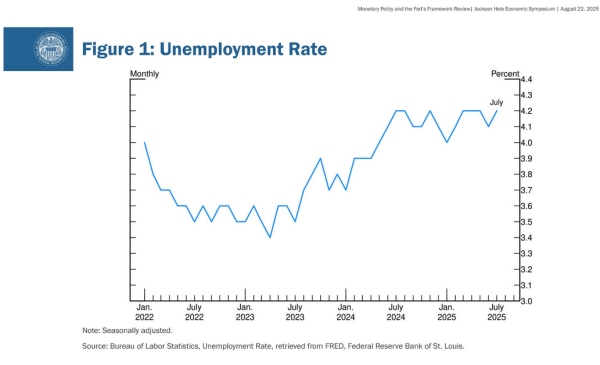
Image: US Unemployment Rate (Bureau of Labor Statistics)
Powell, Fed Reserve Chair, importantly said:
"[With policy already in restrictive territory] the baseline outlook and the shifting balance of risks may warrant adjusting our policy stance.”
Equity markets surged immediately following Powell’s comments. The S&P 500 and Nasdaq rose more than 1.5 percent by noon Friday, the Dow Jones Industrial Average climbed more than 900 points, and the Russell 2000 gained 3.8%. Treasury yields moved lower while the US dollar weakened. Crypto assets also rallied with bitcoin up 3.8% and ether jumping 13.2%.
Market participants interpreted Powell’s message as a strong hint at near term easing. The CME FedWatch tool now shows a near 90% probability of a 25 basis point rate cut in September. Analysts argue that Powell is signalling a tilt toward supporting jobs while treating tariff driven inflation as more temporary. The Fed’s tone has shifted from a singular focus on inflation to a more balanced consideration of employment risks.
The Federal Reserve’s final decision will be based on incoming data. The August employment report and mid September inflation release will be critical in determining whether the Fed follows through with a rate cut. As Powell emphasized, monetary policy will depend on how the evolving balance of risks plays out.
The bottom line is that Powell’s Jackson Hole remarks have repositioned the Fed’s policy stance. By acknowledging weakening labour conditions while downplaying longer lasting inflation threats, Powell has set expectations for a September rate cut, and markets have already pricing in an easier policy, triggering a broad a rally across stocks, bonds, and crypto.
The National Crowdfunding & Fintech Association (NCFA Canada) is a financial innovation ecosystem that provides education, market intelligence, industry stewardship, networking and funding opportunities and services to thousands of community members and works closely with industry, government, partners and affiliates to create a vibrant and innovative fintech and funding industry in Canada. Decentralized and distributed, NCFA is engaged with global stakeholders and helps incubate projects and investment in fintech, alternative finance, crowdfunding, peer-to-peer finance, payments, digital assets and tokens, artificial intelligence, blockchain, cryptocurrency, regtech, and insurtech sectors. Join Canada's Fintech & Funding Community today FREE! Or become a contributing member and get perks. For more information, please visit: www.ncfacanada.org
| | |
|---|---|---|
| | |
Elevate Festival | Aug 22, 2025

Elevate Festival Oct 7 9, 2025, Toronto
The National Crowdfunding and Fintech Association of Canada (NCFA) is proud to be a Community Partner of Elevate Festival 2025. This is the seventh edition of Canada’s largest home grown technology and innovation gathering taking place from October 7 to 9 at Toronto’s Meridian Hall and St. Lawrence Centre. The Elevate Festival will welcome more than ten thousand attendees and over 250 speakers who are innovating the future of business, finance, and technology.
The lineup reads like a who’s who of innovation. Chris Urmson of Aurora, Clay Bavor of Sierra, and Dorothy Kilroy of Oura Health will share their visions for automation, artificial intelligence, and digital health. They will be joined by Erika Ayers Badan of Food52, Ida Tin of Clue, Althea Wishloff of Raven Capital, Harley Finkelstein of Shopify, and Hussein Fazal of Super.com. Together they represent the scale and diversity of thought that defines Elevate.
Elevate is not just a gathering, it is an experience. AI and Scale Up tracks will take the main stage for the first time, drawing thousands to conversations that matter most for Canada’s growth. Eight focused tracks will also cover fintech, moonshots, future talent, investors, and women in tech.
Attendees can join masterclasses limited to one hundred participants, connect in the Women in Tech Lounge presented by Interac, and build relationships in the Startup Lounge presented by Moneris.
One of the things that we love about Elevate is that it continues to lead in representation. More than half of attendees in 2024 identified as women or non binary, which is way above Canadian and global benchmarks for tech gatherings (big and small). The festival has also generated significant startup investment by giving founders access to curated meetings, roundtables, and pitch stages.
That momentum carries into 2025 with the Startup Open House on October 9, where entrepreneurs can open their doors to investors, partners, and future hires. There are a plethora of reasons why entrepreneurs and investors globally should attend Elevate 2025, don't miss out!
For NCFA’s community, Elevate is a fantastic opportunity to be part of Canada’s innovation story. It is where founders meet investors, where startups become scale ups, and where the fintech community can help shape Canada’s economic future. Save 20% on your Elevate Festival pass with the code NCFAELEVATE (offer valid for unlimited uses until October 9).
Register now to secure your ticket before prices rise on September 5.
The National Crowdfunding & Fintech Association (NCFA Canada) is a financial innovation ecosystem that provides education, market intelligence, industry stewardship, networking and funding opportunities and services to thousands of community members and works closely with industry, government, partners and affiliates to create a vibrant and innovative fintech and funding industry in Canada. Decentralized and distributed, NCFA is engaged with global stakeholders and helps incubate projects and investment in fintech, alternative finance, crowdfunding, peer-to-peer finance, payments, digital assets and tokens, artificial intelligence, blockchain, cryptocurrency, regtech, and insurtech sectors. Join Canada's Fintech & Funding Community today FREE! Or become a contributing member and get perks. For more information, please visit: www.ncfacanada.org
| | |
|---|---|---|
| | |
Global Fintech Report | Aug 22, 2025

Image: Pulse of Fintech H1 2025, KPMG
According to the KPMG Pulse of Fintech H1 2025 report (67 page PDF) published in August 2025, global fintech investment in the first half of 2025 fell to $44.7 billion across 2,216 deals, recording the lowest H1 total since early 2020. Investors remain cautious about elevated risks around higher interest rates, capital costs, and geopolitical uncertainty. Q2 2025 was particularly weak, with $18.7 billion across 972 deals.
Investment in digital assets totalled $8.4 billion across 586 deals in H1 2025. Stablecoins attracted attention for payments and remittances in emerging markets, while tokenization platforms and infrastructure also captured capital. Circle's IPO anchored the sector’s strength, raising $1.1 billion with shares jumping 168% on day one.
AI continues to boost fintech investment. Capital flowed into both AI native startups and to incumbents embedding AI in credit scoring, fraud detection, and customer engagement. Investors prioritized business models that combined growth with efficiency and risk control. See NCFAs coverage of AI Fintechs attracting a 242% valuation premium
Regtech attracted $2.1 billion across 190 deals in H1 2025. Adoption of automated KYC, AML, and reporting tools continues to grow as financial institutions look for cost savings and regulatory agility. GenAI in risk and compliance
Insurtech raised $4.8 billion across 141 deals in H1 2025, which is already greater than all of 2024. Wealthtech funding reached $0.9 billion across 14 deals, with AI enabled platforms a recurring theme. Both sectors experienced consolidation as incumbents prefer acquisitions over building new capabilities.
Payments investment slowed to $4.6 billion across 242 deals in H1 2025, as investors grew more selective. But the sector is still foundational with capital being allocated to embedded finance, cross border platforms, and transaction monitoring. For Canada’s policy context see open banking delays and competitiveness and banks exiting merchant acquiring businesses like Moneris.
Cybersecurity specific fintech investment was just $0.1 billion across 26 deals in H1 2025. Despite heightened threat levels, most activity was concentrated at seed and early stages, reflecting investor caution toward scaling security focused fintechs.
Exit momentum is returning. Circle’s successful IPO may open the door for additional digital asset platforms to list in H2 2025, boosting the case for fintech exit activity after years of lack lustre listings.
For Canada, the data shows the window of opportunity for digital assets, AI, and regtech could attract investment with clear policy and infrastructure. The muted state of payments and open banking highlight gaps Canada must address to remain competitive. Clear rules, targeted support, and investment in digital infrastructure are critical to positioning Canadian fintech for growth in the second half of 2025 and beyond. See the crisis Canada and fintech cannot afford to waste
The National Crowdfunding & Fintech Association (NCFA Canada) is a financial innovation ecosystem that provides education, market intelligence, industry stewardship, networking and funding opportunities and services to thousands of community members and works closely with industry, government, partners and affiliates to create a vibrant and innovative fintech and funding industry in Canada. Decentralized and distributed, NCFA is engaged with global stakeholders and helps incubate projects and investment in fintech, alternative finance, crowdfunding, peer-to-peer finance, payments, digital assets and tokens, artificial intelligence, blockchain, cryptocurrency, regtech, and insurtech sectors. Join Canada's Fintech & Funding Community today FREE! Or become a contributing member and get perks. For more information, please visit: www.ncfacanada.org
| | |
|---|---|---|
| | |
Aug 22, 2025

Source: Canva Editor
Folding in poker is one of the moves that, on the surface, looks so simple yet seems to bear a lot of mental weight. To anyone watching, it’s simply a player sliding some cards away from themselves.
To the person making the decision, it can seem like a defining moment wherein logic, emotion, and self-image are in conflict. The problem is not so much in the doing itself but in resolving the psychological push-and-pull that accompanies it.
The fold decision is hardly ever emotionless. In the quick pace of online poker or in real live games, loss aversion regularly wins. Humans innately dread losing more than they value winning the same amount, it tempts them to call just to “see” rather than get out when the odds are against them. Not finding out what an opponent had can leave an itch for closure, feeding regret and second-guessing well after the hand ends.
Finally, there’s the sunk cost fallacy. After investing time and chips, whether at a live table or in poker online games, leaving the table feels like throwing good money after bad. For competitive players, it inflates the challenge, folding can seem to be waving the white flag even though more often it is the discipline of a skilled strategist.
Folding is not viewed as a retreat but rather considered as the conservation of resources. Every chip saved is equivalent to gaining a chance to use that chip later from a better position. In tournaments, just saving by folding can make the difference between an early exit and staying in the game.
There is a psychological benefit, too. Every right fold strengthens the belief in one’s judgment and enhances the capacity to overcome impulsive urges. In the long run, success at poker depends on playing the right pots and not chasing every pot.
Practice and reflection make for good folding habits. Build a history of disciplined decisions by reviewing hands you stepped away from and testing your logic against the result over time; the pride evolves toward making the correct play instead of winning individual pots.
Breaks can play a role too. Emotional fatigue blunts decision-making, and all it takes is a few minutes off the table for things to become clear again. Folding, in this way, is a proactive choice toward retaining sharpness rather than one of giving up.
Firm decisions are an amalgam of reasoning with the management of feelings. Systematically collecting data on betting patterns, player tendencies, and position will surely create a clearer picture of the hand. Pot odds and probability calculations guide the part of the decision that is mathematical.
The math goes with the emotions. Angry math. Anxious math. Overconfident math. These emotional states directly influence how players apply calculations. Emotions skew judgment. People make decisions that logic would not accept. Players who think about decision quality rather than short-term results tend to play better in the inevitable ups and downs of the game.
Mindfulness keeps attention on the present hand, reduces distraction, and does not allow emotions from the previous outcome to carry over. Folding becomes easier to do what the situation demands when one does not develop an attachment to individual results- this should be viewed as a hand within a broader context rather than taking it as a personal test.
Self-review after play is also a very powerful tool. Patterns will begin to emerge away from the table that were impossible to see at the moment. It will often become apparent that the fold which felt so bad was, in fact, the correct decision.
Folding is an ironic form of instant regression, as it often propels a player forward in the future. It requires discipline, emotional maturity, and the humility to understand that the best decision need not always win the hand.
Those who accept this truth, live or online, seem to last longer, tilt less, and play with more satisfaction. At the end of the day, folding has less to do with throwing out cards than it does protecting your cutting edge.
The National Crowdfunding & Fintech Association (NCFA Canada) is a financial innovation ecosystem that provides education, market intelligence, industry stewardship, networking and funding opportunities and services to thousands of community members and works closely with industry, government, partners and affiliates to create a vibrant and innovative fintech and funding industry in Canada. Decentralized and distributed, NCFA is engaged with global stakeholders and helps incubate projects and investment in fintech, alternative finance, crowdfunding, peer-to-peer finance, payments, digital assets and tokens, artificial intelligence, blockchain, cryptocurrency, regtech, and insurtech sectors. Join Canada's Fintech & Funding Community today FREE! Or become a contributing member and get perks. For more information, please visit: www.ncfacanada.org
| | |
|---|---|---|
| | |
Payments | Aug 21, 2025 | Last Updated Sep 21, 2026

Image: Freepik
On August 10, 2026, Francisco Partners agreed to acquire Moneris from RBC and BMO for approximately C$2 billion in cash, subject to regulatory approvals and closing conditions. Each bank is entitled to half of the proceeds. The agreement turns the potential sale first reported in 2025 into a signed change of control.
Moneris supports more than 325,000 points of commerce and handles roughly one in three transactions in Canada. RBC and BMO are selling their ownership interests, but both banks have established long term agreements to refer customers exclusively to Moneris.
RBC and BMO can therefore continue serving business customers and distributing Moneris payment services without owning the processor itself. Francisco Partners will own the company responsible for much of the merchant technology, payment acceptance and commerce infrastructure behind those relationships.
The Moneris sale also leaves the company's Canadian headquarters and technology infrastructure in place while ownership changes hands.
Canada's other major banks already use variations of this model.
In July 2025, TD partnered with Fiserv under a multi year managed services agreement. TD Merchant Solutions uses Fiserv payment processing, servicing and Clover products. Fiserv also agreed to acquire part of TD's merchant processing business covering approximately 3,400 merchant relationships and 30,000 locations.
Scotiabank works with Chase Payment Solutions for merchant services. National Bank refers commercial clients to Clover Canada, a Fiserv company, for payment processing and merchant technology.
Banks can keep the deposit account, lending, treasury services and customer relationship while specialist payment companies carry more of the technology and operating load.
Merchant acquiring now includes ecommerce, mobile acceptance, terminals, fraud controls, reporting, software integrations, inventory tools, analytics and faster settlement. Competing effectively requires continuous investment well beyond processing a card transaction.
Moneris itself is also becoming more than a traditional card processor.
In June 2026, the company expanded Konek pay by bank across Moneris Checkout and its API, giving merchants an online account to account payment option alongside cards.
Moneris has also added accounting integration with QuickBooks and technology that can connect AI agents with commerce tools. Merchant payment providers are now competing across checkout, accounting, data, software integration, fraud controls and business operations as well as payment acceptance.
Francisco Partners is acquiring both a large Canadian processing network and a merchant software platform with room to expand further into commerce technology.
Canada's national payment infrastructure has also advanced substantially since this article was first published.
The Real Time Rail rules and access framework is now approved. The RTR By-law and Rules came into force on August 24, 2026, establishing the legal and operating framework ahead of launch.
Payments Canada is targeting a Q4 2026 launch. Initial direct participants are scheduled to connect first, followed by additional participants and transaction volumes through 2027.
RTR is designed to support instant clearing and settlement around the clock with richer payment data. Payments Canada reported in August that 60% of Canadian businesses surveyed would use real time payments in specified situations. Supplier payments, government payments and domestic account to account transfers were among the identified use cases.
RTR is not a replacement for merchant acquiring or card networks. Banks, fintechs and payment providers still need to build payment initiation, fraud controls, reconciliation, merchant services and customer experiences around the rail.
Account to account products could give merchants another way to receive money and give payment companies another service to integrate into checkout, invoicing and business software.
Canada is also widening access to its national payment infrastructure.
Changes to the Canadian Payments Act expanded Payments Canada membership eligibility to qualifying payment service providers and other organizations that historically operated outside the core systems. The opening of Canada's payment infrastructure has already brought fintechs, PSPs and credit unions into systems once dominated almost entirely by banks.
The Retail Payment Activities Act framework adds regulatory oversight. Registered payment service providers are supervised by the Bank of Canada and must meet requirements covering operational risk, safeguarding funds, incident response and reporting.
Firms still need settlement arrangements, technical connections, fraud controls, liquidity, compliance and reliable operations before they can build competitive products on national payment infrastructure.
For fintech companies, there are more ways to compete around the merchant relationship without owning the underlying processor.
A commerce platform can combine payment acceptance with accounting, reconciliation, lending, payroll, inventory, loyalty and analytics while another company handles regulated payment processing. Banks can distribute these products without building every payment capability themselves.
For merchants, pricing, uptime, settlement timing, dispute handling, fraud protection, software integration, reporting and support matter more than who owns the processor.
Real time account to account payments should eventually add another option once RTR is operating and commercial products are available. Cards will continue to offer different acceptance, credit, rewards and consumer protection features, so merchants are likely to support several payment methods rather than replace one system outright.
RBC and BMO are selling Moneris while keeping exclusive referral relationships. TD uses Fiserv technology and has transferred part of its processing portfolio. Scotiabank works with Chase, while National Bank refers merchants to Clover.
At the same time, RTR is approaching launch and more regulated payment providers can participate in Canada's payment infrastructure.
Ownership of the processor is only one part of the market. Banks can control the commercial relationship, processors can run payment infrastructure, software companies can own the merchant workflow and fintechs can build services across those layers.
That gives new entrants more places to compete than the older model where merchant acquiring was concentrated inside a small number of bank owned networks.
If banks can keep the business customer without owning the payment processor, where will the most valuable part of the merchant relationship sit once real time payments and new account to account products become widely available?
Canada's payments market is opening while banks, processors and fintechs compete across different parts of the merchant relationship.
Francisco Partners has entered into a definitive agreement to acquire Moneris from RBC and BMO for approximately C$2 billion in cash. The transaction remains subject to regulatory approvals and other closing conditions.
RBC and BMO are selling their ownership interests in Moneris, but both banks have established long term agreements to refer customers exclusively to Moneris. Their business customers can therefore continue to use Moneris services after the transaction closes.
TD entered a multi year managed services relationship with Fiserv in 2025. TD Merchant Solutions uses Fiserv payment processing, servicing and Clover products. Fiserv also agreed to acquire part of TD's merchant processing portfolio covering approximately 3,400 merchant relationships and 30,000 locations.
Payments Canada is targeting Q4 2026. The RTR By-law and Rules came into force on August 24, 2026, and participant onboarding and transaction volumes are scheduled to increase in stages through 2027.
RTR is national infrastructure for instant account to account payments. It can support new payment products, but cards offer different acceptance, credit, rewards and consumer protection features. Banks, fintechs and payment companies will decide how RTR is incorporated into merchant and consumer services.
The sale separates ownership of a major Canadian payment processor from the banks distributing its services. Fintechs and software companies can compete around merchant software, payment integration, data and customer experience without owning the underlying processing network.
This article was originally published on August 21, 2025 and updated on September 21, 2026 using public company, regulatory and industry disclosures. The proposed Moneris acquisition remains subject to regulatory approvals and closing conditions. Payments Canada continues to target Q4 2026 for the initial Real Time Rail launch, and implementation timing may change. This content is for informational purposes only and does not constitute investment, financial or legal advice.
 The National Crowdfunding & Fintech Association (NCFA Canada) is a financial innovation ecosystem that provides education, market intelligence, industry stewardship, networking and funding opportunities and services to thousands of community members and works closely with industry, government, partners and affiliates to create a vibrant and innovative fintech and funding industry in Canada. Decentralized and distributed, NCFA is engaged with global stakeholders and helps incubate projects and investment in fintech, alternative finance, crowdfunding, peer-to-peer finance, payments, digital assets and tokens, artificial intelligence, blockchain, cryptocurrency, regtech, and insurtech sectors. Join Canada's Fintech & Funding Community today FREE! Or become a contributing member and get perks. For more information, please visit: www.ncfacanada.org
| | |
|---|---|---|
| | |
Financing | Aug 18, 2025

Image via Cohere's funding announcement 2025
On Aug 14 2025, Cohere announced its latest $500 million raise at a $6.8 billion valuation in an oversubscribed round led by Radical Ventures and Inovia Capital, with participation from AMD Ventures, NVIDIA, PSP Investments, Salesforce Ventures, HOOPP, and others. The fresh capital will help Cohere accelerate efforts to build the next generation of secure enterprise and sovereign AI solutions. Cohere is positioning its security-first agentic AI as an alternative to repurposed consumer models, emphasizing local data control, regulatory compliance, and digital sovereignty.
Jordan Jacobs of Radical Ventures commented:
“Cohere is fulfilling the promise of building privacy-first, cloud-agnostic models and agentic AI applications that drive extraordinary productivity gains for enterprises and governments worldwide.”
Patrick Pichette of Inovia Capital now joining Cohere’s board, said:
"[The company's] relentless focus on data privacy, customization, and time-to-value” [places it at the forefront of global enterprise AI]."
Over the past year, Cohere doubled its annual recurring revenue to more than $100 million USD and launched North, its flagship agentic AI platform, deploying solutions across sectors with partners like Oracle, Dell, RBC, Bell, Fujitsu, LG CNS, SAP, and Ensemble Health Partners. Cohere is also expanding its leadership team, as part of its growth strategy with Joelle Pineau, former VP of AI Research at Meta and professor at McGill University, joining as Chief AI Officer, and Francois Chadwick, former Uber acting CFO, joining as Chief Financial Officer.
Aidan Gomez, Co-founder and CEO of Cohere:
“Cohere is becoming the world’s chosen partner for integrating AI into critical industries. We are at a pivotal moment in accelerating the delivery of secure AI that empowers enterprises worldwide.”
Cohere’s trajectory is part of a much broader Canadian AI scale-up story. The country benefits from deep academic research centres (Mila, Vector, Amii), growing pools of venture capital, and the federal government Scale AI innovation cluster in Montreal which channels hundreds of millions of dollars into commercialization projects. Together these forces are turning Canadian AI from research excellence into global market strength. Below are some Canadian AI companies operating at scale.
Cohere’s $500M raise demonstrates Canada’s growing capacity as a hub for enterprise-level AI innovation, alongside other Canadian-founded scale-ups like Tenstorrent, Waabi, Clio, Docebo, 1QBit, Ada, and Sanctuary AI. Canada's momentum shows that we're not only incubating promising ideas and startups but supporting scale-ups that are impacting global AI markets with capital, partnerships, and converging talent.
The National Crowdfunding & Fintech Association (NCFA Canada) is a financial innovation ecosystem that provides education, market intelligence, industry stewardship, networking and funding opportunities and services to thousands of community members and works closely with industry, government, partners and affiliates to create a vibrant and innovative fintech and funding industry in Canada. Decentralized and distributed, NCFA is engaged with global stakeholders and helps incubate projects and investment in fintech, alternative finance, crowdfunding, peer-to-peer finance, payments, digital assets and tokens, artificial intelligence, blockchain, cryptocurrency, regtech, and insurtech sectors. Join Canada's Fintech & Funding Community today FREE! Or become a contributing member and get perks. For more information, please visit: www.ncfacanada.org
| | |
|---|---|---|
| | |


August 26th, 2025

January 4th, 2024

June 1st, 2021

September 9th, 2020

July 9th, 2018

January 3rd, 2018

September 25th, 2017

June 20th, 2017

May 10th, 2017

December 14th, 2016