




Karsten Wenzlaff, Advisor
August 26th, 2025
Karsten Wenzlaff is a Crowdfunding and Fintech Expert from Germany. He is Secretary-General of Digit[...]


Oct 24, 2026 | Last Updated Nov 4, 2026 | NCFA Fintech Whisperer | Regulation And Policy, Capital Markets Infrastructure And Funding, Artificial Intelligence And Data, Cybersecurity Fraud And Financial Crime, Competition And Market Structure, Cross Border Payments And FX, Wealthtech Investing And Trading, Digital Banking And BaaS, Digital Assets Blockchain And Tokenization, Payments Infrastructure And Money Movement, Risk Compliance And Regtech, Sustainable Finance ESG And Financial Inclusion

Image: Freepik
NCFA Fintech Whisperer tracks weekly fintech market intelligence that changes how financial markets operate. Coverage spans NCFA's full financial innovation taxonomy, with Canada first and global developments included when they materially affect rules, market access, competition, capital, technology adoption, distribution, risk or execution. We focus on changes that founders, investors, financial institutions, regulators and operators may need to act on, not simply what's making headlines. This page is updated throughout the week as material developments emerge, then closed and archived before the next weekly window begins.
Missed a prior week's Fintech Whisperer? Browse December 6 to 12, 2025, December 13 to 19, 2025, January 1 to 9, 2026, January 10 to 16, 2026, January 17 to 23, 2026, January 24 to 30, 2026, January 31 to February 6, 2026, February 7 to 13, 2026, February 14 to 20, 2026, February 21 to 27, 2026, February 28 to March 6, 2026, March 7 to March 13, 2026, March 14 to March 20, 2026, March 21 to March 27, 2026, March 28 to April 3, 2026, April 4 to 10, 2026, April 11 to 17, 2026, April 18 to 24, 2026, April 25 to May 1, 2026, May 2 to 8, 2026, May 9 to 15, 2026, May 16 to 22, 2026, May 23 to 29, 2026, May 30 to June 5, 2026, June 6 to June 12, 2026, June 13 to June 19, 2026, June 20 to June 26, 2026, June 27 to July 3, 2026, July 4 to July 10, 2026, July 11 to July 17, 2026, July 18 to July 24, 2026, July 25 to July 31, 2026, August 1 to August 7, 2026, August 8 to August 14, 2026, August 15 to August 21, 2026, August 22 to August 28, 2026, August 29 to September 4, 2026, September 5 to September 11, 2026, September 12 to September 18, 2026, September 19 to September 25, 2026, September 26 to October 2, 2026, October 3 to October 9, 2026, October 10 to October 16, 2026, October 17 to October 23, 2026.
A shorter national deadline changes staffing, escalation and evidence requirements for dealer complaint teams. Firms that still rely on manual handoffs will have less room for delay. Compliance vendors also get a clearer design target for case routing, document collection and management reporting.
The FCA has converted a promotions case into a practical market exit. Offshore location doesn't protect a crypto platform from UK conduct rules when it still reaches UK customers. Exchanges, affiliates and distribution partners need controls that can prove where promotions land and who can still open or fund an account.
Tokenized collateral now has a defined supervisory route into central clearing. CCPs can design against that route, but approval will still turn on liquidity, custody, legal certainty and access during stress. That connects directly with NCFA’s work on tokenized assets becoming market infrastructure.
The UK equity tape now has a clearer business model and a harder resilience test. Trading venues and prospective tape operators need to price income sharing, service continuity and incident reporting together. Data coverage alone won’t win this market.
Cross border clearing works only when supervisors can rely on each other. This agreement gives Indian clearing corporations a clearer route into UK oversight while preserving the Bank of England’s financial stability role. The next test is whether recognition and access become easier in practice.
The implementation window is effectively over. Fund managers and distributors now need their liquidity controls, derivatives processes and authorization workflows ready for the November 1 rules. The value of the guidance is operational certainty before the new regime goes live.
Canada now has enough detail for firms to start building against the rulebook rather than policy direction. Issuers can model reserve composition, custody, redemption costs, reward structures and Bank of Canada registration now. Payment firms also need to map where stablecoin activity pulls them into RPAA oversight. NCFA's stablecoin regulatory framework tracks those layers together.
Tokenized markets can't run continuously on stale prices. Chainlink is closing that gap with a single pricing reference that stays available when the underlying exchange is shut. The commercial test is whether continuous data supports deeper weekend liquidity and broader use of traditional assets as onchain collateral.
Fund managers can now add a regulated digital issuance layer without replacing the service providers they already use. That lowers the cost of testing tokenized share classes and strengthens the case for tokenized assets as market infrastructure. Live issuance volume and distributor adoption are the next proof points.
Thailand is working to give crypto exchanges a route into regulated derivatives trading without forcing them to build separate businesses. That could lower expansion costs while bringing trading, clearing and risk controls under closer supervision. Combined with Thailand's recently finalized crypto ETF rules, the proposals give exchanges and investment firms more ways to serve investors. The next test is whether the final licensing requirements make commercial entry practical.
A shared ledger becomes more useful as both lenders and large borrowers join it. Goldman adds another major institutional node to 1Source and strengthens the case for replacing bilateral reconciliation with a common record. The next proof point is transaction volume and how quickly more counterparties stop running parallel comparison processes.
Tokenization has moved from DTCC’s roadmap into live depository infrastructure. Banks and asset managers can now test whether tokenized positions improve collateral use, liquidity or settlement while keeping the underlying DTC rights intact. NCFA’s crypto custody intelligence tracks the same shift toward regulated tokenized market infrastructure.
HKEX is pulling more fund distribution work onto shared infrastructure. That can reduce duplicated integrations across managers, distributors and transfer agents. The commercial test is whether the larger network lowers servicing cost and makes new fund distribution easier.
Archax is extending tokenized government debt from issuance into continuous institutional access. The firm has already demonstrated onchain delivery versus payment with tokenized cash. Now the question is whether euro investors use the product for treasury, collateral and liquidity management.
Public blockchain infrastructure is moving into institutional note issuance with regulated distribution attached. Mirae controls the instrument lifecycle while Marketnode provides the investor route. That fits the broader shift NCFA tracks in tokenized capital markets infrastructure.
Private market tokenization needs usable exits, not just digital ownership records. Pontoro is testing that problem with a live pool that combines liquid assets and private fund interests. NCFA has tracked the same liquidity constraint in tokenized asset liquidity infrastructure.
This pushes onchain funds beyond cash and credit into public equities. Janus Henderson already has more than $1 billion in onchain strategies, so distribution and servicing scale now matter more than proof of concept. The larger question is how quickly tokenized funds become normal market infrastructure.
Institutional DeFi has had a custody problem. Institutions often need assets to stay inside qualified custody, while lending protocols expect collateral to interact with onchain contracts. CustodySync creates a bridge between those control models. Usage will show whether that bridge can turn idle custodied assets into repeatable financing activity.
The commercial test for tokenized funds just changed. The question is no longer whether a regulated fund can be put on chain. It's whether investors will use continuous liquidity when the underlying portfolio still operates on conventional market hours. Spreads, market maker depth and off hours price gaps now become the metrics worth watching.
For venue operators, this is an access issue, not a documentation exercise. Firms serving Malaysian institutional flows need to know whether their platform, instruments and client model fall inside the approval perimeter before November 1. Banks and liquidity providers should be checking the venues they rely on at the same time.
This is where digital bond settlement on Pontes starts competing on infrastructure, not demos. The value is interoperability with markets institutions already use. Banks, custodians and issuers can now compare digital issuance with conventional settlement on liquidity, collateral mobility, operating cost and execution time.
This is distribution infrastructure attached to a large existing fund, not a sandbox asset. The Schroders tokenized money market fund approval provides another regulated institutional benchmark. The next proof point is whether tokenized access changes subscriptions, settlement, collateral use or investor reach. Fund managers should watch where wallet based access removes friction and where the conventional fund stack still does the heavy lifting.
AI is now changing the cost structure behind open finance connectivity. Powens is using agents inside production engineering while keeping human approval before release. For operators, the useful benchmark is whether faster connector maintenance improves uptime and coverage without weakening control evidence. NCFA’s open banking intelligence tracks those operating requirements.
The more important signal is operating expansion, not the financing round. Casap is moving agentic automation from one regulated workflow into several functions where decisions affect customers, losses and recovery. Financial institutions adopting similar systems need clear authority boundaries, exception handling and evidence for every automated action as AI agent financial authorization and security becomes an operating control.
Banks are setting the access rules before personal AI agents become a normal financial interface. Canada’s consumer driven banking system is built around permissioned data sharing, while agent access adds delegated authority and transaction control. Authentication, consent and liability now need a workable model for agents as well as people.
The scale makes endpoint access, service permissions and withdrawal authorization a board level control issue for digital asset platforms. The final technical account will matter more than early attack theories. Exchanges, custodians and infrastructure vendors should compare privileged access, transaction approval and emergency freeze controls against the failure path Binance ultimately confirms.
Quantum migration now has federal target dates, which turns a distant security issue into a planning deadline. Financial firms need cryptographic inventories, vendor commitments and replacement schedules before 2030 pressure arrives. NCFA’s post quantum planning analysis explains why the work has to start well before vulnerable systems fail.
App stores are payment gatekeepers, not just software distributors. South Korea's orders challenge the fees and restrictions that make competing payment systems harder to sell. Developers could gain more control over checkout costs and customer payments, while payment providers get a better chance to compete. The commercial test is whether Google and Apple implement the required changes without replacing old restrictions with new ones.
Prediction markets are now a jurisdiction fight over who controls access to federally regulated contracts. The outcome can change where platforms can operate and how state restrictions interact with CFTC registration. Canada is watching the same category develop through firms such as Verdx and its event contract dealer application.
Thai issuers now have firm deadlines to build emissions records, reporting controls and assurance processes that investors can check. That's commercial work for data providers, auditors and compliance software firms. Canada is taking a different approach with its voluntary green and transition taxonomy. Firms serving both markets will need to distinguish mandatory company disclosures from voluntary investment classifications. The immediate priority in Thailand is getting the data and controls ready before the first reporting year.
Connecting RTR and TIPS could give Canadian payment providers a faster, lower cost alternative to traditional international transfers. The commercial opportunity depends on who gets access, how foreign exchange works and what transactions cost. Firms preparing for Canada's Real-Time Rail access requirements should include European connectivity in their planning, but it's not a service they can offer customers yet.
Movantis is adding stablecoin settlement inside an existing payments network rather than launching a separate crypto product. With more than $60 billion in annual flow already on its infrastructure, even a narrow corridor can become meaningful quickly. NCFA’s programmable stablecoin payments opportunity tracks the same commercial shift toward settlement, treasury and payout infrastructure.
This is a live enterprise payment deployment rather than a partnership announcement. Flywire is being embedded inside a marketplace where cross border settlement, foreign exchange and reconciliation are part of the transaction flow. The next proof point is whether the integration lowers payment friction and cost at scale across complex B2B transactions.
Tokenized investing is moving from single assets into packaged portfolio products that can travel across wallets and chains. The early $40 million uptake gives Ondo more evidence than a typical launch. The next test is whether multi asset tokens attract sustained balances and repeat use beyond crypto native investors.
Canadian brokerage competition is moving from AI research tools into account connected workflows. Webull keeps final trade approval with the investor, but the assistant can now reach live balances, positions and order preparation. Questrade introduced a similar Canadian brokerage connection in July, giving the market two live models to compare.
The proposed transfer would consolidate another sponsor bank portfolio inside an institution already operating at material BaaS scale. Fintech partners will be watching program migration, risk appetite and service continuity because banking as a service partnerships depend as much on the regulated bank relationship as on the front end product.
This gives Canada a major test of whether a large incumbent can add a modern core without waiting for a full bank replacement program. Starting with Simplii gives CIBC a digital brand where product speed matters. Watch migration scope, product release cycles and whether the platform eventually expands deeper into CIBC's retail stack.
The charter gives Ripple a federally supervised operating base around reserves and custody, building on the earlier U.S. crypto trust charter approvals. The next test is execution. Institutions will be watching how quickly the bank becomes live capacity and whether Ripple can turn the charter into deeper relationships across payments, custody and capital markets.
The important change is distribution. Existing MetaMask users get Stellar access without installing another wallet, while Stellar gains a direct route into a large self custody user base. Usage will show whether easier access produces more balances, transfers and token activity.
Stablecoins and tokenized assets need deep markets after issuance. Curve gives Stellar a familiar liquidity engine without routing users through another chain. NCFA has tracked the same institutional requirement in tokenized asset liquidity infrastructure. Depth and spreads will determine whether this deployment becomes commercially important.
Banks can add Stellar assets without building another custody stack from scratch. That lowers integration cost and lets network choice depend more on the asset and client use case. NCFA’s crypto custody intelligence tracks why regulated custody and issuance controls are becoming core tokenized market infrastructure.
CADC now has a securities law distribution route that can reach Canada nationally through regulated and exempt participants. That gives wallets, trading platforms and financial institutions another domestic stablecoin model to assess alongside the proposed federal regime. NCFA's Canada stablecoin market entry analysis explains the broader issuer and infrastructure choices opening around these rules.
The live signal is custody access inside BNY's institutional control environment. That removes one practical barrier for firms that can use digital assets only through established custody, governance and operating processes. Adoption now depends less on whether custody exists and more on what institutions are permitted to do with the assets once held.
The operating change is runtime payment choice. An agent can select how money moves instead of following a payment rail fixed earlier in the workflow. That flexibility increases the importance of transaction limits, recipient validation and revocation because AI agent payment authorization now has to hold across several rails, not just one.
The integration reduces how many providers a Solana payments company has to stitch together before it can move money end to end. That makes network choice less important than reach, compliance and payout coverage. The commercial test is whether one orchestration layer can lower integration cost enough to pull more payment volume onto stablecoin rails.
Konek is taking account based payments into merchant distribution rather than waiting for a new national rail to create the use case. PayFacto gives Interac a practical channel into commerce where card economics already matter. NCFA's Canadian online payments analysis tracks how cards, wallets and bank payments are competing for that checkout.
WalletConnect gives Stellar another route into wallets and payment applications at large distribution scale. Merchant rollout in Bermuda still comes later, so adoption should be measured first through wallet connections and payment volume. The direction fits NCFA’s programmable payments opportunity around wallet access, settlement and merchant acceptance.
Authentication is becoming part of payment orchestration rather than another merchant integration. Adyen can now route an eligible shopper into device based authentication from inside its existing stack. Merchants should watch both conversion and fraud because the commercial win requires improvement on both.
This links stablecoin distribution, institutional settlement, treasury and financing inside one large trading group. The important test is usage. Watch settlement volume, treasury adoption and whether RLUSD becomes a working asset across Robinhood's institutional flows rather than another listed stablecoin.
This phase puts migration work into merchant roadmaps. PSPs and payment teams now have to decide when to update integrations, how long to support both rails and which new Wero functions justify moving early. The long overlap gives merchants breathing room, but it also creates a two year distribution contest for the providers handling the transition.
Faster intelligence only matters if it reaches the payment decision before funds move. The integration shortens the gap between a new risk signal and transaction screening while keeping policy configuration with the financial institution. That makes data freshness, alert quality and audit evidence key measures of whether AI and financial crime compliance actually improve in production.
Independent risk analysis is moving into the same environment where onchain capital is allocated. That can make vault selection and governance more comparable for institutions that need third party evidence before deploying funds. The next step is whether protocols and investment committees begin using the assessments as a formal control rather than optional information.
A$260 million turns weak AML controls into a board level cost. Financial firms should read the judgment as an operating warning on customer risk assessment, monitoring and program evidence. The penalty also raises the price of waiting until supervisory concerns become enforcement.
Tokenized assets become easier to scale when compliance rules can travel with the transaction instead of being checked in a separate manual process. Further is testing that model inside a regulated financial center. The critical proof point is whether institutions adopt the controls in live issuance and trading workflows.
OrigenLink changes the handoff between a bank and an alternative lender. Instead of losing a customer when the bank cannot make the loan, the institution can keep the relationship and add another credit path behind its own brand. That gives banks a way to expand SME lending without building every underwriting and servicing capability internally.
Construction finance exposes the working capital problem in unusually clear terms: businesses often have confirmed work but still need liquidity before invoices are paid. Flex Line adds another embedded credit option for that gap and extends the broader shift toward small business working capital and lending being delivered closer to the operating workflow.
Canada's proposed stablecoin rules would require 100% daily reserve backing, redemption within three business days and a maximum 1% redemption fee, with implementation targeted for fall 2027. Meanwhile, Ripple secured final OCC trust bank approval, BNY opened institutional custody for XRP and RLUSD, and Robinhood brought RLUSD into its trading infrastructure, reaching a platform with 28.6 million funded customers. Companies that control custody, distribution and settlement stand to gain.
Canada's challenge is to turn its regulatory framework into commercially viable infrastructure before global networks capture the market.
NCFA offers various curated resources to help founders and investors stay current on developments that impact fintech markets. Get the weekly Whisperer and related market intelligence through NCFA's newsletter, view the latest fintech news and insights, industry research, or launch into emerging financial innovation opportunities.
 The National Crowdfunding & Fintech Association (NCFA Canada) is a financial innovation ecosystem that provides education, market intelligence, industry stewardship, networking and funding opportunities and services to thousands of community members and works closely with industry, government, partners and affiliates to create a vibrant and innovative fintech and funding industry in Canada. Decentralized and distributed, NCFA is engaged with global stakeholders and helps incubate projects and investment in fintech, alternative finance, crowdfunding, peer to peer finance, payments, digital assets and tokens, artificial intelligence, blockchain, cryptocurrency, regtech, and insurtech sectors. Join Canada's Fintech & Funding Community today FREE! Or become a contributing member and get perks. For more information, please visit www.ncfacanada.org
 |  |  |
|---|---|---|
 |  |  |
October 30, 2026 | NCFA Regulatory Insight | Regulation And Policy, Capital Markets Infrastructure And Funding, Competition And Market Structure
Less Regulatory Burden and More Crowdfunding Capacity
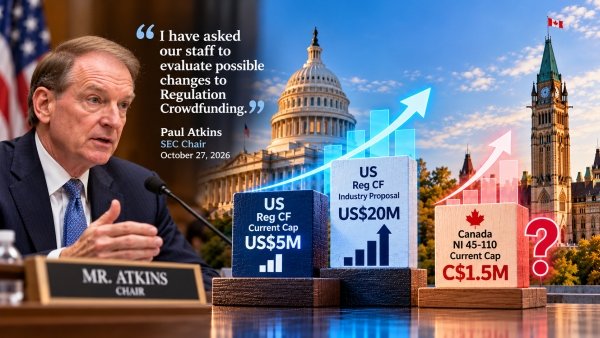
On October 27, 2026, SEC Chair Paul Atkins asked staff to review Regulation Crowdfunding for changes that could reduce compliance burdens and make the exemption more useful to issuers and investors. Reg CF currently lets eligible US companies raise up to US$5 million over 12 months. Industry groups are pushing for a US$20 million ceiling and simpler rules. Canada still caps issuers at C$1.5 million under NI 45-110, even as Canadian companies are now reaching that limit.
Atkins said more than 9,800 Reg CF offerings have taken place over the past decade, with an average raise of about US$364,000. He asked staff to consider changes that could "reduce compliance burdens and improve the rules' attractiveness for issuers and investors." No higher limit has been proposed or adopted by the SEC. The US$20 million figure comes from industry proposals now before the Commission.
Reg CF requires issuers to raise through an SEC registered broker dealer or funding portal. Companies file Form C, provide business and financial information and continue annual reporting while the obligation applies. Securities generally can't be resold for one year. Non accredited investors also face investment limits based on income or net worth, while accredited investors aren't subject to those Reg CF limits.
Crowdfund Capital Advisors wants the annual issuer ceiling raised from US$5 million to US$20 million and indexed to inflation. Its petition also seeks related changes where crowdfunding vehicles and shareholder thresholds could create another barrier for issuers that grow through repeated rounds.
The Crowdfunding Professional Association is pushing in the same direction. Its October 27 recommendations include a simpler compliance tier for offerings up to US$350,000, a US$20 million issuer ceiling, simpler investor rules, clearer issuer communications and more useful ongoing reporting. These remain industry proposals, not SEC rules.
Smaller raises feel compliance costs more sharply. A 2019 SEC study cited market estimates of US$2,000 to US$10,000 for accounting, US$3,000 to US$10,000 for legal work and US$3,000 to US$5,000 for banking and transaction costs. Earlier SEC rulemaking also cited portal fees of 6% to 15%. A smaller raise can lose a meaningful share of its proceeds before the company puts the capital to work.
The average US$364,000 Reg CF raise doesn't tell us much about whether the US$5 million ceiling works for companies that need larger rounds. CCA's October 9 submission found that 28.8% of issuers setting their maximum within 2% of the cap returned for another Reg CF financing, compared with 11.3% of other issuers in the comparison group. Among companies observed for at least 24 months, the figures were 33.0% and 11.9%.
CCA separately found that 40.3% of issuers that raised roughly US$4 million to US$5 million returned for another Reg CF offering. Those companies raised more than US$214 million after first approaching the ceiling. CCA also identified 323 offerings that ran alongside Rule 506(c) raises totalling US$422.6 million. Companies can move into other exemptions, but the data shows that some issuers still have demand for capital after Reg CF starts running out of room.
Crowdfunding is also reaching beyond the largest US venture markets. CCA reports that 62.6% of geographically identified funded Reg CF capital, about US$1.82 billion of US$2.91 billion, went to companies outside Boston, Los Angeles, San Francisco and New York. That gives founders outside the main venture centres another route to investors and gives investors access to companies they may not otherwise see.
Larger rounds can create new regulatory pressure elsewhere. CCA reports that 279 Reg CF issuers have crossed 2,000 holders of record and 11 currently meet both shareholder and asset triggers associated with Exchange Act registration. Its petition asks for related Rule 12g-6 changes alongside a higher fundraising ceiling so issuers don't simply hit another limit as they grow.
Canada is starting to show the same pattern at a much lower ceiling. Stronger campaigns are using nearly all of NI 45-110, and some companies are already combining the exemption with other financing routes to keep raising.
NI 45-110 lets an issuer group raise up to C$1.5 million over 12 months. Investors can put in up to C$2,500 per offering, or up to C$10,000 where a registered dealer determines the investment is suitable. The exemption gives startups and smaller companies a national crowdfunding route, but recent campaigns show that the ceiling is beginning to pinch.
FrontFundr reported C$4.79 million raised under NI 45-110 from 4,320 investors in 2025, up 181% from the previous year. Edison Motors raised C$1,491,043 under the exemption, about 99% of the available ceiling. Blossom Social raised C$1,449,681, or roughly 97%, before accredited investors brought its total FrontFundr financing to approximately C$1.93 million.
The ceiling was fully tested in 2026. Blossom Social reached the C$1.5 million retail limit under NI 45-110 in three hours after building a waitlist of more than 8,000 prospective investors. The company ultimately raised C$2.89 million through FrontFundr after adding accredited investor capital. Canadian founders are no longer approaching the cap in theory. Companies are hitting it while investor demand is still there.
Once the C$1.5 million allowance is used, companies that want to keep raising need another exemption or financing route. FrontFundr itself notes that issuers can combine NI 45-110 with the accredited investor, family and friends or Offering Memorandum exemptions. Those routes can support larger raises, but they come with different investor eligibility and disclosure requirements. A higher NI 45-110 ceiling would let more successful community rounds stay inside one national crowdfunding framework for longer.
NCFA has pushed for more room since at least 2014. Its 2014 crowdfunding submission called for an issuer ceiling of up to C$5 million. NCFA repeated that recommendation in its 2020 NI 45-110 submission, together with proportionate financial reporting and more practical investor participation rules.
NCFA continues to support raising the annual NI 45-110 issuer limit from C$1.5 million to at least C$5 million. The ceiling should also be indexed so inflation doesn't reduce its usefulness over time. Reporting can increase with the size of the raise while smaller offerings remain practical and investor protections remain intact.
Canada's wider capital market is sending the same signal. NACO reports that Canadian angel investors deployed C$113.79 million across 490 investments in 2025, down 22.1% from the year before and the lowest capital deployment in five years. Ottawa has responded with a new C$1.75 billion venture and growth capital plan, including C$75 million for pre seed and seed investment and C$675 million for later and growth stage investment.
Public programs and investment crowdfunding serve different parts of the market, but both are trying to put more capital behind Canadian companies. Keeping NI 45-110 at C$1.5 million while issuers are already filling the exemption limits how much private capital that channel can contribute.
Canadian companies are now filling the C$1.5 million NI 45-110 allowance while investors are still willing to invest. That is the clearest case yet for giving the exemption more room. A C$5 million ceiling would let stronger issuers raise more growth capital from their communities, keep retail investors involved in larger rounds and give regulated portals a larger market to build around. The US is reconsidering a US$5 million cap. Canada shouldn't wait for C$1.5 million to become an even bigger bottleneck.
The National Crowdfunding & Fintech Association (NCFA Canada) is a financial innovation ecosystem that provides education, market intelligence, industry stewardship, networking and funding opportunities and services to thousands of community members and works closely with industry, government, partners and affiliates to create a vibrant and innovative fintech and funding industry in Canada. Decentralized and distributed, NCFA is engaged with global stakeholders and helps incubate projects and investment in fintech, alternative finance, crowdfunding, peer-to-peer finance, payments, digital assets and tokens, artificial intelligence, blockchain, cryptocurrency, regtech, and insurtech sectors. Join Canada's Fintech & Funding Community today FREE! Or become a contributing member and get perks. For more information, please visit: www.ncfacanada.org
| | |
|---|---|---|
| | |
Oct 30, 2026

Vancouver is one of Canada's most expensive places to employ household staff, and B.C. has its own rules for anyone working in a private home. Both points shape the search. A full-time private chef in Vancouver typically cooks for one family five or six days a week and takes over grocery shopping, meal planning, kitchen inventory, and cleanup. For households in West Vancouver, Shaughnessy, Kitsilano, or Point Grey with demanding work schedules, the role often pays for itself in time saved, but hiring one is closer to recruiting a senior employee than booking a caterer.
Here is how to approach it.
Write a job description first. Most households skip this step, and vague expectations are the most common reason these placements end within the first year.
Start with the schedule. Will the chef cook every meal of the day, or only dinners plus weekly meal prep? Then consider the household: how many people the chef will feed on a typical day, how often you entertain, and whether you need someone willing to travel with you to Whistler on weekends or to a Gulf Islands cottage in summer. Live-in arrangements deserve their own conversation. Given Vancouver rent costs, private accommodation has real value for a candidate, and it changes both the salary discussion and the legal paperwork.
Dietary direction belongs in the description too. A family following a plant-based or low-sodium plan needs a chef with that experience on their résumé, and Vancouver's large community of health-focused cooks means those candidates exist. Stating it upfront quickly filters out the wrong applicants.
Be just as clear about where the job ends. Some families expect help with school lunches or light housekeeping, while most career chefs want to stay focused on cooking. A mismatch here causes friction within weeks, so list any non-cooking duties plainly.
Pay depends on scope and experience. Full-time household chefs in Metro Vancouver commonly earn $70,000 to $120,000 a year, and roles with frequent entertaining or travel can pay more. Candidates from the city's restaurant scene will compare your offer with kitchen salaries plus tips, so a lowball number often ends the conversation early.
Experienced candidates look at the full package, which typically includes the following.
Your total cost will run higher than the salary, because employers pay their own share of Canada Pension Plan (CPP) contributions and Employment Insurance (EI) premiums. Running the numbers through payroll built into HR software before you make an offer gives you an accurate figure, and the same tool can handle pay stubs and remittances once the chef starts.
Specialized household staffing agencies are the most reliable source for this level of hire. They charge a placement fee, usually a percentage of first-year salary, yet candidates arrive pre-screened with verified references. Ask any agency about its guarantee period, since many will replace the hire at no extra cost if the placement ends within the first few months.
Referrals from friends who already employ household staff can work well too. So can Vancouver's restaurant and hotel kitchens, where plenty of cooks want the steadier hours of private service. Expect an adjustment period with those hires, because cooking to one family's preferences every day is a very different job from running a dinner line on Robson or in Gastown.
A résumé shows where someone has worked. It says little about whether they will fit into your home. Use the first interview to talk through daily routines, how they handle last-minute changes, and how they communicate when something goes wrong.
Shortlisted candidates should then be invited to a paid trial, usually a full day of cooking in your kitchen. Send a short written brief beforehand so you can judge the food against what you asked for. Pay attention to how they shop, too. A chef who already knows which Granville Island vendors carry the best halibut, or when Fraser Valley berries peak, will cook more seasonally and waste less. Call at least two previous household employers and ask directly why the candidate left. A criminal record check, done with the candidate's written consent, is standard practice for anyone with keys to your home.
A full-time chef who works on your schedule and under your direction is almost always an employee in the eyes of the Canada Revenue Agency (CRA), whatever title the contract uses. You will need to open a CRA payroll account, even as a private household. CPP and EI are then deducted from each paycheque alongside income tax and remitted on schedule, and a T4 slip is issued by the end of February each year. Getting this wrong can leave you owing both the employer and employee shares, plus penalties and interest.
Some families employ household staff through a holding company or family office. If that applies to you, review that company's coverage before the chef starts.
B.C.'s Employment Standards Act has specific provisions for domestic workers, including a written employment contract that sets out duties, hours, wages, and any room and board charges. Standard B.C. rules apply on top of that. Overtime is paid at time and a half after eight hours in a day or 40 in a week, and employees are entitled to five paid sick days a year along with statutory holiday pay.
Workers' compensation is the step families most often miss. According to WorkSafeBC's guidance for homeowners, anyone who hires a person for ongoing home services, chefs included, needs coverage once that person works eight or more hours a week. A full-time chef clears that threshold in a single day, and premiums are generally assessed on the wages you pay, so the cost is modest next to the protection it provides.
Families recruiting from outside Canada face an extra step. A positive Labour Market Impact Assessment (LMIA) is generally required before a foreign national can be hired, and processing can take months, so plan early and consider working with an immigration lawyer.
Retention starts on day one. Schedule a check-in after the first month and again before probation ends, and keep the feedback specific. Chefs leave private service most often over unclear expectations or stalled pay, and both are fixable with regular, honest conversations. An annual salary review goes a long way in a city where living costs keep climbing. Give the chef room to suggest new dishes as well, because cooks stuck on the same weekly rotation are the ones who start answering recruiters' calls.
The National Crowdfunding & Fintech Association (NCFA Canada) is a financial innovation ecosystem that provides education, market intelligence, industry stewardship, networking and funding opportunities and services to thousands of community members and works closely with industry, government, partners and affiliates to create a vibrant and innovative fintech and funding industry in Canada. Decentralized and distributed, NCFA is engaged with global stakeholders and helps incubate projects and investment in fintech, alternative finance, crowdfunding, peer-to-peer finance, payments, digital assets and tokens, artificial intelligence, blockchain, cryptocurrency, regtech, and insurtech sectors. Join Canada's Fintech & Funding Community today FREE! Or become a contributing member and get perks. For more information, please visit: www.ncfacanada.org
| | |
|---|---|---|
| | |
Oct 28, 2026 | Lake Energy

Singapore— The global energy sector is undergoing a major transformation as countries invest in cleaner electricity, modernize power grids, and expand renewable energy capacity. Solar and wind power are becoming increasingly important sources of electricity, while hydropower, biomass, and battery storage are contributing to a more diverse energy system.
Growing electricity demand from businesses, digital infrastructure, and electric technologies is also increasing the focus on reliable energy supplies. As a result, renewable energy projects and supporting infrastructure have become important topics across financial and energy markets.
For cryptocurrency investors looking beyond digital asset trading, renewable energy offers another sector to explore. Lake Energy connects these interests through an online platform offering renewable energy investment plans and support for selected cryptocurrency funding methods.
Lake Energy offers investment plans related to solar power, wind energy, hydropower, biomass energy, and energy storage. Users can compare investment amounts, project durations, and stated terms to understand the options available.
The platform supports several digital assets, including BTC, ETH, XRP, USDT, and USDC, giving users multiple funding options.
Getting started involves three steps: creating an account, reviewing available projects, and selecting a plan based on its stated terms.
Visit lakeenergy.com and create an account by entering your username, email address, login password, and fund password. Complete the CAPTCHA and submit the registration form.
Every newly registered account receives a $10 welcome bonus, giving new users an additional incentive to explore the platform.
Solar energy: Investment: $500 | Period: 7 days | Daily Return: $5.25 | Return at Maturity: $500 + $36.75
Solar energy: Investment: $1,000 | Period: 15 days | Daily Return: $11.00 | Return at Maturity: $1,000 + $165
Wind energy: Investment: $3,000 | Period: 20 days | Daily Return: $34.50 | Return at Maturity: $3,000 + $690
Wind energy: Investment: $5,000 | Period: 25 days | Daily Return: $60.00 | Return at Maturity: $5,000 + $1,500
Energy storage: Investment: $10,000 | Period: 30 days | Daily Return: $126.00 | Return at Maturity: $10,000 + $3,780
Explore the available solar, wind, hydropower, biomass, and energy storage plans. Compare investment amounts, project durations, and the terms of each option to understand how the plans differ.
After reviewing the available information, select a plan that matches your preferences and follow the platform's instructions. Check the applicable funding requirements and settlement terms before completing the process.
Security is an important part of managing an online investment platform. Lake Energy's security framework encompasses website protection, data encryption, digital asset storage, and asset protection measures.
Lake Energy also uses TLS 1.2 encryption to protect information transmitted between users and its website, alongside encryption measures for stored data.
Together, these measures address key aspects of online security, digital asset custody, and account management.
Cryptocurrency and renewable energy operate in different markets. Digital assets are influenced by factors such as market activity and blockchain adoption, while renewable energy development is shaped by electricity demand, infrastructure investment, government policies, and technological progress.
For XRP holders interested in exploring sectors beyond cryptocurrency trading, renewable energy offers another area to research. Lake Energy brings renewable energy investment plans and supported digital asset funding options together in one online environment, allowing users to explore available projects and review their terms.
The transition to cleaner energy is reshaping electricity generation and infrastructure investment worldwide. As solar power, wind energy, and energy storage continue to develop, renewable energy remains an important sector for investors to follow.Lake Energy provides an online platform for exploring investment plans connected with these technologies. Visit lakeenergy.com to learn more about the available projects.
The National Crowdfunding & Fintech Association (NCFA Canada) is a financial innovation ecosystem that provides education, market intelligence, industry stewardship, networking and funding opportunities and services to thousands of community members and works closely with industry, government, partners and affiliates to create a vibrant and innovative fintech and funding industry in Canada. Decentralized and distributed, NCFA is engaged with global stakeholders and helps incubate projects and investment in fintech, alternative finance, crowdfunding, peer-to-peer finance, payments, digital assets and tokens, artificial intelligence, blockchain, cryptocurrency, regtech, and insurtech sectors. Join Canada's Fintech & Funding Community today FREE! Or become a contributing member and get perks. For more information, please visit: www.ncfacanada.org
| | |
|---|---|---|
| | |
October 27, 2026

Today's sales teams sell across borders. A firm often closes deals with clients on different continents. Nonetheless, payment friction slowly eats away at revenue. An individual attempts to purchase a service. The credit card is denied by the local bank. The project is delayed due to a slow wire transfer. Certain areas do not support conventional gateways. This friction prevents growth. Payments through cryptocurrency create a powerful alternative route. Another option reduces lost sales. Organizations use it for greater international reach. It also speeds up the gathering of funds.
Payment processing is usually viewed by business leaders as a finance issue only. A huge blunder took place. Payment friction directly hurts sales conversion. The final checkout screen is reached by the buyer. Their credit card is repulsed by the system due to an unknown reason. The customer leaves without completing the purchase. The revenue of the company eludes.
Chargebacks suck profitability. International buyers often cancel orders when they see unsupported payment methods. An unpleasant checkout process disrupts the customer journey. Every failed transaction is marketing money wasted and selling effort lost.
Digital assets are free from banking restrictions. A digital wallet allows clients to send funds directly to merchants. There is no middle bank that can refuse a transaction. This link eliminates obstacles not based on choice. It assures more customers complete their purchase.
Conventional financial networks impose rigid geographic limits. A consumer in a developing nation typically does not have premium credit cards. Their domestic means of payment fail on international sites. These borders get erased by crypto payments. A merchant may accept value from any customer that has an internet connection. This ability greatly extends the total addressable market.
Credit card networks are often controlled by strict approval systems. These systems don’t work for many users. The merchant has to wait days for the cash. Digital ledgers work differently. Settling of transactions takes minutes. The network is always open on weekends and holidays. When a transaction is confirmed by the network, it is final. This permanent nature prevents fraudulent chargebacks. The business’s working capital is immediately available to them.
People won’t stop using their credit cards. Digital assets sit next to them. A customer at an internet checkout simply chooses a digital wallet option rather than tapping in a card number. For B2B sales, a finance team includes a digital address in the normal invoice. Contemporary software applications come with recurring models. A company may set up an auto monthly subscription or retainer by smart contracts. It's merely another measure to intercept income.
The price of the early digital coins fluctuated significantly. A sales team can’t throw out a price on a stock that could fall ten percent in an hour. This problem is solved by stablecoins. Tokens such as USDT and USDC are directly pegged to the US dollar. A single token is worth one dollar. It enables businesses to quote predictable prices. The organization gets a steady amount. Daily sales and invoicing will not be a market concern. See: Programmable stablecoin payments
Using digital wallets brings real monetary advantages. A business instantly expands its global reach. Sales teams experience a lower frequency of declined transactions. The treasury department benefits from a speedier cash settlement. International clients have a much easier buying experience. This increases the overall rate of conversion. Nonetheless, digital assets can’t make a deficient product successful for long. They only optimize the generation of revenue.
New responsibilities always come with innovation. A business must assess the risks before changing its checkout experience.
Even stablecoins need security attention. A business can lose access to a digital vault, resulting in a permanent loss. Organizations must take fraud prevention more seriously. Compliance also requires hard work. Digital assets are strictly classified by tax agencies. A business is required to keep accurate records of any transactions. In addition, companies should comply with the laws of anti-money laundering (AML) and know your customer (KYC). A qualified legal and tax professional should be consulted by the firm in this regard.
A prudent company incorporates new systems gradually. A company should only start with stablecoins to avoid panic. The new option should be clearly visible on the checkout page. The record keeping habit for the accounting department should begin on the first day. Before promoting the new feature to your entire audience, always run a little test transaction.
Most organizations should not manage raw cryptographic keys. They must be careful with evaluations about third-party providers. A business must check the supported currencies. The software must offer instant crypto-to-fiat conversion. The fee structure, integration options, and reporting tools must be verified by executive teams. Security and compliance are 100% mandatory. For example, the finance director of an organization can go to the Cryptobanco official website to see how enterprise-grade infrastructure safely addresses these specific requirements. A dependable partner takes away the technical burden entirely.
Accepting digital funds helps businesses please and retain worldwide customers. It is very important to have a very detailed implementation strategy. Before production, corporate chiefs should check real demand. They must become familiar with their operating costs and the local regulation. With proper deployment of this technology by a company, it eliminates financial friction and speeds up global growth.
The National Crowdfunding & Fintech Association (NCFA Canada) is a financial innovation ecosystem that provides education, market intelligence, industry stewardship, networking and funding opportunities and services to thousands of community members and works closely with industry, government, partners and affiliates to create a vibrant and innovative fintech and funding industry in Canada. Decentralized and distributed, NCFA is engaged with global stakeholders and helps incubate projects and investment in fintech, alternative finance, crowdfunding, peer-to-peer finance, payments, digital assets and tokens, artificial intelligence, blockchain, cryptocurrency, regtech, and insurtech sectors. Join Canada's Fintech & Funding Community today FREE! Or become a contributing member and get perks. For more information, please visit: www.ncfacanada.org
| | |
|---|---|---|
| | |
October 27, 2026 | NCFA Industry Resource | SME Finance And Business Banking, Sustainable Finance ESG And Financial Inclusion, Capital Markets Infrastructure And Funding

Growth Loans, Regional Financing and Founder Awards
On October 22, 2026, Women's Enterprise Organizations of Canada (WEOC) and the Business Development Bank of Canada (BDC) announced up to C$200,000 in growth loans for eligible women entrepreneurs. WEOC also partnered with Quebec lender Evol to connect more founders with financing and business support. Separately, the Capital Elle Business Impact Award is accepting applications until October 28, 2026, giving Canadian women entrepreneurs three opportunities worth considering.
The new Women Entrepreneur Growth Financing programme combines WEOC loans of up to C$50,000 with BDC loans of up to C$150,000. Backed by a C$12.5 million financing commitment over two years, the pilot targets eligible women owned businesses outside Quebec that need more capital to expand. BDC is contributing C$10 million toward the programme.
For businesses ready to buy equipment, invest in technology, increase production or pursue larger contracts, the additional financing could make a meaningful difference. Regional WEOC lending partners will assess applicants and provide business advice and ongoing support. The combined C$200,000 is a maximum, subject to eligibility and lending approval.
Applications haven't opened yet. Financing is expected to begin later in 2026. Interested founders can register for WEOC growth financing updates to receive application details, eligibility requirements and loan terms when available.
WEOC's new partnership with Evol connects lending services across Canada. Evol supports entrepreneurs throughout Quebec's 17 regions, while WEOC works through lending partners elsewhere in Canada. The organizations will refer founders to suitable financing and advisory services, including businesses that may not qualify for an existing programme.
Both organizations participate in the Women Entrepreneurship Loan Fund, which offers eligible businesses loans of up to C$50,000. The partnership isn't a new grant or an extension of the C$200,000 BDC pilot into Quebec. It helps entrepreneurs find lenders and support suited to their location and financing needs.
The Capital Elle Business Impact Award offers Canadian women entrepreneurs cash awards and business support across three categories covering strategic connections, growth capital and acquisitions. The organizer advertises a combined prize package worth more than C$100,000, including C$5,000 cash for each category winner, professional services, mentoring and business connections.
The award is open to women founders across industries, subject to eligibility requirements. Applicants select the category that best fits their business goals. The application process costs C$50 for nonmembers (nonrefundable), while eligible paid Elleiance members can apply without an additional fee.
Deadline is October 28, 2026, at 9 p.m. Eastern. Founders should review the official award terms and confirm eligibility.
More financing options are welcome, and founders should match the opportunity to their business. Growth loans can fund expansion, regional lenders can provide ongoing support, and awards offer cash and business connections. The best choice depends on how much money the business needs, what it qualifies for and whether it can take on debt.
The National Crowdfunding & Fintech Association (NCFA Canada) is a financial innovation ecosystem that provides education, market intelligence, industry stewardship, networking and funding opportunities and services to thousands of community members and works closely with industry, government, partners and affiliates to create a vibrant and innovative fintech and funding industry in Canada. Decentralized and distributed, NCFA is engaged with global stakeholders and helps incubate projects and investment in fintech, alternative finance, crowdfunding, peer-to-peer finance, payments, digital assets and tokens, artificial intelligence, blockchain, cryptocurrency, regtech, and insurtech sectors. Join Canada's Fintech & Funding Community today FREE! Or become a contributing member and get perks. For more information, please visit: www.ncfacanada.org
| | |
|---|---|---|
| | |
October 26, 2026 | NCFA Industry Resource | Digital Assets Blockchain And Tokenization, Capital Markets Infrastructure And Funding, Digital Identity And Trust

On October 20, 2026, Canada's Digital Governance Standards Institute (DGSI) invited industry participation in a proposed National Standard of Canada for unified ledger infrastructure. CAN/DGSI 145 would cover tokenized identity, financial assets, government records and real world assets on a common programmable platform. DGSI has formed Technical Committee 20 and is looking for organizations and specialists to contribute to the work.
The project moved forward after approval by the Digital Governance Council's Standards Policy Committee on September 22, 2026. For Canadian banks, fintechs, capital markets firms and infrastructure providers, the opportunity is practical. They can contribute before the standard is finalized and before decisions about governance, privacy, security, access and how different systems connect are settled.
The proposed CAN/DGSI 145 standard aims to set minimum requirements for the design, operation and governance of a unified ledger, including how different systems connect and work together. Its scope includes digital identity credentials, tokenized deposits, bonds, securities and central bank digital currencies, along with permits, licences, tax records, property registries, real estate ownership and other tangible assets.
For financial firms, the core issue is how products and records move between organizations. Banks and custodians need clear ways to handle ownership, access, settlement and records. Identity providers need credentials that other organizations can trust. Fintechs building custody, compliance, tokenization or settlement products need to know how their systems may connect with financial institutions and public infrastructure.
Common requirements could reduce some of the custom work needed every time two systems connect, although adoption will determine the commercial value. A good standard has limited impact if major institutions don't use it. Wider adoption could give companies building identity, custody, settlement, compliance and software products a clearer base for connecting across institutions and markets.
Ali Abou Daya, CEO of Transactix Financial, described the opportunity as one to “shape international norms and position our well regarded financial and property sectors as global leaders.” For companies considering participation, the more immediate question is whether the areas covered by the standard touch products or infrastructure they are already building.
DGSI is inviting banks, fintechs, blockchain developers, digital identity specialists, capital markets firms, regulators and other interested organizations to join Technical Committee 20. Participation is free, there is no limit on committee size and every member gets a vote.
The strongest fit is likely companies already working with tokenized assets, digital identity, settlement, custody, compliance or related infrastructure. They can see the requirements while they are still being developed and bring practical experience from products already in market or under development.
Organizations interested in participating can contact Darryl Kingston, Executive Director, Digital Governance Standards Institute, at darryl.kingston@dgc-cgn.org. Firms with only a distant connection to the work may be better served by following the process and deciding later whether the standard affects their products, partnerships or investment plans.
The main advantage of joining early is practical input. Companies working directly in these markets can point out where the proposed standard may clash with existing systems, new regulations or the way products actually operate. It's more important now that Canada has published proposed stablecoin regulations and other digital asset rules are moving ahead. A useful standard will need to work with that wider regulatory and market infrastructure rather than develop in isolation.
CAN/DGSI 145 is still early in development. DGSI's work programme lists it at stage 10.99, starting September 22, 2026, with no public review dates or publication date posted. The final requirements may change substantially, and participation does not guarantee that a company's preferred approach will be adopted.
The standard also won't create a market by itself. Its commercial importance will depend on whether banks, governments, infrastructure providers and other organizations decide to use it. Companies should therefore weigh the value of early participation against the staff time required to stay involved.
DGSI Standards Work Programme (current development stage and public review status)
DGSI Standards Development (technical committee participation and standards process)
The National Crowdfunding & Fintech Association (NCFA Canada) is a financial innovation ecosystem that provides education, market intelligence, industry stewardship, networking and funding opportunities and services to thousands of community members and works closely with industry, government, partners and affiliates to create a vibrant and innovative fintech and funding industry in Canada. Decentralized and distributed, NCFA is engaged with global stakeholders and helps incubate projects and investment in fintech, alternative finance, crowdfunding, peer-to-peer finance, payments, digital assets and tokens, artificial intelligence, blockchain, cryptocurrency, regtech, and insurtech sectors. Join Canada's Fintech & Funding Community today FREE! Or become a contributing member and get perks. For more information, please visit: www.ncfacanada.org
| | |
|---|---|---|
| | |


August 26th, 2025

January 4th, 2024

June 1st, 2021

September 9th, 2020

July 9th, 2018

January 3rd, 2018

September 25th, 2017

June 20th, 2017

May 10th, 2017

December 14th, 2016