




Karsten Wenzlaff, Advisor
August 26th, 2025
Karsten Wenzlaff is a Crowdfunding and Fintech Expert from Germany. He is Secretary-General of Digit[...]


Jan 26, 2026 | NCFA Fintech Market Activity | Digital Assets and Investment Products

Image: Freepik/Rawpixel.com
On January 8 2026, Coincheck Group announced an agreement to acquire approx 97% beneficial ownership of 3iQ, a digital asset investment manager based in Ontario, Canada.
The release values 3iQ at USD 111,840,476 and sets Coincheck Group’s share value at USD 4.00 per ordinary share for the exchange. Coincheck Group plans to issue 27,149,684 new ordinary shares to Monex Group for its stake, and it also plans to offer similar terms to minority shareholders. That offer could take Coincheck Group to 100% beneficial ownership.
Coincheck Group expects closing in the second calendar quarter of 2026 and ties it to regulatory approvals and due diligence conditions. The deal also sits inside a wider expansion effort that includes prior acquisitions the release lists in France and in staking infrastructure.
3iQ brings a Canadian anchored track record in regulated digital asset products. The release says 3iQ was the first regulated digital asset investment fund manager in Canada in 2017 and launched major exchange listed Bitcoin and Ether funds on the Toronto Stock Exchange in 2020. It also lists product milestones that include QMAP in 2023, an Ethereum staking ETF and Ether staking ETP in 2023, and Solana staking and spot based XRP ETF launches in 2025.
This matters because it connects two different strengths. Coincheck brings a large exchange and retail distribution base in Japan. 3iQ brings regulated product structuring and an institutional grade shelf that already fits inside traditional investment accounts. Put together, the combined platform can push deeper into the part of the market where banks, advisors, and asset managers want compliant exposure, not just spot trading.
Gary A Simanson, CEO and Executive Director of Coincheck Group:
“We expect that 3iQ will bring to Coincheck Group proven innovation, expertise and institutional product offerings and infrastructure recognized in the digital asset investment management space. By combining our strengths, we believe we will be better positioned to meet the needs of institutional and sophisticated investors and firms, including traditional financial institutions now seeking to include digital assets in their portfolio offerings to their customers. We also anticipate that the acquisition will be accretive to our earnings.”
Regulated digital asset products keep moving closer to traditional investment plumbing. When more firms offer staking and ETF wrappers, what becomes the real differentiator, product design, distribution, or governance?
Related Stories
Tokenized infrastructure is changing how markets operate
 The National Crowdfunding & Fintech Association (NCFA Canada) is a financial innovation ecosystem that provides education, market intelligence, industry stewardship, networking and funding opportunities and services to thousands of community members and works closely with industry, government, partners and affiliates to create a vibrant and innovative fintech and funding industry in Canada. Decentralized and distributed, NCFA is engaged with global stakeholders and helps incubate projects and investment in fintech, alternative finance, crowdfunding, peer to peer finance, payments, digital assets and tokens, artificial intelligence, blockchain, cryptocurrency, regtech, and insurtech sectors. Join Canada's Fintech & Funding Community today FREE! Or become a contributing member and get perks. For more information, please visit: www.ncfacanada.org
 |  |  |
|---|---|---|
 |  |  |
Jan 26, 2026 | NCFA Fintech Market Activity | Scale and Leadership

Emily Roccheggiani, Chief Sales Officer, VersaPay
On January 26 2026, VersaPay named Emily Roccheggiani as chief sales officer and tasked her with leading the company’s sales organization and commercial growth strategy.
VersaPay describes itself as an accounts receivable platform focused on removing friction in B2B collections and reconciliation. The company reports 10,000 customers, more than 5M companies transacting, more than 110M transactions, and $260B in annual payment volume.
Roccheggiani brings a payments background that fits a scale role. The release says she spent more than eight years at Adyen and joined as the sixth member of the North American sales team during a major expansion period. She later served as chief revenue officer at Forma, where she built and led go to market teams.
The appointment matters because AR automation often wins or loses on distribution. In B2B payments, product capability rarely carries the deal on its own. Sales execution, partner reach, and repeatable deployment inside finance teams decide whether a platform becomes a standard tool or a niche add on.
Carey Kolaja, CEO of Versapay:
"Emily has spent her career inside some of the most important growth stories in modern fintech. She knows what it takes to build, scale, and win--from the earliest days of category creation through global expansion. As Versapay enters a new chapter of product innovation, partner-led distribution, and vertical market acceleration, Emily is exactly the leader we want at the helm of our revenue engine."
VersaPay puts a senior revenue leader in place while it pushes deeper into AR modernization. When CFOs choose AR platforms to improve cash flow visibility and controls, what evidence will actually influence enterprise buying decisions in 2026?
The release positions this hire as part of the company’s next growth stage across verticals and partnerships. The near term test is simple. VersaPay must convert market interest in AR modernization into repeatable wins with measurable cycle time and working capital outcomes.
The National Crowdfunding & Fintech Association (NCFA Canada) is a financial innovation ecosystem that provides education, market intelligence, industry stewardship, networking and funding opportunities and services to thousands of community members and works closely with industry, government, partners and affiliates to create a vibrant and innovative fintech and funding industry in Canada. Decentralized and distributed, NCFA is engaged with global stakeholders and helps incubate projects and investment in fintech, alternative finance, crowdfunding, peer to peer finance, payments, digital assets and tokens, artificial intelligence, blockchain, cryptocurrency, regtech, and insurtech sectors. Join Canada's Fintech & Funding Community today FREE! Or become a contributing member and get perks. For more information, please visit: www.ncfacanada.org
| | |
|---|---|---|
| | |
January 23, 2026 | NCFA Fintech Whisperer Weekly Intelligence | Artificial Intelligence And Data, Payments And Money Movement, Digital Assets Blockchain And Tokenization, Open Banking Open Finance And Data Sharing, Risk Compliance And Regtech

Image: Freepik
This live weekly NCFA intelligence page tracks financial technology developments that significantly affect how fintechs build, sell, raise capital, and operate under scrutiny. Coverage prioritizes Canada and includes global events that directly influence competitive conditions, market access, and execution realities across fintech sectors. This page will be updated throughout the week with market movers in a live format and then each week we'll close the prior week's contents in prep for the upcoming week, and continue on a rolling basis. (Missed prior week's Fintech Whisperer? (December 6-12, 2025, December 13-19, 2025, January 1-9, 2026, January 10-16, 2026)
This lands in the middle of a problem every operator knows. AI stops being a feature once it touches credit, pricing, advice, fraud decisions, or customer outcomes. Buyers and supervisors ask one thing first. Can you prove how it behaves, who owns the decision, and what happens when it fails. Founders who build strong logs, clear accountability, and testable controls keep momentum when scrutiny rises. Investors should back teams that can ship AI inside regulated environments without betting on fuzzy governance.
Travel payments stay messy because suppliers, currencies, fraud controls, and reconciliation collide in one workflow. When a travel platform embeds issuing plus FX plus collections, it turns payments into a default layer that buyers adopt without a separate vendor decision. Fintechs that sell cards, FX, or payables into travel win faster when they integrate into the platforms that already control inventory and supplier routing, and when they ship audit ready controls that finance teams can trust at scale.
Private bank adoption changes buyer expectations fast. Once a top tier wealth manager treats crypto as an investable asset inside the core private bank, every crypto vendor selling into wealth has to meet private bank standards on suitability, controls, reporting, and operational discipline. Founders that sell custody, execution, portfolio reporting, or risk tooling should expect tougher diligence and longer lists of required evidence. Investors should watch for picks and shovels that fit inside existing wealth compliance rather than products that need new rules to work.
Cross border CBDC linkage puts sovereign governed interoperability back on the table as an operating roadmap. Fintechs that sell wallets, settlement tooling, compliance rails, and treasury workflows should plan for rule dense governance, shared operating standards, and audit grade traceability that can survive multi jurisdiction scrutiny.
A serious push for a US banking licence tells the market Revolut wants durable US distribution, not a light footprint. Once a global fintech commits to supervised rails in the United States, competitors face a tighter clock on product depth, compliance maturity, and funding strategy. Founders that sell infrastructure into banks and fintechs should expect more demand for audit ready controls, clean reporting, and resilient operations that hold up under US supervision.
Public markets put custody under a harsher light than private capital. Reporting cadence, risk controls, and operational proof start becoming the product. Founders selling into custody, compliance, and settlement stacks should expect tighter vendor scrutiny and cleaner evidence demands. Investors can treat this as a live benchmark for how the market values regulated digital asset infrastructure once it sits in plain view.
This deal pulls a modern fintech spend platform directly inside a large US bank instead of leaving it at the partnership layer. Once a bank owns the full card, payments, and spend stack, pricing pressure increases and distribution advantages compound fast. Founders building expense management, treasury, or commercial card tooling should expect tougher competition from vertically integrated banks. Investors should treat this as another signal that late stage fintech exits increasingly come through acquisition by incumbents that want product control, not just vendor relationships.
Tokenization stops looking like a side experiment once a core exchange puts its matching engine and brand behind it. The winners don't come from who talks loudest about crypto. The winners come from who can run clean market structure under supervision, with settlement, custody, funding, and controls that broker dealers and clearing members can defend. Founders building post trade, custody, reconciliation, collateral, and stablecoin treasury tooling should treat this as a buyer signal. Regulated infrastructure buyers want fewer moving parts, stronger audit trails, and reliable operating hours that match global capital flows.
Data modernization rarely feels exciting until it hits production. When a supervisor modernizes filing rails, every regulated team ends up rewriting workflows, data mapping, controls, and audit evidence. Fintechs that sell reporting, data, regtech, or infrastructure should treat this as a near term buying trigger. Institutions will pick vendors that reduce change risk and make compliance proof simple, not vendors that add another layer of complexity.
Charter expansion at scale. When a global fintech pursues full licenses market by market, it raises the competitive bar on compliance execution, local product depth, and funding strategy. Competitors feel pressure through faster distribution, tighter pricing room, and regulators expecting stronger controls across the category.
The firms that win are the ones that control where money moves and can prove they run a tight and compliant shop. Payments and treasury are getting built into the software people already live in, not sold as a separate product. Big fintechs keep chasing full licenses so they can offer more, price tighter, and rely less on partners. Governments keep pushing cross border settlement ideas that bring more rules, more reporting, and more scrutiny.
Founders should treat three things as product work. First, build evidence into the workflow so every action leaves a trace you can explain. Second, design for partner and regulator questions before they show up, not after. Third, sell into distribution points that already own the customer and the switching moment, because that's where adoption actually happens. Investors can use the same filter. Back teams that reduce operating risk while keeping shipping speed. Avoid models that need regulatory fog, fragile partners, or perfect market timing. The upside concentrates in infrastructure and platforms that buyers can trust at scale.
NCFA offers various curated resources to help founders and investors stay current on developments that impact fintech markets, subscribe to NCFA’s weekly newsletter, view a rundown of current fintech news and insights, or dive into the latest fintech industry research.
The National Crowdfunding & Fintech Association (NCFA Canada) is a financial innovation ecosystem that provides education, market intelligence, industry stewardship, networking and funding opportunities and services to thousands of community members and works closely with industry, government, partners and affiliates to create a vibrant and innovative fintech and funding industry in Canada. Decentralized and distributed, NCFA is engaged with global stakeholders and helps incubate projects and investment in fintech, alternative finance, crowdfunding, peer-to-peer finance, payments, digital assets and tokens, artificial intelligence, blockchain, cryptocurrency, regtech, and insurtech sectors. Join Canada's Fintech & Funding Community today FREE! Or become a contributing member and get perks. For more information, please visit: www.ncfacanada.org
| | |
|---|---|---|
| | |
AI Governance and Risks | Jan 23, 2026

Image: Freepik/DC Studio
On January 21, 2026, Anthropic announced a new 2026 constitution for Claude, an internal framework that guides how its AI models reasons and responds, moving it's intelligence beyond guardrails and towards explicit value-based judgment, see: Claude's new constitution. This update builds on Anthropic’s original 2023 constitutional AI, which focused on constraining harmful outputs instead of embedding decision logic inside the model.
The timing matters. Policymakers are already warning that AI use in financial services is creating risks that existing oversight struggles to address, including opaque decisioning, unclear accountability, and consumer harm, as detailed in the UK Parliament Treasury Committee’s report on artificial intelligence in financial services. In Canada, the federal government launched a Voluntary Code of Conduct on the Responsible Development and Management of Advanced Generative AI Systems, setting expectations for governance, oversight, and risk management at the organizational level rather than inside individual models. Since its launch in September 2023, a growing group of technology, financial services, and infrastructure firms have signed on with early alignment around common principles even as binding AI legislation is still under development.
Seen in that context, Claude’s 2026 constitution provides a clear example of how decision making is being built into AI models themselves, while responsibility for outcomes still sits with the institutions that use them.
2023 constitution
The original constitution operated primarily as a set of behavioural constraints. It instructed the model on what to avoid and what to prioritize, largely to prevent harmful or non compliant outputs. The emphasis was containment.
2026 revision
The revised constitution introduces embedded judgment logic. Instead of checking outputs against rules, the model is trained to reason through competing objectives using an explicit hierarchy of values.
Under the 2023 framework, a customer support assistant helping with a disputed transaction would follow predefined rules. If the request met policy, the model would proceed. Under the 2026 framework, the model may pause or redirect even when rules allow action, if it determines that safety or downstream harm outweighs helpfulness. The outcome changes not because policy changed, but because judgment moved inside the model. The practical result is that product teams can no longer assume consistent behaviour across similar cases, since internal judgment may lead to different responses even when inputs look the same.
2023 constitution
Values such as safety, helpfulness, and compliance were present but not clearly ordered. The model generally tried to satisfy all simultaneously.
2026 revision
Anthropic now makes the hierarchy explicit. Broad safety and ethics take priority, followed by compliance with rules and policies. Helpfulness ranks last.
Consider a compliant onboarding flow for a higher risk customer segment. In 2023, the model would guide the user through required steps as long as eligibility criteria were met. In 2026, the model may slow the process, add cautionary language, or decline to provide certain guidance if it determines that risk or misuse concerns outweigh the value of completing onboarding smoothly. Over time, this can change conversion and completion rates in ways that are difficult to trace back to a single rule or policy change.
2023 constitution
Explainability centered on technical or policy based reasoning. Outputs were justified by reference to rules or restrictions.
2026 revision
The model is encouraged to explain decisions using value based reasoning, such as safety considerations or ethical caution.
In a credit related inquiry, a 2023 style response would reference eligibility thresholds or policy rules. A 2026 style response may explain that certain guidance cannot be provided because of safety concerns or potential harm. While that explanation may feel reasonable to a customer, it doesn't currently map cleanly to regulatory expectations that rely on objective, measurable criteria. This creates added pressure on compliance teams to reconcile human readable explanations with audit and supervisory requirements.
2023 constitution
Uncertainty was handled implicitly through restrictions.
2026 revision
Anthropic explicitly states that uncertainty warrants caution. The model is trained to err toward conservative responses when intent, impact, or downstream effects are unclear.
In financial education or product comparison tools, a 2023 model would provide general guidance within allowed boundaries. A 2026 model may decline to offer comparisons or suggestions if it believes the information could be misused or misunderstood. This reduces risk, but if left unmanaged it can gradually narrow what the product is willing to do, even when the underlying business intent remains unchanged.
Model risk no longer stops at accuracy, bias, or drift. Those risks are familiar. Since the 2026 constitution itself becomes part of the model, fintechs now inherit a set of embedded priorities that influence how decisions are made when rules alone are not enough. If those priorities are not understood and tested, teams can see unexpected behaviour even when inputs and policies stay the same.
This puts real pressure on procurement and vendor governance. Evaluating models based on performance and compliance checklists is no longer sufficient. Fintechs need to understand how a model handles tradeoffs, when it decides to be cautious, and when it may refuse or redirect actions that the business considers acceptable. Those behaviours directly affect customer experience, conversion, and operational consistency.
Accountability still sits with the organization. Even when an AI model makes its own call, regulators and customers still look to the firm using it. If an AI driven interaction leads to confusion, exclusion, or harm, the explanation and the responsibility is still firmly with the fintech provider, not the AI system or tool. Embedded judgment raises the stakes for internal oversight because there is less room to say the system simply followed a rule.
Canada’s voluntary AI code is an important step but it operates at a different level. It sets expectations for governance, monitoring, and oversight by organizations. It doesn't however address how a model reasons in real situations. That gap becomes more important now that judgment is being built into some models directly. Fintechs can be in a situation where the code meets expectations but they still face questions that they aren't fully prepared to answer when an AI behaves in ways that are technically compliant but operationally unexpected.
The change from Claude’s 2023 constitution to the 2026 update is a breadcrumb trail showing where AI governance is heading. For many firms there could be an emerging gap that shows up when a customer gets a different answer than expected, when a compliance team has to explain why an AI responded the way it did, or when a board asks how much control the firm really has over a third party model.
The real issue is not whether AI follows rules. It is whether fintechs understand how these systems behave in real situations, before that behaviour affects customers, regulators, or the business.
The National Crowdfunding & Fintech Association (NCFA Canada) is a financial innovation ecosystem that provides education, market intelligence, industry stewardship, networking and funding opportunities and services to thousands of community members and works closely with industry, government, partners and affiliates to create a vibrant and innovative fintech and funding industry in Canada. Decentralized and distributed, NCFA is engaged with global stakeholders and helps incubate projects and investment in fintech, alternative finance, crowdfunding, peer-to-peer finance, payments, digital assets and tokens, artificial intelligence, blockchain, cryptocurrency, regtech, and insurtech sectors. Join Canada's Fintech & Funding Community today FREE! Or become a contributing member and get perks. For more information, please visit: www.ncfacanada.org
| | |
|---|---|---|
| | |
Canada | January 20, 2026

Image: PM Mark Carney, WEF 2026 at Davos
Some speeches try to calm markets. Others try to project confidence. Prime Minister Mark Carney’s special address at the 2026 World Economic Form in Davos does neither. Instead, it speaks plainly about where the world actually is, and Canada's place in it.
Carney doesn't describe today’s global system as temporarily strained or waiting to reset. He treats fragmentation, pressure, and mistrust as conditions we are already living with. Economic openness no longer guarantees cooperation. Integration no longer guarantees stability. For countries like Canada, assuming otherwise is not optimism. It is exposure.
That is why this speech lands with unusual weight. It is not aspirational. It is not dressed up. It is grounded in reality.
A central message running through the address is uncomfortable but clear. The idea that a neutral, rules based international order reliably protects middle powers no longer holds in practice.
Trade becomes leverage. Markets get weaponized. Finance turns into a geopolitical arena. In that environment, scale matters, and countries without it cannot rely on habit or goodwill.
Carney does not try to soften this. He acknowledges directly that economic integration itself can be used as a tool of pressure. That recognition marks a break from the language Canada has leaned on for decades.
For Canadians, the message touches jobs, prices, housing, supply chains, energy, investment, and long term growth. For fintechs and financial institutions, it goes even deeper.
Payments infrastructure, capital markets, data flows, compliance frameworks, and cross border operations all depend on trust based systems. When those systems weaken, risk shows up in cost, friction, and constraint.
Ignoring geopolitics does not insulate innovation. It makes it more fragile.
Another core message in PM Carney's address is that in a fractured world, drift is a decision. It means allowing outcomes to be set by external forces through inaction, habit, or default choices rather than deliberate strategy.
Canada cannot assume that openness will persist by default or that others will protect shared systems out of principle. It has to participate actively in building coalitions, standards, and partnerships that still value predictability and accountability.
That kind of leadership is less comforting than the past. It requires clarity, coordination, and follow through rather than rhetoric.
The delivery matters. Carney speaks without inflated promises. No slogans. Just a steady assessment of risk, responsibility, and constraint shaped by experience inside global financial systems.
PM Mark Carney's speech is candid acknowledgement of a new phase of Canadian engagement with the world. One that names limits, acknowledges pressure, and treats resilience as something that must be designed rather than assumed. That is the work ahead, to modernize Canada’s financial systems and infrastructure with purpose and impact, at scale and with urgency.
The National Crowdfunding & Fintech Association (NCFA Canada) is a financial innovation ecosystem that provides education, market intelligence, industry stewardship, networking and funding opportunities and services to thousands of community members and works closely with industry, government, partners and affiliates to create a vibrant and innovative fintech and funding industry in Canada. Decentralized and distributed, NCFA is engaged with global stakeholders and helps incubate projects and investment in fintech, alternative finance, crowdfunding, peer-to-peer finance, payments, digital assets and tokens, artificial intelligence, blockchain, cryptocurrency, regtech, and insurtech sectors. Join Canada's Fintech & Funding Community today FREE! Or become a contributing member and get perks. For more information, please visit: www.ncfacanada.org
| | |
|---|---|---|
| | |
Stablecoins | January 20, 2026
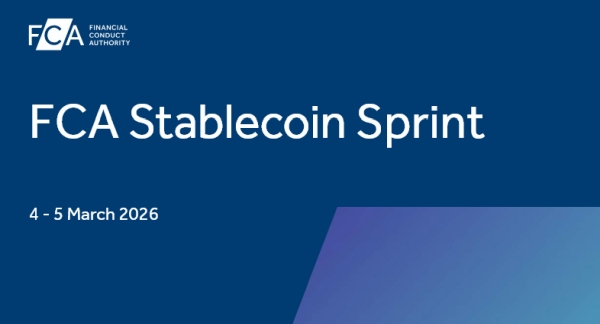
Image: FCA Stablecoin sprint participation pack, March 4-5, 2026
The UK Financial Conduct Authority is hosting a Stablecoin Sprint on March 4 and 5, 2026 in London. Applications are open until February 4, 2026. The Sprint feeds directly into the FCA’s work to finalize stablecoin payment rules later in 2026 and focuses on retail payments and remittances, including point of sale payments, ecommerce, domestic transfers, and cross border payments. A smaller roundtable planned for May will focus on trade payments, including trade finance and B2B payment flows.
The Stablecoin Sprint follows a series of FCA consultations in 2025 covering stablecoin issuance, safeguarding of cryptoassets, prudential capital and liquidity requirements, disclosure for UK issued qualifying stablecoins, and application of the FCA Handbook to regulated crypto activities. The FCA has also opened a stablecoins cohort within its Regulatory Sandbox to allow issuers to test UK issued stablecoins.
The FCA has structured the Sprint around three policy questions that go directly to how stablecoin payments would operate in practice. Full details are set out in the 16 page PDF, FCA Stablecoin Sprint participation pack.
The first problem statement asks what business models firms could use to deliver stablecoin payment use cases. Participants are expected to map payment flows end to end and explain how roles and responsibilities sit across issuers, wallets, payment providers, banks, and infrastructure firms.
The second problem statement examines where opportunities and risks arise within those models. This includes identifying where consumer harm, financial crime exposure, operational failure, or business weakness could appear, as well as where stablecoin payments could offer real improvements over existing payment systems.
The third problem statement focuses on priorities. Participants are asked to consider what regulation is needed, what may not be needed, and where risks could be addressed through business practices or technical design rather than new rules.
Across all three problem statements, the FCA asks participants to test stablecoin payment models against cost, speed, interoperability, certainty of settlement, and consumer protection.
Canadian regulators have already consulted publicly on payment functions through the Retail Payment Activities Act and on stablecoins through federal and securities frameworks. What the FCA Sprint adds is a use case driven exercise that brings those questions together around live payment flows. For Canadian fintechs, it offers a clear view of the practical issues regulators may still need to address as stablecoins move from trading into everyday payments.
As stablecoins move from trading and settlement into everyday payment use, regulators are under pressure to explain how these models fit within existing payment rules. The FCA Stablecoin Sprint shows that key questions around business models, risk ownership, and consumer protection remain open. For fintechs, payment firms, and infrastructure providers, the Sprint offers a clear view of where policy attention now sits and where practical clarity will matter most as stablecoin payment rules take shape. Apply Now
The National Crowdfunding & Fintech Association (NCFA Canada) is a financial innovation ecosystem that provides education, market intelligence, industry stewardship, networking and funding opportunities and services to thousands of community members and works closely with industry, government, partners and affiliates to create a vibrant and innovative fintech and funding industry in Canada. Decentralized and distributed, NCFA is engaged with global stakeholders and helps incubate projects and investment in fintech, alternative finance, crowdfunding, peer-to-peer finance, payments, digital assets and tokens, artificial intelligence, blockchain, cryptocurrency, regtech, and insurtech sectors. Join Canada's Fintech & Funding Community today FREE! Or become a contributing member and get perks. For more information, please visit: www.ncfacanada.org
| | |
|---|---|---|
| | |
AI | January 20, 2026

Image: Freepik
On January 19, 2026 via Reuters, OpenAI's Chief Financial Officer Sarah Friar confirmed that its annualized revenue exceeded US $20B in 2025. Reported figures show revenue was $6B in 2024 and about $2B in 2023, meaning revenue more than tripled this past year alone, mirroring the scale of paid demand for OpenAI services.
Annualized revenue describes what a company would generate over twelve months if current sales levels stayed constant, and is a widely measure to assess momentum in subscription and usage-based businesses. For OpenAI, the number reflects sustained growth in paid ChatGPT subscriptions, enterprise contracts, and API usage across multiple industries.
OpenAI’s revenue growth closely follows its infrastructure expansion. Reuters reports that the company increased its computing capacity from roughly 0.6 gigawatts in 2024 to about 1.9 gigawatts in 2025, nearly tripling in one year. That level of scale requires access to capital, power, chips, and long-term supplier agreements that only a handful of firms can sustain.
As scale increases, it begins to set the rules of the market.
Infrastructure capacity now determines who can offer AI services at competitive prices, who can guarantee availability during peak demand, and who can absorb cost volatility without disrupting customers. Performance expectations increasingly reflect what the largest providers can deliver, not what smaller firms can economically support.
This trajectory does not mean startups disappear overnight, but it raises the survival bar.
Startups that rely on thin margins face the earliest pressure. This includes companies that resell model access, wrap generic AI features into existing products, or compete primarily on convenience rather than control over data or distribution. As OpenAI captures more value directly through subscriptions, enterprise contracts, and advertising, profit margins for intermediaries narrows.
The pressure shows up first in functions that scale with usage rather than revenue, such as customer support automation, fraud monitoring, transaction screening, onboarding workflows, and real time decisioning. In these areas, AI costs rise with activity even when revenue does not.
By contrast, startups with proprietary data, embedded customer relationships, or regulated market access retain leverage. The dividing line is no longer access to AI. It is control over economics, customers, and accountability.
AI pricing is typically usage based. As fintech products scale, AI expenses scale with them, often faster and with less predictability than revenue. This creates margin pressure, particularly in Canada where fintechs operate with smaller domestic scale, tighter capital markets, and higher regulatory expectations. What appears manageable during early deployment can become material at scale.
In regulated financial services, vendor dependency becomes operational risk, and operational risk becomes regulatory exposure.
There is also a governance reality. When AI influences credit decisions, disclosures, complaints, or customer outcomes, fintechs remain fully accountable even when they do not control model behaviour, pricing changes, or service limits.
Pricing power in AI is concentrating upstream. Intelligence is becoming a metered utility controlled by a small number of providers with the capital and infrastructure to set terms. Large global firms can absorb cost swings, negotiate volume discounts, and manage vendor risk across portfolios. Many Canadian fintechs cannot.
The strategic question is not whether to use AI, but how tightly to bind core operations to any single supplier. Fintechs that preserve provider flexibility, constrain AI use to high impact functions, and tie spending directly to measurable outcomes retain an advantage (for now). Those that treat AI as an invisible background feature risk discovering too late that it has become a fixed dependency with variable costs.
OpenAI’s $20B annualized revenue growth is about market structure limits. Scale now determines who sets prices, who absorbs volatility, and who carries risk. For Canadian fintech, AI decisions now belong alongside cloud infrastructure, payments rails, and core systems as board level considerations.The firms that stay competitive will be the ones that manage AI like any other core cost, with clear oversight and control.
The National Crowdfunding & Fintech Association (NCFA Canada) is a financial innovation ecosystem that provides education, market intelligence, industry stewardship, networking and funding opportunities and services to thousands of community members and works closely with industry, government, partners and affiliates to create a vibrant and innovative fintech and funding industry in Canada. Decentralized and distributed, NCFA is engaged with global stakeholders and helps incubate projects and investment in fintech, alternative finance, crowdfunding, peer-to-peer finance, payments, digital assets and tokens, artificial intelligence, blockchain, cryptocurrency, regtech, and insurtech sectors. Join Canada's Fintech & Funding Community today FREE! Or become a contributing member and get perks. For more information, please visit: www.ncfacanada.org
| | |
|---|---|---|
| | |


August 26th, 2025

January 4th, 2024

June 1st, 2021

September 9th, 2020

July 9th, 2018

January 3rd, 2018

September 25th, 2017

June 20th, 2017

May 10th, 2017

December 14th, 2016