




Karsten Wenzlaff, Advisor
August 26th, 2025
Karsten Wenzlaff is a Crowdfunding and Fintech Expert from Germany. He is Secretary-General of Digit[...]


CBDC and Stablecoins | Sep 29, 2025

Image: Freepik
On September 19, 2025, EU finance ministers reached a compromise on the digital euro roadmap, designed to reduce dependence on Visa and Mastercard. The plan gives governments a stronger role in any launch decision and sets limits on how much citizens can hold. For official policy context, see the EU Council’s digital euro page, which outlines objectives and implementation steps.
Just six days later, nine major European banks formed a consortium to launch a MiCA-compliant euro stablecoin, targeting a 2026 launch. The group includes ING, UniCredit, CaixaBank, Danske Bank, SEB, Raiffeisen Bank International, KBC, DekaBank, and Banca Sella. Their goal is to deliver instant payments, programmable settlement, and a regulated alternative to unbacked crypto tokens.
By anchoring the stablecoin in Europe’s MiCA framework, the banks are moving early to define how regulated tokenized money will work. MiCA sets clear standards for issuers on capital, governance, and reserve management. That clarity is drawing incumbents to commit capital and credibility.
The digital euro and the bank consortium stablecoin initiative both look to rebalance power in Europe’s payments market. Today, Visa and Mastercard process around two‑thirds of all European card transactions. Policymakers want to ensure Europe can clear and settle payments domestically without relying on foreign schemes.
The central bank digital currency (CBDC) and stablecoin initiatives also intersect with Wero, the new retail wallet developed under the European Payments Initiative. Wero is designed to give merchants and consumers a unified tool for instant payments across the euro area, and a tokenized euro would strengthen its value proposition. This alignment mirrors the Canadian Real‑Time Rail project, though Europe is tying its upgrades more explicitly to digital money.
A further motivation is market share. Euro stablecoins currently total only about €620 million outstanding, compared to nearly $300 billion for U.S. dollar stablecoins. Europe risks being sidelined if it does not accelerate adoption, as global trade and DeFi increasingly rely on dollar‑based tokens.
For fintechs, these initiatives open a regulated path to experiment with programmable money, cross‑border settlement, and retail wallets. Startups may be able to integrate stablecoin rails into remittances, treasury management, or point‑of‑sale services with legal certainty.
For banks, the picture is mixed. Deposit flight is a risk if customers shift balances into tokenized wallets. Yet the banks launching the consortium also stand to gain by controlling issuance, custody, and compliance, capturing value from tokenization.
Canada has taken a more cautious approach. The Bank of Canada has said there is “no compelling case” for a retail digital dollar and is prioritizing upgrades to payment infrastructure. Policymakers are also examining how to regulate stablecoins, with oversight currently split between federal and provincial authorities. See NCFA's analysis of Canada's stablecoin race entering a critical phase for a more detailed analysis.
Europe’s actions highlight lessons for Canada. Their dual‑track model of a CBDC combined with a bank‑led stablecoin consortium shows how sovereignty and innovation can be balanced. A digital loonie could serve as a public anchor, while regulated Canadian bank or fintech stablecoins could deliver speed and programmability. Equally important, MiCA demonstrates the power of legislative clarity, something Canada lacks as fragmented oversight slows momentum.
Europe’s urgency also stems from the fact that euro stablecoins represent a tiny fraction of the global market. Canada faces the same risk if stablecoin use grows but domestic frameworks stall, Canadians may increasingly rely on U.S. dollar tokens for payments, weakening monetary sovereignty. Europe is also linking its initiatives to Wero, its new retail wallet.
Canada could also add experiments to the rollout of its Real‑Time Rail, ensuring token‑based payments integrate with domestic upgrades. Although Canadians and payment stakeholders can't afford any more delays.
If Canada followed a similar approach as in Europe, payments could become faster and cheaper, and fintechs would gain new opportunities in programmable settlement and remittances. Banks could face pressure on deposits but would gain new business in custody and compliance. If Canada hesitates for much longer, the country risks dollarization via U.S. stablecoins, reducing control over payments and data governance.
 The National Crowdfunding & Fintech Association (NCFA Canada) is a financial innovation ecosystem that provides education, market intelligence, industry stewardship, networking and funding opportunities and services to thousands of community members and works closely with industry, government, partners and affiliates to create aa vibrant and innovative fintech and funding industry in Canada. Decentralized and distributed, NCFA is engaged with global stakeholders and helps incubate projects and investment in fintech, alternative finance, crowdfunding, peer-to-peer finance, payments, digital assets and tokens, artificial intelligence, blockchain, cryptocurrency, regtech, and insurtech sectors. Join Canada's Fintech & Funding Community today FREE! Or become a contributing member and get perks. For more information, please visit: www.ncfacanada.org
 |  |  |
|---|---|---|
 |  |  |
Advocacy | Sep 26, 2025
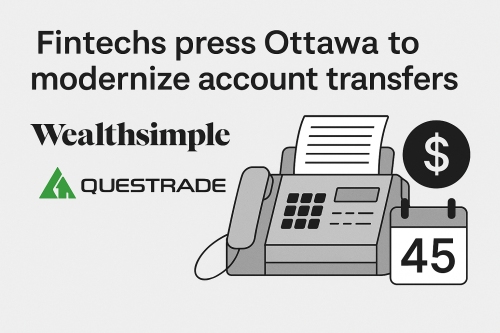
On August 12, 2025, Wealthsimple submitted its recommendations to the federal pre budget consultation, urging Ottawa to regulate how registered accounts such as RRSPs and TFSAs are transferred between financial institutions. The submission says rising transfer fees and weeks long delays undermines Canadians’ ability to manage their savings. Wealthsimple’s call was echoed by Questrade, which also urged stronger federal oversight.
Wealthsimple reported that between late 2024 and early 2025, the average transfer time was 19 days once paperwork was received. More than 13,000 transfers took longer than 45 days, and at any given time over $1 billion of client funds were stuck in transit, peaking at $2 billion in March. During this period, 45% of transfers were executed manually by the sending institution, specifically by fax and mailed cheques.
This outdated reliance on fax machines creates long delays that benefit incumbents. During this delay period, client capital is removed from their accounts by sending institutions (Read: Canadian incumbent banks), so it can be redeployed without clients receiving any benefit.
In fact, 15% of transfer requests were cancelled by clients due to the delays. Another way of putting this is investors are effectively providing interest free loans (to institutions) while paying more than $35 million in transfer fees.
Exit and transfer fees have grown from $0 to $75 a decade ago to an average of $150 per account in 2025.
With more than 40 million registered accounts in Canada, that adds up to hundreds of millions in annual costs.
Flat fees disproportionately harm younger Canadians. CRA data shows that the average TFSA balance for Canadians in their twenties is under $11,000, meaning a $150 fee can take more than 1% of their entire account.
By contrast, Canadians over 50, with TFSA balances above $25,000, are more likely to qualify for reimbursement programs offered by some institutions. Wealthsimple argues that this is a regressive structure that penalizes the very Canadians struggling most with affordability pressures.
The company itself does not charge clients who close or transfer out, and it has urged Ottawa to follow the example of other sectors such as telecom and air travel where hidden exit fees have been capped or eliminated.
The Canadian Investment Regulatory Organization (CIRO) has been studying the issue for years. CIRO's July 2025 White Paper on account transfers found that investor complaints over transfer delays have increased more than fivefold since 2015.
The paper reports widespread allegations that financial institutions intentionally slow transfers to retain business or to keep earning interest on client funds, with many investors stating that charges are too high or reimbursements are not honoured. This unnecessary friction harms consumers (and businesses alike).
CIRO has proposed modernizing the process with mandatory timelines, wider use of automation, and clearer requirements for firms to act diligently.
Wealthsimple’s pre-budget submission asks Ottawa the federal government who already regulates registered plans under the Income Tax Act to take similar steps in other industries to curb hidden fees.
From NCFA's perspective, fax machines and paper cheques are more than an inconvenience; they're systemic barriers to competition. Reform would not only protect consumers but also level the playing field for fintechs that rely on timely transfers to onboard new clients.
Why do Canadians and the government continue to accept an investment transfer system that still depends on fax machines, and why it takes pressure from fintechs to put the issue on the national agenda?
Other industries have modernized. Why has finance been allowed to remain stuck in the past? As Prime Minister Mark Carney puts it, “The premiers and I want to make Canada a global energy superpower and build the strongest economy in the G7.”
The National Crowdfunding & Fintech Association (NCFA Canada) is a financial innovation ecosystem that provides education, market intelligence, industry stewardship, networking and funding opportunities and services to thousands of community members and works closely with industry, government, partners and affiliates to create aa vibrant and innovative fintech and funding industry in Canada. Decentralized and distributed, NCFA is engaged with global stakeholders and helps incubate projects and investment in fintech, alternative finance, crowdfunding, peer-to-peer finance, payments, digital assets and tokens, artificial intelligence, blockchain, cryptocurrency, regtech, and insurtech sectors. Join Canada's Fintech & Funding Community today FREE! Or become a contributing member and get perks. For more information, please visit: www.ncfacanada.org
| | |
|---|---|---|
| | |
Report | Sep 25, 2025

Image: Top 200 Women Powered UK Businesses (report cover)
On September 16, 2025, J.P. Morgan and Beauhurst published the fifth annual Top 200 Women-Powered U.K. Businesses Report (Download 75 page PDF report), showcasing the scale and growth of female-founded and led enterprises in Britain. Since the inaugural edition, the number of women-powered businesses has more than doubled, rising from 6,085 in 2021 to 15,795 in 2025, representing 30.4% of all high-growth companies compared with just 18.3% four years ago.
The data shows that women-powered companies are growing faster than the broader high-growth ecosystem, which expanded by 56.1% over the same period. Regional analysis highlights London and the South East as hubs, with 4,916 and 2,124 women-powered firms respectively. In Wales, women-powered businesses now account for 32.7% of the high-growth firms, the highest proportion of any U.K. region.
Venture capital hit a record high, making up 21.9% of all deals, while women-powered businesses were slightly higher at 22.3%.
Equity crowdfunding has proven itself as transformational, driving the highest number of deals across the U.K.’s high-growth ecosystem. Since 2015, there have been 3,647 equity crowdfunding deals, of which 802 were women-powered fundraises, making it the leading investment route for female-founded and led businesses.
Entrepreneurs are increasingly attracted to equity crowdfunding because it provides access to early-stage capital often unavailable through traditional VC, combined with strong community backing and investor engagement. Two investment crowdfunding platforms stand out:
Over the last five years, equity investment in women-powered businesses grew nearly 97% from £2.29 billion in 2021 to £4.51 billion in 2025.
Exits also tell a updated story. After dipping in 2023, women-led companies generated £5.23 billion in disclosed exits in 2024, compared with £6.74 billion for male-led firms, creating one of the closest splits on record.
Charlotte Bobroff, Head of U.K. Women & Wealth:
"Women are surpassing milestones like never before, and their rapid rise is having a sizable impact on our overall economic output.”
Melis Kahya Akar, Managing Director at General Atlantic, noted persistent capital gaps. She added that investors have a responsibility to foster networks and mentorship:
“According to the World Bank, [women-led businesses] receive just 3% of global VC funding. When women do attract capital, they tend to raise smaller amounts than their male-led equivalents. The result is that fewer women-led businesses reach the later growth stage, at which we usually look to invest.
Representation matters, but there is currently a lack of visible role models, peers and mentors for women entrepreneurs. Only 11% of Fortune 500 CEOs are women, and while this is an increase on previous years, the relative scarcity can act as a deterrent for other women.”
The report highlights fintech and other digital sectors as among the most active areas for women-powered businesses.
In 2024, Software-as-a-Service, online retail, data provision, AI, and fintech were leading sectors for equity deal activity. Data-driven firms led by women have grown sharply, with deal activity in data provision rising from 233 in 2020 to 302 in 2024.
The doubling of female-led high-growth firms, growing access to capital, record-setting exits, and strong representation in fintech and digital-first sectors point to structural change. Download the full report
The National Crowdfunding & Fintech Association (NCFA Canada) is a financial innovation ecosystem that provides education, market intelligence, industry stewardship, networking and funding opportunities and services to thousands of community members and works closely with industry, government, partners and affiliates to create aa vibrant and innovative fintech and funding industry in Canada. Decentralized and distributed, NCFA is engaged with global stakeholders and helps incubate projects and investment in fintech, alternative finance, crowdfunding, peer-to-peer finance, payments, digital assets and tokens, artificial intelligence, blockchain, cryptocurrency, regtech, and insurtech sectors. Join Canada's Fintech & Funding Community today FREE! Or become a contributing member and get perks. For more information, please visit: www.ncfacanada.org
| | |
|---|---|---|
| | |
Stablecoins | Sep 25, 2025

On September 24, 2025, Stablecorp announced a $5 million CAD strategic round led by FTP Ventures to accelerate the rollout of its Canadian dollar stablecoin, QCAD. The financing builds on $2.5M investment by Coinbase Ventures earlier this year on July 2, 2025, and arrives as policymakers in Canada and the United States sharpen oversight of stablecoin issuers.
If that wasn't enough, one day later on September 25, DeFi Technologies announced a strategic investment and commercial partnership with Stablecorp, reinforcing QCAD’s role as compliant infrastructure for cross-border settlement, digital markets, and e-commerce.
Stablecoins are becoming core payment rails globally. In Canada, the Office of the Superintendent of Financial Institutions is drafting a new framework for stablecoin issuers, while the Bank of Canada has urged PM Carney to consider establishing a federal stablecoin framework to help Canada remain competitive in digital assets which are becoming more popular.
The Retail Payments Activities Act took effect on September 8, 2025, now requiring payment service providers to register with the Bank of Canada, creating a compliance base for CAD-denominated digital money. NCFA has previously reported that Canada’s stablecoin race is entering a critical phase, with domestic fintechs pushing to compete with foreign issuers. In the United States, the GENIUS Act passed in June 2025, setting strict standards for reserves, audits, and issuer oversight.
Chainalysis estimates $2.5T in stablecoin transfers over the past year. McKinsey analysis suggests gross annual stablecoin settlement volumes now exceed $27T, pointing to rapid adoption across capital markets and payments.
QCAD is fully backed 1:1 with Canadian dollar reserves, held in an arms-length trust under independent oversight. Stablecorp provides daily transparency reports and monthly third-party attestations, addressing one of the largest concerns regulators have raised around stablecoins. This design allows QCAD to be used in trust-based use cases, such as cross-border trade settlement, on-chain foreign exchange, and tokenized asset markets.
With the Bank of Canada pausing its retail CBDC work, private CAD stablecoins structured for compliance are positioned to fill immediate demand across e-commerce, payroll, and supplier payments.
The $5 million raise was led by FTP Ventures, whose founder Fred Pye described digital dollars as the most efficient payment rail yet devised. Stablecorp also attracted participation from Coinbase Ventures, Circle Ventures, and Side Door Ventures, signaling strong institutional support.
On September 25, DeFi Technologies joined as both investor and partner, announcing plans to develop QCAD-integrated products through Valour, streamline liquidity with Stillman Digital, and build a post-quantum security roadmap with BTQ.
These steps broaden QCAD’s use cases, deepen liquidity for mint and redeem flows, and create recurring revenue streams through fees and spreads.
Kesem Frank, Stablecorp CEO:
"This is another important step in scaling QCAD for the benefit of all Canadians. It is imperative that Canada takes its place as a significant and strategic market for the growth of the digital asset economy, and our development of a trusted and compliant Canadian dollar stablecoin is a critical piece of that puzzle. Our backing by industry majors signals a shared vision for a multi-currency, easy to access, and regulated digital financial system."
Previous NCFA coverage shows how Canadian banks and fintechs are backing regulated stablecoins, and globally, large institutions such as Citi and Bank of America are preparing to issue their own stablecoins under advancing regulation. This convergence of capital and compliance shows how the stablecoin market is entering a new phase of mainstream adoption.
The combined announcements highlight how regulatory clarity and capital investment are converging around Canadian dollar stablecoins. Canada’s trade with the United States, valued at more than C$1 trillion annually, provides a strong corridor for QCAD adoption. Beyond North America, Canada is diversifying trade with partners in Europe, Asia, Africa, and Latin America, where settlement costs and delays limit competitiveness.
A compliant CAD stablecoin can lower transaction frictions and unlock new efficiencies for exporters, importers, and service providers. With domestic CBDC efforts paused, well-regulated stablecoins like QCAD are an immediate solution to modernizing Canada’s payment and settlement infrastructure.
The National Crowdfunding & Fintech Association (NCFA Canada) is a financial innovation ecosystem that provides education, market intelligence, industry stewardship, networking and funding opportunities and services to thousands of community members and works closely with industry, government, partners and affiliates to create aa vibrant and innovative fintech and funding industry in Canada. Decentralized and distributed, NCFA is engaged with global stakeholders and helps incubate projects and investment in fintech, alternative finance, crowdfunding, peer-to-peer finance, payments, digital assets and tokens, artificial intelligence, blockchain, cryptocurrency, regtech, and insurtech sectors. Join Canada's Fintech & Funding Community today FREE! Or become a contributing member and get perks. For more information, please visit: www.ncfacanada.org
| | |
|---|---|---|
| | |
Regulation | Sep 24, 2025

Image: Freepik
On September 13, 2025, Thailand froze approximately 3 million bank accounts in a sweeping anti-scam campaign. Authorities targeted around 177,000 mule accounts linked to fraud. Wisit Wisitsora of Thailand’s Digital Economy and Society Ministry stated:
“We urge the public not to panic. The suspension is only temporary.”
Banks imposed daily transfer caps ranging from 50,000 to 200,000 baht (approx. $2164 CAD - $8657 CAD at today's forex rates) and froze flagged transactions.
Commercial banks could suspend funds for three days, with police empowered to extend freezes up to seven days. While designed to curb online fraud, many individuals and small businesses described being locked out of their only source of funds, leaving households unable to pay for food or bills.
Facing backlash, regulators introduced safeguards. Innocent users can now expect restoration within hours to one day. Banks are required to notify customers of freezes via SMS or mobile banking and to unfreeze wrongly blocked funds proactively. Officials emphasized that disputed amounts are suspended, not entire balances.
Around the world, regulators from the EU to the U.S. and Canada are grappling with similar challenges as regulators expand digital fraud controls. What the Thailand case shows is that the credibility of financial systems depends not only on the strength of anti-scam tools but also on transparent safeguards.
If freezes become a blunt instrument, they risk driving people out of regulated channels and weakening financial inclusion. For fintechs and policymakers, the global lesson learned is that fraud prevention must be paired with due process to preserve trust.
Fraud-related losses in Thailand exceed 6 billion baht annually (approx $200M CAD), but freezing millions of accounts without due process undermines trust in banking.
"The Thai case clearly shows the risk when rapidly scaled enforcement collides with consumer rights. Without transparent criteria, real-time notifications, and clear appeals, innocent users face financial harm."
Legal experts warn this could expose authorities to civil claims and property rights challenges. What if citizens turn to cash, crypto, or unregulated channels instead?
Canada faced a similar backlash during the 2022 trucker protests, when the government invoked the Emergencies Act and froze over 200 bank accounts containing nearly $8M CAD without court orders. The measures were lifted within days, but the incident triggered several knee jerk reactions and lasting debate about transparency, due process, and the role of financial institutions in enforcing emergency powers.
Similar debates are underway in other regions, such as the United States with proposals like the Fairness in Banking Act, which NCFA has examined for its consumer protection impact. The common challenge is ensuring that stronger enforcement powers don't override due process or weaken trust in financial systems.
Both the Thailand crackdown and the Canadian freeze highlight how well intentioned interventions can spiral into government overreach if consumer safeguards are weak. Independent oversight, transparent criteria, communication protocols, and effective redress mechanisms are essential.
As fintechs use AI to spot fraud, regulators need to keep rules fair and accountable. Protecting consumers while keeping trust in financial services is key to Canada’s future growth and inclusion.
The National Crowdfunding & Fintech Association (NCFA Canada) is a financial innovation ecosystem that provides education, market intelligence, industry stewardship, networking and funding opportunities and services to thousands of community members and works closely with industry, government, partners and affiliates to create aa vibrant and innovative fintech and funding industry in Canada. Decentralized and distributed, NCFA is engaged with global stakeholders and helps incubate projects and investment in fintech, alternative finance, crowdfunding, peer-to-peer finance, payments, digital assets and tokens, artificial intelligence, blockchain, cryptocurrency, regtech, and insurtech sectors. Join Canada's Fintech & Funding Community today FREE! Or become a contributing member and get perks. For more information, please visit: www.ncfacanada.org
| | |
|---|---|---|
| | |
AI Innovation | Sep 24, 2025

Image: Freepik
On September 16, 2024, Counterforce Health reported that U.S. platforms are using artificial intelligence to help patients appeal denied health insurance claims by analyzing rejection letters and generating tailored responses at scale.
The rise of AI powered tools is a growing insurtech trend where technology is being used to challenge entrenched industry practices that unfairly hurt consumers. For NCFA's community, the story raises important questions about where AI could play a similar role in our own insurance markets.
Let's look at the data to better understand the scope of the problem. In 2021, insurers on the federal HealthCare.gov marketplace denied about 17% of in network claims. These are services from doctors and hospitals already under contract with the insurer, showing that even approved providers faced a high denial rate.
Yet fewer than 0.2% of these denials were appealed, despite nearly 59% of appeals being successful when filed.
Separate research from the American Medical Association found that prior authorization denials are overturned more than 80% of the time when challenged, but only a small share of patients ever appeal.
The above figures point to a structural imbalance where insurers rely on consumers giving up. By automating appeal letters with expertly assessed supporting evidence, AI systems are changing the game.
Canada’s universal healthcare system means most core medical services are covered publicly, so denials are less about hospital visits or surgeries and more about supplemental benefits such as prescription drugs, dental care, physiotherapy, and other extended health services. Private insurers play a major role in these areas, and disputes are common.
What Canada lacks is transparent national reporting on denial and appeal rates. Unlike the U.S. system where denial data is published for marketplace insurers, Canadian insurers are not required to release such information. The limited statistics that do exist come from independent research or regulator snapshots, which highlight problems but don't provide a complete national picture. This lack of transparency creates a barrier to accountability and also an opportunity for Insurtech innovators.
Even without standardized national data, the available evidence shows that denial issues are widespread across several types of insurance:
Disability insurance denial rates are high. For example, about 60% of Canada Pension Plan disability applications are rejected, a figure that highlights the steep barriers claimants face, even if it is not directly comparable to private disability insurance.
In Quebec, 20% of critical illness and life insurance claims are denied according to the Autorité des marchés financiers. Disputes often stem from exclusions or non-disclosure clauses.
Extended health and drug benefits. Expensive specialty drugs and therapies are frequently denied as “not medically necessary” or outside policy coverage. Appeal processes can be slow and opaque.
Accident benefit disputes are frequent, especially with auto insurance in Ontario. The provincial tribunal system handles thousands of contested denials each year. AI insurtech solutions could help provinces reduce backlogs and streamline case processing.
Property insurance denials are common enough. Regulators report that property insurance denial ratios are around 16%, with most rejections tied to lack of coverage.
For fintech and Insurtech players, the opportunity spams the broader insurance ecosystem. AI could provide consumers with tools to navigate opaque processes, improve transparency, and reduce the cost of disputes.
Regulators have already outlined pan-Canadian guiding principles for responsible AI in health systems (Health Canada), establishing an innovation framework that balances fairness and accountability.
With insurance denial data so limited in Canada, new platforms that integrate appeals with data collection could simultaneously drive consumer protection and market competitiveness.
Denial data transparency can expose inefficiencies between insurers and individuals and AI solutions can help rebalance power. While Canada’s insurance system is structured differently than the U.S., denial disputes are still widespread and certainly costly in terms of time and money for stakeholders.
Fintechs and insurtech innovators should view this is a market opportunity while also protecting consumers. Canada can either wait for U.S. platforms to cross the border, or develop homegrown solutions that lead in fairness, transparency, and competitiveness.
The National Crowdfunding & Fintech Association (NCFA Canada) is a financial innovation ecosystem that provides education, market intelligence, industry stewardship, networking and funding opportunities and services to thousands of community members and works closely with industry, government, partners and affiliates to create aa vibrant and innovative fintech and funding industry in Canada. Decentralized and distributed, NCFA is engaged with global stakeholders and helps incubate projects and investment in fintech, alternative finance, crowdfunding, peer-to-peer finance, payments, digital assets and tokens, artificial intelligence, blockchain, cryptocurrency, regtech, and insurtech sectors. Join Canada's Fintech & Funding Community today FREE! Or become a contributing member and get perks. For more information, please visit: www.ncfacanada.org
| | |
|---|---|---|
| | |
Stablecoin Research | Sep 23, 2025
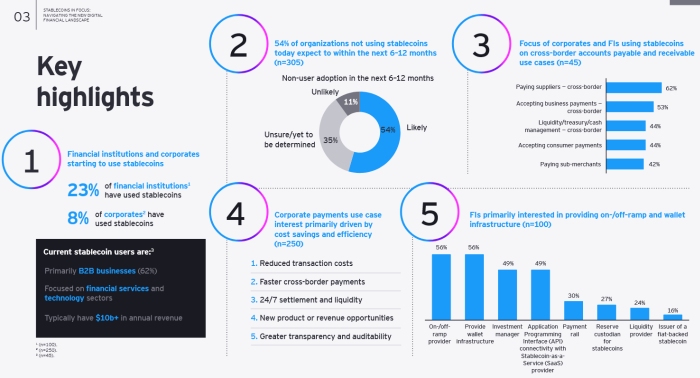
Image: Stablecoin Survey Research Highlights (EY Parthenon Sep 2025)
On September 15, 2025, EY-Parthenon released its latest stablecoin survey results, "Stablecoins: Adoption, Optimism, and Regulatory Clarity" (download 31 page PDF), covering 350 executives from corporates and financial institutions across the US, EMEA and other regions. Research takeaways confirm adoption is picking up speed, supposed by regulatory clarity by the GENIUS Act, recently signed into law.
Why is this happening? Approval of the U.S. GENIUS Act is a regulatory catalyst. Further, pilots are proving real value and corporate treasurers are under pressure to improve efficiency. The thinking is that organizations delaying adoption risk losing ground to competitors who are moving forward and benefiting from the lower cost and faster transactions of stablecoin technologies.
Why is everyone saving money by using stablecoins? The reason is straightforward. Traditional cross border payments involve multiple intermediaries, each adding fees and time. Stablecoins bypass these frictions and settles instantly, so the cost savings are structural (not incremental). For fintech providers, there's a growing opportunity to provide integration and risk management tools to help corporates adopt/use stablecoins and measure their effectiveness.
The reality is that we live and function in a global economy where delays can disrupt supply chains, so it's not surprising that corporates will adopt stablecoins for faster and more streamlined and predictable settlement solutions. This means that stablecoin adoption will likely strong and swift among B2B supplier and trade finance flows before expanding more widely into consumer payments.
In Canada, regulatory inaction is catching up with market momentum. On September 19, 2025, regulators like OSFI have warned the Prime Minister Mark Carney that Canada should accelerate federal stablecoin rules to avoid falling behind global peers. The Bank of Canada has echoed this call, saying stablecoins should be as safe and stable as the balance in your bank account. OSFI is already drafting a new framework to regulate stablecoin issuers, while domestic momentum is building as Tetra Digital Group secured $10M from Canadian banks and fintechs to launch a CAD stablecoin in 2026. Observers including investor John Ruffolo warn in his Looming Stablecoin Storm substack that without clear domestic rules, Canada risks ceding innovation, competitiveness and monetary sovereignty to jurisdictions that move faster.
Canadian corporates and fintechs need to plan not just for current global trends, but for a new local regulatory stablecoin framework. Firms are advised to engage with policymakers to create the right environment, build compliance ready infrastructure now and position for interoperability with USD pegged tokens and domestic stablecoin initiatives.Waiting could result in higher compliance costs, restricted access, and eventually a decline in market share.
Bottom line is banks understand that clients will demand stablecoin services and that failure to provide them risks their disintermediation. There's an intensifying race between traditional institutions and fintech challengers to capture stablecoin transaction flows.
Hybrid build and partner strategy. Corporates are demanding trust and compliance, while financial institutions know they cannot deliver the full stack alone. This means that partnerships between fintechs, banks and technology providers will determine how quickly stablecoin adoption scales.
Stablecoins are moving from pilot projects into enterprise strategy. Corporates see real cost savings and competitive advantage, while financial institutions are preparing to build services at scale to meet client demand. Regulation is beginning to catch up, led by the GENIUS Act in the US, but the global landscape is unbalanced while Canada’s fintech ecosystem is calling on the federal government to create and regulate a stablecoin framework to remain aligned and competitive.
The National Crowdfunding & Fintech Association (NCFA Canada) is a financial innovation ecosystem that provides education, market intelligence, industry stewardship, networking and funding opportunities and services to thousands of community members and works closely with industry, government, partners and affiliates to create aa vibrant and innovative fintech and funding industry in Canada. Decentralized and distributed, NCFA is engaged with global stakeholders and helps incubate projects and investment in fintech, alternative finance, crowdfunding, peer-to-peer finance, payments, digital assets and tokens, artificial intelligence, blockchain, cryptocurrency, regtech, and insurtech sectors. Join Canada's Fintech & Funding Community today FREE! Or become a contributing member and get perks. For more information, please visit: www.ncfacanada.org
| | |
|---|---|---|
| | |


August 26th, 2025

January 4th, 2024

June 1st, 2021

September 9th, 2020

July 9th, 2018

January 3rd, 2018

September 25th, 2017

June 20th, 2017

May 10th, 2017

December 14th, 2016