




Karsten Wenzlaff, Advisor
August 26th, 2025
Karsten Wenzlaff is a Crowdfunding and Fintech Expert from Germany. He is Secretary-General of Digit[...]


July 21, 2026 | NCFA Companies On The Move | Cybersecurity And Fraud, Identity Privacy And Data Governance, Artificial Intelligence And Data
Tailscale is a Toronto founded secure networking company built around WireGuard, identity controls and direct connections between devices. By July 2026, it was nearing 40,000 paid business clients and approximately 300 employees, according to BetaKit. Tailscale’s website separately reports 2.5 million active devices and 100,000 monthly active users.
The core business makes private networks easier to deploy and govern, while Aperture and Border0 take Tailscale into AI access and privileged infrastructure—two markets with bigger security budgets and much heavier competition. This profile looks at what customers are buying today, where the next leg of growth could come from and what the public evidence still can’t tell us.
The best public clues come from customers describing work they no longer have to do. Instacart reduced internal VPN support requests from about 10 each week to nearly zero, cut new user onboarding to less than one minute and reported no outages after deployment. Cribl grew from 18 to approximately 550 employees without hiring a dedicated networking team to administer access, while Corelight reports saving more than 1,000 hours annually and Positron estimates it saves an hour each time a prospect is onboarded.
These are selected Tailscale case studies, not audited results or a measure of what the average customer should expect. Still, they help explain how the product spreads: it removes the VPN tickets, slow onboarding and constant access administration that technical teams already dislike. A developer can start with one live problem, and if the network holds up, IT and security have a practical reason to standardize it, add controls and bring more of the company onto the same service.
Core Tailscale appears to be the product that pays today. It creates an encrypted private network among approved users, devices, servers and services, with identity based policy deciding what can connect. Developers can get started without rebuilding the company network; as use grows, IT and security can add centralized administration, device posture, logs and tighter access controls. Tailscale’s client, command line tool and relay server code are open source, but the hosted coordination server is proprietary. That coordination service distributes public keys and access rules, while customer traffic normally moves directly between endpoints or through encrypted relays. Tailscale Raises $230M To Power Identity-First Networking looked at why this model could pressure conventional VPN and firewall products.
The pricing supports the same bottom up motion. Tailscale currently lists a free Personal plan, Standard at US$8 per user per month, Premium at US$18 and custom Enterprise terms, with paid plans adding provisioning, device posture, administrative roles, network flow logs, regional routing and support. The cost of trying the product is low; the account becomes more valuable as more people, devices and company controls move onto it.
Revenue is the important missing number. Tailscale doesn’t publish it, and the outside estimates aren’t close enough to treat as fact. GetLatka puts 2025 revenue at US$45.2 million, although it says the figure is modelled and that management wasn’t interviewed. Northmetric estimates US$60.1 million in current annual recurring revenue with medium confidence, relying partly on an assumed 54,000 paying customers—well above BetaKit’s July 2026 report of nearly 40,000 paid business clients. Taken together, the estimates point to a company with real commercial scale, but they don’t establish Tailscale’s actual revenue.
Aperture is the move into AI access and cost control. Sitting between approved users or agents and AI model providers, it centralizes credentials while applying access rules, usage visibility and spending limits. That puts platform, security and AI infrastructure teams squarely in the buyer group. AI Agents Enter Governed Financial Workflows explains why permissions, approved tools and audit records matter once agents touch regulated work. Existing Tailscale networks could give Aperture a useful distribution advantage, but the product remains in beta and is currently available without extra cost during testing. Six users are included, with additional access handled through the company; usage, paid conversion and final pricing haven’t been published.
Border0 moves Tailscale into privileged infrastructure access. It governs sensitive connections to servers, databases, Kubernetes environments and internal applications, adding approval workflows, session recording and audit visibility. Those capabilities put Tailscale in front of security, compliance and operations buyers—not just the teams managing everyday network access. After acquiring Border0 in March 2026, Tailscale began connecting the product to its identity and networking layer, although the combined offering remains in beta. Adoption, revenue and final packaging haven’t been disclosed, so Border0 is best viewed as a credible expansion route rather than a proven second engine.
Tailscale now overlaps with secure networking, identity security, privileged access and AI gateways. Each move opens another budget, but it also brings the company up against much larger security platforms with broader bundles, established enterprise sales teams and far more acquisition firepower.
Large security platforms are buying identity. Palo Alto Networks completed its acquisition of CyberArk in February 2026, adding privileged access and identity security to a platform that already spans network, cloud and security operations. CrowdStrike agreed to acquire SGNL for continuous identity controls, while Zscaler agreed to acquire Symmetry Systems for data and AI access visibility. Buyers are clearly paying for identity and access control, but they may increasingly prefer to buy it inside a larger security contract.
SASE rivals have more capital and enterprise reach. Netskope’s September 2025 IPO raised approximately US$992 million and valued the company at about US$9.6 billion on a fully diluted basis. Netskope, Zscaler, Cloudflare and Palo Alto Networks can bundle network access with wider security products and sell through established enterprise teams. Tailscale’s counter is that technical users can adopt its product before a large security procurement begins, although that advantage could narrow as buyers consolidate more of their security spending with fewer vendors.
AI gateways are becoming a real product category. Cloudflare AI Gateway added real time spending limits and identity based controls in June 2026, while Kong sells governance for models, MCP servers and AI agents. Neo Raises US$100M To Control Enterprise AI Agents shows how quickly money and products are gathering around agent inventory, permissions and policy. Aperture approaches the same problem from inside a customer’s private network, which gives it an interesting opening; whether that opening lasts will depend on policy depth, auditability and model coverage.
Canadian financial institutions face clearer AI and vendor controls. OSFI’s July 2026 bulletin on generative and agentic AI connects AI use to existing expectations for technology risk, operational resilience and third party oversight. Its technology and cyber risk guideline and third party risk guideline make identity, logs, access policy and vendor diligence commercially relevant. OSFI And GRI Workshops Reveal What Regulated AI Needs found that weak identity, provider concentration and vendor oversight are already limiting adoption. Tailscale’s SOC 2 Type II status helps. CSA Cybersecurity Guidance For Registered Firms shows why firms will still need documented vendor diligence, access controls and current assurance reports.
Open source keeps the paid product honest. Tailscale identifies Headscale as an independent alternative to its proprietary coordination server, which means a capable technical team can self host that layer. The subscription therefore has to keep earning its place through reliability, administration, policy, support and company controls—not connectivity alone.
Easy adoption doesn’t remove enterprise budget friction. A Tailscale commissioned survey of 1,000 technology leaders found that 42% cited workflow or integration disruption when security upgrades were delayed, while one third cited an unclear business case. Customer results give Tailscale’s sales team concrete savings to work with, but a company wide deployment still needs an owner, a budget and proof that another security vendor can be retired or avoided.
Tailscale’s edge starts with how it gets in. A developer or infrastructure team can solve a live networking problem without waiting for a company wide migration; if the product works, IT and security can add policy, device controls, logs and support around a network that people are already using. Reported results from Instacart, Cribl, Corelight and Positron give that approach substance beyond the usual product pitch. It also places Tailscale across several areas in the NCFA Financial Innovation Map, including digital identity, cyber resilience, AI governance and enterprise infrastructure.
The next act is harder because Aperture and Border0 ask those customers to trust Tailscale with AI access and privileged infrastructure, where the budgets are larger and the incumbents are stronger. Nearly 40,000 paid business clients and 2.5 million active devices give Tailscale a meaningful starting point; what isn’t public yet is whether either product is creating meaningful new revenue.
The Company Intelligence Snapshot follows the funding, customer growth and product decisions that brought Tailscale to this point.
Tailscale was founded in 2019 to reduce the complexity of connecting people, devices and services across the internet. Its first generally available product combined WireGuard encryption, identity and direct connections without requiring companies to rebuild their existing networks.
TailscaleA Canadian founded secure networking company
LaunchGeneral availability arrived in April 2020
US$3M SeedLed by Heavybit with Uncork Capital and others
GlobalRemote teams, cloud infrastructure and personal networks
Developers FirstIndividuals and technical teams could start without enterprise deployment
Simpler VPNDirect encrypted connections reduced reliance on central VPN concentrators
Rather than begin with a top down security sale, Tailscale gave developers a faster way to connect private infrastructure and let working networks make the case for wider adoption.
Information notice: Private-company estimates are identified and attributed. Information may change after the stated update date. This content is provided for informational purposes only and does not constitute investment, financial or legal advice.
 The National Crowdfunding & Fintech Association (NCFA Canada) is a financial innovation ecosystem that provides education, market intelligence, industry stewardship, networking and funding opportunities and services to thousands of community members and works closely with industry, government, partners and affiliates to create a vibrant and innovative fintech and funding industry in Canada. Decentralized and distributed, NCFA is engaged with global stakeholders and helps incubate projects and investment in fintech, alternative finance, crowdfunding, peer-to-peer finance, payments, digital assets and tokens, artificial intelligence, blockchain, cryptocurrency, regtech, and insurtech sectors. Join Canada's Fintech & Funding Community today FREE! Or become a contributing member and get perks. For more information, please visit: www.ncfacanada.org
 |  |  |
|---|---|---|
 |  |  |
July 21, 2026 | NCFA Market Activity | Digital Assets, Lending Consumer Credit And BNPL, Embedded Finance

On July 21, 2026, APX Lending launched its Canadian Lending as a Service platform with Netcoins. Eligible users can access crypto backed loans inside the Netcoins app while APX provides the capital, underwriting, compliance, collateral management, technology and servicing behind the product.
Netcoins is the first Canadian platform to go live on the infrastructure. The rollout builds on an existing relationship rather than starting from zero. BIGG Digital Assets invested in APX and announced the Netcoins partnership in May 2025, and Netcoins later added an in app lending page and calculator while the companies worked toward full integration.
The new launch turns APX’s securities law relief into infrastructure another Canadian platform can distribute. APX can now place its lending system behind a partner’s customer relationship rather than relying only on borrowers who arrive through its own channel.
Netcoins brings the app, customer relationship and regulated crypto trading channel. Netcoins became one of Canada’s early restricted dealer crypto platforms in 2021. It is owned by publicly traded BIGG Digital Assets, which combines Netcoins with blockchain analytics and compliance technology under a compliance first operating model.
APX runs the lending operation behind the interface. It supplies capital, reviews each application, performs the required account appropriateness assessment, manages collateral, handles servicing and monitors loan to value levels around the clock. APX or a wholly owned special purpose vehicle remains the lender under the loan agreement.
The partnership lets Netcoins add credit without creating its own lending balance sheet, underwriting team or collateral controls. APX gains distribution through an established Canadian platform, while Netcoins can add a new revenue line and give customers another reason to keep assets inside its ecosystem.
The model resembles other forms of embedded lending infrastructure, but the collateral is digital. The customer sees a loan inside a familiar platform even though a specialist provider operates the credit system behind it.
Netcoins’ lending page currently shows loans starting at C$10,000 or USDC 10,000, using Bitcoin or Ether as collateral. Terms can run for up to 60 months, and the displayed interest rate starts at 12.99%. Final terms and eligibility are determined during APX’s application process.
Borrowers can access Canadian dollars or USDC without a conventional credit check, but the loan is secured by crypto. If the collateral value falls, the loan to value ratio rises. APX can require more collateral or partial repayment and may liquidate assets when the applicable threshold is reached.
The April 2025 OSC decision permits APX to accept Bitcoin and Ether unless the principal regulator approves another asset. It also requires client disclosures, account appropriateness reviews and third party custody controls. The relief is time limited, expires three years after the decision and should not be treated as a general precedent for other lenders.
APX says collateral is held in segregated BitGo Trust cold storage, remains visible on chain and is not pooled, re-lent or rehypothecated. Customers should still understand that crypto collateral is not protected by the Canadian Investor Protection Fund and can be sold if the loan breaches its terms.
Netcoins adds crypto backed credit to trading, custody, staking and card products without building a lending operation internally.
APX Lending supplies regulated credit infrastructure, capital, collateral controls and servicing behind partner branded experiences.
Ledn operates a specialist Bitcoin backed lending business and has connected crypto loans with institutional funding markets.
Canadian crypto platforms that focus mainly on trading and custody may now need to decide whether lending belongs in their product mix.
Banks and fintechs could eventually use similar infrastructure if they want to offer digital asset secured credit without holding or operating the full crypto lending stack.
The commercial appeal is clear, but do users understand who is doing what?
Netcoins controls the experience, but APX approves and services the loan. Customers need clear information about the lender, collateral transfer, interest costs, margin notices, liquidation rules, data sharing and complaint handling before they apply.
Andrei Poliakov has followed this compliance first approach before. In a 2019 NCFA interview with Coinberry, he described the goal of building a trusted Canadian crypto business with supportive banking and long term operating discipline.
Coinberry was later acquired by WonderFi for C$38.5 million as regulatory costs encouraged consolidation. APX applies that experience to shared infrastructure that several platforms may be able to use rather than each one building a separate lending operation.
If the model performs well, APX could become a common lending layer behind several crypto platforms. If servicing, disclosures or liquidations create friction, the platform presenting the loan will share the reputational cost.
Will APX become the lending layer behind several Canadian crypto platforms, or will larger exchanges eventually build or acquire their own credit infrastructure?
Andrei Poliakov founded APX Lending in 2023 after helping build Coinberry, one of Canada’s early regulated crypto trading platforms. APX focused on secured credit that lets borrowers access liquidity without selling Bitcoin or Ether.
APX LendingCrypto backed lending built around regulated infrastructure
FormationA new lender develops after the Coinberry operating experience
Private FundingEarly financing details not publicly disclosed
CanadaA compliance first route into digital asset credit
Crypto HoldersIndividuals and businesses seeking liquidity without selling
Custody First LendingSegregated collateral and no rehypothecation
APX began with a founder who had already worked through Canadian crypto compliance, banking and custody challenges. The new company applied that experience to lending rather than another trading platform.
The National Crowdfunding & Fintech Association (NCFA Canada) is a financial innovation ecosystem that provides education, market intelligence, industry stewardship, networking and funding opportunities and services to thousands of community members and works closely with industry, government, partners and affiliates to create a vibrant and innovative fintech and funding industry in Canada. Decentralized and distributed, NCFA is engaged with global stakeholders and helps incubate projects and investment in fintech, alternative finance, crowdfunding, peer-to-peer finance, payments, digital assets and tokens, artificial intelligence, blockchain, cryptocurrency, regtech, and insurtech sectors. Join Canada's Fintech & Funding Community today FREE! Or become a contributing member and get perks. For more information, please visit: www.ncfacanada.org
| | |
|---|---|---|
| | |
July 20, 2026 | NCFA Story Intelligence | Regulation And Policy, Capital Markets And Market Infrastructure, Competition And Market Structure
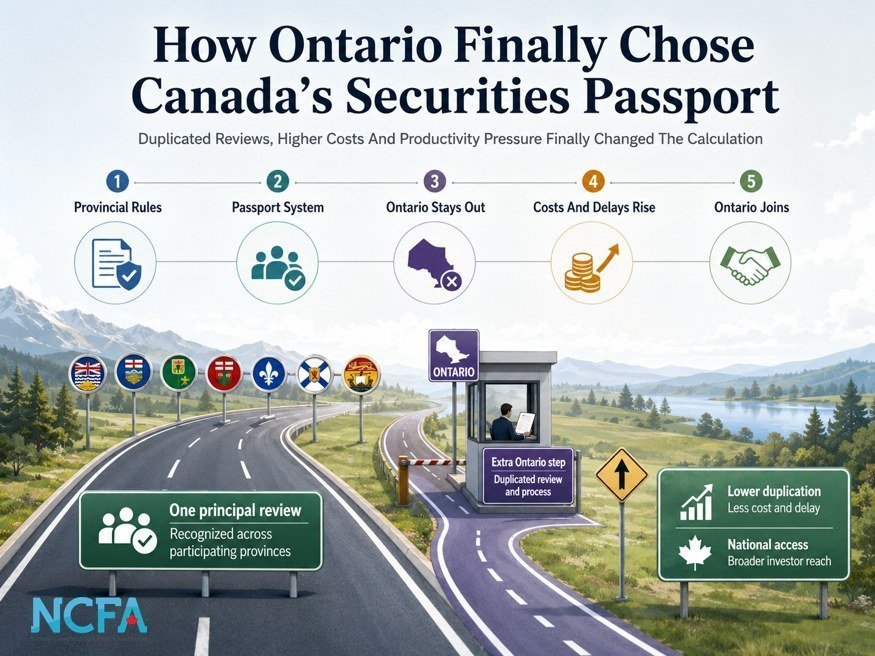
On July 15, 2026, Ontario Finance Minister Peter Bethlenfalvy announced that Ontario had committed to joining Canada’s securities regulatory passport system. The federal Finance Department highlighted the commitment following the federal, provincial and territorial finance ministers’ meeting in Charlottetown, ending almost two decades as the only jurisdiction outside the system.
Finance ministers described the decision as regulatory harmonization, removal of an interprovincial trade barrier and progress toward one Canadian economy. It also resolved a contradiction Ontario had carried for years. The province repeatedly documented duplication, delay and disproportionate compliance costs while continuing to require a separate Ontario decision where most of Canada relied on one principal regulator.
Ontario stayed outside because passport was never the prize it wanted. The province backed a single national regulator, then a cooperative authority with a wider institutional redesign. The first model failed in court. The second survived legally but never opened.
Companies carried the cost of waiting. Equity crowdfunding showed what fragmentation did at company level. A financing model designed to connect issuers and investors online became a provincial compliance exercise that excluded supporters, consumed employee time and made some smaller raises uneconomical.
The story isn’t that Ontario suddenly discovered regulatory friction in 2026. Every alternative gradually weakened while the economic cost of maintaining a separate process became harder to defend.
Canada has one capital market but several securities authorities. Each province and territory retains its legislation, regulator and enforcement powers. The Canadian Securities Administrators develops common instruments, policies and filing systems so companies don’t face entirely different frameworks in every jurisdiction.
Coordination reduces differences without eliminating repeated work. A filing, interpretation, fee or local review may appear reasonable on its own. A company raising capital or operating nationally experiences the accumulated cost through the same legal budget, employees and management time needed to build the business.
Most jurisdictions accept mutual reliance. The principal regulator can develop familiarity with the company, conduct the main review and issue a decision recognized elsewhere. The market gains a national operating mechanism without requiring provinces to surrender jurisdiction.
Ontario remains outside the compromise. An interface arrangement connects it to passport jurisdictions, but companies can still require a separate Ontario decision to access Canada’s largest capital market. The additional step remains while Ontario pursues a more ambitious institution.
The federal proposal reaches far beyond passport. The Canadian Securities Act would place registration, prospectuses, disclosure, derivatives, civil remedies and market offences within one federal regime. Ontario supports a structure that could replace the provincial coordination model rather than simply improve it.
The constitutional loss leaves Ontario without its preferred destination. In 2011, the Supreme Court rejected the proposed Act because Parliament couldn’t assume ordinary provincial securities regulation through its general trade and commerce power. Ontario loses the national model but still doesn’t join passport.
The cooperative model fixes the constitutional problem. Participating provinces would enact uniform laws administered by a common authority, while complementary federal legislation would address systemic risk and national criminal matters. Each legislature remains free to join, amend or leave.
Legal approval cannot assemble the institution. The Supreme Court approved the design in 2018, but major provinces remain outside and implementation dates recede. The first model fails because it takes too much provincial authority. The second preserves authority so carefully that no common regulator opens.
Several provincial rule books confront one digital market. Jurisdictions adopt different offering limits, investor caps, portal obligations, disclosures and filings. NCFA’s archive includes NCFA Canada Response to the Proposed Multilateral Instrument 45-108 Crowdfunding and Start-Up Prospectus Exemption.
The losses appear outside ordinary regulatory statistics. No portal initially registers under MI 45-108. More than 100 startups reportedly lose economical access to Ontario supporters, while one small firm assigns two employees for months to historical compliance work. The underlying record is available in March 1, 2019: NCFA Submission to the Ontario Securities Commission on Regulatory Burden. NI 45-110 harmonizes the market in 2021, but it cannot recover the financing, participation and productive work already lost.
The OSC confirms a pattern rather than a few difficult files. It receives 199 suggestions and identifies 34 underlying concerns, including repeated filings, difficult regulatory navigation, unclear service expectations, outdated technology and requirements that fall more heavily on smaller firms.
The response reveals the jurisdictional limit. The OSC announces 107 initiatives to improve service and remove avoidable work. Related NCFA coverage: OSC Makes Doing Business Easier for Ontario Market Participants. Ontario can improve its own processes, but it cannot eliminate national duplication while continuing to require a separate Ontario decision.
The Taskforce reaches beyond procedural burden. Its recommendations cover governance, competition, capital formation, disclosure, innovation, enforcement and investor protection. NCFA’s formal response is NCFA Response to the Modernizing Ontario’s Capital Markets Consultation Taskforce.
Ontario divides authority inside the OSC while preserving duplication outside it. Capital formation and competition enter the mandate, the Chair and CEO roles are separated and adjudication is placed within a distinct tribunal. The proposed Capital Markets Act does not replace the existing statutes, and no public tracker supports a claim that the complete 74 recommendation program was implemented.
The cooperative transition project winds down without transferring authority. Existing commissions remain responsible, the CSA continues coordinating national policy and passport keeps serving the jurisdictions that joined it. The practical system survives while the ambitious replacement recedes.
Ontario’s holdout loses its destination. The province is no longer choosing between passport and an approaching national regulator. It is choosing between passport and continued duplication with no replacement institution in sight. The original reason for waiting has disappeared, but companies still face the additional process.
The Bank of Canada turns weak productivity into an emergency. In March 2024, Senior Deputy Governor Carolyn Rogers says it is time to break the glass. Weak investment, limited competition and lengthy or unpredictable approvals discourage companies from committing capital.
Ontario’s separate review becomes part of the economic diagnosis. Every repeated filing, legal opinion and approval cycle uses the same employees, financing and management attention needed for technology, customers and expansion. Related NCFA coverage: How Competition Powers Canada’s Economic Growth. Passport doesn’t remove scrutiny. It prevents several regulators from consuming company resources to deliver substantially the same protection.
The cost of duplication is no longer only regulatory. It is productive work that doesn’t happen.
Ontario gives up duplication rather than jurisdiction. One principal regulator can conduct the main review while Ontario retains its legislation, commission, enforcement capability and voice in national policy. The province no longer has to choose between complete institutional control and surrendering its capital market.
The political commitment now faces an operating test. Industry advocates said passport can create a “single regulator experience through a principal regulator,” but harmonization in policy must also deliver harmonization in practice across legislation, policy and regulatory operations. Investment Executive reports the implementation direction and industry response. The strongest evidence of success will be fewer repeated reviews, lower compliance costs and faster interprovincial access while maintaining investor protection.
Ontario’s decision closes a long loop in Canadian capital markets policy.
The province rejected passport because it wanted a more ambitious national regulator. The first version failed constitutionally. The cooperative version survived in court but never became operational. Ontario then documented extensive burden inside its own market, implemented selected modernization reforms and continued requiring a separate provincial process after the national alternative receded.
Equity crowdfunding showed what the delay meant for companies. The market was divided before it could mature nationally. Legal work, platform controls and continuing obligations consumed a large share of modest financings. Investors were excluded by geography. Employees were assigned to compliance work instead of customers and growth.
The productivity emergency raised the stakes. Canada cannot describe weak investment, limited competition and poor productivity as urgent while treating avoidable duplication as institutionally harmless. The same capital and employee time cannot be used twice.
Passport is not a single national regulator, and it does not eliminate provincial authority. Its value is practical. One qualified regulator does the principal work while the others rely on the result.
Ontario didn’t suddenly discover regulatory friction in 2026. It gradually accepted that preserving every layer of control carried an economic cost that internal reform and an unfinished national project had not removed.
Ontario should publish an implementation schedule, identify the decisions covered by passport and report whether review periods, professional costs and duplicate regulatory interactions decline. Results for smaller firms should be reported separately because they carry fixed compliance costs most heavily.
Investor protection remains central. Reliance should remove repetition, not scrutiny. Principal regulators need the information, expertise and authority required to make decisions every participating jurisdiction can trust.
The larger question extends beyond securities regulation. Canada often pursues national economic outcomes through provincial institutions. Governments may continue debating the ideal architecture, but companies shouldn’t be required to finance avoidable friction while they wait.
When governments measure regulatory burden, should they count only compliance expenses that appear on company records, or also the financings, investment and productive work that never occur because the combined process makes them uneconomical?
Share this story → Explore related intelligence → Subscribe
The National Crowdfunding & Fintech Association (NCFA Canada) is a financial innovation ecosystem that provides education, market intelligence, industry stewardship, networking and funding opportunities and services to thousands of community members and works closely with industry, government, partners and affiliates to create a vibrant and innovative fintech and funding industry in Canada. Decentralized and distributed, NCFA is engaged with global stakeholders and helps incubate projects and investment in fintech, alternative finance, crowdfunding, peer-to-peer finance, payments, digital assets and tokens, artificial intelligence, blockchain, cryptocurrency, regtech, and insurtech sectors. Join Canada's Fintech & Funding Community today FREE! Or become a contributing member and get perks. For more information, please visit: www.ncfacanada.org
| | |
|---|---|---|
| | |
July 20, 2026 | NCFA Market Activity | Cybersecurity And Fraud, Artificial Intelligence And Data, Risk Compliance And Regtech

On July 20, 2026, Neo emerged from stealth with US$100 million in combined seed and Series A financing from Andreessen Horowitz, Bessemer Venture Partners, Craft Ventures and Merlin Ventures.
The Boston cybersecurity company was founded in 2025 by Nick Warner, Shlomi Salem and Eran Shirazi. Note that it's unrelated to Calgary based Neo Financial. Warner previously served as SentinelOne president and COO, Salem led detection engineering and threat research at SentinelOne, and Shirazi previously co-founded EasySend after leading vulnerability research in Israel’s Unit 8200.
Neo is building what it calls an agentic software control layer. The platform gives security teams an inventory of AI agents, AI enabled applications, plugins, extensions, MCP servers and traditional software that has gained agentic capabilities. It then maps permissions, attributes actions and applies policy before software reaches sensitive data or systems.
The company plans to use the financing to expand engineering and go to market operations. Neo hasn't disclosed revenue, customer counts, named customers, valuation or the allocation between its seed and Series A rounds.
Enterprise security was built around human users, known applications and recognizable data flows. AI agents can act differently. They may inherit a user’s permissions, call several tools, reach files and credentials, communicate with other agents and continue operating without a conventional interface.
That means risky activity may not even resemble a conventional intrusion. An agent can use valid credentials and approved applications while still exporting too much data, reading a secret, pushing code or initiating an action that exceeds the authority its operator intended to grant. NCFA’s analysis of AI agents gaining identity and wallet access shows how quickly this issue reaches financial APIs and real infrastructure.
Neo’s platform combines four functions. It finds AI software, checks what it can access, shows who or what is behind each action, and lets security teams allow, block or pause that action for approval.
Threat's aren't limited to deliberately malicious agents. ShadowLeak demonstrated how hidden instructions could manipulate an AI agent and expose private information without a user clicking a malicious link.
Its Neoverse knowledge base maps the capabilities, risks and behaviour of agentic software before it enters an enterprise environment. Neo says enforcement occurs natively at the endpoint, where the software can intercept tool calls, API access, credential reads and data transfers before the action is completed.
Neo combines software inventory, posture intelligence, attribution and endpoint enforcement across agentic and traditional applications.
Check Point is developing a wider AI security control plane covering employee AI use, AI applications and agentic systems.
SailPoint is extending identity governance to AI agents and other non-human identities.
Existing endpoint security providers already control devices, files and processes, but may not yet map the permissions and chained actions occurring inside agentic software.
Cloud and application security companies can govern models, APIs and data access, creating a competitive question around whether customers will buy a separate agentic control layer or expect existing security platforms to absorb the function.
Banks and other regulated organizations will need more than a list of approved AI tools. They need to know which person authorized an agent, what credentials it inherited, which systems it can call, what information it can export and when human approval is mandatory.
Neo’s opportunity is to show who or what can access each system and enforce clear limits on what they can do. Its challenge is that endpoint, identity, cloud and network security companies are all pursuing parts of the same problem. Large institutions may prefer one more specialized control layer, or they may demand that existing suppliers add agent governance to products already deployed across the organization.
Financial institutions are adopting AI while remaining accountable for privacy, cybersecurity, third party risk, operational resilience and auditability. An agent that can access customer information, initiate a payment, change code or communicate externally will need authority limits that security, risk and compliance teams can understand.
Neo has the capital and founding team to compete early, but the category is still forming. Enterprise adoption, integration depth and the quality of its policy enforcement will matter more than the size of the launch financing.
Will enterprises buy a dedicated control layer for agentic software, or will endpoint, identity and cloud security providers absorb the function before the category becomes independent?
Nick Warner, Shlomi Salem and Eran Shirazi founded Neo in 2025 to build security controls for enterprise software gaining autonomous and agentic capabilities.
Neo SecurityEnterprise cybersecurity company focused on agentic software
FormationExperienced operators assemble before the public launch
Early Institutional BackingSeed and Series A allocation not publicly disclosed
Enterprise SecurityAI driven software environments
SecOps TeamsLarge organizations adopting AI enabled software
Operator ExperienceFounders previously built and scaled enterprise security companies
Neo begins with founders who have built cybersecurity products and commercial organizations before. That lowers some execution risk, but it does not yet establish enterprise adoption.
The National Crowdfunding & Fintech Association (NCFA Canada) is a financial innovation ecosystem that provides education, market intelligence, industry stewardship, networking and funding opportunities and services to thousands of community members and works closely with industry, government, partners and affiliates to create a vibrant and innovative fintech and funding industry in Canada. Decentralized and distributed, NCFA is engaged with global stakeholders and helps incubate projects and investment in fintech, alternative finance, crowdfunding, peer-to-peer finance, payments, digital assets and tokens, artificial intelligence, blockchain, cryptocurrency, regtech, and insurtech sectors. Join Canada's Fintech & Funding Community today FREE! Or become a contributing member and get perks. For more information, please visit: www.ncfacanada.org
| | |
|---|---|---|
| | |
July 20, 2026 | NCFA Market Activity | Lending Consumer Credit And BNPL, Embedded Finance, Banking And Credit

On July 20, 2026, OnePay launched personal loans ranging from US$1,000 to US$50,000 through a new partnership with Upgrade. Eligible customers can check rates, review an offer, accept the terms and manage repayment without leaving the OnePay app.
OnePay is the consumer finance platform backed by Walmart and Ribbit Capital. Its app already offers banking, high yield savings, a digital wallet, credit cards, investing, crypto, credit building and point of sale lending. Customers who bank through OnePay may receive funds as soon as the same day. Annual percentage rates range from 7.74% to 35.99%, depending on eligibility.
Upgrade provides and services the loans, while Cross River Bank issues them. OnePay controls the app experience and customer distribution. That division of work gives OnePay a lending product without requiring it to build the full underwriting, funding and servicing operation internally.
Personal loans extend that relationship beyond everyday payments and retail financing. The new product is designed for debt consolidation, major purchases and unexpected expenses rather than financing a single transaction at Walmart checkout.
Point of sale lending helps complete a purchase. A personal loan gives OnePay a role in a customer’s wider balance sheet and monthly cash flow. A borrower may use the proceeds to refinance higher cost debt, fund a large expense or cover an emergency.
OnePay says the application can use information customers have already supplied, reducing repeated data entry. That may improve conversion, but it also makes data permissions and decision responsibilities more important. Customers need to understand which company holds their information, which institution makes the loan and who controls servicing or collection decisions.
The expansion follows OnePay’s work with Synchrony on a Walmart credit card program and Klarna on OnePay Later. Together, those products give the app several ways to serve consumers across everyday spending, retail financing, credit building and larger borrowing.
Upgrade brings the credit machinery behind the product. The company has delivered more than US$50 billion in credit to over 8 million customers since 2017 across personal loans, cards, buy now pay later, home improvement and auto financing.
For Upgrade, the OnePay agreement adds distribution through an app connected to millions of consumers and Walmart’s retail ecosystem. Instead of acquiring every borrower through its own brand, Upgrade can supply lending inside another company’s customer relationship.
This is the same operating structure seen across embedded finance. The distributor owns the interface and customer traffic, while a regulated bank and specialist technology provider supply the financial product behind it.
That structure can lower customer acquisition costs and shorten product development. It also creates dependencies. OnePay relies on Upgrade’s underwriting and servicing performance. Upgrade relies on OnePay to present the product responsibly and bring suitable borrowers into the funnel. Cross River Bank carries the regulated lending role.
OnePay combines Walmart linked distribution with banking, payments, rewards and credit inside one app.
Upgrade supplies underwriting, loan technology and servicing rather than requiring OnePay to build those capabilities.
SoFi offers personal loans inside a broader consumer finance relationship that includes banking and investing.
Robinhood is also extending beyond its original product into a wider lifestyle finance relationship spanning investing, credit, banking and rewards, although OnePay brings Walmart linked retail distribution rather than a brokerage led customer base. See NCFA’s analysis of Robinhood’s lifestyle finance strategy.
LendingClub competes in unsecured personal credit with a bank funded model and direct consumer acquisition.
Major banks already hold deposits and customer data, but may offer slower applications or less integrated digital experiences.
Personal loans could deepen OnePay’s role in customers’ financial lives, especially when borrowing, banking, payments and rewards sit inside the same app. Will the app's convenience produce durable trust rather than simply more credit volume is the question.
Pricing near the top of the 35.99% APR range carries the clearest risk. Approval may be fast, but repayment can become difficult when the loan is used for an emergency or to consolidate existing debt.
OnePay will also carry much of the reputational impact even when lending decisions and servicing sit with partners. Unclear terms, poor servicing or aggressive collections could affect how customers view the wider platform.
Canadian banks, retailers and fintechs face the same trade-off. Embedded lending through consented financial data could help companies add credit faster, but the business controlling the interface still needs to make pricing, data use, lender identity and repayment responsibility clear.
Can OnePay turn Walmart scale distribution into a primary consumer finance relationship, or will it remain a storefront for credit products supplied by banks and specialist lenders?
Angus McDonald and Chris Bayley founded Cover Genius after encountering fragmented insurance distribution while operating an online travel business. RentalCover became the first use case for combining digital distribution, policy administration and claims support.
RentalCoverRental vehicle protection distributed through digital booking platforms
LaunchA focused first product built around a clear travel use case
Founder LedEarly development preceded the company’s later institutional funding rounds
Travel And MobilityRental car bookings across multiple countries
Travel PlatformsOnline travel agencies and rental car booking businesses
Integrated ProtectionInsurance offered inside the booking flow rather than through a separate purchase
The first product mattered because it gave Cover Genius a practical route into a difficult market. The company learned the operating work before expanding the platform.
The National Crowdfunding & Fintech Association (NCFA Canada) is a financial innovation ecosystem that provides education, market intelligence, industry stewardship, networking and funding opportunities and services to thousands of community members and works closely with industry, government, partners and affiliates to create a vibrant and innovative fintech and funding industry in Canada. Decentralized and distributed, NCFA is engaged with global stakeholders and helps incubate projects and investment in fintech, alternative finance, crowdfunding, peer-to-peer finance, payments, digital assets and tokens, artificial intelligence, blockchain, cryptocurrency, regtech, and insurtech sectors. Join Canada's Fintech & Funding Community today FREE! Or become a contributing member and get perks. For more information, please visit: www.ncfacanada.org
| | |
|---|---|---|
| | |
July 17, 2026 | NCFA Market Activity | Payments And Money Movement, Embedded Finance, Competition And Market Structure

On July 15, 2026, Mastercard launched Wallet Services, a development package that helps banks, fintechs and digital businesses add contactless payments to their own iOS and Android apps. Mastercard supplies the software development kits, Secure Element applet and tokenization through Mastercard Digital Enablement Service.
The product reduces work that previously required separate operating system integrations, security approvals and EMVCo certification. Mastercard says its software kits are available wherever Mastercard Digital Enablement Service operates, covering more than 200 countries and territories. Several banks are already building with the product, although Mastercard hasn’t named them or confirmed their launch markets.
A bank can now keep tap to pay inside mobile banking instead of sending customers to Apple Wallet or Google Wallet. Payments can sit beside card controls, rewards, instalments, merchant offers and account data. Mastercard gains another role beneath the customer interface even when the issuer owns the app.
Apple created the opening. With iOS 18.1, approved developers gained access to the iPhone Secure Element and near field communication functions for contactless transactions. Canada joined the first group of supported markets. Developers can also ask users to select another app as the default contactless wallet.
Access still comes with conditions. Developers need an Apple commercial agreement, an entitlement, security approval and payment of associated fees. Apple permits more competition while retaining control over device permissions and the economics of iPhone access.
Mastercard packages that access into a bank ready product. Push provisioning already lets issuers send cards into Apple Wallet or Google Wallet. Wallet Services goes further because the bank or fintech app can become the contactless payment interface.
That fact is at the centre of competition concerns around Apple Wallet. Banks and payment companies could issue cards, but Apple controlled how contactless payments worked on the iPhone. Opening NFC access gives them a way to build their own wallet experience. Mastercard now provides the software and tokenization needed to do it.
Issuer control improves, but independence remains limited. Mastercard still manages the payment token and credential process. Apple still decides which iPhone apps receive access. Consumers must also choose the bank app over wallets they already use for cards, tickets, transit passes and identification.
Wallet Services fits a wider pattern of payment networks opening access while tightening control. Banks receive a new route to the customer, but Mastercard and Apple retain authority over the credential, security standards and device access that make the wallet work.
Mastercard benefits from that split. Banks can own more of the customer experience while Mastercard supplies tokenization, security and cross platform integration. The network can strengthen its position even when its brand isn’t visible at checkout.
Apple Wallet and Google Wallet retain the strongest consumer distribution. Visa can answer with its own tokenization and issuer software. Paze follows a different model. The bank consortium wallet focuses on online checkout, not device level contactless payments, though it reflects the same effort to retain wallet distribution. Independent providers such as Thales also sell branded NFC wallet technology to banks and fintechs.
Mastercard’s advantage comes from combining network credentials with the wallet build. Its weakness comes from the same design. Banks with Visa, Interac and Mastercard cards may not want separate wallet logic for each network. A single network product works more cleanly for a fintech running one Mastercard card program than for a large Canadian bank serving customers across several payment schemes.
Canada offers an immediate test because Apple already permits third party NFC access here. A bank could connect contactless payment with credit card controls, loyalty, fraud alerts and merchant offers inside mobile banking. A fintech could combine a prepaid or credit product with budgeting, expense management or instalment features.
The customer use case is less certain. Apple Wallet and Google Wallet already give users one place for several cards and services. A bank owned wallet needs a clear reason to replace that convenience. Better rewards, stronger controls or a more useful account experience could help. Branding alone won’t.
Coverage will shape adoption as well. Mastercard’s release focuses on Mastercard credentials. Canadian consumers often carry Visa credit cards and Interac debit cards alongside Mastercard products. Banks will need to know whether Wallet Services can exist inside a wider wallet or whether each network requires separate development and commercial terms.
Mastercard hasn’t disclosed pricing, data ownership, merchant data access, fraud liability or support for non Mastercard credentials. It also hasn’t identified the first banks or launch markets. Those omissions limit any claim that the product will change wallet competition quickly.
The technology lowers a real build barrier. Commercial success now depends on whether banks can assemble complete wallets and give customers a reason to use them.
Can banks turn contactless payments inside mobile banking into a better customer experience, or will Apple and Google remain the default because one wallet already serves every card?
The National Crowdfunding & Fintech Association (NCFA Canada) is a financial innovation ecosystem that provides education, market intelligence, industry stewardship, networking and funding opportunities and services to thousands of community members and works closely with industry, government, partners and affiliates to create a vibrant and innovative fintech and funding industry in Canada. Decentralized and distributed, NCFA is engaged with global stakeholders and helps incubate projects and investment in fintech, alternative finance, crowdfunding, peer-to-peer finance, payments, digital assets and tokens, artificial intelligence, blockchain, cryptocurrency, regtech, and insurtech sectors. Join Canada's Fintech & Funding Community today FREE! Or become a contributing member and get perks. For more information, please visit: www.ncfacanada.org
| | |
|---|---|---|
| | |
July 17, 2026 | NCFA Market Activity | Insurance And Insurtech, Embedded Finance, Artificial Intelligence And Data

On July 14, 2026, Cover Genius announced a US$100 million capital raise backed by Vista Credit Partners. The financing transaction values the embedded insurance company at US$1.9 billion and will support new AI tools, deeper platform integrations, international growth and selected acquisitions.
The size of the raise is only part of the story. Cover Genius is taking capital from the credit arm of Vista Equity Partners rather than announcing another conventional venture round. It comes after the company increased revenue by 50% in 2025 and built a large base of recurring platform relationships. That gives Vista a more established enterprise software business to finance, although the interest rate, maturity, covenants and any equity features weren’t disclosed.
Cover Genius now connects more than 200 digital platforms with over 50 insurance carriers. It has issued 240 million policies, protected more than 70 million customers and recorded US$3.2 billion in cumulative gross written sales. Its products are available in more than 60 countries and across all 50 US states.
Cover Genius is no longer simply distributing travel insurance at checkout. It provides the software, carrier connections, product design, pricing, claims handling and payment tools that let another company offer protection inside its own customer experience.
Cover Genius works behind platforms including Klarna, Revolut, Stripe, Booking.com, Agoda, Priceline, Uber, eBay and Turkish Airlines. Its reach now spans travel, ecommerce, retail, ticketing, logistics, mobility and financial services.
A platform can use Cover Genius to add insurance or a warranty without building separate systems for each carrier and country. Cover Genius adapts the product, price and presentation to the customer, transaction and location. It can also manage the policy after purchase and pay approved claims in more than 90 currencies.
That operating model reflects the same infrastructure approach seen across embedded financial services. The customer stays inside the merchant or fintech app while a specialist provider handles regulated work behind the scenes. The platform gains another source of revenue and can make the main purchase easier to protect.
Cover Genius competes with several companies. Bolttech combines insurance exchange technology with a broad carrier and distribution network. Qover builds digital insurance programs for fintech, mobility and other European platforms. Boost Insurance provides the regulated and technical stack behind embedded products in the United States. Tint works with marketplaces and software companies on tailored protection programs. Traditional insurers are also improving their APIs and selling directly through large digital partners.
Cover Genius has a scale advantage in the number of countries, industries and large platforms already connected to its system. That scale creates useful data across product selection, pricing, conversion and claims. It also makes the company harder to replace when a partner relies on it across several markets.
The new capital will fund three defined areas of AI development. Cover Genius plans to(1) improve how protection is selected and presented for each customer, (2) support agent led purchasing, and (3) automate more of the claims process.
1. Personalization could help a platform offer the right protection without adding too many choices at checkout. A travel site may know the destination, fare type, booking value and traveller profile. A retailer may know the product category, delivery route and expected replacement cost. Better use of that information could raise insurance sales while reducing irrelevant offers.
2. Agentic distribution has a less settled business case. As software agents begin booking travel or making purchases for users, they may also compare protection, read exclusions and complete the insurance purchase. Cover Genius wants its products and APIs to be available inside that process rather than waiting for a person to select a box on a checkout page.
3. Claims may deliver the clearer near term return. Cover Genius already operates XCover for policy and claims management, XClaim for approved payments and BrightWrite for pricing and product recommendations. More automation could shorten review times and reduce the support burden for both Cover Genius and its partners.
It also raises an important control question. Automated decisions need reliable evidence, clear reasons and a practical route for customers to challenge an outcome. Insurance claims are more sensitive than product recommendations. Faster processing will only improve the customer experience when the decision is also fair and understandable.
The financing choice suggests Cover Genius believes it has enough operating scale to add debt without giving up another large ownership stake. That can be attractive when revenue is growing and enterprise contracts provide better visibility. It also adds fixed obligations that equity financing doesn’t carry.
The company raised US$80 million in a Series D led by Spark Capital in 2024 after reporting 107% revenue growth for 2023. The latest transaction gives it more capital for product development and expansion, but the company hasn’t disclosed current revenue, profitability, cash flow or the cost of the new financing. A US$1.9 billion valuation alone doesn’t answer whether the credit structure is conservative or aggressive.
There are several ways the investment could work well. Cover Genius may deepen existing partner relationships, enter new industries and use AI to improve conversion and reduce claims costs. Its global carrier network could also make selected acquisitions more valuable because acquired products can be distributed through an existing platform.
Execution could become harder as the company expands. Insurance regulation remains local, partner integrations can be complex and claims quality has a direct effect on trust. Larger insurers and other global insurtech platforms are also investing in the same distribution layer. Cover Genius must grow without making its products harder to understand or its claims process harder to challenge.
Canadian insurers, fintechs, travel companies and ecommerce platforms face the same integration problem. Building protection internally requires carrier relationships, licensing, pricing, compliance and claims operations. A provider such as Cover Genius can shorten that work, although Canadian companies still need to understand who controls the customer data, product terms and claims decision.
The funding structure also offers a useful comparison for Canadian growth companies. Private capital markets are giving mature technology businesses more ways to finance expansion after venture equity. Credit can preserve ownership, but it works best when recurring revenue and cash flow can support repayment through a slower period.
Has Cover Genius become the insurance infrastructure layer for digital platforms, or will global carriers and competing insurtechs make embedded protection a lower margin service?
Angus McDonald and Chris Bayley founded Cover Genius after encountering fragmented insurance distribution while operating an online travel business. RentalCover became the first use case for combining digital distribution, policy administration and claims support.
RentalCoverRental vehicle protection distributed through digital booking platforms
LaunchA focused first product built around a clear travel use case
Founder LedEarly development preceded the company’s later institutional funding rounds
Travel And MobilityRental car bookings across multiple countries
Travel PlatformsOnline travel agencies and rental car booking businesses
Integrated ProtectionInsurance offered inside the booking flow rather than through a separate purchase
The first product mattered because it gave Cover Genius a practical route into a difficult market. The company learned the operating work before expanding the platform.
The National Crowdfunding & Fintech Association (NCFA Canada) is a financial innovation ecosystem that provides education, market intelligence, industry stewardship, networking and funding opportunities and services to thousands of community members and works closely with industry, government, partners and affiliates to create a vibrant and innovative fintech and funding industry in Canada. Decentralized and distributed, NCFA is engaged with global stakeholders and helps incubate projects and investment in fintech, alternative finance, crowdfunding, peer-to-peer finance, payments, digital assets and tokens, artificial intelligence, blockchain, cryptocurrency, regtech, and insurtech sectors. Join Canada's Fintech & Funding Community today FREE! Or become a contributing member and get perks. For more information, please visit: www.ncfacanada.org
| | |
|---|---|---|
| | |


August 26th, 2025

January 4th, 2024

June 1st, 2021

September 9th, 2020

July 9th, 2018

January 3rd, 2018

September 25th, 2017

June 20th, 2017

May 10th, 2017

December 14th, 2016