




Karsten Wenzlaff, Advisor
August 26th, 2025
Karsten Wenzlaff is a Crowdfunding and Fintech Expert from Germany. He is Secretary-General of Digit[...]


Mar 18, 2026 | NCFA Fintech Market Activity | Banking Distribution And Market Expansion

On Mar 17 2026, BMO announced a multi year expansion of new financial centers in the United States, adding more than 130 locations in California and about 15 in Arizona over the next five years. BMO already operates more than 220 financial centers in California, so the new build represents growth of more than 50% in that state.
Seven California financial centers are scheduled to open in 2026, with three in Greater Los Angeles, two in the Bay Area, and two in San Diego. In Arizona, the bank plans to expand in Phoenix and Tucson.
BMO is betting on distribution by putting more capital behind in person, advice led banking in high growth U.S. markets at a time when many firms still talk as if digital channels alone will carry the next phase of growth.
BMO describes each new site as a modern financial advice hub covering personal and business banking, commercial banking, and wealth management. It is expanding to deepen relationships, cross sell more products, and win over higher value clients who still want face to face advice for borrowing, business growth, and wealth decisions.
This also shows that branch strategy is splitting by market. Some regions still face access pressure from branch closures, which NCFA has covered in rural cash access, while banks such as BMO are still adding physical advice hubs in faster growing urban markets.
That's the strategic point. Digital tools lower servicing cost, but physical distribution remains important when banks compete for trust, complex financial needs, and local business relationships.
BMO is also signalling confidence in the long term value of U.S. regional expansion. The bank says the new network across California and Arizona is expected to support hundreds of jobs over five years, while also investing in renovations and relocations across its existing footprint.
If TradFi banks invest in physical centers for advice, trust, and higher value relationships in growing urban markets is it because digital banking plus AI services are at risk of missing the mark?
In growth markets, a physical footprint can still be a customer acquisition and advisory asset if the banking experience moves from transaction counter to relationship hub.
 The National Crowdfunding & Fintech Association (NCFA Canada) is a financial innovation ecosystem that provides education, market intelligence, industry stewardship, networking and funding opportunities and services to thousands of community members and works closely with industry, government, partners and affiliates to create a vibrant and innovative fintech and funding industry in Canada. Decentralized and distributed, NCFA is engaged with global stakeholders and helps incubate projects and investment in fintech, alternative finance, crowdfunding, peer-to-peer finance, payments, digital assets and tokens, artificial intelligence, blockchain, cryptocurrency, regtech, and insurtech sectors. Join Canada's Fintech & Funding Community today FREE! Or become a contributing member and get perks. For more information, please visit: www.ncfacanada.org
 |  |  |
|---|---|---|
 |  |  |
Mar 16, 2026 | NCFA Insight | Consumer Fintech And Housing Payments
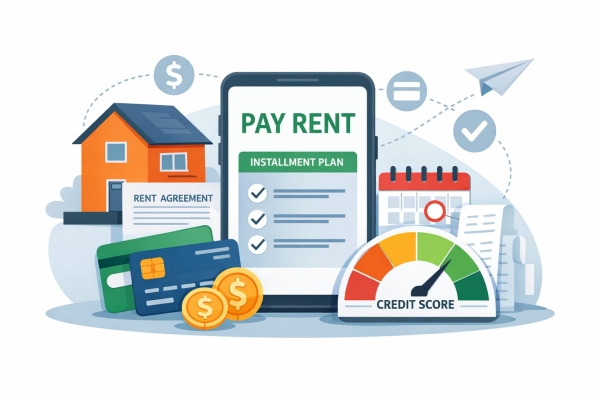
AI generated image: Rent Now Pay Later (RNPL)
On Mar 14 2026, CNN rent BNPL trend coverage in the US highlighted a new area of growth for consumer fintech, Rent Now Pay Later. BNPL providers and payment platforms are starting to move into rent payments, the largest recurring expense for many households.
Canada is already heading down this path. Fintech firms have spent several years pulling rent into the credit system through reporting and credit building services. KOHO rent credit programs allow renters to build credit history through rent payments, while rent credit history tools from Borrowell allow renters to add up to two years of past rent payments to their credit profile.
Now the model goes further.
Instead of only reporting rent payments, fintech platforms are beginning to split, finance, or route rent payments through credit rails. Rent is starting to look less like a fixed housing cost and more like a financial transaction that can generate data, fees, rewards, and short term credit exposure.
The underlying driver is housing affordability. rent burden data from Statistics Canada shows 33.0% of Canadian renter households spent 30% or more of income on shelter costs in 2022, a commonly used affordability threshold. Among private market renters who don't receive rent subsidies, the share rises slightly to 34.0%.
When roughly one third of renters already operate near an affordability limit, even small timing mismatches between income and rent payments can create pressure. Many workers receive pay every two weeks while rent is due monthly. Payment flexibility tools are now working to bridge that gap.
Several Canadian fintech firms are building products around rent payments. Zenbase offers split rent payments while reporting payment history to credit bureaus. Toronto fintech Chexy allows renters to pay rent by card, turning rent into a transaction that can generate rewards and short term credit float.
Borrowell focuses on rent reporting, allowing rent payment history to appear in an Equifax credit file. Products from KOHO, Borrowell, Zenbase, and Chexy differ in structure but share the same direction. They're moving rent deeper into payments infrastructure and credit data systems.
It's an important problem to focus on because rent is one of the largest financial flows in household budgets. Once fintech platforms innovate the payment stream, the implications extend into credit scoring, underwriting, rewards programs, and consumer debt exposure.
The benefits are straightforward. Rent reporting can help renters build credit files that traditional lending products often overlook. Payment flexibility can help align rent payments with pay cycles.
The risk emerges when flexibility substitutes for affordability. The reality is splitting rent into installments doesn't reduce the underlying cost of housing. It only spreads the obligation across time. Service fees, credit card interest, and repeated installment use can gradually turn a convenience feature into ongoing credit reliance.
This fact will likely determine how the category evolves. Products designed for occasional payment timing behave very differently from models that depend on frequent borrowing by financially stressed households.
Canadian regulators already monitor buy now pay later products as a consumer finance issue. The BNPL pilot study from the Financial Consumer Agency of Canada surveyed 1,034 Canadians to better understand how these services are used and whether consumers fully understand repayment terms and penalties.
Rent installment services raise similar questions. When the largest household bill starts moving onto credit rails, repayment discipline, fee transparency, and repeat usage patterns become key areas of concern and focus for both fintech providers and regulators.
Products that help renters manage payment timing or build credit history can deliver real value. But if rent flexibility becomes another channel for consumer borrowing, the category will face the same scrutiny that now surrounds buy now pay later services.
The National Crowdfunding & Fintech Association (NCFA Canada) is a financial innovation ecosystem that provides education, market intelligence, industry stewardship, networking and funding opportunities and services to thousands of community members and works closely with industry, government, partners and affiliates to create a vibrant and innovative fintech and funding industry in Canada. Decentralized and distributed, NCFA is engaged with global stakeholders and helps incubate projects and investment in fintech, alternative finance, crowdfunding, peer-to-peer finance, payments, digital assets and tokens, artificial intelligence, blockchain, cryptocurrency, regtech, and insurtech sectors. Join Canada's Fintech & Funding Community today FREE! Or become a contributing member and get perks. For more information, please visit: www.ncfacanada.org
| | |
|---|---|---|
| | |
Mar 10, 2026 | NCFA Market Activity | Alternative Finance And Consumer Lending

On March 10 2026, Canadaian non bank, non prime consumer lender goeasy Ltd. released a financial and operational update ahead of its fourth quarter earnings report and said it expects about $178M in incremental charge offs tied mainly to its LendCare business. The company said total net charge offs for the quarter rise to about $331M and its allowance for credit losses increases by about $86M. goeasy share price tanked over 40% on the news.
The disclosure was significant enough that CIRO imposed a temporary trading halt pending the news release.
goeasy said its full year 2025 net charge off rate is about 12.9% and now expects that figure to rise into the mid teens in 2026 before improving in 2027. The company also warned the deterioration could create pressure under certain financing covenants and said it has entered into an accommodation agreement with lenders while negotiating amendments to its credit facilities.
goeasy withdrew its previously issued fourth quarter 2025 outlook and its three year forecast while management reassesses portfolio performance and the impact on the business. The company also said it will suspend its dividend and halt share buybacks under its normal course issuer bid in order to preserve capital while it works through higher losses and funding discussions.
Although this is a specific company event, the implications are beyond one issuer. goeasy is one of the most visible publicly listed companies in Canada’s alternative lending market, and developments at a large lender often influence how investors, warehouse lenders, and institutional funding partners view risk across the wider non bank consumer credit sector.
When a lender withdraws forecasts, increases loss reserves, and begins negotiating covenant relief, the market typically responds swiftly. Funding partners may tighten terms, demand more protection, or become more selective about similar credit exposures. It doesn't mean every lender faces the same situation, but it makes investors and new capital cautious.
For Canadian fintech lenders and point of sale financing platforms, it means a tighter credit cycle that will impact underwriting discipline, funding flexibility, and covenant headroom as much as origination growth. Companies that rely on institutional funding or structured facilities need clear visibility into portfolio performance and the ability to react quickly if delinquencies or losses begin to rise.
This update does not change financial infrastructure or market rules on its own, but it does highlight how quickly stress in non prime consumer lending can influence investor sentiment and capital availability across the sector.
The National Crowdfunding & Fintech Association (NCFA Canada) is a financial innovation ecosystem that provides education, market intelligence, industry stewardship, networking and funding opportunities and services to thousands of community members and works closely with industry, government, partners and affiliates to create a vibrant and innovative fintech and funding industry in Canada. Decentralized and distributed, NCFA is engaged with global stakeholders and helps incubate projects and investment in fintech, alternative finance, crowdfunding, peer-to-peer finance, payments, digital assets and tokens, artificial intelligence, blockchain, cryptocurrency, regtech, and insurtech sectors. Join Canada's Fintech & Funding Community today FREE! Or become a contributing member and get perks. For more information, please visit: www.ncfacanada.org
| | |
|---|---|---|
| | |
Mar 9, 2026 | NCFA Fintech Market Activity | Lending And Consumer Finance

Image: Freepik/senivpetro
On Mar 9 2026, autologiQ acquired FIX4’s dealer network and repair financing originations, effective immediately.
Imagine that a customer is hit with a high cost repair, the dealer or service centre needs payment to start or finish the work, and financing becomes the bridge. autologiQ’s EasyPay product positions itself as a repair, maintenance, and upgrades financing option with two loan types, asset based loans and credit based loans.
autologiQ is an Oakville based automotive services and financing platform. Its LinkedIn page lists a 2017 founding year and core focus areas that include digital platforms, repair financing, and automotive services. See autologiQ company profile.
FIX4 operates in a similar market with a dedicated repair loan product and an authorized service centre network. On its website, it says FIX4's car repair loan platform can approve claims within minutes and markets to targets customers who cannot cover emergency repair bills. FIX4 repair loan offer includes product terms such as up to $10,000 over 36 months.
Jeffrey Newhouse, CEO autologiQ:
“This acquisition aligns with autologiQ’s strategy to expand our advisory services and offer repair finance and insurance solutions to Canadian automotive dealerships, building on our strong foundation in the automotive aftermarket.”
The practical impact of this deal is distribution plus origination flow. Dealers that previously used FIX4 now route repair financing through autologiQ’s EasyPay while keeping immediate payment on repair invoices in the dealer workflow.
This is also a consumer credit channel that can grow quietly. Repair finance is somewhere between a credit card and a personal loan, but it's delivered at the point of need, when the customer has limited time and limited alternatives. Platforms that control dealer distribution and approval flow can compound volume faster than platforms that only compete on rate.
As more dealerships embed repair financing at checkout, does the advantage move to the platform that controls dealer distribution and approvals rather than the platform that only funds the loan?
The National Crowdfunding & Fintech Association (NCFA Canada) is a financial innovation ecosystem that provides education, market intelligence, industry stewardship, networking and funding opportunities and services to thousands of community members and works closely with industry, government, partners and affiliates to create a vibrant and innovative fintech and funding industry in Canada. Decentralized and distributed, NCFA is engaged with global stakeholders and helps incubate projects and investment in fintech, alternative finance, crowdfunding, peer-to-peer finance, payments, digital assets and tokens, artificial intelligence, blockchain, cryptocurrency, regtech, and insurtech sectors. Join Canada's Fintech & Funding Community today FREE! Or become a contributing member and get perks. For more information, please visit: www.ncfacanada.org
| | |
|---|---|---|
| | |
Mar 10, 2026 | NCFA Fintech Market Activity | Wealthtech And Consumer Finance

On March 4 2026, Robinhood unveiled new family finance products at its Take Flight event, adding a family investing experience, custodial and trust accounts, expanded managed investing tools, a new Platinum Card, and new Gold perks.
Vlad Tenev, CEO said:
“Robinhood will be the financial superapp for families to invest, plan, and grow wealth across generations.”
The platform continues to push further beyond retail trading and into family account oversight, wealth transfer, premium credit, and long term asset management. The new family hub is built to let households group accounts by family member, choose which accounts are visible, and assign permissions from view only access to full authority. Custodial accounts are rolling out now, while trust accounts and the family hub begin rolling out later this year.
This launch builds on an earlier NCFA analysis of Robinhood's wealthtech push and lifestyle finance strategy, but the new announcement goes further by tying family visibility, investing, credit, and wealth transfer into one customer experience.
The scale behind the launch is material. The platform reports 27.2 million funded customers, $324 billion in total platform assets, and $4.5 billion in 2025 revenue. That revenue rose 52% from 2024. Managed investing is also getting bigger. The firm says Robinhood Strategies now serves more than $1.5 billion in assets under management across more than 250,000 funded customers.
On the money side, it says there are more than 700,000 Gold Card customers with over $10 billion in annualized spend, while Robinhood Banking has more than 50,000 funded customers and over $800 million in cash deposits to date.
The premium card launch shows where the model is heading. The new invite only card carries a $695 annual fee and comes with richer travel, dining, and wellness benefits. That pricing puts the platform into a higher value segment as it tries to deepen relationships with customers whose financial lives are getting more complex.
When a platform bundles enough strategic product that can handle family account access, children’s investing, trust structures, managed portfolios, cash, and premium spending, it's getting closer to owning the main financial relationship in the household. That should raise eyebrows for banks, wealth platforms, and fintechs that still treat investing, credit, and family finance as separate product lines.
The National Crowdfunding & Fintech Association (NCFA Canada) is a financial innovation ecosystem that provides education, market intelligence, industry stewardship, networking and funding opportunities and services to thousands of community members and works closely with industry, government, partners and affiliates to create a vibrant and innovative fintech and funding industry in Canada. Decentralized and distributed, NCFA is engaged with global stakeholders and helps incubate projects and investment in fintech, alternative finance, crowdfunding, peer-to-peer finance, payments, digital assets and tokens, artificial intelligence, blockchain, cryptocurrency, regtech, and insurtech sectors. Join Canada's Fintech & Funding Community today FREE! Or become a contributing member and get perks. For more information, please visit: www.ncfacanada.org
| | |
|---|---|---|
| | |
Mar 8, 2026 | NCFA Fintech Market Activity | Digital Banking And Data Governance

On Mar 7 2026, The Guardian posted that UK challenger bank Monzo is dealing with backlash from Monzo’s Year in review spending recap, a trust issue created by automated personalization. A customer escalated a complaint to the UK Financial Ombudsman Service after the AI recap used mocking language about food spending. The simple truth is banks can use AI to summarize spending, but it should avoid a tone that feels like judgement.
Two examples of the AI lines personalization that didn't sit well with customers after letting AI analyze their spending habits:
“Mainly, you fast fooded.”
“You like your banquets beige and boxed up.”
The customer described the wording as humiliating. The story also makes clear why tone can hurt even when the data is accurate. Spend patterns can reflect disability, illness, caregiving, job loss, stress, or crisis routines. A system that only sees categories and merchants can't understand the exact context. When it adds snark, it fills that context with judgement.
Monzo’s response was mixed. They didn't accept the complaint, but they still admitted the tone was wrong for that customer and apologized, and offered £20 as a goodwill payment. That mix reduces immediate heat, but it does not fix the underlying product risk.
“I recognise that in your case, the automated and standardised language we used was inappropriate and caused genuine upset.”
The primary lesson here is that personal spending data is too sensitive for automated copy that sounds like judgement.
Opt out doesn't fix a bad default. Banks and fintechs need controls that block mockery, shame, and moral scoring in any automated spending narrative. Teams also need to test outputs against vulnerable scenarios and worst case interpretations, not just average reactions.
Complaint handling needs a fast way to learn from these mistakes and force product improvements. A goodwill payment helps one customer, but it does not change the system. Banks and fintechs need escalation that can remove harmful language templates quickly, suppress outputs for affected customers, and pause the feature when tone crosses the line.
Automated spending recaps will continue to grow because customers want clarity and progress tracking. Banks and fintechs should keep recaps factual, let customers choose tone, and treat trust as a product requirement. When a bank speaks about a customer’s money, it needs to speak with care.
When a bank turns transaction history into a narrative, what standard should govern tone, testing for vulnerable scenarios, and escalation when a customer reports harm?
The National Crowdfunding & Fintech Association (NCFA Canada) is a financial innovation ecosystem that provides education, market intelligence, industry stewardship, networking and funding opportunities and services to thousands of community members and works closely with industry, government, partners and affiliates to create a vibrant and innovative fintech and funding industry in Canada. Decentralized and distributed, NCFA is engaged with global stakeholders and helps incubate projects and investment in fintech, alternative finance, crowdfunding, peer-to-peer finance, payments, digital assets and tokens, artificial intelligence, blockchain, cryptocurrency, regtech, and insurtech sectors. Join Canada's Fintech & Funding Community today FREE! Or become a contributing member and get perks. For more information, please visit: www.ncfacanada.org
| | |
|---|---|---|
| | |
Mar 6, 2026 | NCFA Fintech Market Activity | Consumer Credit And Identity And Data Governance

Image: Freepik/fabrikasimf
Per an Investment Executive article, on February 22, 2026, a proposed class action application was filed in Quebec alleging that repeated access to a consumer credit file data occurred without authorization through a third party platform account that the applicant says he never opened or approved.
The application says an unauthorized party created an account on Borrowell and used it to access the applicant’s Equifax credit file. It alleges the matching and authentication process accepted partial, inaccurate, or outdated personal information without enhanced identity verification and without effective controls to detect inconsistencies.
The filing describes a series of inquiries and access events through Borrowell at almost weekly frequency over roughly four months. It alleges the access did not affect the applicant’s credit score, but harmful with unauthorized disclosure of highly sensitive personal and financial information.
The application also alleges that Equifax uses a similar access model with multiple third party partner platforms in Canada, and it names examples including KOHO Financial Inc., Credit Karma Canada, Mogo Inc., and Chexy, among others.
This is a market structure issue inside consumer credit. Credit file access is part of many modern onboarding and underwriting flows across lending, banking, payments, and personal finance apps. If a court accepts the argument that matching and authentication rules allowed unauthorized access through partner channels, it will raise scrutiny for how bureaus and partner platforms handle identity verification, monitoring, and anomaly detection for credit file requests.
Both the credit bureau and third party partners need tighter identity checks, clearer consent proof, and better alerts for repeat access. Canadian regulators already expect financial institutions to manage these risks. For example, OSFI’s Third Party Risk Management Guideline B-10 requires federally regulated institutions to remain accountable for services delivered through partners and to maintain strong due diligence, monitoring, and control frameworks across the full lifecycle of third party relationships.
If partner platforms can trigger credit file access using partial or outdated identifiers, what standard should govern consent checks, anomaly detection, and step up verification for repeat inquiries?
The National Crowdfunding & Fintech Association (NCFA Canada) is a financial innovation ecosystem that provides education, market intelligence, industry stewardship, networking and funding opportunities and services to thousands of community members and works closely with industry, government, partners and affiliates to create a vibrant and innovative fintech and funding industry in Canada. Decentralized and distributed, NCFA is engaged with global stakeholders and helps incubate projects and investment in fintech, alternative finance, crowdfunding, peer-to-peer finance, payments, digital assets and tokens, artificial intelligence, blockchain, cryptocurrency, regtech, and insurtech sectors. Join Canada's Fintech & Funding Community today FREE! Or become a contributing member and get perks. For more information, please visit: www.ncfacanada.org
| | |
|---|---|---|
| | |


August 26th, 2025

January 4th, 2024

June 1st, 2021

September 9th, 2020

July 9th, 2018

January 3rd, 2018

September 25th, 2017

June 20th, 2017

May 10th, 2017

December 14th, 2016