




Karsten Wenzlaff, Advisor
August 26th, 2025
Karsten Wenzlaff is a Crowdfunding and Fintech Expert from Germany. He is Secretary-General of Digit[...]


Stablecoins | May 31, 2024

Image: Solana
With the integration of PayPal's PYUSD stablecoin onto the Solana blockchain comes 'confidential transfers'—a function that preserves regulatory visibility while keeping transaction amounts private—have been added to its global payment offerings. This innovation ensures that financial authorities can still monitor transactions for compliance purposes while maintaining customer privacy by enabling merchants to hide transaction details from them.
Solana blockchain was chosen because of its sophisticated programmability and fast transaction capabilities, which means digital payments cost less time time and money, a competitive advantage over conventional payments and even other blockchain networks. Its token extension standard makes development easier and provides enterprise-ready solutions for secure transactions. These transfers achieve a balance between transparency and privacy, which is essential for stopping illegal activity and safeguarding user data. Several use cases are made possible by PYUSD on Solana, including as almost instantaneous cross-border payments, economical business transfers, international payouts, microtransactions, and Web3 payments.
PayPal's decision fits into a broader pattern wherein central banks and private businesses are investigating technology that improves privacy in digital transactions. Similar functionalities are being added by other stablecoin issuers like Tether and Circle while still complying to stringent legal requirements. The Federal Reserve and the Bank of England are two examples of central banks creating frameworks for Central Bank Digital Currencies (CBDCs) that guarantee private, safe transactions under regulatory supervision.
Stablecoin issuers face serious dangers associated with data breaches and central bank surveillance, even as they improve transaction privacy. These organizations seek to safeguard user data and maintain compliance by putting advanced security processes and regulatory frameworks into place. The creation of capabilities for confidential transfers on platforms such as Solana is an important step in striking a balance between privacy and legal needs.
The integration of PYUSD by PayPal on Solana is an example of how digital currencies can improve efficiency and privacy. Digital transactions should become more secure and user-friendly in the future as long as central banks and private businesses keep innovating.
 The National Crowdfunding & Fintech Association (NCFA Canada) is a financial innovation ecosystem that provides education, market intelligence, industry stewardship, networking and funding opportunities and services to thousands of community members and works closely with industry, government, partners and affiliates to create a vibrant and innovative fintech and funding industry in Canada. Decentralized and distributed, NCFA is engaged with global stakeholders and helps incubate projects and investment in fintech, alternative finance, crowdfunding, peer-to-peer finance, payments, digital assets and tokens, artificial intelligence, blockchain, cryptocurrency, regtech, and insurtech sectors. Join Canada's Fintech & Funding Community today FREE! Or become a contributing member and get perks. For more information, please visit: www.ncfacanada.org
 |  |  |
|---|---|---|
 |  |  |
VoPay | Release | May 29, 2024

Image: Freepik
Canadian fintech, VoPay, just announced the release of its Transaction Banking (TXB) solution, which aims at assisting banks and credit unions to implement API-first transaction banking and cash management systems. The TXB solution offers an API-first architecture, which makes it seamless to integrate with existing systems. With this approach, banks and credit unions can take advantage of automated transaction workflows, which will result in enhanced operational efficiency.
Hamed Abbasi, Co-Founder and CEO of VoPay:
"We are thrilled to unveil TXB, the latest evolution of the VoPay platform. This launch is a direct response to the evolving needs of businesses as we continually strive to anticipate and address the next frontier in business solutions, empowering organizations to scale and operate with greater efficiency. I am immensely proud of the innovative spirit exhibited by our team and the unparalleled uniqueness of this product. With unwavering support from our partners and customers, TXB is poised to elevate VoPay to new heights on a global scale."
VoPay’s TXB technology transforms transaction banking for financial institutions that use API-first structures to improve security, efficiency, and operational performance while enabling banks and credit unions meet growth goals and offer better services to their customers. TBX will become available July 1 to existing customers. Not a customer? Speak with a specialist here.
The National Crowdfunding & Fintech Association (NCFA Canada) is a financial innovation ecosystem that provides education, market intelligence, industry stewardship, networking and funding opportunities and services to thousands of community members and works closely with industry, government, partners and affiliates to create a vibrant and innovative fintech and funding industry in Canada. Decentralized and distributed, NCFA is engaged with global stakeholders and helps incubate projects and investment in fintech, alternative finance, crowdfunding, peer-to-peer finance, payments, digital assets and tokens, artificial intelligence, blockchain, cryptocurrency, regtech, and insurtech sectors. Join Canada's Fintech & Funding Community today FREE! Or become a contributing member and get perks. For more information, please visit: www.ncfacanada.org
| | |
|---|---|---|
| | |
Capital Markets | Release | May 29, 2024

Image: Freepik/rawpixel,com
A leading Canadian fintech company, Katipult Technology Corp. (TSXV: FUND.V), has announced a strategic integration with a leading investment dealer. The deal will combine Katipult's latest technology with the investment dealer's wide market reach and expertise. The partnership will result in the ability to offer greater operational efficiency in the capital raising procedure and more streamlined compliance management across a wider client base.
By integrating with a leading investment dealer, Katipult is now well positioned to offer clients industry-leading levels of service and efficient operations across both debt and equity market transactions. The deal will boost Katipult's market standing and its cutting-edge DealFlow platform.
Gord Breese, CEO of Katipult:
"This collaboration is a testament to the robust capabilities of our DealFlow platform and our commitment to driving innovation in the fintech space. We are excited about the opportunities this partnership presents for our clients and the broader capital markets."
Moving forward, Katipult is now well positioned for further growth and innovation. This partnership should increase its market reach, bring further improvements to its product offerings, and help further streamline the capital raising process.
The National Crowdfunding & Fintech Association (NCFA Canada) is a financial innovation ecosystem that provides education, market intelligence, industry stewardship, networking and funding opportunities and services to thousands of community members and works closely with industry, government, partners and affiliates to create a vibrant and innovative fintech and funding industry in Canada. Decentralized and distributed, NCFA is engaged with global stakeholders and helps incubate projects and investment in fintech, alternative finance, crowdfunding, peer-to-peer finance, payments, digital assets and tokens, artificial intelligence, blockchain, cryptocurrency, regtech, and insurtech sectors. Join Canada's Fintech & Funding Community today FREE! Or become a contributing member and get perks. For more information, please visit: www.ncfacanada.org
| | |
|---|---|---|
| | |
Payments | Release | May 24, 2024

Image: Lightspeed partners with Uber Eats Marketplace and Uber Direct, CNW Group/Lightspeed Commerce Inc
Lightspeed's new North American partnership with Uber Direct and Uber Eats is expected to streamline delivery services and operational capabilities for merchants like hotels, restaurants, and retail, while expanding their market reach by accessing millions of new potential customers.
This collaboration enables merchants to focus on their core operations and growth while offering customers efficient and cost-effective delivery options. Ultimately, this partnership fosters innovation and growth in the fintech space, setting a new standard for delivery services and operational capabilities for merchants.
The National Crowdfunding & Fintech Association (NCFA Canada) is a financial innovation ecosystem that provides education, market intelligence, industry stewardship, networking and funding opportunities and services to thousands of community members and works closely with industry, government, partners and affiliates to create a vibrant and innovative fintech and funding industry in Canada. Decentralized and distributed, NCFA is engaged with global stakeholders and helps incubate projects and investment in fintech, alternative finance, crowdfunding, peer-to-peer finance, payments, digital assets and tokens, artificial intelligence, blockchain, cryptocurrency, regtech, and insurtech sectors. Join Canada's Fintech & Funding Community today FREE! Or become a contributing member and get perks. For more information, please visit: www.ncfacanada.org
| | |
|---|---|---|
| | |
Corporate Venture Capital | May 17, 2024

Image: The State of Corporate Venture Capital in Canada 2024, Deloitte and BDC
Published this week, "The State of Corporate Venture Capital in Canada," produced by Deloitte Ventures in collaboration with BDC Capital, highlights the potential for growth and innovation that CVC can bring to Canadian corporates, startups, and the broader economy. However, it also underscores significant challenges and areas where Canada lags behind its international counterparts, particularly the United States. Read the release
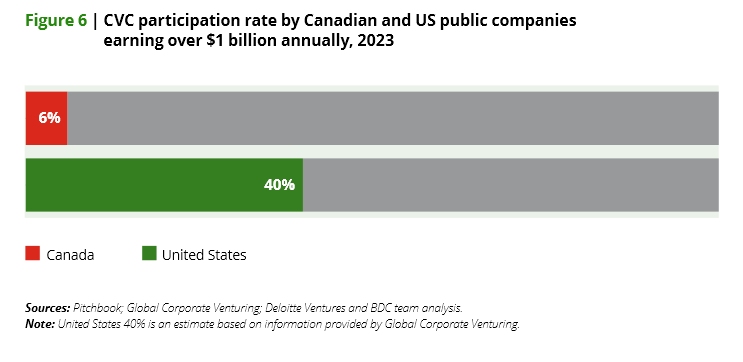
Image: Figure 6 from The State of CVC in Canada 2024 (Deloitte/BDC)
The report is a thorough examination of the current landscape and potential future of CVC in Canada. However, there are some notable exclusions that would have been interesting to discuss:
Richard Remillard, President of RCG Group and Board Director NCFA Canada says it well:
" This Deloittte paper prepared in conjunction with BDC points to some revealing information about the state of corporate venture capital(CVC) in both the US and Canada. Unsurprisingly, Canada trails significantly behind the US on this front. The paper notes that a mere 6% of publicly-traded Canadian corporations have CVC's versus 19% of those in the US. This gap has long been noted and decried by venture capital industry participants, including BDC. Where the paper is lacking is in identifying the source(s) of this weakness in the Canadian risk capital ecosystem. It could be a function of Canada simply not having a substantial number of publicly-traded firms compared to the US - and, many of the latter having received venture capital funding previously. Another factor might be the greater corporate concentration in Canada than in the US that is visible in many industries from banking to telecom, airlines, retail grocery and rail transportation. Or, it could be the business culture in Canada, long considered more risk averse than it is south of the 49th parallel. As well, and importantly, it could simply be the result of the relative lack of transparency about the return on investment(ROI) of the CVC segment of the venture capital asset class to say nothing of the relative illiquidity of venture investments. ROI is missing in action in the Deloitte paper which does spend some time and effort in discussing the overall benefits of investing in tech in Canada - a curious omission. Finally, the paper would have been strengthened if some of the 94% of corporations in Canada had been canvassed about their decision(s) to avoid the CVC route or to get out of the asset class, as some have done in years gone by, in light of the internal management challenges pertaining to remuneration of CVC managers relative to managers in the parent firm."
Corporate Venture Capital holds promise for Canada. This requires addressing the barriers to entry, providing clear financial performance metrics, and fostering a culture that values long-term strategic investments. By doing so, Canada can unlock the potential of its startups, drive economic growth, and become more competitive on the global stage.
The National Crowdfunding & Fintech Association (NCFA Canada) is a financial innovation ecosystem that provides education, market intelligence, industry stewardship, networking and funding opportunities and services to thousands of community members and works closely with industry, government, partners and affiliates to create a vibrant and innovative fintech and funding industry in Canada. Decentralized and distributed, NCFA is engaged with global stakeholders and helps incubate projects and investment in fintech, alternative finance, crowdfunding, peer-to-peer finance, payments, digital assets and tokens, artificial intelligence, blockchain, cryptocurrency, regtech, and insurtech sectors. Join Canada's Fintech & Funding Community today FREE! Or become a contributing member and get perks. For more information, please visit: www.ncfacanada.org
| | |
|---|---|---|
| | |
DeFi | May 15, 2024

Image: Freepik
Valour Inc., a subsidiary of DeFi Technologies, is partnering with the Core Foundation to launch the world's first yield-bearing Bitcoin (BTC) Exchange Traded Products (ETPs). This innovative financial product aims to provide investors with returns directly from blockchain operations, specifically through Core Chain's block rewards, without the need to move Bitcoin off its network.
The key players involved in this initiative include:
This development is significant because it represents a novel integration of traditional financial mechanisms (like yield from investments) with the emerging technologies of blockchain and cryptocurrencies. By offering a yield-bearing ETP, Valour Inc. not only enhances the utility of Bitcoin as more than just a speculative asset but also promotes its use in more diverse financial portfolios.
As these ETPs blend the boundaries between decentralized finance and conventional financial systems, they might influence future regulatory frameworks and market structures.
The National Crowdfunding & Fintech Association (NCFA Canada) is a financial innovation ecosystem that provides education, market intelligence, industry stewardship, networking and funding opportunities and services to thousands of community members and works closely with industry, government, partners and affiliates to create a vibrant and innovative fintech and funding industry in Canada. Decentralized and distributed, NCFA is engaged with global stakeholders and helps incubate projects and investment in fintech, alternative finance, crowdfunding, peer-to-peer finance, payments, digital assets and tokens, artificial intelligence, blockchain, cryptocurrency, regtech, and insurtech sectors. Join Canada's Fintech & Funding Community today FREE! Or become a contributing member and get perks. For more information, please visit: www.ncfacanada.org
| | |
|---|---|---|
| | |
Capital Raising | May 13, 2024

Image: Freepik/jcomp
The Ontario Securities Commission (OSC) has published three new interim class orders to foster capital formation, offering targeted relief and clear directives to specific groups within Ontario’s financial ecosystem. Effective May 9, 2024, these orders address not-for-profit angel investor groups, early-stage businesses, and streamline reporting processes under the self-certified investor prospectus exemption. Here, we break down the essential features and limitations of each order, clarifying their purpose, target audience, and anticipated impact on the markets.
Grant Vingoe, Chief Executive Officer of the OSC:
“New and growing businesses play an essential role in our economy, contributing to job creation and driving productivity gains through innovation and competition. These initiatives reflect the OSC’s commitment to fostering the conditions for growth and innovation in Ontario’s capital markets without compromising investor protection, as outlined in our recently released strategic plan.”
Leslie Byberg, Executive Vice President, Strategic Regulation:
“The OSC TestLab initiatives will provide important insights as we work to support access to finance at all stages of business growth. The data and information collected will help inform future policymaking, including promoting access to capital for early-stage businesses in Ontario while also ensuring investor protections.”
These interim class orders from the OSC are designed to reduce regulatory impediments and support innovative financing structures. Each order is crafted with specific features and limitations to ensure the balance between capital formation and investor protection. As these initiatives unfold, they are anticipated to help improve Ontario’s economic landscape by enabling more capital-raising pathways for early-stage businesses.
The National Crowdfunding & Fintech Association (NCFA Canada) is a financial innovation ecosystem that provides education, market intelligence, industry stewardship, networking and funding opportunities and services to thousands of community members and works closely with industry, government, partners and affiliates to create a vibrant and innovative fintech and funding industry in Canada. Decentralized and distributed, NCFA is engaged with global stakeholders and helps incubate projects and investment in fintech, alternative finance, crowdfunding, peer-to-peer finance, payments, digital assets and tokens, artificial intelligence, blockchain, cryptocurrency, regtech, and insurtech sectors. Join Canada's Fintech & Funding Community today FREE! Or become a contributing member and get perks. For more information, please visit: www.ncfacanada.org
| | |
|---|---|---|
| | |


August 26th, 2025

January 4th, 2024

June 1st, 2021

September 9th, 2020

July 9th, 2018

January 3rd, 2018

September 25th, 2017

June 20th, 2017

May 10th, 2017

December 14th, 2016