




Karsten Wenzlaff, Advisor
August 26th, 2025
Karsten Wenzlaff is a Crowdfunding and Fintech Expert from Germany. He is Secretary-General of Digit[...]


AI Innovation | June 16, 2025

Image: Freepik AI
The UK's Financial Conduct Authority (FCA)'s Chief Data Information and Intelligence Officer, Jessica Rusu announced in a speech delivered during London Tech Week 2025 that the FCA is expanding its Digital Sandbox with new AI capabilities via a collaboration with Nvidia.
The supercharged sandbox offers startups, financial institutions, researchers, and technology developers access to GPU computing, advanced AI tools, and enriched datasets to test and train models safely in a secure environment (not live in market), and is part of the FCA's commitment to support responsible AI innovation in regulated markets. It includes both regulated firms and unregulated developers working in financial services.
The upgraded sandbox gives participants access to Nvidia’s full stack AI platform, including GPU infrastructure and NVIDIA AI Enterprise. Users can test proofs of concept using synthetic datasets, train models, and access technical support and educational resources from Nvidia’s developer network.
The sandbox is now open for applications. Selected firms will begin developing and testing proofs of concept in October 2025. The enhanced sandbox program includes the AI Sandbox launched earlier this year, the FCA’s internal AI Lab, and an ongoing consultation on live AI testing environments.
The FCA is setting an international example of how to help firms explore AI safely while also supporting smarter oversight and policy design by the regulator. The collaboration with Nvidia creates a space where both innovation and consumer protection can be tested together.
The FCA's model will offer key lessons into lowering barriers for AI experimentation, providing access to data and compute resources, and encouraging collaboration between novel startups and regulators.
 The National Crowdfunding & Fintech Association (NCFA Canada) is a financial innovation ecosystem that provides education, market intelligence, industry stewardship, networking and funding opportunities and services to thousands of community members and works closely with industry, government, partners and affiliates to create a vibrant and innovative fintech and funding industry in Canada. Decentralized and distributed, NCFA is engaged with global stakeholders and helps incubate projects and investment in fintech, alternative finance, crowdfunding, peer-to-peer finance, payments, digital assets and tokens, artificial intelligence, blockchain, cryptocurrency, regtech, and insurtech sectors. Join Canada's Fintech & Funding Community today FREE! Or become a contributing member and get perks. For more information, please visit: www.ncfacanada.org
 |  |  |
|---|---|---|
 |  |  |
Tokenization | June 18 2025

As covered by Retuers, Coinbase is officially asking the U.S. Securities and Exchange Commission (SEC) to approve tokenized equities (or stocks), a new class of financial product. These would be blockchain representations of traditional equities, such as Apple or Tesla, designed to trade 24/7 with almost instant settlement and lower overhead. Coinbase is seeking a no-action letter or regulatory exemption from the SEC, and if they grant it, Coinbase would be the first major U.S. exchange operating with such tokenized products, evolving well beyond just a standard crypto trading exchange.
The tokenized equity model would allow retail and institutional users to access fractional ownership of blue-chip stocks via a blockchain interface and operate largely without the constraints of traditional brokerage platforms. For example transactions could take place globally, 24 hours a day, without relying on legacy clearing infrastructure. It could mean significant improvements in market efficiency, reduce settlement risk and include new financial products natively on-chain.
While Coinbase looks to break new ground in American markets, other jurisdictions are already operating. Rival exchange Kraken has launched tokenized stock trading for non-U.S. customers through its partnership with Swiss-based Backed Finance. For example, tokenized versions of Apple and Tesla stock, bAAPL and bTSLA respectively, are live pioneering examples of tokenized equities executed issued on the Solana blockchain, backed by 1:1 real shares held in custody, and tradeable with no minimum investment size and operate legally under global regulatory frameworks with blockchain flexibility, and 24/7 trading.
Europe is ahead of the curve on regulation. The EU’s MiCA framework was fully implemented as of 2024, providing legal clarity for tokenized securities across 27 member states. In Asia, Hong Kong is piloting tokenized gold, bonds, and equities under regulatory supervision. These jurisdictions are showing that comprehensive tokenization frameworks can unlock innovation while still preserving investor protection and market integrity.
Tokenized securities may require broker-dealer registration, SEC exchange approval, and compliance with the Investment Company Act. Since, Coinbase is not currently licensed as a broker-dealer, it may need a partner or entirely new structure to support these offerings legally.
There are also questions about liquidity. The World Economic Forum has identified low secondary market trading volumes and lack of standardization as persistent challenges in real-world asset tokenization.
While the tech stack can actually enforce compliance rules directly within smart contracts using standards for Real World Assets (RWA) like ERC-3643, adoption of these instruments will depend on regulators aligning globally and investors gaining trust.
If the U.S. and EU formalize tokenized security frameworks, capital will flow toward platforms offering speed, access, and interoperability, leaving slow movers behind. Companies should be exploring how to integrate tokenized equities into their product roadmaps while remaining compliant. NCFA and its members can play a leadership role in what responsible tokenized finance, launch educational initiatives, and collaborate with global infrastructure providers. At the of the day, tokenized assets are poised to become a competitive advantage or missed opportunity.
The National Crowdfunding & Fintech Association (NCFA Canada) is a financial innovation ecosystem that provides education, market intelligence, industry stewardship, networking and funding opportunities and services to thousands of community members and works closely with industry, government, partners and affiliates to create a vibrant and innovative fintech and funding industry in Canada. Decentralized and distributed, NCFA is engaged with global stakeholders and helps incubate projects and investment in fintech, alternative finance, crowdfunding, peer-to-peer finance, payments, digital assets and tokens, artificial intelligence, blockchain, cryptocurrency, regtech, and insurtech sectors. Join Canada's Fintech & Funding Community today FREE! Or become a contributing member and get perks. For more information, please visit: www.ncfacanada.org
| | |
|---|---|---|
| | |
Crypto | March 18, 2025

On June 17, 2025, a watershed moment for digital finance and crypto with the U.S. Senate passing the GENIUS Act, bipartisan 68-30 vote, establishing the country’s first federal regulatory framework for stablecoins. This legislation is the most significant digital asset policy breakthrough to date in the United States.
The GENIUS Act stands for 'Guiding and Establishing National Innovation for U.S. Stablecoins'and lays out clear rules for the issuance, required reserves, transparency, and oversight of U.S. dollar backed stablecoins. It's expected to boost financial innovation in America by providing a coherent national policy to streamline the governance patchwork created by state-to-state rules. The stablecoin market has now surpassed $260 billion in total value (up about 22% in 2025 alone), and is growing rapidly with rising institutional demand.
As reported by WSJ, Senator Cynthia Lummis (R-WY, one of the bill's key sponsors) said:
“This is the first step in establishing trust, protecting consumers, and ensuring the dollar remains the global standard for digital finance,”
The bill outlines strict guardrails for stablecoin issuers to prevent another collapse like TerraUSD while ensuring stability, liquidity, and auditability:
The GENIUS Act delivers some legal clarity to a sector long operating under ambiguous guidance from regulators.
Notably, the issuer of USDC, Circle saw its pre-IPO share price boost nearly 10% on the news, rising from $31 to over $160 as investor confidence rebounded. The company’s CEO Jeremy Allaire explained the bill as “the foundation of dollar dominance in the digital era.”
The bill is still not without some controversy as critics flagged the exclusion of President Trump from the conflict of interest restrictions - seen as politically motivated and related to the Trump family's interests and ties to private stablecoin ventures.
The bill now moves to the House of Representatives to be reconciled with the STABLE Act, and then once approved in both chambers the bill would be sent to President Trump for signing the first major federal stablecoin bill into law.
Will Canadian regulators follow with similar national standards for fiat-backed digital assets? As OSFI and FINTRAC review their guidance, Canadian fintechs operating in cross-border payments, custody, and token issuance will begin to face rising pressure to align with U.S. rules or risk falling behind in market access and credibility. The global sector is consolidating quickly and Canadian innovators must determine whether or not to build on this momentum with their own regulatory clarity.
The National Crowdfunding & Fintech Association (NCFA Canada) is a financial innovation ecosystem that provides education, market intelligence, industry stewardship, networking and funding opportunities and services to thousands of community members and works closely with industry, government, partners and affiliates to create a vibrant and innovative fintech and funding industry in Canada. Decentralized and distributed, NCFA is engaged with global stakeholders and helps incubate projects and investment in fintech, alternative finance, crowdfunding, peer-to-peer finance, payments, digital assets and tokens, artificial intelligence, blockchain, cryptocurrency, regtech, and insurtech sectors. Join Canada's Fintech & Funding Community today FREE! Or become a contributing member and get perks. For more information, please visit: www.ncfacanada.org
| | |
|---|---|---|
| | |
BNPL | June 17, 2025
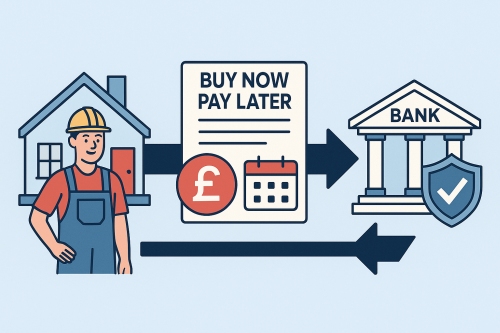
On June 16, 2025, the UK HM Treasury published a policy update that says 'domestic premises suppliers' (aka door to door vendors or companies that provide goods or services in a customer's home) no longer need to be licensed as credit brokers to offer Buy Now Pay Later (BNPL) services. The change to BNPL regulation is aimed at supporting smaller businesses without weakening consumer protections. This exemption includes services like home improvement consultations, kitchen installations, in-home services like cleaning or fitness, or any other sale that takes place during a visit to the customer's home.
Many industry stakeholders warned that requiring a credit broker license for these types of businesses isn't necessary and overly burdensome. The government agreed because these in-home suppliers do not offer financial services as their primary business activity. Instead, the typically introduce customers to a single BNPL lender as part of a product or service sale. Additionally, regulators realized that the risk of consumer harm in these cases is relatively low since the financial exposure sits with the BNPL lender who is regulated, not the seller, and felt that requiring small businesses to apply and maintain broker requirements is disproportionate to their role.
While the sellers are now exempt, BNPL lenders will still be fully regulated under the new rules, and must perform creditworthiness and affordability checks and comply with FCA Consumer Duty requirements. They must also ensure that purchases made using BNPL are protected under Section 75 of the Consumer Credit Act 1974, and that customers have access to the UK’s Financial Ombudsman Service to address complaints.
The full BNPL regulatory framework in the UK is expected to come into force by mid-2026, including secondary legislation to implement the exemption for in-home sellers.
Canada doesn't currently have a dedicated national BNPL regulatory framework. It also doesn't require BNPL sellers to have a credit-brokering license. The Financial Consumer Agency of Canada (FCAC) continues to monitor the sector but doesn't directly regulate BNPL lending. Oversight is through a mix of provincial consumer protection laws and federal rules related to money laundering and data privacy.
In Ontario as an example, BNPL offerings must comply with the Consumer Protection Act, which requires clear disclosures and restricts misleading marketing. If a provider handles payments, they may also need to register as a money services business under federal law.
As BNPL continues to grow, pressure is building for regulators to provide clearer guidance. The UK’s model may offer a useful reference for policymakers looking to balance access to BNPL services while protecting Canada's evolving credit sector.
The National Crowdfunding & Fintech Association (NCFA Canada) is a financial innovation ecosystem that provides education, market intelligence, industry stewardship, networking and funding opportunities and services to thousands of community members and works closely with industry, government, partners and affiliates to create a vibrant and innovative fintech and funding industry in Canada. Decentralized and distributed, NCFA is engaged with global stakeholders and helps incubate projects and investment in fintech, alternative finance, crowdfunding, peer-to-peer finance, payments, digital assets and tokens, artificial intelligence, blockchain, cryptocurrency, regtech, and insurtech sectors. Join Canada's Fintech & Funding Community today FREE! Or become a contributing member and get perks. For more information, please visit: www.ncfacanada.org
| | |
|---|---|---|
| | |
Open Banking | June 17, 2025

Today at Toronto's Open Banking Expo, the Canadian federal government says they will introduce the long delayed open banking legislation 'at the earliest opportunity'. The Financial Consumer Agency of Canada (FCAC) responsible for implementing and regulating Open Banking in Canada confirmed that Ottawa remains committed to building the infrastructure for consumer-driven banking, despite momentum stalling after a Spring without a federal budget or any kind of legislative update.
Open banking allows Canadians to securely share their financial data with apps and services outside their traditional banks. Instead of screen scraping which is a risky process where users give third parties their login credentials for use on their behalf, open banking would give users a more control over what data is shared, with whom, and for how long.
In December 2024, Canada announced that open banking would be delayed until 2026. Now, according to the Department of Finance, the remaining parts of Canada's Open Banking Framework will be introduced as soon as possible (not a specific date or deadline). This includes the process for accrediting service providers, establishing common rules for data access, and creating a public registry.
The FCAC is preparing the groundwork by developing a public registry of accredited fintech firms and collaborating with Finance Canada to finalize operating rules, but let's be honest here. Without the final legislation, the FCAC is limited in what it can do.
While Prime Minister Mark Carney and the Liberals returned with a minority government, open banking unfortunately wasn't included in the party's platform, and given the delays following the Spring 2025 election and absence of a Spring budget, more delays were expected despite advocates remaining optimistic given the change in Canada's leadership and need to improve productivity and economic strength.
The National Crowdfunding & Fintech Association of Canada (NCFA) believes that consumer-driven finance is a key milestone for driving innovation, competition, and financial inclusion in financial services. NCFA's Executive Director/CEO, Craig Asano said:
“Consumer-driven banking is not just a policy item, it’s critical infrastructure for unlocking productivity and creating an ecosystem that works better for consumers and fintech innovators. Canada cannot afford another year of delay.”
While some fintechs and financial institutions have gone ahead and prepared for open banking the best they can ahead of final legislation, others are waiting for clarity from the Canadian government before moving forward, especially considering there have been many years of delay.
Open Banking could transform Canada's financial sector, making it easier for consumers to access improved products and services. It would also improve competition by enabling qualifying fintech firms to connect directly to consumer data in a secure and regulated way.
However, simply saying that Open Banking will be implemented 'as soon as possible' without committing to a specific date, Canada continues to fall behind other jurisdictions of its peers.
The National Crowdfunding & Fintech Association (NCFA Canada) is a financial innovation ecosystem that provides education, market intelligence, industry stewardship, networking and funding opportunities and services to thousands of community members and works closely with industry, government, partners and affiliates to create a vibrant and innovative fintech and funding industry in Canada. Decentralized and distributed, NCFA is engaged with global stakeholders and helps incubate projects and investment in fintech, alternative finance, crowdfunding, peer-to-peer finance, payments, digital assets and tokens, artificial intelligence, blockchain, cryptocurrency, regtech, and insurtech sectors. Join Canada's Fintech & Funding Community today FREE! Or become a contributing member and get perks. For more information, please visit: www.ncfacanada.org
| | |
|---|---|---|
| | |
Regulation | June 13, 2025

Image: Freepik/marymarkevich
Canadian regulators joined a coordinated global crackdown last week targeting unlawful finfluencers, or social media personalities promoting investments without registration or oversight. While enforcement activity is increasingly in focus, global experts and finfluencer advocates are warning that overly restrictive approaches will harm innovation, reduce access to financial education, and weaken digital financial literacy efforts.
As part of the Global Week of Action Against Unlawful Finfluencers, the Ontario Securities Commission (OSC) collaborated with regulators from the UK, Australia, the United Arab Emirates, Italy, and Hong Kong to investigate unlawful influencer activity.
The OSC reviewed 87 finfluencers and 9 issuers that used influencer promotions, and found some were offering unregistered investment advice or sharing misleading content, especially in the crypto sector. In-person warnings, gathering of evidence, and educational outreach were used to prevent retail investors being harmed.
Bonnie Lysyk, Executive Vice President of Enforcement at the OSC:
“International relationships are vital in countering this growing issue. The OSC’s recent research highlights the substantial influence social media personalities have on investor behaviour.”
In May 2025, the International Organization of Securities Commissions - IOSCO published its final report on finfluencers, to address online retail investor safety. Both the OSC and IOSCO's research on the impact of finfluencers were aligned, highlighting risks such as gamification and how social media and trading platforms can blur the line between general information and regulated investment advice.
IOSCO doesn't advocate for bans but rather outlines a series of good practices for regulators, platforms, market intermediaries, and finfluencers:
Jean-Paul Servais, Chair of IOSCO and FSMA Belgium:
“These reports set out globally aligned expectations for ethical conduct and effective oversight... ensuring that technology enhances trust, rather than undermining it,”
Not all creators are breaking the rules. According to the CFA Institute’s 2024 finfluencers appeal report, many finfluencers are filling educational gaps and helping demystify investing and financial planning for younger and underserved audiences. They create digestible and accessible content, often without commercial promotion or investment recommendations. Some are careful to include disclaimers and avoid offering specific advice.
A Wealth Professional Canada article cited Tangerine survey that discovered 60% of Canadians who follow finfluencers said they had benefited from their content. At the same time, those who acted on influencer tips were found to be 12 times more likely to experience scams.
Advocates argue that regulation should distinguish between financial education and commercial promotion. They are calling for clarity on how to remain compliant, not for the removal of content that informs and empowers.
“Most of us want to educate and uplift. But we need the rules to be clear and fair, not just fear-based.”
While Canada takes a proactive, data driven approach to enforcement of finfluencers while increasing public awareness for finfluencer risks, how do we shape up to our peer countries?
In Australia, the Australian Securities and Investments Commission - ASIC released guidance for social media influencers through INFO 269. ASIC warns that creators discussing financial products may be in breach of the law if they are unlicensed and don't follow compliance standards. The guidance supports financial literacy content as long as it avoids over promotion and includes proper disclosures.
In the United Kingdom, the Financial Conduct Authority (FCA) has focused on financial promotions. The FCA targets firms that pay finfluencers to promote investments without regulatory approval and has updated the financial promotions regime to apply to social media content.
Italy’s CONSOB and other European and Middle Eastern regulators also participated in the coordinated enforcement week. These jurisdictions are enhancing joint oversight of social media investment promotions, especially in the context of crypto and speculative assets.
In the United States, regulators such as the SEC and FINRA have pursued enforcement through existing anti-fraud provisions. While there is no finfluencer-specific guidance, recent actions have targeted offside celebrity crypto endorsements and undisclosed paid promotions.
Importantly, none of the major jurisdictions have called for bans, so global consensus is aligning with regulators to build frameworks that promote compliance, transparency, and public awareness instead.
Finfluencers are becoming as influential as traditional advisors, even more so for digitally native and younger investors. So oversight is warranted but the focus should be on compliance that doesn't undermine financial literacy and inclusion. Regulatory consensus shows that with clear rules, good practices, and global cooperation that clear rules and strategic oversight can protect investors while empowering open access to useful financial content online.
Want to stay ahead of regulatory shifts affecting digital finance and investor education? Subscribe to the NCFA newsletter for updates, insights, and expert analysis.
The National Crowdfunding & Fintech Association (NCFA Canada) is a financial innovation ecosystem that provides education, market intelligence, industry stewardship, networking and funding opportunities and services to thousands of community members and works closely with industry, government, partners and affiliates to create a vibrant and innovative fintech and funding industry in Canada. Decentralized and distributed, NCFA is engaged with global stakeholders and helps incubate projects and investment in fintech, alternative finance, crowdfunding, peer-to-peer finance, payments, digital assets and tokens, artificial intelligence, blockchain, cryptocurrency, regtech, and insurtech sectors. Join Canada's Fintech & Funding Community today FREE! Or become a contributing member and get perks. For more information, please visit: www.ncfacanada.org
| | |
|---|---|---|
| | |
Crypto Policy | June 11, 2025
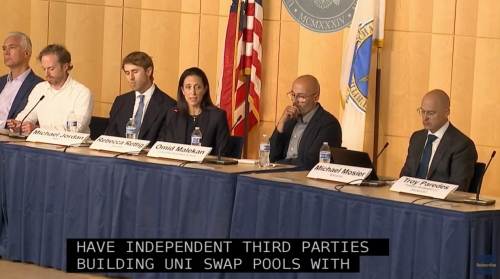
Image: June 9, 2025 DeFi Crypto Roundtable (Coindesk via youtube)
On June 9, the U.S. Securities and Exchange Commission (SEC) hosted another crypto task force roundtable series session called, "DeFi and the American Spirit", bringing together together regulators, legal experts, DeFi protocol developers, and investors to discuss how to the potential of regulating decentralized financial systems in ways that protects users without stifling innovation.
From the get-go, Chair Paul Atkins set the tone by opening the event by clearly stating that publishing code should not be treated as a crime:
“We will not regulate the act of writing open-source software. We do not prosecute the author of a hammer manual when someone misuses a hammer.”
The rest of the session built on this idea and focused on how the SEC can provide safe ways for DeFi projects to operate legally while still addressing investor risks.
In his remarks, Chair Atkins introduced the idea of a “conditional exemptive relief framework” which would allow DeFi innovators to build and launch on-chain products under limited conditions without triggering enforcement right away. This type of framework is similar to a regulatory sandbox that provides time-bound relief as long as participants meet specific safeguards.
“We are exploring a conditional exemptive relief framework that would allow experimentation under defined boundaries, similar to an innovation safe harbor.”
Commissioner Hester Peirce (aka Crypto mom) echoed this sentiment saying without a structured pathways to compliance, many innovators will either operate in legal uncertainty or offshore their projects out of the United States.
“Without a clear, conditional pathway, we are telling innovators you are on your own. That is not a message we want to send if we value the benefits of decentralized systems.”
In addition to the DeFi safe harbour, Chair Atkins also called upon his staff to modernize the current SEC rules to accommodate traditional issuers and intermediaries who want to use on-chain infrastructure.
This move shows that the SEC is looking to facilitate both new DeFi entrants and existing market players who are building tokenized products or using smart contracts to manage trading, issuance, or custody.
“I have asked the staff to consider whether amendments to the Commission’s rules and regulations would be better suited to provide needed accommodation for issuers and intermediaries who seek to administer on-chain financial systems.”
Atkins also discussed that on-chain systems can bring real benefits to the market, such as lower transaction costs, faster settlement, broader access, and the ability to create entirely new asset classes.
“I also am excited about the use of on-chain software systems by issuers and intermediaries to eliminate economic frictions, increase capital efficiency, enable new types of financial products, and enhance liquidity.”
It's clear support and endorsement of blockchain as a tool for economic growth, not just a solution for compliance challenges.
Several panelists, including Rebecca Rettig of Polygon Labs, warned that some of the most serious risks in DeFi happen off-chain. These include hidden liquidity deals, token allocations to insiders, or governance control partnerships.
“It is not always what is on-chain that creates the risk. It is often what is not disclosed, like side agreements, control over governance tokens, or preferential liquidity deals.”
Panelists argued that DeFi projects need better disclosure on how protocols are governed, how tokens are distributed, and whether any third parties receive special treatment or not.
Legal and industry experts said regulators should stop focusing on whether a token is a security and start regulating based on what the product or service actually does.
Angela Angelovska-Wilson of DLx Law said:
“We waste enormous energy litigating over whether X token is a security. The better path is regulating the activity, such as staking, custody, or lending, regardless of the label.”
Michael Jordan of the Digital Dollar Foundation agreed, saying:
“If we regulate the technology, someone will build around it. If we regulate the activity, we have a chance at real consumer protection.”
Important to understand the growing consensus that rules should distinguish between different types of financial behaviour even when the technology is similar.
Josh Garcia of Ketsal pointed out that some interfaces like custodial front ends that take custody of user funds or routes trades on behalf of users may require stricter oversight whereas protocols without admin control may require lighter regulation. Advocating for a layered regulatory approach that differentiates on function and control.
“A protocol with no privileged admin keys is not the same as a custodial front end that routes retail funds. The obligations differ, and so should the rules.”
After several Crypto Task force roundtable sessions, the SEC and participants are finally getting on the same page while focusing on conditional exemptions, regulatory modernization, and functional oversight. All together, it's a series effort to balance investor protection with lawful DeFi innovation. For fintech founders and digital asset platforms in Canada and globally, it's an important benchmark. If the U.S. begins providing clear compliance pathways and policy support for tokenized systems, then other jurisdictions will need to keep up or risk flight of builders and capital.
The National Crowdfunding & Fintech Association (NCFA Canada) is a financial innovation ecosystem that provides education, market intelligence, industry stewardship, networking and funding opportunities and services to thousands of community members and works closely with industry, government, partners and affiliates to create a vibrant and innovative fintech and funding industry in Canada. Decentralized and distributed, NCFA is engaged with global stakeholders and helps incubate projects and investment in fintech, alternative finance, crowdfunding, peer-to-peer finance, payments, digital assets and tokens, artificial intelligence, blockchain, cryptocurrency, regtech, and insurtech sectors. Join Canada's Fintech & Funding Community today FREE! Or become a contributing member and get perks. For more information, please visit: www.ncfacanada.org
| | |
|---|---|---|
| | |


August 26th, 2025

January 4th, 2024

June 1st, 2021

September 9th, 2020

July 9th, 2018

January 3rd, 2018

September 25th, 2017

June 20th, 2017

May 10th, 2017

December 14th, 2016