




Karsten Wenzlaff, Advisor
August 26th, 2025
Karsten Wenzlaff is a Crowdfunding and Fintech Expert from Germany. He is Secretary-General of Digit[...]


AI Policy | June 11, 2025
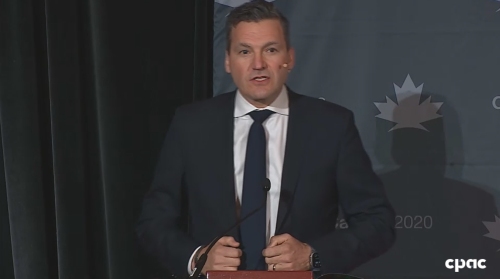
Image: Canada's Minister of AI and Digital Innovation, Solomon Evans Keynote at Canada 2020 event Ottawa (CPAC)
Prime Minister Mark Carney recently appointed Solomon Evans as Canada's first ever Minister of artificial intelligence and digital innovation to lead AI policy development and scale industry, trust and adoption. Solomon just delivered his first public remarks saying that the federal government will prioritize economic growth from artificial intelligence over advancing strict new rules. This new approach follows the collapse of Bill C-27’s AI framework, which failed to pass before the election and left Canada without a federal AI law.
Delivering a key note at a Canada 2020 event in Ottawa on June 10, 2025, Solomon said regulation must protect privacy and personal data but should not constrain innovation. Solomon confirmed that the previous governments AI regulation bill is currently under review.
“We’re not here to throw a saddle on the bucking bronco of AI but we do need to make sure it doesn’t kick anyone in the face.”
Feeling the heat of competition, even governments feel FOMO, and the global trend currently is moving from AI safety messaging towards AI adoption strategies. At the AI Action Summit in Paris, U.S. Vice President JD Vance pushed back on Europe’s regulatory overreach, while President Trump’s draft 'One Big Beautiful Bill' includes a proposed ten-year ban on state-level AI rules. Solomon seems aligned with this shift suggesting that global coordination is difficult, and Canada “won’t go it alone”.
NCFA Canada supports a speedy, focused rollout of AI investments that prioritize open access and trust, especially for smaller firms. Without clear guidance, shared tools and integrate support, SMEs will fall behind. Most do not have the internal capacity to evaluate or safely integrate AI, and that puts Canada’s productivity and innovation milestones in jeopardy. Canada's new AI czar, Solomon, acknowledged this gap, saying big companies are adopting AI, but “small and medium enterprises are not.”
Solomon also emphasized government support for Canadian champions like Cohere. In cases where specialized technical leadership is required to build national AI infrastructure, such as secure compute environments, working with proven domestic firms can make strategic sense. But NCFA cautions that these partnerships must be transparent, based on merit, and designed to benefit the broader ecosystem. The priority must remain funding open infrastructure and access, not enabling a sustainable advantage to a select few. Without transparency on this front, Canada risks loss of investment, talent, and IP.
The reality is that Canada’s innovation economy simply can't afford red tape bottlenecks or further restrictions that slow AI growth, especially since its hoping that broad adoption of the technology will turn the countries productivity woes around.
Canada also can't afford regulatory ambiguity that raises red flags for domestic and global firms alike. Solomon says he wants to “crank up commercialization” and support IP protection. That will only work if firms trust the environment they’re entering. For that, Canada needs smart policy, not just encouragement.
Canada is in a global race to lead in responsible AI and having a dedicated AI minister is a positive step, but evolving Canada into a trusted AI economy depends on speed, clarity and inclusion among other things. NCFA calls for the government to boost support for SME adoption, ensure rules are clear and fair, and build national infrastructure that attracts global innovators without sidelining local ones.
 The National Crowdfunding & Fintech Association (NCFA Canada) is a financial innovation ecosystem that provides education, market intelligence, industry stewardship, networking and funding opportunities and services to thousands of community members and works closely with industry, government, partners and affiliates to create a vibrant and innovative fintech and funding industry in Canada. Decentralized and distributed, NCFA is engaged with global stakeholders and helps incubate projects and investment in fintech, alternative finance, crowdfunding, peer-to-peer finance, payments, digital assets and tokens, artificial intelligence, blockchain, cryptocurrency, regtech, and insurtech sectors. Join Canada's Fintech & Funding Community today FREE! Or become a contributing member and get perks. For more information, please visit: www.ncfacanada.org
 |  |  |
|---|---|---|
 |  |  |
AI | June 9, 2025

Image: Freepik
On June 4, 2025, Reddit filed a lawsuit against Anthropic, alleging that the AI tech system conducted more than than 100,000 unauthorized data scraping events since last July, violating Reddit's user terms. It comes at a time when Anthropic is expanding the reach of Claude, its AI model family, across enterprise and government sectors. The legal, ethical, and commercial stakes are high.
Reddit's lawsuit is a critical test of Anthropic’s values and the public credibility of responsible AI branding. As Claude advances deeper into sensitive sectors like national security, it'll be more important than ever to define what real accountability with regards to data use looks like, and for Claude/Amodei to deliver on his ethical promise.
The National Crowdfunding & Fintech Association (NCFA Canada) is a financial innovation ecosystem that provides education, market intelligence, industry stewardship, networking and funding opportunities and services to thousands of community members and works closely with industry, government, partners and affiliates to create a vibrant and innovative fintech and funding industry in Canada. Decentralized and distributed, NCFA is engaged with global stakeholders and helps incubate projects and investment in fintech, alternative finance, crowdfunding, peer-to-peer finance, payments, digital assets and tokens, artificial intelligence, blockchain, cryptocurrency, regtech, and insurtech sectors. Join Canada's Fintech & Funding Community today FREE! Or become a contributing member and get perks. For more information, please visit: www.ncfacanada.org
| | |
|---|---|---|
| | |
AI | June 9, 2025
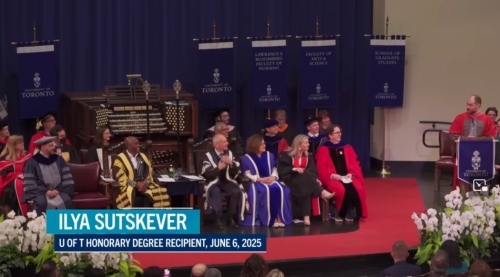
Image: Ilya Sutskever at University of Toronto convocation June 6, 2025 via Youtube
On June 6, 2025 at the University of Toronto’s convocation, Ilya Sutskever, cofounder of OpenAI and lead innovator of ChatGPT, delivered a powerful message while accepting an honorary degree in Doctor of Science (actually his fourth UoT degree). He warned that artificial intelligence (AI) is quickly advancing to a point where it will do everything humans can do, and we're not ready for what comes next.
Once a machine can learn anything a person can learn, no task is out of reach. This idea is central to Sutskever’s argument that AI will eventually match all human abilities. “We have a brain, and the brain is a biological computer… So why can't a digital brain do the same things?”
“The day will come when AI will do all of the things that we can do, not just some of them, but all of them.”
The timeline is uncertain but the direction is clear. Whether it takes 3, 5 or 10 years, general purpose AI will change how the economy functions and how people define and measure productivity.
Sutskever warns that even efforts to retrain workers may fall short because as technology marches forward, the very jobs people train for could vanish before they are ready to take them on.
“Many will find that the new job they were training for no longer exists by the time they finish retraining.”
He also said that while some will turn to universal basic income but it may not hold up because people may be seen as no longer economically productive.
Sutskever predicts two long-term outcomes. If humans find a way to offer lasting value, we may be treated as companions to AI systems. If not, we risk becoming irrelevant or extinct.
“In the best-case scenario, humanity will become like pets or the microbiome of artificial intelligence. In the worst-case scenario, humanity will become obsolete or even extinct.”
“The challenge that AI poses is the greatest challenge of humanity ever. And overcoming it will bring the greatest reward.”
He stresses that the response cannot be passive. Every person and institution will need to participate in what this technology becomes.
“Accept reality as it is, try not to regret the past, and try to improve the situation.”
Meeting this moment requires emotional resilience. He says people should remain focused on the present instead of looking backward and encouraged others to adopt the same mindset.
Sutskever’s speech is measured insight into the future, and governments, industry, innovators globally need to take his message as a direct challenge to act now (if you're not already sweating the pace of change in 2025). At NCFA Canada, we believe his message carries the kind of disruption that financial leaders must (anticipate and) respond to with urgency.
Canada cannot afford to be unprepared. While the changes can be guided with responsible AI efforts, they seemingly cannot be stopped, and so we must act with urgency to be prepared as new AI powered systems will influence financial markets, education, investment models, employment pathways, human mobility and more. the fintech sector needs to become more agile, more connected, and more willing to build for what's coming next.
"Innovating and adapting at the speed of AI development means building solutions and platforms that help people create value alongside AI, not behind or beneath it. It also means designing incentives and safeguards that match the reality of a hybrid workforce where humans and machines co-exist, and to embolden the leadership and collaboration needed to work together to solve problems." Craig Asano, NCFA
Canada cannot rely on other jurisdictions to define what safe and responsible AI looks like, and Canadian fintechs and institutions should play a direct role in developing policies, models, and frameworks that ensure AI serves the public interest.
This is not just a technology issue. It is a national competitiveness issue. It is also a question of whether we will help define the rules of the future or simply be beholden to them.
The National Crowdfunding & Fintech Association (NCFA Canada) is a financial innovation ecosystem that provides education, market intelligence, industry stewardship, networking and funding opportunities and services to thousands of community members and works closely with industry, government, partners and affiliates to create a vibrant and innovative fintech and funding industry in Canada. Decentralized and distributed, NCFA is engaged with global stakeholders and helps incubate projects and investment in fintech, alternative finance, crowdfunding, peer-to-peer finance, payments, digital assets and tokens, artificial intelligence, blockchain, cryptocurrency, regtech, and insurtech sectors. Join Canada's Fintech & Funding Community today FREE! Or become a contributing member and get perks. For more information, please visit: www.ncfacanada.org
| | |
|---|---|---|
| | |
Regulation | June 6, 2025

Image: Freepik
On June 5 2025, the Competition Bureau of Canada released final guidelines for greenwashing rules. The new rules apply to any business making environmental claims when selling products or promoting business activities including financial tech companies, ESG platforms, green loan providers, carbon credit startups, and any firm using green language in advertising, websites, or investor materials.
These updated guidelines reflect changes to the Competition Act which began on June 20, 2024. The law now clearly defines when green claims are allowed and what kind of evidence is needed to support them. The Bureau says they developed the final rules after reviewing over 400 public submissions, and are now in force. Now any firm that makes an environmental claim about it's product or business must be ready to prove it with fact-based evidence and proper documentation.
There are two provisions in the new Competition Act about greenwashing, (1) one about environmental benefit claims of individual products; and (2) another about environmental claims about a company and its business activities.
If a fintech makes a green claim about a product (i.e., protects the environment or reduces harm), it must be backed by suitable testing before the claim is made. Anecdotal evidence such as customer reviews or sales figures are not proper testing.
If a fintech claims that the company is environmentally responsible or heading toward net zero, then the claim must meet a reliable standard or an accepted protocol in Canada and internationally, including frameworks like ISO 14064 or GHG Protocol.
The Bureau makes it clear that companies must not exaggerate environmental benefits. Can't be vague or use 'feel good' language like 'eco-friendly' or 'sustainable' unless the claim is backed by specific evidence. For example, a product that uses 20% recycled packaging cannot advertise itself as 'environmentally neutral' unless the rest of the product has been tested to meet that standard.
Claims about future benefits, such as achieving carbon neutrality by 2030, require a clear and verifiable plan with interim targets and real progress tracking towards that goal.
There are numerous green financial products from lending products tied to home retrofits, solar energy or electric vehicles to 'low carbon' investment portfolios that will be impacted. If these products are being advertised as good for the environment or tied to climate goals then firms must now have data/documentation to support those claims or face enforcement.
The Bureau expects to see testing evidence before any green claim is made. What was the methodology used to support the green claim and is it internationally recognized and suitable in the Canadian context.
Penalties for corporations can reach up to $10 million for the first violation and $15 million for every violation thereafter. Also, if the value derived from the green claim benefit cannot be accurately measured, then the penalty can be up to 3% of the corporation's global gross revenue. The Bureau has already taken enforcement action in previous greenwashing cases, including against Keurig and Volkswagen.
Also as of June 20, 2025, individuals and private organizations can apply directly to the Competition Tribunal to challenge misleading green claims, opening the door for private sector oversight and potential legal action from investors, competitors, and consumer advocates.
There is however one safeguard for companies, which is a due diligence defence. If a fintech can show that it took reasonable steps to verify its claims and they followed recognized practices, it may help them avoid fines. Going forward, the pressure and burden is on companies to have robust compliance and documentation from engineering product development teams to marketing.
The bar is raised. For fintechs operating in Canada, green language can no longer be used for branding and promotion without properly being supported as it's a legal risk. Having said that, Canadian fintechs that can back up their green claims and properly document them will improve credibility with customers, regulators and global partners alike. Now how many of the banks will back off from their environmental claims?
The National Crowdfunding & Fintech Association (NCFA Canada) is a financial innovation ecosystem that provides education, market intelligence, industry stewardship, networking and funding opportunities and services to thousands of community members and works closely with industry, government, partners and affiliates to create a vibrant and innovative fintech and funding industry in Canada. Decentralized and distributed, NCFA is engaged with global stakeholders and helps incubate projects and investment in fintech, alternative finance, crowdfunding, peer-to-peer finance, payments, digital assets and tokens, artificial intelligence, blockchain, cryptocurrency, regtech, and insurtech sectors. Join Canada's Fintech & Funding Community today FREE! Or become a contributing member and get perks. For more information, please visit: www.ncfacanada.org
| | |
|---|---|---|
| | |
DeFi Policy | June 5, 2025

Image: Freepik/rawpixel.com
On June 9, the U.S. Securities and Exchange Commission is hosting a policy roundtable titled “DeFi and the American Spirit” to have an open and structured policy dialogue with decentralized finance developers, innovators, and legal experts alongside SEC legal and regulatory voices. The roundtable is part of the SEC's Crypto Task Force's ongoing series of crypto asset regulation events.
These gatherings are not 'hearings', nor are they 'policy announcements' but rather conversations with people who have actually built defi systems, in fact many who have publicly challenged the SEC's approach. It’s a live forum where ideas about risk, innovation, and policy design can be tested in real time. So in that way, it's a rare and important event for DeFi in the U.S. and fintechs watching from other jurisdictions like Canada.
The speaker lineup is a mix of founders, researchers, lawyers, and advocates who all have somewhat different views on how DeFi should work and be handled from a regulatory and practical perspective.
Erik Voorhees, founder of ShapeShift (and now Venice AI) is known for arguing that decentralized tools and open-source software should not be regulated like traditional financial intermediaries. His participation ensures that the case for user autonomy and protocol neutrality will be represented without compromise.
Michael Mosier, former acting director of FinCEN who founded Arktouros is focused on financial crime and compliance. He's likely to advocate for more robust frameworks for identifying illegal flows through permissionless systems. He'll ensure that AML and systemic risk questions are part of the core conversation.
Rebecca Rettig, general counsel at Jito Labs and formerly with Polygon, brings first-hand experience in understanding protocol development and legal structure, and is well positioned to bring up solutions that don’t rely on full centralization, such as voluntary disclosures or protocol guardrails.
Kevin Werbach, a professor at Wharton, has spent years studying how decentralized systems intersect with regulation. He tends to advocate for layered frameworks that separate software, governance, and commercial activity to provide a way to regulate outcomes without halting innovation.
There are several other panelists including Jill Gunter (Espresso Systems), Peter Van Valkenburgh (Coin Center), Omid Malekan (Columbia Business School), Gabe Shapiro (MetaLeX), and others who will no doubt have ample to contribute in helping the SEC understand as well as framing the policy of decentralized systems.
It’s a great cross-section of people trying to answer the same question from different angles: how should decentralized finance be understood and governed?
Here are some core questions that may come up during the discussions:
At the end of the day, the SEC should be commended for their willingness to engage with key foundational questions in effort to both understand at a deeper level, as well as inform future policy making. Leaps and bounds better than regulate by enforcement under the SEC's ex-Chair, Gary Gensler and a commission that would rather assume that every DeFi project is either a rug-pull or disguised as a securities platform.
If the roundtable opens the door to more flexible or fit-for-purpose regulation, Canadian regulators will face growing calls to follow suit. It also offers Canadian founders a window into how U.S. regulators are thinking, what they are worried about, what they may be willing to tolerate, and where they are open to compromise. It's clear proof that the SEC is finally recognizing that DeFi isn't going away and that series policy design needs inputs from the people building it.
The National Crowdfunding & Fintech Association (NCFA Canada) is a financial innovation ecosystem that provides education, market intelligence, industry stewardship, networking and funding opportunities and services to thousands of community members and works closely with industry, government, partners and affiliates to create a vibrant and innovative fintech and funding industry in Canada. Decentralized and distributed, NCFA is engaged with global stakeholders and helps incubate projects and investment in fintech, alternative finance, crowdfunding, peer-to-peer finance, payments, digital assets and tokens, artificial intelligence, blockchain, cryptocurrency, regtech, and insurtech sectors. Join Canada's Fintech & Funding Community today FREE! Or become a contributing member and get perks. For more information, please visit: www.ncfacanada.org
| | |
|---|---|---|
| | |
Crypto Regulation | June 2, 2025

AI Image, SEC says crypto staking not a security
On May 29, 2025, the U.S. Securities and Exchange Commission (SEC) published new guidance, "Statement on certain protocol staking activities". The Corporation Finance Division said that staking crypto assets on proof-of-stake networks does not count as offering or selling a security under federal law.
The SEC guidance says these 3 models do not involve the kind of for profit structure that securities law covers, which shows how the SEC is now approaching proof-of-stake blockchain systems in practice: (1) staking by individuals (solo staking), (2) delegating staking rights to a non-custodial third party, and (3) custodial staking done by platforms that hold assets on behalf of users.
The Division stated, “Protocol staking does not involve entrepreneurial or managerial efforts by third parties." Meaning it does not meet the Howey Test which the SEC uses to determine what counts as an investment contract (or not).
Two SEC commissioners published separate statements that highlight the ongoing debate inside the agency.
Commissioner Hester Peirce (Crypto mom) supports the new staking guidance, saying it was long overdue and provides clarity that developers and users have been asking for:
“Today’s statement is a step in the right direction. Market participants have long sought guidance on staking, and this statement, although overdue, provides helpful clarity.”
“Staking is not a financial investment in a business venture. It is a technical function essential to many blockchain networks.”
Commissioner Caroline Crenshaw raised concerns over the staking guidance, warning that it may weaken protections for retail users and was issued without a formal public process.
“This Staff statement attempts to draw lines in a complex and evolving ecosystem without the benefit of a Commission vote or notice and comment. That is not the kind of transparency or rigor that investors or market participants deserve.”
Crenshaw also said staking programs can still involve risk, especially when intermediaries are holding customer assets.
“Even assuming the best of intentions, staking programs can pose meaningful risks, especially when intermediaries custody or manage assets.”
Canadian regulators already have clear guidance on when staking may fall under securities law. According to CSA Staff Notice 81-336, the key trigger is custody. If a platform takes control of client crypto assets and stakes them on the client’s behalf, this may be considered a securities or derivatives activity and could require registration or compliance under existing rules.
However by contrast, individuals who stake their own crypto assets directly or delegate staking rights without giving up custody are generally not subject to regulation, as long as the activity does not involve other investment features or representations.
“Depending on how it is conducted, staking of crypto assets may involve the issuance of a security or derivative and/or may raise other investor protection concerns.”
The U.S. position is different becomes it frames protocol staking itself as a technical service (even when done by custodians), and not an investment contract. At the end of the day, U.S. firms will now face less friction when offering staking services, while Canadian platforms still operate under stricter conditions if custody is involved.
The question now is whether Canada will maintain this more cautious approach or align with emerging U.S. standards. If many firms start moving operations to the U.S. to take advantage of fewer barriers, then regulators may feel pressure to change.
Be aware that the guidance reflects the views of the SEC's Corporate Finance Division staff. It's not a new law or exempt from any activity from enforcement but it does offer helpful insight into current staff interpretations under existing U.S securities law (but it's not binding or the full Commission or court). It was raised that some common staking features like pooled assets, slashing protection, or enhanced reward mechanisms could till meet the criteria for an investment contract under Howey.
Further, the staff statement doesn't include liquid staking, restaking, or other models that add financial structuring, which is outside the scope of the guidance and could still raise regulatory concerns. See this A&O Shearman article for deeper analysis.
Staking is one of the core functions of proof-of-stake blockchains, including Ethereum. For developers and users, the ability to stake without regulatory risk is essential to network growth and security.
The SEC's staking guidance removes barriers, adds clarity, and will certainly give the market a boost. It will be interesting to see if staking adoption is slower here in Canada and if domestic platforms can compete or are overly restricted, due to the different approaches.
The National Crowdfunding & Fintech Association (NCFA Canada) is a financial innovation ecosystem that provides education, market intelligence, industry stewardship, networking and funding opportunities and services to thousands of community members and works closely with industry, government, partners and affiliates to create a vibrant and innovative fintech and funding industry in Canada. Decentralized and distributed, NCFA is engaged with global stakeholders and helps incubate projects and investment in fintech, alternative finance, crowdfunding, peer-to-peer finance, payments, digital assets and tokens, artificial intelligence, blockchain, cryptocurrency, regtech, and insurtech sectors. Join Canada's Fintech & Funding Community today FREE! Or become a contributing member and get perks. For more information, please visit: www.ncfacanada.org
| | |
|---|---|---|
| | |
AI Regulation | May 29, 2025

Image: Freepik/luis molinero
In March 2024 last year, the European Union adopted the AI Act, the world’s first comprehensive regulatory framework on artificial intelligence. It follows a risk-based approach, categorizing AI systems into four tiers based on risk with the highest risk systems facing strict requirements around data governance, transparency, human oversight, and cybersecurity. Fines for noncompliance can reach up to €35 million or 7% of global revenue.
However, according to Sifted the European Commission's President Ursula von der Leyen's team is now considering to delay enforcement of the EU's AI Act to introduce changes that will simplify the law. The delay was triggered by concerns from startups, global tech firms, and even non-EU governments, highlighting tensions between innovation and oversight in AI regulation. It also puts renewed pressure on countries like Canada, where formal legislation remains stalled, to clarify their position on AI governance in an industry moving faster than light.
One of the core controversies is how AI systems are categorized, since higher risk systems face the most rigorous requirements. For example, when AI is used to perform a type of 'social scoring' it's banned outright. Many firms warned at this framework could backfire.
Earlier this year, Capgemini CEO Aiman Ezzat warned that "the EU went too far" making the deployment of AI too difficult compared to other jurisdictions like the U.S and Asia.
Others, including some lawmakers in the European Parliament cursed the delay as a capitulation to Big Tech. A letter from several MEPs called any move to make compliance optional “dangerous and undemocratic”.
Adding to the pressure, the U.S. Trump administration submitted a letter challenging the EU Commission's guidelines for advanced AI systems saying that the framework would create regulatory burdens and stifle innovation.
In 2022, Bill C-27 or the Artificial Intelligence and Data Act (AIDA) was introduced to regulate high impact AI systems but the AIDA bill died on the order paper when Parliament was prorogued in January 2025. So instead of an AI law, the Canadian government issued a Voluntary Code of Conduct for Advanced GenAI Systems. While this level of guidance is useful, it's not enforceable so it lacks the 'stick and carrot' that these global AI firms need.
Regulatory Comparison: EU vs Canada
| Feature | EU AI Act (2024) | Canada’s AIDA (Status: Dead Bill) |
| Legal Status | Enacted March 2024 | Died in January 2025 |
| Enforcement | Mandatory with fines up to €35M / 7% of turnover | Voluntary code; no penalties |
| Risk Classification | 4 levels: banned, high, limited, minimal | Focus on “high-impact systems” (undefined) |
| Implementation Timeline | Staggered from 2025 to 2027 | Not applicable |
| Market Reach | Extraterritorial (global firms included) | Focused on domestic AI systems |
The EU’s AI Act framework has extraterritorial reach, meaning Canadian firms offering services in Europe could fall under its scope regardless of where they’re based. So Canadian fintechs developing credit risk scoring models, biometric ID systems, or fraud detection tools for European markets, are breathing a sigh of relief given the current pause.
At the same time, Canada’s lack of enforceable AI legislation creates uncertainty. Without clear national rules, companies must operate in a fragmented environment of global regulatory expectations. With PM Carney now at the helm, Canada could update its regulatory approach to a more innovation-friendly framework. One that's interoperable with Europe but grounded in domestic market needs.
The EU AI Act’s pause is a warning that global AI regulations are still up in the air. So companies need to be agile, stay informed and proactive. Canadian fintechs and AI developers operating globally should use this strategic window of time to impact emerging norms while preparing for stricter enforcement ahead.
The National Crowdfunding & Fintech Association (NCFA Canada) is a financial innovation ecosystem that provides education, market intelligence, industry stewardship, networking and funding opportunities and services to thousands of community members and works closely with industry, government, partners and affiliates to create a vibrant and innovative fintech and funding industry in Canada. Decentralized and distributed, NCFA is engaged with global stakeholders and helps incubate projects and investment in fintech, alternative finance, crowdfunding, peer-to-peer finance, payments, digital assets and tokens, artificial intelligence, blockchain, cryptocurrency, regtech, and insurtech sectors. Join Canada's Fintech & Funding Community today FREE! Or become a contributing member and get perks. For more information, please visit: www.ncfacanada.org
| | |
|---|---|---|
| | |


August 26th, 2025

January 4th, 2024

June 1st, 2021

September 9th, 2020

July 9th, 2018

January 3rd, 2018

September 25th, 2017

June 20th, 2017

May 10th, 2017

December 14th, 2016