




Karsten Wenzlaff, Advisor
August 26th, 2025
Karsten Wenzlaff is a Crowdfunding and Fintech Expert from Germany. He is Secretary-General of Digit[...]


Feb 17, 2026 | NCFA Fintech Market Activity | AI and Developer Infrastructure

Freepik Two AI agents celbrating new years
On Feb 5 2026, OpenAI launched GPT 5.3 Codex and on the same day competitor Anthropic launched Claude Opus 4.6 both major updates that evolve AI assisted software development from helpful autocomplete towards longer running agent style work that can plan, review, and debug across real codebases.
OpenAI describes GPT 5.3 Codex as its most capable agentic coding model so far and says it runs 25% faster than the prior generation while combining stronger coding performance with improved reasoning for professional workflows. This update matters in practice because speed changes behaviour. When a model returns usable work faster, teams try more tasks, run tighter loops, and start trusting the agent with bigger pieces of the build.
Anthropic frames Opus 4.6 as an upgrade to its smartest model and says it improves planning, sustains agentic tasks for longer, operates more reliably in larger codebases, and gets better at code review and debugging so it catches its own mistakes. Anthropic also says Opus 4.6 includes a 1M token context window in beta, which points straight at the enterprise reality of sprawling repositories and long technical histories that never fit cleanly into small prompts.
Once AI coding agents start handling larger chunks of work, the bottleneck (read human programmers) changes from writing code to proving that the code is safe, compliant, and traceable. For fintechs and financial institutions, that means stronger SDLC controls, tighter review gates, clearer model use policies, and improved audit trails and incident response.
Development teams that treat agent output like a black box will create new operational risk. Teams that treat AI agents like a new developer class with strict controls can amplify delivery speed without losing accountability.
As AI coding agents mature, the competitive edge goes from model novelty to measurable enterprise output, reinforcing the ROI thesis around return on intelligence in finance. The winners will not be the teams that generate the most code. The winners will be the teams that ship faster while keeping controls intact, then turn that delivery speed into better products, lower operating cost, and tighter feedback loops with customers.
With every new update and release, every dev tool vendor and cloud provider deepens their own agent workflows, raising pricing pressure, and the fight for default placement inside IDEs, repos, CI pipelines, and enterprise procurement. If your stack standardizes on one agent layer, switching later will feel like migrating a core platform, not swapping a plugin.
For Canadian fintechs weighing build versus buy, the question isn't whether to use coding agents. The question is how to build an operating model around them. Practical guidance on building enterprise AI agents can help teams decide what stays in house, what stays vendor managed, and what governance needs to exist before agents touch regulated codepaths.
AI coding agents continue to get more capable and are becoming embedded in more real workflows. When your team adopts one as a daily builder, what controls will you require so you can move faster without weakening security, testing discipline, and auditability?
For fintech builders, the near term edge comes from shipping faster while keeping standards high, and from choosing an AI developer stack that doesn't trap you with a single vendor later.
 The National Crowdfunding & Fintech Association (NCFA Canada) is a financial innovation ecosystem that provides education, market intelligence, industry stewardship, networking and funding opportunities and services to thousands of community members and works closely with industry, government, partners and affiliates to create a vibrant and innovative fintech and funding industry in Canada. Decentralized and distributed, NCFA is engaged with global stakeholders and helps incubate projects and investment in fintech, alternative finance, crowdfunding, peer-to-peer finance, payments, digital assets and tokens, artificial intelligence, blockchain, cryptocurrency, regtech, and insurtech sectors. Join Canada's Fintech & Funding Community today FREE! Or become a contributing member and get perks. For more information, please visit: www.ncfacanada.org
 |  |  |
|---|---|---|
 |  |  |
Feb 10, 2026 | NCFA Fintech Market Activity | Alternative Finance and Capital Markets
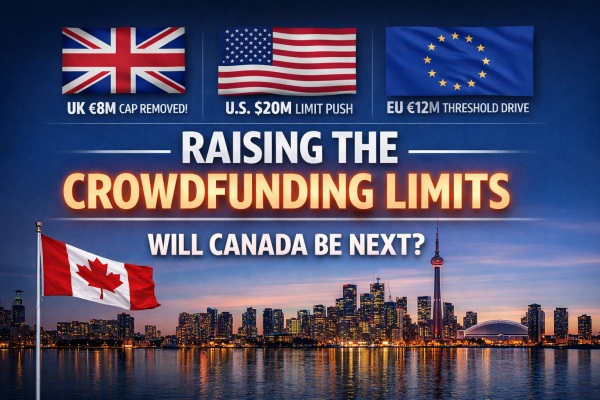
On February 10 2026, UK POP rules go live, removing the old prospectus trigger that made large public raises expensive, slow, and out of reach for many private companies.
For years, UK companies faced a hard line. If a business raised more than €8 million in securities from the public in a year, it had to produce a full prospectus (NB: the UK retained that euro-denominated threshold in its domestic framework post-brexit). Crowdcube says that prospectus costs could cost more than £250,000 and take months, which pushed many companies away from public community rounds even when demand existed.
Under the Public Offer Platform regime, raises above £5 million now run through a regulated POP, and the regime removes the upper fundraising cap for those offers (No more funding caps). Raises under £5 million remain outside the POP requirement, but regulated execution and investor protection expectations still apply.
Platforms now carry more responsibility for diligence, disclosure quality, and investor safeguards. That shifts the burden from a giant issuer document to a supervised platform process that can move faster.
The UK is not alone. In the United States, Crowdfund Capital Advisors submitted a $20M Reg CF petition asking the SEC to raise the Regulation Crowdfunding cap from $5M to $20M. In Europe, the European Digital Finance Association are pushing to increase the ECSP threshold from €5m to €12m.
After years of advocating, Canada finally harmonized nationally its startup-crowdfunding exemption in 2021, but regulators have kept the issuer cap conservative. Under National Instrument 45 110, eligible issuers can raise up to $1.5m in a 12 month period, which a growing company can quickly outgrow and end up soon looking for more funding via heavier paths for larger rounds. If the government wants to prioritize funding scape-ups, they should take another look at increasing equity crowdfunding caps in Canada to be in line with global peers.
This funding cap tension isn't new. In fact NCFA has been advocating for the OSC and CSA to raise issuer funding caps for years. In 2017 for example, NCFA petitioned to raise caps to modernize equity crowdfunding in Ontario. In 2019, $5m cap formed part of NCFA's recommendations to reduce regulatory burden and unlock growth capital. Again in 2020, during national harmonization discussions, NCFA advocated to modernize NI 45 110 including increasing caps to $5 million so the framework could match real funding needs in a digital economy.
Now with the UK FCA removing prospectus triggers and the US and EU push for higher caps, there may be a new policy window for Canada's equity crowdfunding participants to petition yet again. If other jurisdictions support $10m to $20m community rounds under platform oversight, Canada needs to decide whether it wants founders scaling here or structuring growth capital elsewhere.
A higher ceiling, including a path toward $5m and beyond, would better match growth stage reality while keeping platform level investor protection front and centre. The global direction of travel now strengthens the case for a renewed Canadian push grounded in data, experience, and competitiveness.
If regulated platforms can run larger public offers without a prospectus wall in the UK, what should Canada do next, raise the ceiling, create a platform lane for larger rounds, or keep the cap and accept that growth capital routes around Canada?
One practical takeaway stands out. POP style rules treat the platform as the compliance spine, not the issuer. That design can cut cost and time while still demanding clear disclosures, suitability controls, and due diligence at the point of sale. While Canada doesn't necessarily need to copy the UK, it does need a credible path for larger community rounds that doesn't force founders into a prospectus sized bill before they have the scale to absorb it.
The National Crowdfunding & Fintech Association (NCFA Canada) is a financial innovation ecosystem that provides education, market intelligence, industry stewardship, networking and funding opportunities and services to thousands of community members and works closely with industry, government, partners and affiliates to create a vibrant and innovative fintech and funding industry in Canada. Decentralized and distributed, NCFA is engaged with global stakeholders and helps incubate projects and investment in fintech, alternative finance, crowdfunding, peer to peer finance, payments, digital assets and tokens, artificial intelligence, blockchain, cryptocurrency, regtech, and insurtech sectors. Join Canada's Fintech & Funding Community today FREE! Or become a contributing member and get perks. For more information, please visit: www.ncfacanada.org
| | |
|---|---|---|
| | |
February 17 2026 | Equity Crowdfunding and Retail Investors

Image: Freepik/pressfoto
On February 16 2026, multiple UK reports say BrewDog has hired advisers to explore a potential sale after years of losses and slower growth. As a result, about 220,000 Equity for Punks retail shareholders may lose money depending on deal structure and payout priority.
Do you remember the Equity for Punks BrewDog story from years past? It was a story of community empowerment in the early days of the equity crowdfunding movement. NCFA and established partners like Crowdfund Insider tracked that momentum, such as when when BrewDog plans a $50M US equity crowdfunding round. The story today however offers practical lessons about capital structure, liquidity, and investor protection.
BrewDog built one of the most visible equity crowdfunding programs in the world through Equity for Punks. The model gave everyday consumers direct exposure to private company ownership and it proved that brand and community could mobilize serious capital.
In 2017 however, BrewDog took a major private equity investment from TSG Consumer Partners. Reporting in The Guardian describes preferential rights that sit ahead of common shareholders in a sale. That structure now drives the risk for small shareholders in the current sale process, based on how the deal structure affects what retail shareholders receive in a sale. The core point is simple. Structure governs outcomes in private markets.
Phil Halsey (47) invested about £2,500, starting in the second cash call in 2011:
“It’s extremely disappointing that it’s gone this way,” said Halsey. “The last time you could have done some form of cashing out was about a year and a half ago.”
1. Capital stack always decides the payout. Retail investors often focus on brand, traction, and growth narrative. Professional investors focus first on the capital stack. If a preferred investor holds liquidation preferences or other senior rights, that investor receives sale proceeds first. Common shareholders receive what remains. In a strong exit everyone wins. In a weaker exit, common shareholders may receive little or nothing. Investors should read share class terms and understand exactly where they sit before they invest.
2. Liquidity risk shows up at the worst time. Equity crowdfunding expands access, but it rarely guarantees a clean exit path. If investors rely on one big liquidity event, timing risk becomes real. Investors should treat these positions as long duration holdings. Founders and platforms should design credible liquidity pathways where rules allow, because trust grows when investors understand how they can eventually exit.
3. Growth narratives do not replace unit economics. The sale process follows years where BrewDog reported losses. When costs rise and category growth cools, expansion heavier models feel pressure quickly. Investors should challenge founders and operators on the road to profitability, not just the top line story. Founders should align growth with durable margins, because narrative alone doesn't protect valuation.
4. Community builds momentum but it does not hedge downside. Equity for Punks turns customers into owners and it proves that community capital can scale a consumer brand. That impact remains real. Yet community alignment does not override contractual rights in a sale. Retail investors should value perks and participation for what they are, and they should separate those benefits from expected financial return.
BrewDog's case encourages retail investors to have more mature conversations about disclosure, investor education, and deal structure literacy. For Canada, the case reinforces why clear explanations of share classes, payout priority, and realistic liquidity expectations are important for investor protection and long term market credibility.
The National Crowdfunding & Fintech Association (NCFA Canada) is a financial innovation ecosystem that provides education, market intelligence, industry stewardship, networking and funding opportunities and services to thousands of community members and works closely with industry, government, partners and affiliates to create a vibrant and innovative fintech and funding industry in Canada. Decentralized and distributed, NCFA is engaged with global stakeholders and helps incubate projects and investment in fintech, alternative finance, crowdfunding, peer-to-peer finance, payments, digital assets and tokens, artificial intelligence, blockchain, cryptocurrency, regtech, and insurtech sectors. Join Canada's Fintech & Funding Community today FREE! Or become a contributing member and get perks. For more information, please visit: www.ncfacanada.org
| | |
|---|---|---|
| | |
Feb 17, 2026 | NCFA Fintech Market Activity | Payroll and HR Tech

Image: Freepik
On February 17 2026, Nmbr announced the Collage Payroll launch, positioning it as the first benefits connected HR platform in Canada to embed payroll inside its HR workflow. Collage says customers can onboard employees once, manage time off and timesheets, and sync HR, payroll, and benefits data through a single login.
Collage says it began partnering with Nmbr in 2024 to build payroll directly inside its HR and benefits workflow (see embedded finance). Then in September 2024, Nmbr announced that they raised CAD $7.6M for Embedded Payroll in Canada. An early rollout in 2025 showed traction, with clients ranging from one to hundreds of employees already using the embedded payroll functionality.
The announcement also calls out real operating pain being solved. Research says nearly a third of businesses spend more than 30 hours a week managing data across payroll and other systems. Collage and Nmbr are betting that fewer handoffs reduces admin burden, lowers compliance risk, and cuts the error rate that shows up every time a hire, pay change, benefits update, or termination forces duplicate data work.
Mark Bluvshtein, Chief Executive Officer, Collage, and Vice President of HR Solutions at People Corporation:
“Payroll has been the number one request from our customers for years. Even when HR and payroll systems work closely together, businesses still feel the friction of managing two platforms. Bringing payroll directly into Collage allows us to finally deliver a single system that manages it all, reducing complexity and giving employers far greater control.”
Nmbr positions itself as payroll infrastructure rather than a standalone payroll brand. Nmbr handles core payroll requirements including payments, compliance, and data accuracy, so platforms can ship payroll inside their own products without rebuilding the hardest pieces from scratch. Noteworthy that Nmbr’s founding team previously helped build and scale Humi, while Collage points to leadership experience across Wave and Humi.
Simon Bourgeois, Chief Executive Officer, Nmbr:
“Payroll is one of the most complex systems a business can run, which is why so few companies have tried to build it themselves. By partnering with Collage, we’re enabling payroll to be built the right way, fully embedded, compliant, and designed for Canadian businesses. This partnership shows what’s possible when modern payroll infrastructure meets a platform that deeply understands HR and benefits.”
As more HR platforms embed payroll, what becomes the differentiator for employers, accuracy and compliance controls, speed of implementation, or the ability to bundle payroll with benefits and other people operations workflows without extra vendors?
Embedded payroll changes the competitive map for HR platforms in Canada. If payroll lives inside the HR and benefits workflow, employers stop treating payroll as a separate purchasing decision and start treating it as a built in capability. That dynamic rewards platforms that control the end-to-end workflow and can keep payroll accurate across provinces, remittances, and reporting cycles.
The National Crowdfunding & Fintech Association (NCFA Canada) is a financial innovation ecosystem that provides education, market intelligence, industry stewardship, networking and funding opportunities and services to thousands of community members and works closely with industry, government, partners and affiliates to create a vibrant and innovative fintech and funding industry in Canada. Decentralized and distributed, NCFA is engaged with global stakeholders and helps incubate projects and investment in fintech, alternative finance, crowdfunding, peer-to-peer finance, payments, digital assets and tokens, artificial intelligence, blockchain, cryptocurrency, regtech, and insurtech sectors. Join Canada's Fintech & Funding Community today FREE! Or become a contributing member and get perks. For more information, please visit: www.ncfacanada.org
| | |
|---|---|---|
| | |
Feb 16, 2026 | NCFA Fintech Market Activity | Funding and Capital Markets

On February 12 2026, according to Reuters fintech brokerage and clearing firm Clear Street postponed its US IPO after downsizing its planned public offering.
Earlier in February, Clear Street had marketed 23.8 million shares at $40 to $44 per share, targeting a raise of up to $1.05B and a valuation as high as $11.8B. However, the latest reporting indicates due to market volatility and investor demand conditions, not a change in the company's core strategy, the company reduced the size of the deal to approximately $364M before ultimately postponing the offering. The scale of the adjustment is significant.
Clear Street reported estimated 2025 net revenue in the range of $1.04B to $1.06B, up from $463.6M the prior year. That type of growth profile would normally support strong IPO momentum. The pullback shows how sensitive public market pricing is when risk appetite tightens.
It's not just a US story. Canadian public markets have faced similar pressure. Reuters reporting earlier this year noted that the Toronto Stock Exchange saw only two IPOs and 55 delistings in 2025, even as the S&P TSX Composite rose 29%.
However, recent reporting on Canada’s IPO market revival outlook points to improving economic confidence heading into 2026 after a muted 2025 cycle.
Canadian IPO momentum may be rebuilding, but institutional investors on both sides of the border remain focused on revenue durability, capital efficiency, and realistic pricing. Market windows are opening selectively, not broadly.
For Canadian fintechs considering a public listing, the lesson is calibration, not delay. Public markets appear more receptive again, but pricing discipline and governance strength now carry more weight than growth alone.
If public markets reprice risk this fast, what proof points must fintechs demonstrate to defend valuation under pressure, revenue quality, capital efficiency, or market share durability?
Clear Street’s postponed IPO doesn't close the door on fintech listings. It reinforces that in 2026, timing and pricing discipline matter as much as growth.
The National Crowdfunding & Fintech Association (NCFA Canada) is a financial innovation ecosystem that provides education, market intelligence, industry stewardship, networking and funding opportunities and services to thousands of community members and works closely with industry, government, partners and affiliates to create a vibrant and innovative fintech and funding industry in Canada. Decentralized and distributed, NCFA is engaged with global stakeholders and helps incubate projects and investment in fintech, alternative finance, crowdfunding, peer to peer finance, payments, digital assets and tokens, artificial intelligence, blockchain, cryptocurrency, regtech, and insurtech sectors. Join Canada's Fintech & Funding Community today FREE! Or become a contributing member and get perks. For more information, please visit: www.ncfacanada.org
| | |
|---|---|---|
| | |
The National Crowdfunding & Fintech Association (NCFA Canada) is a financial innovation ecosystem that provides education, market intelligence, industry stewardship, networking and funding opportunities and services to thousands of community members and works closely with industry, government, partners and affiliates to create a vibrant and innovative fintech and funding industry in Canada. Decentralized and distributed, NCFA is engaged with global stakeholders and helps incubate projects and investment in fintech, alternative finance, crowdfunding, peer-to-peer finance, payments, digital assets and tokens, artificial intelligence, blockchain, cryptocurrency, regtech, and insurtech sectors. Join Canada's Fintech & Funding Community today FREE! Or become a contributing member and get perks. For more information, please visit: www.ncfacanada.org
| | |
|---|---|---|
| | |
The National Crowdfunding & Fintech Association (NCFA Canada) is a financial innovation ecosystem that provides education, market intelligence, industry stewardship, networking and funding opportunities and services to thousands of community members and works closely with industry, government, partners and affiliates to create a vibrant and innovative fintech and funding industry in Canada. Decentralized and distributed, NCFA is engaged with global stakeholders and helps incubate projects and investment in fintech, alternative finance, crowdfunding, peer-to-peer finance, payments, digital assets and tokens, artificial intelligence, blockchain, cryptocurrency, regtech, and insurtech sectors. Join Canada's Fintech & Funding Community today FREE! Or become a contributing member and get perks. For more information, please visit: www.ncfacanada.org
| | |
|---|---|---|
| | |
February 16, 2026

Image: Freepik/lifefostock
The roof is the primary defence against natural forces. Strong winds are one such natural disaster that can pose a formidable threat to the roofing system. If you live in Canada, roof damage from strong winds is common.
Most roofs are designed to withstand wind speeds, but severe storms can easily cause significant damage. It is essential to recognize the signs of wind damage to prevent costly repairs. Given the prevalence of strong winds in Canada, it's critical to identify the common signs of wind-related roof damage.
Damaged and missing shingles are common signs of wind damage in Halifax. Strong winds can tear and lift singles from the roof, leaving them completely exposed to the elements. After facing a windy storm, get your roof inspected by professionals. Also, check the shingles for visible damage. Prompt action in replacement is essential to prevent water infiltration.
Tiny granules are used to coat roof shingles, which in turn helps to protect it from the harsh UV rays and changing weather. These granules can be stripped off by high winds, making the shingles highly vulnerable. When you see granules in the downspouts and gutters, it indicates that the roof needs repair due to wind damage. Loss of granules can even lead to premature aging of shingles.
Roof ventilation components, such as turbine ridge vents and vent pipes, can be damaged by strong winds. A proper ventilation system is crucial for preventing moisture buildup and balancing the attic temperature. You can check out with insulation contractors Halifax. Adequate inspection of components shall be conducted to check for cracks, density, and displacement after strong winds and heavy storms. Remember, poor ventilation can lead to poor air quality and higher bills.
In some instances, strong winds can cause structural damage to the roofing system. A deformed or sagging roof line clearly indicates such damage. If you notice irregularities in the shape of your roof, it's essential to contact roofing professionals without delay. A compromised roofing structure can pose a significant risk factor and should be addressed immediately.
The effects of wind damage are not immediately visible at certain times. The water stains on the walls and ceiling are indicative of hidden damage. If you notice discoloration or damp spots, call the experts right away to identify the source of the leak. This can lead to mould growth and structural damage if prompt action is not taken.
Your roof is the first line of defence; hence it is important that you take proper care of it. The moment you recognize the early signs of wind damage, you should take prompt action to prevent extensive repairs down the road. Regular roof inspections from Artisanroofing.ca, especially after severe weather, can help you maintain a weather-resistant, secure roofing system. If you suspect any kind of wind damage to the roofing system, immediately contact the expert-looking contractors to assess the extent of the damage and the cost.
The National Crowdfunding & Fintech Association (NCFA Canada) is a financial innovation ecosystem that provides education, market intelligence, industry stewardship, networking and funding opportunities and services to thousands of community members and works closely with industry, government, partners and affiliates to create a vibrant and innovative fintech and funding industry in Canada. Decentralized and distributed, NCFA is engaged with global stakeholders and helps incubate projects and investment in fintech, alternative finance, crowdfunding, peer-to-peer finance, payments, digital assets and tokens, artificial intelligence, blockchain, cryptocurrency, regtech, and insurtech sectors. Join Canada's Fintech & Funding Community today FREE! Or become a contributing member and get perks. For more information, please visit: www.ncfacanada.org
| | |
|---|---|---|
| | |
February 13, 2026 | NCFA Fintech Whisperer Weekly Intelligence | Regulation And Policy, Digital Assets Blockchain And Tokenization, Risk Compliance And Regtech, Payments And Money Movement, Digital Banking And BaaS

Image: Freepik
This live weekly NCFA intelligence page tracks financial technology developments that significantly affect how fintechs build, sell, raise capital, and operate under scrutiny. Coverage prioritizes Canada and includes global events that directly influence competitive conditions, market access, and execution realities across fintech sectors. This page will be updated throughout the week with market movers in a live format and then each week we'll close the prior week's contents in prep for the upcoming week, and continue on a rolling basis. (Missed prior week's Fintech Whisperer? (December 6-12, 2025, December 13-19, 2025, January 1-9, 2026, January 10-16, 2026, January 17-23, 2026, January 24-30, 2026, January 31-February 6, 2026).
If Congress moves in the spring, US partners will start asking harder questions now on stablecoin rewards, reserve treatment, and how customer funds and disclosures work across the full stack. Canadian fintechs that sell into US banks, issuers, brokers, or payment programs should treat this as a near term diligence trigger and tighten their positioning on governance, controls, and commercial terms before counterparties freeze decisions waiting for clarity.
This can tighten the enforcement loop for fintech ecosystems that touch payments, onboarding, compliance tooling, crypto rails, and cross border flows. Expect more partner questions on how you detect red flags, how you document decisions, and how quickly you can freeze, unwind, and report activity when a credible tip lands. Teams that treat case management and audit trails as part of the product will move faster in enterprise sales and face fewer surprises when an investigation starts.
This matters because sandbox access only helps when it reduces time and uncertainty. Teams that show strong governance, clear client protections, and clean reporting will move faster than teams that treat testing as a demo day. Learn about eligibility of the application process.
When a major hub ties tokenization to competitiveness, it raises the stakes for everyone else. Canadian fintechs that sell tokenized rails, custody, compliance, or payments infrastructure should watch how Hong Kong turns policy into approvals, because global buyers will compare jurisdictions and pick the one that reduces execution risk. The winners will package governance, controls, and reporting into the product so expansion doesn't turn into a compliance rebuild.
If the UK market truly removes practical caps for platform led raises, UK equity crowdfunding starts to compete more directly with later stage private rounds, not just seed. Canadian issuers and Canadian investors who already treat the UK as a secondary capital lane should watch how this affects round structure, disclosure burden, investor protections, and the cost of running a raise at scale.
This opens a practical channel for policy and market alignment with a top tier global finance hub. Fintechs that sell into banks, asset managers, or capital markets should track what this dialogue prioritizes, because it can influence what partners will fund, which standards they adopt, and where they source talent. Teams that can show real solutions in sustainable finance workflows, regulated innovation, and cross border market plumbing can use this moment to get in front of the right officials and decision makers early.
This matters because institutional adoption follows clarity. If your product cannot explain who holds control, who reconciles records, and how disputes get resolved, distribution will slow down no matter how good the tech looks.
Competition under the microscope, and it matters far beyond chatbots. If regulators treat access to high reach consumer channels as a competition issue, fintechs and financial institutions that rely on dominant platforms for onboarding, support, commerce, and embedded services should expect tighter questions about platform dependency, partner lock in, and contingency plans when a gatekeeper changes the rules.
Pakistan has moved a fully digital Islamic bank from pilot to commercial operations. The market test is now whether API-first banking and Shariah-compliant products can expand formal financial access at scale while meeting the control, resilience and trust expectations attached to a newly licensed bank.
The DIGIT pilot forces a few hard questions that every tokenized issuance vendor will face next. Who carries legal finality at each step. How participants reconcile token records with existing books without creating mismatches in stress. How the platform handles failed settlement, partial fills, and corporate actions without manual fire drills. HSBC’s selection also sets a benchmark for what UK buyers treat as table stakes, clean integration into current dealer and custodian workflows, clear control over keys and permissions, and audit ready evidence for every movement. If you sell issuance tooling, custody, post trade automation, or compliance workflows, you should map your roadmap to those practical asks now, because this pilot will shape the next wave of due diligence questions across wholesale markets.
This puts distribution and settlement on the same track as liquidity. Fintechs selling custody, treasury, payments, or compliance tooling should expect tougher buyer questions on how funds move end to end, how controls stay intact through banking rails, and how settlement risk gets boxed in when volume spikes.
If Malaysia standardizes supervised testing around wholesale payments and asset settlement, builders should track what the regulator expects around issuance controls, settlement finality, and operational risk. For banks and fintech partners, the fastest path to scale usually comes from proving how the money behaves under stress, not from polishing the user interface.
Fintech teams that rely on paid social, affiliates, influencers, or embedded widgets should treat marketing controls as part of the product. Buyers and partners will ask who approves copy, how teams prove UK targeting rules, and how fast they can pull campaigns across every channel. The teams that answer those questions cleanly keep momentum. The teams that cannot will watch growth stall at the trust layer. On a similar vein in Canada, the CSA and CIRO Set Clear Rules for Finfluencers.
This kind of operational failure rarely stays a one day headline in regulated markets. It turns into tougher questions from banks, insurers, and regulators about change controls, payout logic, segregation, and how quickly a platform can prove what happened. Fintech teams should treat payment engines and automated transfers like critical infrastructure, with tight permissions, clear audit trails, and hard stops that prevent a bad config from turning into a balance sheet event.
LSEG putting its name behind on chain settlement changes the competitive map, where regulators, CCPs, CSDs, custodians, and major brokers set the rules of the road. Interoperability becomes the make or break issue, not chain choice, because participants will demand one operating model that works across traditional settlement, collateral, corporate actions, and reporting. Fintechs that want to matter here should lean into the hard parts, how they reconcile token and legacy records without gaps, how they manage permissions and key control at institutional scale, and how they keep settlement predictable during spikes, outages, and exceptions. The winners will look like the safest pair of hands in the room, with proof that their tooling reduces manual breaks and shrinks settlement risk for real participants, not just pilot users.
This matters because cross border money movement often breaks first when liquidity gets tight. A stronger euro backstop can reduce settlement fear for banks that route Europe linked flows, and it can change how counterparties price risk in FX, trade finance, and payouts. Fintechs that sell treasury, FX, and cross border payment tooling can stand out when they show how their rails behave under stress and how they keep funds moving when funding markets turn ugly.
Stablecoin reward design sits on the desk of banks and lawmakers. CIRO custody expectations raise the standard for how platforms document segregation and access. The UK payments plan turns into real requirements that land inside onboarding, fraud controls, and settlement resilience. Tokenized assets, including tokenized gold, now face the same demand from buyers, show custody, show redemption, and show who owns the problem when something goes wrong. NCFA offers various curated resources to help founders and investors stay current on developments that impact fintech markets, subscribe to NCFA weekly newsletter updates, view a rundown of current fintech news and insights, or dive into the latest fintech industry research.
The National Crowdfunding & Fintech Association (NCFA Canada) is a financial innovation ecosystem that provides education, market intelligence, industry stewardship, networking and funding opportunities and services to thousands of community members and works closely with industry, government, partners and affiliates to create a vibrant and innovative fintech and funding industry in Canada. Decentralized and distributed, NCFA is engaged with global stakeholders and helps incubate projects and investment in fintech, alternative finance, crowdfunding, peer-to-peer finance, payments, digital assets and tokens, artificial intelligence, blockchain, cryptocurrency, regtech, and insurtech sectors. Join Canada's Fintech & Funding Community today FREE! Or become a contributing member and get perks. For more information, please visit: www.ncfacanada.org
| | |
|---|---|---|
| | |


August 26th, 2025

January 4th, 2024

June 1st, 2021

September 9th, 2020

July 9th, 2018

January 3rd, 2018

September 25th, 2017

June 20th, 2017

May 10th, 2017

December 14th, 2016