





Karsten Wenzlaff, Advisor
August 26th, 2025
Karsten Wenzlaff is a Crowdfunding and Fintech Expert from Germany. He is Secretary-General of Digit[...]


Apr 3, 2026 | NCFA Fintech Market Insight | Digital Assets Blockchain And Tokenization
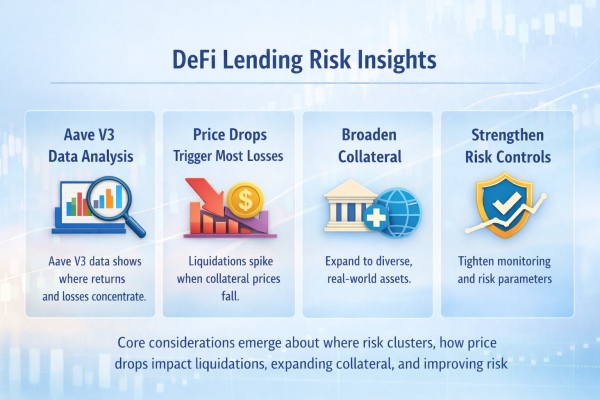
On April 2, 2026, a DeFi lending risk analysis using Aave V3 data from the Bank of Canada analyzes transaction data on Ethereum to find a market that works operationally, but depends on narrow revenue pools, heavy overcollateralization, and fast liquidation when collateral prices fall.
The paper focuses on Aave V3 because it is the largest decentralized lending protocol by total value locked. It cites about $34 billion secured in smart contracts, roughly 25% of all DeFi TVL and about 50% of lending sector TVL. The data analyzed runs from January 27, 2023 to May 6, 2025, which gives the study enough depth to study how the model behaves in live market conditions and not just theory.
The earnings base is much narrower than the deposit base. On Aave V3, WETH, USDT, and USDC generate nearly 83% of total protocol earning in the sample. That doesn't mean the same pattern holds across the entire DeFi lending market, but it does show the largest lending protocol still relies heavily on a small set of assets to produce revenue.
Supply alone does not tell you much. Utilization does. A token can hold a large share of deposits and still contribute very little if borrowing demand stays weak. So careful about judging a lending model by total deposits alone. Look at it by which assets actually generate borrow demand, spread income, and recurring usage.
The comparison with banking makes the constraint clearer. In 2024, Aave V3 posts an estimated 0.64% net interest margin, versus 2.48% for major US banks and 1.69% for major Canadian banks.
Aave V3 also shows a 40.0% loan to deposit ratio, compared with 61.2% for major US banks and 74.2% for major Canadian banks. The model runs with lower overhead, but it also runs with tighter economics and lower capital efficiency.
Repeated borrowing and redepositing of the same collateral accounts for about 20.46% of total borrowed volume and 8.20% of borrowing transactions on Aave V3.
Only about 2% of active users engage in this behaviour, but that small group borrows more often, takes larger positions, uses more flash loans, and runs closer to liquidation.
Risk isn't evenly spread across the user base, but with a relatively small group of sophisticated users who amplify exposure through repeated borrow and redeposit loops. A protocol can look healthy at the aggregate level while vulnerability builds inside a small cluster of accounts.
The largest liquidation wave in the sample reached about $258 million, and the top ten waves account for roughly 80% of total liquidated volume.
WETH, wstETH, WBTC, and weETH account for about 90% of total liquidated value. Collateral diversity on paper is not the same as resilience in practice. When account stress rises, losses still cluster around a small set of core assets.
For all liquidated users, 84.40% of health factor deterioration comes from collateral price declines. For the largest borrowers, that rises to 97.28%. Interest rate changes play only a minor role in the hour before liquidation. So do borrower actions like repaying, withdrawing, borrowing, or supplying more assets.
Immediate risk is mostly market driven. If collateral drops hard enough, the position breaks. Everything else is secondary.
Liquidation fees range from about 5% to 10% of liquidated value. When missed upside from post liquidation price recovery is added, combined borrower losses can reach roughly 10% to 30%.
Automation protects lenders and preserves solvency, but it forces borrowers out at the worst possible time. That raises a harder design question. How do you reduce forced exits before volatility does the damage?
The authors highlight tokenized real world assets as a way to broaden the collateral base and improve stability. They point to decentralized identity frameworks to support better underwriting.
They also raise the question of prudential tools such as leverage limits, capital requirements, or liquidity thresholds.
Concentration risk in DeFi isn't just exposure to a single token. It's dependence on a narrow collateral base, a narrow earnings base, and a narrow set of highly leveraged users. Broader collateral, stronger underwriting signals, and tighter limits can each address a different part of that problem.
Focus on where revenue actually comes from. If earnings depend on a small number of assets, growth is more fragile than it looks.
Track who drives leverage, not just how many users exist. A small group can shape downside risk.
Improve collateral quality, not just collateral variety. Adding assets does not reduce risk if stress still runs through the same core tokens.
Build liquidation buffers into the product. Earlier warnings, better position visibility, and automated risk controls can reduce forced selling.
The strategic takeaway is DeFi lending demand isn't the issue, but rather risk concentration is. The platforms that stand out will spread exposure across better collateral, reduce reliance on highly leveraged users, and design systems that hold up when prices drop. That's how the model can mature from access to durable growth.
 The National Crowdfunding & Fintech Association (NCFA Canada) is a financial innovation ecosystem that provides education, market intelligence, industry stewardship, networking and funding opportunities and services to thousands of community members and works closely with industry, government, partners and affiliates to create a vibrant and innovative fintech and funding industry in Canada. Decentralized and distributed, NCFA is engaged with global stakeholders and helps incubate projects and investment in fintech, alternative finance, crowdfunding, peer-to-peer finance, payments, digital assets and tokens, artificial intelligence, blockchain, cryptocurrency, regtech, and insurtech sectors. Join Canada's Fintech & Funding Community today FREE! Or become a contributing member and get perks. For more information, please visit: www.ncfacanada.org
 |  |  |
|---|---|---|
 |  |  |
Apr 2, 2026 | NCFA Insight | Capital Markets And Market Infrastructure
The market is no longer asking if tokenization works. It is deciding where it works first.
An OMFIF report on tokenization frameworks lays out how this market is forming. Not all tokenization is created equal. It breaks into different legal and operating models, and those models scale at different speeds. That aligns with what NCFA has already highlighted in how tokenized infrastructure is starting to change market operations.
In practice, the limits are already clear. On March 11, 2026, the European Central Bank confirmed Pontes will launch in Q3 2026 to enable central bank money settlement for DLT based transactions. The Eurosystem has also made clear that central bank money remains the anchor for settlement. Without trusted settlement, tokenized assets do not scale.
The OMFIF report separates tokenization into three models.
Most activity today sits in indirect and incomplete models. Fully native on chain markets remain limited. These structures carry different rights the affects ownership, investor protection, and how claims hold up under stress.
The spread across asset classes is now visible in real issuance and product data. As shown below, activity clusters where structure, custody, and settlement align with existing market practice.
Slovenia’s €30m sovereign issue and the World Bank’s €100m digital notes sit alongside tokenized fund products like BlackRock’s BUIDL at about $1.8bn and Franklin Templeton’s Benji fund at about $865m.
Real asset platforms such as RedSwan and Toucan extend this into real estate and carbon markets.
Infrastructure layers like Broadridge’s distributed ledger repo platform process about $385.5bn in daily volume. Adoption follows existing workflows.

Illustrative examples based on OMFIF report data and public disclosures
Most of the activity is around collateral. Assets remain with custodians while ownership records update faster, improving how collateral moves across the system. Market data supports this. RWA.xyz shows tokenized US Treasuries at about $10B and $27.57B in distributed asset value, alongside $299.32B in stablecoins.
Franklin Templeton’s off exchange collateral program shows how this works in practice. Clients use tokenized money market fund shares as collateral while assets remain in regulated custody, which is similar to what NCFA covered in institutional tokenized money market fund adoption. Collateral efficiency and usable capital drive early adoption.
According to the OMFIF report survey, faster isn't always better. Only 16% of bond market participants prefer T+0. Most prefer longer cycles to manage liquidity and funding. The target is settlement on demand, not instant settlement. That's why central banks are focusing on the money leg. Without trusted cash rails, tokenized assets don't scale cleanly.
At the same time, fragmentation still limits how far the model can go. There are 72 blockchains in use across financial services, and assets don't move easily across them without shared standards. Policy adds another constraint. In 2022, the Basel Committee set very high capital requirements for some public blockchain exposures, making them costly for banks to hold.
Even so, infrastructure is advancing. DTCC is preparing tokenization services for DTC-custodied assets, with rollout expected in the second half of 2026. The focus is on collateral mobility, continuous access, and programmable assets within existing systems.
Tokenization already works at scale in market infrastructure. Platforms like Broadridge’s distributed ledger repo solution support high volume repo activity, with reported usage reaching about $385bn in daily volume and roughly $9tn monthly across thousands of trades. It reduces friction in collateral movement and short term liquidity without requiring full market redesign. This is where adoption is already real.
The market is not converging on one model. It is dividing across designs impacted by real constraints. Products that match existing legal structures and improve workflows will adopt first. Others will take longer.
The National Crowdfunding & Fintech Association (NCFA Canada) is a financial innovation ecosystem that provides education, market intelligence, industry stewardship, networking and funding opportunities and services to thousands of community members and works closely with industry, government, partners and affiliates to create a vibrant and innovative fintech and funding industry in Canada. Decentralized and distributed, NCFA is engaged with global stakeholders and helps incubate projects and investment in fintech, alternative finance, crowdfunding, peer-to-peer finance, payments, digital assets and tokens, artificial intelligence, blockchain, cryptocurrency, regtech, and insurtech sectors. Join Canada's Fintech & Funding Community today FREE! Or become a contributing member and get perks. For more information, please visit: www.ncfacanada.org
| | |
|---|---|---|
| | |
April 2, 2026

Online casinos have changed a lot in recent years. The biggest shift involves the rise of crypto casinos, which allow players to bet with digital currencies like Bitcoin and Ethereum instead of regular money. These sites work differently from traditional online casinos in several important ways.
Crypto casinos offer faster payments, more privacy, and different bonus structures compared to traditional online casinos, though they also face unique regulatory challenges and learning curves for new users. Traditional sites use standard money and follow strict government rules, while crypto sites use blockchain technology to process bets and withdrawals. Each type has its own strengths and weaknesses that matter to different types of players.
The choice between crypto and traditional online casinos depends on what matters most to each player. Some people value speed and privacy, while others prefer the familiar systems and stronger legal protections of regular sites. This article explores how these two types of sites differ, what advantages crypto casinos provide, and what challenges they face in the current market.
Crypto casinos and traditional online gambling sites operate on different foundations that affect how players deposit funds, withdraw wins, and protect their personal information. The currency type, transaction speed, privacy levels, and access restrictions vary significantly between these two sites.
Traditional online casinos accept fiat currencies like dollars, euros, and pounds. Players deposit funds through bank transfers, credit cards, or e-wallets like PayPal. These methods connect directly to financial institutions and require verification of bank accounts or cards.
Crypto casinos accept digital currencies such as Bitcoin, Ethereum, and other cryptocurrencies. Players need a crypto wallet to store and transfer their digital assets. For example, sites like www.biggerz.com/, www.betpandacasino.io/, or others, allow users to gamble with various cryptocurrencies instead of traditional money.
The payment infrastructure differs substantially. Traditional sites rely on payment processors that charge fees for each transaction. Crypto sites use blockchain technology, which removes middlemen from the process. This means crypto casinos often have lower fees or no fees at all for deposits and withdrawals.
Traditional online casinos process withdrawals slowly. Bank transfers can take three to seven business days to complete. Credit card refunds may require five to ten days. E-wallets are faster but still need one to three days in most cases.
Crypto casinos process transactions much quicker. Deposits appear almost instantly in player accounts. Withdrawals typically complete within minutes to a few hours, depending on the blockchain network traffic. Bitcoin transactions might take longer than other cryptocurrencies, but they still beat traditional methods.
The speed difference comes from the verification process. Traditional casinos must verify transactions through banks and payment processors. Crypto transactions only need confirmation on the blockchain network. This removes delays caused by bank hours, holidays, or manual review processes.
Traditional gambling sites require extensive personal information. Players must provide their full name, address, date of birth, and phone number. They also need to submit identification documents like passports or driver's licenses. Banks and payment processors add another layer of data collection.
Crypto casinos offer more privacy. Many sites only ask for an email address and username to create an account. Players can gamble without submitting identity documents in most cases. Cryptocurrency transactions don't reveal personal details since they only show wallet addresses.
However, complete anonymity isn't guaranteed. Some crypto casinos still require verification for large withdrawals or to comply with regulations. The blockchain itself is public, so anyone can trace transaction patterns if they know which wallet belongs to a specific person.
Traditional online casinos face strict geographic restrictions. Many countries ban or heavily regulate online gambling. Payment processors often block transactions to and from gambling sites in restricted regions. Banks may decline deposits or freeze accounts linked to gambling activities.
Crypto casinos offer broader access. They can serve players in countries where traditional online gambling faces restrictions. The decentralized nature of cryptocurrency makes it harder for authorities to block transactions. Players can access these sites with fewer geographic barriers.
Regulations still apply in many jurisdictions. Some countries prohibit all forms of online gambling, whether crypto or traditional. Players remain responsible for following their local laws. Additionally, some crypto casinos choose to block certain countries to avoid legal complications.
Crypto casinos bring unique benefits like fair game verification and faster payments, but they also face hurdles with regulation and security concerns that players need to understand.
Provably fair gaming stands as one of the most significant features that sets crypto casinos apart from traditional sites. This technology uses blockchain and cryptographic algorithms to let players verify each game outcome independently. Players can check the fairness of every bet or spin through a hash function that proves the casino didn't manipulate results.
The system works through a process where the casino generates a random seed, and the player also contributes a seed. These seeds combine to create the game result. After each round, players receive all the information needed to verify that the outcome was truly random and not altered.
However, this advantage comes with a learning curve. Many players find the verification process confusing at first. The technical nature of hash verification requires some basic understanding of how blockchain works. Despite this challenge, provably fair systems offer a level of transparency that traditional online casinos cannot match.
Blockchain technology provides strong security features for crypto casino transactions. Every deposit and withdrawal gets recorded on a public ledger that cannot be changed or deleted. This creates a permanent record that both players and casinos can reference.
Players gain more control over their funds because cryptocurrencies eliminate the need for banks or payment processors. Transactions happen directly between the player's wallet and the casino. This direct transfer reduces the risk of payment fraud and chargebacks.
The transparency of blockchain also means players can verify casino reserves in some cases. Smart contracts can automate payments and enforce rules without human intervention. These features reduce the possibility of disputes over winnings.
On the other hand, cryptocurrency security depends heavily on proper wallet management. Players who lose their private keys lose access to their funds permanently. There is no customer service team that can reset a forgotten password or recover lost crypto. This responsibility shifts more risk onto the player compared to traditional casinos, where account recovery options exist.
Crypto casinos operate in a complex legal environment that varies widely between countries. Many jurisdictions have not yet created clear rules for cryptocurrency-based sites. This regulatory uncertainty creates risks for both operators and players.
Traditional online casinos typically hold licenses from established authorities that enforce player protection standards. Crypto casinos may operate with fewer restrictions, but this also means less oversight. Players might have limited recourse if disputes arise with unlicensed operators.
Some crypto casinos obtain licenses from recognized jurisdictions to build trust with players. However, the licensing requirements for crypto sites often differ from traditional casino regulations. This creates a patchwork of different standards across the industry.
Tax implications also present challenges for crypto casino players. Many tax authorities require individuals to report cryptocurrency gains, but tracking winnings and losses across multiple transactions can be difficult. Players bear the responsibility to understand and comply with their local tax laws.
Both crypto and traditional online casinos offer distinct advantages that appeal to different types of players. Crypto casinos provide faster transactions, more privacy, and lower fees, which attract those who value speed and anonymity. Traditional sites offer more established regulations, familiar payment methods, and a sense of security through licensed oversight.
The right choice depends on what matters most to each player. Those who prioritize quick withdrawals and privacy may prefer crypto sites, while players who want regulated environments with consumer protections might choose traditional sites.
The National Crowdfunding & Fintech Association (NCFA Canada) is a financial innovation ecosystem that provides education, market intelligence, industry stewardship, networking and funding opportunities and services to thousands of community members and works closely with industry, government, partners and affiliates to create a vibrant and innovative fintech and funding industry in Canada. Decentralized and distributed, NCFA is engaged with global stakeholders and helps incubate projects and investment in fintech, alternative finance, crowdfunding, peer-to-peer finance, payments, digital assets and tokens, artificial intelligence, blockchain, cryptocurrency, regtech, and insurtech sectors. Join Canada's Fintech & Funding Community today FREE! Or become a contributing member and get perks. For more information, please visit: www.ncfacanada.org
| | |
|---|---|---|
| | |
Apr 1, 2026 | NCFA Fintech Market Activity | Cross Border Payments And FX
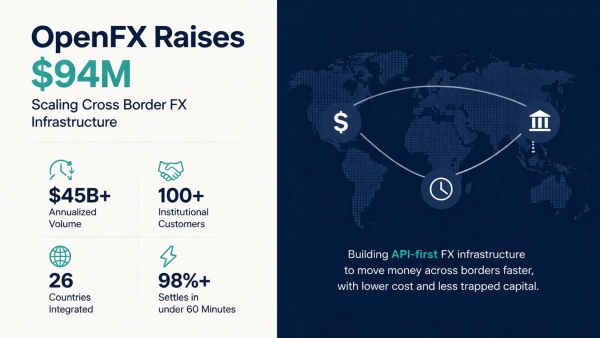
On March 31, 2026, OpenFX raised $94M to expand across Southeast Asia and Latin America. Two years after launch, the company says it now has 105 employees across four continents, handles more than $45B a year in cross border volume, and has onboarded more than 100 institutional customers.
The operating numbers are hard to ignore. OpenFX says 98% of transactions settle in under 60 minutes. In May 2025 the company said it had already integrated 26 countries and 7 major FX pairs, and that one newly onboarded client reached $100M in transaction volume in 17 days, with all of that settling within 60 minutes.
The product vision is more specific than a generic stablecoin pitch. Founder and CEO Prabhakar Reddy wrote that OpenFX didn't want to be “a crypto company moving Stablecoins,” but “a FX company moving money across the globe.”
OpenFX has built the hardest part of cross border payments first, including liquidity, cost, and settlement mechanics. It's tech stack offers collections, FX, payouts, banking, yield, compliance, and liquidity, delivered through API based infrastructure that runs 24/7.
That focus helps explain the customer base. OpenFX says it serves fintechs, neobanks, remittance providers, and payroll platforms, including MoneyGram, Yellow Card, and alfred. The company also says there's more than $200T in money movement that still relies on slow and fragmented cross border infrastructure.
OpenFX isn't selling speed on its own. Its announcement post argues that legacy cross border payments still hide fees inside exchange rates, trap capital in pre funded accounts, and leave businesses waiting days for settlement. OpenFX says stablecoins let value cross borders in seconds while sender and recipient still use local fiat. That reduces idle capital, compresses settlement time, and gives payment firms a cleaner way to handle large transfers.
There is a useful lesson here for founders and investors. OpenFX didn't try to fix every payment problem at once. It picked a part of the market where delay is expensive, built around API access and 24/7 settlement, then pushed that model into live institutional volume. If that keeps working, expect pressure to build around flows based on old economics andslow settlement, trapped liquidity, and wide spreads on large transfers.
If large ticket FX settles in under an hour, which parts of the old cross border fee stack get hardest to defend?
The National Crowdfunding & Fintech Association (NCFA Canada) is a financial innovation ecosystem that provides education, market intelligence, industry stewardship, networking and funding opportunities and services to thousands of community members and works closely with industry, government, partners and affiliates to create a vibrant and innovative fintech and funding industry in Canada. Decentralized and distributed, NCFA is engaged with global stakeholders and helps incubate projects and investment in fintech, alternative finance, crowdfunding, peer-to-peer finance, payments, digital assets and tokens, artificial intelligence, blockchain, cryptocurrency, regtech, and insurtech sectors. Join Canada's Fintech & Funding Community today FREE! Or become a contributing member and get perks. For more information, please visit: www.ncfacanada.org
| | |
|---|---|---|
| | |
April 1, 2026

The Bitelity broker further reveals its core concept through the development of a web-based trading infrastructure, emphasizing that browser-based solutions are becoming the foundation of modern trading, providing users with maximum flexibility, security, and stability. In this context, trading via web interfaces is not merely an alternative to traditional applications, but a полноцен technological standard that enables seamless and simultaneous access to multiple markets without the need to install additional software. This is especially important in the context of growing demands for cybersecurity and operational speed.
At the same time, the Bitelity platform is positioned as one of the fastest and most stable solutions on the market, offering users the ability to execute trades efficiently with just a few clicks, while maintaining high order execution accuracy and access to a wide range of analytical tools that go beyond standard mobile and desktop solutions. This creates a modern and intelligent trading environment focused on maximum convenience and performance.
A key advantage of the web platform is the absence of any installation requirement, which not only simplifies the onboarding process but also significantly reduces potential risks associated with downloading third-party software. Users are not required to grant access to personal data or system resources of their device, and the likelihood of malware infection is eliminated, collectively increasing trust in the platform and making the trading process more secure.
Additionally, the lack of installation means no strain on device memory and complete independence from its technical specifications, making the platform a universal tool accessible from any device with an internet connection. An important element of this concept is full compatibility and remote access, allowing users to connect to their trading account at any time, monitor market changes, and respond promptly regardless of their location—whether in a workspace or at home.
Thus, Bitelity creates a flexible interaction model in which the trader is not tied to a specific device and can freely manage their investments. This is especially relevant in dynamic financial markets, where timing plays a crucial role. Special attention is also given to eliminating limitations associated with relying solely on mobile applications, since dependence on a single device may lead to loss of access in case of loss or technical issues. In contrast, the web platform ensures continuity by allowing login from any device connected to the network, guaranteeing constant access to trading operations and reducing stress related to possible technical failures.
Another important advantage is the platform’s operational stability, achieved through a unified interface and identical functionality regardless of the device used. This provides users with a familiar and intuitive environment without the need to adapt to different software versions, which distinguishes the web solution from traditional approaches where differences between mobile and desktop applications can complicate the trading process. In the case of Bitelity, this issue is eliminated through interface and logic unification, ensuring a smooth user experience and minimizing the likelihood of errors.
Taken together, all these characteristics form a solid technological foundation that supports the platform’s core idea: to provide users with the most accessible, secure, and efficient tool for operating in financial markets. Every detail is aimed at enhancing convenience and reliability, and it is precisely this integration of speed, stability, and universality that allows the Bitelity web platform to be considered the central element of the entire ecosystem—combining the advantages of modern technology with the practical needs of traders. This creates the conditions for confident and uninterrupted trading in any situation, regardless of external factors, thereby strengthening the company’s overall direction toward creating long-term value for clients through technological excellence and a thoughtfully designed user experience.
The National Crowdfunding & Fintech Association (NCFA Canada) is a financial innovation ecosystem that provides education, market intelligence, industry stewardship, networking and funding opportunities and services to thousands of community members and works closely with industry, government, partners and affiliates to create a vibrant and innovative fintech and funding industry in Canada. Decentralized and distributed, NCFA is engaged with global stakeholders and helps incubate projects and investment in fintech, alternative finance, crowdfunding, peer-to-peer finance, payments, digital assets and tokens, artificial intelligence, blockchain, cryptocurrency, regtech, and insurtech sectors. Join Canada's Fintech & Funding Community today FREE! Or become a contributing member and get perks. For more information, please visit: www.ncfacanada.org
| | |
|---|---|---|
| | |
March 31, 2026

Crypto casino gaming now moves billions of dollars every year. Many players prefer these sites because they use provably fair technology, allow fast blockchain withdrawals, and offer games designed specifically for cryptocurrency betting. With the right site and game, players can verify outcomes and track exactly what happens to every wager.
The online gambling market is projected to surpass $100 billion by 2026, and crypto casinos continue to gain market share. Players are increasingly drawn to transparent systems, quick withdrawals that settle in minutes rather than days, and games whose outcomes can be verified.
Some of the most popular crypto casino games today include crash multiplier games, provably fair Plinko, high-volatility themed slots, modern 3D slot titles, and live dealer roulette with multiplier bonuses. Each offers a different style of gameplay and risk level.
This guide covers five of the most popular crypto casino games in 2026. All of them appear on licensed sites with fairness verification systems, fast crypto withdrawals, and active player communities.
Choosing the right crypto casino game requires understanding a few key factors.
The following five games are widely played by crypto casino users in 2026:
Each represents a different type of gameplay, from multiplier betting to slots and live dealer experiences. Let’s start:
Best for: Players who enjoy fast rounds and transparent outcomes.
Standout feature: A very low house edge combined with provably fair verification for every round.
Best for: Players seeking frequent payouts and unique slot mechanics.
Standout feature: A rare slot format where characters appear from underground instead of spinning reels.
Best for: Players looking for a high-volatility slot with the possibility of large multiplier wins.
Standout feature: Stacking multipliers combined with cascading reels and a maximum payout exceeding 21,000x the original bet.
Best for: Players who prefer simple gameplay with strong transparency.
Standout feature: Flexible risk settings combined with high RTP and full outcome verification.
Best for: Players who enjoy live dealer experiences combined with high multiplier potential.
Standout feature: Random lightning multipliers that dramatically increase payouts on selected numbers.
A trustworthy license ensures player protection and fair payouts. Always confirm the casino is regulated before depositing cryptocurrency.
High-volatility games may produce huge wins but also long losing streaks. Select games that fit your budget and risk tolerance.
Provably fair technology allows players to verify that outcomes were generated before the wager was placed, improving transparency.
One advantage of crypto gambling is fast payouts. Choose sites that process withdrawals quickly so winnings can be accessed without delays.
Some bonuses exclude certain games from wagering contributions. Reading the rules first prevents unexpected restrictions.
Transparency is one of the main reasons crypto casino gaming continues to grow. Provably fair algorithms and publicly listed RTP values allow players to analyze games before placing bets. This level of accountability is uncommon in traditional online casinos.
Selecting the right game involves more than choosing the biggest bonus or flashiest design. The most important factors are volatility, bankroll compatibility, fairness verification, and withdrawal reliability.
Before depositing, always confirm the site’s license and payout speed. Those checks ensure that when you win, your funds are secure and accessible.
The National Crowdfunding & Fintech Association (NCFA Canada) is a financial innovation ecosystem that provides education, market intelligence, industry stewardship, networking and funding opportunities and services to thousands of community members and works closely with industry, government, partners and affiliates to create a vibrant and innovative fintech and funding industry in Canada. Decentralized and distributed, NCFA is engaged with global stakeholders and helps incubate projects and investment in fintech, alternative finance, crowdfunding, peer-to-peer finance, payments, digital assets and tokens, artificial intelligence, blockchain, cryptocurrency, regtech, and insurtech sectors. Join Canada's Fintech & Funding Community today FREE! Or become a contributing member and get perks. For more information, please visit: www.ncfacanada.org
| | |
|---|---|---|
| | |
Mar 30, 2026 | NCFA Insight | Regulation And Policy, Digital Assets

On Mar 26, 2026, Bill C-25 was introduced to amend the Canada Elections Act (download 45 page Bill C-25 PDF). The bill blocks third parties from accepting contributions made in cryptoassets, prepaid payment products, or money orders for partisan activity, election advertising, or surveys. If received, those funds must be returned, destroyed, or converted and handed to the Receiver General.
Anonymous contributions are prohibited. Foreign sourced funds, property, and services are prohibited. Regulated expenses must be funded by Canadian individuals, with a limited exception allowing a third party to use its own funds only when prior year contributions are 10% or less of revenue. Disclosure also tightens. Once a contributor exceeds $200, reporting must include name, address, amount, and timing.
In practice, this closes most of the remaining paths for political money that cannot be clearly attributed.
The bill does not regulate crypto markets. It removes funding methods that make source of funds and identity harder to verify. Crypto sits alongside instruments that break clean audit trails.
This is consistent with how Canadian regulators already handle higher risk flows. When identity or intent cannot be confirmed, access gets restricted. That same pressure showed up in rules applied to donation crowdfunding platforms and in guidance on bitcoin ATMs, where operators are expected to treat even smaller transactions within a broader AML framework.
Political finance applies that standard without exception.
This is a political funding rule, and doesn't apply to general payments or everyday crypto use.
It does show how regulators act when attribution cannot be optional. Funding must be tied to identifiable sources, supported by records, and capable of audit.
Failures to meet that bar already carry real consequences. Major AML breakdowns at large institutions and advances in detection, including AI driven money laundering techniques and shell company structures, show how quickly expectations are rising.
Bill C-25 is focused on political funding. Money used in elections must be attributable, traceable, and tied to identifiable Canadian sources. Fintech and financial institutions dealing with Canadian election flows must be able to prove who sent the money, where it came from, and how it moved, otherwise they'll soon be under pressure.
The National Crowdfunding & Fintech Association (NCFA Canada) is a financial innovation ecosystem that provides education, market intelligence, industry stewardship, networking and funding opportunities and services to thousands of community members and works closely with industry, government, partners and affiliates to create a vibrant and innovative fintech and funding industry in Canada. Decentralized and distributed, NCFA is engaged with global stakeholders and helps incubate projects and investment in fintech, alternative finance, crowdfunding, peer-to-peer finance, payments, digital assets and tokens, artificial intelligence, blockchain, cryptocurrency, regtech, and insurtech sectors. Join Canada's Fintech & Funding Community today FREE! Or become a contributing member and get perks. For more information, please visit: www.ncfacanada.org
| | |
|---|---|---|
| | |



August 26th, 2025

January 4th, 2024

June 1st, 2021

September 9th, 2020

July 9th, 2018

January 3rd, 2018

September 25th, 2017

June 20th, 2017

May 10th, 2017

December 14th, 2016
