




Karsten Wenzlaff, Advisor
August 26th, 2025
Karsten Wenzlaff is a Crowdfunding and Fintech Expert from Germany. He is Secretary-General of Digit[...]


January 21, 2026 | Report Insights
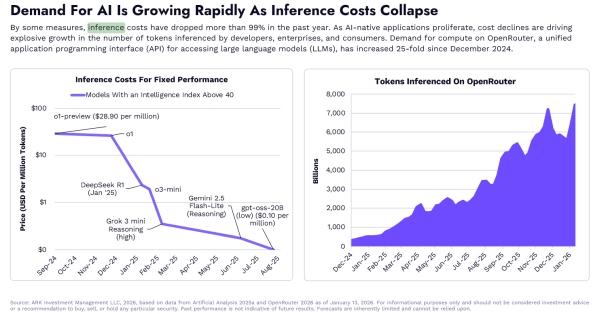
Image: ARK Invest, Big Ideas 2026 report. AI inference cost data reproduced for commentary and analysis.
In January 2026, ARK Invest released its annual research report Big Ideas 2026, building on trends first measured in Big Ideas 2025. The 111 page report spans artificial intelligence, tokenized assets, decentralized finance, Bitcoin, consumer AI platforms, and what ARK describes as the Great Acceleration. Rather than summarizing each theme in isolation, this article focuses on how these technologies accelerate change together inside financial systems.
What felt experimental in 2024 and operationally strained in 2025 now shows up as baseline reality in 2026. AI costs collapse, investment capital concentrates in infrastructure, digital assets move closer to settlement rails, and consumer AI platforms compress decision cycles. These forces do not arrive sequentially. They compound. The result is technically a financial system that no longer needs to pause between decisions.
ARK’s data on collapsing AI inference costs explains why this shift becomes unavoidable. At the same time, investment capital continues to concentrate in infrastructure designed for continuous operation. Together, these forces change how money moves, settles, and gets controlled.
Finance is AI-native by design. It already runs on software, explicit rules, and constant feedback. As AI becomes cheap enough to run continuously, software acts directly inside financial systems instead of waiting for human input.
ARK’s Big Ideas 2026 research shows AI inference costs dropped more than 99% in the past year. That single data point explains why continuous operation becomes economically viable at scale for the first time.
When inference costs fall that far, AI stops being something teams consult occasionally. It becomes something that runs all the time. Human prompts, batch reviews, and periodic decision cycles turn into friction rather than safeguards.
In financial systems, this breaks a long standing boundary. AI no longer stops at scoring, forecasting, or recommendations. It initiates actions. Payment routing adjusts automatically. Exposure limits rebalance in real time. Liquidity thresholds enforce themselves continuously. Software no longer waits for approval at every step.
Founders experience this when systems stay busy all the time instead of spiking occasionally. Investors see it when infrastructure costs stop falling as predictably even while revenue continues to grow. Operating leverage behaves differently because systems no longer rest between decisions.
ARK’s capital analysis shows where investment capital flows as systems scale. In 2025, annual investment in data center systems reached roughly $500B, nearly 2.5 times the long term average from 2012 through 2023. Since the ChatGPT moment, ARK shows growth accelerating from about 5% to 29% annually. The report projects this category of investment could approach $1.4T by the end of the decade.
That level of spending signals where long term value accrues. Capital is not chasing surface automation features. It is concentrating where compute, data availability, uptime, and recovery determine whether systems can operate continuously without failure.
For fintech teams, this breaks a familiar assumption. Products designed for occasional use face redesign pressure. Infrastructure built for constant operation gains structural leverage. Cost structure, resilience, and throughput now shape competitive advantage more than feature differentiation.
Traditional payment systems assume a person initiates the transaction. AI breaks that assumption. Software now initiates payments, manages balances, and settles obligations automatically as conditions change.
This pushes pressure into liquidity management, fraud controls, and settlement logic. Batch review fails quietly when systems never pause. ARK’s analysis of AI driven transaction flows emphasizes sustained throughput and recovery under stress rather than peak performance.
Founders building payment infrastructure encounter this pressure early. Systems designed for bursts now operate under constant load, and cost curves change accordingly. Reliability becomes a competitive feature rather than an operational afterthought.
ARK’s 2026 research frames consumer AI as an operating layer rather than a feature. AI models converge into a consumer operating system, and adoption accelerates faster than earlier digital platforms. As these systems take on purchasing, allocation, and coordination tasks, decision making shifts closer to software execution.
Wallets evolve alongside this change. They function less as interfaces and more as control layers for software driven financial activity. Identity, permissions, and payment logic compress into the same layer.
Investors familiar with earlier platform cycles recognize this pattern. Control consolidates where decisions execute, not where they are merely displayed.
ARK frames tokenized assets as market infrastructure moving trillions of dollars in asset value onto blockchains. Tokenization matters because assets move and settle automatically. DeFi matters because financial rules run on software without manual steps.
ARK’s data shows digital asset application revenue reaches roughly $3.8B in 2025, with around one fifth generated in January alone. The report also notes that about 70 applications generate more than $1M each in monthly recurring revenue. Value capture shifts from base networks toward platforms that control execution, coordination, and user interaction.
For fintech builders, this exposes a structural mismatch. Systems designed for batch reconciliation struggle when assets move continuously.
ARK’s research treats stablecoins as payment and settlement rails, not alternative products. Transaction activity reaches record levels because stablecoins can now move value automatically and clear obligations without waiting for manual steps.
Bitcoin functions as a monetary network with predictable issuance and global settlement. In 2026, its relevance aligns with the same requirement driving stablecoin use. When systems run continuously, money must move at software speed.
This doesn't remove banks, payment firms, or regulators. It changes how settlement works underneath them, reflected in Canada’s Stablecoin Act draft, which outlines how programmable settlement rails are governed.
ARK's analysis points to convergence. Continuous systems expose the limits of oversight built around delayed reporting and human initiated workflows. Design, auditability, and real time visibility matter more because systems no longer pause between decisions.
For policymakers, this changes where effective oversight begins. Rules written for periodic review struggle when financial activity runs continuously. Payments oversight, digital asset policy, and AI governance increasingly overlap because the systems themselves overlap.
Teams that design for transparency and control early reduce downstream risk. Regulators that focus on system behaviour rather than product labels gain clearer visibility and fewer surprises.
Big Ideas 2026 highlights what happens when AI inference costs collapse by more than 99%, investment capital concentrates at unprecedented scale, digital assets mature into settlement rails, and consumer AI platforms compress decision cycles at the same time. Finance changes faster because it already runs on rules, incentives, and software.
AI systems now run continuously. Many teams still model for peak usage instead of sustained operation. The gap appears in compute, monitoring, compliance operations, and incident response long before it shows up in customer metrics.
Infrastructure intensity rises faster than application revenue. ARK’s capital data shows control and throughput capture value before features do. Margins do not scale linearly during infrastructure transitions.
Human initiated workflows. Cost per transaction and average response time lose meaning when systems never pause. Sustained throughput and recovery time under stress become the binding constraints.
Frameworks assume discrete events. Continuous systems blur those boundaries. Risk appears as operational mismatch rather than enforcement action.
 The National Crowdfunding & Fintech Association (NCFA Canada) is a financial innovation ecosystem that provides education, market intelligence, industry stewardship, networking and funding opportunities and services to thousands of community members and works closely with industry, government, partners and affiliates to create a vibrant and innovative fintech and funding industry in Canada. Decentralized and distributed, NCFA is engaged with global stakeholders and helps incubate projects and investment in fintech, alternative finance, crowdfunding, peer-to-peer finance, payments, digital assets and tokens, artificial intelligence, blockchain, cryptocurrency, regtech, and insurtech sectors. Join Canada's Fintech & Funding Community today FREE! Or become a contributing member and get perks. For more information, please visit: www.ncfacanada.org
 |  |  |
|---|---|---|
 |  |  |
Stablecoins | January 20, 2026
Image: FCA Stablecoin sprint participation pack, March 4-5, 2026
The UK Financial Conduct Authority is hosting a Stablecoin Sprint on March 4 and 5, 2026 in London. Applications are open until February 4, 2026. The Sprint feeds directly into the FCA’s work to finalize stablecoin payment rules later in 2026 and focuses on retail payments and remittances, including point of sale payments, ecommerce, domestic transfers, and cross border payments. A smaller roundtable planned for May will focus on trade payments, including trade finance and B2B payment flows.
The Stablecoin Sprint follows a series of FCA consultations in 2025 covering stablecoin issuance, safeguarding of cryptoassets, prudential capital and liquidity requirements, disclosure for UK issued qualifying stablecoins, and application of the FCA Handbook to regulated crypto activities. The FCA has also opened a stablecoins cohort within its Regulatory Sandbox to allow issuers to test UK issued stablecoins.
The FCA has structured the Sprint around three policy questions that go directly to how stablecoin payments would operate in practice. Full details are set out in the 16 page PDF, FCA Stablecoin Sprint participation pack.
The first problem statement asks what business models firms could use to deliver stablecoin payment use cases. Participants are expected to map payment flows end to end and explain how roles and responsibilities sit across issuers, wallets, payment providers, banks, and infrastructure firms.
The second problem statement examines where opportunities and risks arise within those models. This includes identifying where consumer harm, financial crime exposure, operational failure, or business weakness could appear, as well as where stablecoin payments could offer real improvements over existing payment systems.
The third problem statement focuses on priorities. Participants are asked to consider what regulation is needed, what may not be needed, and where risks could be addressed through business practices or technical design rather than new rules.
Across all three problem statements, the FCA asks participants to test stablecoin payment models against cost, speed, interoperability, certainty of settlement, and consumer protection.
Canadian regulators have already consulted publicly on payment functions through the Retail Payment Activities Act and on stablecoins through federal and securities frameworks. What the FCA Sprint adds is a use case driven exercise that brings those questions together around live payment flows. For Canadian fintechs, it offers a clear view of the practical issues regulators may still need to address as stablecoins move from trading into everyday payments.
As stablecoins move from trading and settlement into everyday payment use, regulators are under pressure to explain how these models fit within existing payment rules. The FCA Stablecoin Sprint shows that key questions around business models, risk ownership, and consumer protection remain open. For fintechs, payment firms, and infrastructure providers, the Sprint offers a clear view of where policy attention now sits and where practical clarity will matter most as stablecoin payment rules take shape. Apply Now
The National Crowdfunding & Fintech Association (NCFA Canada) is a financial innovation ecosystem that provides education, market intelligence, industry stewardship, networking and funding opportunities and services to thousands of community members and works closely with industry, government, partners and affiliates to create a vibrant and innovative fintech and funding industry in Canada. Decentralized and distributed, NCFA is engaged with global stakeholders and helps incubate projects and investment in fintech, alternative finance, crowdfunding, peer-to-peer finance, payments, digital assets and tokens, artificial intelligence, blockchain, cryptocurrency, regtech, and insurtech sectors. Join Canada's Fintech & Funding Community today FREE! Or become a contributing member and get perks. For more information, please visit: www.ncfacanada.org
| | |
|---|---|---|
| | |
Stablecoins | Jan 19, 2026

January 2026 finds stablecoins firmly inside the regulatory process. Governments are writing rules that determine how these instruments can operate within payment systems. In Canada, draft federal legislation is now under review, as outlined in Canada releases the first draft of the Stablecoin Act. In the United States, policymakers and industry groups are focused on a narrower question: whether regulators should treat rewards offered by third party platforms the same way they treat interest paid by stablecoin issuers?
Canada’s draft framework draws a clear line at issuer behaviour. The draft rules prohibit stablecoin issuers from paying interest or yield, reinforcing the view that stablecoins should function as payment instruments rather than deposit substitutes. The draft does not yet spell out how regulators will treat rewards offered by wallets, exchanges, or other platforms once those rules take effect. The above open question explains why the US debate has relevance in Canada. Incentive design often becomes the point regulators use to decide whether a product remains within payments or moves closer to deposit like treatment, even when the user experience appears unchanged.
In Washington, the argument doesn't focus on issuer paid interest. That restriction is largely settled. The disagreement is whether third-party platforms should be allowed to offer rewards that encourage people to hold or use stablecoins.
Banking groups argue that rewards tied to balances could draw funds away from traditional deposits and weaken lending models.
Crypto and fintech advocates respond that platform funded rewards resemble familiar payment incentives such as card rebates or loyalty programs and do not create a claim on the stablecoin issuer. The analysis of whether third party stablecoin rewards should be banned walks through how lawmakers are weighing whether issuer interest bans should also capture platform rewards.
For Canada, the point is how regulators separate issuer obligations from platform competition when incentives sit on top of a payment instrument.
Canada’s draft framework concentrates on issuer conduct. Issuers would need to meet requirements around reserves, redemption, governance, and risk management, and they would be barred from paying interest or yield. This keeps stablecoins from being marketed as savings products. What the draft does not spell out is how independently funded rewards offered by wallets, exchanges, or other platforms would be treated in practice. NCFA has previously noted how regulatory tolerance tightens as stablecoins move closer to core payments infrastructure.
As of the time of publishing, neither the Bank of Canada nor Finance Canada has published summaries of stakeholder submissions on the draft stablecoin rules (although some may have been directly published), and no further official public guidance on platform rewards or inducements has been released yet.
Stablecoins now fall within the scope of Canada’s payments modernization process, even though final rules are still pending. Regulators classify stablecoins as payment instruments that intersect with payment service providers, real time settlement, and retail payments supervision. NCFA walks through how this plays out in Stablecoin payments have wings, showing how digital payment instruments move from edge cases into everyday payment design.
How regulators handle rewards on stablecoins will influence how other payment products using rebates, credits, or embedded incentives are treated. This goes beyond crypto and into the design of future payment services.
Once stablecoins sit inside everyday payments, regulators have to decide whether usage based incentives fit within a payments framework or whether they push products toward deposit like treatment. That decision will affect not only stablecoin products, but also other payment models that rely on incentives to drive adoption.
For Canadian fintechs, incentive design now carries regulatory weight. Who pays the reward, how it’s described, whether it remains discretionary, and how custody is structured could influence how a product is classified. This isn’t a narrow crypto issue. It’s part of how Canada decides what belongs inside payments regulation and what doesn’t.
The National Crowdfunding & Fintech Association (NCFA Canada) is a financial innovation ecosystem that provides education, market intelligence, industry stewardship, networking and funding opportunities and services to thousands of community members and works closely with industry, government, partners and affiliates to create a vibrant and innovative fintech and funding industry in Canada. Decentralized and distributed, NCFA is engaged with global stakeholders and helps incubate projects and investment in fintech, alternative finance, crowdfunding, peer-to-peer finance, payments, digital assets and tokens, artificial intelligence, blockchain, cryptocurrency, regtech, and insurtech sectors. Join Canada's Fintech & Funding Community today FREE! Or become a contributing member and get perks. For more information, please visit: www.ncfacanada.org
| | |
|---|---|---|
| | |
January 16, 2026 | NCFA Fintech Whisperer Weekly Intelligence | Regulation And Policy, Payments And Market Infrastructure, Lending Consumer Credit And BNPL, Digital Assets Blockchain And Tokenization

Image: Freepik
This live weekly NCFA intelligence page tracks financial technology developments that significantly affect how fintechs build, sell, raise capital, and operate under scrutiny. Coverage prioritizes Canada and includes global events that directly influence competitive conditions, market access, and execution realities across fintech sectors. This page will be updated throughout the week with market movers in a live format and then each week we'll close the prior week's contents in prep for the upcoming week, and continue on a rolling basis. (Missed prior week's Fintech Whisperer? (December 6-12, 2025, December 13-19, 2025, January 1-9, 2026)
Cross border payments still break down in the same places. Too many handoffs, too much reconciliation, and too much time and cost hiding in the middle. When central banks and major banks test a shared settlement model together, they start setting expectations for speed, data standards, and risk controls. Fintechs that sell treasury, compliance, and payment operations tooling should prepare for buyers that demand cleaner audit trails and tighter settlement logic as the new baseline.
This places SME lending market structure under direct policy scrutiny rather than access narratives alone. For fintech lenders, the signal favours models that reduce switching friction, improve transparency, or introduce credible competitive pressure. For incumbents, the risk sits in policy driven changes that reshape pricing power and distribution over time.
Crypto and stablecoin distribution is tied to unresolved legislative design choices rather than settled rules. Platforms planning to scale under supervision must design operating models that handle changes in incentive treatment, oversight jurisdiction, and compliance expectations without disrupting delivery. Capital and distribution advantage increasingly favour teams that can adapt quickly as market structure rules evolve. US Crypto Week to Impact Global Policy
The UK is putting stablecoin payments into hands on market design, not only policy debate. Builders that want UK distribution should treat this as a signal to get practical fast on consumer protection, complaint handling, safeguarding, and settlement controls. The teams that show working flows, clean reporting, and clear accountability win mindshare early and they tend to shape what becomes normal later.
Clear rules increasingly define who can scale in crypto and stablecoin markets. Platforms that rely on regulatory ambiguity face shrinking room to operate, while firms built for supervision gain an advantage. Founders should plan for explicit role separation, auditable controls, and regulator ready operating models across exchanges, custody, and wallets. Investors should expect value to concentrate in businesses that can grow inside defined rules without slowing product execution.
Supporting links:
Congressional Research Service overview
MiCA turns EU market access into a deadline with real exit risk. Crypto firms that sell into Europe now need licensing readiness and an orderly wind down plan partners can accept, because regulators are already mapping who intends to comply and who intends to leave.
Stablecoin settlement is turning into a control point, not a feature. When a platform owns more of the settlement stack, it can ship faster, price tighter, and negotiate from strength with banks and distribution partners. Founders should treat integration readiness, reconciliation, and audit grade controls as table stakes. Investors should expect the best outcomes to cluster around teams that control settlement plus compliance plus distribution.
Legislative work in the United States and platform moves to control settlement and compliance show where the market is heading, and growth will favour firms that can run clean operations, manage risk inside regulated environments, and still move fast. Investors should focus on teams that can scale without relying on regulatory gaps or temporary structures. NCFA offers various curated resources to help founders and investors stay current on developments that impact fintech markets, subscribe to NCFA’s weekly newsletter, view a rundown of current fintech news and insights, or dive into the latest fintech industry research.
The National Crowdfunding & Fintech Association (NCFA Canada) is a financial innovation ecosystem that provides education, market intelligence, industry stewardship, networking and funding opportunities and services to thousands of community members and works closely with industry, government, partners and affiliates to create a vibrant and innovative fintech and funding industry in Canada. Decentralized and distributed, NCFA is engaged with global stakeholders and helps incubate projects and investment in fintech, alternative finance, crowdfunding, peer-to-peer finance, payments, digital assets and tokens, artificial intelligence, blockchain, cryptocurrency, regtech, and insurtech sectors. Join Canada's Fintech & Funding Community today FREE! Or become a contributing member and get perks. For more information, please visit: www.ncfacanada.org
| | |
|---|---|---|
| | |
Crypto | Jan 15, 2026

Image: Freepik/fabrikasimf
On January 9, 2026, the Ontario Superior Court ordered Binance to pay $261,900 in legal costs after finding that its attempt to force a Hong Kong arbitration was abusive and aimed at intimidating Canadian investors. The ruling issued in Lochan v. Binance Holdings Limited, 2026 ONSC 194 didn't decide whether Binance ultimately violated securities law, but it delivered a clear rebuke of litigation tactics designed to undermine a certified Canadian class action.
The case was brought by Christopher Lochan and Jeremy Leeder, two Canadian investors acting as representative plaintiffs on behalf of other Canadians who used Binance’s platform. They allege that Binance allowed Canadians to trade crypto products that fall under Ontario securities law without registering or providing a compliant prospectus, contrary to the Ontario Securities Act.
NCFA first covered the lawsuit when Canadian investors led a class action against Binance Canada, highlighting why the case raised broader questions about how crypto platforms operate in Canada. The Ontario court later certified the case as a class action in 2024, allowing it to proceed on behalf of affected users rather than as individual claims.
Binance attempted to block the lawsuit by relying on an arbitration clause in its standard user agreement that required disputes to be resolved in Hong Kong. Ontario courts rejected that strategy. In 2023, the court found the clause unenforceable, concluding that the cost and structure of the arbitration process would make it unrealistic for ordinary Canadians to pursue claims and would place Binance beyond the reach of Canadian courts.
NCFA later examined this turning point in Ontario court blocks Binance’s costly arbitration clause. Those findings were upheld on appeal, confirming that the arbitration clause was void as contrary to public policy.
Despite those rulings, Binance later began arbitration proceedings in Hong Kong through a related offshore entity. That arbitration targeted Lochan and Leeder personally and claimed they breached their contract simply by starting the Ontario lawsuit.
The court found that the offshore entity was an alter ego of Binance and that the arbitration was a direct attempt to sidestep earlier Ontario decisions. In 2025, Justice Morgan issued an anti-suit injunction restricting Binance and its affiliates from continuing the Hong Kong arbitration.
As Justice Morgan put it,
“That approach by the Defendants appeared to me to have been aimed not at building a meritorious argument, but at, frankly, scaring the Plaintiffs away from their claim.”
In January 2026, the court said Binance’s conduct crossed a line. The judge found that the company used litigation tactics that were abusive and unfair, and that they exposed the representative plaintiffs to personal financial risk simply for bringing a certified class action on behalf of other Canadians.
Although the court hearing itself was brief, the judge made clear that the work behind it was not. The plaintiffs had to respond quickly to a complicated cross-border legal move that threatened to derail a case the court had already approved to proceed. Because of that effort, the court ordered Binance to pay $261,900 to cover the plaintiffs’ legal costs.
The Ontario court's decision draws a clear line for global fintech and crypto platforms operating in Canada. Once a Canadian court takes jurisdiction, companies are expected to deal with the case directly and in good faith. Contract clauses and offshore tactics cannot be used to pressure individual plaintiffs or shut down class actions.
The National Crowdfunding & Fintech Association (NCFA Canada) is a financial innovation ecosystem that provides education, market intelligence, industry stewardship, networking and funding opportunities and services to thousands of community members and works closely with industry, government, partners and affiliates to create a vibrant and innovative fintech and funding industry in Canada. Decentralized and distributed, NCFA is engaged with global stakeholders and helps incubate projects and investment in fintech, alternative finance, crowdfunding, peer-to-peer finance, payments, digital assets and tokens, artificial intelligence, blockchain, cryptocurrency, regtech, and insurtech sectors. Join Canada's Fintech & Funding Community today FREE! Or become a contributing member and get perks. For more information, please visit: www.ncfacanada.org
| | |
|---|---|---|
| | |
Prediction Markets | Jan 12, 2026

On January 10, 2026, prediction markets were back in the spotlight when an anonymous trader wagered more than $30,000 USD on the removal of Venezuelan president Nicolás Maduro and later collected over $400,000 USD once the outcome became public. No regulator has confirmed insider trading and no enforcement action has been announced, but the successful trade result matters because it shows how quickly prediction markets can price almost anything including geopolitical outcomes ahead of official confirmation.
It's another visible, benchmarked stress test of a category that has been scaling quietly for years. Prediction markets have gone mainstream and are evolving into fast moving information markets that sit at the intersection of finance, media, and public policy. In some way, they're beginning to resemble consumer finance products rather than novelty bets. Then distribution was another recent inflection point when MetaMask added Polymarket access directly inside its self custody wallet, prediction markets moved closer to everyday crypto workflows. Once markets become native features rather than standalone destinations, scale accelerates.
Prediction markets scale because they sell something scarce. A continuously updating probability signal backed by capital. Traders adjust prices faster than surveys (as they have skin in the game). Media repeats those prices as indicators. Investors track them as sentiment inputs and risk signals. That loop turns a market price into a reference point that travels quickly across sectors.
At scale, intent matters less than structure. Markets don't need bad actors to create risk. Risk emerges when incentives move faster than controls. The Maduro trade illustrates this dynamic without proving wrongdoing. A sensitive geopolitical outcome was priced by a market before institutions and the public had time to react.
Regulatory friction starts with classification, and prediction markets sit between gambling and financial products, depending on jurisdiction and design.
In the United States, Kalshi operates as a designated contract market overseen by the Commodity Futures Trading Commission. The CFTC explains that designated contract markets are federally regulated trading venues subject to surveillance, reporting, and market integrity requirements in its Designated Contract Markets overview. US regulators and courts continue to debate which categories of event contracts are appropriate for trading under this structure, particularly where contracts resemble gambling rather than traditional risk management.
Polymarket followed a different path. The platform previously faced enforcement action from US regulators for offering unregistered event based binary options to American users, resulting in a monetary penalty and a wind down of those markets. Then the company experienced a regulatory reset. NCFA previously covered how Polymarket earned approval to relaunch in the US.
Canada banned short term binary options for retail investors in 2017 after widespread fraud harmed consumers. The Canadian Securities Administrators set out the prohibition and its scope, and clarified that products paying out on simple yes or no outcomes fall within that restriction under Multilateral Instrument 91-102. Because most prediction market contracts share that payout structure, independent prediction markets are effectively prohibited unless operated directly by provincial gaming authorities.
That approach reduced direct consumer exposure. It did not eliminate influence. Canadians still consume market driven narratives generated elsewhere. Market odds circulate through global media and social platforms regardless of domestic rules. Capital continues to flow to platforms operating in more flexible jurisdictions.
The Maduro payout highlights a structural challenge rather than an allegation. When markets are novel, fast, and global, existing frameworks struggle to answer basic integrity questions.
In traditional securities markets, insider trading rules address the use of material non-public information. Prediction markets often sit outside that framework. Platforms may prohibit insider use contractually, but enforcement becomes difficult when identity is masked and funds move through crypto rails.
Integrity risks extend beyond insider advantage. Wash trading incentives can distort volume. Thin liquidity in long tail markets can exaggerate price movement. Concentrated positions can temporarily push odds that then echo through coverage and perception. These dynamics do not stay contained within the platform.
Prediction market operators often describe their platforms as sentiment barometers. Prices aggregate belief. Odds update with new information. That framing holds more easily on entertainment or sports outcomes.
It gets harder when markets trade on politics, elections, or government decisions. Prices stop being just signals of opinion. People notice them, talk about them, and react to them. Once those prices show up in headlines, they start to influence how investors, the media, and the public think about what is likely to happen. Markets that say they only reflect reality can end up helping to shape it.
Prediction markets are scaling because they meet demand for real time signals in an uncertain world. Regulators now face a strategic choice. Continue treating these platforms as edge cases, or acknowledge that they are becoming part of the financial and information ecosystem and design rules accordingly.
For Canada, the question is whether governance evolves in step with market reach, or whether influence continues to arrive from outside the regulatory perimeter.
When markets bet on geopolitics, the issue is not the trade itself. It is whether the rules governing markets, information, and incentives are built for the reality that now exists.
The National Crowdfunding & Fintech Association (NCFA Canada) is a financial innovation ecosystem that provides education, market intelligence, industry stewardship, networking and funding opportunities and services to thousands of community members and works closely with industry, government, partners and affiliates to create a vibrant and innovative fintech and funding industry in Canada. Decentralized and distributed, NCFA is engaged with global stakeholders and helps incubate projects and investment in fintech, alternative finance, crowdfunding, peer-to-peer finance, payments, digital assets and tokens, artificial intelligence, blockchain, cryptocurrency, regtech, and insurtech sectors. Join Canada's Fintech & Funding Community today FREE! Or become a contributing member and get perks. For more information, please visit: www.ncfacanada.org
| | |
|---|---|---|
| | |
January 9, 2026 | NCFA Fintech Whisperer Weekly Intelligence | Digital Assets Blockchain And Tokenization, Payments And Money Movement, Regulation And Policy
Image: Freepik
This live weekly NCFA intelligence page tracks financial technology developments that significantly affect how fintechs build, sell, raise capital, and operate under scrutiny. Coverage prioritizes Canada and includes global events that directly influence competitive conditions, market access, and execution realities across fintech sectors. This page will be updated throughout the week with market movers in a live format and then each week we'll close the prior week's contents in prep for the upcoming week, and continue on a rolling basis. (Missed prior week's Fintech Whisperer? (December 6-12, 2025, December 13-19, 2025)
This moves crypto distribution deeper into mainstream wealth plumbing where compliance, custody, and operational control define who wins. Founders should plan for bank grade diligence on custody, reporting, and risk controls, and investors should expect value to concentrate in infrastructure that supports regulated product distribution, not retail hype cycles.
Moves from experimentation to system level execution for a sovereign digital currency. For fintechs and infrastructure providers, the signal is not retail adoption but architecture. Digital money is being designed as a governed liability with defined operational rules, which sharpens competition between CBDCs, stablecoins, and tokenized deposits. Founders should watch where interoperability, wallet design, and settlement interfaces align with central bank control, and investors should expect digital money infrastructure to increasingly price around governance and balance sheet integration rather than novelty.
This tightens the path for payment fintechs that rely on regulatory ambiguity to move fast. Founders selling into India or routing flows through India should treat governance clarity as a timeline accelerator for compliance builds and a bar raiser for risk and controls, especially for cross border money movement and large scale consumer rails.
This raises the governance bar in a part of the banking system that often intersects with local credit, deposits, and community distribution. Fintechs that partner with co operative banks should expect tighter board level scrutiny on vendor selection, risk oversight, and operating controls, especially where products touch lending, onboarding, and customer outcomes.
OSFI resets the near term work queue for banks and insurers, and that changes where compliance and risk budgets land first. Fintechs that sell governance, reporting, climate data, or risk tooling win more deals when they attach to everyday evidence and controls that teams must run year round, not one time deadline projects that slide when priorities change.
This extends a bank style public interest standard into non bank mortgage lending. Fintech mortgage lenders that want scale in New York now need measurable community lending performance alongside compliant underwriting.
This pulls pricing design into enforcement scope. Fintechs that rely on fee complexity to lift margins now face a tighter line on what counts as fair dealing at the point of sale.
This treats retention design as a consumer protection issue. Fintech subscription models now need clean consent, simple cancellation, and pricing clarity that holds up under scrutiny.
This turns proficiency into an operational constraint across the dealer channel, and it pushes firms to modernize how they manage role readiness at scale. Founders building wealth infrastructure can win by solving proficiency workflow friction across recruiting, training evidence, supervision, and audit trails, and investors should watch for platforms that become the system of record for dealer readiness.
This makes cost disclosure a data integrity and evidence problem, not a communications exercise. Founders should expect dealers to prioritize vendors that prove traceable fee logic, clean client presentation, and compliance evidence, and investors should treat reporting accuracy as a differentiator that drives conversions in regulated distribution.
This forces crypto linked product teams to design around bank balance sheet constraints instead of assuming unlimited partner capacity. Founders should tighten classification, exposure monitoring, and governance artifacts that bank partners can defend to supervisors, and investors should prefer models that grow without breaching capital linked limits that slow distribution.
This week highlights where early intent and hard execution both matter. A major US bank filing for crypto ETFs pushes regulated wealth distribution toward broader digital asset access, while Canada moves dealer proficiency and cost reporting into day to day operating reality and tightens how institutions treat crypto exposures in capital planning. At the same time, India’s moves on payments oversight and bank governance show that even high growth markets are prioritizing supervisory clarity, signalling that scale increasingly comes with stricter operating expectations rather than looser ones. NCFA offers various curated resources to help founders and investors stay current on developments that impact fintech markets, subscribe to NCFA’s weekly newsletter, view a rundown of current fintech news and insights, or dive into the latest fintech industry research.
The National Crowdfunding & Fintech Association (NCFA Canada) is a financial innovation ecosystem that provides education, market intelligence, industry stewardship, networking and funding opportunities and services to thousands of community members and works closely with industry, government, partners and affiliates to create a vibrant and innovative fintech and funding industry in Canada. Decentralized and distributed, NCFA is engaged with global stakeholders and helps incubate projects and investment in fintech, alternative finance, crowdfunding, peer-to-peer finance, payments, digital assets and tokens, artificial intelligence, blockchain, cryptocurrency, regtech, and insurtech sectors. Join Canada's Fintech & Funding Community today FREE! Or become a contributing member and get perks. For more information, please visit: www.ncfacanada.org
| | |
|---|---|---|
| | |


August 26th, 2025

January 4th, 2024

June 1st, 2021

September 9th, 2020

July 9th, 2018

January 3rd, 2018

September 25th, 2017

June 20th, 2017

May 10th, 2017

December 14th, 2016