




Karsten Wenzlaff, Advisor
August 26th, 2025
Karsten Wenzlaff is a Crowdfunding and Fintech Expert from Germany. He is Secretary-General of Digit[...]


FT Partners Crypto and Blockchain Update | Oct 9, 2025
Source: Financial Technology Partners
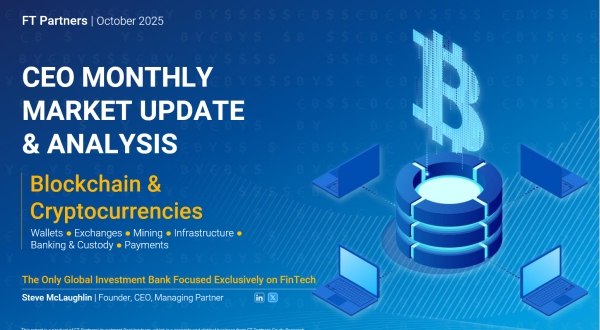
Financial Technology Partners (FT Partners) October 2025 Crypto and Blockchain Update shows that capital is flowing back into regulated digital asset infrastructure.
The Financial Technology Partners (FT Partners) October 2025 Blockchain and Cryptocurrencies Monthly report shows that digital asset M&A and financing activity has rebounded, led by exchanges, custody networks, and compliance technology. Institutional demand is piling into the market as regulated entities capture a growing share of capital and deal flow, with climbing valuations across regulated segments.
The FTP report data indicates that infrastructure remains the strongest and most resilient part of the market. Custody systems, settlement networks, and tokenization technology are attracting the largest investments as firms position to meet higher institutional and compliance standards. Transactions through 2025 is proof of how global players are consolidating around regulated platforms, liquidity access, and cross-border interoperability.
Ripple Labs acquired Standard Custody & Trust for $120 million in January, expanding its regulated tokenization and trust charter capabilities.
In April, Fireblocks raised $150 million at a $10 billion valuation to scale enterprise-grade custody and settlement systems. Komainu attracted $25 million in strategic investment during the same month to strengthen its institutional custody platform and compliance integrations.
May brought a $100 million raise for Anchorage Digital to expand its regulated digital asset banking and custody operations.
BitGo followed in June with a $100 million Series C round at a $1.75 billion valuation to deepen institutional tokenization services.
By September, Galaxy Digital acquired GK8 for $44 million, adding institutional self-custody and wallet management capabilities.
WonderFi completed a $100 million merger with Coinsquare and Bitbuy in January, forming one of Canada’s largest regulated crypto trading platforms.
Then later in March, Robinhood acquired WonderFi for C$250 million (around US$179 million), uniting Coinsquare and Bitbuy under its global exchange network.
Coinbase expanded twice, acquiring Circle’s European operations in February to enhance stablecoin settlement systems, then Deribit in August for $2.9 billion in cash and stock to extend crypto derivatives trading and clearing.
Chainalysis closed a $200 million Series F in June at a $4.2 billion valuation to expand blockchain intelligence and compliance monitoring.
A month later, Elliptic raised $50 million in a Series D extension to develop new anti–financial-crime tools for banks and exchanges.
Circle completed its acquisition of Archblock in February, integrating cross-chain USDC routing and compliance layers.
In May, Tether acquired Bitfinex Securities’ minority stake to reinforce its regulated token issuance network.
Ripple invested $285 million in August to expand global tokenization and CBDC settlement projects.
Kraken Ventures launched a $200 million fund in July focused on blockchain infrastructure and fintech platforms.
FT Partners’ 2025 data confirm that regulated infrastructure has become the foundation of digital finance. Valuations for infrastructure and compliance platforms now exceed eight times revenue, while consumer trading firms remain below four.
That spread shows that investors see real value in predictable, institutionally integrated systems rather than volatile retail flows. Institutional adoption continues through regulated products such as spot Bitcoin ETFs, tokenized funds, and custody-integrated settlement rails.
These channels represent a transition from speculative trading to reliable yield generation. Capital is rewarding throughput, compliance, and interoperability the same factors that define successful cross-border fintech models.
Growth will continue through robust compliance-oriented networks linking tokenized assets, stablecoins, and regulated exchanges. 2025 transactions signal global alignment toward clearer regulatory frameworks across Canada, Europe, and the United States. Taken together, these developments are building a more mature, data-driven digital finance ecosystem that's preparing for institutional scale.
 The National Crowdfunding & Fintech Association (NCFA Canada) is a financial innovation ecosystem that provides education, market intelligence, industry stewardship, networking and funding opportunities and services to thousands of community members and works closely with industry, government, partners and affiliates to create aa vibrant and innovative fintech and funding industry in Canada. Decentralized and distributed, NCFA is engaged with global stakeholders and helps incubate projects and investment in fintech, alternative finance, crowdfunding, peer-to-peer finance, payments, digital assets and tokens, artificial intelligence, blockchain, cryptocurrency, regtech, and insurtech sectors. Join Canada's Fintech & Funding Community today FREE! Or become a contributing member and get perks. For more information, please visit: www.ncfacanada.org
 |  |  |
|---|---|---|
 |  |  |
Fintech | Oct 3, 2025
Image: Freepik/newelement
On September 26, 2025, the Globe and Mail released its 2025 Report on Business ranking of Canada’s Top Growing Companies. The annual list tracks Canadian firms based on three-year revenue growth, offering a quick snapshot of where innovation is scaling fastest (think revenue, headcount, growth).
This year’s ranking features a great group of fintech and digital finance firms that are impacting how Canadians borrow, pay, invest, insure, and embed financial services into everyday life.
| Rank | Company | Sector | Description |
| #3 | Gearlay | Web3 / Blockchain | Blockchain-based enterprise financial software |
| #4 | Float | Lending & Embedded Finance | SME finance and corporate card platform |
| #5 | veritree | ESG & Green Finance | Digital carbon credits and reforestation finance |
| #11 | Novisto | ESG & Green Finance | ESG disclosure, data, and reporting platform |
| #24 | FundMore | Lending & AI | Automated mortgage underwriting |
| #32 | Quandri | AI & Automation / Insurtech | Insurance automation bots |
| #39 | Autocorp.ai | AI & Lending | AI-powered auto retail finance |
| #44 | Helcim | Payments | Merchant payment processing |
| #57 | CapIntel | WealthTech | Digital platform for advisors and wealth managers |
| #62 | PomeGran | Digital Infrastructure | Broadband and connectivity backbone |
| #65 | BOXX Insurance | Insurtech | Cyber insurance and protection |
| #72 | SWTCH Energy | Payments Infra / Energy | EV charging + payments integration |
| #86 | Makeship | Alternative Finance / Crowdfunding | Creator crowdfunding platform |
| #108 | Fintel Connect | Web3 / Marketing | Performance marketing for fintechs and crypto |
| #110 | Justwealth | WealthTech | Robo-advisor portfolio management |
| #112 | HONK | Payments | Contactless mobility/parking payments |
| #119 | Merchant Growth | Lending & SME Finance | Working capital financing |
| #129 | MindBridge | AI & Regtech | AI anomaly detection and audit |
| #137 | Loans Canada | Lending & Alt Finance | Loan marketplace and credit scoring |
| #140 | PolicyMe | Insurtech | Digital-first life insurance |
| #149 | Zum Rails | Open Banking & Payments | Open banking and payments APIs |
| #158 | Trolley | Payments | Global payouts and compliance |
| #204 | FundThrough | Lending & Alt Finance | Invoice financing and cash flow optimization |
While the Globe and Mail ranking provides a valuable view of Canadian fintech growth, it is far from exhaustive. Many high-growth firms remain absent because they operate in stealth mode, choose not to disclose financial data, or do not meet eligibility thresholds. Early-stage innovators, companies with holding structures abroad, and ventures acquired by larger incumbents also fall outside the ranking.
For NCFA’s community, this means the list represents only part of the country’s dynamic ecosystem of fintech, Web3, AI, alternative finance, and digital-first ventures that are scaling globally. For a broader view of Canada’s financial tech innovation landscape, see NCFA’s fintech directory at https://fintechcanada.io/.
Canadian fintech companies are excelling in lending, payments, Web3, insurtech, ESG, AI, digital infrastructure, and many other subcategories. These companies mirror how regulation, access to capital, and collaboration between industry and government is critical to ensure Canadian fintechs continue to thrive in an increasingly globally competitive landscape.
The National Crowdfunding & Fintech Association (NCFA Canada) is a financial innovation ecosystem that provides education, market intelligence, industry stewardship, networking and funding opportunities and services to thousands of community members and works closely with industry, government, partners and affiliates to create aa vibrant and innovative fintech and funding industry in Canada. Decentralized and distributed, NCFA is engaged with global stakeholders and helps incubate projects and investment in fintech, alternative finance, crowdfunding, peer-to-peer finance, payments, digital assets and tokens, artificial intelligence, blockchain, cryptocurrency, regtech, and insurtech sectors. Join Canada's Fintech & Funding Community today FREE! Or become a contributing member and get perks. For more information, please visit: www.ncfacanada.org
| | |
|---|---|---|
| | |
Digital Asset Regulation | Oct 1, 2025

Image: Freepik
On September 29, 2025, the U.S. Securities and Exchange Commission (SEC, Corporate Finance Division) issued a no action letter for DoubleZero that addresses how decentralized physical infrastructure networks (DePIN) should be treated under securities law.
The SEC's staff concluded that tokens earned by providing infrastructure services did not need to be registered as securities. Commissioner Hester Peirce reinforced this position in a follow-up statement, where she described DePIN tokens as rewards for real work rather than investments reliant on others’ managerial efforts.
DePIN refers to decentralized physical infrastructure networks where people contribute bandwidth, storage, mapping, or energy and receive tokens in return. These networks create open marketplaces for infrastructure and reduce reliance on centralized ownership.
Peirce (aka Crypto mom) described this approach as a new way to organize services using blockchain technology. She argued that tokens functioning as rewards for services are economically distinct from securities and that forcing all blockchain models into securities law could suppress innovation.
DoubleZero avoided the pitfalls of speculative fundraising from token sales marketed with profit expectations. Instead of pre-selling tokens to investors, its 2Z token was earned by participants who contributed infrastructure services, such as bandwidth, storage, and node operation.
The SEC staff stated that it would not recommend enforcement if tokens were distributed under the programmatic model presented by counsel. The relief granted was narrow and applied only to the programmatic model where tokens were distributed automatically to contributors per present conditions.
The letter also made clear that different facts could lead to a different outcome. You can read DoubleZero's response to the no-action letter here.
In the vein of avoiding token fundraising and keeping distributions tied to real services, networks that reward participants for sharing unused internet bandwidth, provide hard drive capacity, or feed energy into microgrids could potentially align with this reasoning. Other applications might include mapping and geospatial services, where users are rewarded for validated data contributions.
By contrast, projects that conduct presales or ICOs with promises of speculative returns, rely heavily on centralized managerial efforts, or direct most tokens to investors rather than active participants are less likely to qualify. The SEC emphasized that the economic reality must be compensation for work or services, not profit expectations.
While Canada hasn't yet issued specific guidance for DePIN tokens, the DoubleZero letter offers a comparison that Canadian entrepreneurs and policymakers can evaluate when distinguishing between functional reward tokens and investment contracts.
It's another clear acknowledgement from the SEC that not all tokens should be treated as securities. For builders, it shows how models tied to infrastructure participation can be designed to avoid speculative classification.
The National Crowdfunding & Fintech Association (NCFA Canada) is a financial innovation ecosystem that provides education, market intelligence, industry stewardship, networking and funding opportunities and services to thousands of community members and works closely with industry, government, partners and affiliates to create aa vibrant and innovative fintech and funding industry in Canada. Decentralized and distributed, NCFA is engaged with global stakeholders and helps incubate projects and investment in fintech, alternative finance, crowdfunding, peer-to-peer finance, payments, digital assets and tokens, artificial intelligence, blockchain, cryptocurrency, regtech, and insurtech sectors. Join Canada's Fintech & Funding Community today FREE! Or become a contributing member and get perks. For more information, please visit: www.ncfacanada.org
| | |
|---|---|---|
| | |
Blockchain | Sep 29, 2025
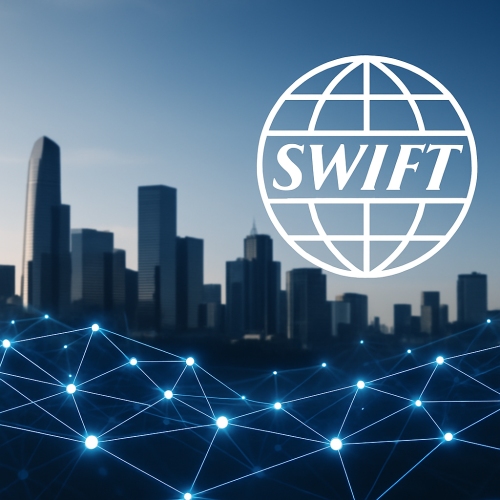
On September 29, 2025, Swift announced its blockchain-based ledger at Sibos 2025. The initiative brings together more than 30 financial institutions worldwide, including Royal Bank of Canada and TD Bank, to design and test a prototype with Consensys. The project is aimed at enabling real time, 24/7 cross-border payments to more than 200 countries and territories.
Javier Pérez-Tasso, Swift CEO:
“We provide powerful and effective rails today and are moving at a rapid pace with our community to create the infrastructure stack of the future. Through this initial ledger concept we are paving the way for financial institutions to take the payments experience to the next level with Swift’s proven and trusted platform at the centre of the industry’s digital transformation.”
Swift’s prototype will provide a secure log of transactions between banks that is updated in real time. The ledger will validate and sequence payments while using smart contracts to enforce agreed rules automatically. Unlike a public blockchain, this shared ledger is a permissioned infrastructure operated by Swift and its member banks. While it's blockchain-based in design, drawing on distributed ledger technology for resilience and transparency, it's not an onchain network like Ethereum.
Rather than creating new tokens itself, Swift’s role will be to provide the infrastructure for financial institutions and central banks to settle regulated tokenised value. By focusing on interoperability, Swift is designing the ledger so that it can operate alongside both traditional rails and emerging blockchain networks to reduce fragmentation and help financial institutions transition smoothly.
Also as a separate blockchain track, Swift is also experimenting with onchain migration of its messaging system using Ethereum Layer 2 Linea, as reported by The Block, which includes banks such as BNP Paribas and BNY. Swift is undergoing a parallel strategy to both upgrade existing rails while also preparing future digital rails.
The direct participation of RBC and TD gives Canada a seat at the table in Swift's financial infrastructure modernization initiatives. Their involvement means that Canadian banks intend to remain competitive globally as tokenised settlement gains traction. For Canada, the implications could be far reaching, making it easier for businesses to manage international trade and for capital to move efficiently across borders.
Swift’s work comes at a time when market forecasts suggest rapid growth in tokenised payments. Citi’s GPS report on stablecoins 2030 projects that stablecoin issuance could reach $1.9 trillion under a base case and as high as $4 trillion in a bull case by 2030, with transaction volumes approaching $100 trillion if stablecoins circulate at payment velocity.
The report also says stablecoins will likely coexist with tokenised deposits and bank-issued tokens, which may surpass them in scale.The question is whether Swift’s infrastructure approach will become the primary neutral rails that digital assets need to move securely across borders, or not.
After years of blockchain push-back denial, the launch of Swift’s blockchain ledger prototype is a key milestone in the modernization of global financial infrastructure. With RBC and TD among the participants, Canada is positioned within the group to contribute to the design and development of standards from the start. Digital assets and traditional financial networks seem to be converging at a global scale.
Other reads you may like:
The National Crowdfunding & Fintech Association (NCFA Canada) is a financial innovation ecosystem that provides education, market intelligence, industry stewardship, networking and funding opportunities and services to thousands of community members and works closely with industry, government, partners and affiliates to create aa vibrant and innovative fintech and funding industry in Canada. Decentralized and distributed, NCFA is engaged with global stakeholders and helps incubate projects and investment in fintech, alternative finance, crowdfunding, peer-to-peer finance, payments, digital assets and tokens, artificial intelligence, blockchain, cryptocurrency, regtech, and insurtech sectors. Join Canada's Fintech & Funding Community today FREE! Or become a contributing member and get perks. For more information, please visit: www.ncfacanada.org
| | |
|---|---|---|
| | |
CBDC and Stablecoins | Sep 29, 2025

Image: Freepik
On September 19, 2025, EU finance ministers reached a compromise on the digital euro roadmap, designed to reduce dependence on Visa and Mastercard. The plan gives governments a stronger role in any launch decision and sets limits on how much citizens can hold. For official policy context, see the EU Council’s digital euro page, which outlines objectives and implementation steps.
Just six days later, nine major European banks formed a consortium to launch a MiCA-compliant euro stablecoin, targeting a 2026 launch. The group includes ING, UniCredit, CaixaBank, Danske Bank, SEB, Raiffeisen Bank International, KBC, DekaBank, and Banca Sella. Their goal is to deliver instant payments, programmable settlement, and a regulated alternative to unbacked crypto tokens.
By anchoring the stablecoin in Europe’s MiCA framework, the banks are moving early to define how regulated tokenized money will work. MiCA sets clear standards for issuers on capital, governance, and reserve management. That clarity is drawing incumbents to commit capital and credibility.
The digital euro and the bank consortium stablecoin initiative both look to rebalance power in Europe’s payments market. Today, Visa and Mastercard process around two‑thirds of all European card transactions. Policymakers want to ensure Europe can clear and settle payments domestically without relying on foreign schemes.
The central bank digital currency (CBDC) and stablecoin initiatives also intersect with Wero, the new retail wallet developed under the European Payments Initiative. Wero is designed to give merchants and consumers a unified tool for instant payments across the euro area, and a tokenized euro would strengthen its value proposition. This alignment mirrors the Canadian Real‑Time Rail project, though Europe is tying its upgrades more explicitly to digital money.
A further motivation is market share. Euro stablecoins currently total only about €620 million outstanding, compared to nearly $300 billion for U.S. dollar stablecoins. Europe risks being sidelined if it does not accelerate adoption, as global trade and DeFi increasingly rely on dollar‑based tokens.
For fintechs, these initiatives open a regulated path to experiment with programmable money, cross‑border settlement, and retail wallets. Startups may be able to integrate stablecoin rails into remittances, treasury management, or point‑of‑sale services with legal certainty.
For banks, the picture is mixed. Deposit flight is a risk if customers shift balances into tokenized wallets. Yet the banks launching the consortium also stand to gain by controlling issuance, custody, and compliance, capturing value from tokenization.
Canada has taken a more cautious approach. The Bank of Canada has said there is “no compelling case” for a retail digital dollar and is prioritizing upgrades to payment infrastructure. Policymakers are also examining how to regulate stablecoins, with oversight currently split between federal and provincial authorities. See NCFA's analysis of Canada's stablecoin race entering a critical phase for a more detailed analysis.
Europe’s actions highlight lessons for Canada. Their dual‑track model of a CBDC combined with a bank‑led stablecoin consortium shows how sovereignty and innovation can be balanced. A digital loonie could serve as a public anchor, while regulated Canadian bank or fintech stablecoins could deliver speed and programmability. Equally important, MiCA demonstrates the power of legislative clarity, something Canada lacks as fragmented oversight slows momentum.
Europe’s urgency also stems from the fact that euro stablecoins represent a tiny fraction of the global market. Canada faces the same risk if stablecoin use grows but domestic frameworks stall, Canadians may increasingly rely on U.S. dollar tokens for payments, weakening monetary sovereignty. Europe is also linking its initiatives to Wero, its new retail wallet.
Canada could also add experiments to the rollout of its Real‑Time Rail, ensuring token‑based payments integrate with domestic upgrades. Although Canadians and payment stakeholders can't afford any more delays.
If Canada followed a similar approach as in Europe, payments could become faster and cheaper, and fintechs would gain new opportunities in programmable settlement and remittances. Banks could face pressure on deposits but would gain new business in custody and compliance. If Canada hesitates for much longer, the country risks dollarization via U.S. stablecoins, reducing control over payments and data governance.
The National Crowdfunding & Fintech Association (NCFA Canada) is a financial innovation ecosystem that provides education, market intelligence, industry stewardship, networking and funding opportunities and services to thousands of community members and works closely with industry, government, partners and affiliates to create aa vibrant and innovative fintech and funding industry in Canada. Decentralized and distributed, NCFA is engaged with global stakeholders and helps incubate projects and investment in fintech, alternative finance, crowdfunding, peer-to-peer finance, payments, digital assets and tokens, artificial intelligence, blockchain, cryptocurrency, regtech, and insurtech sectors. Join Canada's Fintech & Funding Community today FREE! Or become a contributing member and get perks. For more information, please visit: www.ncfacanada.org
| | |
|---|---|---|
| | |
Stablecoins | Sep 25, 2025

On September 24, 2025, Stablecorp announced a $5 million CAD strategic round led by FTP Ventures to accelerate the rollout of its Canadian dollar stablecoin, QCAD. The financing builds on $2.5M investment by Coinbase Ventures earlier this year on July 2, 2025, and arrives as policymakers in Canada and the United States sharpen oversight of stablecoin issuers.
If that wasn't enough, one day later on September 25, DeFi Technologies announced a strategic investment and commercial partnership with Stablecorp, reinforcing QCAD’s role as compliant infrastructure for cross-border settlement, digital markets, and e-commerce.
Stablecoins are becoming core payment rails globally. In Canada, the Office of the Superintendent of Financial Institutions is drafting a new framework for stablecoin issuers, while the Bank of Canada has urged PM Carney to consider establishing a federal stablecoin framework to help Canada remain competitive in digital assets which are becoming more popular.
The Retail Payments Activities Act took effect on September 8, 2025, now requiring payment service providers to register with the Bank of Canada, creating a compliance base for CAD-denominated digital money. NCFA has previously reported that Canada’s stablecoin race is entering a critical phase, with domestic fintechs pushing to compete with foreign issuers. In the United States, the GENIUS Act passed in June 2025, setting strict standards for reserves, audits, and issuer oversight.
Chainalysis estimates $2.5T in stablecoin transfers over the past year. McKinsey analysis suggests gross annual stablecoin settlement volumes now exceed $27T, pointing to rapid adoption across capital markets and payments.
QCAD is fully backed 1:1 with Canadian dollar reserves, held in an arms-length trust under independent oversight. Stablecorp provides daily transparency reports and monthly third-party attestations, addressing one of the largest concerns regulators have raised around stablecoins. This design allows QCAD to be used in trust-based use cases, such as cross-border trade settlement, on-chain foreign exchange, and tokenized asset markets.
With the Bank of Canada pausing its retail CBDC work, private CAD stablecoins structured for compliance are positioned to fill immediate demand across e-commerce, payroll, and supplier payments.
The $5 million raise was led by FTP Ventures, whose founder Fred Pye described digital dollars as the most efficient payment rail yet devised. Stablecorp also attracted participation from Coinbase Ventures, Circle Ventures, and Side Door Ventures, signaling strong institutional support.
On September 25, DeFi Technologies joined as both investor and partner, announcing plans to develop QCAD-integrated products through Valour, streamline liquidity with Stillman Digital, and build a post-quantum security roadmap with BTQ.
These steps broaden QCAD’s use cases, deepen liquidity for mint and redeem flows, and create recurring revenue streams through fees and spreads.
Kesem Frank, Stablecorp CEO:
"This is another important step in scaling QCAD for the benefit of all Canadians. It is imperative that Canada takes its place as a significant and strategic market for the growth of the digital asset economy, and our development of a trusted and compliant Canadian dollar stablecoin is a critical piece of that puzzle. Our backing by industry majors signals a shared vision for a multi-currency, easy to access, and regulated digital financial system."
Previous NCFA coverage shows how Canadian banks and fintechs are backing regulated stablecoins, and globally, large institutions such as Citi and Bank of America are preparing to issue their own stablecoins under advancing regulation. This convergence of capital and compliance shows how the stablecoin market is entering a new phase of mainstream adoption.
The combined announcements highlight how regulatory clarity and capital investment are converging around Canadian dollar stablecoins. Canada’s trade with the United States, valued at more than C$1 trillion annually, provides a strong corridor for QCAD adoption. Beyond North America, Canada is diversifying trade with partners in Europe, Asia, Africa, and Latin America, where settlement costs and delays limit competitiveness.
A compliant CAD stablecoin can lower transaction frictions and unlock new efficiencies for exporters, importers, and service providers. With domestic CBDC efforts paused, well-regulated stablecoins like QCAD are an immediate solution to modernizing Canada’s payment and settlement infrastructure.
The National Crowdfunding & Fintech Association (NCFA Canada) is a financial innovation ecosystem that provides education, market intelligence, industry stewardship, networking and funding opportunities and services to thousands of community members and works closely with industry, government, partners and affiliates to create aa vibrant and innovative fintech and funding industry in Canada. Decentralized and distributed, NCFA is engaged with global stakeholders and helps incubate projects and investment in fintech, alternative finance, crowdfunding, peer-to-peer finance, payments, digital assets and tokens, artificial intelligence, blockchain, cryptocurrency, regtech, and insurtech sectors. Join Canada's Fintech & Funding Community today FREE! Or become a contributing member and get perks. For more information, please visit: www.ncfacanada.org
| | |
|---|---|---|
| | |
Sep 24, 2025
Image courtesy of Flipper AI DEX
The Open Network (TON) Telegram games leverage blockchain technology to offer decentralized, secure, and transparent gaming for all users. Beginners can enjoy simple and readily accessible gameplay by playing TON games on Telegram. These games provide you with a simple way to explore the growing world of crypto and blockchain technology powered by Telegram’s vast user base. There are several Telegram gaming products that incorporate decentralization, smart contracts, and blockchain integration. Decentralization enables game data and logic to be shared across a network of computers securely and transparently. From ensuring fairness to creating monetary reward opportunities, TON offers several benefits to gamers.
Telegram’s platform not only offers opportunities for dApps within the ecosystem, but it also introduces user-friendly in-game economies. This combination lets developers build more advanced and interactive crypto gaming applications that players can trust. As more users continue to embrace TON, you can expect to see new and innovative gaming solutions that blend entertainment with real-life monetary benefits. Here are some great reasons to play Telegram TON games as a beginner.
Telegram TON games come with minimalistic designs. They are developed with simple and engaging gameplay in mind. This makes them vital entertainment tools for beginners looking to transform their online crypto gaming experiences. For those who prefer short gaming sessions, TON could be the perfect way to escape from everyday distractions and experience fun to the max. Newcomers can utilize reliable decentralized exchanges, like Flipper DEX, to earn free crypto tokens, including NOTCOIN. You can find tutorials and guidance to level up your skills and achieve your objectives in no time.
Potential for real rewards is another huge benefit of playing Telegram TON games. Popular play-to-earn Telegram models like TON allow users to accumulate virtual financial assets by completing basic tasks like tapping and swiping. You can convert your in-game currencies into actual crypto tokens like NOT and Hamster Kombat. Another great reason to play Telegram games is their low-cost entry. Beginners can start earning money without making any initial investment. While some Telegram crypto games offer upgrades or features that users can choose to purchase, it’s worth noting that these are not always required to start.
Thanks to the built-in community and social features, Telegram TON games lets players engage with their friends or join squads to conduct missions and compete on leaderboards. If you want to add fun and a social layer to your crypto gaming experience, you should consider taking advantage of TON Telegram games. Social media referral awards help create bonuses for beginners who invite their friends to play. These are primarily designed to motivate more players to explore the expanding world of Telegram games and boost their earning potential.
TON stands out in the blockchain ecosystem due to its relatively high speed and affordable transaction fees. Whether you’re a beginner or pro, you can interact with the crypto space directly and benefit from smooth experiences in a low-risk environment. There is no doubt that TON-based wallet integration is one of the easiest entry points into web3.
Telegram TON crypto games have gained widespread popularity lately thanks to their ease of access and community-driven experiences. The remarkable success of The Open Network onboarding millions of web3 users has played a key role in enabling beginners to build their digital assets portfolios.
The National Crowdfunding & Fintech Association (NCFA Canada) is a financial innovation ecosystem that provides education, market intelligence, industry stewardship, networking and funding opportunities and services to thousands of community members and works closely with industry, government, partners and affiliates to create aa vibrant and innovative fintech and funding industry in Canada. Decentralized and distributed, NCFA is engaged with global stakeholders and helps incubate projects and investment in fintech, alternative finance, crowdfunding, peer-to-peer finance, payments, digital assets and tokens, artificial intelligence, blockchain, cryptocurrency, regtech, and insurtech sectors. Join Canada's Fintech & Funding Community today FREE! Or become a contributing member and get perks. For more information, please visit: www.ncfacanada.org
| | |
|---|---|---|
| | |


August 26th, 2025

January 4th, 2024

June 1st, 2021

September 9th, 2020

July 9th, 2018

January 3rd, 2018

September 25th, 2017

June 20th, 2017

May 10th, 2017

December 14th, 2016