




Karsten Wenzlaff, Advisor
August 26th, 2025
Karsten Wenzlaff is a Crowdfunding and Fintech Expert from Germany. He is Secretary-General of Digit[...]


Stablecoin Research | Sep 23, 2025
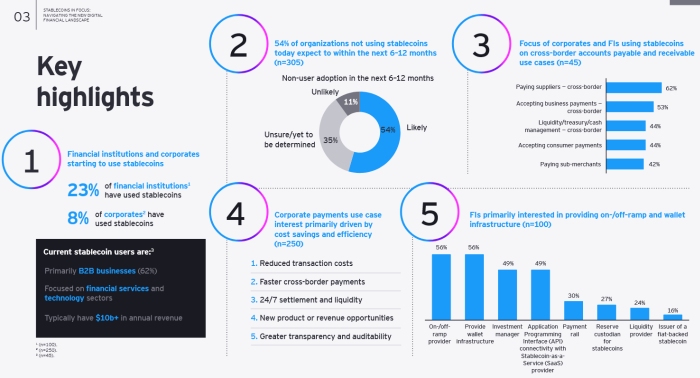
Image: Stablecoin Survey Research Highlights (EY Parthenon Sep 2025)
On September 15, 2025, EY-Parthenon released its latest stablecoin survey results, "Stablecoins: Adoption, Optimism, and Regulatory Clarity" (download 31 page PDF), covering 350 executives from corporates and financial institutions across the US, EMEA and other regions. Research takeaways confirm adoption is picking up speed, supposed by regulatory clarity by the GENIUS Act, recently signed into law.
Why is this happening? Approval of the U.S. GENIUS Act is a regulatory catalyst. Further, pilots are proving real value and corporate treasurers are under pressure to improve efficiency. The thinking is that organizations delaying adoption risk losing ground to competitors who are moving forward and benefiting from the lower cost and faster transactions of stablecoin technologies.
Why is everyone saving money by using stablecoins? The reason is straightforward. Traditional cross border payments involve multiple intermediaries, each adding fees and time. Stablecoins bypass these frictions and settles instantly, so the cost savings are structural (not incremental). For fintech providers, there's a growing opportunity to provide integration and risk management tools to help corporates adopt/use stablecoins and measure their effectiveness.
The reality is that we live and function in a global economy where delays can disrupt supply chains, so it's not surprising that corporates will adopt stablecoins for faster and more streamlined and predictable settlement solutions. This means that stablecoin adoption will likely strong and swift among B2B supplier and trade finance flows before expanding more widely into consumer payments.
In Canada, regulatory inaction is catching up with market momentum. On September 19, 2025, regulators like OSFI have warned the Prime Minister Mark Carney that Canada should accelerate federal stablecoin rules to avoid falling behind global peers. The Bank of Canada has echoed this call, saying stablecoins should be as safe and stable as the balance in your bank account. OSFI is already drafting a new framework to regulate stablecoin issuers, while domestic momentum is building as Tetra Digital Group secured $10M from Canadian banks and fintechs to launch a CAD stablecoin in 2026. Observers including investor John Ruffolo warn in his Looming Stablecoin Storm substack that without clear domestic rules, Canada risks ceding innovation, competitiveness and monetary sovereignty to jurisdictions that move faster.
Canadian corporates and fintechs need to plan not just for current global trends, but for a new local regulatory stablecoin framework. Firms are advised to engage with policymakers to create the right environment, build compliance ready infrastructure now and position for interoperability with USD pegged tokens and domestic stablecoin initiatives.Waiting could result in higher compliance costs, restricted access, and eventually a decline in market share.
Bottom line is banks understand that clients will demand stablecoin services and that failure to provide them risks their disintermediation. There's an intensifying race between traditional institutions and fintech challengers to capture stablecoin transaction flows.
Hybrid build and partner strategy. Corporates are demanding trust and compliance, while financial institutions know they cannot deliver the full stack alone. This means that partnerships between fintechs, banks and technology providers will determine how quickly stablecoin adoption scales.
Stablecoins are moving from pilot projects into enterprise strategy. Corporates see real cost savings and competitive advantage, while financial institutions are preparing to build services at scale to meet client demand. Regulation is beginning to catch up, led by the GENIUS Act in the US, but the global landscape is unbalanced while Canada’s fintech ecosystem is calling on the federal government to create and regulate a stablecoin framework to remain aligned and competitive.
 The National Crowdfunding & Fintech Association (NCFA Canada) is a financial innovation ecosystem that provides education, market intelligence, industry stewardship, networking and funding opportunities and services to thousands of community members and works closely with industry, government, partners and affiliates to create aa vibrant and innovative fintech and funding industry in Canada. Decentralized and distributed, NCFA is engaged with global stakeholders and helps incubate projects and investment in fintech, alternative finance, crowdfunding, peer-to-peer finance, payments, digital assets and tokens, artificial intelligence, blockchain, cryptocurrency, regtech, and insurtech sectors. Join Canada's Fintech & Funding Community today FREE! Or become a contributing member and get perks. For more information, please visit: www.ncfacanada.org
 |  |  |
|---|---|---|
 |  |  |
Crypto | Sep 22, 2025

Image: Freepik/krakenimages.com
On September 20, 2025, Coinbase CEO Brian Armstrong announced that NBA star Kevin Durant had regained access to his Coinbase account nearly ten years after first buying Bitcoin, and then initially purchasing it for around $650 per Bitcoin in 2015, implying a whopping gain of more than 17,000% ten years later.
Armstrong confirmed the recovery on X, which followed Durant’s story earlier in the week at the CNBC x Boardroom Game Plan summit in Santa Monica. Durant described how he first bought Bitcoin in 2014–2015
We got this fixed. Account recovery complete! https://t.co/TWYFpQkXsb
— Brian Armstrong (@brian_armstrong) September 19, 2025
Durant’s first exposure to Bitcoin came around 2014–2015, when he says he “started watching YouTube videos” about the emerging digital asset. Intrigued, he encouraged his agent, Rich Kleiman, to take a closer look. Their enthusiasm was quickly cooled when, according to Kleiman, their business manager “said, ‘No, don’t do that.’ So we didn’t.”
That might have been the end of the story if not for a party hosted by venture capitalist Ben Horowitz. Kleiman recounted how they heard Bitcoin mentioned repeatedly that night, and “we woke up the next day and said, ‘We have to do this.’” From there, they invested in Bitcoin and later became early backers of Coinbase through their firm Thirty Five Ventures.
According to Coindesk, Durant’s entry point was near $650 per Bitcoin in 2015, a level that makes his eventual recovery especially striking. With Bitcoin trading above $115,000 in September 2025, that original purchase reflects a gain of more than 17,000%, a staggering return on investment that Durant could only access once his Coinbase account was unlocked nearly a decade later.
Durant’s lost account access resulted in type of “forced hodling” through multiple market cycles. Chainalysis-based research on permanently lost Bitcoin estimates millions of crypto assets are out of reach because people have lost their passwords or recovery keys. That reduces the amount available to trade and makes the asset more scarce. Durant’s case shows that being locked out by accident can sometimes lead to big gains, but it also reveals the real danger for everyday users who may never regain access to their accounts.
Coinbase outlines strict processes for regaining access if emails or two factor devices are lost. Users may need to reset forgotten passwords, recover two factor authentication, or provide identity documents through account access troubleshooting. Many users report challenges completing these steps. After Durant’s recovery, social media threads filled with complaints from customers who have been locked out for years.
In response, Armstrong reposted a detailed thread from his support team on X, promising product improvements and faster support. Coinbase also maintains VIP service tiers for high volume traders. Reuters published an article in August 2025 about widespread user frustration with locked accounts and the Verge covered investigations into delays in customer support. Clearly more work needs to be done by Coinbase to support all customers, and not just celebrities that might be prioritized for obvious reasons.
Durant's experience of lost keys and account access can happen to even the most sophisticated investors, causing an incredible amount of frustration. Prevention is the best protection. Coinbase advises enabling multiple two factor authentication methods, including hardware keys, and updating recovery emails and phone numbers regularly.
Also, users should evaluate the benefits and risks of storing crypto on exchanges versus self custody options using a secure wallet. Digital asset investors should only work with crypto exchanges that offer reliable recovery workflows and strong customer support.
Thanks to Durant's celebrity status, consumer protection from lost keys and account access is back in the news. For Durant, it's another story and a drop in the bucket but for regulators and industry leaders it's a recurring lessons that equitable account recovery and strong consumer support is essential to wider adoption. While new trading features are also being developed and released, crypto exchanges and leaders need to prioritize safeguarding access for all users.
The National Crowdfunding & Fintech Association (NCFA Canada) is a financial innovation ecosystem that provides education, market intelligence, industry stewardship, networking and funding opportunities and services to thousands of community members and works closely with industry, government, partners and affiliates to create aa vibrant and innovative fintech and funding industry in Canada. Decentralized and distributed, NCFA is engaged with global stakeholders and helps incubate projects and investment in fintech, alternative finance, crowdfunding, peer-to-peer finance, payments, digital assets and tokens, artificial intelligence, blockchain, cryptocurrency, regtech, and insurtech sectors. Join Canada's Fintech & Funding Community today FREE! Or become a contributing member and get perks. For more information, please visit: www.ncfacanada.org
| | |
|---|---|---|
| | |
Regulation | Sep 18, 2025
On September 17, 2025, the U.S. Securities and Exchange Commission (SEC) approved generic exchange listing standards for Commodity-Based Trust Shares. This decision means that exchanges can now list new products without filing for case by case approvals, including those backed by digital assets.
This policy update is arguably the most significant since the SEC’s approval of spot bitcoin ETFs earlier this year, and is anticipated to accelerate the rollout of digital asset funds across U.S. markets.
Commodity Based Trust Shares are exchange traded products that hold physical assets like metals or digital assets, instead of being regulated under the Investment Company Act of 1940. Under the new rules, this means that digital assets can be listed more quickly if they meet certain standards.
The new framework effectively creates a fast track for digital asset ETFs. Before every product required a Section 19(b) filing with reviews that could stretch for months.
To qualify, the product must either track an asset traded on a market that is part of the Intermarket Surveillance Group with data sharing agreements, be linked to a regulated futures contract that has been trading for at least six months, or have at least 40% of its portfolio in a single commodity already covered by another listed product.
The SEC stressed that even though these products are not investment companies, they must still publish key disclosures, including their holdings and daily net asset value, similar to ETFs.
In addition to the new generic listing standards, the SEC also approved two specific applications that will give investors more ways to gain regulated exposure to crypto assets:
Not all commissioners agreed. Commissioner Caroline Crenshaw warned that generic standards could change responsibility for investor protection. Read the formal statement 'Passing the Buck' by Commissioner Caroline Crenshaw for her concerns about speed and scrutiny in volatile markets.
Market observers expect a wave of new filings.
For investors, more products mean greater choice and a need to understand custody, valuation, and disclosures.
For fintechs and asset managers, shorter timelines create room for innovation in fund design, multi asset strategies, and derivatives.
Commissioner Hester Peirce welcomed the decision as overdue. In her statement on the approval , she noted that generic listing standards “eliminate the need for prior SEC approval under Section 19(b)” and would reduce time and resources required to bring new products to market. Peirce acknowledged past delays and court rulings that pushed the SEC to open a path for spot crypto ETPs, and she emphasized that the new rules provide alternative eligibility criteria beyond surveillance sharing agreements. She argued that the streamlined process will benefit investors, issuers, market participants, and the Commission itself by increasing predictability and efficiency.
Canada approved the first spot bitcoin ETF in 2021, but most digital asset funds are still reviewed case by case. By approving new generic exchange listing standards, the United States has adopted a scalable model that could influence regulators globally.
If Canada doesn't modernize its framework, fintech innovators and investor capital could drain south where products can launch faster. Aligning with an efficient standard could help maintain Canada’s leadership in fintech while ensuring investor protections.
The National Crowdfunding & Fintech Association (NCFA Canada) is a financial innovation ecosystem that provides education, market intelligence, industry stewardship, networking and funding opportunities and services to thousands of community members and works closely with industry, government, partners and affiliates to create aa vibrant and innovative fintech and funding industry in Canada. Decentralized and distributed, NCFA is engaged with global stakeholders and helps incubate projects and investment in fintech, alternative finance, crowdfunding, peer-to-peer finance, payments, digital assets and tokens, artificial intelligence, blockchain, cryptocurrency, regtech, and insurtech sectors. Join Canada's Fintech & Funding Community today FREE! Or become a contributing member and get perks. For more information, please visit: www.ncfacanada.org
| | |
|---|---|---|
| | |
Crypto | Sep 16, 2025

Image: Freepik/drobotdean
As reported by MarketWatch, the S&P Dow Jones Indices announced its quarterly rebalance and chose not to add Strategy Inc. (formerly, MicroStrategy) to the S&P 500.
Strategy Inc is the largest corporate holder of bitcoin with more than 630,000 BTC, equal to over 3% of the total supply, and met all the published criteria on market capitalization, liquidity, and profitability, but was essentially excluded by the powers of committee discretion. JPMorgan analysts said this exclusion is a warning shot to company boards that bitcoin heavy treasuries may face barriers to benchmark inclusion, limiting access to the large automatic flows of index tracking funds.
In response, Strategy’s executive chair Michael Saylor posted an image showing that its shares have outperformed the S&P 500 and Bitcoin with the caption “Thinking about the S&P right now ….” He also told Barron’s, “Every quarter, we make new believers. I think that will continue for the foreseeable future.”
Thinking about the S&P right now… pic.twitter.com/Y5nPc9XT4l
— Michael Saylor (@saylor) September 6, 2025
The S&P 500 is the most tracked equity index in the world. Entry usually lowers a company’s funding costs while expanding its investor base. Trillions of dollars are passively allocated to its members. While the methodology spells out eligibility rules, the committee reserves the right to apply judgment.
Inclusion in the S&P 500 forces trillions of dollars of index tracking funds to buy a company’s stock, creating large automatic inflows that lower funding costs and deepen liquidity. Exclusion means those compulsory passive flows never materialize.
Strategy built its bitcoin position through repeated equity offerings, which turned its stock into a leveraged proxy for bitcoin. That model is now constrained. At the same time, Nasdaq (where Strategy MSTR is currently listed) requires shareholder approval for certain crypto related financing steps, which increases governance complexity and slows decision making.
Together these barriers raise the cost and difficulty of growing corporate bitcoin reserves through treasury strategies. Boards now face a choice of maintaining a bitcoin identity with limited access to mainstream capital markets, or rebalance treasury policies to preserve index eligibility and liquidity.
Some investors may prefer exposure through ETFs rather than dealing with dilution or volatility inside an operating company. Equity research coverage and institutional ownership might reduce if analysts see a company as primarily a bitcoin vehicle rather than an operating business.
Exchange traded funds present a clear alternative. Canada approved spot bitcoin ETFs in 2021 and the United States followed in 2024. ETFs hold bitcoin directly in custody and issue units that trade on exchanges, offering regulated and liquid exposure. ETF fees are typically between 0.2% and 1.0%, relatively modest compared to the governance and financing costs of treasury strategies.
However, corporate treasuries allow boards to control timing and scale, use equity issuance to accelerate exposure, and attract investors who prefer equity proxies for bitcoin. Yet these benefits are balanced by costs that now include index exclusion, shareholder approval requirements, and stock valuations that swing with bitcoin more than business fundamentals.
The early regulatory approval of spot bitcoin ETFs in Canada gave investors a first mover's advantage, and a clear and credible option for digital asset exposure at a time when corporate treasuries were still the main vehicle in other markets.
Since then, Canadian companies including miners and digital asset firms such as Hut 8 and BIGG Digital Assets have also pursued bitcoin treasury strategies. This means Canada now has both treasuries and ETFs operating side by side, and it is expected that additional pathways to digital asset investments will emerge over time as regulations evolve.
The S&P committee will meet again this December to review index composition. That update could determine whether Strategy’s exclusion is temporary or a longer standing policy. Regardless of the outcome, the September rejection may already be impacting board room decisions affecting the balance between treasury exposure versus ETFs. ETFs offer a regulator approved and stable pathway for investor demand, while treasuries provide control and branding but now carry higher financing and governance costs.
The National Crowdfunding & Fintech Association (NCFA Canada) is a financial innovation ecosystem that provides education, market intelligence, industry stewardship, networking and funding opportunities and services to thousands of community members and works closely with industry, government, partners and affiliates to create aa vibrant and innovative fintech and funding industry in Canada. Decentralized and distributed, NCFA is engaged with global stakeholders and helps incubate projects and investment in fintech, alternative finance, crowdfunding, peer-to-peer finance, payments, digital assets and tokens, artificial intelligence, blockchain, cryptocurrency, regtech, and insurtech sectors. Join Canada's Fintech & Funding Community today FREE! Or become a contributing member and get perks. For more information, please visit: www.ncfacanada.org
| | |
|---|---|---|
| | |
Regulation | Sep 15, 2025

Image: Paul Atkins, SEC Chair
On September 10, 2025, SEC Chair Paul S. Atkins delivered a keynote address in Paris at the OECD Roundtable on Global Financial Markets, resetting the tone for U.S. capital markets. His speech positioned the SEC not as an adversary to entrepreneurs but as an enabler of growth, advancing Project Crypto, a broad modernization initiative aimed at bringing securities regulation into the blockchain era.
Paul S. Atkins, SEC Chair:
“It is a new day at the SEC. Policy will no longer be set by ad hoc enforcement actions. We will provide clear, predictable rules of the road so that innovators can thrive in the United States.”
One of the most significant parts of Atkins' remarks was his (the SEC's) endorsement of “super-app” platforms. This vision is a welcomed 180 after years of a type of regulate by enforcement approach that drove many U.S. crypto companies overseas.
For fintechs, it means a future where integrated platforms can grow under clear oversight, with investors able to choose from multiple custody models.
For Canadian innovators and regulators, it further raises urgent questions about how Canada will remain competitive if the U.S. creates a friendlier landscape for capital formation and digital asset services.
“We must allow for ‘super-app’ trading platform innovation that increases choice for market participants. Platforms should be able to offer trading, lending, and staking under a single regulatory umbrella.”
Atkins acknowledged that Europe has already moved ahead with the Markets in Crypto Assets regulation, praising the framework as a first attempt at comprehensive digital asset oversight while stressing that the U.S. will not fall behind. By declaring that America must be “second to none” in fostering innovation, he more or less confirmed that the competitive race was on.
For Canadian fintechs, this accelerates the competition challenge with Europe and the U.S. both moving towards clarity, while Canada’s rules remain relatively limited. This moment calls for proportionate approaches to policy that reduce friction for innovators while protecting investors, as highlighted in NCFA’s Canadian Banks and Fintechs Back Regulated Stablecoin post.
Beyond crypto, Atkins described the changes coming in the era of “agentic finance” where autonomous AI agents execute trades, allocate capital, and manage risk with compliance built directly into their code.
Coupled with blockchain, he argued, AI could democratize access to advanced strategies and lower costs for individuals.
The challenge for regulators is to install commonsense guardrails without overreacting.
Fintech builders heard that AI in finance is not only here to stay but will be supported if developed responsibly.
Atkins’ Paris keynote can be taken as a statement of intent. He placed crypto super apps, AI finance, and tokenized markets front and center of U.S. strategy. Fintechs and investors have immediate takeaways. That is regulatory clarity is coming, and the players and markets that adapt quickly will benefit most.
As U.S. and Europe continue to advance crypto regulatory frameworks, it's more critical than ever that Canada expeditiously create proportionate regulation, double down on enabling frameworks, and collaborate with global peers. Canada would benefit from positioning itself as a jurisdiction that rewards responsible experimentation. As Atkins put it, “crypto’s time has come.”
The National Crowdfunding & Fintech Association (NCFA Canada) is a financial innovation ecosystem that provides education, market intelligence, industry stewardship, networking and funding opportunities and services to thousands of community members and works closely with industry, government, partners and affiliates to create aa vibrant and innovative fintech and funding industry in Canada. Decentralized and distributed, NCFA is engaged with global stakeholders and helps incubate projects and investment in fintech, alternative finance, crowdfunding, peer-to-peer finance, payments, digital assets and tokens, artificial intelligence, blockchain, cryptocurrency, regtech, and insurtech sectors. Join Canada's Fintech & Funding Community today FREE! Or become a contributing member and get perks. For more information, please visit: www.ncfacanada.org
| | |
|---|---|---|
| | |
Sep 15, 2025

Image: Pexels/Alesia Kozik
Fintech keeps nudging online gambling into a different shape. Not in one big leap, more like a series of quick steps. Blockchain, AI, digital wallets, and mobile-first rails are taking the lead, or at least that’s how it looks from recent rollouts. People want speed, privacy, and fewer hoops to jump through. One stat often cited: around 35% of global online casino operators supported crypto in early 2024, per the European Business Review.
Platforms have answered with provably fair mechanics, faster withdrawals, and fees that drift toward zero. AI is seeping into everything from gameplay suggestions to risk checks. New payment links try to satisfy regulators as much as players, which is harder than it sounds. This isn’t just a tech upgrade. It is slowly changing how players pay, play, and decide whom to trust. Both sides of the table feel it, and the ripple seems set to carry into 2025 and, probably, a bit beyond.
Crypto-friendly online casino now list Bitcoin, Ethereum, and a handful of stablecoins as routine options. Some sites go further, running almost entirely on-chain, which can mean near-instant deposits and withdrawals for local and cross-border users. Compared with bank transfers, wait times have dropped from days to minutes in many cases. A few platforms even enable peer-to-peer movement of funds, trimming out processors and, usually, costs. The old banking rails aren’t always required. Privacy tends to improve, too, because identities can be minimal or encrypted on decentralised ledgers.
The bigger shift may be transparency. Immutable records log bets, outcomes, and payouts so players can check results themselves. That “provably fair” idea, noted by Morningstar, appears to build confidence and draw in younger, more crypto-native audiences. Access expands as well. Where banking controls are tight, crypto can offer a route in. Trends flagged by RadCred suggest that more than 60% of new crypto casino sign-ups in 2025 could come from outside North America and Western Europe. If anything, crypto and blockchain still look like the sector’s loudest fintech swing.
Contactless options and e-wallets now feel standard on major platforms. Integrations with tools like GCash make deposits and payouts feel almost casual, which, admittedly, is the point. Speed leads. Instead of the old waiting windows, balances appear quickly, sometimes immediately. Security gets a boost as well through two-factor checks and encrypted channels. For the online casino market, where trust and immediacy matter, these payment features have become non-negotiable.
Mobile-first design tracks the broader iGaming pivot to phones. Most players, it seems, have left desktops behind, and their payment habits followed. Apps are being tuned for one-tap flows, biometrics, and live balances that update without fuss. TechSpective reports that e-wallet adoption can cut payment drop-off by about 27%. Operators benefit on the back end, too, with automated compliance screens and lower fraud exposure. It’s not only a UX story. Payment innovation tends to raise operational efficiency and make audits easier, which keeps both customers and regulators relatively satisfied.
AI now threads through much of the customer journey. Recommendation engines learn from play patterns to surface games a player might actually enjoy. Bonuses adjust on the fly. European Business Review points to retention improving by as much as 32% in year one for some adopters, though results vary.
There’s a safety angle, too. Models scan for risk signals and can flag patterns that resemble harmful play, then nudge for a pause or trigger a cool-off. Support has shifted as well. Chatbots handle quick questions instantly, so human agents focus on tougher issues. Net result: platforms feel more responsive while still ticking the social responsibility box. AI’s weight in both satisfaction and compliance strategies seems to be growing, even if the playbooks are still being refined.
Security has not been an afterthought. Biometric logins, end-to-end encryption, and in some cases blockchain-backed ledgers protect accounts and transactions. For plenty of players, confidence that outcomes and funds cannot be quietly altered matters as much as speed. The Maui News reported a 19% drop in cyber-fraud across major online gambling markets after multi-factor authentication and newer encryption standards rolled out in late 2024, which is encouraging if not a cure-all.
Meanwhile, social layers are getting thicker. Multiplayer modes, chat features, and live events turn solitary spins into shared moments. With 5G helping out, live gaming holds up on the go. Under the hood, fintech automation tightens payment flows, reduces fraud risk, and sharpens compliance accuracy. Put together, stronger security, richer community tools, and smoother operations have pushed usage and revenue higher, with sector reports putting 2023 global revenues above $95 billion. It could climb further, though cycles have a way of surprising us.
As payments accelerate, responsible gambling has to keep pace. Operators are leaning on AI to spot risk earlier and step in sooner. Self-exclusion and spend caps are, by now, standard kit. Payment blocks and faster ID checks add another layer, slowing unauthorized access and helping prevent harm.
Regulators increasingly expect these protections to ship alongside convenience, not after it. For the ecosystem to stay healthy, technology and accountability need to move together. Sustainable progress, ideally, gives players more control and clearer support. The exact balance is still being worked out, and maybe that’s healthy progress rather than a finished product.
The National Crowdfunding & Fintech Association (NCFA Canada) is a financial innovation ecosystem that provides education, market intelligence, industry stewardship, networking and funding opportunities and services to thousands of community members and works closely with industry, government, partners and affiliates to create aa vibrant and innovative fintech and funding industry in Canada. Decentralized and distributed, NCFA is engaged with global stakeholders and helps incubate projects and investment in fintech, alternative finance, crowdfunding, peer-to-peer finance, payments, digital assets and tokens, artificial intelligence, blockchain, cryptocurrency, regtech, and insurtech sectors. Join Canada's Fintech & Funding Community today FREE! Or become a contributing member and get perks. For more information, please visit: www.ncfacanada.org
| | |
|---|---|---|
| | |
AI Innovation | Sep 12, 2025

Image: Freepik/DC Studio
As reported by Venture Beat, Microsoft Research has released rStar2-Agent framework, a new training model approach that demonstrates how smaller models can deliver reasoning logic and performance once reserved for massive frontier models, but doesn't require massive systems or costs. While reinforcement learning in agentic AI isn't new, Microsoft's model adds important innovations in how it carefully verifies each step with fewer resources.
A 14 billion parameter model deliver results on math and science benchmarks that matched or even outperformed much larger 600-billion-parameter systems. Astonishingly, Microsoft's own tech report explains that that rStar2-Agent, “reached state-of-the-art results in under a week of training, surpassing a 671B-parameter system despite being just 14B in size.”
This scale difference is significant. Frontier models often need entire data centres while rStar2-Agent can be quickly trained and deployed on just a few high-end servers. For businesses and regulators in Canada, the impact could mean opening up access to this type of hyper efficient reasoning AI at a fraction of the cost, making it practical for fintech startups, universities, and financial institutions to adopt.
Competing head-to-head against giant foundation models isn't realistic for most Canadian firms or government programs. Efficient reasoning models, which can operate with constrained compute while still producing transparent and auditable steps, align directly with Canadian strengths, and is a pathway that Canadian innovators are well positioned to take on.
Canadian fintechs and startups can prioritize smarter training methods with domain specific fine tuning rather than trying to match the infrastructure scale of global hyperscalers. Smaller reasoning models also lower the barrier for enterprises that want to use AI in production but can't justify the heavy infrastructure investments of the largest and latest models.
As Microsoft describes it:
"[rStar2-Agent] demonstrates advanced cognitive behaviors, such as thinking carefully before using Python coding tools and reflecting on code execution feedback to autonomously explore, verify, and refine intermediate steps in complex problem-solving.”
The Canadian regulatory environment makes verified reasoning especially valuable. Models that validate their steps provide transparency and compliance support, which are essential in sectors like finance. This type of approach matches Canada’s push for trust, accountability, and explainability in AI.
Innovation, not size, could define Canada's leadership in AI. National strategies that support funding, research, and pilot programs for efficient reasoning AI could accelerate adoption across regulated industries. Fintech and financial institutions are natural leaders in this space because they already require digital public infrastructure that balances efficiency and inclusion.
The opportunity also extends beyond finance. Healthcare systems could use efficient reasoning AI for diagnostics where transparency is vital. Universities and research labs could run experiments on smaller models without prohibitive costs, fostering local innovation.
Canada has the opportunity to turn its limitations into a competitive edge by becoming a global hub for efficient reasoning AI that is affordable, reliable, exportable expertise, and aligned with priorities in finance, governance, and inclusion.
The National Crowdfunding & Fintech Association (NCFA Canada) is a financial innovation ecosystem that provides education, market intelligence, industry stewardship, networking and funding opportunities and services to thousands of community members and works closely with industry, government, partners and affiliates to create aa vibrant and innovative fintech and funding industry in Canada. Decentralized and distributed, NCFA is engaged with global stakeholders and helps incubate projects and investment in fintech, alternative finance, crowdfunding, peer-to-peer finance, payments, digital assets and tokens, artificial intelligence, blockchain, cryptocurrency, regtech, and insurtech sectors. Join Canada's Fintech & Funding Community today FREE! Or become a contributing member and get perks. For more information, please visit: www.ncfacanada.org
| | |
|---|---|---|
| | |


August 26th, 2025

January 4th, 2024

June 1st, 2021

September 9th, 2020

July 9th, 2018

January 3rd, 2018

September 25th, 2017

June 20th, 2017

May 10th, 2017

December 14th, 2016