





Karsten Wenzlaff, Advisor
August 26th, 2025
Karsten Wenzlaff is a Crowdfunding and Fintech Expert from Germany. He is Secretary-General of Digit[...]


Crypto Policy | Aug 11, 2025

Image: Freepik
On August 7, 2025, President Trump signed an executive order called, "Democratizing Access to Alternative Assets for 401(k) Investors", directing U.S. regulators to explore ways to allow cryptocurrencies and other alternative assets in defined contribution plans like 401(k)s.
While it doesn't immediately mean that Americans can directly hold crypto investments in their retirement accounts, it does instruct the Department of Labor (DOL), the Securities and Exchange Commission (SEC), and the Treasury to coordinate on new frameworks that could make it possible. If this happens, it will have significant implications for U.S investors but also for fintech innovators and regulators in Canada who are monitoring trends South of the border.
The order requires the DOL to review and update its fiduciary guidance for retirement plan sponsors, with a specific focus on clarifying what due diligence, risk disclosure, and participant education would be required if crypto were included as an option.
It also directs the SEC to consider revisions to certain securities rules, including elements of the accredited investor framework, that could impact the packaging of crypto investment products for retirement plans.
Treasury and related agencies have been tasked with aligning tax, reporting, and compliance rules to avoid conflicting obligations. According to the official fact sheet, the review process is expected to produce proposed rule changes by early 2026.
Advocates explain that opening retirement plans to digital assets could help diversification and align with investor demand, especially among younger savers who already hold crypto in personal accounts.
This change could also create a massive new liquidity channel for the crypto sector while bringing it further into regulated financial infrastructure, as reported by Forbes.
For fintech and crypto innovators, Trump's executive order could blow up the addressable market for crypto retirement products, custody solutions, and participant education tools.
With opportunity comes risks of course. The DOL has previously raised concerns about crypto’s volatility, liquidity constraints, and valuation complexities in retirement plans.
Business Insider reported that plan sponsors could face elevated litigation risks if participant loses are tied to crypto holdings, especially without clear safe harbour protections. Implementation also requires custodians and record keepers to adapt their current systems for daily valuations, liquidity management, and tax reporting.
The U.S. executive order isn't about adding more ETFs to retirement accounts. It opens the door for 401(k) participants to gain exposure to actively managed investment vehicles investing in digital assets and other private market investments, directly within a tax-advantaged plan registered with the government. This could mean direct holdings of Bitcoin or Ethereum, or participation in private crypto funds not listed on public exchanges, if fiduciaries deem them prudent and compliant with ERISA standards.
In Canada, the gap is very real today. Registered plans like RRSPs, RRIFs, TFSAs, and employer pension plans cannot directly hold cryptocurrency. The Canada Revenue Agency’s qualified investment rules prohibit digital assets themselves from being held in registered accounts, whether or not the plan is self-directed. Investors can only gain crypto exposure through qualified investments such as Bitcoin or Ether ETFs listed on a designated stock exchange, or shares of publicly traded crypto companies. Private crypto funds, unlisted trusts, or direct wallet holdings are currently prohibited in all registered accounts.
If the U.S. implements this framework, Canadian retirement plans would be at a competitive disadvantage in offering digital asset investment innovation. For Canadian fintechs, such U.S. policy could create new product development opportunities south of the border, while providing an unprecedented case study for domestic regulators on how to balance investor protection with access to alternative assets.
This latest crypto policy development is another wake-up call and market opportunity for Canadian fintechs and regulators. The next 12 to 18 months will determine whether or not U.S. agencies can produce rules that satisfy both innovation advocates and investor protection, fiduciary watchdogs. If they succeed, Canada’s own retirement savings design could be the next frontier for digital asset integration, and if so, they need to be ready to respond.
 The National Crowdfunding & Fintech Association (NCFA Canada) is a financial innovation ecosystem that provides education, market intelligence, industry stewardship, networking and funding opportunities and services to thousands of community members and works closely with industry, government, partners and affiliates to create a vibrant and innovative fintech and funding industry in Canada. Decentralized and distributed, NCFA is engaged with global stakeholders and helps incubate projects and investment in fintech, alternative finance, crowdfunding, peer-to-peer finance, payments, digital assets and tokens, artificial intelligence, blockchain, cryptocurrency, regtech, and insurtech sectors. Join Canada's Fintech & Funding Community today FREE! Or become a contributing member and get perks. For more information, please visit: www.ncfacanada.org
 |  |  |
|---|---|---|
 |  |  |
Crypto | Aug 4, 2025

Image: Freepik/brgfx
American crypto leadership is back and this time it is strategic. On July 31, 2025, U.S. SEC Chairman Paul S. Atkins delivered a major policy address, American Leadership in the Digital Finance Revolution, outlining a full plan to onshore digital asset innovation and modernize U.S. capital markets.
The centerpiece of the announcement is Project Crypto, a leading Commission initiative that includes new guidelines for tokenized securities, decentralized finance, crypto custody, and financial super-apps. Positioned as a generational opportunity to return blockchain finance to American soil, the strategy aligns closely with President Trump’s policy direction and has immediate implications for Canada’s competitiveness.
Paul Atkins, SEC Chair:
“We will not watch from the sidelines. We will lead. We will build. And, we will ensure that the next chapter of financial innovation is written right here in America.”
Chairman Atkins clear states that the SEC will no longer treat most digital assets as securities and will instead create rules that clearly define asset categories.
“Despite what the SEC has said in the past, most crypto assets are not securities.”
Confusion created by the Howey Test has discouraged entrepreneurs from launching token projects in the U.S., but this new framework will encourage American participation and investment. The changes are expected to enable capital formation for crypto projects, and reduce reliance on offshore entities.
Canadian regulators have long pointed to U.S. uncertainty to justify delay. With this new clarity, the bar has been raised. Canada’s sandbox models and exemptive relief approach now risk falling behind.
“A Cambrian explosion in innovation could occur if we stay true to this course,” - SEC Chair Atkins
One of the more significant features of Project Crypto is the SEC’s support for platforms that offer multiple services, combining trading, lending, staking, and payments under a single license. This opens the door for fintechs and broker-dealers to offer tokenized stocks, stablecoins, and on-chain financial services together.
Chairman Atkins also emphasized the SEC’s willingness to enable tokenized capital markets across all asset classes. Read NCFA’s coverage of Robinhood's tokenized securities and tokenized funds for a look at how this trend is already reshaping investment models.
The SEC now plans to support integration of DeFi into U.S. markets. Atkins outlined a vision for DeFi platforms that do not require intermediaries, provided they meet transparency and code publication requirements. This includes automated market makers and consensus-based networks.
For Canadian DeFi builders, it's an opportunity to create a presence in a jurisdiction that now welcomes non-intermediated finance, further challenging Canada's policy approach in the space.
With the signing of the GENIUS Act, the U.S. has created a formal federal regime for stablecoin issuance and oversight. The SEC plans to align its rules accordingly and support market structure legislation that complements the Act.
Canada’s own stablecoin policy is still being shaped. See NCFA’s article on stablecoin regulation in Canada for current developments under OSFI.
The SEC will revise outdated custody requirements and support multiple business lines under one registration. This will make it easier for new entrants and regulated institutions to provide safe crypto custody and enable self-custody options. The Commission also highlighted support for protocols like ERC3643 that embed compliance functions directly into token standards that support tokenization of Real-World-Assets (RWA).
As part of its strategy to gather industry insights and boost regulatory transparency, the SEC’s Crypto Task Force will host a series of roundtables across the U.S. from August to December 2025, focusing on issues like custody, tokenization, DeFi, and trading infrastructure. These sessions reflect the agency’s intent to involve stakeholders early in the policy creating process and to include perspectives from small crypto startups and innovators
Project Crypto is a very real operational directive to all SEC policy divisions. A coordinated national policy backed by the White House and reinforced by the President’s Working Group on Digital Asset Markets.
For Canada and much of the world, this means the U.S. is will now be one of the preferred destinations for digital asset ventures, tokenized capital formation, and DeFi projects. Canadian stakeholders must respond with a coordinated strategy of their own that modernizes regulation, supports responsible innovation, and protects sovereignty in financial technology. Canada cannot afford to watch from the sidelines. A future of digital finance is being built now, and the center of gravity is moving.
The National Crowdfunding & Fintech Association (NCFA Canada) is a financial innovation ecosystem that provides education, market intelligence, industry stewardship, networking and funding opportunities and services to thousands of community members and works closely with industry, government, partners and affiliates to create a vibrant and innovative fintech and funding industry in Canada. Decentralized and distributed, NCFA is engaged with global stakeholders and helps incubate projects and investment in fintech, alternative finance, crowdfunding, peer-to-peer finance, payments, digital assets and tokens, artificial intelligence, blockchain, cryptocurrency, regtech, and insurtech sectors. Join Canada's Fintech & Funding Community today FREE! Or become a contributing member and get perks. For more information, please visit: www.ncfacanada.org
| | |
|---|---|---|
| | |
Crypto Regulation | July 31, 2025
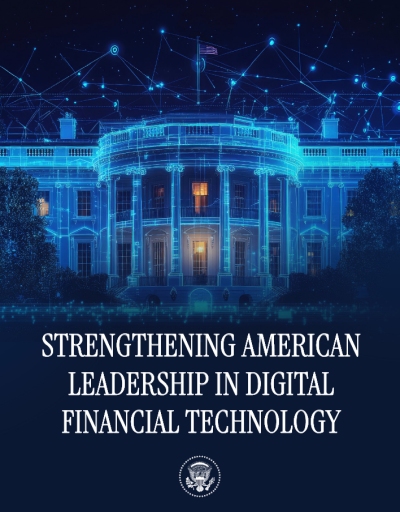
Image: Strengthening American Leadership in Digtal Financial Technology, White House report
On July 30, 2025, the White House released a major 160 page PDF report from the President’s Working Group on Digital Asset Markets called, "Strengthening American Leadership in Digital Financial Technology". The document lays out how the United States plans to build a clear rulebook for crypto and position itself as a leading global hub for blockchain technology, a huge change in direction from a government that previously relied on regulation by enforcement.
The White House report says the US needs a stronger framework for digital asset markets. It calls on Congress to pass the Digital Asset Market Clarity Act to remove gaps in oversight. The plan would give the Commodity Futures Trading Commission authority over trading in digital assets that are not securities, while the Securities and Exchange Commission would focus on those that are securities. The two agencies are asked to provide clear guidance on custody, registration, and record keeping so that new products can launch faster without long delays.
For fintech companies and investors, a more predictable environment is welcomed, and means that developers and platforms would know in advance what licenses they need and how to stay compliant instead of risking enforcement.
A large part of the report focuses on modern banking regulation. It urges federal banking regulators to stop blocking lawful digital asset companies from access to banking, a practice that was known as Operation Choke Point 2.0.
It also suggests a clear process for banks to gain approval for activities such as custody of crypto, tokenization of assets, issuing stablecoins, and using blockchains in financial services. If these changes are implemented, banks will have a clearer path to offer blockchain based products and services, which could expand customer access to digital assets directly through mainstream banks.
The report confirms the importance of stablecoins that are backed by the US dollar. It points to the GENIUS Act, signed into law on July 18, 2025, as the foundation for a federal framework for stablecoins. It also calls for a law to ban central bank digital currencies in the United States, emphasizing that the private sector should lead innovation in payments.
It suggests that the U.S. views private stablecoins as a way to maintain the dollar’s global role. It could lead to faster payments and new payment rails, but it's also a policy preference against government issued digital money.
The Working Group recommends updating anti money laundering rules to reflect how digital assets work. The plan would clarify the reporting obligations for different types of actors, including those in decentralized finance, and protect the right of law abiding citizens to hold their own digital assets. This could make it easier for compliant companies to operate while still giving regulators more effective tools against bad actors.
The report asks the Treasury and IRS to publish clear guidance on how taxes apply to crypto, including on staking, mining, and small day to day transactions. It also calls for Congress to adjust the tax code so that digital assets are treated consistently with other assets such as securities or commodities. Simplified tax rules could lower the cost of compliance and help bring more participants into the market.
If the recommendations are carried out, the US could become a more attractive market for crypto investment and product development. Other countries, including Canada, need to watch closely, as competition for talent and venture funding heats up.
For Canadian fintechs and blockchain companies, this development could open up opportunities for cross border partnerships but also create a more competition.
The National Crowdfunding & Fintech Association (NCFA Canada) is a financial innovation ecosystem that provides education, market intelligence, industry stewardship, networking and funding opportunities and services to thousands of community members and works closely with industry, government, partners and affiliates to create a vibrant and innovative fintech and funding industry in Canada. Decentralized and distributed, NCFA is engaged with global stakeholders and helps incubate projects and investment in fintech, alternative finance, crowdfunding, peer-to-peer finance, payments, digital assets and tokens, artificial intelligence, blockchain, cryptocurrency, regtech, and insurtech sectors. Join Canada's Fintech & Funding Community today FREE! Or become a contributing member and get perks. For more information, please visit: www.ncfacanada.org
| | |
|---|---|---|
| | |
Tokenization | July 21, 2025

Image: Freepik
On July 16, 2025, the U.S. Securities and Exchange Commission (SEC) held a private meeting with Ethereum-linked groups including ERC-3643 Association and Chainlink Labs to explore standards for compliant tokenized securities. At the same time, SEC Chair Paul Atkins confirmed that the agency is reviewing an innovation exemption that could allow programmable compliance frameworks to operate with targeted regulatory relief. It's a new development that confirms growing regulatory support for tokenized finance, further raising the bar for Canadian policymakers to respond.
In a major development during Crypto Week, the SEC held a private session with Ethereum-aligned groups, such as the ERC‑3643 Association, Chainlink Labs, the Enterprise Ethereum Alliance, Etherealize, and LF Decentralized Trust to explore the use of public blockchain infrastructure for regulated securities.
The meeting focused on how blockchain systems can follow existing rules for verifying identities, tracking ownership, and controlling who can buy or sell tokenized securities. The groups shared technical solutions that help meet these requirements while still using decentralized public blockchains.
Dennis O’Connell, president of the ERC‑3643 Association said the SEC showed a “noticeable shift in tone” and openness to openly source industry standards.
Two frameworks were at the center of the meeting:
Chainlink Labs in a statement:
“Only Chainlink provides the compliance, privacy, cross-chain, and data infrastructure needed to scale digital asset adoption in a single platform.”
In partnership with the Blockchain Association, Chainlink recently launched Tokenized in America, a national ranking of blockchain leadership across all 50 U.S. states.
The SEC meeting coincided with Crypto Week where rapid legislative developments were taking place in Washington. The GENIUS Act was signed into law, establishing a federal framework for stablecoin regulation, and recognizing the role of tokenized payment infrastructure. It was passed alongside the CLARITY Act, which defines treatment for digital assets, and the Anti-CBDC Surveillance State Act.
SEC Chair Paul Atkins spoke publicly about the Commission’s interest in creating an “innovation exemption” that would allow compliant tokenized securities to be piloted without full adherence to legacy rules, saying:
“If it can be tokenized, it will be tokenized.”
Sergey Nazarov, Chainlink co-founder:
Excited to see our industry reaching new heights and getting global adoption from governments because of the fundamental value that our technology provides.
The GENIUS Act is a huge step forward for stablecoins, forming the basis of on-chain payments for retail users in both… https://t.co/QlgtUgOHlu
— Sergey Nazarov (@SergeyNazarov) July 18, 2025
Canada is already evaluating stablecoins under its existing regulatory framework. The CSA classifies fiat-backed coins like USDC as “Value‑Referenced Crypto Assets” and recently allowed more time for issuers to comply. At the same time, OSFI, Department of Finance and the Bank of Canada are developing new federal rules to license stablecoin issuers to include reserve requirements, redemption, audits, and consumer protection.
However, Canada currently lacks equivalent legal tools for programmable compliance mechanisms like ERC‑3643 or Chainlink ACE. If the SEC approves a standards-based tokenization model, Canadian fintechs will face increasing cross-border friction unless policymakers adapt quickly. NCFA previously highlighted this policy gap in its advocacy post, such as Coinbase Pushes for Tokenized Equities Approval commentary. Canadian regulators cannot fall further behind.
The National Crowdfunding & Fintech Association (NCFA Canada) is a financial innovation ecosystem that provides education, market intelligence, industry stewardship, networking and funding opportunities and services to thousands of community members and works closely with industry, government, partners and affiliates to create a vibrant and innovative fintech and funding industry in Canada. Decentralized and distributed, NCFA is engaged with global stakeholders and helps incubate projects and investment in fintech, alternative finance, crowdfunding, peer-to-peer finance, payments, digital assets and tokens, artificial intelligence, blockchain, cryptocurrency, regtech, and insurtech sectors. Join Canada's Fintech & Funding Community today FREE! Or become a contributing member and get perks. For more information, please visit: www.ncfacanada.org
| | |
|---|---|---|
| | |
Digital Asset Regulation | July 18, 2025

Image: Freepik/cookiestudio
The US House of Representatives moved mountains yesterday and approve 3 major crypto bills during what lawmakers called 'Crypto Week', reflecting growing political support for crypto regulation. Some observers warn though that it could create another shadow banking system without sufficient oversight.
On Thursday, July 17, AP News reported the House passed the CLARITY Act in a 294–134 vote. The bill, which outlines crypto market structure reforms, will now move to the Senate for further debate. The GENIUS Act, focused on stablecoin rules, passed 308–122 and has already cleared the Senate. It now awaits President Donald Trump’s signature, with the White House expected to approve it. A third bill, the Anti-CBDC Surveillance State Act, passed by a narrower 219–210 margin and also heads to the Senate.
The Independent Community Bankers of America (ICBA) released a statement opposing key provisions in both the GENIUS and CLARITY bills. ICBA President Rebeca Romero Rainey wrote:
"[The bills risk] establishing a parallel banking system that lacks the regulatory framework necessary to protect consumers and preserve financial stability, [if crypto firms are allowed to bypass traditional oversight]. [The proposed reforms could] allow crypto companies to offer products that resemble deposits or banking services without adhering to the same prudential standards."
The ICBA urged Congress to prohibit nonbanks from accessing Federal Reserve master accounts and to bar stablecoin issuers from offering yield-like products via affiliates or subsidiaries.
Crypto markets responded with optimism with prices pushing all time highs, but not all stakeholders are convinced. Sen. Elizabeth Warren warned that the CLARITY Act could allow firms like Tesla or Meta to tokenize assets and sidestep SEC oversight.
If President Trump signs the GENIUS Act, it will become the first U.S. federal law specifically regulating stablecoins, setting up a nationwide reserve, audit, and disclosure standards for issuers. The Senate’s upcoming hearings on the CLARITY and Anti‑CBDC bills will determine whether U.S. crypto markets receive cohesive federal oversight or remain subject to a fragmented mix of state rules and judicial rulings. With pressure mounting from banking groups, consumer advocates, and industry, the final outcome will determine if Washington will become a true global magnet for blockchain innovation, or a shadow financial system without full protections.
The National Crowdfunding & Fintech Association (NCFA Canada) is a financial innovation ecosystem that provides education, market intelligence, industry stewardship, networking and funding opportunities and services to thousands of community members and works closely with industry, government, partners and affiliates to create a vibrant and innovative fintech and funding industry in Canada. Decentralized and distributed, NCFA is engaged with global stakeholders and helps incubate projects and investment in fintech, alternative finance, crowdfunding, peer-to-peer finance, payments, digital assets and tokens, artificial intelligence, blockchain, cryptocurrency, regtech, and insurtech sectors. Join Canada's Fintech & Funding Community today FREE! Or become a contributing member and get perks. For more information, please visit: www.ncfacanada.org
| | |
|---|---|---|
| | |
Canadian Crypto | July 18, 2025

Image: Freepik
On July 17 2025, the Bitcoin Treasury Corporation (TSXV: BTCT) announced that they have filed a preliminary CAD $300 million base shelf prospectus, a sign that it intends to operate as a public company providing institutional Bitcoin services. The filing allows the company or certain shareholders to raise capital through securities such as common shares, debt, or warrants over the next 25 months, pending regulatory approval. While no offering is currently planned, the filing provides flexibility to act when strategic opportunities arise.
The company describes itself as Canada’s first Bitcoin-native public company, focused on creating value through Bitcoin-denominated financial services and strategic accumulation. CEO Elliot Johnson says the goal is to grow its Bitcoin per share (BPS) metric, which is central to their long-term strategy. In short, BTCT wants to be the Canadian MicroStrategy which has used corporate reserves to accumulate over 200,000 BTC.
Bitcoin Treasury is aiming to build a business around bitcoin as a treasury asset and institutional product. Its current services include Bitcoin loans, and its positioning in Canadian public markets makes it a pure play for those seeking exposure to Bitcoin in equity portfolios.
Unlike Bitcoin ETFs that passively hold BTC, such as CI Galaxy Bitcoin ETF (BTCC), Purpose Bitcoin ETF (BTCX) or 3iQ CoinShares Bitcoin ETF (BTCQ), Bitcoin Treasury has a business model and currently provides services like Bitcoin-denominated loans and is developing a scalable platform to monetize and deploy Bitcoin strategically. So it combines Bitcoin exposure with active financial operations that focuses on capital markets, treasury efficiency, and lending BTC itself.
Other Canadian public companies such as LQWD Technologies (TSXV: LQWD, just raised $2.3 million CAD to buy more Bitcoin) are active in the Bitcoin space but have distinct business models. LQWD focuses on payment routing and infrastructure for the Lightning Network.
The prospectus is available through the company’s Sedar Plus profile and doesn't represent an offering but it positions the company to respond quickly if an opportunity arises. For institutional investors and fintechs tracking crypto adoption in Canada, Bitcoin Treasury’s approach could become a reference point.
The National Crowdfunding & Fintech Association (NCFA Canada) is a financial innovation ecosystem that provides education, market intelligence, industry stewardship, networking and funding opportunities and services to thousands of community members and works closely with industry, government, partners and affiliates to create a vibrant and innovative fintech and funding industry in Canada. Decentralized and distributed, NCFA is engaged with global stakeholders and helps incubate projects and investment in fintech, alternative finance, crowdfunding, peer-to-peer finance, payments, digital assets and tokens, artificial intelligence, blockchain, cryptocurrency, regtech, and insurtech sectors. Join Canada's Fintech & Funding Community today FREE! Or become a contributing member and get perks. For more information, please visit: www.ncfacanada.org
| | |
|---|---|---|
| | |
Stablecoins | July 18, 2025

Image: Freepik/gstudioimagen
The dominoes are definitely starting to fall. Citigroup and Bank of America have confirmed they are developing or preparing to launch their own stablecoins. In back-to-back Q2 earnings calls this week, executives from both banks outlined their intentions to support stablecoin issuance for use cases like digital payments and tokenized deposits.
As reported by Reuters, Citigroup CEO Jane Fraser said on July 15 that the bank is “looking at the issuance of a Citi stablecoin” and that stablecoins would fit within the bank’s current initiatives in tokenized deposits, custody, and digital cash on/off-ramp services.
Then just a day later, Bank of America CEO Brian Moynihan confirmed that Bank of America is actively preparing to issue a stablecoin of its own. He told analysts the bank “expects to launch” a stablecoin and is in conversations with regulators about what a compliant U.S. dollar-backed version would require. Moynihan also pointed to the advancement of the GENIUS Act in Congress as a key milestone for legal clarity.
Note, JPMorgan Chase already has functional stablecoin infrastructure. JPM Coin, a wholesale payments vehicle used by institutional clients, currently moves over $1 billion in transactions daily. The bank is now expanding into tokenized deposit products for digital settlement use.
Tokenized deposits are regular bank deposits that have been turned into digital tokens. They still belong to the customer and are backed by the bank, but because they run on blockchain technology, they can move money faster and incorporate programmable rules.
Worth noting that while Morgan Stanley has not announced its own stablecoin it confirmed during its latest earnings call that it is “actively discussing” potential use cases. CFO Sharon Yeshaya said the firm is monitoring the regulatory landscape and evaluating client needs.
In a Reuters article May 23, 2025, mentioned that JPMorgan Chase, Bank of America, Citigroup, Wells Fargo, and other large commercial banks (including U.S. Bank via consortium channels) are “exploring whether to team up to issue a joint stablecoin,”, but there have been no commitments or formal statements issued yet.
Traditional banks are positioning themselves to be regulated providers of digital dollars that can be used in fast, transparent, and low-cost transactions across modern financial systems.
Stablecoins issued by large banks could compete or potentially replace legacy payment systems for cross-border transfers, securities settlement, reserve management, and cash liquidity optimization. Eventually they may support consumer payments, although bank executives have stressed that the focus is on B2B use cases first.
Bank of England Governor Andrew Bailey recently warned that privately issued stablecoins could destabilize global financial systems if left unregulated, reinforcing the urgency for banks to operate within robust legal and supervisory frameworks.
Traditional finance (TradFi) is gearing up to compete directly with crypto native infrastructure in the issuance and management of digital cash.
The rapid entry of big banks like Citi and Bank of America into stablecoins confirm what fintech leaders have predicted for years. Programmable money will enter the banking mainstream, depending on regulatory approval and market demand.
The National Crowdfunding & Fintech Association (NCFA Canada) is a financial innovation ecosystem that provides education, market intelligence, industry stewardship, networking and funding opportunities and services to thousands of community members and works closely with industry, government, partners and affiliates to create a vibrant and innovative fintech and funding industry in Canada. Decentralized and distributed, NCFA is engaged with global stakeholders and helps incubate projects and investment in fintech, alternative finance, crowdfunding, peer-to-peer finance, payments, digital assets and tokens, artificial intelligence, blockchain, cryptocurrency, regtech, and insurtech sectors. Join Canada's Fintech & Funding Community today FREE! Or become a contributing member and get perks. For more information, please visit: www.ncfacanada.org
| | |
|---|---|---|
| | |



August 26th, 2025

January 4th, 2024

June 1st, 2021

September 9th, 2020

July 9th, 2018

January 3rd, 2018

September 25th, 2017

June 20th, 2017

May 10th, 2017

December 14th, 2016
