





Karsten Wenzlaff, Advisor
August 26th, 2025
Karsten Wenzlaff is a Crowdfunding and Fintech Expert from Germany. He is Secretary-General of Digit[...]


Crypto Policy | July 15, 2025

Image: Freepik
This week, the U.S. House of Representatives is organizing a series of votes on three major cryptocurrency bills. American lawmakers are calling this “Crypto Week” because the outcome of debated decisions will likely impact digital assets and the future of crypto for years to come.
Included this week is how crypto and stablecoins are regulated,= and whether the U.S. government can issue its own central bank digital currency (CBDC). The outcome of course may influence how other countries including Canada approach regulation and innovation in the crypto-driven fintech sector.
Despite some chop in markets at these prices, Bitcoin rose to over US$123,000 on Monday, recording another new all time high as investors were drawn to the crypto policy news and congressional process taking place in the U.S., after years of regulation by enforcement. Investors see these bills as a clear sign that the U.S. will finally bring clarity to crypto regulation. There's also been steady growing demand and support from institutions, including companies like BlackRock, MicroStrategy and the list goes on.
This bill aims to define the roles of the Securities and Exchange Commission (SEC) and the Commodity Futures Trading Commission (CFTC). It would also allow some crypto projects to operate without registering as securities, if they meet certain technical standards.
This bill sets clear rules for companies that want to issue stablecoins. It requires 1:1 reserves in U.S. dollars or similarly defined safe assets, and also expands financial reporting and compliance rules for issuers.
This bill would block the U.S. Federal Reserve from launching a digital dollar. It says only Congress can approve a U.S. CBDC and aims to stop the central bank from using it to monitor or influence spending.
Votes are scheduled throughout the week, with final decisions on the CLARITY and Anti-CBDC bills expected by Thursday, and the GENIUS Act vote likely on Friday.
The U.S. is Canada’s closest financial partner. If Congress passes new laws that support crypto innovation while protecting consumers, it could set a standard for others to follow. A stablecoin framework in the U.S. could push Canadian regulators to accelerate efforts of their own.
Cross border and global fintech companies will benefit from clearer rules in the U.S., opening doors for new investment and partnerships. And as more large players move into crypto under a stable legal framework, Canada’s own financial institutions will face increasing pressure to compete.
The momentum is real. If these bills pass, the U.S. will take a significant leap towards a national digital policy. Canadian fintech leaders, investors and regulators must pay attention.
 The National Crowdfunding & Fintech Association (NCFA Canada) is a financial innovation ecosystem that provides education, market intelligence, industry stewardship, networking and funding opportunities and services to thousands of community members and works closely with industry, government, partners and affiliates to create a vibrant and innovative fintech and funding industry in Canada. Decentralized and distributed, NCFA is engaged with global stakeholders and helps incubate projects and investment in fintech, alternative finance, crowdfunding, peer-to-peer finance, payments, digital assets and tokens, artificial intelligence, blockchain, cryptocurrency, regtech, and insurtech sectors. Join Canada's Fintech & Funding Community today FREE! Or become a contributing member and get perks. For more information, please visit: www.ncfacanada.org
 |  |  |
|---|---|---|
 |  |  |
Crypto | July 11, 2025

Image: BTCUSD Tradingview
Bitcoin just printed a massive green candle, BTC reaching a new all-time-high (ATH) of USD $118,000, boosted by institutional inflows, constrained supply, and regulatory momentum in global markets. At the same time, Canada is working to finalize long awaited rules to bring clarity to crypto exposure for funds and federally regulated financial institutions. Collectively, it's a rare convergence of events that are pushing up price. It's a timely opportunity for Canadian fintechs, fund managers, and policymakers to assess their positioning and prepare for what's next.
Global capital flows into Bitcoin are accelerating, as international financial markets interact with the asset.
U.S. spot Bitcoin ETFs have attracted over $51 billion USD in net inflows since January 2025. These products are managed by firms like BlackRock and Fidelity, are offering institutional investors direct and regulated access to Bitcoin at scale. On July 9 alone, daily flows exceeded USD $1.18 billion.
Bitcoin balances held on exchanges have fallen to their lowest levels since 2017, according to Glassnode data. It means long term hodlers are accumulating and there are fewer sellers which tightens liquidity and pushes prices upwards during surges.
Roughly $1 billion USD in short positions were liquidated in early July, forcing traders to buy back positions at higher prices, creating momentum that further boosts demand and additional institutional entry.
The GENIUS Act cleared the Senate with a bipartisan 68–30 vote on June 17, 2025, establishing the first federal framework for stablecoins (see SEC Issues Covered Stablecoin Statement, Risks Remain), including issuer registration, reserve and audit rules, and oversight. Next up is a House vote during “Crypto Week” starting July 14. In March, the White House issued an executive order creating a Strategic Bitcoin Reserve stocked with seized BTC and a broader digital assets stockpile, which aims to treat Bitcoin as a national reserve asset.
Major asset managers like Fidelity and BlackRock are incorporating Bitcoin as a foundational allocation. In May, U.S. spot Bitcoin ETFs saw a net inflow of $9.209 billion USD in just one week led by BlackRock’s IBIT and Fidelity’s FBTC. While global forces are transforming financial markets, what matters for Canadian fintechs and financial institutions is how Canada is responding.
In February 2025, the Office of the Superintendent of Financial Institutions (OSFI) published its final guideline on crypto-asset exposures. Taking effect later this year, the new framework applies to all federally regulated banks and insurers. According to Norton Rose Fulbright, it establishes:
These rules are an important step in integrating crypto within Canada’s prudential regulatory system, and they provide institutions with clearer guardrails to support innovation while managing systemic risk.
On April 17, 2025, the Canadian Securities Administrators (CSA) finalized amendments to NI 81-102, the national rule governing mutual funds and investment products. These changes come into force on July 16, 2025.
As detailed by McMillan and McCarthy Tétrault, the new rules say that:
The OSFI and CSA frameworks are opening clearer paths for new crypto products and more diversified portfolios. Fund managers can now launch Bitcoin-focused vehicles with defined rules around eligibility, custody, and risk.
Banks and insurers must begin planning for capital and governance policies that align with OSFI’s exposure thresholds.
Fintech platforms have more certainty when adding Bitcoin related features, with legal and compliance expectations now taking shape.
These changes also raise the bar for investor protection, requiring firms to strengthen disclosures, improve internal oversight, and adopt secure custody practices.
Another Bitcoin ATH is worth celebrating but the deeper trend is about normalization. Not too long ago, crypto assets were speculative but they are now moving to regulated infrastructure.
Canada is positioning itself to participate in a more stable and credible digital crypto future, and there's growing alignment between global investment flows and domestic regulatory action, providing fintechs and capital providers with greater clarity and confidence than ever before.
The National Crowdfunding & Fintech Association (NCFA Canada) is a financial innovation ecosystem that provides education, market intelligence, industry stewardship, networking and funding opportunities and services to thousands of community members and works closely with industry, government, partners and affiliates to create a vibrant and innovative fintech and funding industry in Canada. Decentralized and distributed, NCFA is engaged with global stakeholders and helps incubate projects and investment in fintech, alternative finance, crowdfunding, peer-to-peer finance, payments, digital assets and tokens, artificial intelligence, blockchain, cryptocurrency, regtech, and insurtech sectors. Join Canada's Fintech & Funding Community today FREE! Or become a contributing member and get perks. For more information, please visit: www.ncfacanada.org
| | |
|---|---|---|
| | |
Tokenization | July 10, 2025

Image: Freepik
On July 9, 2025, U.S. Securities and Exchange Commissioner Hester Peirce (aka Crypto Mom) issued a clear statement about tokenized securities: "Tokenization may facilitate capital formation and enhance investors’ ability to use their assets as collateral" but they are still subject to existing securities laws.
Her comments are directed at companies using blockchain technology to issue or trade digital versions of financial instruments like stocks or bonds. Major U.S. firms such as Franklin Templeton, BlackRock, and Robinhood are already exploring tokenized fund structures and products.
Hester Perice, SEC Commissioner:
“Calling a token representing a security by a different name or moving it to a blockchain does not change its fundamental nature,"
“Tokenizing securities does not render them unrecognizable to our existing rule set. If you issue or trade a tokenized version of a stock or bond, you still must comply with the relevant rules.”
Her statement confirms that registration, disclosure, custody, and investor protection rules apply whether a security is paper-based or tokenized. As more and more firms turn to blockchain to modernize capital markets, the SEC is reminding them that the legal definitions of securities have not changed.
She highlights two categories of tokenized securities and in both cases full compliance is required: (1) those issued directly by a company and (2) those created by a third party based on an existing security.
She also cautioned that third-party tokenization can raise new risks, especially if the offering is misleading or undermines investor protections.
“A third party seeking to tokenize someone else’s security must ensure that such efforts are not misleading, do not violate the securities laws, and do not compromise investor protections.”
Blockchain infrastructure can improve how markets operate. Tokenization allows for faster settlement, greater transparency, and lower administrative costs. It also enables fractional ownership, which can make investing more accessible. Restrictions can be built in and help enforce compliance automatically, some platforms may also offer 24/7 continuous trading access.
In Peirce’s view, innovation and regulation don't have to be in conflict:
“We should consider exemptions, no-action relief, or other tailored regulatory accommodations where the benefits of blockchain technology can be realized without undermining investor protections.”
The SEC’s position does not change Canadian law, but it provides useful direction for NCFA members and fintechs active in U.S. markets. In Canada, tokenized offerings must comply with securities rules. If a financial product is a security under Canadian law then it's subject to regulation.
Canadian fintechs exploring tokenization should expect scrutiny on custody, disclosures, and investor onboarding. Issuers must also ensure that the technology used does not obscure risk or circumvent investor rights. Regulatory engagement is key.
Peirce's statement shows that regulators are open to innovation but only if it maintains transparency and investor safeguards.
The National Crowdfunding & Fintech Association (NCFA Canada) is a financial innovation ecosystem that provides education, market intelligence, industry stewardship, networking and funding opportunities and services to thousands of community members and works closely with industry, government, partners and affiliates to create a vibrant and innovative fintech and funding industry in Canada. Decentralized and distributed, NCFA is engaged with global stakeholders and helps incubate projects and investment in fintech, alternative finance, crowdfunding, peer-to-peer finance, payments, digital assets and tokens, artificial intelligence, blockchain, cryptocurrency, regtech, and insurtech sectors. Join Canada's Fintech & Funding Community today FREE! Or become a contributing member and get perks. For more information, please visit: www.ncfacanada.org
| | |
|---|---|---|
| | |
Crypto Banking | July 7, 2025
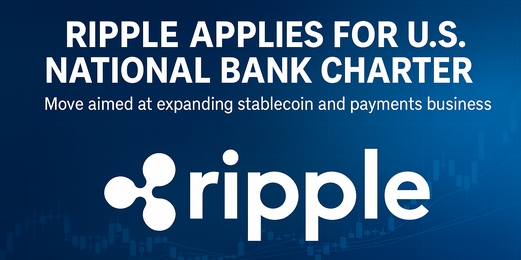
Ripple has officially applied for a national bank charter from the US Office of the Comptroller of the Currency (OCC). The company is also seeking a Federal Reserve master account to support direct access to US payment rails.
CEO Brad Garlinghouse confirmed the news on X:
True to our long-standing compliance roots, @Ripple is applying for a national bank charter from the OCC. If approved, we would have both state (via NYDFS) and federal oversight, a new (and unique!) benchmark for trust in the stablecoin market.
Earlier in the week via… https://t.co/IdiR7x3eWZ
— Brad Garlinghouse (@bgarlinghouse) July 2, 2025
If approved, Ripple would bypass correspondent banks by settling payments directly with the Fed and holding dollar reserves without intermediaries. This is designed to support Ripple’s push to offer a compliant, enterprise-grade stablecoin and accelerate global payments. These objectives align with new federal rules proposed under the GENIUS Act, which sets clear reserve and disclosure standards for stablecoin issuers.
Ripple’s approach mirrors that of Anchorage Digital and Circle, which operate under national trust bank charters regulated by the OCC. Ripple may use its regulated subsidiary, Standard Custody & Trust, to separate digital asset exposure from its core balance sheet. This structure could help the firm meet Basel III capital requirements by keeping volatile assets like XRP off its banking books.
Following the announcement, XRP surged above $2.28 as trading volume spiked. Analysts said the rally was driven by rising confidence that Ripple’s regulatory strategy will boost its long-term institutional credibility.
If Ripple is granted the charter and Fed account, it will become one of the few crypto-native firms operating fully within the traditional banking system. It's a significant and growing trend among major fintechs like Circle, Wise, and others seeking deeper integration with regulated payment rails. For Canadian fintechs and regulators, Ripple’s move could accelerate the need to clarify stablecoin policy, custody standards, and access to domestic settlement infrastructure. Regulatory certainty is a competitive advantage today and quickly becoming the norm.
The National Crowdfunding & Fintech Association (NCFA Canada) is a financial innovation ecosystem that provides education, market intelligence, industry stewardship, networking and funding opportunities and services to thousands of community members and works closely with industry, government, partners and affiliates to create a vibrant and innovative fintech and funding industry in Canada. Decentralized and distributed, NCFA is engaged with global stakeholders and helps incubate projects and investment in fintech, alternative finance, crowdfunding, peer-to-peer finance, payments, digital assets and tokens, artificial intelligence, blockchain, cryptocurrency, regtech, and insurtech sectors. Join Canada's Fintech & Funding Community today FREE! Or become a contributing member and get perks. For more information, please visit: www.ncfacanada.org
| | |
|---|---|---|
| | |
Crypto | July 2, 2025

On June 27, 2025, the U.S. Securities and Exchange Commission (SEC) officially approved the conversion of Grayscale’s Digital Large Cap Fund (GDLC) into a spot exchange traded fund (ETF). The fund is now listed on NYSE Arca, offering investors access to five major crypto assets in one regulated product. It's the first time that a U.S. spot ETF includes not just Bitcoin and Ethereum but also Solana, XRP and Cardano, establishing a new precedent for how diversified crypto products can be structured and approved under SEC oversight.
The Grayscale Digital Large Cap ETF largely follows the CoinDesk Large Cap Select Index, which rebalances monthly. As of July 1, 2025, the fund holds:
GDLC now offers direct access to these assets through a public listing.
Prior to this approval, GDLC operated as a closed-end trust on OTC markets. It lacked daily liquidity and tradeed at a discount or premium to the fund’s net asset value. The new ETF lets large investors swap crypto directly for shares in the fund, and vice versa, which helps align market prices with the actual value of the crypto held.
Grayscale completed the conversion of approx $775 million USD in assets by the SEC’s July 2 compliance deadline, making the ETF now the largest multi-crypto fund of its kind in the United States.
This is the first time U.S. investors can now access a range of large-cap crypto assets, beyond just Bitcoin and Ethereum, through a regulated spot ETF. It reduces the need to manage separate holdings or rely on offshore exchanges.
Analysts now estimate a 95% likelihood that ETFs for XRP, Solana, and Litecoin will be approved in the U.S. later this year. Major firms including Bitwise and Franklin Templeton have already submitted filings.
This approval reinforces legal and regulatory precedent and build's on Grayscale’s 2023 legal victory, which challenged the agency’s rejection of a Bitcoin ETF. That ruling continues to impact how the SEC responds to ETF applications. It also highlights the SEC's evolving policy on crypto including assets that were previously under regulatory scrutiny such as XRP. The SEC is now clearly willing to consider broader crypto exposure in compliant funds, even while legal classification questions remain up in the air.
The door to broader index-based crypto products is likely to follow, such as new ETFs tied to crypto indices, sector themes, and/or platform categories. See NCFA’s article on the crypto ETF battle intensifying with XRP, Solana, and Dogecoin.
Canada continues to lead with crypto ETF adoption. The Purpose XRP ETF launched on the TSX on June 18, 2025, while Canadian investors already have access to ETFs for Bitcoin, Ethereum, and Solana. See also NCFA’s report on Canada’s first Solana spot ETF with staking.
For Canadian fintechs and investors, growing alignment in North American regulation signals an opportunity to expand services built around compliant digital asset products. As U.S. markets open up to a wider mix of crypto ETFs, Canadian firms offering custody, compliance, or portfolio tools will be well positioned to support cross-border demand and deepen product innovation.
The National Crowdfunding & Fintech Association (NCFA Canada) is a financial innovation ecosystem that provides education, market intelligence, industry stewardship, networking and funding opportunities and services to thousands of community members and works closely with industry, government, partners and affiliates to create a vibrant and innovative fintech and funding industry in Canada. Decentralized and distributed, NCFA is engaged with global stakeholders and helps incubate projects and investment in fintech, alternative finance, crowdfunding, peer-to-peer finance, payments, digital assets and tokens, artificial intelligence, blockchain, cryptocurrency, regtech, and insurtech sectors. Join Canada's Fintech & Funding Community today FREE! Or become a contributing member and get perks. For more information, please visit: www.ncfacanada.org
| | |
|---|---|---|
| | |
Crypto Regulation | June 30, 2025

Image: Freepik/rawpixel.com
On June 26, The Logic and Morningstar reported that Canada’s federal government is drafting a new legislative framework for stablecoin issuers. The Department of Finance is leading the effort, with support from the Office of the Superintendent of Financial Institutions (OSFI) and the Bank of Canada.
The framework is expected to define which companies can issue stablecoins, what assets they must hold in reserve, and how redemption and consumer protections will work. While OSFI already issued guidelines in early 2025 for how banks and insurers must treat crypto assets like stablecoins on their balance sheets, the new law will apply directly to stablecoin creators for the first time.
On June 26, 2025, OSFI Superintendent Peter Routledge confirmed that the Department of Finance is drafting stablecoin legislation.
Peter Routledge, Superintendent of Financial Institutions via The Logic article:
“We are preparing for the day that there is a legislative framework that gives us the authority to regulate and supervise that particular innovation in a constructive way.”
Although the draft bill hasn't yet been released, Finance Canada has signalled that the framework may include:
This would align Canada with international approaches, such as the EU’s MiCA regulation and the global Financial Stability Board’s recommendations.
QCAD is a Canadian dollar stablecoin backed by reserves held in Canadian financial institutions, issued by Stablecorp. It's governed by a legal trust structure and verified through third-party attestations. On June 16, 2025, Stablecorp filed a preliminary prospectus with the Ontario Securities Commission under the CSA’s interim framework for fiat-referenced crypto assets and per the release, "[QCAD] will bring the first regulated Canadian stablecoin to market", and is a good example of Canadian issuers proactively taking steps to comply with rules the upcoming law may apply.
In February 2025, OSFI released the Capital and Liquidity Treatment of Crypto-asset Exposures for Banks guideline (after holding consultations), which applies only to federally regulated financial institutions. It defines how banks and insurers must treat stablecoins and other crypto assets in terms of capital and liquidity requirements.
While OSFI can guide how stablecoins are handled by banks and insurers, it does not currently have legal authority to supervise stablecoin issuers directly. The new legislative framework is expected to close that gap. This will ensure that any company issuing a Canadian dollar stablecoin is subject to consistent national rules, regardless of whether they are a financial institution or a fintech startup.
Stablecoins are gaining traction in Canada and globally, but the companies that issue them operate in a legal grey area. The new federal legislative framework will give regulators the tools to oversee how stablecoins are issued, backed, and redeemed. This will help protect consumers, reduce financial risk, and give fintechs a clear path towards compliance. For stablecoin projects like QCAD, the upcoming rules will provide an opportunity to become fully recognized under Canadian law.
The National Crowdfunding & Fintech Association (NCFA Canada) is a financial innovation ecosystem that provides education, market intelligence, industry stewardship, networking and funding opportunities and services to thousands of community members and works closely with industry, government, partners and affiliates to create a vibrant and innovative fintech and funding industry in Canada. Decentralized and distributed, NCFA is engaged with global stakeholders and helps incubate projects and investment in fintech, alternative finance, crowdfunding, peer-to-peer finance, payments, digital assets and tokens, artificial intelligence, blockchain, cryptocurrency, regtech, and insurtech sectors. Join Canada's Fintech & Funding Community today FREE! Or become a contributing member and get perks. For more information, please visit: www.ncfacanada.org
| | |
|---|---|---|
| | |
Crypto Adoption | June 27, 2025
Image: Freepik/studiogstock
For the first time, cryptocurrency is being considered in U.S. mortgage financing. On June 25, 2025, the Federal Housing Finance Agency (FHFA) told Fannie Mae and Freddie Mac to prepare proposals that would let homebuyers include crypto assets when being assessed for their mortgage applications.
In a public post on X, FHFA Director Bill Pulte said this change supports the U.S. goal of becoming a global leader in crypto. The order allows crypto to be included as a financial reserve, meaning lenders could soon treat some digital assets the same way they treat cash or stocks when reviewing mortgage risk. This is not a new rule yet but it's the start of a planning phase where the agencies will write and review draft policies.
After significant studying, and in keeping with President Trump’s vision to make the United States the crypto capital of the world, today I ordered the Great Fannie Mae and Freddie Mac to prepare their businesses to count cryptocurrency as an asset for a mortgage.
SO ORDERED pic.twitter.com/Tg9ReJQXC3
— Pulte (@pulte) June 25, 2025
Remarkable to see the crypto sentiment change so rapidly in the United States. This latest change reflects the wider effort by U.S. officials to include digital assets in traditional finance. An article in Barron’s noted that reserve rules may apply to bitcoin, ether, and other widely held tokens. The Washington Post also reported concerns about volatility, especially with some tokens rising or falling by 40% or more in a single day.
While this directive applies only in the United States, it sends a strong message. If crypto is accepted in mainstream mortgage reviews, financial technology firms in Canada may start building new tools to support similar models. That could include connecting wallets to mortgage applications or building credit models that accept tokenized savings.
For Canadian fintechs focused on lending, payments, or digital identity, this is an early signal of significant changes to come. With more Canadians holding crypto, pressure will likely grow for Canadian regulators to respond or risk falling behind global standards. That's what happens when your a country deemed 'fast follower'.
The National Crowdfunding & Fintech Association (NCFA Canada) is a financial innovation ecosystem that provides education, market intelligence, industry stewardship, networking and funding opportunities and services to thousands of community members and works closely with industry, government, partners and affiliates to create a vibrant and innovative fintech and funding industry in Canada. Decentralized and distributed, NCFA is engaged with global stakeholders and helps incubate projects and investment in fintech, alternative finance, crowdfunding, peer-to-peer finance, payments, digital assets and tokens, artificial intelligence, blockchain, cryptocurrency, regtech, and insurtech sectors. Join Canada's Fintech & Funding Community today FREE! Or become a contributing member and get perks. For more information, please visit: www.ncfacanada.org
| | |
|---|---|---|
| | |



August 26th, 2025

January 4th, 2024

June 1st, 2021

September 9th, 2020

July 9th, 2018

January 3rd, 2018

September 25th, 2017

June 20th, 2017

May 10th, 2017

December 14th, 2016
