




Karsten Wenzlaff, Advisor
August 26th, 2025
Karsten Wenzlaff is a Crowdfunding and Fintech Expert from Germany. He is Secretary-General of Digit[...]


AI Research | May 31, 2024

Image: Freepik/macrovector_official
Elliptic, in collaboration with the MIT-IBM Watson AI Lab, has unveiled updated research showcasing the potential of AI in enhancing blockchain analytics, and more specifically using AI to detect money laundering in crypto markets. The study uses deep learning models to identify money laundering activities, using the extensive Elliptic2 dataset comprising over 200 million transactions. This approach not only detects known laundering patterns but also uncovers new, previously undetectable illicit activities.
Instead of concentrating on finding specific unlawful wallets, Elliptic's AI models identify "subgraphs," which are collections of transactions that indicate laundering operations. A more thorough and precise detection of money laundering is possible with this approach. The AI model used in the study demonstrated remarkable performance measures, such as an F1 score of 0.933 and a ROC-AUC of 0.889. The model's effectiveness was validated through practical testing with a cryptocurrency exchange, which correctly detected 14 out of 52 flagged subgraphs as potentially related to money laundering.
Elliptic has made the Elliptic2 dataset publicly available in addition to its technical accomplishments in order to promote additional study and advancement in the area. By encouraging cooperation and creativity, this openness hopes to improve the identification of illegal cryptocurrency activity. Read the full research paper here.
The creative application of AI in blockchain analytics by Elliptic's new research is a major advancement in the battle against financial crime. Through the utilization of vast datasets and sophisticated artificial intelligence methodologies, this study improves the security and transparency of blockchain transactions.
 The National Crowdfunding & Fintech Association (NCFA Canada) is a financial innovation ecosystem that provides education, market intelligence, industry stewardship, networking and funding opportunities and services to thousands of community members and works closely with industry, government, partners and affiliates to create a vibrant and innovative fintech and funding industry in Canada. Decentralized and distributed, NCFA is engaged with global stakeholders and helps incubate projects and investment in fintech, alternative finance, crowdfunding, peer-to-peer finance, payments, digital assets and tokens, artificial intelligence, blockchain, cryptocurrency, regtech, and insurtech sectors. Join Canada's Fintech & Funding Community today FREE! Or become a contributing member and get perks. For more information, please visit: www.ncfacanada.org
 |  |  |
|---|---|---|
 |  |  |
GenAI | May 28, 2024

Image: Freepik/rawpixel.com
As generative AI (GenAI) technologies are increasingly being integrated into fintech companies to create unrivalled opportunities for efficiency and innovation, fintech founders need to develop responsibly and respect the most crucial human rights. B-Tech, a project of the UN Human Rights Office of the High Commissioner has published an informative paper linking these risks to the Universal Declaration of Human Rights (UDHR) in a recent report titled, "Taxonomy of Human Rights Risks Connected to Generative AI". Such risks include threats to privacy, further discrimination and bias, job displacement that leads to economic instability, and an infringement on freedom of expression and access to true information. Below are some key fintech related risks. Let's dig in...
"No one shall be subjected to arbitrary interference with his privacy, family, home or correspondence, nor to attacks upon his honour and reputation. Everyone has the right to the protection of the law against such interference or attacks." UDHR Article 12
Financial technology companies are processing reams of sensitive personal data. GenAI technology enhances the data analytics, but at the same time, it risks serious threats to privacy. The greatest fears are around the deepfake abuse, unauthorized data scraping, and intrusions into the privacy of personal data.
"All are equal before the law and are entitled without any discrimination to equal protection of the law." UDHR Article 7
GenAI systems can further highlight, replicate, and amplify training data bias, leading to adverse practices in credit scoring, loan approval, customer service, among others.
"Everyone has the right to work, to free choice of employment, to just and favourable conditions of work and to protection against unemployment." UDHR Article 23(1)
Potential GenAl applications in fintech may automate even repeatable jobs, thus leading to relocation of employment opportunities. This affects the economic stability and right of gainful living.
"Everyone has the right to freedom of opinion and expression; this right includes freedom to hold opinions without interference and to seek, receive and impart information and ideas through any media and regardless of frontiers." UDHR Article 19
In fintech, the key is trustworthy information to support making informed decisions based on facts and reliability. AI in its current form might propagate misinformation adversely affecting trust in financial systems and fuelling the flow of incorrect information.
A violation of any of these human rights can lead to various forms of recourse:
As one can see from the long list above, violated individuals and organizations have a range of channels to seek redress and hold the fintech companies accountable for human rights violations.
Several best practices that fintech companies and financial institutions might adopt to proactively mitigate these risks of human rights.
Generative AI is a game-changer in fintech but it can amplify potential human rights risks. Companies big and small are advised to proactively mitigate core risks through privacy-first design, elimination of biases through culture, staff training, and ethical leadership and integrity around the processes and information within their organizations. Businesses need to embrace ethical guidelines, be subject to periodic audits, and include stakeholders in the process of building trust and responsibility in the use of AI for financial services.
The National Crowdfunding & Fintech Association (NCFA Canada) is a financial innovation ecosystem that provides education, market intelligence, industry stewardship, networking and funding opportunities and services to thousands of community members and works closely with industry, government, partners and affiliates to create a vibrant and innovative fintech and funding industry in Canada. Decentralized and distributed, NCFA is engaged with global stakeholders and helps incubate projects and investment in fintech, alternative finance, crowdfunding, peer-to-peer finance, payments, digital assets and tokens, artificial intelligence, blockchain, cryptocurrency, regtech, and insurtech sectors. Join Canada's Fintech & Funding Community today FREE! Or become a contributing member and get perks. For more information, please visit: www.ncfacanada.org
| | |
|---|---|---|
| | |
Data Privacy | May 27, 2024

Image: Freepik/rawpixel.com
On September 2024, Quebec's Law 25—namely, An Act to Modernize Legislative Provisions as Regards the Protection of Personal Information—will begin, creating a sea change in data privacy regulation that governs all transactions of companies in Quebec. This law intends to increase individuals' control over their personal data and provide additional responsibilities for firms in terms of data processing, transparency, and security. With these looming changes, Law 25 is something a fintech firm must understand now to stay compliant in the future and to deter hefty fines. NCFAs industry partner, Gowling WLG has put together this handy guide called, 'The Right to Data Portability: Everything You Need to Know"
The following is an in-depth comparison of the similarities and differences between PIPEDA and Quebec's Law 25.
| Feature | Quebec's Law 25 | PIPEDA |
|---|---|---|
| Scope and Jurisdiction | Applies to organizations in Quebec and those doing business with Quebec residents, focusing on protecting residents' privacy regardless of business location. | Applies to private-sector organizations across Canada involved in commercial activities, focusing on national-level privacy protection. |
| Consent Requirements | Requires explicit, informed consent, separate from other terms of service, similar to GDPR standards. | Allows for either express or implied consent, depending on the sensitivity of the personal information being collected. |
| Data Portability | Introduces the right to data portability, allowing individuals to transfer their personal data between organizations starting September 22, 2024. | Does not explicitly provide for data portability rights. |
| Privacy by Default | Mandates the highest privacy settings enabled by default, ensuring maximum data protection from the outset. | Does not specifically mandate privacy by default settings. |
| Privacy Impact Assessments (PIAs) | Requires organizations to conduct PIAs before transferring personal data outside Quebec, similar to GDPR requirements. | Encourages PIAs but does not mandate them. |
| Penalties for Non-Compliance | Imposes fines ranging from $15,000 to $25,000,000 CAD, or up to 4% of the company's worldwide annual turnover. | Imposes fines up to $100,000 CAD for non-compliance. |
| Data Protection Officer (DPO) | Requires certain organizations to appoint a privacy officer responsible for compliance. | Does not require the appointment of a DPO, but recommends it for large organizations. |
| Right to Erasure | Introduces the right to erasure, allowing individuals to request deletion of their personal information. | Does not include a specific right to erasure, but individuals can request corrections to their personal information. |
| Private Right of Action | Empowers individuals to take legal action against businesses for privacy violations, allowing for collective actions. | Does not provide a broad private right of action. |
| Cross-Border Data Transfers | Requires PIAs to assess the equivalence of foreign data protection laws before transferring data outside Quebec. | Requires organizations to use contractual or other means to protect personal information when transferring it to a third party. |
While Quebec's Law 25 is currently specific to the province of Quebec, there is growing momentum for similar privacy protections to be adopted across Canada.
The federal Bill C-27, which includes provisions for a new Consumer Privacy Protection Act, signals an ongoing effort to enhance data privacy nationwide. If adopted, these regulations could harmonize with Quebec's stringent standards, setting a unified framework for data protection across the country.
For organizations operating in the fintech space, it is important to remain aware of the law and how it is evolving in order to ensure full compliance for the protection of the data of their users. This will raise consumer trust in the economy and yield a safer and more transparent digital environment.
The National Crowdfunding & Fintech Association (NCFA Canada) is a financial innovation ecosystem that provides education, market intelligence, industry stewardship, networking and funding opportunities and services to thousands of community members and works closely with industry, government, partners and affiliates to create a vibrant and innovative fintech and funding industry in Canada. Decentralized and distributed, NCFA is engaged with global stakeholders and helps incubate projects and investment in fintech, alternative finance, crowdfunding, peer-to-peer finance, payments, digital assets and tokens, artificial intelligence, blockchain, cryptocurrency, regtech, and insurtech sectors. Join Canada's Fintech & Funding Community today FREE! Or become a contributing member and get perks. For more information, please visit: www.ncfacanada.org
| | |
|---|---|---|
| | |
Crypto Regulation | May 27, 2024

Image; Pathways to Regulation of Crypto Assets - A Global Approach (WEF)
Regulating crypto assets that are continuously evolving at light speed is complex and coordination among international jurisdictions, national regulators, and industry participants is key. In this light, WEF 2023 report (34 page PDF) offers a comprehensive set of recommendations and insights for a harmonized approach to regulating crypto assets.
This article reviews the recommendations drawn from the report and compares them with the current approach for different regions.
International bodies have a role in setting the stage for a unified global approach on crypto regulation.
National and regional regulators should build a safe and sound environment for crypto assets. Key points are cross-segment coordination, regulatory certainty, and using technology to design regulation.
Some proactive steps that the industry will have to take in order to achieve global coordination and regulatory alignment are discussed in the WEF report. It also calls for standard setting, sharing best practices, and responsible innovation in technology.
As of 2024, several countries are progressing their regulatory landscape for cryptocurrencies. These nations are setting benchmarks by implementing comprehensive regulatory frameworks that align closely with the World Economic Forum’s (WEF) recommendations for a global approach to crypto regulation. Here’s an overview at some of these countries (in no particular order).
Here is the table summarizing the alignment of various countries' crypto regulations with the World Economic Forum's recommendations. The alignment score is based on the extent to which each country's regulations incorporate elements of the WEF's recommendations, such as consumer protection, regulatory certainty, and the use of technology for regulation.
| Country/Region | Alignment with WEF Recommendations | Score | |
|---|---|---|---|
| European Union | Comprehensive regulatory framework, consumer protection, cross-border coordination, and use of technology for compliance. | 9/10 | |
| United Kingdom | Phased regulatory approach, strong consumer protection, and supportive of technological innovation. | 8/10 | |
| United States | Fragmented approach with ongoing regulatory uncertainty, significant enforcement actions, and legislative efforts. | 6/10 | |
| Canada | Robust framework, stringent consumer protection, and proactive stance on innovation and regulation. | 8/10 | |
| United Arab Emirates (UAE) | Detailed regulatory framework, cross-border coordination, and clear guidelines for licensing and operation. | 9/10 | |
| Hong Kong | Comprehensive regulations, focus on responsible innovation, and high standards for retail crypto trading services. | 9/10 | |
| Singapore | Strong regulatory framework, stringent consumer protection measures, and support for fintech innovation through regulatory sandbox. | 9/10 |
As the landscape of crypto asset regulation continues to evolve around the globe, it is crucial that international bodies, national regulators, and the industry itself work together to create a harmonized and robust framework by promoting consistent standards, sharing best practices, and fostering responsible innovation.
The National Crowdfunding & Fintech Association (NCFA Canada) is a financial innovation ecosystem that provides education, market intelligence, industry stewardship, networking and funding opportunities and services to thousands of community members and works closely with industry, government, partners and affiliates to create a vibrant and innovative fintech and funding industry in Canada. Decentralized and distributed, NCFA is engaged with global stakeholders and helps incubate projects and investment in fintech, alternative finance, crowdfunding, peer-to-peer finance, payments, digital assets and tokens, artificial intelligence, blockchain, cryptocurrency, regtech, and insurtech sectors. Join Canada's Fintech & Funding Community today FREE! Or become a contributing member and get perks. For more information, please visit: www.ncfacanada.org
| | |
|---|---|---|
| | |
Corporate Venture Capital | May 17, 2024

Image: The State of Corporate Venture Capital in Canada 2024, Deloitte and BDC
Published this week, "The State of Corporate Venture Capital in Canada," produced by Deloitte Ventures in collaboration with BDC Capital, highlights the potential for growth and innovation that CVC can bring to Canadian corporates, startups, and the broader economy. However, it also underscores significant challenges and areas where Canada lags behind its international counterparts, particularly the United States. Read the release
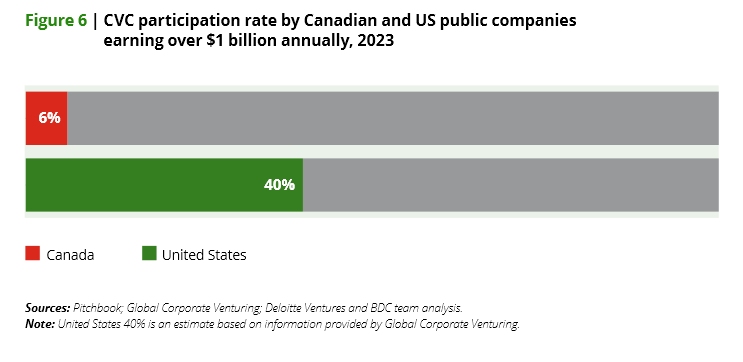
Image: Figure 6 from The State of CVC in Canada 2024 (Deloitte/BDC)
The report is a thorough examination of the current landscape and potential future of CVC in Canada. However, there are some notable exclusions that would have been interesting to discuss:
Richard Remillard, President of RCG Group and Board Director NCFA Canada says it well:
" This Deloittte paper prepared in conjunction with BDC points to some revealing information about the state of corporate venture capital(CVC) in both the US and Canada. Unsurprisingly, Canada trails significantly behind the US on this front. The paper notes that a mere 6% of publicly-traded Canadian corporations have CVC's versus 19% of those in the US. This gap has long been noted and decried by venture capital industry participants, including BDC. Where the paper is lacking is in identifying the source(s) of this weakness in the Canadian risk capital ecosystem. It could be a function of Canada simply not having a substantial number of publicly-traded firms compared to the US - and, many of the latter having received venture capital funding previously. Another factor might be the greater corporate concentration in Canada than in the US that is visible in many industries from banking to telecom, airlines, retail grocery and rail transportation. Or, it could be the business culture in Canada, long considered more risk averse than it is south of the 49th parallel. As well, and importantly, it could simply be the result of the relative lack of transparency about the return on investment(ROI) of the CVC segment of the venture capital asset class to say nothing of the relative illiquidity of venture investments. ROI is missing in action in the Deloitte paper which does spend some time and effort in discussing the overall benefits of investing in tech in Canada - a curious omission. Finally, the paper would have been strengthened if some of the 94% of corporations in Canada had been canvassed about their decision(s) to avoid the CVC route or to get out of the asset class, as some have done in years gone by, in light of the internal management challenges pertaining to remuneration of CVC managers relative to managers in the parent firm."
Corporate Venture Capital holds promise for Canada. This requires addressing the barriers to entry, providing clear financial performance metrics, and fostering a culture that values long-term strategic investments. By doing so, Canada can unlock the potential of its startups, drive economic growth, and become more competitive on the global stage.
The National Crowdfunding & Fintech Association (NCFA Canada) is a financial innovation ecosystem that provides education, market intelligence, industry stewardship, networking and funding opportunities and services to thousands of community members and works closely with industry, government, partners and affiliates to create a vibrant and innovative fintech and funding industry in Canada. Decentralized and distributed, NCFA is engaged with global stakeholders and helps incubate projects and investment in fintech, alternative finance, crowdfunding, peer-to-peer finance, payments, digital assets and tokens, artificial intelligence, blockchain, cryptocurrency, regtech, and insurtech sectors. Join Canada's Fintech & Funding Community today FREE! Or become a contributing member and get perks. For more information, please visit: www.ncfacanada.org
| | |
|---|---|---|
| | |
Carbon Pricing | May 17, 2024

Image: Freepik
Carbon pricing is emerging as an effective mechanism in combating climate change, influencing industries worldwide, including fintech. For fintech founders and investors, understanding carbon pricing's role and potential impacts is essential for strategic decision-making. A study published in Nature Communications suggests that carbon pricing is essential for achieving net-zero emissions by 2050. It acts as a financial incentive for businesses to innovate and invest in clean technologies, fostering a sustainable economic model
Carbon pricing is a tool used to reduce greenhouse gas emissions but it's under intense scrutiny. With diverse implementations globally, its effectiveness remains an important question for policymakers, businesses, and environmentalists. Research indicates that carbon pricing mechanisms, such as carbon taxes and cap-and-trade systems, have been effective in reducing emissions. A meta-analysis of ex-post evaluations reveals that regions with carbon pricing saw significant reductions in CO2 emissions. For example, Sweden’s carbon tax, introduced in 1991, has been credited with reducing its emissions by approximately 25% while the economy grew by 75%.
As of 2023, over 60 carbon pricing initiatives have been implemented globally, covering about 20% of global emissions. The European Union’s carbon price has surged past €50 per ton, while Canada plans to increase its price to CAN$170 per ton by 2030.
Concerns about the economic impact of carbon pricing are common, yet evidence suggests that it does not stifle economic growth. Studies show that well-designed carbon pricing can stimulate innovation and lead to more efficient energy use. For instance, British Columbia's carbon tax, implemented in 2008, has been associated with a 5-15% reduction in emissions with no adverse impact on GDP growth.
The effectiveness of carbon pricing also depends on how the generated revenue is used. Countries like Canada and Switzerland use carbon tax revenues to fund green initiatives or to reduce other taxes, thereby mitigating any regressive effects and garnering public support. In Canada, the revenue from carbon pricing is returned to households through rebates, making the policy more politically palatable and socially equitable.
Investors are increasingly incorporating carbon pricing into their decision-making processes. According to the World Bank, carbon pricing policies generated approximately $95 billion in revenue in 2023, underscoring their economic significance. For fintech investors, understanding these dynamics is crucial as companies with robust carbon management strategies often attract more investment. The integration of carbon pricing data helps in assessing the financial risk associated with carbon-intensive operations.
Fintech is driving innovations in green finance by facilitating investments in sustainable projects. Blockchain technology, for instance, enhances the transparency and integrity of green bond markets, fostering greater investor confidence. Platforms that provide real-time environmental data are enabling more accurate assessment and management of carbon emissions, which is critical for compliance and strategic planning.
Carbon accounting has become a well-funded sector within climate fintech, with startups raising significant capital to develop tools that measure and report carbon emissions. In 2022, carbon accounting startups attracted $970 million globally. Carbon offsetting, the practice of compensating for emissions by investing in environmental projects, also saw substantial growth, indicating a growing market opportunity for fintech solutions that facilitate these transactions.
The adoption of carbon pricing varies globally, with the EU Emissions Trading System (EU ETS) being one of the largest schemes. However, challenges persist, such as carbon leakage, where businesses move production to countries with laxer emission regulations (a sort of 'race to the bottom'). Addressing these challenges requires international cooperation and mechanisms to ensure a level playing field.
The increasing adoption of internal carbon pricing by corporations reflects a proactive approach to managing climate risks. More than 2,000 companies worldwide are using or plan to implement internal carbon prices. This trend is driven by regulatory pressures and the growing demand for transparency from investors and stakeholders. The International Monetary Fund (IMF) suggests that coordinated international efforts, such as establishing a global carbon price floor, could further enhance the effectiveness of carbon pricing policies.
The data-driven consensus from multiple studies is that carbon pricing works effectively in reducing greenhouse gas emissions without harming economic growth. By encouraging energy efficiency and green innovation, it's an important tool in the global effort to combat climate change. However, its success largely depends on how policies are implemented, international cooperation, and transparent use of revenues.
The National Crowdfunding & Fintech Association (NCFA Canada) is a financial innovation ecosystem that provides education, market intelligence, industry stewardship, networking and funding opportunities and services to thousands of community members and works closely with industry, government, partners and affiliates to create a vibrant and innovative fintech and funding industry in Canada. Decentralized and distributed, NCFA is engaged with global stakeholders and helps incubate projects and investment in fintech, alternative finance, crowdfunding, peer-to-peer finance, payments, digital assets and tokens, artificial intelligence, blockchain, cryptocurrency, regtech, and insurtech sectors. Join Canada's Fintech & Funding Community today FREE! Or become a contributing member and get perks. For more information, please visit: www.ncfacanada.org
| | |
|---|---|---|
| | |
Bitcoin ATM Guidance | May 16, 2024

Image: FINTRAC
The Financial Transactions and Reports Analysis Centre of Canada (FINTRAC) has issued a Sectoral and Geographic Advisory "The Role of Virtual Currency Automatic Teller Machines in Laundering the Proceeds of Crime" to highlight the risks and provide guidance to businesses, financial institutions, and the public. Cryptocurrency has revolutionized the financial landscape, offering unprecedented accessibility and anonymity. However, these advantages also attract illicit activities. One growing concern is the use of virtual currency automated teller machines (ATMs) in laundering proceeds of crime.
Virtual currency ATMs, also known as Bitcoin ATMs, are internet-linked terminals allowing users to exchange fiat currency, such as Canadian dollars, for cryptocurrencies. Unlike traditional ATMs, these machines do not require a bank account, directly connecting users to the virtual currency exchange. While most transactions are legitimate, the ease of converting cash to crypto makes these ATMs an attractive tool for money laundering.
FINTRAC's advisory identifies significant risks associated with virtual currency ATMs. Based on suspicious transaction reports, key hotspots include the Greater Toronto Area, Greater Montréal Area, and Metro Vancouver, with notable volumes of suspicious activities also in Edmonton, Calgary, Winnipeg, Nelson, Abbotsford, Victoria, Ottawa, and Hamilton.
These machines are pivotal in the "placement stage" of money laundering, where illicit cash is converted into virtual currency, making the source of funds difficult to trace. Criminals use various techniques to obscure the identity of those controlling the funds, including falsified identities and money mules.
The advisory highlights several trends and techniques used by criminals:
FINTRAC emphasizes the importance of compliance. Virtual currency ATM operators must implement robust policies, procedures, and internal controls, including client identification and ongoing monitoring of high-risk transactions.
Failure to comply with the Proceeds of Crime (Money Laundering) and Terrorist Financing Act (the Act) can result in severe penalties, including fines up to CAN $2,000,000 and imprisonment.
Consumers are urged to be cautious of scams involving virtual currency investments. Fraudulent schemes often solicit investments through social media or impersonate government agencies to extort payments. Individuals should thoroughly research any virtual currency exchange or investment opportunity and be wary of offers that seem too good to be true.
If you encounter suspicious transactions or suspect money laundering or terrorist financing activities, report them to your financial institution and FINTRAC. In urgent cases, contact local law enforcement. Victims of fraud are encouraged to report to the Canadian Anti-Fraud Centre.
The National Crowdfunding & Fintech Association (NCFA Canada) is a financial innovation ecosystem that provides education, market intelligence, industry stewardship, networking and funding opportunities and services to thousands of community members and works closely with industry, government, partners and affiliates to create a vibrant and innovative fintech and funding industry in Canada. Decentralized and distributed, NCFA is engaged with global stakeholders and helps incubate projects and investment in fintech, alternative finance, crowdfunding, peer-to-peer finance, payments, digital assets and tokens, artificial intelligence, blockchain, cryptocurrency, regtech, and insurtech sectors. Join Canada's Fintech & Funding Community today FREE! Or become a contributing member and get perks. For more information, please visit: www.ncfacanada.org
| | |
|---|---|---|
| | |


August 26th, 2025

January 4th, 2024

June 1st, 2021

September 9th, 2020

July 9th, 2018

January 3rd, 2018

September 25th, 2017

June 20th, 2017

May 10th, 2017

December 14th, 2016