




Karsten Wenzlaff, Advisor
August 26th, 2025
Karsten Wenzlaff is a Crowdfunding and Fintech Expert from Germany. He is Secretary-General of Digit[...]


Crowdfunding Regulation | June 23, 2025

Image: Freepik/rawpixel.com
As reported by Crowdfund Insider, on June 11, 2025 the U.S. House Financial Services Committee voted unanimously (51-0) to progress the ACCESS Act (H.R. 3645), a bipartisan bill seeking to modernize and expand Regulation Crowdfunding (Reg CF). The legislation would crease the cap on Reg CF offerings and reduce costly compliance obligations for early-stage businesses. Supporters say these changes are urgently needed to make equity crowdfunding more viable for smaller companies struggling with capital access and high review costs.
Rep. Dan Meuser, House Financial Services Committee:
“America’s entrepreneurs shouldn’t have to choose between raising the capital they need and paying accountants more than they plan to raise. The ACCESS Act updates outdated thresholds so the next great neighborhood brewery, tech start-up, or Main Street retailer can spend its first dollars on growth—not paperwork.”
Small businesses and startups often say that raising capital is a top barrier to growth. In the U.S., Regulation Crowdfunding allows private companies to raise money from the general public through SEC-registered broker-dealer platforms but expensive compliance costs can limit use of the pathway. According to everyone who unanimously voted for the bill on the House Financial Services Committee, increasing the exemption threshold for reviewed statements will reduce costs, improve the uptake of Reg CF, and provide early-stage smaller firms a fairer path to funding.
On the other hand, invest advocates like NASAA, warn that loosening reporting requirements could raise investor risk, but supporters say platforms and disclosure rules already provide sufficient baseline protection.
Given the current economic climate and the unanimous and the fact that both major parties support the bill means there's a good chance of being approved. If adopted by the full U.S. House and Senate, the ACCESS Act could significantly increase the use of equity crowdfunding by small businesses across the U.S.
The Canadian equivalent to Reg CF in the U.S. is National Instrument 45-110 (startup crowdfunding), which has a $1.5 million issuer cap per 12 month period without any requirement to provide reviewed or audited financial statements.
The ACCESS Act is a rare bipartisan effort to reduce friction in Reg CF capital formation for small businesses, and if passed, could significantly boost the utility of the instrument and reduce compliance burdens holding back many early stage fundraising efforts in the U.S. Canadian regulators and industry should be closely following these changes to see how they can strengthen their own equity crowdfunding frameworks under Ni 45-110.
 The National Crowdfunding & Fintech Association (NCFA Canada) is a financial innovation ecosystem that provides education, market intelligence, industry stewardship, networking and funding opportunities and services to thousands of community members and works closely with industry, government, partners and affiliates to create a vibrant and innovative fintech and funding industry in Canada. Decentralized and distributed, NCFA is engaged with global stakeholders and helps incubate projects and investment in fintech, alternative finance, crowdfunding, peer-to-peer finance, payments, digital assets and tokens, artificial intelligence, blockchain, cryptocurrency, regtech, and insurtech sectors. Join Canada's Fintech & Funding Community today FREE! Or become a contributing member and get perks. For more information, please visit: www.ncfacanada.org
 |  |  |
|---|---|---|
 |  |  |
Fintech Partnership | June 19, 2025

Image: Freepik
Canadian fintech platform Zūm Rails has partnered with Western Union Canada to offer real time global money transfers. Using Interac e‑Transfer and Zūm’s API infrastructure, Canadian users can now send money to recipients in over 200 countries from their bank accounts, with funds delivered in minutes.
The partnership combines Zūm’s compliance and payment engine with Western Union’s international remittance network. Funds move through Interac e‑Transfer in Canada, then settle globally through Western Union’s infrastructure. The result is faster payouts, a simplified user experience, and improved access for both individuals and small businesses.
The new money transfer system allows customers to use a familiar Interac e‑Transfer interface, with Zūm Rails acting as the engine behind the scenes. Its role includes API routing, onboarding, compliance, and settlement integration. The entire experience is designed to run seamlessly on mobile or desktop.
For Canadian fintechs, this type of architecture demonstrates how open APIs and established networks can combine to deliver immediate value without needing to rebuild global infrastructure from scratch.
Craig Asano, NCFA Founding CEO:
“Zūm Rails’ API‑first approach and Western Union’s global network show how Canadian fintechs can lead in both innovation and scale.”
Many Canadian Small to Medium Sized Enterprises (SMEs) rely on global suppliers, freelance talent, or overseas partners but traditional international transfers can take several days and often carry high fees or lack transparency. So the ability to send or receive cross-border payments instantly delivers major benefits.
By moving funds in real time, companies enjoy faster access to working capital, can pay contractors on time, and support better financial planning. Moving money faster also improves the customer experience for refunds or disbursements, which all helps to build trust.
This partnership is in line with broader trends in Canadian payments. The federal government is advancing Open Banking through the Financial Consumer Agency of Canada, while Payments Canada continues to develop the real time rail (RTR) system.
Although those frameworks are still being finalized, Zūm Rails and Western Union are already showing what real time payments can look like in action.
The use of Interac e‑Transfer as a launchpad demonstrates the importance of maintaining open access to Canada’s core infrastructure. As global money movement becomes faster and faster, financial institutions are turning to fintechs for agile solutions.
Real time global payments are here, and they are being built in Canada. Zūm Rails and Western Union have shown how fintech can unlock new speed and scale by using trusted domestic rails and global infrastructure.
This partnership could impact open payments in Canada and offers a live case study of innovation already in market, and is a good example of how large players can approach platform collaboration, embedded finance, and cross-border transaction design.
The National Crowdfunding & Fintech Association (NCFA Canada) is a financial innovation ecosystem that provides education, market intelligence, industry stewardship, networking and funding opportunities and services to thousands of community members and works closely with industry, government, partners and affiliates to create a vibrant and innovative fintech and funding industry in Canada. Decentralized and distributed, NCFA is engaged with global stakeholders and helps incubate projects and investment in fintech, alternative finance, crowdfunding, peer-to-peer finance, payments, digital assets and tokens, artificial intelligence, blockchain, cryptocurrency, regtech, and insurtech sectors. Join Canada's Fintech & Funding Community today FREE! Or become a contributing member and get perks. For more information, please visit: www.ncfacanada.org
| | |
|---|---|---|
| | |
AI Innovation | June 16, 2025

Image: Freepik AI
The UK's Financial Conduct Authority (FCA)'s Chief Data Information and Intelligence Officer, Jessica Rusu announced in a speech delivered during London Tech Week 2025 that the FCA is expanding its Digital Sandbox with new AI capabilities via a collaboration with Nvidia.
The supercharged sandbox offers startups, financial institutions, researchers, and technology developers access to GPU computing, advanced AI tools, and enriched datasets to test and train models safely in a secure environment (not live in market), and is part of the FCA's commitment to support responsible AI innovation in regulated markets. It includes both regulated firms and unregulated developers working in financial services.
The upgraded sandbox gives participants access to Nvidia’s full stack AI platform, including GPU infrastructure and NVIDIA AI Enterprise. Users can test proofs of concept using synthetic datasets, train models, and access technical support and educational resources from Nvidia’s developer network.
The sandbox is now open for applications. Selected firms will begin developing and testing proofs of concept in October 2025. The enhanced sandbox program includes the AI Sandbox launched earlier this year, the FCA’s internal AI Lab, and an ongoing consultation on live AI testing environments.
The FCA is setting an international example of how to help firms explore AI safely while also supporting smarter oversight and policy design by the regulator. The collaboration with Nvidia creates a space where both innovation and consumer protection can be tested together.
The FCA's model will offer key lessons into lowering barriers for AI experimentation, providing access to data and compute resources, and encouraging collaboration between novel startups and regulators.
The National Crowdfunding & Fintech Association (NCFA Canada) is a financial innovation ecosystem that provides education, market intelligence, industry stewardship, networking and funding opportunities and services to thousands of community members and works closely with industry, government, partners and affiliates to create a vibrant and innovative fintech and funding industry in Canada. Decentralized and distributed, NCFA is engaged with global stakeholders and helps incubate projects and investment in fintech, alternative finance, crowdfunding, peer-to-peer finance, payments, digital assets and tokens, artificial intelligence, blockchain, cryptocurrency, regtech, and insurtech sectors. Join Canada's Fintech & Funding Community today FREE! Or become a contributing member and get perks. For more information, please visit: www.ncfacanada.org
| | |
|---|---|---|
| | |
June 19, 2025

Image: Freepik
A well-maintained office reflects positively on your business. It contributes to employee satisfaction, client perception, and even productivity. While basic tidying might be handled in-house, a professional cleaning service brings structure, expertise, and consistency to the process. But if you've never used a cleaning company for your workplace before, it's natural to wonder: what should you expect?
In this article, we’ll explore what a standard professional cleaning service involves, how they operate, and what benefits they bring to a workplace. If you're considering office cleaning services Vancouver, this guide will help you understand what’s typically included, how to prepare, and what outcomes you can count on.
Most office cleaning services start with a standard checklist of essential tasks. These include:
These tasks form the backbone of a healthy office environment and are usually performed on a daily or weekly basis, depending on your business's size and needs.
Beyond the basics, professional cleaning companies often provide specialised services, either upon request or as part of a periodic deep clean:
These additional services are typically offered monthly or quarterly and can be scheduled to minimise disruption.
No two workplaces are identical, and cleaning services acknowledge that with customisable plans. A reputable provider will offer a consultation or walk-through to assess your office size, layout, foot traffic, and industry-specific needs. From there, they create a schedule tailored to your environment, whether it’s daily, nightly, biweekly, or something more unique.
For example, a law office with client-facing spaces may need frequent touch-ups, while a warehouse with limited office space may be fine with weekly service. Open-concept coworking spaces, medical offices, and retail storefronts all require different cleaning priorities.
Many businesses prefer cleaning crews to come in after hours to avoid interrupting operations. However, daytime cleaning is also common, especially for visible, high-traffic areas like lobbies or restrooms.
Professional cleaning teams are trained to work discreetly and efficiently, regardless of the time of day, and can adjust their methods to minimise noise and inconvenience.
One of the advantages of using a reputable service is the assurance that all staff are vetted, insured, and trained. You can expect:
This helps maintain security and trust in shared or private office spaces.
Professional cleaning services follow strict health and safety guidelines, including:
This is especially critical for businesses in healthcare, education, or food service, where hygiene is non-negotiable.
Expect open communication from your cleaning provider. There should be a designated point of contact, whether a supervisor, account manager, or scheduler, to handle special requests, complaints, or service adjustments.
Professional companies often use mobile apps or portals where you can:
To ensure consistency, cleaning companies usually implement quality assurance measures. These might include:
These systems ensure accountability and allow you to monitor the service you're receiving.
Before service begins, it helps to communicate with your staff. Let them know when cleaning will occur and whether desks need to be cleared or if personal items should be secured.
Having a designated point of contact in your office can also streamline communication between your team and the cleaners, ensuring expectations are met on both sides.
If your office contains sensitive or confidential information, it’s important to establish boundaries. Most cleaning companies are happy to exclude specific rooms or filing cabinets as part of the plan. Some offer NDAs or sign confidentiality agreements, especially when servicing medical, legal, or tech offices.
Today, many office cleaning companies offer eco-friendly options. These services are used:
Green cleaning not only reduces your environmental footprint but also improves indoor air quality—a win-win for your employees and the planet.
Professional services often help manage recycling, composting, and the proper disposal of electronic waste or cleaning product containers. They may also offer guidance on improving your current waste management system.
Most professional cleaners offer quotes after a site evaluation. Costs depend on:
Be wary of low-ball estimates, these often cut corners. Reliable companies offer fair pricing and clear breakdowns so you know what you're paying for.
Some services operate on month-to-month agreements, while others offer discounts for longer commitments. Always read the terms carefully—especially regarding cancellation policies, emergency services, and service guarantees.
Clean workspaces improve focus, reduce stress, and lower the chances of employees calling in sick. A clean environment shows employees they are valued and promotes professionalism.
Clients and visitors form opinions the moment they walk into your office. Clean floors, streak-free windows, and tidy restrooms communicate that you run an organised, detail-oriented business. This can directly impact your brand reputation.
Regular maintenance extends the life of carpets, furniture, and flooring. Professional cleaning prevents wear-and-tear damage from dust, spills, or improper DIY cleaning techniques.
Ultimately, outsourcing cleaning frees up your time and energy. You don’t need to worry about ordering supplies, hiring janitorial staff, or micromanaging daily chores. Instead, you get consistent, high-quality service you can trust.
Hiring a professional office cleaning service is about more than just appearances. It’s a strategic decision that improves workplace hygiene, boosts employee morale, and enhances your company’s image. From customised plans and safety compliance to green cleaning options and flexible scheduling, these services deliver value far beyond the mop and bucket.
For businesses seeking trusted cleaning solutions, Double Clean offers the kind of consistency, care, and quality that helps workplaces thrive.
The National Crowdfunding & Fintech Association (NCFA Canada) is a financial innovation ecosystem that provides education, market intelligence, industry stewardship, networking and funding opportunities and services to thousands of community members and works closely with industry, government, partners and affiliates to create a vibrant and innovative fintech and funding industry in Canada. Decentralized and distributed, NCFA is engaged with global stakeholders and helps incubate projects and investment in fintech, alternative finance, crowdfunding, peer-to-peer finance, payments, digital assets and tokens, artificial intelligence, blockchain, cryptocurrency, regtech, and insurtech sectors. Join Canada's Fintech & Funding Community today FREE! Or become a contributing member and get perks. For more information, please visit: www.ncfacanada.org
| | |
|---|---|---|
| | |
Innovation Award | June 16, 2025

Image from the Tokyo Financial Award 2025 website
Applications are now open for the Tokyo Financial Award 2025, a global competition organized by EY Strategy and Consulting on behalf of the Tokyo Metropolitan Government. The award targets financial technology companies at the edge of financial services, and also those working on sustainable finance problems. Canadian fintechs with global ambitions are encouraged to apply.
The Tokyo Financial Award is part of Tokyo’s push to become Asia’s financial innovation hub. Selected firms will gain visibility, mentorship, funding, and direct support for business expansion in Japan.
This category is for fintech companies and financial service providers offering innovative solutions that address the real needs of Tokyo’s citizens and businesses. This includes everything from digital payments to inclusive finance, automation, regtech, and more.
Deadline to apply: July 31, 2025 (23:59 JST) - Apply here
This category rewards companies using finance to support the transition to a sustainable society and has 3 subcategories:
Deadline to apply: August 31, 2025 (23:59 JST) - Apply here
The Tokyo Financial Award connects emerging fintech and sustainability leaders to one of Asia’s most dynamic financial markets. This is a great opportunity for Canadian fintech companies to diversify to new markets and gain recognition, funding, and in-market support while contributing to real world impact in Tokyo, Japan and beyond.
Visit the website to learn more or email: tfa@jp.ey.com.
The National Crowdfunding & Fintech Association (NCFA Canada) is a financial innovation ecosystem that provides education, market intelligence, industry stewardship, networking and funding opportunities and services to thousands of community members and works closely with industry, government, partners and affiliates to create a vibrant and innovative fintech and funding industry in Canada. Decentralized and distributed, NCFA is engaged with global stakeholders and helps incubate projects and investment in fintech, alternative finance, crowdfunding, peer-to-peer finance, payments, digital assets and tokens, artificial intelligence, blockchain, cryptocurrency, regtech, and insurtech sectors. Join Canada's Fintech & Funding Community today FREE! Or become a contributing member and get perks. For more information, please visit: www.ncfacanada.org
| | |
|---|---|---|
| | |
AI Policy | June 11, 2025
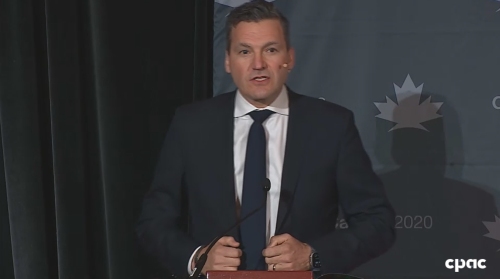
Image: Canada's Minister of AI and Digital Innovation, Solomon Evans Keynote at Canada 2020 event Ottawa (CPAC)
Prime Minister Mark Carney recently appointed Solomon Evans as Canada's first ever Minister of artificial intelligence and digital innovation to lead AI policy development and scale industry, trust and adoption. Solomon just delivered his first public remarks saying that the federal government will prioritize economic growth from artificial intelligence over advancing strict new rules. This new approach follows the collapse of Bill C-27’s AI framework, which failed to pass before the election and left Canada without a federal AI law.
Delivering a key note at a Canada 2020 event in Ottawa on June 10, 2025, Solomon said regulation must protect privacy and personal data but should not constrain innovation. Solomon confirmed that the previous governments AI regulation bill is currently under review.
“We’re not here to throw a saddle on the bucking bronco of AI but we do need to make sure it doesn’t kick anyone in the face.”
Feeling the heat of competition, even governments feel FOMO, and the global trend currently is moving from AI safety messaging towards AI adoption strategies. At the AI Action Summit in Paris, U.S. Vice President JD Vance pushed back on Europe’s regulatory overreach, while President Trump’s draft 'One Big Beautiful Bill' includes a proposed ten-year ban on state-level AI rules. Solomon seems aligned with this shift suggesting that global coordination is difficult, and Canada “won’t go it alone”.
NCFA Canada supports a speedy, focused rollout of AI investments that prioritize open access and trust, especially for smaller firms. Without clear guidance, shared tools and integrate support, SMEs will fall behind. Most do not have the internal capacity to evaluate or safely integrate AI, and that puts Canada’s productivity and innovation milestones in jeopardy. Canada's new AI czar, Solomon, acknowledged this gap, saying big companies are adopting AI, but “small and medium enterprises are not.”
Solomon also emphasized government support for Canadian champions like Cohere. In cases where specialized technical leadership is required to build national AI infrastructure, such as secure compute environments, working with proven domestic firms can make strategic sense. But NCFA cautions that these partnerships must be transparent, based on merit, and designed to benefit the broader ecosystem. The priority must remain funding open infrastructure and access, not enabling a sustainable advantage to a select few. Without transparency on this front, Canada risks loss of investment, talent, and IP.
The reality is that Canada’s innovation economy simply can't afford red tape bottlenecks or further restrictions that slow AI growth, especially since its hoping that broad adoption of the technology will turn the countries productivity woes around.
Canada also can't afford regulatory ambiguity that raises red flags for domestic and global firms alike. Solomon says he wants to “crank up commercialization” and support IP protection. That will only work if firms trust the environment they’re entering. For that, Canada needs smart policy, not just encouragement.
Canada is in a global race to lead in responsible AI and having a dedicated AI minister is a positive step, but evolving Canada into a trusted AI economy depends on speed, clarity and inclusion among other things. NCFA calls for the government to boost support for SME adoption, ensure rules are clear and fair, and build national infrastructure that attracts global innovators without sidelining local ones.
The National Crowdfunding & Fintech Association (NCFA Canada) is a financial innovation ecosystem that provides education, market intelligence, industry stewardship, networking and funding opportunities and services to thousands of community members and works closely with industry, government, partners and affiliates to create a vibrant and innovative fintech and funding industry in Canada. Decentralized and distributed, NCFA is engaged with global stakeholders and helps incubate projects and investment in fintech, alternative finance, crowdfunding, peer-to-peer finance, payments, digital assets and tokens, artificial intelligence, blockchain, cryptocurrency, regtech, and insurtech sectors. Join Canada's Fintech & Funding Community today FREE! Or become a contributing member and get perks. For more information, please visit: www.ncfacanada.org
| | |
|---|---|---|
| | |
AI | June 9, 2025

Image: Ilya Sutskever at University of Toronto convocation June 6, 2025 via Youtube
On June 6, 2025 at the University of Toronto’s convocation, Ilya Sutskever, cofounder of OpenAI and lead innovator of ChatGPT, delivered a powerful message while accepting an honorary degree in Doctor of Science (actually his fourth UoT degree). He warned that artificial intelligence (AI) is quickly advancing to a point where it will do everything humans can do, and we're not ready for what comes next.
Once a machine can learn anything a person can learn, no task is out of reach. This idea is central to Sutskever’s argument that AI will eventually match all human abilities. “We have a brain, and the brain is a biological computer… So why can't a digital brain do the same things?”
“The day will come when AI will do all of the things that we can do, not just some of them, but all of them.”
The timeline is uncertain but the direction is clear. Whether it takes 3, 5 or 10 years, general purpose AI will change how the economy functions and how people define and measure productivity.
Sutskever warns that even efforts to retrain workers may fall short because as technology marches forward, the very jobs people train for could vanish before they are ready to take them on.
“Many will find that the new job they were training for no longer exists by the time they finish retraining.”
He also said that while some will turn to universal basic income but it may not hold up because people may be seen as no longer economically productive.
Sutskever predicts two long-term outcomes. If humans find a way to offer lasting value, we may be treated as companions to AI systems. If not, we risk becoming irrelevant or extinct.
“In the best-case scenario, humanity will become like pets or the microbiome of artificial intelligence. In the worst-case scenario, humanity will become obsolete or even extinct.”
“The challenge that AI poses is the greatest challenge of humanity ever. And overcoming it will bring the greatest reward.”
He stresses that the response cannot be passive. Every person and institution will need to participate in what this technology becomes.
“Accept reality as it is, try not to regret the past, and try to improve the situation.”
Meeting this moment requires emotional resilience. He says people should remain focused on the present instead of looking backward and encouraged others to adopt the same mindset.
Sutskever’s speech is measured insight into the future, and governments, industry, innovators globally need to take his message as a direct challenge to act now (if you're not already sweating the pace of change in 2025). At NCFA Canada, we believe his message carries the kind of disruption that financial leaders must (anticipate and) respond to with urgency.
Canada cannot afford to be unprepared. While the changes can be guided with responsible AI efforts, they seemingly cannot be stopped, and so we must act with urgency to be prepared as new AI powered systems will influence financial markets, education, investment models, employment pathways, human mobility and more. the fintech sector needs to become more agile, more connected, and more willing to build for what's coming next.
"Innovating and adapting at the speed of AI development means building solutions and platforms that help people create value alongside AI, not behind or beneath it. It also means designing incentives and safeguards that match the reality of a hybrid workforce where humans and machines co-exist, and to embolden the leadership and collaboration needed to work together to solve problems." Craig Asano, NCFA
Canada cannot rely on other jurisdictions to define what safe and responsible AI looks like, and Canadian fintechs and institutions should play a direct role in developing policies, models, and frameworks that ensure AI serves the public interest.
This is not just a technology issue. It is a national competitiveness issue. It is also a question of whether we will help define the rules of the future or simply be beholden to them.
The National Crowdfunding & Fintech Association (NCFA Canada) is a financial innovation ecosystem that provides education, market intelligence, industry stewardship, networking and funding opportunities and services to thousands of community members and works closely with industry, government, partners and affiliates to create a vibrant and innovative fintech and funding industry in Canada. Decentralized and distributed, NCFA is engaged with global stakeholders and helps incubate projects and investment in fintech, alternative finance, crowdfunding, peer-to-peer finance, payments, digital assets and tokens, artificial intelligence, blockchain, cryptocurrency, regtech, and insurtech sectors. Join Canada's Fintech & Funding Community today FREE! Or become a contributing member and get perks. For more information, please visit: www.ncfacanada.org
| | |
|---|---|---|
| | |


August 26th, 2025

January 4th, 2024

June 1st, 2021

September 9th, 2020

July 9th, 2018

January 3rd, 2018

September 25th, 2017

June 20th, 2017

May 10th, 2017

December 14th, 2016