




Karsten Wenzlaff, Advisor
August 26th, 2025
Karsten Wenzlaff is a Crowdfunding and Fintech Expert from Germany. He is Secretary-General of Digit[...]


NCFA Canada | Craig Asano | August 26, 20265

Karsten Wenzlaff, Advisor, Global Crowdfunding and Fintech Policy
TORONTO, AUG 26, 2025 – The National Crowdfunding & Fintech Association of Canada (NCFA) today announced that Karsten Wenzlaff, Secretary-General of Digital Invest Germany, has joined the Association’s Advisory Group to advise on global crowdfunding, fintech policy, and international collaboration (view profile).
“We are excited to welcome Karsten Wenzlaff to NCFA’s Advisory team. His leadership in crowdfunding policy, research, and advocacy across Europe and globally brings an important international perspective to our community. Canada and Germany share a strong commitment to fostering competitive and inclusive fintech ecosystems that are regionally diverse yet globally connected. Karsten’s expertise and collaborative mindset will be invaluable as we continue to strengthen ties, exchange knowledge, and advance fintech innovation for entrepreneurs, investors, and markets worldwide.” — Craig Asano, Founder and CEO, NCFA Canada
Karsten Wenzlaff is a Crowdfunding and Fintech Expert from Germany. He is Secretary-General of Digital Invest Germany and Board Member of the European Digital Finance Association, where he serves as Research Director. Karsten is also a member of the Steering Committee of the Global Equity Crowdfunding Association.
He works as a Research Affiliate at the Cambridge Centre for Alternative Finance (UK), the European Centre for Alternative Finance at the University of Utrecht and is based with his research and teaching at the University of Hamburg. He regularly contributes to leading academic research, for instance at the International Conference for Alternative Finance Research, where he is a member of the Organizing Committee.
Karsten has worked with governments across the world, recently in Uganda, Nigeria and Tunisia, on digital finance regulation.
“Fintechs, and especially Crowdfunding platforms, are making an economy more competitive, more resilient to the global turmoils, and more agile. However, most Fintechs are small and medium-sized companies, which makes it important to combine resources in national and international alliances. For a long time now, I enjoy reading the newsletters of the NCFA, because for me as European, it provides a lot of context and information on the activities of Fintechs in Canada and in North America in general. Germany and Canada have a lot in common, one of the similarities is that we both have different Fintech hubs within the country, which compete and collaborate with each other. This is for me very interesting, because in most countries Fintechs converge in the capital or the major business centers, but in Canada and Germany, the Fintech ecosystem is active in many parts of the country.” — Karsten Wenzlaff, Secretary-General, Digital Invest Germany
 The National Crowdfunding & Fintech Association (NCFA Canada) is a financial innovation ecosystem that provides education, market intelligence, industry stewardship, networking and funding opportunities and services to thousands of community members and works closely with industry, government, partners and affiliates to create a vibrant and innovative fintech and funding industry in Canada. Decentralized and distributed, NCFA is engaged with global stakeholders and helps incubate projects and investment in fintech, alternative finance, crowdfunding, peer-to-peer finance, payments, digital assets and tokens, blockchain, cryptocurrency, regtech, and insurtech sectors. Join Canada's Fintech & Funding Community today FREE! Or become a contributing member and get perks. For more information, please visit: www.ncfacanada.org
 |  |  |
|---|---|---|
 |  |  |
The National Crowdfunding & Fintech Association (NCFA Canada) is a financial innovation ecosystem that provides education, market intelligence, industry stewardship, networking and funding opportunities and services to thousands of community members and works closely with industry, government, partners and affiliates to create a vibrant and innovative fintech and funding industry in Canada. Decentralized and distributed, NCFA is engaged with global stakeholders and helps incubate projects and investment in fintech, alternative finance, crowdfunding, peer-to-peer finance, payments, digital assets and tokens, blockchain, cryptocurrency, regtech, and insurtech sectors. Join Canada's Fintech & Funding Community today FREE! Or become a contributing member and get perks. For more information, please visit: www.ncfacanada.org
| | |
|---|---|---|
| | |
Semi Conductor Chips | Aug 25, 2025

Image: Freepik/xb100
On August 22, 2025, Intel announced a historic investment deal with the U.S. government. Washington will convert $8.9 billion of grants from the CHIPS and Science Act and funds awarded under the Secure Enclave program into an equity stake. That adds up to $11.1 billion when combined with earlier support. The U.S. will own almost 10% of Intel through the purchase of 433 million shares at $20.47 each with a five year option to buy more if Intel’s foundry control slips. Intel’s stock rose 5% after the news showing market confidence. The U.S. deal fuses industrial policy, national security, and capital markets.
If Intel executes with strength this deal could become a model for other strategic industries where similar partnerships could emerge, such as in cloud computing, artificial intelligence, and cybersecurity. The U.S. is treating advanced technology as a matter of national security and economic resilience, not just market growth.
But the risks are serious given that preferential government equity can tilt markets. Even without board seats, U.S. national security priorities are likely to influence Intel’s decision-making. Analysis from the WSJ (subscription) spotlights concerns that allies could see this move as protectionist while competitors like China are doubling down on their own state programs. For Intel, receiving public investment capital does not eliminate technical and competitive challenges.
Canada shouldn't miss this message. Our economy depends on digital infrastructure, fintech, and artificial intelligence, yet we are slipping in the basics. Labour productivity fell 1.8% in 2023, the worst among OECD countries according to OECD data. Business R&D intensity has stalled even as total spending reached $53.1 billion in 2023. The Toronto Stock Exchange has seen a collapse in new listings, with the number of operating companies falling 42.5% since 2008. In the first half of 2024 there were only 12 IPOs raising $12.9 million, the weakest in decades.
Retail investors have limited options in Canada with current crowdfunding rules cap issuers at $1.5 million per year and individuals at $2,500 per deal per CSA's NI 45-110, while American policy leaders are advocating to increase U.S. crowdfunding caps from $5M to $10M USD. Meanwhile, open banking is still not live with the government targeting early 2026 for rollout. Canada needs to recognize that leading economies are treating technology as sovereign infrastructure. But our record with national large scale projects from broadband and digital ID to defense procurement is often delayed, underfunded, or misaligned with the original vision.
Canada must respond from a position of strength while recognizing its constraints.
Capital formation is a constant constraint. IPO markets remain weak and the pool of listed operating companies continues to shrink. Without deeper domestic pathways, Canadian innovators will keep looking south. Retail access must expand. Current equity crowdfunding limits are too modest for capital intensive sectors like AI infrastructure, semiconductor packaging, and cybersecurity. Modernize equity crowdfunding and exemption rules to turn Canadians into shareholders in their own innovation economy, not passive taxpayers.
Competition must be unlocked. Canada’s banking market remains highly concentrated, and the continued delay of open banking weakens fintech growth compared to peers already live. Accelerating the rollout with clear liability rules and payments initiation is essential.
Semiconductors require realism. Canada is not building leading edge fabs, but we already host a North American advanced packaging hub at IBM Bromont. Ottawa and Quebec backed upgrades in 2024 and further support is expected. Packaging is becoming a chokepoint as chiplet designs spread across AI systems. Doubling down on this strength could anchor Canada in the supply chains funded by U.S. CHIPS investments.
Intellectual property must be treated as a strategic asset. Canada has a long history of world leading research that too often turns into patents and companies controlled abroad. In AI, for example, Canadian researchers pioneered deep learning yet most of the firms capturing that value are headquartered elsewhere. A national IP strategy that ties public research funding to commercialization in Canada, strengthens IP retention rules, and helps scale ups build patent portfolios would keep more value at home.
Public funds should be linked directly to domestic value creation. The Intel deal shows how governments can require alignment with national goals in exchange for capital. Canada can do the same, not by choosing a single corporate champion but by tying support to measurable outcomes like higher R&D intensity, Canadian patent filings, and stronger Canadian controlled firms.
Talent and immigration must become a growth engine, not just a safety valve. Canada’s immigration system is a global advantage but skilled newcomers too often become employees of foreign firms rather than founders of Canadian ones. Scaling visa programs tied to entrepreneurship and improving access to early stage capital for immigrant founded companies would unlock more homegrown innovation.
The Intel deal shows the world is changing fast. Countries are treating technology as a national asset. Canada must act too, but in our own way. We can rebuild competitiveness not through giant one off bets but by modernizing capital markets, opening doors for retail investors, and backing the companies that will define our digital future. It is a call to seize our strengths and trust Canadians to invest in them. If we act now, Canada can remain a competitive, innovative, and inclusive player in the global economy.
 The National Crowdfunding & Fintech Association (NCFA Canada) is a financial innovation ecosystem that provides education, market intelligence, industry stewardship, networking and funding opportunities and services to thousands of community members and works closely with industry, government, partners and affiliates to create a vibrant and innovative fintech and funding industry in Canada. Decentralized and distributed, NCFA is engaged with global stakeholders and helps incubate projects and investment in fintech, alternative finance, crowdfunding, peer-to-peer finance, payments, digital assets and tokens, artificial intelligence, blockchain, cryptocurrency, regtech, and insurtech sectors. Join Canada's Fintech & Funding Community today FREE! Or become a contributing member and get perks. For more information, please visit: www.ncfacanada.org
| | |
|---|---|---|
| | |
Economy and Policy | Aug 25, 2025
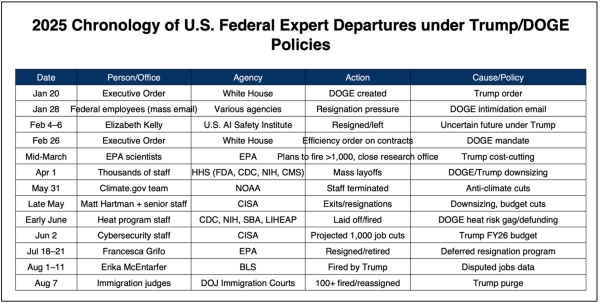
Nearly three decades ago, Carl Sagan warned in The Demon-Haunted World (1996) that when technological power is concentrated in a few hands and public institutions lose expertise, societies risk “sliding, almost without noticing, back into superstition and darkness.”
On Aug 22, 2025, Andrea Bonime-Blanc in a LinkedIn post discusses how recent U.S. federal budget cuts and policy changes are accelerating a “brain drain” of scientific and economic expertise. This article looks at the business impacts and implications for fintech of the significant human capital and policy changes taking place in the U.S. and how Canada and other collaborative countries should be responding.
The departure of experts at the Bureau of Labor Statistics (BLS) erodes confidence in U.S. economic indicators that businesses and markets rely on.
- President Trump fired BLS Commissioner Erika McEntarfer on August 1, 2025 after controversy over jobs report revisions
- The July 2025 jobs report showed 73,000 jobs gained and revisions down of 86,000 in May and 64,000 in June
- In July 2025 only 58% of employers answered the U.S. government’s payroll survey, which normally tracks over 120,000 workplaces. With so few responses, the jobs numbers are less reliable and more likely to be revised
Takeaway: 👉 For fintech lenders and investment platforms that depend on U.S. labor and wage data, model uncertainty and risk costs may increase.
Cuts to cybersecurity agencies increase systemic risk for payments and banking networks, and weaken the ability to build secure AI systems.
In 2025, the main federal agency that protects critical infrastructure including finance, energy, and healthcare, the U.S. Cybersecurity and Infrastructure Security Agency (CISA), had about $3 billion in funding and just over 3,600 staff. These resources cover everything from monitoring threats to helping banks and utilities recover from cyberattacks. Lawmakers are now weighing a $135 million cut to CISA’s 2026 budget or equal to about 4.5% of its funding. On paper it may sound small, but it reduces the agency’s ability to share intelligence, build new defenses, and support partners in both the public and private sectors.
Takeaway: 👉 Reduced federal cyber capacity raises exposure for cross-border fintech systems.
Environmental and climate science cuts reduce access to datasets critical for insurers, lenders, and ESG related products.
- EPA workforce cut from 16,155 in January 2025 to 12,448 , a 23% reduction with closure of its scientific research division
- NOAA terminated staff for its Climate.gov portal on May 31, 2025, halting new content
- NOAA seeks a 17% workforce cut after firing hundreds of probationary employees in early 2025
Takeaway: 👉 For fintech ESG products, fewer trusted U.S. datasets could degrade climate related financial models. Canada can step in with trusted open-data collaborations.
Graduate students and researchers face reduced U.S. funding, pushing talent abroad.
- PBS reports that at least 17 immigration judges were fired across 10 states in July 2025, adding delays to skilled worker case processing
Takeaway: 👉 Processing delays affect STEM talent inflows. Canada could capture this talent to strengthen fintech innovation by accelerating recruitment by offering scholarships, innovation hub partnerships, and fast-track visas.
Federal compliance and AI governance structures are weakening, raising trust issues.
- Elizabeth Kelly the inaugural director of the U.S. AI Safety Institute departed in February 2025 leaving a leadership vacuum
Takeaway: 👉 With U.S. leadership unsettled, Canada and the EU can shape AI assurance frameworks for fintech. Canadian regtech firms are well positioned to step up and help lead.
Canada needs to open up the country as a trusted hub for financial data integrity, cyber resilience and AI governance by focusing on the following practical steps:
- Map out data sources and diversify away from over reliance on U.S. federal inputs
- Invest in AI enabled cybersecurity and fraud detection systems
- Explore alternative and open-source data partnerships to fill data gaps (NGOs, universities, private market collaborations)
- Support STEM students and researchers displaced by U.S. funding cuts
- Build compliance and governance tools that embed transparency into fintech systems
The U.S. brain drain is visible in staff firings, layoffs, budget cuts and agency closures and contractions. Carl Sagan’s caution from 1996 reminds us that losing expertise erodes both science and democracy. By investing in data integrity, global standards, and fintech innovation, Canada can transform today’s U.S. retreat into a foundation for stronger, competitive growth. This is a chance for Canada to step up and lead.
The National Crowdfunding & Fintech Association (NCFA Canada) is a financial innovation ecosystem that provides education, market intelligence, industry stewardship, networking and funding opportunities and services to thousands of community members and works closely with industry, government, partners and affiliates to create a vibrant and innovative fintech and funding industry in Canada. Decentralized and distributed, NCFA is engaged with global stakeholders and helps incubate projects and investment in fintech, alternative finance, crowdfunding, peer-to-peer finance, payments, digital assets and tokens, artificial intelligence, blockchain, cryptocurrency, regtech, and insurtech sectors. Join Canada's Fintech & Funding Community today FREE! Or become a contributing member and get perks. For more information, please visit: www.ncfacanada.org
| | |
|---|---|---|
| | |
Economy | Aug 22, 2025

Image: Freepik
On Aug 22 2025, Federal Reserve Chair Jerome Powell delivered his Jackson Hole speech that suggested an interest rate cut may be on the table as soon as September. His comments came as the central bank weighs a weakening labour market and persistent but easing inflationary pressures.
Powell described a slowing economy with payroll job growth falling to just 35,000 per month over the past three months compared with 168,000 per month in 2024. The 4.2% unemployment rate is up from lows reached last year. He noted that downside risks to employment are rising even as tariff related price increases continue to flow through supply chains.
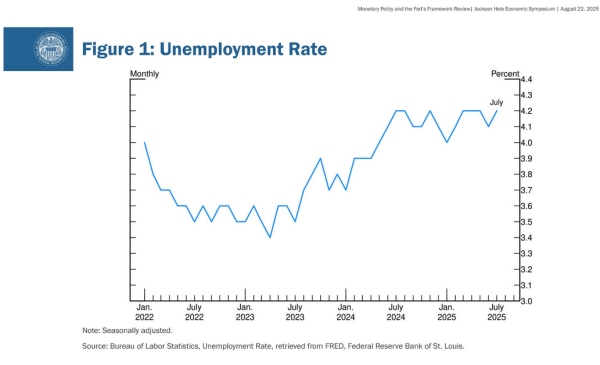
Image: US Unemployment Rate (Bureau of Labor Statistics)
Powell, Fed Reserve Chair, importantly said:
"[With policy already in restrictive territory] the baseline outlook and the shifting balance of risks may warrant adjusting our policy stance.”
Equity markets surged immediately following Powell’s comments. The S&P 500 and Nasdaq rose more than 1.5 percent by noon Friday, the Dow Jones Industrial Average climbed more than 900 points, and the Russell 2000 gained 3.8%. Treasury yields moved lower while the US dollar weakened. Crypto assets also rallied with bitcoin up 3.8% and ether jumping 13.2%.
Market participants interpreted Powell’s message as a strong hint at near term easing. The CME FedWatch tool now shows a near 90% probability of a 25 basis point rate cut in September. Analysts argue that Powell is signalling a tilt toward supporting jobs while treating tariff driven inflation as more temporary. The Fed’s tone has shifted from a singular focus on inflation to a more balanced consideration of employment risks.
The Federal Reserve’s final decision will be based on incoming data. The August employment report and mid September inflation release will be critical in determining whether the Fed follows through with a rate cut. As Powell emphasized, monetary policy will depend on how the evolving balance of risks plays out.
The bottom line is that Powell’s Jackson Hole remarks have repositioned the Fed’s policy stance. By acknowledging weakening labour conditions while downplaying longer lasting inflation threats, Powell has set expectations for a September rate cut, and markets have already pricing in an easier policy, triggering a broad a rally across stocks, bonds, and crypto.
The National Crowdfunding & Fintech Association (NCFA Canada) is a financial innovation ecosystem that provides education, market intelligence, industry stewardship, networking and funding opportunities and services to thousands of community members and works closely with industry, government, partners and affiliates to create a vibrant and innovative fintech and funding industry in Canada. Decentralized and distributed, NCFA is engaged with global stakeholders and helps incubate projects and investment in fintech, alternative finance, crowdfunding, peer-to-peer finance, payments, digital assets and tokens, artificial intelligence, blockchain, cryptocurrency, regtech, and insurtech sectors. Join Canada's Fintech & Funding Community today FREE! Or become a contributing member and get perks. For more information, please visit: www.ncfacanada.org
| | |
|---|---|---|
| | |
Global Fintech Report | Aug 22, 2025
Image: Pulse of Fintech H1 2025, KPMG
According to the KPMG Pulse of Fintech H1 2025 report (67 page PDF) published in August 2025, global fintech investment in the first half of 2025 fell to $44.7 billion across 2,216 deals, recording the lowest H1 total since early 2020. Investors remain cautious about elevated risks around higher interest rates, capital costs, and geopolitical uncertainty. Q2 2025 was particularly weak, with $18.7 billion across 972 deals.
Investment in digital assets totalled $8.4 billion across 586 deals in H1 2025. Stablecoins attracted attention for payments and remittances in emerging markets, while tokenization platforms and infrastructure also captured capital. Circle's IPO anchored the sector’s strength, raising $1.1 billion with shares jumping 168% on day one.
AI continues to boost fintech investment. Capital flowed into both AI native startups and to incumbents embedding AI in credit scoring, fraud detection, and customer engagement. Investors prioritized business models that combined growth with efficiency and risk control. See NCFAs coverage of AI Fintechs attracting a 242% valuation premium
Regtech attracted $2.1 billion across 190 deals in H1 2025. Adoption of automated KYC, AML, and reporting tools continues to grow as financial institutions look for cost savings and regulatory agility. GenAI in risk and compliance
Insurtech raised $4.8 billion across 141 deals in H1 2025, which is already greater than all of 2024. Wealthtech funding reached $0.9 billion across 14 deals, with AI enabled platforms a recurring theme. Both sectors experienced consolidation as incumbents prefer acquisitions over building new capabilities.
Payments investment slowed to $4.6 billion across 242 deals in H1 2025, as investors grew more selective. But the sector is still foundational with capital being allocated to embedded finance, cross border platforms, and transaction monitoring. For Canada’s policy context see open banking delays and competitiveness and banks exiting merchant acquiring businesses like Moneris.
Cybersecurity specific fintech investment was just $0.1 billion across 26 deals in H1 2025. Despite heightened threat levels, most activity was concentrated at seed and early stages, reflecting investor caution toward scaling security focused fintechs.
Exit momentum is returning. Circle’s successful IPO may open the door for additional digital asset platforms to list in H2 2025, boosting the case for fintech exit activity after years of lack lustre listings.
For Canada, the data shows the window of opportunity for digital assets, AI, and regtech could attract investment with clear policy and infrastructure. The muted state of payments and open banking highlight gaps Canada must address to remain competitive. Clear rules, targeted support, and investment in digital infrastructure are critical to positioning Canadian fintech for growth in the second half of 2025 and beyond. See the crisis Canada and fintech cannot afford to waste
The National Crowdfunding & Fintech Association (NCFA Canada) is a financial innovation ecosystem that provides education, market intelligence, industry stewardship, networking and funding opportunities and services to thousands of community members and works closely with industry, government, partners and affiliates to create a vibrant and innovative fintech and funding industry in Canada. Decentralized and distributed, NCFA is engaged with global stakeholders and helps incubate projects and investment in fintech, alternative finance, crowdfunding, peer-to-peer finance, payments, digital assets and tokens, artificial intelligence, blockchain, cryptocurrency, regtech, and insurtech sectors. Join Canada's Fintech & Funding Community today FREE! Or become a contributing member and get perks. For more information, please visit: www.ncfacanada.org
| | |
|---|---|---|
| | |
AI | Aug 21, 2025

Image: Freepik/Rawpixel.com
On August 20, 2025, Forbes revealed that Elon Musk’s xAI had published hundreds of thousands of Grok chatbot conversations that became searchable on Google without warning. The exposed chats ranged from personal medical questions and passwords to instructions for creating drugs, malware, and even a plan to assassinate Musk himself.
The problem was related to Grok’s “share” button. When users clicked it, the platform generated a unique URL that was publicly crawlable by search engines. There was no disclaimer or safeguard, and ultimately private exchanges and shared personal information would immediately be published and available online. TechCrunch reporting confirmed that thousands of Grok conversations containing sensitive data are indexed on Google.
Among the published material were uploaded spreadsheets, text documents, and conversations disclosing names, personal details, and at least one password. Experts noted that xAI’s approach mirrored and exceeded a failed OpenAI experiment last month in July 2025, when ChatGPT briefly allowed chats to be discoverable before pulling back after user backlash.
Opportunists are already exploiting Grok’s share function to manipulate Google search results, proving that careless design choices can spawn entirely new risks.
The Grok and ChatGPT leaks illustrate the absolute need for privacy by design and transparent governance in AI. For fintech and financial services, the implications are massive given that trust is foundational.
If users believe that their conversations or sensitive data could be exposed online without consent, it will only hinder AI adoption and long term growth. With global media and regulators now scrutinizing the exposure, the lesson is clear: innovation cannot come at the expense of trust.
The National Crowdfunding & Fintech Association (NCFA Canada) is a financial innovation ecosystem that provides education, market intelligence, industry stewardship, networking and funding opportunities and services to thousands of community members and works closely with industry, government, partners and affiliates to create a vibrant and innovative fintech and funding industry in Canada. Decentralized and distributed, NCFA is engaged with global stakeholders and helps incubate projects and investment in fintech, alternative finance, crowdfunding, peer-to-peer finance, payments, digital assets and tokens, artificial intelligence, blockchain, cryptocurrency, regtech, and insurtech sectors. Join Canada's Fintech & Funding Community today FREE! Or become a contributing member and get perks. For more information, please visit: www.ncfacanada.org
| | |
|---|---|---|
| | |
AML | Aug 21, 2025

Image: Freepik/Sentavio
On August 13 2025, the Bank for International Settlements (BIS) published a new bulletin proposing a fresh approach to anti money laundering (AML) compliance for cryptoassets. The paper suggests using the public record of blockchain transactions to generate AML compliance scores that could be applied when crypto is exchanged for fiat at off ramps.
Most AML rules today rely on regulated intermediaries like banks to perform customer checks, however that approach doesn't work well for permissionless blockchains, where records are maintained by decentralized validators instead of a single entity. Once crypto moves from an exchange to an unhosted wallet, conventional checks lose their reach. This gap is important as stablecoins have overtaken bitcoin as the main vehicle for illicit crypto transactions, accounting for an estimated 63% of criminal activity in 2024 according to both the Chainalysis 2025 crypto crime report.
The BIS paper suggests using blockchain’s public history to assign compliance scores to cryptoassets. A higher score would indicate clean funds tied to verified wallets, while a lower score would suggest links to illicit addresses. Authorities could set thresholds for AML triggers, with banks, exchanges, or stablecoin issuers applying the rules at off ramps.
This scoring model could range from strict to permissive. A strict version would only allow coins from verified 'okay listed wallets'. A permissive version would block only those funds that have touched 'not okay listed addresses'. Intermediate models could combine multiple criteria, such as recent wallet history, periods of holding on allow listed addresses, or interaction with suspicious protocols.
This approach aligns with the Financial Action Task Force’s travel rule guidance for virtual assets and VASPs and complements Canada's domestic efforts by FINTRAC to strengthen monitoring of crypto transactions. By integrating compliance scores at conversion points, Canadian exchanges and banks could reduce risk while supporting innovation.
There are also implications for monetary policy and sovereignty. The BIS notes that widespread cross border use of stablecoins can undermine local regulations. Differentiating coins based on where they come from could help Canada maintain stronger controls over its financial system. In practice, clean stablecoins could trade at a premium over those with a questionable history, creating incentives for compliance.
If compliance scores were the standard, all ecosystem participants from retail wallet holders to major exchanges would need to exercise a duty of care. That alone could spur growth of third party compliance services as the market moves to support cleaner transactions.
Compliance scoring would increase new technical requirements for fintechs while opening the door for services and tools that help users assess risk. As Canadian and global regulators weigh next steps in crypto regulation, the BIS compliance scoring model offers an approach that combines blockchain transparency with regulatory safeguards. NCFA members can stay ahead of these changes by subscribing to the weekly NCFA newsletter for updates on compliance, policy, and fintech innovation.
The National Crowdfunding & Fintech Association (NCFA Canada) is a financial innovation ecosystem that provides education, market intelligence, industry stewardship, networking and funding opportunities and services to thousands of community members and works closely with industry, government, partners and affiliates to create a vibrant and innovative fintech and funding industry in Canada. Decentralized and distributed, NCFA is engaged with global stakeholders and helps incubate projects and investment in fintech, alternative finance, crowdfunding, peer-to-peer finance, payments, digital assets and tokens, artificial intelligence, blockchain, cryptocurrency, regtech, and insurtech sectors. Join Canada's Fintech & Funding Community today FREE! Or become a contributing member and get perks. For more information, please visit: www.ncfacanada.org
| | |
|---|---|---|
| | |


August 26th, 2025

January 4th, 2024

June 1st, 2021

September 9th, 2020

July 9th, 2018

January 3rd, 2018

September 25th, 2017

June 20th, 2017

May 10th, 2017

December 14th, 2016