




Karsten Wenzlaff, Advisor
August 26th, 2025
Karsten Wenzlaff is a Crowdfunding and Fintech Expert from Germany. He is Secretary-General of Digit[...]


February 5, 2026

Early online iGaming platforms worked with very limited payment options. A player added one card to a profile and waited for funds to move through bank systems. Delays were common, and account control stayed minimal. Fintech changed that structure. Platforms such as Wildrobin Casino now rely on modern financial tools that support faster money flow, flexible account setup, and better control over digital funds.
The shift away from single-card links toward multi‑channel finance gave operators more stability and gave users clearer access to their balances without repeated manual steps.
Modern iGaming platforms rely on named payment systems that support speed and reliability. Interac e‑Transfer serves as a core option in Canada for direct bank payments. Visa and Mastercard remain active through tokenized card processing by providers such as Nuvei and Worldpay.
Digital payment networks such as PayPal and Skrill support fast deposits without card exposure. Some platforms also accept Bitcoin and Ethereum through processors like BitPay and CoinPayments.
Each method routes through a central payment gateway that manages settlement and tracking. This setup allows platforms to handle volume without manual review. Funds move through clear paths with predictable timing.
Wallet systems have become a core part of how iGaming platforms manage player funds. Services like Skrill Wallet, Neteller, and PayPal Balance let users load money once and use it across sessions without needing to go back to their bank each time. This setup keeps the process simple for the user and reduces friction during deposits and withdrawals.
Behind the scenes, real-time ledger systems track every transaction and update balances instantly. That helps prevent failed payments and gives support teams fewer issues to handle.
Some platforms also connect with crypto wallets through providers like Coinbase Commerce that allow players to use digital currencies without directly linking a bank account. Wildrobin Casino relies on these wallet solutions to keep money movement smooth and account values easy to manage.
Fintech companies provide tools that help platforms monitor payments and spot unusual account behavior. Risk engines from providers like Feedzai and SEON track how users deposit and withdraw, then check those patterns before any payment goes through. If something seems off, the system flags it right away.
For financial tracking, platforms often use systems like Stripe Sigma or the Nuvei Control Panel. These tools show payment totals, processing speed, and method breakdowns in real time. That means operators don’t need to wait for reports or pull numbers manually.
Platforms such as Wildrobin Casino use these systems to keep payment operations running smoothly while staying on top of account activity and transaction flow.
 The National Crowdfunding & Fintech Association (NCFA Canada) is a financial innovation ecosystem that provides education, market intelligence, industry stewardship, networking and funding opportunities and services to thousands of community members and works closely with industry, government, partners and affiliates to create a vibrant and innovative fintech and funding industry in Canada. Decentralized and distributed, NCFA is engaged with global stakeholders and helps incubate projects and investment in fintech, alternative finance, crowdfunding, peer-to-peer finance, payments, digital assets and tokens, artificial intelligence, blockchain, cryptocurrency, regtech, and insurtech sectors. Join Canada's Fintech & Funding Community today FREE! Or become a contributing member and get perks. For more information, please visit: www.ncfacanada.org
 |  |  |
|---|---|---|
 |  |  |
Feb 4, 2026 | NCFA Fintech Market Activity | Regulation and Digital Assets

On February 3 2026, Nevada filed a civil enforcement action against Coinbase prediction markets in court alleging Coinbase offered sports-linked event contracts without a required Nevada gaming licence.
The regulator argues that the contracts available through Coinbase’s prediction markets are considered wagering activity under Nevada law and therefore requires state authorization. The filing seeks a temporary restraining order and preliminary injunction to prevent Coinbase from operating these markets in Nevada while the case proceeds.
Coinbase launched its prediction markets nationally in all 50 states in late January through a partnership with Kalshi, a derivatives exchange registered with the U.S. Commodity Futures Trading Commission. Users can trade yes or no contracts on real world outcomes, including professional sports events, directly inside the Coinbase app. NCFA has previously examined how prediction markets begin pricing geopolitical and financial outcomes across traditional and digital finance.
This case highlights a growing regulatory conflict. Coinbase maintains that prediction markets fall under federal derivatives oversight through the CFTC. Nevada’s regulator treats the same product as sports wagering that falls under state gaming law. That difference creates immediate compliance risk for fintech platforms offering event-based contracts across multiple jurisdictions.
Several other U.S. states have already taken steps to restrict or challenge similar markets tied to sports outcomes. Nevada’s action is the first to move into formal court proceedings against Coinbase’s implementation.
When prediction markets sit between derivatives law and gaming law, how should fintech platforms design licensing, governance, and market access controls across jurisdictions?
This case forces a legal definition of where and when prediction markets belong inside financial regulation and whether digital platforms can rely solely on federal derivatives oversight when states interpret the same contracts as wagering.
The National Crowdfunding & Fintech Association (NCFA Canada) is a financial innovation ecosystem that provides education, market intelligence, industry stewardship, networking and funding opportunities and services to thousands of community members and works closely with industry, government, partners and affiliates to create a vibrant and innovative fintech and funding industry in Canada. Decentralized and distributed, NCFA is engaged with global stakeholders and helps incubate projects and investment in fintech, alternative finance, crowdfunding, peer-to-peer finance, payments, digital assets and tokens, artificial intelligence, blockchain, cryptocurrency, regtech, and insurtech sectors. Join Canada’s Fintech & Funding Community today FREE! Or become a contributing member and get perks. For more information, please visit: www.ncfacanada.org
| | |
|---|---|---|
| | |
Feb 4, 2026 | NCFA Fintech Market Activity | Funding and Capital Markets

Image: Freepik
On February 4 2026, NEO Financial announced it secured $68.5 million in equity capital from more than 100 Canadian investors to accelerate its securitization strategy and support further growth of its lending and credit products. The round includes participation from Alberta Investment Management Corporation (AIMCo), Northleaf Capital Partners, Plaza Ventures, Sandstone Asset Management, and Caldwell Growth Opportunities Fund. These are not typical venture participants. They are institutional capital allocators with deep experience in private credit, structured finance, and asset-backed investing.
NEO positions the raise as strengthening its balance sheet to expand its asset-backed funding programs and diversify capital sources tied to its consumer and merchant credit offerings. The company isn't raising capital simply to extend runway. It's raising capital specifically to support securitization activity that allows the company to recycle lending capital through structured vehicles and continue originating credit without relying solely on sponsor-bank facilities or traditional debt lines.
NEO reports that it serves millions of Canadians across retail and business financial products and has already built a sizeable loan portfolio through point of sale financing, credit products, and merchant services. Securitization allows that loan book to become a capital markets asset rather than a balance sheet constraint.
For Canadian fintech lenders, this represents a maturation point. Early growth in fintech credit often depends on venture equity and warehouse funding. Long term scale depends on access to institutional capital markets that can absorb receivables and recycle liquidity. NEO's financing is a sign that Canadian institutional investors are increasingly comfortable backing fintech platforms that combine lending operations with disciplined capital markets execution.
Andrew Chau, Co-Founder and CEO, NEO Financial:
"This investment supports the continued expansion of our securitization strategy and strengthens our ability to scale credit products responsibly for Canadians and businesses across the country."
When fintech lenders can turn their loan portfolios into new funding through securitization, does access to capital markets become the main factor separating national scale players from niche credit providers?
This raise shows how NEO is tying its lending growth directly to capital markets capability. Platforms that can convert loan origination into structured investment assets will have a structural advantage as lending volumes grow.
The National Crowdfunding & Fintech Association (NCFA Canada) is a financial innovation ecosystem that provides education, market intelligence, industry stewardship, networking and funding opportunities and services to thousands of community members and works closely with industry, government, partners and affiliates to create a vibrant and innovative fintech and funding industry in Canada. Decentralized and distributed, NCFA is engaged with global stakeholders and helps incubate projects and investment in fintech, alternative finance, crowdfunding, peer-to-peer finance, payments, digital assets and tokens, artificial intelligence, blockchain, cryptocurrency, regtech, and insurtech sectors. Join Canada’s Fintech & Funding Community today FREE! Or become a contributing member and get perks. For more information, please visit: www.ncfacanada.org
| | |
|---|---|---|
| | |
Canadian Fintech Funding | February 3, 2026

Image: Freepik/DC Studio
On February 3, 2026, Montreal-based startup Velix announces a $2M pre-seed funding round led by Luge Capital with participation from Stand Up Ventures and Accelia Capital to modernize how logistics companies handle billing, reconciliation, and financial disputes as trade volumes rise across Canada.
David Nault, Partner, Luge Capital:
“Logistics has invested heavily in moving goods more efficiently, but little innovation has occurred on the financial layer, resulting in massive inefficiencies as volume increased. We’re excited to partner with Velix to launch a modern financial platform to automate billing and reconciliations for logistics operators.”
Canada’s logistics networks expand quickly. Forecasts estimate the market will reach $65B by 2030 while the federal government commits $4.1B to strengthen trade corridors and supply chain resilience. As physical networks scale across carriers, warehouses, and border touchpoints, financial attribution becomes harder across multiple parties and systems.
Third party logistics providers now act as financial intermediaries between carriers, brands, and end customers. They assign dollars to every parcel and service across invoices, rate cards, surcharges, and service levels. Many still rely on paper, email, flat files, and siloed legacy tools. These workflows slow billing cycles, create errors, delay cash collection, and reduce margins.
“The majority of 3PL operators I’ve worked with of all sizes share one thing in common, clunky and time consuming billing processes that create the cashflow drag. What Maeghan and the Velix team are building is game changing, helping operators structure and automate a critical, massively underserved part of the logistics stack.” Nicholas Richards, Co Founder, ShipHero
Velix's financial operations platform allows logistics teams to automate freight and parcel reconciliation, customer billing, and dispute resolution in one system. The platform closes the gap between the movement of goods and the financial workflows required to settle accounts across many participants.
As Canada invests $4.1B to strengthen trade corridors and supply chain resilience across roads, ports, and rail, the financial systems behind those movements become a constraint. This story sits at the intersection of fintech and industrial infrastructure. It shows how financial operating systems inside vertical industries remain under served even as payments innovation advances at the consumer layer.
As trade corridors expand and logistics volumes rise, billing accuracy, reconciliation integrity, and dispute resolution directly affect how quickly revenue moves through the system. Velix addresses an bottleneck where operational finance limits the benefits of national infrastructure spending.
This development shows how financial infrastructure inside critical Canadian industries receives far less attention than physical infrastructure. As trade corridors expand and freight volumes increase, the ability to bill accurately, reconcile quickly, and resolve disputes efficiently becomes part of how well that infrastructure performs in practice.
The National Crowdfunding & Fintech Association (NCFA Canada) is a financial innovation ecosystem that provides education, market intelligence, industry stewardship, networking and funding opportunities and services to thousands of community members and works closely with industry, government, partners and affiliates to create a vibrant and innovative fintech and funding industry in Canada. Decentralized and distributed, NCFA is engaged with global stakeholders and helps incubate projects and investment in fintech, alternative finance, crowdfunding, peer-to-peer finance, payments, digital assets and tokens, artificial intelligence, blockchain, cryptocurrency, regtech, and insurtech sectors. Join Canada's Fintech & Funding Community today FREE! Or become a contributing member and get perks. For more information, please visit: www.ncfacanada.org
| | |
|---|---|---|
| | |
Feb 2, 2026 | NCFA Fintech Market Activity | Funding and Ecosystem

Image: Freepik
On February 2 2026, applications open for the Road to Web Summit Women (R2WSV) in Tech and Impact Tech Pitch Showcase, a Vancouver Entrepreneurs Forum (VEF) pathway built to prepare women identifying founders to pitch and sell at Web Summit Vancouver.
The program targets founders who are actively preparing to raise capital, win customers, or accelerate growth, and it sets a clear deadline. Applications stay open until March 2 2026.
VEF positions the opportunity as a selective readiness track with hands on training and direct feedback. Selected founders receive in person pitch and storytelling training, a finance bootcamp, and sales training, plus live feedback from investors and ecosystem leaders. The pathway culminates in a curated showcase pitch opportunity in front of a live audience.
The timeline is tight and practical. VEF plans application review from March 2 to March 6, invitations in the week of March 9, in person training on March 30, and the showcase pitch final on April 21.
For founders, it's great value to participate in a compressed learning loop before a high stakes event. You get structured preparation, real critique, and a clear runway to refine your story before Web Summit attention arrives.
For investors and partners, this is a deal flow filter ahead of Web Summit Vancouver. VEF positions the showcase as a way to see founder readiness early, meet teams that are actively building and fundraising, and build relationships before the global noise peaks.
When a global tech event comes to your home market, do you want to meet investors for the first time on the conference floor, or show up with a tested pitch, clear asks, and proof points already in hand?
What are you waiting for? Apply now
The National Crowdfunding & Fintech Association (NCFA Canada) is a financial innovation ecosystem that provides education, market intelligence, industry stewardship, networking and funding opportunities and services to thousands of community members and works closely with industry, government, partners and affiliates to create a vibrant and innovative fintech and funding industry in Canada. Decentralized and distributed, NCFA is engaged with global stakeholders and helps incubate projects and investment in fintech, alternative finance, crowdfunding, peer-to-peer finance, payments, digital assets and tokens, artificial intelligence, blockchain, cryptocurrency, regtech, and insurtech sectors. Join Canada's Fintech & Funding Community today FREE! Or become a contributing member and get perks. For more information, please visit: www.ncfacanada.org
| | |
|---|---|---|
| | |
January 30, 2026 | NCFA Fintech Whisperer Weekly Intelligence | Payments And Money Movement, Artificial Intelligence And Data, Capital Markets And Market Infrastructure, Digital Assets Blockchain And Tokenization, Open Banking Open Finance And Data Sharing

Image: Freepik
This live weekly NCFA intelligence page tracks financial technology developments that significantly affect how fintechs build, sell, raise capital, and operate under scrutiny. Coverage prioritizes Canada and includes global events that directly influence competitive conditions, market access, and execution realities across fintech sectors. This page will be updated throughout the week with market movers in a live format and then each week we'll close the prior week's contents in prep for the upcoming week, and continue on a rolling basis. (Missed prior week's Fintech Whisperer? (December 6-12, 2025, December 13-19, 2025, January 1-9, 2026, January 10-16, 2026, January 17-23, 2026)
Payment activity, API demand and recurring use increased while system performance remained stable. The figures establish an operating benchmark for countries building open banking around data access, payment initiation and commercial services. The later one billion payment milestone shows how quickly that base continued to expand.
Once a PSP can join the payments club directly, it can cut onboarding friction, tighten settlement and reconciliation, and show stronger operational maturity to banks, enterprise buyers, and regulators. Founders that treat membership readiness as an operating system will move faster when big partners demand proof. Investors should watch which PSPs turn access into volume and repeatable unit economics, not just press.
This is a planning signal for how the UK approaches AI in retail finance. Firms that sell into regulated buyers win time if they can show who owns outcomes, how models get tested, and how controls work across vendors and data flows. Teams that cannot evidence that quickly will find AI work slows down at the point of trust, not the point of build.
This matters to fintechs that sell into regulated buyers because coordination changes the buyer checklist. The winners standardize controls and reporting across spot, derivatives, custody, and settlement workflows so they do not rebuild the stack every time definitions and boundaries tighten.
This takes tokenization out of the hype lane and into build discipline. If you sell tokenized security rails to real institutions, you win deals when you answer the hard questions fast, who controls the record, how transfers stay legally effective, and where the product plugs into broker dealer, transfer agent, and clearing and settlement expectations.
This move embeds regulated stablecoin issuance directly into a global payments platform instead of leaving it at the edge. When stablecoins sit inside licensed EMI rails, settlement, liquidity management, and compliance become part of the core payments stack. Founders building wallets, FX, treasury, or cross border infrastructure should expect buyers to favor platforms that combine regulated issuance with distribution at scale.
A federal trust structure offers nationwide reach, clearer supervision, and stronger institutional credibility. Fintechs selling custody, settlement, compliance, or risk tooling should prepare for customers that operate under bank grade expectations. Investors should watch which applicants can survive the supervision burden that comes with federal status.
This pulls crypto compliance into product planning. Teams that want UK market access move faster when they convert these rule areas into workflows early, especially safeguarding, reporting, and accountable ownership across senior roles.
Payments access expands in Canada while regulators in the UK and US push firms toward clearer accountability in AI, crypto, and tokenized securities. The common thread is execution readiness. Buyers now ask who owns the record, who controls outcomes, and how a platform proves it can operate under supervision without slowing down. Fintechs that build for audit, governance, and market access early earn trust faster and avoid costly rebuilds when rules tighten around custody, settlement, and consumer outcomes. NCFA offers various curated resources to help founders and investors stay current on developments that impact fintech markets, subscribe to NCFA’s weekly newsletter, view a rundown of current fintech news and insights, or dive into the latest fintech industry research.
The National Crowdfunding & Fintech Association (NCFA Canada) is a financial innovation ecosystem that provides education, market intelligence, industry stewardship, networking and funding opportunities and services to thousands of community members and works closely with industry, government, partners and affiliates to create a vibrant and innovative fintech and funding industry in Canada. Decentralized and distributed, NCFA is engaged with global stakeholders and helps incubate projects and investment in fintech, alternative finance, crowdfunding, peer-to-peer finance, payments, digital assets and tokens, artificial intelligence, blockchain, cryptocurrency, regtech, and insurtech sectors. Join Canada's Fintech & Funding Community today FREE! Or become a contributing member and get perks. For more information, please visit: www.ncfacanada.org
| | |
|---|---|---|
| | |
Jan 30, 2026 | NCFA Fintech Market Activity | Funding and Ecosystem
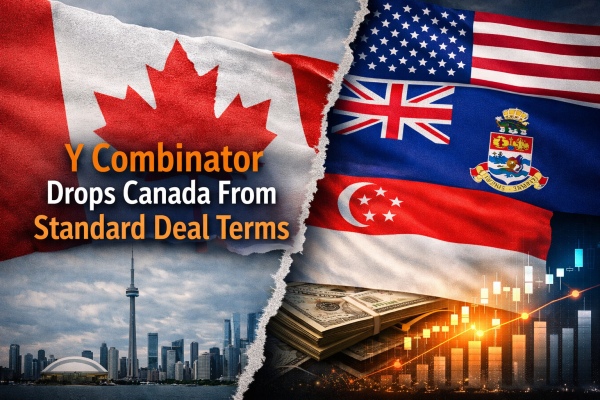
On January 26 2026, Y Combinator updated its standard deal terms to limit eligible investment jurisdictions to the United States, Cayman Islands, and Singapore. Canada no longer appears as a jurisdiction where YC will invest directly under its standard structure.
The financial terms remain unchanged. YC continues to offer $500,000 per company, split between $125,000 for a fixed 7% equity stake and $375,000 on an uncapped MFN SAFE. YC also states it can assist founders with incorporation if they have not yet formed a company.
The practical impact for Canada based founders is immediate. Teams can still apply to YC, but a Canadian incorporated startup must now establish a parent company in one of the eligible jurisdictions before YC completes the investment. That moves incorporation decisions forward in the startup lifecycle, often before product market fit or initial customer traction.
This matters because corporate structure is not a paperwork detail. It affects ownership control, intellectual property placement, option plans, investor rights, tax exposure, and the mechanics of future fundraising. What was once handled after a seed round now sits directly on the path to accelerator participation.
YC’s decision also highlights how early stage capital increasingly flows through standardized structures. Accelerators and seed funds optimize for speed and repeatability. When jurisdiction narrows, founders adapt by default, even if their teams, customers, and operations remain Canadian.
When access to top accelerators depends on jurisdiction first and execution second, how early should founders be forced to trade structural flexibility for capital velocity?
This is not a withdrawal from Canadian talent. It is a capital routing decision. But when global accelerators set the defaults, those defaults shape where companies incorporate, where value accrues, and how national ecosystems compete for long term upside.
The National Crowdfunding & Fintech Association (NCFA Canada) is a financial innovation ecosystem that provides education, market intelligence, industry stewardship, networking and funding opportunities and services to thousands of community members and works closely with industry, government, partners and affiliates to create a vibrant and innovative fintech and funding industry in Canada. Decentralized and distributed, NCFA is engaged with global stakeholders and helps incubate projects and investment in fintech, alternative finance, crowdfunding, peer to peer finance, payments, digital assets and tokens, artificial intelligence, blockchain, cryptocurrency, regtech, and insurtech sectors. Join Canada's Fintech & Funding Community today FREE! Or become a contributing member and get perks. For more information, please visit: www.ncfacanada.org
| | |
|---|---|---|
| | |


August 26th, 2025

January 4th, 2024

June 1st, 2021

September 9th, 2020

July 9th, 2018

January 3rd, 2018

September 25th, 2017

June 20th, 2017

May 10th, 2017

December 14th, 2016