




Karsten Wenzlaff, Advisor
August 26th, 2025
Karsten Wenzlaff is a Crowdfunding and Fintech Expert from Germany. He is Secretary-General of Digit[...]


October 27, 2026 | NCFA Industry Resource | SME Finance And Business Banking, Sustainable Finance ESG And Financial Inclusion, Capital Markets Infrastructure And Funding

Growth Loans, Regional Financing and Founder Awards
On October 22, 2026, Women's Enterprise Organizations of Canada (WEOC) and the Business Development Bank of Canada (BDC) announced up to C$200,000 in growth loans for eligible women entrepreneurs. WEOC also partnered with Quebec lender Evol to connect more founders with financing and business support. Separately, the Capital Elle Business Impact Award is accepting applications until October 28, 2026, giving Canadian women entrepreneurs three opportunities worth considering.
The new Women Entrepreneur Growth Financing programme combines WEOC loans of up to C$50,000 with BDC loans of up to C$150,000. Backed by a C$12.5 million financing commitment over two years, the pilot targets eligible women owned businesses outside Quebec that need more capital to expand. BDC is contributing C$10 million toward the programme.
For businesses ready to buy equipment, invest in technology, increase production or pursue larger contracts, the additional financing could make a meaningful difference. Regional WEOC lending partners will assess applicants and provide business advice and ongoing support. The combined C$200,000 is a maximum, subject to eligibility and lending approval.
Applications haven't opened yet. Financing is expected to begin later in 2026. Interested founders can register for WEOC growth financing updates to receive application details, eligibility requirements and loan terms when available.
WEOC's new partnership with Evol connects lending services across Canada. Evol supports entrepreneurs throughout Quebec's 17 regions, while WEOC works through lending partners elsewhere in Canada. The organizations will refer founders to suitable financing and advisory services, including businesses that may not qualify for an existing programme.
Both organizations participate in the Women Entrepreneurship Loan Fund, which offers eligible businesses loans of up to C$50,000. The partnership isn't a new grant or an extension of the C$200,000 BDC pilot into Quebec. It helps entrepreneurs find lenders and support suited to their location and financing needs.
The Capital Elle Business Impact Award offers Canadian women entrepreneurs cash awards and business support across three categories covering strategic connections, growth capital and acquisitions. The organizer advertises a combined prize package worth more than C$100,000, including C$5,000 cash for each category winner, professional services, mentoring and business connections.
The award is open to women founders across industries, subject to eligibility requirements. Applicants select the category that best fits their business goals. The application process costs C$50 for nonmembers (nonrefundable), while eligible paid Elleiance members can apply without an additional fee.
Deadline is October 28, 2026, at 9 p.m. Eastern. Founders should review the official award terms and confirm eligibility.
More financing options are welcome, and founders should match the opportunity to their business. Growth loans can fund expansion, regional lenders can provide ongoing support, and awards offer cash and business connections. The best choice depends on how much money the business needs, what it qualifies for and whether it can take on debt.
 The National Crowdfunding & Fintech Association (NCFA Canada) is a financial innovation ecosystem that provides education, market intelligence, industry stewardship, networking and funding opportunities and services to thousands of community members and works closely with industry, government, partners and affiliates to create a vibrant and innovative fintech and funding industry in Canada. Decentralized and distributed, NCFA is engaged with global stakeholders and helps incubate projects and investment in fintech, alternative finance, crowdfunding, peer-to-peer finance, payments, digital assets and tokens, artificial intelligence, blockchain, cryptocurrency, regtech, and insurtech sectors. Join Canada's Fintech & Funding Community today FREE! Or become a contributing member and get perks. For more information, please visit: www.ncfacanada.org
 |  |  |
|---|---|---|
 |  |  |
October 26, 2026 | NCFA Market Activity | Capital Markets Infrastructure And Funding, Digital Assets Blockchain And Tokenization, SME Finance And Business Banking

On October 26, 2026, Atlanta based trade finance company PrimeRevenue announced plans to tokenize trade finance assets on Solana, bringing its Electronic Time Drafts (ETDs) to blockchain capital markets. These instruments represent corporate buyers' obligations to pay suppliers on agreed future dates and can be financed to provide suppliers with earlier cash. PrimeRevenue aims to expand beyond its established bank funding network by connecting these obligations with additional institutional and eligible blockchain investors.
PrimeRevenue reports 50,000 companies using its platform, more than 100 funding partners and over US$300 billion in annual payment transactions. That established network gives the company a strong starting point for bringing corporate payment obligations to new investors. Rather than building a financing market from scratch, PrimeRevenue can extend its existing relationships, financial instruments and distribution capabilities into blockchain capital markets.
When a corporate buyer owes a supplier money, the supplier may have to wait 30, 60 or 90 days for payment. PrimeRevenue's Electronic Time Draft allows the buyer's payment obligation to be transferred to a financing bank at a discount. The supplier receives cash early, while the bank collects the full amount from the buyer when payment comes due. Financing terms reflect factors including the buyer's credit rating and the remaining payment period.
For example, a supplier owed US$100,000 in 90 days could exchange the draft for an earlier discounted payment. A smaller supplier working with a financially stronger corporate customer may secure more attractive financing than borrowing against its own credit. The buyer retains the agreed payment date, the supplier receives working capital and the bank earns a return for providing the funding and assuming the buyer's payment risk.
ETDs aren't ordinary digital invoices. PrimeRevenue's patented process creates and signs a time draft electronically, supports its transfer to the financing bank and arranges collection at maturity. The company says the structure also removes certain lien search and release requirements that can complicate conventional receivables financing.
Over time, tokenized ETDs could support a continuously replenishing working capital market. Corporate buyers generate new payment obligations, suppliers receive early financing, and investors recover capital as drafts mature. That money could finance the next round of transactions, potentially giving suppliers more flexible access to funding without relying on a single lender. Each draft would still carry its own credit risk, but the financing network could operate more like a revolving pool of capital.
In 2018, PrimeRevenue reported US$1.78 billion in ETD financing, helping nearly 1,000 suppliers across 13 countries get paid early. The program involved 14 banks and more than 100 corporate buyer programs, showing that ETDs were already being used internationally well before the Solana initiative.
PrimeRevenue currently connects corporate payment obligations with established funding institutions. Tokenization could allow other eligible investors to finance or acquire interests in those obligations, depending on how the legal structure is implemented. Solana would provide a shared record of issuance, transfers and settlements, while PrimeRevenue continues supplying the corporate relationships and transaction activity.
PJ Bain PrimeRevenue CEO described the intended expansion in the company's announcement:
"It creates new pathways to unlock working capital and liquidity for our customers and funding partners."
A bank might gain another way to distribute its exposure instead of holding every draft until maturity. New investors could gain access to corporate credit with defined payment dates. Suppliers could benefit if competition among funding providers improves pricing or financing availability. None of these benefits is established until investors commit capital and completed transactions demonstrate the economics.
PrimeRevenue still needs to clarify what investors would actually own, how they would receive payments and what happens if a corporate buyer fails to pay. Holding a token on Solana doesn't automatically give an investor the legal right to collect the underlying debt. Investors would also need to consider whether they could sell their holdings before payment is due.
The bigger opportunity is bringing more investors into trade finance, not simply processing transactions faster. PrimeRevenue already connects corporate buyers, suppliers and banks. Tokenization could open that network to additional investors, giving suppliers access to more funding options and potentially better rates.
Unlike Fission's tokenized fund liquidity model, which helps investors access cash from existing fund holdings, PrimeRevenue is bringing corporate payment obligations to new funding markets. Both use tokenization to connect financial assets with capital, but they serve different financing needs.
Canadian businesses face similar working capital pressures. Payments Canada's 2026 research found that 37% of surveyed small and medium businesses consider payment delays a significant problem. Recent Canadian SME financing initiatives are expanding access to smaller loans and more flexible supplier payments. Tokenized ETDs could offer another option, especially for suppliers selling to large, creditworthy corporate customers.
Canadian banks, commercial lenders and financing platforms could eventually use similar models to connect corporate payment obligations with a wider pool of investors. This could give suppliers more financing choices while opening new opportunities for lenders and financial technology providers.
PrimeRevenue describes the Solana initiative as its first step toward decentralized finance (DeFi), connecting traditional trade finance with new blockchain funding markets.
PrimeRevenue already has the corporate customers, financing network and bank relationships to bring trade finance assets to new investors. Solana could help attract more capital and give suppliers better financing options. Can PrimeRevenue turn tokenized trade finance into a larger, more competitive funding market that delivers real value to businesses?
The National Crowdfunding & Fintech Association (NCFA Canada) is a financial innovation ecosystem that provides education, market intelligence, industry stewardship, networking and funding opportunities and services to thousands of community members and works closely with industry, government, partners and affiliates to create a vibrant and innovative fintech and funding industry in Canada. Decentralized and distributed, NCFA is engaged with global stakeholders and helps incubate projects and investment in fintech, alternative finance, crowdfunding, peer-to-peer finance, payments, digital assets and tokens, artificial intelligence, blockchain, cryptocurrency, regtech, and insurtech sectors. Join Canada's Fintech & Funding Community today FREE! Or become a contributing member and get perks. For more information, please visit: www.ncfacanada.org
| | |
|---|---|---|
| | |
Oct 17, 2026 | Last Updated: Oct 30, 2026 | NCFA Fintech Whisperer | Artificial Intelligence And Data, Capital Markets Infrastructure And Funding, Competition And Market Structure, Cross Border Payments And FX, Cybersecurity Fraud And Financial Crime, Digital Assets Blockchain And Tokenization, Digital Identity And Trust, Embedded Finance, Payments Infrastructure And Money Movement, Regulation And Policy, Risk Compliance And Regtech, Sustainable Finance ESG And Financial Inclusion, Digital Banking And BaaS, Treasury Liquidity And Cash Management, Wealthtech Investing And Trading, Open Banking Open Finance And Data Sharing

] Image: Freepik
This live weekly NCFA intelligence page tracks financial technology developments that significantly affect how fintechs build, sell, raise capital, and operate under scrutiny. Coverage prioritizes Canada and includes global events that directly influence competitive conditions, market access, and execution realities across fintech sectors. This page will be updated throughout the week with market movers in a live format and then each week we'll close the prior week's contents in prep for the upcoming week, and continue on a rolling basis. (Missed prior week's Fintech Whisperer? (December 6-12, 2025, December 13-19, 2025, January 1-9, 2026, January 10-16, 2026, January 17-23, 2026, January 24-30, 2026, January 31-February 6, 2026, February 7-13, 2026, February 14-20, 2026, February 21-27, 2026, February 28-March 6, 2026, March 7-March 13, 2026, March 14-March 20, 2026, March 21-March 27, 2026, March 28-April 3, 2026, April 4-10, 2026, April 11-17, 2026, April 18-24, 2026, April 25-May 1, 2026, May 2-8, 2026, May 9-15, 2026, May 16-22, 2026, May 23-29, 2026, May 30-June 5, 2026, June 6-June 12, 2026, June 13-June 19, 2026, June 20-June 26, 2026, June 27-July 3, 2026, July 4-July 10, 2026, July 11-July 17, 2026, July 18-July 24, 2026, July 25-July 31, 2026, August 1-August 7, 2026, August 8-August 14, 2026, August 15-August 21, 2026, August 22-August 28, 2026, August 29-September 4, 2026, September 5-September 11, 2026, September 12-September 18, 2026, September 19-September 25, 2026, September 26-October 2, 2026, October 3-October 9, 2026, October 10-October 16, 2026).
Sezzle is trying to move from distributing credit through banking partners toward owning a federally supervised banking platform. If approved, that would give it more control over deposits, credit products, funding and customer economics. The next signals are OCC and FDIC decisions, capital requirements and how much of Sezzle's current partner model eventually moves inside the bank.
Mortgage technology only earns its place when it improves underwriting, servicing and broker economics. NORTHGUARD has acquired an operating base rather than starting with software alone. Founders and capital partners should watch how quickly it expands beyond Quebec, how it funds mortgages and whether faster decisions translate into stronger loan performance.
Ramp is seeking direct control over regulated investment and custody capabilities rather than relying entirely on external providers. Following its recent funding and expansion, the charter application adds another route for the company to broaden its financial services business. The key tests are OCC approval, which capabilities Ramp brings in-house, and how the new entity would work alongside existing bank partners.
SoFi is testing whether customers will keep digital dollar balances at a bank until they need to transact. The split between an insured deposit and a transferable stablecoin is commercially important because the legal protections change at conversion. Banks and fintechs should compare yield, redemption terms and access rather than treating both tokens as the same product.
Banks are starting to offer controlled data access where customers already work with AI, rather than forcing every question back into a banking app. Finom’s read-only design keeps the risk boundary relatively clear. The test is whether business owners use it routinely and whether future payment permissions can be added without sacrificing that control.
A bank can now test whether AI cuts investigation costs without losing control of the decision trail. Starling’s approach also raises the bar for vendors that sit outside the banking core. But speed isn’t enough. Compliance teams still need to know when a decision should be challenged, who owns an error and whether the economics hold across higher risk cases.
AI risk is moving from broad supervisory concern into bank level remediation work. The practical question is no longer whether banks recognize the threat. It's whether they can show the ECB who owns the risk, what systems need investment and how quickly controls can change as models become more capable. NCFA first tracked the supervisory direction in ESRB Warns Frontier AI Models Could Strain Cyber Resilience. The October action plans turn that warning into an execution deadline.
The FCA has made current obligations easier to test against real deployment patterns without creating a separate AI rulebook. Firms can compare their controls with concrete supervisory examples before weak ownership, monitoring or vendor dependence becomes an operating problem. NCFA has been tracking the same AI governance and compliance costs as financial institutions move from experiments into live workflows.
This expands the market infrastructure available for event driven securities products before the products themselves reach investors. The commercial test is whether Cboe and Robinhood can turn the new clearing authority into meaningful trading volume while keeping the risk, margin and settlement controls expected of regulated securities markets.
Private credit is becoming too large for market data firms to treat as a side business. LSEG is paying for proprietary information, workflow and distribution in a market it estimates at US$3.5 trillion. Investors should watch whether the deal improves pricing and risk visibility in less liquid credit or simply concentrates more valuable data inside one platform. The commercial upside depends on cross selling without weakening the specialist product customers already pay for.
Fund managers have a new capital application window, but founders still need to meet the investment criteria of the funds receiving public commitments. The capital won’t necessarily reach businesses outside the venture model. The immediate tests are which managers apply, how they attract pension and private capital, and whether founders beyond established funding hubs gain access.
This separates collateral custody from the funding used on a derivatives platform. Traders can keep crypto exposure while obtaining dollar margin, but the convenience comes with another lender, security interest and liquidation process. Custodians and brokers should watch collateral valuation, loan terms and who can act when markets gap outside banking hours.
French managers seeking US advisory access have a clearer supervisory cooperation arrangement behind their applications. The practical question is how registration processing, compliance preparation and ongoing examination responsibilities operate under the memorandum. Asset managers expanding internationally should distinguish the renewed application pathway from permission to begin serving clients without SEC registration.
Malaysia has moved tokenized fixed income into core market infrastructure rather than leaving it in a pilot. That matters because issuance, ownership records and settlement now sit inside infrastructure controlled by the central bank. NCFA previously tracked the earlier groundwork in Bank Negara Malaysia Onboards Ringgit Stablecoin And Tokenized Deposit Pilots. The next test is issuance volume and whether banks, governments and corporate borrowers start using the new rails regularly.
Mobile wallet providers and fintechs could gain more control over how contactless services reach iPhone users. Fees, available technical methods and contractual access are the practical questions. Firms considering wallet or account-based payment products should examine the consultation now, rather than planning around terms that have not yet been finalized.
Western Union already has customer distribution and cash access. The harder work is fitting a stablecoin rail into local payout rules, liquidity and customer support. Noah gains an important infrastructure role, but both firms still need to show where customers can actually use the service and whether fees fall without making redemption harder.
Cross border card programs become expensive when every new country needs another bank relationship and operating stack. Newline is using Fifth Third's balance sheet and Visa's network to give fintechs one route into more than 40 markets. The opportunity is meaningful for software platforms serving global employers and businesses. The real test is whether local authorization and issuing reduce fees and failed transactions enough to justify the added compliance work.
Fiserv is selling fewer integrations as a cross border growth advantage. Large merchants can add local payment methods without rebuilding settlement, reporting and operational controls market by market. The commercial test is whether that consolidation lowers total payment costs and speeds expansion enough to outweigh the value of using specialized providers in individual countries.
Cross-border digital money won’t scale if every bank has to negotiate a different settlement and compliance arrangement in every market. BLOOM puts three central banks at the table with the providers building those connections. Operators should follow the actual commercial agreements, supported assets and settlement rules, not just the growing participant list.
Stablecoin payments are being fitted into existing institutional fraud and compliance operations rather than treated as a separate risk channel. Banks and payment providers will need to test whether the combined intelligence improves decisions across conversion, transfer and payout stages, and how responsibility is divided between partners when a suspicious transaction is held or rejected.
Agent-driven commerce needs a way to recognize authorized software without giving fraudsters a free pass. Identity signals that enter the merchant’s existing risk engine offer one practical approach. The next test is whether checkout performance holds across more merchants, higher transaction volumes and contested payments, where evidence of the human mandate matters as much as recognizing the agent.
Loan participation payments are still full of reconciliation work after the money arrives. Moving the payment and loan records together attacks that operating cost directly. Banks should care less about the token label than whether the process shortens settlement, reduces exceptions and keeps every participant on the same loan balance. Repeat volume across more institutions would turn this from a useful transaction into infrastructure.
Institutional settlement now has another bank deposit option on a public blockchain where tokenized assets already trade. Treasury and digital asset teams can compare the legal claim, eligible counterparties, network access and liquidity against stablecoin-based settlement. The commercial test is whether institutions use the additional network for regular transactions, not simply as another technical connection.
Revolut now has another regulated entity it can use to expand crypto services without relying on one licensing base for every market. The value will come from where the Gibraltar permission actually opens distribution, custody and staking at scale. Investors should watch which markets are added, how quickly customers migrate to the new entity and whether regulatory expansion improves revenue without adding disproportionate compliance cost.
Switzerland already had deep crypto infrastructure, but retail fund approval changes distribution. Wealth platforms and advisers can now offer Bitcoin through a supervised investment product instead of pushing every customer toward direct ownership. The advantage is easier custody and familiar fund controls. The risk doesn't disappear, and competing providers will still have to win on fees, liquidity and investor trust.
Failed cross border payments are expensive because the bank or fintech still absorbs investigation, repair and customer service costs. Connecting verification across bank accounts and wallets gives institutions a chance to catch bad recipient data before funds leave. The value will show up in lower exception rates and fewer fraud losses. Adoption will depend on how much coverage Liink participants can use without adding another slow step to the payment flow.
Payment providers can’t afford a different wallet authentication arrangement for every country or partner. A common set of rules could lower integration costs and clarify liability. The industry now has time to shape those rules, but firms shouldn’t treat a published development plan as a completed authentication standard.
Financial identity checks are extending beyond onboarding into agent interactions, remote approvals and sensitive communications. Firms considering these tools need to test exactly which facts a proof establishes, what data must be retained and who accepts liability if a verified participant still gives fraudulent instructions. Design-partner use is an early distribution step, not proof of broad institutional adoption.
AI assistants are moving from advice into execution inside everyday business software. Stripe gives Claude access to payment and commerce tools while keeping the owner at the approval point. For founders, that can cut routine admin without handing an agent open ended spending authority. The commercial question is whether customers trust the controls enough to move real purchasing and finance work into the interface.
Stablecoin adoption is moving into a bank's existing retail distribution rather than asking customers to adopt a new crypto wallet. That cuts a major onboarding barrier. The numbers to watch now are wallet activation, payment frequency and merchant usage. If customers use RedCoin for ordinary transactions, regulated stablecoins start competing as payment products rather than mainly trading and settlement tools.
Payment margins can depend on who controls the local acquiring relationship. Nuvei can now bring more of that work inside its own network instead of paying intermediaries. Merchants should compare actual approval rates and processing costs after implementation. For Canadian payment firms, the licence shows how regulated local access can strengthen international distribution.
Agents that buy software services need spending limits that survive across multiple suppliers. Mastercard is testing a way to approve a budget once without granting open access to company funds. The commercial question is whether developers and merchants adopt one shared payment method instead of creating another patchwork of wallets, credits and billing accounts.
Euronet wants a larger share of the merchant relationship than payment processing alone. Connecting checkout, reconciliation and business software can improve retention and open new service revenue. Merchants will judge the platform on integration costs and daily usefulness. Competing payment providers should watch whether the Greece rollout turns Euronet’s distribution into a durable advantage.
Business payment automation is crossing a practical barrier: recognized agents can finish authorized transactions inside supplier portals without a person manually completing every step. Finance teams will need to define mandate limits, approval evidence and exception handling before using this model more widely. Successful pilot transactions are a useful milestone, but broad interoperability and dispute processes remain to be proven.
Card networks are designing agent payment protocols, but local bank account and wallet schemes can’t simply assume those rules fit. The council gives payment providers a place to settle the hard questions around mandates, identity and refunds before agents become another checkout channel. Its value depends on usable technical specifications and adoption by real payment schemes.
More official repo capacity gives market makers another liquidity buffer as Hong Kong builds deeper offshore RMB markets. The increase itself is modest, but the control point is important. Banks competing for RMB flows now have stronger public liquidity support behind market making, while exchanges, payment firms and treasury platforms get a deeper funding base for products built around offshore RMB.
Corporate treasurers leave cash idle when fund cut off times don't match when money becomes available. This transaction shows how tokenized bank money can connect that cash directly to an investment product without rebuilding the treasury stack around a stablecoin. The opportunity is better use of working cash. The business case will depend on redemption speed, fund access and whether the model scales beyond bespoke transactions.
The important shift isn't that an AI can read a balance. It can now carry out approved treasury work inside the financial account. Founders gain leverage if routine transfers and invoice payments move out of the admin queue without weakening controls. Banks and fintechs will need equally clear permission models because the competitive question is moving from who has an AI assistant to who safely lets it touch money.
AI and tokenization are no longer sitting outside the routine examination cycle. Firms using either in regulated workflows should expect questions about governance, supervision, records, controls and investor outcomes. For infrastructure providers, the combination of Treasury clearing and tokenization also puts implementation risk closer to the examiner's desk, not just the product roadmap.
Regulatory competitiveness now has explicit federal policy requirements, but better outcomes aren't automatic. Fintechs and investors should watch whether impact assessments, burden offsets and regulatory reviews actually reduce entry costs and approval friction. The same questions around OSFI's approach to growth and competition extend across federal regulation: will the new requirements make it easier for credible entrants to launch, scale and compete?
The final rule gives stablecoin issuers a clearer operating framework, but rewards remain a competitive fault line between banks and crypto platforms. Exchanges may still have room to pay customers when the reward isn't simply interest for holding a stablecoin, yet there is no blanket approval. Issuers and partners now need structures they can defend under OCC review. For banks, the deposit competition debate isn't settled just because the rule is final.
Crypto firms need to establish which activities require authorization and which qualify for exclusions before committing to licensing and operating structures. The distinction is particularly important for stablecoin payments, decentralized protocol interfaces and technical service providers. Firms affected by uncertainty over arranging permissions should engage with the FCA during the application window rather than assume that forbearance extends the application deadline.
Canada's existing restrictions can complicate fintech investments when a business combines financial services with other commercial activities. The proposed fintech investment reforms would give banks and insurers more room to invest, acquire and build technology businesses while retaining limits on their exposure. Fintech founders could gain access to strategic capital and established distribution networks. The commercial test is whether institutions use that flexibility to expand products and partnerships, rather than simply absorb promising competitors.
Hiring senior leaders can take months when every role requires an external approval. The UK is proposing to put more of that decision back on regulated firms without removing accountability. Boards and compliance teams should compare the proposed savings with the additional burden of documenting their own assessments before changing staffing or control plans.
Retail brokers now have a dated supervisory benchmark for scam controls rather than a general warning about fraud exposure. Firms should review the full guidelines and FAQs against their customer protection, escalation and operational processes, identify changes requiring development or vendor support, and budget the work ahead of June 2027.
A global crypto brand still needs effective controls inside its locally regulated payments entity. Reliance on a parent company doesn’t transfer accountability for safeguarding customer funds. Payment firms expanding into Europe should verify daily reconciliations, board visibility and the resources available to challenge a group service provider when problems appear.
Financial crime controls built around yesterday’s payment and customer patterns can miss risks introduced by agents, crypto products and new vendors. Firms should test whether their transaction evidence, staff escalation and sanctions processes still work across those channels. The consultation offers a chance to challenge unclear expectations before the final guide is issued.
A shared classification method could give issuers and capital providers a more consistent basis for assessing transition-finance claims. But the real allocation decisions will turn on sector thresholds, supporting evidence and independent review. Investors and borrowers should not treat today’s methodology as a certification of individual projects or assume that unsettled greenwashing and disclosure risks have disappeared.
Financial data partnerships now carry clearer accountability beyond the initial customer consent. Banks and fintech aggregators need to map every downstream recipient, inspect contract rights and test whether their oversight works when data are reused. Access to the rail is valuable, but it won’t excuse weak controls at the next company in the chain.
Canada put C$1.75 billion in venture and growth capital on the table and introduced new rules to make federal regulation more competitive. Internationally, banks and fintechs advanced tokenized deposits, cross-border settlement and AI-controlled financial transactions. These are becoming practical business decisions about who controls customer access, payment infrastructure and compliance costs. The opportunity for Canadian fintechs is to compete on execution, building products customers trust, securing distribution and turning regulatory change into commercial advantage.
NCFA offers various curated resources to help founders and investors stay current on developments that impact fintech markets. Get the weekly Whisperer and related market intelligence through NCFA's newsletter, view the latest fintech news and insights, industry research, or launch into emerging financial innovation opportunities.
The National Crowdfunding & Fintech Association (NCFA Canada) is a financial innovation ecosystem that provides education, market intelligence, industry stewardship, networking and funding opportunities and services to thousands of community members and works closely with industry, government, partners and affiliates to create a vibrant and innovative fintech and funding industry in Canada. Decentralized and distributed, NCFA is engaged with global stakeholders and helps incubate projects and investment in fintech, alternative finance, crowdfunding, peer to peer finance, payments, digital assets and tokens, artificial intelligence, blockchain, cryptocurrency, regtech, and insurtech sectors. Join Canada's Fintech & Funding Community today FREE! Or become a contributing member and get perks. For more information, please visit www.ncfacanada.org
| | |
|---|---|---|
| | |
October 23, 2026 | NCFA Insight | Capital Markets Infrastructure And Funding, Competition And Market Structure, SME Finance And Business Banking
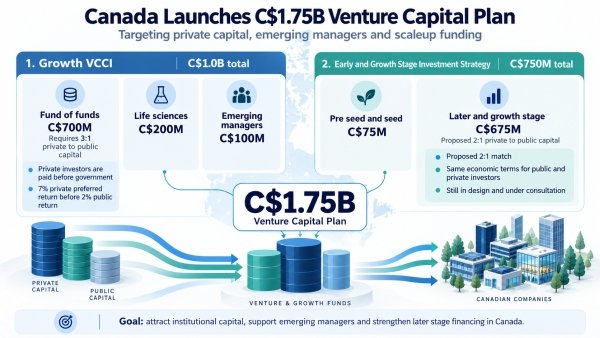
On October 22, 2026, Industry Minister Mélanie Joly launched Canada's C$1.75 billion Venture and Growth Capital Plan. It combines C$1 billion for a new Venture and Growth Capital Catalyst Initiative with C$750 million for early and growth stage investing. Ottawa expects the programs to attract at least C$3.8 billion of private investment, taking the total pool above C$5.5 billion.
Canada may be reaching an important turning point in how it supports venture capital. The plan is more targeted than another funding announcement. It uses public capital to attract institutional investors, broaden the fund manager base and strengthen later stage financing where Canadian companies often rely heavily on foreign capital.
The C$1.75 billion is federal capital, not money already invested in startups. Most of it will move through fund managers that must raise private capital before investing in venture funds or companies. The first C$700 million fund of funds competition is open now, while the largest growth stage stream is still being designed.
The plan has five funding streams.
Founders won't apply directly for most of this money. BDC will manage the federal investments, while selected fund managers raise private capital and invest through venture funds or eligible companies. The structure is meant to increase the amount of private money available across the financing cycle rather than turn C$1.75 billion into startup grants.
The C$700 million fund of funds stream is the first part with final application terms. Applications close January 21, 2027 at noon Pacific. Managers must be raising at least C$150 million, show Canadian venture investment experience and demonstrate institutional backing or a comparable track record.
The C$100 million emerging manager allocation addresses another weakness. In 2025, the five largest Canadian venture funds captured 83% of all capital raised, while emerging managers raised only C$249 million. A separate stream gives newer managers room to build track records without having to clear the C$150 million minimum used for the main fund of funds competition.
The C$675 million later and growth stage stream targets Series B and beyond, where the financing gap becomes more pronounced. Its current design covers growth equity, opportunity funds, continuation vehicles and some innovation focused buyout strategies. It isn't open for applications yet, and ISED and BDC are accepting feedback until November 23, 2026 at 5 p.m. Pacific.
The most consequential part of the plan may be how Ottawa is using public money to improve the economics for private investors. Selected fund of funds managers must raise C$3 of private capital for every C$1 of public capital. A fund receiving C$50 million from Ottawa would therefore need at least C$150 million from private investors.
The fund of funds terms give private investors priority when returns are distributed. Private investors are paid before the government. They first recover their contributed capital and receive enough additional distributions to reach a 7% internal rate of return. Federal capital is then repaid and begins earning its 2% return before remaining profits are distributed under the fund's waterfall. The 7% isn't guaranteed. Private investors still carry venture risk, but they receive better economics than the federal government when a fund performs well enough to return capital and profits.
Federal money is also put to work early. Public and private capital are generally drawn equally until the government's commitment has been used, even though federal capital represents about 25% of a fund meeting the minimum 3 to 1 private match. That can make participation more attractive to institutional investors by delaying some of their capital calls.
The program still keeps a strong Canadian investment requirement. At least 60% of fund investments must go into qualifying Canadian venture funds. Managers can invest up to 30% of a fund directly into companies, but at least 90% of those direct investments must go to Canadian based businesses.
Previous programs show that the model can attract larger pools of capital. Across VCAP and earlier VCCI programs, Ottawa reports C$1.2 billion of federal investment, C$3.7 billion raised by recipient managers and C$6.4 billion invested in Canadian companies by supported funds and other investors.
The proposed C$675 million growth stage stream takes a different approach. Its current design calls for at least C$2 of private capital for every C$1 of federal investment, but public and private investors would receive the same economic terms. That could make sense in a market where the priority is increasing the number of investors able to finance larger Canadian rounds.
The need is visible in the numbers. Canadian VC investment reached C$2.69 billion across 250 deals in the first half of 2026, but 16 financings of C$50 million or more absorbed 59% of all capital. Later stage activity fell to 18 deals, growth stage financing totalled only C$127 million across three deals and foreign investors participated in 56% of later stage rounds.
International capital is an advantage, something Canada should augment, not replace. The weakness appears when Canadian investors aren't able to lead or anchor enough of those larger rounds. More domestic growth capital can give strong companies another option when they are deciding where to raise, who joins the cap table and how much of the next stage of growth remains anchored in Canada.
Private capital is already moving into the gap. RBC recently launched a C$1.4 billion Canadian technology initiative that includes a growth fund for later stage technology companies. Public capital can widen that market by bringing more pension funds, insurers, family offices and fund managers into the same part of the financing cycle.
The emerging manager stream could broaden Canada's venture market as well. In 2025, government backed VCAP and VCCI capital represented 36% of Canadian VC fundraising. The next step is getting more pension funds, insurers, family offices and other private investors to keep investing after public capital has helped funds build a track record.
Exit markets remain a constraint. Canada recorded 18 venture backed exits worth C$716 million in the first half of 2026 and no venture backed IPOs. Funds ultimately need acquisitions, secondary sales or public markets to return money to investors and put that capital back to work.
Canada has an opportunity to use public capital differently this time. The C$1.75 billion plan can bring more institutional investors into venture, give emerging managers room to build credible track records and expand the pool of capital available when Canadian companies reach larger rounds. The turning point comes if it broadens the investor base (not just the amount of capital available), and those investors earn competitive returns and keep allocating capital after the incentives have done their job. That would move Canada closer to a venture market that compounds on its own rather than waiting for the next government program.
The National Crowdfunding & Fintech Association (NCFA Canada) is a financial innovation ecosystem that provides education, market intelligence, industry stewardship, networking and funding opportunities and services to thousands of community members and works closely with industry, government, partners and affiliates to create a vibrant and innovative fintech and funding industry in Canada. Decentralized and distributed, NCFA is engaged with global stakeholders and helps incubate projects and investment in fintech, alternative finance, crowdfunding, peer-to-peer finance, payments, digital assets and tokens, artificial intelligence, blockchain, cryptocurrency, regtech, and insurtech sectors. Join Canada's Fintech & Funding Community today FREE! Or become a contributing member and get perks. For more information, please visit: www.ncfacanada.org
| | |
|---|---|---|
| | |
October 22, 2026 | NCFA Insight | Regulation And Policy, Competition And Market Structure, Capital Markets Infrastructure And Funding

On October 21, 2026, the Canadian government published a new federal regulatory competitiveness directive that takes effect December 31, 2026. Federal regulators covered by it will have to assess how proposed rules affect competitiveness, remove $2 of regulatory burden for every $1 they add to business over three years, and review regulations on clearer schedules.
The change puts regulatory costs, competition and investment closer to the centre of federal rule making. It doesn't require weaker financial safeguards. Regulators can still impose rules needed for financial stability, consumer protection, market integrity or other public interests, but they will have to pay more attention to what those rules cost and how they affect market entry.
It's highly important for fintech firms and smaller financial institutions because many compliance costs are fixed. Legal work, compliance staff, reporting systems and technology builds can consume a much larger share of a smaller firm's budget than a major bank's. The value comes from whether regulators measure those costs properly and change requirements that make it unnecessarily expensive to compete.
The directive replaces the 2018 Cabinet Directive on Regulation, but Canada isn't starting from zero. The earlier framework already told regulators to consider competition, innovation, regulatory alignment and the burden on smaller businesses.
The 2026 directive makes several of those expectations more specific. Proposed regulations now require a dedicated competitiveness assessment whose results must be communicated. Significant regulations must be reviewed within five years of taking effect, while other regulations must be reviewed at least once every ten years. Regulators are also told to consider recognized Canadian and international standards and use them where appropriate. New rules should remain workable as technology changes, and businesses should receive clearer guidance on how they can safely introduce new products, services and technologies.
The biggest numerical change is the new $2 for $1 rule. For every $1 of new regulatory burden added to business, the government must remove $2 elsewhere over a three year period. Canada's existing one for one rule is narrower. It focuses mainly on administrative work such as forms, reporting and record keeping and requires an equal administrative cost offset.
The existing regulatory burden policy uses a Standard Cost Model and federal cost calculator. Treasury Board hasn't yet published the detailed guidance for the broader $2 for $1 approach. Until it does, important questions remain about which costs will count, where savings can be found and how exemptions will work. Businesses shouldn't read the new ratio as a promise that their own compliance costs will fall by half. The impact will depend on which costs the government counts and which requirements it actually removes.
The Canadian Federation of Independent Business estimates that businesses across all levels of government spent $51.5 billion on regulatory compliance in 2024. It estimates that about $17.9 billion could be reduced without sacrificing the public interest. The smallest businesses paid more than five times as much per employee as larger firms. Those figures cover the whole economy rather than financial services, but they show why fixed regulatory costs can shape who can afford to compete.
The directive doesn't name financial regulators one by one. Its scope depends on how a rule is made. It directly covers many federal regulations approved by Cabinet, Treasury Board or a federal minister. It doesn't automatically apply to every guideline, supervisory decision or rule issued by another body. So that means many federal financial regulations can fall under the new framework. Department of Finance regulations approved through Cabinet or Treasury Board are covered. Regulations made under the Bank Act and other federal financial laws can also be covered when they go through those federal processes.
OSFI is a federal regulator, but not everything it issues is a federal regulation. The directive can apply to regulations affecting federally regulated banks and insurers, while OSFI guidelines, advisories and supervisory expectations are different. They still shape how institutions operate, but they don't automatically fall under the directive in the same way. OSFI is already giving more weight to growth and competition within its mandate, including through recent changes to how it balances regulation, growth and competition.
The Bank of Canada is also a federal regulator. Federal payments regulations can fall under the directive when they are made through Cabinet, Treasury Board or ministerial processes, while the Bank's own supervisory decisions are separate.
FCAC and FINTRAC also operate under federal laws where Cabinet approved regulations can fall under the directive. Provincial securities regulators don't. CIRO's own rules also sit outside this federal framework. The directive may encourage better coordination, but it doesn't change which regulator has legal authority over each market.
The government is also moving ahead with Bill S-7, the Cutting Red Tape for All Canadians Act. Introduced October 7, it remains at second reading in the Senate. The bill would amend 31 federal laws. The Cabinet directive changes how federal regulations are developed and reviewed. Bill S-7 is still proposed legislation, while the directive is adopted government policy that takes effect December 31.
A competitiveness assessment gives fintech firms, smaller financial institutions and industry groups a clearer place to show what a proposed rule will cost. That can include compliance staff, legal work, technology builds, capital tied up before launch, approval delays and duplicate reporting.
Open banking shows how those costs can affect competition. Finance Canada's proposal estimated C$13.2 billion in benefits over ten years and C$457.7 million in regulatory costs, with hundreds of small businesses expected to participate. The Privacy Commissioner's proposed changes to Canada's open banking rules could add stronger safeguards as well as new requirements. Each requirement should provide enough additional protection to justify what it adds to the cost of entering and competing in the market.
The same issue appears in payments. Registered payment service providers are gaining greater access to Canada's payment infrastructure while operating under the Retail Payment Activities Act. Future payments rules still need to protect customer funds and operational resilience, but regulators will have to consider whether reporting, technical requirements or overlapping controls make participation unnecessarily expensive for smaller firms.
Stablecoins, tokenization and AI in financial services will raise similar questions. The directive doesn't weaken anti money laundering rules, consumer protection or financial stability requirements.
It asks regulators to consider whether the same protection can be achieved at a lower regulatory cost.
A 2026 C.D. Howe Institute review found that 92% of the financial regulatory measures it examined emphasized stability, transparency, market abuse or consumer protection, while 17% addressed efficiency, growth or innovation. It also found limited formal analysis of regulatory costs and benefits. A financial system can protect consumers and remain stable without making it unnecessarily expensive for new firms to compete.
Founders and industry groups can make the new process more useful by bringing numbers to consultations. Staff hours, outside legal bills, technology spending, approval delays and duplicate requirements give regulators something concrete to assess. Companies can also show how many customers or transactions they need before complying with a new requirement becomes commercially viable.
Canadian Chamber of Commerce CEO Candace Laing called for "measurable reductions in red tape." Lower duplicate costs, faster decisions, more viable entrants and rules that remain workable as technology changes will show whether the directive is producing results.
Canada's regulatory problem been the difficulty of seeing when several reasonable requirements combine into a barrier that protects incumbents as much as consumers. Putting a price on regulatory burden could expose those hidden barriers. The bigger opportunity is to make competition part of regulatory design before new costs become embedded and expensive to unwind.
The National Crowdfunding & Fintech Association (NCFA Canada) is a financial innovation ecosystem that provides education, market intelligence, industry stewardship, networking and funding opportunities and services to thousands of community members and works closely with industry, government, partners and affiliates to create a vibrant and innovative fintech and funding industry in Canada. Decentralized and distributed, NCFA is engaged with global stakeholders and helps incubate projects and investment in fintech, alternative finance, crowdfunding, peer-to-peer finance, payments, digital assets and tokens, artificial intelligence, blockchain, cryptocurrency, regtech, and insurtech sectors. Join Canada's Fintech & Funding Community today FREE! Or become a contributing member and get perks. For more information, please visit: www.ncfacanada.org
| | |
|---|---|---|
| | |
Oct 22, 2026

Image: Pexels/Gustavo Fring
A workplace injury can quickly disrupt your finances and budget if an absence expected to last a few days stretches into weeks or months. Rent/mortgage payments, groceries, loans, and other fixed expenses will look a lot different if you have to multiply them. And understanding how an extended recovery affects a WSIB claim becomes increasingly important.
If an injury keeps you from working more than a few days, speaking with a WSIB lawyer can help you understand whether your benefits, medical evidence, and return-to-work plan address your actual circumstances. Longer claims often involve more decisions about functional abilities, suitable work, benefit entitlement, and changes in medical status. A misunderstanding can get costly if it affects weeks or months of income replacement.
For an allowed claim, WSIB typically pays loss-of-earnings benefits when a work-related injury or illness prevents you from working or causes you to earn less. Benefits for injuries (on or after January 1, 1998) are calculated at 85% of take-home pay, subject to an annual maximum.
An extended absence doesn’t necessarily mean the end of your entitlement. WSIB may continue benefits while the workplace injury affects your ability to earn, although it can review your medical condition, income, and return-to-work status. Updated medical information becomes especially important if recovery takes longer than predicted.
Early medical reports may predict a short recovery period. If that estimate no longer applies, your records must reflect the change.
Follow-up appointments should document ongoing symptoms, treatment recommendations, and functional limitations. The key issue is often what you can safely do at work. If you still can’t lift, stand, sit, concentrate, or perform essential tasks safely, those restrictions need to be documented.
Gaps in treatment or outdated evaluations can create questions about whether your limitations remain connected to the workplace injury.
When an employer offers modified work, the proposed duties must be analyzed from a practical standpoint. WSIB assesses suitability by comparing the job against your physical or psychological functional abilities and considering whether the work is safe, productive, and likely to interfere with recovery.
Ask for enough detail to make that comparison possible. A modified-duty offer should make clear what tasks you will perform, the physical or cognitive demands involved, the schedule, and any accommodations being provided. If your current restrictions prevent you from repeatedly bending or lifting above a certain weight, for example, a vague description of "light duties" doesn’t establish whether your employer’s expectations fit those restrictions.
If there is a disagreement, WSIB can assess the proposed work using medical information, your functional abilities, and details about the duties offered. If WSIB determines that suitable work is available and you are capable of performing it, your loss-of-earnings entitlement can be affected.
Some workers with a prolonged medical absence may also qualify for Ontario's long-term illness leave. Under the Employment Standards Act, eligible employees who have worked for their employer for at least 13 consecutive weeks can take up to 27 weeks of unpaid, job-protected leave within a 52-week period for a serious medical condition.
The leave can also be taken in separate periods rather than all at once, although taking only part of a week can still count as a full week toward the entitlement. The Ontario government's long-term illness leave guide explains how the 27-week entitlement is calculated and what happens when another period of leave becomes necessary.
A long recovery can result in several WSIB decisions rather than one final determination. You may receive separate decisions about loss-of-earnings benefits, suitable work, return-to-work arrangements, re-employment, or other aspects of the claim.
Treat each WSIB letter as a decision that needs to be understood and addressed by its specific deadline, and remember to consult a WSIB lawyer before responding to ensure your rights are protected.
The National Crowdfunding & Fintech Association (NCFA Canada) is a financial innovation ecosystem that provides education, market intelligence, industry stewardship, networking and funding opportunities and services to thousands of community members and works closely with industry, government, partners and affiliates to create a vibrant and innovative fintech and funding industry in Canada. Decentralized and distributed, NCFA is engaged with global stakeholders and helps incubate projects and investment in fintech, alternative finance, crowdfunding, peer-to-peer finance, payments, digital assets and tokens, artificial intelligence, blockchain, cryptocurrency, regtech, and insurtech sectors. Join Canada's Fintech & Funding Community today FREE! Or become a contributing member and get perks. For more information, please visit: www.ncfacanada.org
| | |
|---|---|---|
| | |
October 15, 2026 | Market Activity | Capital Markets Infrastructure And Funding, Digital Assets Blockchain And Tokenization, Wealthtech Investing And Trading

On October 15, 2026, New York fintech Fission announced a US$10 million Series A financing led by Pantera Capital to help investors sell tokenized fund holdings before their normal withdrawal dates. Circle Ventures, Borderless Capital, New Form, gumi Cryptos Capital and GTS CEO Ari Rubenstein also participated. Fission is building a business around buying investments from people who don't want to wait months to get their money back.
The round closed in September and follows a US$1.6 million pre-seed financing in Oct 2024. Fission plans to add more supported funds and increase the capital available for investor purchases. Its valuation and committed buying capacity haven't been disclosed.
Private investment funds often limit when investors can withdraw money. Some offer quarterly redemption dates, while others require approval before an investor can sell to someone else. Representing fund shares as digital tokens can make transfers easier, but investors still need an eligible buyer willing to pay for them.
Fission provides that buyer for supported investments. An eligible investor connects a digital wallet and requests a sale. Fission arranges the purchase and handles the required transaction steps. The investor receives cash before the fund's normal withdrawal date, while the buyer takes on the wait and the investment risk. The fund doesn't have to sell its underlying assets to complete that investor's early exit.
Founder and CEO Jonathan Shaffer told Fortune that an exit which might normally take about 200 days could settle through Fission in 90 seconds or less, for a fee. In August, Centrifuge introduced Fission liquidity for four tokenized funds linked to investment strategies from New York Life Investment Management, Apollo and Janus Henderson. The products include high yield corporate bonds, diversified credit, highly rated collateralized loan obligations and short term U.S. Treasuries.
Eligible holders can receive USDC, a stablecoin linked to the U.S. dollar, while the funds continue their usual settlement and withdrawal schedules. Those schedules range from the next business day to quarterly. For investors holding the Apollo diversified credit product, that could mean receiving money through Fission rather than waiting for the next quarterly redemption.
Shaffer described Fission's role in Centrifuge's announcement as providing "an independent liquidity layer" across different investment strategies. The company says it has processed millions of dollars in transactions, but hasn't published an exact total, transaction count or average price paid to investors. The four fund integrations show a working commercial application. They don't establish how much liquidity Fission can provide at scale.
Getting money out early has a price, and it varies considerably by fund. Research published in September 2026 estimated Fission's fees at 5.70% for Apollo's ACRDX diversified credit fund, 0.34% for New York Life's HYB high yield bond fund and just 0.02% for Janus Henderson's JTRSY Treasury fund. On a $10,000 holding, that means an estimated cost ranging from $570 to $2. These were estimates as of September 17, not fixed or guaranteed prices. The difference reflects the cost and risk of providing cash before the underlying investments settle.
That trade could appeal to an investor facing an unexpected cash need. For someone who can afford to wait until the next redemption date, paying for an earlier exit may make less sense. The service has to offer a price investors will accept while leaving enough return to compensate whoever supplies the cash.
There is also risk between the sale and the buyer's eventual exit. A fund's investments could fall in value. Withdrawals could be delayed during difficult markets. Some fund interests may require approval before being transferred. The buyer needs to understand those restrictions and price them correctly before committing capital.
Fund managers have a different concern. An outside buyer can provide liquidity without forcing the fund to sell assets early, which could make the investment more attractive to customers. But repeated sales at steep discounts could undermine confidence in the fund's reported value. Managers will want to know how Fission prices transactions and whether those prices reflect the need for quick cash or problems with the investments themselves.
Fission's growth will also depend on how much capital it can put to work. A fast sale of a small holding is one thing. Handling many large investor exits during a market downturn is a different test.
Fission's founders bring experience from institutional investing and digital securities. CEO Jonathan Shaffer previously worked at Point72, while cofounder Steve Bendit worked at Securitize. They know that making an investment easier to buy doesn't necessarily make it easier to sell. Fission's business depends on finding buyers, securing enough capital and offering prices investors will accept.
Existing tokenized fund operations already need to handle ownership records, investor eligibility and transfer restrictions. Fission must work within those rules while financing earlier exits. For Canadian private credit funds and alternative investment platforms, that could help attract investors who are reluctant to lock up their money. Any Canadian offering would still need to comply with securities laws and fund transfer requirements. Fission hasn't confirmed that its service is available in Canada.
Fission's opportunity isn't making private funds digital. It's making them easier to exit. If the company can consistently find buyers, offer fair prices and manage the risk of holding investments until redemption, it could remove an important barrier to private market investing.
The National Crowdfunding & Fintech Association (NCFA Canada) is a financial innovation ecosystem that provides education, market intelligence, industry stewardship, networking and funding opportunities and services to thousands of community members and works closely with industry, government, partners and affiliates to create a vibrant and innovative fintech and funding industry in Canada. Decentralized and distributed, NCFA is engaged with global stakeholders and helps incubate projects and investment in fintech, alternative finance, crowdfunding, peer-to-peer finance, payments, digital assets and tokens, artificial intelligence, blockchain, cryptocurrency, regtech, and insurtech sectors. Join Canada's Fintech & Funding Community today FREE! Or become a contributing member and get perks. For more information, please visit: www.ncfacanada.org
| | |
|---|---|---|
| | |


August 26th, 2025

January 4th, 2024

June 1st, 2021

September 9th, 2020

July 9th, 2018

January 3rd, 2018

September 25th, 2017

June 20th, 2017

May 10th, 2017

December 14th, 2016