




Karsten Wenzlaff, Advisor
August 26th, 2025
Karsten Wenzlaff is a Crowdfunding and Fintech Expert from Germany. He is Secretary-General of Digit[...]


Alternative Assets | Nov 12, 2025
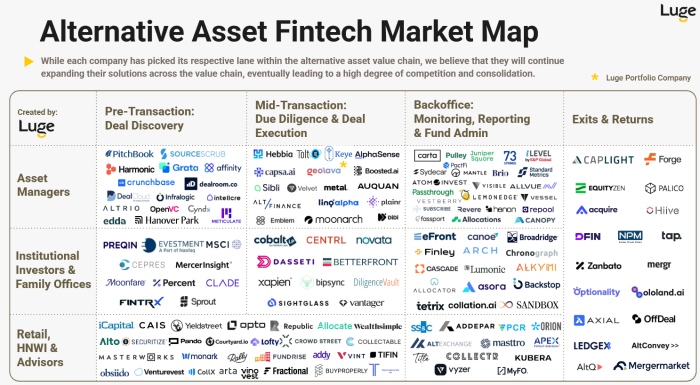
Image: State of Alternative Assets: A Fintech Perspective (Luge Capital, Nov 2025)
On November 11, 2025 Luge Capital published an informative report titled "2025 State of Alternative Assets: A Fintech Perspective'. Global Alternative Assets (Alts or AltAssets) reached $19 trillion in 2023 and could grow to $33 trillion by 2030, per the report's analysis of verified data from Preqin, BCG, and Deloitte.
Private equity and private credit stand out as the biggest categories but behind this growth, fintech companies are quietly rebuilding how money is raised, managed, and circulated across private investments.
Laviva Mazhar, a Principal at Luge Capital and Author of the report, compares what's happening today to the early computerization of trading desks. Manual processes are being replaced by connected systems that make private markets work more smoothly.
New companies are designing tools that handle every step of the process, from AI-supported deal sourcing and due diligence to data collection and performance reporting. The report names Canoe Intelligence (U.S.), 73 Strings (India), and Mantle (Canada) among the firms setting new benchmarks for automation.
Large players such as BlackRock, iCapital, and Hamilton Lane are also expanding through partnerships and acquisitions, bringing these innovations into the mainstream.
Private equity assets under management reached $5.8 trillion in 2023, while private credit is expected to reach $2.6 trillion by 2029. The number of U.S. companies backed by private equity has climbed 490% since 2000, validating how deep private capital is supporting business growth.
Company buyouts or public companies being taken private off the stock market increased 32% year over year, pointing to strong investor appetite for longer-term ownership. Across North America $297 billion has flowed into 7,300 private Canadian companies since 2013, backed by the shared strength of regional investment ecosystems.
Luge reports that 86% of institutional investors already allocate to alternatives, but individual investors are beginning to play a larger role. Assets from the wealth channel in the U.S. are projected to more than double to $3 trillion by 2029.
Fintech platforms like iCapital (U.S.), Yieldstreet (U.S.), and Opto Investments (U.S.) are developing digital pathways that make it easier for people to participate in funds once reserved for large institutions. This growing inclusion is one of the strongest patterns Luge identifies across the market.
According to Luge, the biggest opportunities now lie in the systems that connect private markets together. These include data sharing networks, portable investor identity tools, and liquidity platforms for secondary trading. The report also highlights a new class of software that helps fund managers handle onboarding, compliance, and reporting in one place. These initiatives are setting the stage for a more open and efficient investment environment.
Fintech companies that make it easier to access capital, reduce paperwork, and build trust are helping the global economy work better. This focus mirrors NCFA Canada’s commitment to supporting innovation, inclusion, and competitiveness through responsible market design that benefits investors, businesses, and communities alike. Download Luge Capital's latest report on the State of Alternative Assets in 2025 and/or subscribe to NCFA's weekly newsletter.
 The National Crowdfunding & Fintech Association (NCFA Canada) is a financial innovation ecosystem that provides education, market intelligence, industry stewardship, networking and funding opportunities and services to thousands of community members and works closely with industry, government, partners and affiliates to create a vibrant and innovative fintech and funding industry in Canada. Decentralized and distributed, NCFA is engaged with global stakeholders and helps incubate projects and investment in fintech, alternative finance, crowdfunding, peer-to-peer finance, payments, digital assets and tokens, artificial intelligence, blockchain, cryptocurrency, regtech, and insurtech sectors. Join Canada's Fintech & Funding Community today FREE! Or become a contributing member and get perks. For more information, please visit: www.ncfacanada.org
 |  |  |
|---|---|---|
 |  |  |
Digital Money | Nov 12, 2025

Image: Freepik/Pikisuperstar
On November 12, 2025, J.P. Morgan announced that it had become the first major bank to issue a USD deposit token on a public blockchain. The new JPM Coin (ticker JPMD) allows institutional clients to send and receive funds instantly using Base, the Ethereum Layer 2 network developed by Coinbase.
The project follows successful testing in June of this year with B2C2, Coinbase, and Mastercard, which achieved real-time issuance and redemption of the token. The initiative is led by Kinexys by J.P. Morgan, the bank’s blockchain division that has built digital financial infrastructure since 2015.
J.P. Morgan’s motivation goes beyond efficiency. By placing regulated deposits directly on a public chain, the bank is positioning itself for the next era of interoperable digital finance. Its clients can now settle cross-border trades, treasury flows, and digital asset transactions onchain, with the reliability and security of a regulated deposit. This model combines bank-grade security with blockchain’s speed and transparency.
Rather than competing with stablecoins, J.P. Morgan is building a framework where traditional deposits become programmable financial instruments, integrated with smart contracts.
The launch shows how large banks are implementing strategies for digital money. For global institutions, it reduces the friction of moving funds across time zones and platforms, offering constant access to liquidity and settlement.
By offering instant, always-on settlement and programmable deposits backed by a regulated bank, J.P. Morgan is setting a new standardfor how traditional finance can participate safely in the digital asset economy while maintaining oversight and trust.
For Canada, J.P. Morgan’s approach provides a clear case study as the Office of the Superintendent of Financial Institutions (OSFI) and the Bank of Canada (BoC) advance their own stablecoin policy framework. If Canada adopts similar standards for CAD-denominated deposit tokens, it could enable cheaper, faster settlements while maintaining full regulatory oversight.
There's also an opportunity for Canadian fintechs to collaborate with banks on compliant blockchain payment rails. Domestic players like Interac and major banks may soon face competitive pressure if global stablecoin transactions become a new standard. This type of regulatory model would allow Canadian financial institutions to issue tokenized deposits that preserve trust while keeping innovation local.
Once Canadian regulators establish clarity around digital deposits, the cost of settlement could fall dramatically. Current payment systems such as e-Interac and card networks, rely on intermediaries that add delay and cost. Regulated tokens could settle value directly between wallets within seconds, removing several layers of friction.
While this could reduce traditional fee income, it also supports innovation and opens new business models.
Banks could earn from providing liquidity, token custody, or smart contract services. Fintechs could integrate programmable money into real-time lending, payroll, or cross-border commerce.
If Canada aligns with international standards, the combination of stable onchain settlement and regulatory assurance could strengthen national competitiveness and attract global capital.
J.P. Morgan’s entry into public blockchain payments proves that regulated institutions can safely participate in decentralized finance while meeting compliance standards. The ability to move regulated value instantly across borders could help Canadian firms compete globally, expand access to capital, and reinforce confidence in digital finance.
The National Crowdfunding & Fintech Association (NCFA Canada) is a financial innovation ecosystem that provides education, market intelligence, industry stewardship, networking and funding opportunities and services to thousands of community members and works closely with industry, government, partners and affiliates to create a vibrant and innovative fintech and funding industry in Canada. Decentralized and distributed, NCFA is engaged with global stakeholders and helps incubate projects and investment in fintech, alternative finance, crowdfunding, peer-to-peer finance, payments, digital assets and tokens, artificial intelligence, blockchain, cryptocurrency, regtech, and insurtech sectors. Join Canada's Fintech & Funding Community today FREE! Or become a contributing member and get perks. For more information, please visit: www.ncfacanada.org
| | |
|---|---|---|
| | |
Financing | Nov 11, 2025

Image: Freepik/rawpixel.com
On November 6 2025, Canadian founded DealMaker announced that it has secured $20 million USD in equity and debt financing led by Information Venture Partners and CIBC Innovation Banking. The company recently opened new U.S. headquarters in New York City in April of this year. DealMaker says funds will support product innovation, AI deployment, and market expansion as the company continues to innovate how issuers connect directly with investors (aka investment crowdfunding).
DealMaker’s model is built around direct-to-investor offerings, allowing startups, growth stage companies, and pre-IPO issuers to raise funds without intermediaries. The company has now powered over 900 offerings and processed more than 1.5 million individual investments, representing over $2.3 billion raised.
By combining digital onboarding, payments, and investor relations tools, DealMaker positions itself as a single platform for issuers seeking efficiency and transparency in capital formation. While its current operations are centered in the United States, DealMaker’s origins and investor ties highlight the role Canadian fintech expertise continues to play in North American capital markets.
Rebecca Kacaba, DealMaker Co-Founder & CEO:
"This round allows us to accelerate the deployment of AI across our product line, capitalize on emerging ownership models across professional and collegiate sports, and deliver greater value to our customers. This positions DealMaker to be a market leader in a rapidly growing sector where more and more companies-from startups to the hottest IPOs are prioritizing retail investors."
The capital will accelerate the rollout of AI across its platform and strengthen products such as DealMaker Sports, its new division connecting retail investors to sports ownership opportunities.
DealMaker Sports enables leagues, teams, and athletes to tap into their own communities for capital by converting fans into investors. With a platform built for speed, checkout is mobile-friendly and brands get real-time analytics on who’s investing and why. Raise under exemptions like Reg CF, Reg A+ and Reg D, whether you’re targeting $500 K or $50 M and build loyalty, revenue and growth all at once.
As AI becomes embedded in every part of financial infrastructure, platforms like DealMaker could help reduce friction, lower costs, and expand access to retail participation. For Canadian fintechs, DealMaker's success reinforces the importance of building scalable, compliant, and investor-centric solutions that can compete globally while supporting innovation and inclusion.
The National Crowdfunding & Fintech Association (NCFA Canada) is a financial innovation ecosystem that provides education, market intelligence, industry stewardship, networking and funding opportunities and services to thousands of community members and works closely with industry, government, partners and affiliates to create a vibrant and innovative fintech and funding industry in Canada. Decentralized and distributed, NCFA is engaged with global stakeholders and helps incubate projects and investment in fintech, alternative finance, crowdfunding, peer-to-peer finance, payments, digital assets and tokens, artificial intelligence, blockchain, cryptocurrency, regtech, and insurtech sectors. Join Canada's Fintech & Funding Community today FREE! Or become a contributing member and get perks. For more information, please visit: www.ncfacanada.org
| | |
|---|---|---|
| | |
Policy | Nov 11, 2025

Image: Relative labour productivity Canada vs US (Source: CSLS 2025)
The Centre for the Study of Living Standards released a November 2025 report titled, "Can a Lack of Pro-Productivity Policies Explain the Secular Decline in Canada’s Productivity Growth?", outlining why Canada’s productivity growth has stalled even as macroeconomic policy remains stable. The study finds that steps in the 2025 federal budget while positive, will not by themselves reverse the long slowdown. The authors argue that deeper structural change is needed to rebuild the foundations of business investment and innovation in Canada.
The report traces much of the post 2015 slowdown to long term structural and global factors that are as a result of how past policy choices influenced business behaviour. Verified causes that reduced the total investment per worker and limited productivity even as macro conditions stayed the same include:
Evidence from major institutions supports this view. The analysis in the OECD 2025 Economic Survey of Canada and the IMF 2024 Article IV consultation finds that Canada’s productivity gap reflects long standing frameworks that influence how firms invest and compete. These findings show that the challenge is structural, a long term misalignment between national policy intent and firm level behaviour.
The recently announced Budget 2025 aims to address parts of Canada's productivity, innovation and competition gaps. It includes improvements to the Scientific Research and Experimental Development program by increasing the annual expenditure limit for the enhanced credit to $6 million, restoring eligibility for capital expenditures, and extending eligibility to Canadian public corporations. These measures target investment in intangible assets and innovation, the areas identified as weak.
The budget also commits over $1 billion in resources over five years for AI compute and quantum computing while proposing a TechStat program to track technology adoption, as described in the digital infrastructure plan.
Finally, the budget also advances open banking and stablecoin rules that can improve competition and trust.
Productivity growth depends on what happens inside firms, how they invest, adopt technology, and organize production. Canada’s frameworks have been stable but haven't created strong enough conditions for private reinvestment in digital and intangible assets.
When policy creates the right incentives and financial infrastructure removes friction, investment decisions shift. That alignment between public objectives and private behaviour is where lasting productivity growth emerges.
Canada’s weakness lies in underinvestment in intangible assets such as software, data, intellectual property, and organizational know how. Past tools have not reversed this pattern and Canada needs to reward reinvestment in intangible and digital assets. NCFA has argued for tax credits that mobilize private capital for innovation for years including in an open letter to government during the COVID 19 pandemic, urging government to collaborate with fintechs while proposing investment tax credits to crowd in private capital.
The United Kingdom’s Enterprise Investment Scheme (EIS) offers a clear example of how targeted tax relief can mobilize private capital into early-stage ventures. Since its launch in 1994, the EIS has attracted over £30 billion of private investment into more than 53,000 small and growing companies, according to HM Revenue & Customs.
The EIS program provides individual investors with income tax relief of up to 30% on investments in qualifying startups, along with capital gains deferrals. Analysts credit it with strengthening the UK’s innovation ecosystem and building one of the world’s most active early-stage funding markets.
Reducing interprovincial barriers and boosting competition are valuable but not sufficient on their own. The next step is to modernize how policy and firm level decisions connect. Fintechs can help turn policy into practice by improving access to capital, ensuring reliable and interoperable data, and scaling innovation across the economy. That's how Canada can turn structural reform into more practical and realized productivity gains.
The National Crowdfunding & Fintech Association (NCFA Canada) is a financial innovation ecosystem that provides education, market intelligence, industry stewardship, networking and funding opportunities and services to thousands of community members and works closely with industry, government, partners and affiliates to create a vibrant and innovative fintech and funding industry in Canada. Decentralized and distributed, NCFA is engaged with global stakeholders and helps incubate projects and investment in fintech, alternative finance, crowdfunding, peer-to-peer finance, payments, digital assets and tokens, artificial intelligence, blockchain, cryptocurrency, regtech, and insurtech sectors. Join Canada's Fintech & Funding Community today FREE! Or become a contributing member and get perks. For more information, please visit: www.ncfacanada.org
| | |
|---|---|---|
| | |
Nov 11, 2025

Image: Freepik/pch.vector
Family law can be one of the most challenging areas of life to navigate. Whether it involves separation, divorce, child custody disputes, or property settlement, dealing with legal issues affecting your family is emotionally taxing. It is essential to have professional guidance from experts who understand not only the law but also the personal and emotional complexities that come with these matters. This is where Certified family lawyers Springwood come in, providing support, advice, and representation to help you manage family legal issues with clarity and confidence.
A family lawyer is not just someone who prepares legal documents. They are your advisor, advocate, and guide through potentially stressful times. Their role is to ensure that your rights are protected, your interests are represented, and that you can make informed decisions with confidence.
Family law covers a wide range of legal matters related to relationships and family structures. This includes issues such as divorce, child custody, parenting arrangements, spousal support, property settlement, and domestic violence matters. Each case is unique, and the laws governing these issues can be complex. Consulting Certified family lawyers Springwood ensures that you receive accurate legal advice tailored to your individual circumstances.
Family law is not solely about legal proceedings; it also focuses on resolving disputes in a way that considers the emotional well-being of all involved, particularly children. Certified family lawyers provide guidance on both the legal and practical aspects of family issues, helping you make decisions that are in your best interests and the best interests of your family.
Not all family lawyers have the same level of experience or qualifications. Certified family lawyers are recognised for their expertise in family law and their commitment to maintaining high professional standards. They possess the knowledge and experience necessary to handle complex legal issues and offer solutions that reflect best practices in the field.
Selecting Certified family lawyers Springwood ensures that you are working with professionals who have a proven track record in handling family law cases. Their certification is a reflection of their dedication, skill, and knowledge, which can provide peace of mind during challenging times.
Choosing a lawyer in your local area has several advantages. Local lawyers have a deep understanding of the regional legal system, including local courts, procedures, and professionals who can support your case. They can navigate local requirements efficiently and are readily available for consultations or urgent matters.
By engaging Certified family lawyers Springwood, you benefit from professionals who are familiar with the specific practices and expectations of local courts. This knowledge can make a significant difference in the outcome of your case and ensures smoother communication throughout the legal process.
Family law covers many areas, and it is important to select a lawyer whose expertise matches your needs. Some lawyers specialise in divorce and property settlements, while others focus on parenting disputes or domestic violence cases. For cases involving complicated financial arrangements or high-value assets, specialised knowledge is crucial to ensure fair and thorough handling.
Certified family lawyers also bring experience in mediation, negotiation, and collaborative law approaches. They understand how to resolve disputes in ways that minimise conflict and reduce the emotional impact on all parties involved. Choosing the right lawyer for your specific situation can make the process more manageable and lead to better outcomes.
Effective communication is essential in family law matters. The legal process often involves multiple meetings, correspondence, and court appearances. A lawyer who communicates clearly and promptly can make a significant difference in how you experience your case.
Certified family lawyers Springwood are trained to explain complex legal matters in a straightforward and understandable way. They listen to your concerns, answer questions, and keep you informed about progress. This approach helps you feel supported and confident as you navigate legal decisions and ensures that you are fully aware of your options at every stage.
One of the most important roles of a family lawyer is to help you understand your legal rights and options. Many people entering family law matters are unsure of what is legally possible or the implications of their choices. Certified family lawyers provide clarity and guidance, explaining potential outcomes and the pros and cons of different approaches.
They can advise you on how to protect your interests, whether through negotiation, mediation, or court proceedings. By understanding your rights and options, you can make informed decisions that align with your goals and protect your future.
Not all family law issues need to be resolved in court. Mediation, negotiation, and collaborative law are increasingly popular alternatives that can save time, reduce stress, and preserve relationships. These methods encourage cooperation and allow parties to reach mutually acceptable agreements without resorting to litigation.
Certified family lawyers are skilled in alternative dispute resolution techniques and can guide you through these processes. They ensure that any agreements are fair, legally binding, and in compliance with relevant laws. Engaging a lawyer with experience in these approaches can make the resolution process smoother and more amicable.
When children are involved, family law matters become even more sensitive. Decisions regarding custody, parenting arrangements, and visitation must prioritise the best interests of the child. Certified family lawyers provide guidance on creating arrangements that support the child’s well-being while balancing the rights of each parent.
They help prepare parenting plans, advise on compliance with court orders, and represent your interests in disputes related to child custody and support. Their expertise ensures that children are considered at every stage, and that solutions promote stability, safety, and emotional support.
Dividing assets and property can be one of the most complicated aspects of family law. Certified family lawyers help clients navigate these issues with precision and care. They ensure that property and financial matters are addressed fairly, taking into account contributions, needs, and future obligations.
Lawyers can assist in negotiations, agreements, and court applications related to property settlement. Their goal is to achieve a fair outcome that protects your financial security while resolving disputes efficiently and effectively.
Family lawyers also provide assistance in situations involving domestic violence or abuse. They can guide you through legal protections such as restraining orders, intervention orders, or other court measures designed to ensure safety. Certified family lawyers understand the sensitive nature of these cases and handle them with discretion, urgency, and professionalism.
By seeking expert legal support, you can protect yourself and your loved ones while navigating the legal system with confidence.
One of the most effective ways to handle family law matters is to plan ahead. Early legal advice helps you understand your position, explore options, and prepare for potential outcomes. Certified family lawyers Springwood can guide you through preventive steps, document preparation, and strategic planning to ensure that your interests are safeguarded.
Taking a proactive approach can reduce the likelihood of disputes escalating and provide you with a clearer path forward during challenging times.
Trust is a crucial component when working with a family lawyer. Legal matters involving family are deeply personal, and it is essential to feel comfortable with the professional representing you. Certified family lawyers combine expertise with empathy, creating an environment where you can discuss sensitive matters openly and receive thoughtful guidance.
A lawyer who listens, communicates effectively, and respects your concerns can help you feel confident in your decisions and supported throughout the legal journey.
Selecting the right lawyer involves careful consideration. Look for certification, experience, local knowledge, and a client-focused approach. Ask about their experience with cases similar to yours, their communication style, and their approach to dispute resolution. By conducting consultations and asking questions, you can determine which lawyer is the best fit for your needs.
Choosing Certified family lawyers Springwood ensures that you have access to legal professionals who are competent, reliable, and committed to achieving positive outcomes while supporting your well-being.
Family law matters can be complicated, stressful, and emotionally challenging. Working with Certified family lawyers Springwood provides the guidance and support you need to navigate these issues effectively. From divorce and child custody to property settlement and protective measures, a qualified family lawyer can help you understand your options, protect your rights, and reach solutions that work for your family.
Investing in the right legal support is an investment in your peace of mind and your future. With expert guidance, clear communication, and professional representation, you can move through family law challenges with confidence and clarity, knowing that your interests are being safeguarded every step of the way

Jennifer Aguirre
Jennifer Aguirre is an experienced SEO Specialist and Content Writer at Justice Network | Australia, where she helps businesses enhance their online presence through strategic SEO and high-quality, engaging content. With a keen eye for detail and a passion for crafting content that resonates, Jennifer combines technical SEO knowledge with creative storytelling to drive traffic, improve search rankings, and deliver measurable results. She is committed to helping brands communicate effectively online while staying ahead in the ever-evolving digital landscape.
The National Crowdfunding & Fintech Association (NCFA Canada) is a financial innovation ecosystem that provides education, market intelligence, industry stewardship, networking and funding opportunities and services to thousands of community members and works closely with industry, government, partners and affiliates to create a vibrant and innovative fintech and funding industry in Canada. Decentralized and distributed, NCFA is engaged with global stakeholders and helps incubate projects and investment in fintech, alternative finance, crowdfunding, peer-to-peer finance, payments, digital assets and tokens, artificial intelligence, blockchain, cryptocurrency, regtech, and insurtech sectors. Join Canada's Fintech & Funding Community today FREE! Or become a contributing member and get perks. For more information, please visit: www.ncfacanada.org
| | |
|---|---|---|
| | |
AI Agent Research | Nov 10, 2025

Image: McKinsey and Google Cloud AI in Finance 2025 report covers
November 2025 research from McKinsey's The State of AI in 2025 and Google's The ROI of AI in Financial Services reveal that the way banks measure value from AI is changing. Instead of chasing fast gains from early generative tools, the financial sector is moving toward agentic AI platforms that produce steady operational returns and stronger control over risk and cost.
Google’s global financial services study found that 77% of firms report positive ROI from generative AI this year, matching last year’s figure. The data point indicates that the return base has stabilized after an initial surge (not stagnation or decline). Among responders reporting higher revenue, 51% saw growth (6%-10%), while 30% achieved gains above 10%. These numbers dipped slightly year over year, pointing to a normalization phase as programs scale.
The same study found that:
Spending priorities have shifted decisively:
McKinsey’s global findings confirm this rotation:
High performers stand out whose choices correlate directly with both revenue growth and cost reductions.
Benefits are appearing fastest in software engineering, IT, customer service, and marketing. The McKinsey report found that organizations deploying AI across these functions experienced:
• Average productivity gains of 15%-30% in service and technology teams
• Cost decreases of up to 12% in customer operations and risk processing
• Deployment cycles reduced to three to six months, down from an average of twelve months in 2023
• Revenue growth between 6%-10% for over half of financial institutions using AI in production
• Improved fraud detection accuracy by up to 20%, especially among banks integrating multi-agent risk models
Organizations combining workflow redesign with governance and human oversight achieve higher and more consistent ROI than those focused only on model performance.
According to Google and McKinsey's 2025 AI in finance research reports, AI has entered a new phase. The early boom in generative tools has given way to a steadier phase of operational performance driven by agents. The majority of institutions are already realizing returns, but the next iteration of value capture will come from how well they govern, measure, and scale these systems. Canada’s Opportunity In Efficient Reasoning AI its competitive edge, using discipline, design, and data to turn intelligence into growth.
The National Crowdfunding & Fintech Association (NCFA Canada) is a financial innovation ecosystem that provides education, market intelligence, industry stewardship, networking and funding opportunities and services to thousands of community members and works closely with industry, government, partners and affiliates to create a vibrant and innovative fintech and funding industry in Canada. Decentralized and distributed, NCFA is engaged with global stakeholders and helps incubate projects and investment in fintech, alternative finance, crowdfunding, peer-to-peer finance, payments, digital assets and tokens, artificial intelligence, blockchain, cryptocurrency, regtech, and insurtech sectors. Join Canada's Fintech & Funding Community today FREE! Or become a contributing member and get perks. For more information, please visit: www.ncfacanada.org
| | |
|---|---|---|
| | |
BNPL | Nov 10, 2025

Image: Freepik/Halayalex
On November 10, 2025, PayPal announced the launch of its Pay in 4 installment plan in Canada, a no-fee, interest-free Buy Now Pay Later (BNPL) option designed to help shoppers manage spending during the holidays.
The rollout arrives just ahead of Black Friday, Cyber Monday, and Boxing Day, allowing Canadians to split eligible purchases from $30 to $1,500 into four equal payments over six weeks.
The service is available at millions of stores including Knix, Samsonite, Silk & Snow, The Home Depot Canada, and Ticketmaster, with automatic payments through debit, credit, or bank account and the option to pay early using the PayPal app or online account.
Pay in 4 gives Canadians more breathing room at a time when budgets are stretched and the cost of living remains high. It includes no sign-up fees, no late fees, and no hidden charges, while eligible purchases are protected under PayPal Purchase Protection.
According to PayPal’s 2025 Festive Spending Survey conducted by Leger including 1,500 adults, 60% of respondents who have never used BNPL said they would be encouraged to try it if there were no fees. The same survey found 74% of Canadians set a holiday budget, 72% plan shopping in advance, and 51% plan to spend the same as last year.
Michelle Gill, General Manager, Small Business and Financial Services, PayPal:
"PayPal has served Canadians for over 15 years and is one of the most trusted brands across the country. To meet demand for transparent and trusted payment options, PayPal's Pay in 4 helps Canadians manage cash flow without late fees or hidden costs. Businesses also benefit as those who offer PayPal BNPL offerings experience increased conversion and higher sales—both critical during peak holiday season."
Canada’s high household debt underscores why flexible, low-cost payment options are gaining traction. Statistics Canada data show that total household credit-market debt reached $3.07 trillion in Q1 2025, while the ratio of debt to disposable income climbed to 173.9% which means households owed about $1.74 for every $1 of disposable income. The household debt-service ratio, which measures the share of disposable income allocated to debt repayments, stood at 14.4%.
Canadians are devoting a large share of income to existing obligations. As mortgage renewals roll in at higher rates and everyday costs stay elevated, the ability to spread payments without added interest or fees could prove appealing. However, using these BNPL options requires discipline and can spiral out of control if used irresponsibly as installement plans can compound debt stress.
For Canadian retailers, Pay in 4 is integrated directly with PayPal’s existing checkout system, making it easy to activate. Merchants are paid in full at the time of purchase, while shoppers repay over six weeks.
PayPal reports that globally its BNPL offerings have a 90% approval rate and deliver an 80% higher average order value, suggesting that installment options can lift both conversion rates and aggregate value sizes during peak shopping periods.
PayPal is also partnering with Cadillac Fairview to host Pay in 4, Play in 4 holiday pop-ups at major malls in Toronto, Montreal, Calgary, and Vancouver. The events combine digital and in-person experiences, offering shoppers a chance to win prizes of up to $1,000 and further reinforcing awareness of the new payment option across multiple channels.
PayPal’s entry into Canada’s no-fee BNPL space brings new consumer credit alternatives to market. Competing platforms like Affirm, Klarna, and Afterpay have established awareness, but most still rely on some form of fee or interest revenue. PayPal’s approach is a competitive play emphasizing consumer trust and merchant performance instead of cost-based pricing.
It also boosts the case for embedded finance offerings where seamless integration of payment flexibility can improve both customer experience and sales outcomes. However, as household leverage continues to rise, policymakers and industry participants will be watching closely to ensure that convenience doesn’t outpace affordability. The sustainability of Canada’s BNPL growth will depend on transparency, responsible design, and the financial resilience of users.
The National Crowdfunding & Fintech Association (NCFA Canada) is a financial innovation ecosystem that provides education, market intelligence, industry stewardship, networking and funding opportunities and services to thousands of community members and works closely with industry, government, partners and affiliates to create a vibrant and innovative fintech and funding industry in Canada. Decentralized and distributed, NCFA is engaged with global stakeholders and helps incubate projects and investment in fintech, alternative finance, crowdfunding, peer-to-peer finance, payments, digital assets and tokens, artificial intelligence, blockchain, cryptocurrency, regtech, and insurtech sectors. Join Canada's Fintech & Funding Community today FREE! Or become a contributing member and get perks. For more information, please visit: www.ncfacanada.org
| | |
|---|---|---|
| | |


August 26th, 2025

January 4th, 2024

June 1st, 2021

September 9th, 2020

July 9th, 2018

January 3rd, 2018

September 25th, 2017

June 20th, 2017

May 10th, 2017

December 14th, 2016