




Karsten Wenzlaff, Advisor
August 26th, 2025
Karsten Wenzlaff is a Crowdfunding and Fintech Expert from Germany. He is Secretary-General of Digit[...]


Artificial Intelligence | Nov 7, 2025
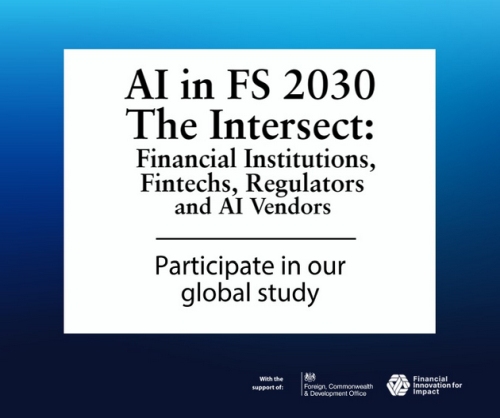
On November 4, 2025 the Cambridge Centre for Alternative Finance (CCAF) at Cambridge Judge Business School launched the AI in Financial Services 2030 Global Survey in collaboration with the World Bank, International Monetary Fund, Bank for International Settlements, and the World Economic Forum.
The National Crowdfunding & Fintech Association of Canada (NCFA) is happy to support this initiative as a survey partner inviting all professionals working in fintechs, banks, and other financial institutions to share their insights on how artificial intelligence is being planned, adopted, and managed across the sector. The survey takes about 25 minutes and explores governance, strategy, technology use, risk, and expectations for how AI will influence financial services by 2030.
This global initiative aims to build the most complete evidence base on AI’s real-world use in financial services. Findings will inform international policy and guide how innovation and regulation can support trust, access to capital, and sustainable growth.
By contributing, respondents will help ensure that fintech perspectives and diverse experiences are reflected in the data driving decisions at both policy and industry levels. The results will provide valuable benchmarks for AI adoption and readiness across different markets and institutions.
Take part in the Industry Survey for Fintechs and Financial Institutions: Access the AI in Financial Services 2030 Industry Survey
Other versions of the survey are available for regulators and AI vendors.
AI is moving incredibly fast, and this study gives everyone in the financial sector a chance to ground the conversation in real data and practical experience. By taking part, you’re helping ensure that future innovation in finance is guided by insight, accountability, and inclusion, values shared across the NCFA community.
 The National Crowdfunding & Fintech Association (NCFA Canada) is a financial innovation ecosystem that provides education, market intelligence, industry stewardship, networking and funding opportunities and services to thousands of community members and works closely with industry, government, partners and affiliates to create a vibrant and innovative fintech and funding industry in Canada. Decentralized and distributed, NCFA is engaged with global stakeholders and helps incubate projects and investment in fintech, alternative finance, crowdfunding, peer-to-peer finance, payments, digital assets and tokens, artificial intelligence, blockchain, cryptocurrency, regtech, and insurtech sectors. Join Canada's Fintech & Funding Community today FREE! Or become a contributing member and get perks. For more information, please visit: www.ncfacanada.org
 |  |  |
|---|---|---|
 |  |  |
Nov 7, 2025

Image: Freepik
Toronto’s aging infrastructure and harsh seasonal changes make drainage issues common in both residential and commercial properties. From slow drains in condo bathrooms to main sewer backups in older homes, the city’s pipes face constant stress.
Clogs often develop quietly—caused by grease buildup, hair, roots, or mineral deposits—until they lead to flooding or property damage. That’s where professional drain cleaning services in Toronto play an essential role in keeping plumbing systems healthy and functional.
The most common and cost-effective drain cleaning method is drain snaking, also known as mechanical augering. This process involves inserting a flexible steel cable with a rotating tip into the drain to dislodge blockages.
Snaking works best for:
Professional technicians from Delta Plumbers use high-powered electric augers that can clear even stubborn blockages deep inside the line. Unlike chemical cleaners, snaking doesn’t harm your pipes and provides an immediate fix for most surface-level clogs.
When buildup goes beyond simple obstructions, hydro-jetting becomes the solution of choice. This advanced method uses high-pressure water—up to 4,000 PSI—to scour the inside of your pipes clean.
Hydro-jetting can:
Businesses and property managers often schedule hydro-jet drain cleaning in Toronto as a preventive measure. It not only clears blockages but also cleans the interior of the pipe, reducing the risk of recurring clogs. For older downtown buildings, this is especially useful, since cast-iron pipes often accumulate sediment over time.
Sometimes the real cause of a blockage isn’t obvious. Before deciding on the right method, professionals conduct a video camera drain inspection.
This involves inserting a waterproof camera into the drain to pinpoint the exact location and type of obstruction.
It helps detect:
Using inspection technology, Toronto drain repair specialists can recommend whether you need a simple cleaning, a pipe replacement, or trenchless repair. This eliminates guesswork and saves time, especially in commercial setups or multi-unit buildings.
In suburban areas of Toronto, tree roots are one of the leading causes of main drain blockages. As roots seek moisture, they infiltrate small cracks in underground pipes, eventually blocking water flow.
Professional plumbers use special cutting tools or hydro-jet attachments to remove these roots safely.
Once cleared, applying root-control treatments helps prevent regrowth.
Regular sewer line cleaning in Toronto is essential for properties with mature trees, preventing future blockages that could lead to basement flooding.
Basements, garages, and utility rooms often have floor drains designed to handle excess water. Over time, these drains collect dirt, soap residue, and sediment. In Toronto’s rainy climate, storm drains outside homes can also clog with leaves and debris.
A professional floor drain cleaning Toronto service uses industrial vacuums and augers to clear buildup before it causes water pooling or backups.
If you live near older city zones like Etobicoke, High Park, or the Junction, keeping these drains clear protects your foundation from potential flooding during heavy rains.
When recurring clogs indicate pipe damage, modern trenchless technology can repair drains without excavation. This includes techniques like pipe bursting and cured-in-place pipe (CIPP) lining.
After a thorough drain cleaning service, professionals reline your existing pipes with epoxy resin, sealing cracks and restoring full flow capacity.
Homeowners in tight urban spaces appreciate this method because it avoids tearing up driveways or landscaping—saving both time and money while extending pipe life by decades.
Toronto property owners can save thousands annually by enrolling in a preventive drain maintenance program. These services include periodic snaking, hydro-jetting, and camera inspections to keep the plumbing system flowing freely year-round.
Delta Plumbers’ drain maintenance programs are designed for both homeowners and property managers, ensuring issues are identified early and addressed before they turn into emergencies.
Scheduling regular service not only protects your property but also preserves water pressure and improves hygiene by preventing foul odours.
Many homeowners wait until the water stops draining completely before calling for help. But early warning signs can help prevent bigger problems.
Watch for:
If any of these symptoms appear, call a professional immediately. A quick inspection and cleaning can prevent structural damage or sewer backups that are far more expensive to repair.
Toronto’s plumbing systems are unique, with varying pipe materials and layouts depending on neighbourhood age. Hiring a local team like Delta Plumbers ensures your technician understands the city’s water infrastructure, bylaws, and seasonal maintenance challenges.
With over 17 years of experience, Delta Plumbers provides comprehensive drain cleaning services in Toronto—from downtown condos to industrial facilities across the GTA.
Their experts use advanced diagnostic tools and eco-friendly methods to clean and protect your drains safely.
Whether it’s a minor kitchen clog or a full main-line backup, professional drain cleaning is essential for every Toronto property owner. Techniques like hydro-jetting, camera inspection, and trenchless cleaning ensure your drains stay efficient, sanitary, and long-lasting.
Instead of relying on temporary fixes, invest in expert solutions that address the problem at its source.
For reliable, same-day drain cleaning services in Toronto, homeowners and businesses trust Delta Plumbers for precision, professionalism, and guaranteed results.
The National Crowdfunding & Fintech Association (NCFA Canada) is a financial innovation ecosystem that provides education, market intelligence, industry stewardship, networking and funding opportunities and services to thousands of community members and works closely with industry, government, partners and affiliates to create a vibrant and innovative fintech and funding industry in Canada. Decentralized and distributed, NCFA is engaged with global stakeholders and helps incubate projects and investment in fintech, alternative finance, crowdfunding, peer-to-peer finance, payments, digital assets and tokens, artificial intelligence, blockchain, cryptocurrency, regtech, and insurtech sectors. Join Canada's Fintech & Funding Community today FREE! Or become a contributing member and get perks. For more information, please visit: www.ncfacanada.org
| | |
|---|---|---|
| | |
CIX | Nov 6, 2025

Image courtesy of CIX
Applications have officially opened for the 2026 CIX Startup Awards, one of Canada’s most respected platforms for emerging and growth-stage companies. Run by the Canadian Innovation Exchange (CIX), the program celebrates leading tech startups that that create commercial or social value. A panel of more than 100 North American investors selects the winners, giving founders direct access to some of the most influential decision-makers in the industry.
Recognition through CIX can change everything for a young company. 78% of past winners that were raising capital secured funding within six months, and 86% within a year. On top of that, award recipients reported gaining roughly 35% more customers and partnerships globally after being featured. Those are the kinds of outcomes that make CIX a launchpad rather than just another award.
CIX is open to startups that are incorporated and headquartered in Canada. Companies must be privately held and not listed on any exchange. To be eligible, startups should have a strong technology foundation and a functional prototype or product already in the market. The company’s founder or CEO must also be available to present in person at the summit.
Each winning startup is invited to present live at CIX Summit 2026 in downtown Toronto on March 25, 2026. The experience includes exclusive one-on-one investor meetings, three complimentary passes to the summit, and a dedicated meeting table to connect with potential partners and clients. Winners are permanently listed on the CIX website and often featured in national media, expanding their credibility and visibility far beyond the event itself.
CIX has earned its reputation as a gateway to investors and growth. While it's great to be recognized, it's about visibility, validation, and opportunity. For many founders, presenting at CIX is the moment when their startup story reaches the right audience. With no cost to apply and a process that takes about twenty minutes, the upside is significant. If you’re building something innovative and ready to take the next step, this is your chance to get noticed.
The National Crowdfunding & Fintech Association (NCFA Canada) is a financial innovation ecosystem that provides education, market intelligence, industry stewardship, networking and funding opportunities and services to thousands of community members and works closely with industry, government, partners and affiliates to create a vibrant and innovative fintech and funding industry in Canada. Decentralized and distributed, NCFA is engaged with global stakeholders and helps incubate projects and investment in fintech, alternative finance, crowdfunding, peer-to-peer finance, payments, digital assets and tokens, artificial intelligence, blockchain, cryptocurrency, regtech, and insurtech sectors. Join Canada's Fintech & Funding Community today FREE! Or become a contributing member and get perks. For more information, please visit: www.ncfacanada.org
| | |
|---|---|---|
| | |
Federal Budget 2025 | Nov 5, 2025

Image courtesy of AI
On November 4, 2025, the Government of Canada tabled Budget 2025, announcing targeted investments in several fintech and related sectors of interest including open banking, digital assets, artificial intelligence, and venture capital to strengthen national competitiveness and expand innovation.
NCFA welcomes these measures that taken together, form a coordinated strategy to modernize Canada’s financial system and accelerate technology adoption across sectors. While there are many parts to the 493 page PDF document designed to modernize government, stimulate investment and support key sectors of the economy (especially those being adversely impacted by the weight of Washington's tariff policy), this article focuses on 6 select areas of the budget.
Budget 2025 confirms that Canada will move forward with the Consumer-Driven Banking Act to establish a national open banking framework. Oversight will rest with the Bank of Canada, which receives $19.3 million over two years to build and supervise the system. The $36.9 million previously allocated to the Financial Consumer Agency of Canada (FCAC) will be reprofiled to align with this transition. To support cybersecurity and national security functions, $25.7 million over five years and $5 million ongoing are provided to CSIS and the RCMP.
The government also commits that Canadians will not be subject to fees when accessing and sharing their financial data under the new regime. This right will be included in federal privacy legislation to protect consumers from banks charging for data portability.
Timeline:
The data access fee ban effectively aligns Canada with the UK and Australia, where accredited fintechs can access user-permitted financial data without paying incumbent banks, creating a more level playing field for startups.
Firms should focus on accreditation, API readiness, and user consent ecosystems now, while anticipating the full rollout with data portability and write-access functionality expected in 2027. The Bank of Canada’s new role brings institutional authority to open banking, aligning Canada’s model with prudential oversight practices seen in advanced financial systems.
Budget 2025 introduces a federal framework for fiat-backed stablecoins to protect consumers and ensure financial stability. Issuers must maintain adequate reserves, provide redemption rights, and follow strict disclosure and audit rules. The Bank of Canada will oversee compliance and receive $10 million over two years starting in 2026–27, with ongoing costs of about $5 million annually recovered from issuers. The Retail Payment Activities Act will be amended to extend oversight to payment service providers dealing in prescribed stablecoins.
This is Canada's first major step towards integrating digital assets within regulated finance. Fintechs and payment firms can soon align product design with national standards for reserve management and risk controls. The framework signals Canada’s preference for stablecoins backed by traditional assets and issued under domestic supervision, distinguishing it from more permissive global approaches.
Budget 2025 strengthens financial system integrity by modernizing the Proceeds of Crime (Money Laundering) and Terrorist Financing Act and the Personal Information Protection and Electronic Documents Act. The updates ban cash transactions over $10,000, prohibit third-party cash deposits, and authorize real-time information sharing through the new Integrated Money Laundering Intelligence Partnership. FINTRAC is added to the Financial Institutions Supervisory Committee, expanding coordination with the Bank of Canada, OSFI, and the Department of Finance.
This overhaul moves compliance toward continuous data exchange rather than static reporting. For regtech and fintech firms, it expands the market for monitoring, analytics, and automation tools. By embedding FINTRAC directly within the supervisory structure, the government is creating a multi-agency model similar to the UK’s Joint Money Laundering Intelligence Taskforce. These measures are foundational to supporting open banking and payments modernization safely.
Budget 2025 commits $925.6 million over five years starting in 2025–26 to build sovereign public AI infrastructure, including a Canadian sovereign cloud for compute capacity. Of this, $800 million comes from reallocated funds. The new Minister of Artificial Intelligence and Digital Innovation will coordinate partnerships with industry and direct investments through the Canada Infrastructure Bank. Statistics Canada receives $25 million over six years and $4.5 million ongoing for AI and digital measurement programs.
The budget also reforms the Scientific Research and Experimental Development (SR&ED) tax incentive. The annual enhanced credit limit rises from $4.5 million to $6 million, and companies can elect pre-claim approval for faster reimbursements, reducing average processing from 180 days to 90 days by April 2026.
This is the largest coordinated investment in Canada’s digital productivity to date. Sovereign compute and AI infrastructure will help domestic firms train and deploy large models while maintaining data residency. The SR&ED reform improves liquidity during tight capital cycles for startups, software developers, and AI ventures by accelerating access to refundable credits. These changes directly respond to longstanding calls from the innovation community for faster turnaround and broader eligibility for digital R&D.
To expand the growth capital ecosystem, Budget 2025 allocates $1 billion over three years starting in 2026–27 to the Business Development Bank of Canada (BDC) for the Venture and Growth Capital Catalyst Initiative. This fund will leverage pension and institutional investment to scale up Canadian venture capital and support new, diverse fund managers. Additional measures include:
These measures help close gaps between early-stage funding and commercialization. The Catalyst Initiative could attract more private capital into growth-stage companies, while IP and R&D supports strengthen Canada’s intangible economy. For fintechs, this capital mobilization aligns with efforts to improve scaling conditions, enabling firms to move beyond domestic pilots into global markets. By expanding the Canada Growth Fund Venture Program and the Venture Capital Catalyst Initiative, Ottawa is trying to fill the scale-up gap where private funding has been slow to follow through.
Budget 2025 targets long-standing consumer frustrations with high fees, slow transfers, and limited access to funds. The government will review ATM and Interac e-Transfer fees charged by federally regulated institutions and will report on corrective actions in 2026.
By spring 2026, the government will also ban investment and registered account transfer fees, which average $150 per account, and mandate faster, transparent transfers. Fintechs such as Wealthsimple and Questrade have supported these measures for years, arguing they will remove switching barriers and increase competition.
Consumer access to deposited funds will also improve. The Bank Act will be amended to raise immediate access for cheque deposits from $100 to $150, close the gap between in-person and digital deposits, and shorten cheque-hold times by raising the threshold for early release from $1,500 upward.
To strengthen competition, the public-holding threshold for smaller banks and credit unions will double from $2 billion to $4 billion, supported by a new voluntary code of conduct on brokered deposit access and fair distribution.
These reforms respond directly to public frustration with high account transfer costs, after firms like Wealthsimple and Questrade called for faster, cheaper asset portability. Lower fees, faster access to money, and easier account switching will force incumbents to compete on value. Fintech companies gain room to build better portability and payments solutions within a simpler and more open regulatory landscape.
Budget 2025 delivers the clearest roadmap for a more competitive financial services sector and digital economy. Open banking, AI, and venture capital measures finally intersect within a national policy framework designed to increase innovation and resilience. The obvious challenge now is delivery and execution. Timelines must hold, interoperability standards must stay open, and public-private coordination must translate funding into outcomes. Canada has a window to jump-start competitiveness by executing on what has already been announced rather than starting new consultations. The need is there. The foundation is set. It's now time to build and execute Canada.
Subscribe to NCFA Canada’s weekly newsletter for news, analysis and updates on fintech innovation, policy, and funding.
The National Crowdfunding & Fintech Association (NCFA Canada) is a financial innovation ecosystem that provides education, market intelligence, industry stewardship, networking and funding opportunities and services to thousands of community members and works closely with industry, government, partners and affiliates to create a vibrant and innovative fintech and funding industry in Canada. Decentralized and distributed, NCFA is engaged with global stakeholders and helps incubate projects and investment in fintech, alternative finance, crowdfunding, peer-to-peer finance, payments, digital assets and tokens, artificial intelligence, blockchain, cryptocurrency, regtech, and insurtech sectors. Join Canada's Fintech & Funding Community today FREE! Or become a contributing member and get perks. For more information, please visit: www.ncfacanada.org
| | |
|---|---|---|
| | |
Nov 6, 2025

Image: Freepik
Reviews on the internet can be the difference between success and failure for an organization. They have become a crucial part of how consumers evaluate and decide on brands. Each company should pay careful attention to online reviews.
The modern day consumer trusts online reviews just as much as personal suggestions. Positive feedback increases trust and attracts potential buyers. If you do not take care, negative reviews could damage your brand's reputation. Understanding how to handle reviews is essential to ensure online success.
Manually managing the reviews isn't easy and can become overwhelming. Nowadays, businesses use software for online review management. The tools collect reviews across multiple sites into one dashboard. They assist you in monitoring responses, analyzing, and responding to reviews efficiently.
A good software for online review management provides automation as well as real-time alerts. The software allows quick resolution of negative reviews and thank happy customers. The quick response will help ensure your reputation on the internet. All reviews being all in one location helps save time and energy which makes it simpler to identify trends and problems.
Advanced platforms can also provide analytics. They can show which topics pop on the top of their list, analyze customer sentiment, and highlight areas. Certain tools allow you to solicit new reviews from happy clients. The result is that your profile stays current and positive.
The reviews on websites are open and are permanent. Prospective customers frequently read reviews before making a decision. One bad review could turn away buyers, but the majority of positive reviews will boost sales. The company must concentrate on review management to safeguard their reputation.
Reviews provide feedback directly about the products as well as services. Companies can gain insight into what is working and improve upon. By responding to customer reviews, you show the value of customer reviews. This builds trust and increases trust and loyalty. The proper review management turns feedback into business growth.
Yotpo is the best alternative for managing reviews on the web. It comes with extensive features to allow review management simple and effective. Yotpo collects reviews from a variety of sources and puts them on one dashboard. Companies can effortlessly monitor the feedback, reply to it, and analyse all reviews.
Yotpo stands out due to its automation tools. It automatically requests reviews immediately after purchase, providing an ongoing flow of feedback. Yotpo lets you show reviews on your site which increases trust as well as increasing conversion rates. Yotpo's analytics tools allow you to keep track of customer sentiment and spot trends to help you make better business choices.
Integration integration with eCommerce platforms is easy. Yotpo connects to major shopping carts, which makes setting up simple. Yotpo's moderation functions help in removing fake as well as fake reviews.
There are many tools that offer Digital Reputation Management, but not all of them are created equal. Some tools focus on gathering feedback while others offer more comprehensive analytics. Yotpo offers both and provides complete tools to manage and review reviews.
Some tools might not have automation as well as real-time alerts. The result is slower responses to feedback that is negative. Yotpo's software for online review management has stood out due to its innovative features. Its integration and customization options makes it a good fit to fit any size business.
Yotpo is also an extensive moderation as well as reporting tools. This ensures that only genuine reviews are published and allow brands to assess the effects of review reviews on sales. Regarding online review management, Yotpo's comprehensive approach makes it the perfect choice for those seeking to increase and secure their reputation.
The Yotpo makes it easier to collect, organize and publish online reviews. It makes requests easier and accumulates reviews in one location. Brands are able to monitor reviews across platforms, respond rapidly, and then analyze patterns.
Yotpo's analytics aid in digital reputation management by tracking customer sentiment. The company's integration to eCommerce platforms as well as sophisticated moderation makes it different. Most businesses will find that Yotpo is the top choice of software for online review management.
The Trustpilot provides a reliable platform for collecting testimonials from actual customers. The dashboard is simple to use, and it provides the most basic analytics. Brands are able to reply to reviews directly, inciting greater engagement.
Trustpilot's platform for public use helps increase the transparency of digital reputation management. Customers can read real reviews and improve brand credibility.
The Birdeye collects reviews from more than 150 websites into one dashboard. The platform provides tools to monitor responses, soliciting review updates. Automated features allow brands to reduce time.
Birdeye's analytics and reports help with digital reputation management by identifying the trends that are most prevalent and those areas where there is room to improve. The user-friendly interface works for businesses of any size.
The Podium concentrates on helping businesses gather reviews through texts. This improves the rate of response and guarantees constant feedback. It also allows two-way communication for direct contact with the customer.
The Podium software for online review management offers sentiment analysis and reporting. These tools can help brands safeguard and boost their reputation online.
The ReviewTrackers consolidates reviews from different review sites. It provides instant notifications as well as an integrated dashboard which makes managing more productive. Brands can make use of analytics to identify problems and potential opportunities.
ReviewTrackers aids in digital reputation management by allowing prompt response to customer feedback. The features for tracking are beneficial in improving service reputation.
The Reputation.com offers enterprise-level software for online review management. It streamlines review requests and gathers feedback from different sources. Brands can make use of dashboards for monitoring sentiment and performance.
Their digital reputation management tools include analytics reports, analytics, as well as competitive benchmarking. Brands with large footprints as well as franchises reap in the most significant way from these functions.
The Sprout Social combines review management along with other social media tools. It organizes mentions, reviews as well as messages into one mailbox. Brands are able to interact with their users across multiple social media platforms.
The Sprout Social analytics aid in tracking online sentiment and also overall brand reputation. This is ideal for companies needing review or social management of media.
Google My Business lets brands control reviews appearing in the search results as well as maps. Businesses are able to reply to reviews and update their details effortlessly. It's completely free and widely utilized.
Even though it is basic, Google My Business remains essential to digital reputation management. Local companies especially profit from its reach as well as its simplicity.
The Grade.us can customize review campaigns for acquisition. Companies can manage requests via text messages and email. Its platform collects reviews from a variety of sites to allow an easy and efficient following.
Grade.us assists with digital reputation management by encouraging positive feedback and addressing negative reviews in the early stages. The company's reporting tools help brands measure the impact.
The Capterra is a specialist in reviews of software in helping B2B businesses build their credibility. Capterra is a safe place where customers can leave comprehensive reviews.
Capterra's software for online review management is easy to use but highly effective for both tech as well as SaaS companies. With its focus on transparency, it boosts digital reputation management in the software sector.
Yotpo is a leader in software for online review management using its integrated platform. Automated features collect reviews easily and ensure a constant supply of feedback. The integrated dashboard allows you to monitor and respond to reviews. Yotpo's analytics and moderation tools go beyond the basics of management and provide deep insight.
Yotpo's integration with the most popular eCommerce platforms gives it more versatility and scope. Companies can show trusted reviews in the areas where customers shop while also assisting with digital reputation management. The system's moderation makes sure that only real reviews are displayed, safeguarding your company from being sucked into spam or fake reviews.
Different platforms could offer comparable features, but Yotpo's blend with automation, analytics, and user-friendliness sets the platform distinct. If you're serious about expanding your business and securing their online presence, Yotpo is the clear top choice in software for online review management.
The management of online reviews is crucial for the business's success. It is essential to choose the right software for online review management for example, such as Yotpo helps streamline feedback and assists with digital reputation management. Through automation and analytics companies can increase trust as well as improve service and ensure a robust online reputation.
The National Crowdfunding & Fintech Association (NCFA Canada) is a financial innovation ecosystem that provides education, market intelligence, industry stewardship, networking and funding opportunities and services to thousands of community members and works closely with industry, government, partners and affiliates to create a vibrant and innovative fintech and funding industry in Canada. Decentralized and distributed, NCFA is engaged with global stakeholders and helps incubate projects and investment in fintech, alternative finance, crowdfunding, peer-to-peer finance, payments, digital assets and tokens, artificial intelligence, blockchain, cryptocurrency, regtech, and insurtech sectors. Join Canada's Fintech & Funding Community today FREE! Or become a contributing member and get perks. For more information, please visit: www.ncfacanada.org
| | |
|---|---|---|
| | |
WealthTech | Nov 5, 2025

Image: Freepik/nensuria
On November 5, 2025, Canadian fintech company OneVest announced the launch of its modular no-code Wealth Operating System that unifies onboarding, compliance, and client servicing for financial institutions. It's a milestone that builds on the company’s $20 million Series B funding led by Salesforce Ventures made public in January of this year. Headquartered in Calgary, with operations in Toronto, OneVest is strengthening its position as a Canadian WealthTech leader expanding across North America.
OneVest’s platform is modular and built on open architecture, connecting CRM, financial planning, custodian, and reporting tools in one workspace. This unified, no-code system reduces complexity for firms by eliminating costly migrations and giving them full control and flexibility. The “One View. One Flow. One Hub.” framework brings client data, workflows, and oversight together in real time through an API-first design that allows firms to deploy in weeks instead of months, improving scalability, compliance, and operational efficiency.
The Series B capital is accelerating OneVest’s growth strategy, including expansion of its technology infrastructure and product suite. With support from Salesforce Ventures, Allianz Life Ventures, and TIAA Ventures, the company is focused on serving wealth managers and banks across both Canada and the United States. The funding underscores investor confidence in OneVest’s role as a modern infrastructure provider for digital wealth management.
In March 2025, the company introduced its AI-driven “Next Best Action” feature to help advisors deliver timely, personalized client recommendations that uses artificial intelligence to modernize workflows. In April 2025, the platform also launched a customizable mobile app that extends its modular architecture to mobile channels, enhancing collaboration and access for clients and advisors.
OneVest also announced a partnership with Envestnet in early 2025 to strengthen its advisor network and connect with one of North America’s largest wealth management platforms. The collaboration adds a bilingual and customizable layer for institutions that want more flexibility in how advisors and clients interact.
As OneVest expands, it shows how Canadian fintech companies are combining strong governance with practical, emerging technology. By focusing on open systems, automation, and interoperability, OneVest is changing how financial institutions manage client relationships and compliance.
Once backed with the right capital, partnerships, and technology, its growth proves that Canadian fintechs can compete with the best across North America.
The National Crowdfunding & Fintech Association (NCFA Canada) is a financial innovation ecosystem that provides education, market intelligence, industry stewardship, networking and funding opportunities and services to thousands of community members and works closely with industry, government, partners and affiliates to create a vibrant and innovative fintech and funding industry in Canada. Decentralized and distributed, NCFA is engaged with global stakeholders and helps incubate projects and investment in fintech, alternative finance, crowdfunding, peer-to-peer finance, payments, digital assets and tokens, artificial intelligence, blockchain, cryptocurrency, regtech, and insurtech sectors. Join Canada's Fintech & Funding Community today FREE! Or become a contributing member and get perks. For more information, please visit: www.ncfacanada.org
| | |
|---|---|---|
| | |
Digital Banking | Nov 5, 2025

Image: Freepik/vectorpocket
On November 4, 2025, Tangerine Bank announced a 10-year partnership with UK Fintech, Engine by Starling to deliver a next generation digital banking platform for more than two million Canadians. The agreement marks Engine’s first North American deployment, and for Tangerine, a commitment towards faster, cloud-based innovation.
For Canada and the buy Canadian movement, it's a reminder of the importance of building homegrown fintech infrastructure that can compete globally.
Tangerine chose Engine by Starling (part of the UK’s Starling Group) to provide a cloud-based, API-powered banking platform that includes digital onboarding, chequing and savings accounts, payments, and spending insights. The company already supports banks in Europe and Australia. By adopting Engine's platform solution, Tangerine is upgrading its technology foundation to deliver quicker feature rollouts, smoother operations, and better digital experiences for clients.
Engine’s expansion into North America has been steady. The company took part in the Grow London Global Fintech Trade Mission to North America 2025, which visited Toronto and New York in mid-October. The mission brought together sixteen UK fintechs to meet with banks, investors, and ecosystem partners, helping build connections that may have opened doors for the Tangerine partnership announced just weeks later.
Canada has a strong and growing community of fintech infrastructure firms such as VoPay, Fintel Connect, and Zevoy Canada that are developing payments, data, and Banking-as-a-Service platforms. What remains a challenge is scale. Few Canadian providers have reached the same visibility or size as the international players that dominate large transformation projects. More partnerships and work has to be done for domestic financial tech firms to capture these opportunities.
The Tangerine–Engine deal proves that if Canadian fintechs have the right mix of support, capital, and partnerships, they can compete similarly in global markets. It’s a chance for Canada’s policymakers, investors, and banks to create more conditions that help local technology providers grow into global suppliers of digital infrastructure.
While it's great for millions of Canadians that Tangerine's upgrade will provide a faster and more modern digital banking experience, it highlights gaps and opportunities for growth in Canada's fintech ecosystem.
Innovation is a global game for many fintechs and strengthening Canada’s fintech infrastructure will help ensure that the next digital banking platform upgrade has 'built in Canada' digitally printed on it.
The National Crowdfunding & Fintech Association (NCFA Canada) is a financial innovation ecosystem that provides education, market intelligence, industry stewardship, networking and funding opportunities and services to thousands of community members and works closely with industry, government, partners and affiliates to create a vibrant and innovative fintech and funding industry in Canada. Decentralized and distributed, NCFA is engaged with global stakeholders and helps incubate projects and investment in fintech, alternative finance, crowdfunding, peer-to-peer finance, payments, digital assets and tokens, artificial intelligence, blockchain, cryptocurrency, regtech, and insurtech sectors. Join Canada's Fintech & Funding Community today FREE! Or become a contributing member and get perks. For more information, please visit: www.ncfacanada.org
| | |
|---|---|---|
| | |


August 26th, 2025

January 4th, 2024

June 1st, 2021

September 9th, 2020

July 9th, 2018

January 3rd, 2018

September 25th, 2017

June 20th, 2017

May 10th, 2017

December 14th, 2016