




Karsten Wenzlaff, Advisor
August 26th, 2025
Karsten Wenzlaff is a Crowdfunding and Fintech Expert from Germany. He is Secretary-General of Digit[...]


IP Policy and Competition | August 7, 2025
 Image: Freepik
On August 6, 2025, there's an inspiring OpEd in the Financial Post by Jim Hinton and Alexis Conrad, who argued that Canada’s sovereignty is being eroded not by military threats but by the loss of control over its intellectual property. They warn in today's economy it's no longer about "flags, borders, boots on the ground" that define national strength but rather it's the intangibles, such as the source code, algorithms patents, and digital infrastructure that strengthen global leverage and competitiveness, and Canada's current approach to IP is giving it away faster than innovators can build them.
Prime Minister Mark Carney has committed to raising defence spending to $150 billion annually by 2035. But Canada still lacks a framework to retain the intellectual property created through public investment. More than 50 % of university-developed IP ends up in foreign hands, often with no commercial benefit to Canadian firms. Patent office filings show transfers of Canadian-invented technology from Dalhousie to Tesla and from the University of Toronto to Google. Researchers from 50 Canadian universities co-authored work with Chinese military related scientists between 2005 and 2022. Foreign ownership of Canadian inventions and patents has tripled since 2001, now accounting for 56 % of the total.
Canada’s first major contract under the new defence strategy for an arctic radar system valued at $6.5 billion was awarded to an Australian firm. Although there may not be an exact equivalent defence supplier in Canada, there was no public evidence showed that Canadian options were seriously considered. In cleantech, a Burnaby-based carbon capture pioneer Svante is considering a move to the U.S. after being excluded from Canada’s clean tech tax credits. These examples show that public funding and procurement are not aligned with long-term national control.
ElevateIP is a federal initiative created to help startups protect and manage intellectual property, but it lacks key structural elements. It does not require Canadian IP ownership or tie support to procurement or national priorities. It does not coordinate with university tech transfer or public research institutions. It does not track the outcomes of supported IP. As a result, it helps educate founders on IP strategy but offers no protection against IP loss or foreign transfer.
The challenges raised by this article are highly relevant to fintech. Canadian fintech companies often rely on proprietary algorithms, transaction infrastructure, digital identity systems, and embedded financial technologies that qualify as intellectual property. But there is no policy ensuring that publicly supported fintech innovation remains in Canadian control. Many early-stage fintechs are spun out of university labs or supported by public accelerators. Without clear ownership conditions or commercialization requirements, they face the same risks as cleantech and AI firms via acquisition or licensing by larger foreign organizations that ultimately repatriate value outside of Canada.
Fintech IP is also foundational to digital sovereignty. Payments, lending, credit scoring, open banking infrastructure, compliance automation, and digital asset platforms depend on core IP and data control. If these are owned abroad, Canada risks falling behind on financial inclusion, global competitiveness, and platform security.
Public funding that supports fintech innovation without securing ownership or commercialization rights fails to build long term value at home.
Countries like the U.S., South Korea, and Finland have updated their strategies to secure domestic IP and use procurement as a growth lever. Canada still relies on outdated models. Innovation without ownership means financing someone else’s economy. Canada must close the policy gaps between research, funding, procurement, and commercialization if it wants to retain control of its own innovation pipeline and competitiveness.
 The National Crowdfunding & Fintech Association (NCFA Canada) is a financial innovation ecosystem that provides education, market intelligence, industry stewardship, networking and funding opportunities and services to thousands of community members and works closely with industry, government, partners and affiliates to create a vibrant and innovative fintech and funding industry in Canada. Decentralized and distributed, NCFA is engaged with global stakeholders and helps incubate projects and investment in fintech, alternative finance, crowdfunding, peer-to-peer finance, payments, digital assets and tokens, artificial intelligence, blockchain, cryptocurrency, regtech, and insurtech sectors. Join Canada's Fintech & Funding Community today FREE! Or become a contributing member and get perks. For more information, please visit: www.ncfacanada.org
 |  |  |
|---|---|---|
 |  |  |
AI Fintech Report | Aug 5, 2025

Image: Freepik
The latest Q3 2025 PitchBook report confirms an investment gap is being driven by a clear premium on automation and AI-enhanced infrastructure. PitchBook data shows that early stage AI-enabled fintechs are raising at a median pre-money valuation of $134 million. That is 242% higher than the $39.2 million median for non-AI peers. Startups with built-in AI capabilities have raised $3.5 billion across 171 venture deals so far this year, capturing 54.4% of total deal value. By comparison, non-AI fintech firms closed 195 deals but raised only $3 billion.
The largest gap is at the early stage. AI-enabled fintech startups are raising at a median pre-money valuation of $134 million, compared to $39.2 million for non-AI peers. That is a 242% premium, the highest of all stages in 2025. Only the pre-seed and seed levels showed a small dip but Pitchbook attributes to limited disclosures and early year sample effects.
At the venture growth stage, AI fintechs are closing deals with a median round size of $50 million, compared to $30 million for non-AI fintechs, a 66.7% premium.
Later stage AI fintechs are also attracting higher valuations. Their median pre-money valuation is $72.5 million, 6.7% higher than the $68 million median for non-AI companies.
Of all U.S. AI-enabled fintech companies, 80.3% are B2B. The most active segments are CFO stack (19.5%), wealthtech (18.4%), and financial services infrastructure (15%). These areas are drawing the largest funding rounds and investor attention.
In 2025, financial infrastructure AI firms raised $887.9 million, while non-AI peers in the same segment raised just $216 million. Ramp, Plaid, and Addepar each secured funding rounds of $200 million or more.
AI of course dominates the regtech sector with At the venture growth stage, AI fintechs are closing deals with a median round size of $50 million, compared to $30 million for non-AI fintechs, a 66.7% premium..
In 2025 to date AI fintechs are raising more money per round than their non-AI peers. The typical deal size for an AI fintech is $8.4 million, which is 7.7% higher than the $7.8 million median for non-AI companies. At the seed stage the gap is even wider. AI startups are raising $4.1 million per round, compared to $3.2 million for non-AI startups, a 28.5% premium.
These companies are not just raising more. They are also raising faster. The average time between funding rounds is 1.85 years for AI fintechs, slightly shorter than the 1.90 years it takes non-AI fintechs. The difference may seem small but it suggests that investors are more willing to write follow-up checks quickly when they see momentum and early results.
So far in 2025 exits for AI fintech companies remain limited. These companies have generated $10.6 billion in total exit value across 17 deals, but most of that came from one transaction. Chime’s IPO alone accounted for $9.1 billion. Without it, the remaining exits add up to just $1.5 billion, which is lower than the $2.3 billion recorded across 31 exit deals by non-AI fintech companies.
On the other hand, mergers and acquisitions (M&A) are gaining momentum. AI fintechs have completed $20.7 billion in M&A activity across 24 deals so far this year. That puts 2025 on pace to match 2024, which ended with $53.2 billion in total M&A deal value for AI companies. Buyers are looking to speed up their internal AI capabilities, improve their product offerings, compete with new startups, and build stronger decision-making systems powered by data.
AI is no longer optional for fintech companies that want to lead. Investors are rewarding AI first companies with faster funding, larger checks, and significantly higher valuations. These companies aren't just building automation tools but are quickly becoming the new infrastructure layer across enterprise finance, compliance, and infrastructure. It's pretty clear that founders who want to be globally competitive must build AI into the core of it's model, not the margins.
The National Crowdfunding & Fintech Association (NCFA Canada) is a financial innovation ecosystem that provides education, market intelligence, industry stewardship, networking and funding opportunities and services to thousands of community members and works closely with industry, government, partners and affiliates to create a vibrant and innovative fintech and funding industry in Canada. Decentralized and distributed, NCFA is engaged with global stakeholders and helps incubate projects and investment in fintech, alternative finance, crowdfunding, peer-to-peer finance, payments, digital assets and tokens, artificial intelligence, blockchain, cryptocurrency, regtech, and insurtech sectors. Join Canada's Fintech & Funding Community today FREE! Or become a contributing member and get perks. For more information, please visit: www.ncfacanada.org
| | |
|---|---|---|
| | |
Crypto | Aug 4, 2025

Image: Freepik/brgfx
American crypto leadership is back and this time it is strategic. On July 31, 2025, U.S. SEC Chairman Paul S. Atkins delivered a major policy address, American Leadership in the Digital Finance Revolution, outlining a full plan to onshore digital asset innovation and modernize U.S. capital markets.
The centerpiece of the announcement is Project Crypto, a leading Commission initiative that includes new guidelines for tokenized securities, decentralized finance, crypto custody, and financial super-apps. Positioned as a generational opportunity to return blockchain finance to American soil, the strategy aligns closely with President Trump’s policy direction and has immediate implications for Canada’s competitiveness.
Paul Atkins, SEC Chair:
“We will not watch from the sidelines. We will lead. We will build. And, we will ensure that the next chapter of financial innovation is written right here in America.”
Chairman Atkins clear states that the SEC will no longer treat most digital assets as securities and will instead create rules that clearly define asset categories.
“Despite what the SEC has said in the past, most crypto assets are not securities.”
Confusion created by the Howey Test has discouraged entrepreneurs from launching token projects in the U.S., but this new framework will encourage American participation and investment. The changes are expected to enable capital formation for crypto projects, and reduce reliance on offshore entities.
Canadian regulators have long pointed to U.S. uncertainty to justify delay. With this new clarity, the bar has been raised. Canada’s sandbox models and exemptive relief approach now risk falling behind.
“A Cambrian explosion in innovation could occur if we stay true to this course,” - SEC Chair Atkins
One of the more significant features of Project Crypto is the SEC’s support for platforms that offer multiple services, combining trading, lending, staking, and payments under a single license. This opens the door for fintechs and broker-dealers to offer tokenized stocks, stablecoins, and on-chain financial services together.
Chairman Atkins also emphasized the SEC’s willingness to enable tokenized capital markets across all asset classes. Read NCFA’s coverage of Robinhood's tokenized securities and tokenized funds for a look at how this trend is already reshaping investment models.
The SEC now plans to support integration of DeFi into U.S. markets. Atkins outlined a vision for DeFi platforms that do not require intermediaries, provided they meet transparency and code publication requirements. This includes automated market makers and consensus-based networks.
For Canadian DeFi builders, it's an opportunity to create a presence in a jurisdiction that now welcomes non-intermediated finance, further challenging Canada's policy approach in the space.
With the signing of the GENIUS Act, the U.S. has created a formal federal regime for stablecoin issuance and oversight. The SEC plans to align its rules accordingly and support market structure legislation that complements the Act.
Canada’s own stablecoin policy is still being shaped. See NCFA’s article on stablecoin regulation in Canada for current developments under OSFI.
The SEC will revise outdated custody requirements and support multiple business lines under one registration. This will make it easier for new entrants and regulated institutions to provide safe crypto custody and enable self-custody options. The Commission also highlighted support for protocols like ERC3643 that embed compliance functions directly into token standards that support tokenization of Real-World-Assets (RWA).
As part of its strategy to gather industry insights and boost regulatory transparency, the SEC’s Crypto Task Force will host a series of roundtables across the U.S. from August to December 2025, focusing on issues like custody, tokenization, DeFi, and trading infrastructure. These sessions reflect the agency’s intent to involve stakeholders early in the policy creating process and to include perspectives from small crypto startups and innovators
Project Crypto is a very real operational directive to all SEC policy divisions. A coordinated national policy backed by the White House and reinforced by the President’s Working Group on Digital Asset Markets.
For Canada and much of the world, this means the U.S. is will now be one of the preferred destinations for digital asset ventures, tokenized capital formation, and DeFi projects. Canadian stakeholders must respond with a coordinated strategy of their own that modernizes regulation, supports responsible innovation, and protects sovereignty in financial technology. Canada cannot afford to watch from the sidelines. A future of digital finance is being built now, and the center of gravity is moving.
The National Crowdfunding & Fintech Association (NCFA Canada) is a financial innovation ecosystem that provides education, market intelligence, industry stewardship, networking and funding opportunities and services to thousands of community members and works closely with industry, government, partners and affiliates to create a vibrant and innovative fintech and funding industry in Canada. Decentralized and distributed, NCFA is engaged with global stakeholders and helps incubate projects and investment in fintech, alternative finance, crowdfunding, peer-to-peer finance, payments, digital assets and tokens, artificial intelligence, blockchain, cryptocurrency, regtech, and insurtech sectors. Join Canada's Fintech & Funding Community today FREE! Or become a contributing member and get perks. For more information, please visit: www.ncfacanada.org
| | |
|---|---|---|
| | |
Public Markets | Aug 1, 2025

Image: Freepik/ijeab
According to a Reuters report, President Donald Trump has begun private talks with the heads of the largest US banks about how to return Fannie Mae and Freddie Mac to the public markets. These two companies (government sponsored enterprises with private shareholders), which guarantee most American mortgages, have been under government control since the 2008 financial crisis.
Trump has had meetings with bank CEOs, the discussions include executives such as Jamie Dimon from JPMorgan Chase, David Solomon from Goldman Sachs, and Brian Moynihan from Bank of America. The White House is gathering proposals on how a stock offering for Fannie and Freddie could work if the companies are moved out of federal conservatorship.
Fannie Mae and Freddie Mac were taken over by the US government during the 2008 financial crisis when losses in the housing market threatened to bring them down. Since then they have returned to profitability and repaid the funds that the US Treasury provided at the time.
Trump has said on Truth Social that he wants to explore ways to bring these companies back to the stock market while keeping some form of government guarantee for the mortgage market. Fannie (FNMA) and Freddie (FMCC) shares have surged 8.72% and 14.8% respectively after news of the bank meetings.
How these companies are handled will have a direct effect on investors, banks, and taxpayers. A public stock offering could return value to shareholders and possibly reduce the taxpayer risk that comes with government control. At the same time, if guarantees remain in place, taxpayers could still carry some exposure to future losses.
The Federal Housing Finance Agency, which oversees Fannie Mae and Freddie Mac, has said that the companies will remain in conservatorship for now. Any plan to sell stock or change their status would need approval from the President and would likely be debated in Congress.
These changes are not just about the United States. Canadian pension funds, banks, and other institutions invest in American mortgage backed securities that are tied to Fannie Mae and Freddie Mac. A change in their structure could affect the value of these investments and may influence how Canadian regulators look at housing finance and risk management.
It is also possible that US mortgage reform could shift how capital markets treat housing assets, which in turn may influence borrowing costs and investor strategies across North America.
The talks with the banks are at an early stage. In the coming months the White House is expected to receive detailed proposals from these financial institutions. From there, a plan could be developed that would outline whether there will be a public stock sale, how much government support would remain, and the timeline for any transition.
Canadian investors and policy makers will be watching these developments closely. The scale of Fannie Mae and Freddie Mac makes any change in their structure important well beyond US borders.
The National Crowdfunding & Fintech Association (NCFA Canada) is a financial innovation ecosystem that provides education, market intelligence, industry stewardship, networking and funding opportunities and services to thousands of community members and works closely with industry, government, partners and affiliates to create a vibrant and innovative fintech and funding industry in Canada. Decentralized and distributed, NCFA is engaged with global stakeholders and helps incubate projects and investment in fintech, alternative finance, crowdfunding, peer-to-peer finance, payments, digital assets and tokens, artificial intelligence, blockchain, cryptocurrency, regtech, and insurtech sectors. Join Canada's Fintech & Funding Community today FREE! Or become a contributing member and get perks. For more information, please visit: www.ncfacanada.org
| | |
|---|---|---|
| | |
Crypto Regulation | July 31, 2025
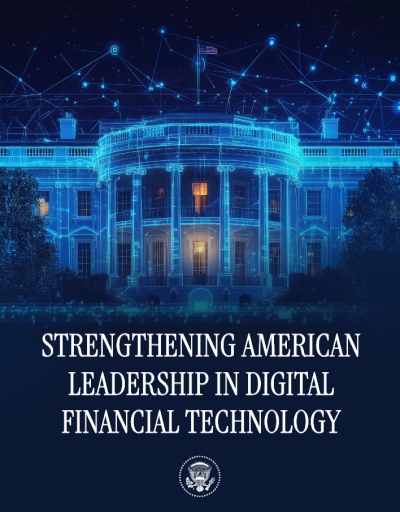
Image: Strengthening American Leadership in Digtal Financial Technology, White House report
On July 30, 2025, the White House released a major 160 page PDF report from the President’s Working Group on Digital Asset Markets called, "Strengthening American Leadership in Digital Financial Technology". The document lays out how the United States plans to build a clear rulebook for crypto and position itself as a leading global hub for blockchain technology, a huge change in direction from a government that previously relied on regulation by enforcement.
The White House report says the US needs a stronger framework for digital asset markets. It calls on Congress to pass the Digital Asset Market Clarity Act to remove gaps in oversight. The plan would give the Commodity Futures Trading Commission authority over trading in digital assets that are not securities, while the Securities and Exchange Commission would focus on those that are securities. The two agencies are asked to provide clear guidance on custody, registration, and record keeping so that new products can launch faster without long delays.
For fintech companies and investors, a more predictable environment is welcomed, and means that developers and platforms would know in advance what licenses they need and how to stay compliant instead of risking enforcement.
A large part of the report focuses on modern banking regulation. It urges federal banking regulators to stop blocking lawful digital asset companies from access to banking, a practice that was known as Operation Choke Point 2.0.
It also suggests a clear process for banks to gain approval for activities such as custody of crypto, tokenization of assets, issuing stablecoins, and using blockchains in financial services. If these changes are implemented, banks will have a clearer path to offer blockchain based products and services, which could expand customer access to digital assets directly through mainstream banks.
The report confirms the importance of stablecoins that are backed by the US dollar. It points to the GENIUS Act, signed into law on July 18, 2025, as the foundation for a federal framework for stablecoins. It also calls for a law to ban central bank digital currencies in the United States, emphasizing that the private sector should lead innovation in payments.
It suggests that the U.S. views private stablecoins as a way to maintain the dollar’s global role. It could lead to faster payments and new payment rails, but it's also a policy preference against government issued digital money.
The Working Group recommends updating anti money laundering rules to reflect how digital assets work. The plan would clarify the reporting obligations for different types of actors, including those in decentralized finance, and protect the right of law abiding citizens to hold their own digital assets. This could make it easier for compliant companies to operate while still giving regulators more effective tools against bad actors.
The report asks the Treasury and IRS to publish clear guidance on how taxes apply to crypto, including on staking, mining, and small day to day transactions. It also calls for Congress to adjust the tax code so that digital assets are treated consistently with other assets such as securities or commodities. Simplified tax rules could lower the cost of compliance and help bring more participants into the market.
If the recommendations are carried out, the US could become a more attractive market for crypto investment and product development. Other countries, including Canada, need to watch closely, as competition for talent and venture funding heats up.
For Canadian fintechs and blockchain companies, this development could open up opportunities for cross border partnerships but also create a more competition.
The National Crowdfunding & Fintech Association (NCFA Canada) is a financial innovation ecosystem that provides education, market intelligence, industry stewardship, networking and funding opportunities and services to thousands of community members and works closely with industry, government, partners and affiliates to create a vibrant and innovative fintech and funding industry in Canada. Decentralized and distributed, NCFA is engaged with global stakeholders and helps incubate projects and investment in fintech, alternative finance, crowdfunding, peer-to-peer finance, payments, digital assets and tokens, artificial intelligence, blockchain, cryptocurrency, regtech, and insurtech sectors. Join Canada's Fintech & Funding Community today FREE! Or become a contributing member and get perks. For more information, please visit: www.ncfacanada.org
| | |
|---|---|---|
| | |
Financing | July 31, 2025

Image from RAMP $500M financing announcement blog post
On July 31, 2025, New York-based expense management platform Ramp announced that it secured $500 million dollars in a Series E 2 round led by Iconiq Capital (just 45 days after raising $200M in March). The new funding places the company’s valuation at $22.5 billion dollars.
Ramp says it now serves more than 40,000 businesses including companies Shopify, Notion and Quora, and that it became cash flow positive in early 2025. TechCrunch previously reported that Ramp crossed $700 million dollars in annualized revenue as of January.
Eric Glyman, Co-founder/CEO of Ramp explained the purpose of the new capital and wrote:
“45 days ago I said let the robots chase receipts. Today, they’re not just chasing receipts. They’re filing your expenses, booking your travel, paying your invoices and closing your books. And we’ve raised another $500M at a $22.5 billion valuation to pick up the pace.”
"The year is 2025: pick your poison"
Glyman described two types of finance teams. The first is focused on day to day tasks with no time to change the way they work. The second is already testing tools that automate as much manual work as possible. He noted that more companies are moving into the second group and that once teams use agents that can automatically handle travel or expense tasks they rarely return to the old way of working.
"By 2026: agents take over the busywork"
Ramp’s plan for 2026 is to let its agents manage low risk expenses, answer employee policy questions over text, and flag unusual transactions for review. Glyman explains how one small expense can interrupt people three times and take 14 minutes of time.
Teams in the beta program are now doing 85% fewer manual reviews. These agents have already caught 15 times more policy violations and processed ten thousand transactions automatically.
"By 2027: finance starts running in parallel"
Today's financial workflow tends to happen in a strict order where one department waits for another to finish before it begins its part. In the near future, when software agents are doing the work these steps can happen in parallel. Legal, risk and procurement copilots could review the same request at the same time and prepare approvals before anyone asks.
“Right now, Ramp users are getting 3× more done per minute compared to two years ago. By 2027 as our agents start working in parallel we’re aiming for 30×.”
"By 2028: autonomous AI with human oversight"
Looking ahead to 2028 Glyman describes a model where fintech AI agents think and act on their own with human supervision. These agents will optimize cash positions, clear most transactions without manual review, and produce live forecasts so that people can spend less time on admin work and more on analysis and strategy.
Ramp has raised $1.9 billion dollars since its launch in 2019, and increased its valuation from $13 billion in March to $22.5 billion in less than five months. To say there's investor appetite for automating finance is an understatement.
Although the company has not disclosed exact revenue figures, it says its income comes from interchange fees, transaction fees on bill payments, software subscriptions, foreign exchange and affiliate fees on travel. We're truly witnessing transformational and rare times of opportunity.
The National Crowdfunding & Fintech Association (NCFA Canada) is a financial innovation ecosystem that provides education, market intelligence, industry stewardship, networking and funding opportunities and services to thousands of community members and works closely with industry, government, partners and affiliates to create a vibrant and innovative fintech and funding industry in Canada. Decentralized and distributed, NCFA is engaged with global stakeholders and helps incubate projects and investment in fintech, alternative finance, crowdfunding, peer-to-peer finance, payments, digital assets and tokens, artificial intelligence, blockchain, cryptocurrency, regtech, and insurtech sectors. Join Canada's Fintech & Funding Community today FREE! Or become a contributing member and get perks. For more information, please visit: www.ncfacanada.org
| | |
|---|---|---|
| | |
Fintech Report | July 30, 2025

Image: BCG QED Report Scaled Winners, Emerging Disruptors (Cover)
The latest analysis from BCG and QED Partners in a report titled, "Fintech's Next Chapter: Scaled Winners and Emerging Disruptors" (38 page PDF), shows that fintech companies currently capture just 3% of global banking and insurance revenues, leaving substantial room to grow.
The study frames this stage around two groups. The scaled winners are fewer than 100 companies generating more than $500 million in annual revenue. They account for most of the sector’s revenues and are now focused on profitability, compliance and expansion into adjacent services.
The emerging disruptors are thousands of smaller companies between $50 to $500 million in revenue. They are fast moving, often AI native, and are working in underserved markets and niches. Some of these emerging disruptors are well on their way to becoming the next generation of scaled winners.
In 2024, global fintech revenues increased 21% compared with 13% the previous year. Segments such as deposits grew 23%, trading and investment 21% and insurance 40%. This growth is happening while valuations and funding have recovered. In the first quarter of 2025, equity funding was 34% higher than a year earlier and valuations improved by 10%.
Earnings margins improved by 4% points to reach 16% in 2024. 69% of public fintechs are profitable, up from less than half the year before, and 35% now meet the rule of 40. Valuations are being driven by these fundamentals. Forward revenue growth and profitability explain half of the variation in valuations. Size and research and development spending explain another 39%.
Fintechs generate 3% of banking and insurance revenues. Penetration is as high as 14% in payments but under 1% in insurance, leaving a large gap for future growth. Payments still make up 55% of scaled fintech revenues (see image below), followed by challenger banks at 15%, crypto trading at 7% and buy now pay later at 4%.

Image: Distribution of Scaling fintechs 2024 BCG report 'Scaled Winners, Emerging Disruptors'
New AI models can act as autonomous agents that execute payments, preapprove loans, rebalance portfolios and anticipate risk exposures. Fintechs that are AI native receive 49% of all equity funding even though their seed rounds are smaller. Over the past three years, $32 billion has gone to B2B fintechs and $30 billion to financial infrastructure providers, with most of this capital flowing to AI powered models.
Large institutions are piloting tokenized bonds and funds. Tokenizing assets can remove up to $20 billion in intermediary costs every year, shorten settlement times and broaden access. Progress depends on clear regulatory frameworks and infrastructure ready for institutional standards.
After years of rapid expansion, challenger banks are focusing on core markets. 92 of them are now profitable and 24 generate more than $500 million in revenue. Geographic distribution of scaled fintech revenue remains uneven with 52% from the United States, 10% each from Asia Pacific excluding China and from Latin America, and 1% from the Middle East and Africa.
Fintech originated loans total $500 billion while private credit funds manage $1.7 trillion. There is a $280 billion gap in capital deployment, and partnerships between private credit funds and fintech lenders are set to grow quickly. Strong funding conditions in early 2025 support this trend.
B2B payments, treasury and workflow automation are still underdeveloped. Deposit related revenues grew 23% in 2024, ahead of the 21% industry growth rate. Insurtech fintechs grew by 40% over the same period, driven by distribution and brokerage models. These segments are becoming the growth engines for disruptors.
There are still 150 private fintechs founded before 2016 that have each raised more than $500 million and have not yet gone public, showing that investors are still ready to back scale-up stories.
The report highlights fintechs need to choose whether they are on a path to becoming a scaled winner or emerging disruptor. Canadian fintechs and NCFA members should prioritize sustainable growth in home markets before pursuing global expansion.
AI native products will be the key differentiator. Companies that engage early with regulators on AI and digital asset rules will be better positioned as these markets evolve. Partnerships with private credit funds can provide growth in lending. B2B automation and modernization of financial infrastructure are major opportunities.
The National Crowdfunding & Fintech Association (NCFA Canada) is a financial innovation ecosystem that provides education, market intelligence, industry stewardship, networking and funding opportunities and services to thousands of community members and works closely with industry, government, partners and affiliates to create a vibrant and innovative fintech and funding industry in Canada. Decentralized and distributed, NCFA is engaged with global stakeholders and helps incubate projects and investment in fintech, alternative finance, crowdfunding, peer-to-peer finance, payments, digital assets and tokens, artificial intelligence, blockchain, cryptocurrency, regtech, and insurtech sectors. Join Canada's Fintech & Funding Community today FREE! Or become a contributing member and get perks. For more information, please visit: www.ncfacanada.org
| | |
|---|---|---|
| | |


August 26th, 2025

January 4th, 2024

June 1st, 2021

September 9th, 2020

July 9th, 2018

January 3rd, 2018

September 25th, 2017

June 20th, 2017

May 10th, 2017

December 14th, 2016