




Karsten Wenzlaff, Advisor
August 26th, 2025
Karsten Wenzlaff is a Crowdfunding and Fintech Expert from Germany. He is Secretary-General of Digit[...]


Jun 26, 2026
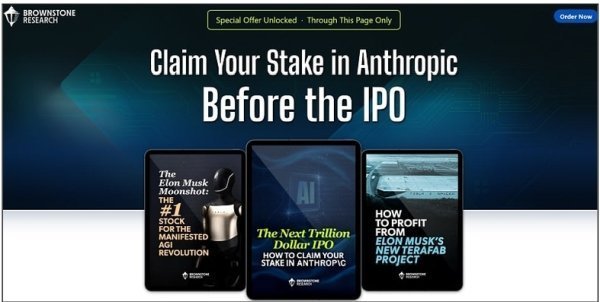
Artificial intelligence has become one of the most exciting sectors for investors. From generative AI tools to enterprise automation, companies developing advanced AI models have attracted billions of dollars in funding and global attention. As a result, investors are increasingly looking for the next major opportunity among AI IPOs and pre-IPO AI companies.
One company generating significant interest is Anthropic. Known for developing Claude AI, Anthropic has emerged as one of the strongest competitors in the AI industry. Some technology analysts, including Jeff Brown, believe the company could eventually become one of the world's most valuable AI businesses. That growing optimism has fueled widespread searches for information about a potential Anthropic IPO and whether investors can benefit before the company goes public.
Anthropic is an artificial intelligence company founded by former OpenAI researchers with the goal of building reliable and safe AI systems for businesses and developers. Its flagship product, Claude, is a large language model designed to assist with writing, coding, research, data analysis, and complex business workflows.
Unlike many AI startups that primarily target consumers, Anthropic has focused heavily on enterprise customers. Businesses use Claude to summarize lengthy documents, automate repetitive tasks, generate software code, and improve productivity across different departments.
The company has also attracted partnerships and investments from some of the biggest names in technology. These strategic relationships have strengthened Anthropic's position in the rapidly expanding AI market while placing it alongside major competitors such as OpenAI and Google.
Interest in Anthropic investment opportunities has grown alongside the rapid adoption of generative AI. Organizations across healthcare, finance, legal services, education, and software development are integrating AI into daily operations, creating enormous demand for advanced language models.
According to the research discussed in the uploaded documents, Jeff Brown highlights Anthropic's enterprise-focused approach, rapid business expansion, and support from leading technology companies as key reasons for investor optimism.
Growing interest in the company has led many investors to examine Jeff Brown's Anthropic forecast, which explores why some believe Anthropic could become one of the most valuable AI businesses in the coming years.
Although Anthropic remains privately owned, its funding rounds and growing customer base have made it one of the most closely watched pre-IPO AI companies in today's market.
Jeff Brown's prediction centers on the belief that Anthropic could become a trillion-dollar AI company if enterprise AI adoption continues to accelerate.
In his published research, Brown argues that Anthropic's Claude platform solves real business problems rather than simply providing consumer chat experiences. He points to enterprise use cases such as document analysis, software development, and workflow automation as major drivers of long-term growth.
Brown also highlights the company's ability to attract substantial investments from major technology firms. Strong financial backing, experienced leadership, and growing enterprise demand form the basis of his long-term AI investing thesis.
Investors should remember that these are forecasts rather than guarantees. Predicting whether a private company will eventually reach trillion-dollar status involves many assumptions, including future revenue growth, competitive positioning, market conditions, and successful execution.
Even highly respected analysts can be wrong. Investment decisions should never rely solely on one prediction, regardless of the source.

One of the biggest questions investors ask is whether an Anthropic IPO will happen soon. At present, Anthropic remains a privately held company. Like many successful AI startups, it continues raising capital from institutional investors instead of offering shares through public stock markets.
Before an IPO occurs, companies typically strengthen financial reporting, expand operations, satisfy regulatory requirements, and determine favorable market conditions. The exact timing depends on management decisions and broader market sentiment.
Because Anthropic is still privately held, many investors are researching how investors may gain exposure to Anthropic before an IPO through indirect investment opportunities and related public companies.
While direct investment is generally unavailable for retail investors, many choose to monitor developments until official announcements are made.
Investors don't necessarily have to wait for an Anthropic IPO to participate in AI investing.
Several established companies already benefit from the growth of artificial intelligence:
Diversification helps reduce the risks associated with relying on a single pre-IPO company while still participating in the broader AI revolution.
Every investment carries risk, particularly when evaluating private companies.
Potential challenges include:
Predictions about future AI stocks should therefore be viewed as informed opinions rather than certain outcomes.
Anthropic has established itself as one of the most closely watched AI companies thanks to its Claude platform, enterprise adoption, and support from major technology investors. These strengths explain why discussions surrounding a possible Anthropic IPO continue gaining momentum.
Jeff Brown predictions have further increased public interest by suggesting the company could become a future leader in artificial intelligence. However, investors should remember that these forecasts remain speculative until supported by future business performance and official company decisions.
Whether you're evaluating Anthropic stock opportunities, researching AI startup investments, or exploring the next wave of AI IPOs, maintaining a diversified portfolio and conducting independent research remain the most effective long-term investment strategies.
 The National Crowdfunding & Fintech Association (NCFA Canada) is a financial innovation ecosystem that provides education, market intelligence, industry stewardship, networking and funding opportunities and services to thousands of community members and works closely with industry, government, partners and affiliates to create a vibrant and innovative fintech and funding industry in Canada. Decentralized and distributed, NCFA is engaged with global stakeholders and helps incubate projects and investment in fintech, alternative finance, crowdfunding, peer-to-peer finance, payments, digital assets and tokens, artificial intelligence, blockchain, cryptocurrency, regtech, and insurtech sectors. Join Canada's Fintech & Funding Community today FREE! Or become a contributing member and get perks. For more information, please visit: www.ncfacanada.org
 |  |  |
|---|---|---|
 |  |  |
June 26, 2026 | NCFA Insight | SME Finance And Business Banking, Artificial Intelligence And Data, Open Banking And Open Finance, Fintech And Innovation

On June 26, 2026, the OECD published Leveraging AI and Digital Tools for SME Sustainable Finance, arguing that one of the biggest barriers to sustainable finance for small and medium sized businesses is not only capital availability but the cost of collecting, verifying, sharing, and monitoring reliable business information.
SMEs account for around 50% of economic output and business sector environmental impacts, yet remain underrepresented in sustainable finance. Sustainable finance markets have grown, but smaller firms still struggle because sustainability data is costly to generate, difficult to verify, and fragmented across reporting frameworks.
So what does this mean?
AI can help lenders process information faster, automate routine work, and monitor portfolios, but only when SMEs can produce trusted, reusable data. Without that foundation, AI just processes weak information faster.
The OECD identifies four main barriers holding back SME sustainable finance:
The report cites survey evidence that SMEs identify lack of time at 42%, technical difficulties at 41%, and high reporting costs at 41% as top barriers to sustainability measurement and reporting.
Many SMEs may want financing for efficiency upgrades, transition investments, or buyer requirements, but the paperwork and verification burden can make targeted sustainable finance harder to access than standard financing.
The OECD looks at the full financing path, not just the lending decision. The process starts when an SME collects sustainability information and continues through bank onboarding, risk review, monitoring, and reporting.
For SMEs, the first job is basic data capture. Carbon calculators, digital templates, consent based APIs, and automated reporting tools can help owners turn energy use, emissions, invoices, utility data, and operating records into information lenders can review.
For financial institutions, the work then moves through three stages. Front office tools can help with onboarding, document intake, product matching, and early screening. Middle office tools can support risk review, evidence checks, benchmarking, and sustainability claim review. Back office tools can monitor targets, prepare reports, track KPIs, and keep portfolio records current.
The OECD’s warning is direct and impactful. AI cannot compensate for missing, inconsistent, or weakly verified data. AI becomes useful only when the underlying information is trusted enough to compare, reuse, and monitor over time.
Sustainable finance does not scale for SMEs if every small loan requires a custom review. Origination, due diligence, verification, monitoring, and reporting all take time. When the loan is small, those fixed costs can make SME sustainable finance unattractive for lenders even when capital is available.
This is why the OECD's lifecycle approach may help. Digital onboarding, reusable sustainability credentials, API based data sharing, AI assisted verification, and continuous monitoring can reduce the cost of serving smaller borrowers.
The opportunity is not just faster approvals. It is making small ticket sustainable finance workable for lenders and less painful for SMEs.
The OECD highlights several initiatives that show how reusable sustainability data can work in practice.
Denmark's Climate Compass gives SMEs a free digital tool to calculate Scope 1, 2, and 3 emissions in line with recognized standards. The SME Climate Hub offers a free carbon calculator for micro and small businesses. Ireland's Climate Toolkit 4 Business combines an emissions calculator with a climate action plan.
Singapore's Project Greenprint helps SMEs generate emissions reports by pulling data from trusted sources, while the United Kingdom's Project Perseus explores how SMEs can share energy data with banks through reporting solutions. Belgium's Kube ESG, developed with major Belgian banks, gives SMEs a digital platform for sustainability reporting.
SMEs shouldn't have to rebuild the same sustainability file for every bank, buyer, or public program. They need data that can be generated once, verified, and reused with permission.
Canada already has many of the building blocks the OECD describes, but policy and market conversations are often separate.
Open banking and open finance can support permission based business data sharing. Digital identity can improve trust and verification. AI underwriting can reduce manual review. Embedded finance can connect lending to accounting, payments, invoicing, payroll, and commerce data. Sustainability reporting tools can help SMEs generate the evidence lenders and buyers increasingly request.
The opportunity is to connect those pieces. If Canadian SMEs can share trusted business and sustainability data through secure, interoperable systems, lenders can reduce manual work and price risk with better information.
That is where sustainable finance becomes a fintech infrastructure problem. The outcome is trusted business data that SMEs can reuse across banks, buyers, insurers, platforms, and government programs.
Open banking in Canada shows how permission based data sharing can improve financial services and reduce friction for consumers and businesses.
NCFA's Open Banking Opportunity Brief explores the commercial opportunities created by data portability and controlled financial data access.
Float's AI business finance stack points to how Canadian SME finance platforms are moving toward connected finance workflows.
EQ Bank's SME operating account push shows how business banking is expanding from accounts into spending, cash flow, and operating tools.
NCFA's Financial Innovation Map tracks opportunities across SME finance, open finance, AI, digital identity, sustainability, and financial data infrastructure.
If trusted SME data was portable and secure between businesses, lenders, buyers, insurers, platforms, and public programs with permission, which parts of commercial lending would still need manual verification?
The National Crowdfunding & Fintech Association (NCFA Canada) is a financial innovation ecosystem that provides education, market intelligence, industry stewardship, networking and funding opportunities and services to thousands of community members and works closely with industry, government, partners and affiliates to create a vibrant and innovative fintech and funding industry in Canada. Decentralized and distributed, NCFA is engaged with global stakeholders and helps incubate projects and investment in fintech, alternative finance, crowdfunding, peer-to-peer finance, payments, digital assets and tokens, artificial intelligence, blockchain, cryptocurrency, regtech, and insurtech sectors. Join Canada's Fintech & Funding Community today FREE! Or become a contributing member and get perks. For more information, please visit: www.ncfacanada.org
| | |
|---|---|---|
| | |
June 25, 2026 | NCFA Fintech Market Activity | Capital Markets And Funding, Wealthtech, Fintech And Innovation

On June 25, 2026, TD Securities and Luma Financial Technologies announced a partnership to bring Luma's structured products platform to Canadian investment professionals. The rollout gives advisors a better way to monitor structured notes, track key events, review performance, and manage reporting after the trade.
Structured notes can help advisors build specific risk and return outcomes for clients, but they're not simple set and forget products. Advisors need to know what clients own, how each note is performing, when events occur, and what needs attention before maturity.
The first phase focuses on TD Securities structured notes. Later updates are expected to add advanced reporting, customized education, stronger order management, and broader access through Luma's Creation Hub and Marketplace.
Structured products become harder to manage when advisors work across multiple issuer portals, spreadsheets, email alerts, and manual reminders. Better workflow gives advisors one place to monitor client holdings, product events, and reporting after the trade.
For TD Securities, the partnership strengthens the service layer around its structured note business. Product choice matters. So does the ability to monitor, explain, and manage those products throughout their lifecycle.
Luma CEO and co-founder Tim Bonacci said the partnership reflects "a new level of support for Canadian advisors." Will better monitoring, education, reporting, and order management help advisors use structured products with more confidence and less manual work?
Questrade's Custom Indexing platform puts portfolio construction directly into investors' hands, giving self directed investors new tools to build, customize, and rebalance portfolios.
Tetrix's AI platform targets private market reporting and investment data infrastructure.
RBC's investment in d1g1t reflects continued demand for analytics and portfolio reporting across wealth and asset management.
NCFA's Financial Innovation Map tracks innovation across wealthtech, capital markets infrastructure, portfolio management, and investment technology.
If structured notes become easier to monitor and manage, will advisor adoption depend more on product design or workflow confidence?
The National Crowdfunding & Fintech Association (NCFA Canada) is a financial innovation ecosystem that provides education, market intelligence, industry stewardship, networking and funding opportunities and services to thousands of community members and works closely with industry, government, partners and affiliates to create a vibrant and innovative fintech and funding industry in Canada. Decentralized and distributed, NCFA is engaged with global stakeholders and helps incubate projects and investment in fintech, alternative finance, crowdfunding, peer-to-peer finance, payments, digital assets and tokens, artificial intelligence, blockchain, cryptocurrency, regtech, and insurtech sectors. Join Canada's Fintech & Funding Community today FREE! Or become a contributing member and get perks. For more information, please visit: www.ncfacanada.org
| | |
|---|---|---|
| | |
June 25, 2026 | NCFA Fintech Market Activity | Capital Markets And Funding, SME Finance And Business Banking, Artificial Intelligence And Data, Fintech And Innovation

On June 24, 2026, Float Financial announced a CAD $85 million all equity Series C led by Inovia Capital, with continued participation from Goldman Sachs Alternatives and Garage Capital, and new investment from BDC Capital and Northleaf. Float says the round raises its valuation by 70% and brings total capital raised since inception to CAD $300 million, including debt and equity financing.
The financing gives Float more capital to expand its AI finance workflow layer, grow across Western Canada and Quebec, and hire across product, R&D, sales, and marketing. The company now serves more than 7,500 Canadian businesses and says revenue has grown more than 120% since its Series B.
Float’s own growth data shows how quickly Canadian business finance is moving from point solutions into connected operating platforms. Business account balances are up more than 4.5x, volumes across five products are up more than 100%, and nearly one third of customers now use more than one Float product which suggests Float is expanding inside existing finance teams rather than only adding new accounts.
Float gives Canadian businesses tools for corporate cards, expense management, bill pay, reimbursements, foreign exchange, business accounts, reporting, and working capital credit. The Series C adds more fuel to Float Intelligence, the company’s AI layer for automating finance workflows.
Rob Khazzam, CEO and co-founder of Float, framed the round around infrastructure:
“We are not building a single feature. We are building the infrastructure that powers how Canada does business - and proving that the best financial tools for Canadian businesses don't have to come from somewhere else.”
Canadian businesses want fewer disconnected finance tools. They need better control over spending, faster approvals, clean reporting, cash visibility, cross border payments, and finance workflows that don't depend on manual work.
Float says its platform is trusted by companies including Cohere, Knix, Neo, Jane, and Rebel. The Jane customer quote in the release points to the same theme: Canadian companies want AP, expense, and finance tools built for the Canadian market, not adapted from U.S. systems.
If Float keeps expanding across cards, accounts, payments, credit, and AI finance workflows, Canadian businesses may get a stronger local alternative to the tools many finance teams stitch together today.
Float secured $100 million in debt financing to expand SME finance in Canada before this Series C.
EQ Bank launched a Business Card, adding spending, cashback, interest, and cash flow tools to its SME banking stack.
Relay secured $50 million to grow its SMB finance platform.
Payments Canada admitted new payment service providers, including Float, as access to payment infrastructure opens to more fintech operators.
Canadian SMB banking research highlights high fees, credit friction, and outdated financial systems as ongoing barriers for business owners.
If Canadian businesses adopt one platform for spending, payments, cash, credit, and AI finance workflows, which institution owns the primary operating relationship: the bank, the fintech, or the software layer?
The National Crowdfunding & Fintech Association (NCFA Canada) is a financial innovation ecosystem that provides education, market intelligence, industry stewardship, networking and funding opportunities and services to thousands of community members and works closely with industry, government, partners and affiliates to create a vibrant and innovative fintech and funding industry in Canada. Decentralized and distributed, NCFA is engaged with global stakeholders and helps incubate projects and investment in fintech, alternative finance, crowdfunding, peer-to-peer finance, payments, digital assets and tokens, artificial intelligence, blockchain, cryptocurrency, regtech, and insurtech sectors. Join Canada's Fintech & Funding Community today FREE! Or become a contributing member and get perks. For more information, please visit: www.ncfacanada.org
| | |
|---|---|---|
| | |
June 24, 2026 | NCFA Fintech Market Activity | Capital Markets And Funding, Artificial Intelligence And Data, Fintech And Innovation

On June 23, 2026, Tetrix announced a $15 million Series A financing co-led by White Star Capital and Innovation Endeavors to expand its AI platform for private market investors. The company says its technology already supports clients managing more than $100 billion in assets and helps transform private market documents into structured investment data.
The funding is significant because it connects AI, private markets, and the broader modernization of private market technology infrastructure, a challenge that receives far less attention than trading systems or portfolio construction. Much of private market investing still depends on manually extracting information from fund reports, capital account statements, subscription documents, and other files that were never designed for machine readable analysis.
Tetrix estimates that private market participants manage information across more than 100 million PDFs within an asset class exceeding $20 trillion globally. According to the company, investment teams often spend weeks collecting, organizing, validating, and reconciling information before it becomes usable for analysis and reporting.
Tetrix says its platform can reduce workflows that previously required up to 45 days of analyst effort to a single day. The goal isn't simply faster document review. The larger objective is converting fragmented information into a usable data layer for investment operations.
It's a unique gap to solve because private markets continue attracting institutional capital while much of the underlying reporting infrastructure remains heavily dependent on manual processes.
Private market investing involves far more than sourcing deals and generating returns. Investment firms must monitor fund performance, process capital calls, review portfolio updates, track exposures, prepare investor reporting, support audits, and maintain records across multiple managers and asset classes.
Brothers Nick Chirls and Alex Chirls founded Tetrix after working in private markets and investment operations. They built the platform to address the reporting and data management challenges investment teams face when information remains scattered across PDFs, statements, and fund documents.
Those activities generate enormous volumes of information. Much of that work still relies on spreadsheets, PDFs, emails, and manual review. Rather than helping investors find the next investment, Tetrix is focused on making existing investment information easier to access, verify, analyze, and use.
For Canada, the financing is another example of a locally connected technology company building infrastructure for a global capital markets problem. Tetrix serves investment firms across multiple regions, reflecting how private market modernization has become an international opportunity rather than a domestic niche.
Fintechs are digitizing alternative assets as firms seek better access, reporting, and transparency across private markets.
Private market technology providers continue expanding data and analytics capabilities as institutional investors demand greater visibility into portfolio performance.
RBC's investment in d1g1t highlighted growing demand for investment analytics infrastructure across wealth and asset management.
Large asset managers are increasingly focused on data, technology, and private markets as competitive differentiators.
AI continues moving deeper into financial infrastructure, supporting workflows that previously depended on manual review and human data entry.
If AI can reliably convert private market documents into structured, searchable data, investors gain faster reporting, stronger benchmarking, improved monitoring, and more timely decision making. The opportunity extends beyond productivity. Better data infrastructure may improve transparency across an asset class that has traditionally been difficult to analyze at scale.
The challenge is trust. Private market investors need accuracy, auditability, and explainable outputs. Reducing analyst workload creates value, but confidence in the underlying data remains essential. Firms adopting AI infrastructure will ultimately be judged not by how much work they automate, but by whether investors trust the results.
If AI turns private market reporting into structured, searchable data, which investment operations tasks remain the most difficult to automate?
The National Crowdfunding & Fintech Association (NCFA Canada) is a financial innovation ecosystem that provides education, market intelligence, industry stewardship, networking and funding opportunities and services to thousands of community members and works closely with industry, government, partners and affiliates to create a vibrant and innovative fintech and funding industry in Canada. Decentralized and distributed, NCFA is engaged with global stakeholders and helps incubate projects and investment in fintech, alternative finance, crowdfunding, peer-to-peer finance, payments, digital assets and tokens, artificial intelligence, blockchain, cryptocurrency, regtech, and insurtech sectors. Join Canada's Fintech & Funding Community today FREE! Or become a contributing member and get perks. For more information, please visit: www.ncfacanada.org
| | |
|---|---|---|
| | |
June 23, 2026 | NCFA Fintech Market Activity | Wealthtech, Capital Markets And Funding, Fintech And Innovation

On June 2, 2026, Questrade launched Custom Indexing, describing it as Canada’s first personalized index investing product with no management fees. The product lets self directed investors build a customized index portfolio, own the underlying stocks through fractional shares, and rebalance in one click.
The product page positions Custom Indexing as a middle ground between ETFs and stock picking. Investors can start with a template, adjust stocks or sectors, receive drift alerts, and rebalance when their index moves away from target weights.
Wealthtech competition is evolving beyond low cost trading and into portfolio controls. Questrade is betting that some DIY investors want the simplicity of index investing without giving up control over what they actually own.
ETFs give investors diversified exposure, but the investor owns units of a fund rather than the individual holdings inside it. Questrade’s Custom Indexing gives users direct ownership of the securities in their index through fractional shares.
Investors can remove or adjust holdings, change sector exposure, and maintain a customized portfolio without building every position manually. Questrade says the product has no management fees, no MERs, and no commissions, although all indexes are held in US dollars and foreign exchange fees still apply.
Custom Indexing currently supports US securities only, with Canadian fractional shares expected later. It also requires a dedicated Custom Indexing account, available through TFSA, RRSP, FHSA, or Cash account types, so the index remains separate from other holdings.
Custom Indexing doesn't try to replace every ETF or every advisor.
It targets investors who want more control than a pooled fund gives them, but less manual work than managing a basket of individual stocks.
The product uses templates, stock and sector level customization, drift notifications, and one click rebalancing. Questrade says investors can start with as little as $10, then edit the index over time as their preferences change.
Custom indexing brings Questrade closer to one of the key retail wealth question. How much personalization can digital investing platforms give users before the product becomes too complex for everyday investors?
Envestnet expanded direct indexing in Canada, giving registered firms more control over tax treatment, exclusions, personalization, and security level portfolio design.
Wealthsimple launched IPO access, adding another retail investing feature that shifts competition toward access, loyalty, and differentiated wealth products.
Wealthsimple acquired Fey to add AI research tools and strengthen its trading platform.
OSFI cleared Questrade to open Questbank, pointing to a broader move from brokerage into banking and deeper financial relationships.
DIY investing continues gaining traction in Canada as more investors seek control, personalization, and lower cost access.
If custom indexing gains traction with self directed investors, more wealth platforms may have to compete on portfolio design, not only fees, access, or trading tools. The product could also make direct indexing feel less like an advisor only capability and more like a retail wealth feature.
More control can create better fit, but it can also create more responsibility. Investors still need to understand concentration, sector exposure, currency costs, taxes, and when customization improves a portfolio versus simply making it more complicated.
NCFA's Financial Innovation Map tracks wealthtech opportunities including personalized investing, direct indexing, portfolio automation, investor intelligence, and digital advisory models.
If personalized indexing becomes easy for retail investors, will the next wealthtech fight be about fees, access, or who gives investors the best control without adding confusion?
The National Crowdfunding & Fintech Association (NCFA Canada) is a financial innovation ecosystem that provides education, market intelligence, industry stewardship, networking and funding opportunities and services to thousands of community members and works closely with industry, government, partners and affiliates to create a vibrant and innovative fintech and funding industry in Canada. Decentralized and distributed, NCFA is engaged with global stakeholders and helps incubate projects and investment in fintech, alternative finance, crowdfunding, peer-to-peer finance, payments, digital assets and tokens, artificial intelligence, blockchain, cryptocurrency, regtech, and insurtech sectors. Join Canada's Fintech & Funding Community today FREE! Or become a contributing member and get perks. For more information, please visit: www.ncfacanada.org
| | |
|---|---|---|
| | |
June 23, 2026 | NCFA Community Announcement | Fintech And Innovation, Artificial Intelligence And Data, Capital Markets And Funding

Canada's innovation economy needs more than ideas. It needs active deal flow, customer discovery, capital conversations, policy signal, and founder-to-founder learning.
That's why NCFA is pleased to return as a Community Partner for Elevate Festival 2026 in Toronto (#ElevateFest2026), taking place September 22-24 at Meridian Hall. Elevate brings Canada's tech ecosystem together for three days of speakers, content tracks, startup programming, investor access, and curated networking.
Elevate expects approximately 10,000 tech professionals, entrepreneurs, founders, CEOs, and investors to attend, with programming that spotlights Canadian innovation and connects people working across technology, capital, and company building.
Elevate Festival 2026 puts founders, investors, operators, and builders at the center of the experience. The program features more than 250 speakers, seven content tracks, curated networking, crash courses, founder and investor programming, and startup opportunities.
Investor programming is a major draw this year. Elevate points to curated one-to-one meetings, live pitch competitions, investor-focused networking, and more than 750 meeting opportunities for founders and investors.
For fintech founders, the value goes beyond fintech sessions. A founder working on fraud, lending, payments, compliance, or capital access may find the most useful conversation with an AI operator, enterprise buyer, infrastructure partner, or investor looking across sectors.
Before heading to Toronto, explore NCFA's Innovation Map to identify emerging opportunity areas, market gaps, and technology themes that may shape founder, investor, and partnership conversations at Elevate.
Register for Elevate Festival 2026 tickets and use code NCFAELEVATE20 at checkout for 20% off General Pass tickets.
Limited time: Women+ in Tech can also access an additional 20% off Early Bird pricing through July 3. Visit the Women+ in Tech Elevate ticket offer for details.
Explore the Elevate Festival 2026 speaker lineup and 2026 Elevate content tracks as more speakers and sessions during the show's run up to September.
We look forward to connecting with Canada's fintech, funding, AI, and innovation community in Toronto!
If you are building, funding, regulating, scaling, or studying innovation in Canada, Elevate is a strong place to meet the people and ideas shaping what comes next.
The National Crowdfunding & Fintech Association (NCFA Canada) is a financial innovation ecosystem that provides education, market intelligence, industry stewardship, networking and funding opportunities and services to thousands of community members and works closely with industry, government, partners and affiliates to create a vibrant and innovative fintech and funding industry in Canada. Decentralized and distributed, NCFA is engaged with global stakeholders and helps incubate projects and investment in fintech, alternative finance, crowdfunding, peer-to-peer finance, payments, digital assets and tokens, artificial intelligence, blockchain, cryptocurrency, regtech, and insurtech sectors. Join Canada's Fintech & Funding Community today FREE! Or become a contributing member and get perks. For more information, please visit: www.ncfacanada.org
| | |
|---|---|---|
| | |


August 26th, 2025

January 4th, 2024

June 1st, 2021

September 9th, 2020

July 9th, 2018

January 3rd, 2018

September 25th, 2017

June 20th, 2017

May 10th, 2017

December 14th, 2016