




Karsten Wenzlaff, Advisor
August 26th, 2025
Karsten Wenzlaff is a Crowdfunding and Fintech Expert from Germany. He is Secretary-General of Digit[...]


May 25, 2026 | NCFA Fintech Market Activity | Digital Assets Blockchain And Tokenization

On May 20, 2026, 3iQ selected Anchorage Digital as the infrastructure and custody partner for its Canadian product suite. Subject to regulatory approvals and required prospectus or offering document amendments, 3iQ intends to migrate a significant portion of assets under management across six TSX listed exchange traded products to Anchorage Digital.
3iQ is a Canadian digital asset investment manager with a regulated public product suite. Anchorage Digital became the first OCC approved national crypto bank in the U.S. Canada has qualified digital asset custodians, but not an equivalent national crypto bank structure at Anchorage’s scale. The decision puts a hard question in front of Canada’s digital asset sector. Can Canadian infrastructure win large institutional mandates when issuers need custody, settlement, staking support, and regulatory comfort at scale?
The warning is now showing up in market activity. Canada has already debated whether domestic digital asset infrastructure can compete with larger U.S. regulated platforms. That issue became more visible when Balance applied for a Canadian special purpose trust structure to build institutional digital asset custody capacity at home.
If Canada approves digital asset products but doesn't build trusted infrastructure at home, more of the work, jobs, and revenue may migrate south. In this case, 3iQ keeps the Canadian listed products while Anchorage Digital captures more of the custody and infrastructure work behind them.
That choice is commercial, not patriotic. Large issuers choose the stack that lowers operating risk and helps them launch better products. That’s the reality test Canadian infrastructure providers now face.
3iQ says Anchorage Digital lets funds settle trades from cold storage without relying on hot wallets. Its Atlas network also lets 3iQ settle directly with trading counterparties and remove extra wallet steps. It means custody now affects much more than safekeeping. It affects how funds trade, settle, manage risk, support staking, and protect investors.
The partnership is also expected to support 3iQ’s expanded staking capabilities. That raises the stakes. Staking needs more than token custody. It needs validator access, clean reporting, strong controls, and regulatory comfort. The right custody partner can give a fund more room to build. The wrong one can hold it back.
Tommaso Mancuso, President and CIO of 3iQ:
"3iQ needs infrastructure providers that meet “the highest standards for security, flexibility, and regulatory alignment.”
That is the standard Canadian infrastructure has to meet now. Canada has digital asset talent, regulated products, custody ambition, and a real institutional market. But the operating stack behind those products still needs more depth, if they want to compete. Fund issuers need platforms that can handle scale, connect cleanly to trading counterparties, support approved product features, and satisfy regulators without adding friction.
Canadian policymakers should treat this as a competitiveness warning. Product approvals aren't enough if the custody, settlement, staking, and fund operations work scales outside Canada. The goal should be to keep more trusted digital asset infrastructure, jobs, and revenue at home.
 The National Crowdfunding & Fintech Association (NCFA Canada) is a financial innovation ecosystem that provides education, market intelligence, industry stewardship, networking and funding opportunities and services to thousands of community members and works closely with industry, government, partners and affiliates to create a vibrant and innovative fintech and funding industry in Canada. Decentralized and distributed, NCFA is engaged with global stakeholders and helps incubate projects and investment in fintech, alternative finance, crowdfunding, peer-to-peer finance, payments, digital assets and tokens, artificial intelligence, blockchain, cryptocurrency, regtech, and insurtech sectors. Join Canada's Fintech & Funding Community today FREE! Or become a contributing member and get perks. For more information, please visit: www.ncfacanada.org
 |  |  |
|---|---|---|
 |  |  |
May 25, 2026 | NCFA Insight | Artificial Intelligence And Data, Capital Markets And Funding

On May 23, 2026, hundreds marched in downtown Vancouver against proposed AI data centres, concerned about electricity use, water use, and environmental impact. The protest puts Canada’s AI compute plans under pressure. Communities want to know who gets clean power, what they get back, and whether data centre operators can earn public trust.
The pressure comes from specific projects. On May 11, 2026, TELUS and the federal government announced work on a proposed Sovereign AI Factory cluster in B.C. that would expand TELUS’s Kamloops data centre and add two Vancouver facilities with Westbank and partners. TELUS says the cluster starts with 85 MW of clean renewable power secured from BC Hydro and is designed to scale to more than 60,000 GPUs and 150 MW by 2032.
After the May 23 protest, TELUS told Daily Hive that its proposed AI infrastructure is a “critical national asset” built for Canada and by Canadians. They said the project could add $9 billion to Canada’s economy, protect sensitive Canadian data, use 98% clean renewable electricity from BC Hydro, cut energy use by 80%, reduce water use by 90%, and save an estimated 300 million litres of water each year through closed loop liquid cooling.
TELUS is framing the project as sovereign AI infrastructure with climate and data benefits. Critics are asking whether those claims will be visible, measurable, and credible enough for communities that are being asked to host large AI facilities.
Ottawa wants more domestic AI compute so Canadian researchers, companies, and public institutions don't have to rely solely on foreign infrastructure. From January 15 to February 15, 2026, the federal government accepted proposals from companies and consortia seeking support to build large scale sovereign AI data centres. The federal government also said no funding has yet been committed or distributed under the process.
On January 30, 2026, the Province and BC Hydro launched a competitive electricity process for AI and data centre projects. The goal is to manage rising demand and prioritize projects with stronger economic, community, and environmental benefits.
BC Hydro’s 2026 call shows the cap constraint. Its Q&A says up to 300 MW has been allocated to storage data centres and up to 100 MW to conventional data centres. Each project site request must not exceed 145 MW. TELUS’s stated 150 MW 2032 target shows how quickly one AI project can approach the size of the current allocation.
BC Hydro says it doesn't comment on specific customer load requests. That leaves communities with headline numbers and proposed locations, but not always the full project picture on grid upgrades, water use, tax benefits, jobs, or local access to compute.
Data centres turn AI from software policy into physical infrastructure. They need land, power, cooling, permits, grid planning, and local acceptance.
Households, industry, electrification, and AI projects are all competing for clean power, which is scare ad valuable. If communities don't see clear local benefits, approvals will get harder.
Critics point to electricity demand, water use, environmental impact, and the risk that public infrastructure supports private AI capacity without enough community return.
B.C. is already choosing which projects get access to limited clean power. Canada needs compute, but scarce electricity should go first to projects that use power efficiently, protect data sovereignty, create local benefits, and make capacity available to Canadian users.
Canada wants sovereign AI compute. Can governments and operators prove that clean power used for AI will create enough local benefit, public trust, and Canadian owned value to justify the buildout?
The National Crowdfunding & Fintech Association (NCFA Canada) is a financial innovation ecosystem that provides education, market intelligence, industry stewardship, networking and funding opportunities and services to thousands of community members and works closely with industry, government, partners and affiliates to create a vibrant and innovative fintech and funding industry in Canada. Decentralized and distributed, NCFA is engaged with global stakeholders and helps incubate projects and investment in fintech, alternative finance, crowdfunding, peer-to-peer finance, payments, digital assets and tokens, artificial intelligence, blockchain, cryptocurrency, regtech, and insurtech sectors. Join Canada's Fintech & Funding Community today FREE! Or become a contributing member and get perks. For more information, please visit: www.ncfacanada.org
| | |
|---|---|---|
| | |
May 25, 2026

The global beauty economy is massive. We are talking about a sector that generates half a trillion dollars in annual retail sales; it is an economic powerhouse driven by skincare, cosmetics, and personal care services. Yet, for a long time, the actual infrastructure behind your neighborhood salon or luxury spa felt stuck in the past. You walk into a high-end salon, get a forward-thinking haircut, and then encounter a clunky, slow payment counter. It was a strange mismatch.
Things are shifting rapidly now. Digital modernization is sweeping through personal services, and it is not just about booking apps or Instagram marketing. The real transformation is happening deep in the financial backend. Fintech innovation has quietly become the operational backbone of this massive industry, changing how money moves between clients, stylists, and suppliers.
Running a service-oriented business presents unique operational headaches. Unlike traditional retail where you just buy a product and walk out, beauty services rely heavily on human time; scheduling is variable, and tipping is an essential part of the worker's income. Traditional banking systems were never built with these specifics in mind. High processing fees, delayed payouts, and rigid merchant setups have historically eaten into the profit margins of small and medium-sized beauty enterprises.
Cash used to be king in salons because it bypassed these frictions. However, consumer habits have changed dramatically, especially over the last few years; modern clients expect fast, digital, and contactless options at checkouts. Salon owners who stick exclusively to old-school payment systems find themselves facing high cart abandonment for online bookings or losing clients who simply do not carry physical wallets anymore. The pressure to adapt is real.
To survive in this competitive space, beauty entrepreneurs must look closely at their underlying transaction infrastructure. A salon's payment processing setup shouldn't just be an afterthought or a utility expense; it is a core business strategy. Choosing the right specialized merchant services means minimizing transaction downgrades, protecting client data, and ensuring that mobile and contactless wallets work flawlessly every single time. Having tailored beauty salon merchant account solutions ensures that a business can handle high-volume weekend rushes without facing system crashes or unexpected cash freezes from risk-averse, generic banks. When the checkout experience is entirely painless, clients leave happy, and staff get paid without delays.
The modern salon needs more than a standard card reader. Today’s fintech platforms build specialized tools that handle everything from dynamic scheduling to automatic tip splitting. Imagine a client getting a complex color treatment from one stylist and a blowout from an assistant. A generic payment system struggles to divide that revenue cleanly. Modern platforms solve this automatically at the moment of tap.
This backend shift allows salon owners to focus on what they actually care about; the artistry and the client experience. It cuts down hours of manual bookkeeping.
Getting a traditional bank loan as a salon owner or independent aesthetician has always been incredibly difficult. Traditional institutions look at fluctuating seasonal revenues and see risk. They demand mountains of paperwork. Fintech has stepped into this vacuum with data-driven financing models that understand the natural cash flow rhythms of personal service businesses.
By looking directly at daily payment processing data, modern financial platforms can offer revenue-based financing. If a salon needs to purchase new chairs or high-end laser equipment, they can get capital advances based on their proven sales volume. Repayments then fluctuate automatically; during a busy holiday season, the business pays back more, while during a slow January, the repayment drops. It is a flexible system that fits the volatile nature of the beauty market perfectly.
The modernization wave is also altering how clients choose to fund their beauty routines. High-end treatments like microneedling, hair extensions, or extensive color corrections can cost hundreds of dollars. Historically, these were luxury investments that required saving up. Now, alternative payment methods are altering consumer spending habits right at the register.
Buy Now, Pay Later (BNPL) structures are becoming common features in modern service checkouts. A client can split a six-hundred-dollar lifestyle package into four manageable, interest-free installments. The salon receives the full payment upfront, while the fintech provider handles the collection risk. It increases average ticket sizes significantly. Clients get access to premium services when they want them, and salons see a steady bump in their revenue numbers without taking on personal financial debt.
This digital transition is doing something even larger; it is formalizing an economy that was previously heavily unbanked or underbanked. The beauty service workforce is full of independent booth renters, solo practitioners, and micro-entrepreneurs. Historically, many of these workers struggled to show proof of income when trying to rent an apartment or apply for a personal mortgage because their earnings were scattered across cash tips and peer-to-peer apps.
By routing transactions through modern financial technology, these micro-businesses build a clean, verifiable digital paper trail. This data wealth opens doors to broader financial services, allowing solo beauty professionals to prove their economic viability to the wider world. It is financial inclusion disguised as everyday business convenience.
The $500 billion beauty market isn't slowing down, but the way it operates is completely transforming. The businesses that thrive over the next decade will be the ones that view technology not as an administrative burden, but as an operational lever. Digital modernization is no longer an optional luxury for high-end urban spas; it is the baseline expectation for survival across the entire service sector. Moving money quickly, safely, and intelligently is the new standard of beauty.
The National Crowdfunding & Fintech Association (NCFA Canada) is a financial innovation ecosystem that provides education, market intelligence, industry stewardship, networking and funding opportunities and services to thousands of community members and works closely with industry, government, partners and affiliates to create a vibrant and innovative fintech and funding industry in Canada. Decentralized and distributed, NCFA is engaged with global stakeholders and helps incubate projects and investment in fintech, alternative finance, crowdfunding, peer-to-peer finance, payments, digital assets and tokens, artificial intelligence, blockchain, cryptocurrency, regtech, and insurtech sectors. Join Canada's Fintech & Funding Community today FREE! Or become a contributing member and get perks. For more information, please visit: www.ncfacanada.org
| | |
|---|---|---|
| | |
May 22, 2026 | NCFA Fintech Market Activity | Digital Assets Blockchain And Tokenization, Payments And Money Movement

On May 21, 2026, Montreal based Shakepay opened the waitlist for its physical Shakepay Visa Prepaid Card and launched a 21 day campaign that turns everyday card payments into bitcoin rewards for customers and participating local businesses. The campaign builds on Shakepay’s Virtual Card, which the company says thousands of Canadians already use every week to earn bitcoin rewards on purchases.
Here’s how it works. Customers tap the Virtual Shakepay Card in store and earn points toward early access to the physical card. Those payments can also place local businesses on Shakepay’s campaign map. Businesses that sign up for Shakepay for Business during the campaign can claim bitcoin rewards after verification.
Shakepay is using rewards, merchants, and local campaign mechanics to push bitcoin into daily payment behaviour without asking customers or businesses to use bitcoin at checkout.
Jean Amiouny, CEO, Shakepay:
“Most rewards programs give people points they can only use inside someone else's system. We think Canadians should be able to earn an asset they can actually own,”
Shakepay is reframing rewards around ownership. Customers spend from their cash balance and earn rewards paid in bitcoin. That differs from closed loyalty points, which usually keep value inside one retailer, issuer, or rewards system.
Small businesses can explore bitcoin reserves without rebuilding payment acceptance or asking customers to pay with crypto. The bitcoin reward is tied to campaign activity and business onboarding, not direct bitcoin checkout.
The top 21,000 customers on the waitlist will receive early access to the physical card. The top 2,100 will be eligible for a Launch Edition card engraved with their waitlist rank. That gamified structure gives Shakepay a way to measure demand before full rollout.
The company says it helps more than 1.5 million Canadians access and use bitcoin through everyday financial products. Shakepay is a CIRO member, an Investment Dealer registered with the AMF, and a FINTRAC registered Money Service Business. They also recently became a member of Payments Canada. The Shakepay Visa Prepaid Card is issued by Peoples Trust Company under licence from Visa International Service Association.
Shakepay is testing whether bitcoin rewards can become a daily payments wedge in Canada. If the model works, bitcoin doesn't need to replace card rails to gain utility. It can ride on top of card spending, rewards, and small business treasury behaviour.
Will bitcoin adoption in Canada grow through direct crypto payments, or through familiar card and rewards products that make bitcoin part of everyday spending?
The National Crowdfunding & Fintech Association (NCFA Canada) is a financial innovation ecosystem that provides education, market intelligence, industry stewardship, networking and funding opportunities and services to thousands of community members and works closely with industry, government, partners and affiliates to create a vibrant and innovative fintech and funding industry in Canada. Decentralized and distributed, NCFA is engaged with global stakeholders and helps incubate projects and investment in fintech, alternative finance, crowdfunding, peer-to-peer finance, payments, digital assets and tokens, artificial intelligence, blockchain, cryptocurrency, regtech, and insurtech sectors. Join Canada's Fintech & Funding Community today FREE! Or become a contributing member and get perks. For more information, please visit: www.ncfacanada.org
| | |
|---|---|---|
| | |
May 22, 2026 | NCFA Fintech Market Activity | Digital Assets Blockchain And Tokenization, Payments And Money Movement, Capital Markets And Market Infrastructure
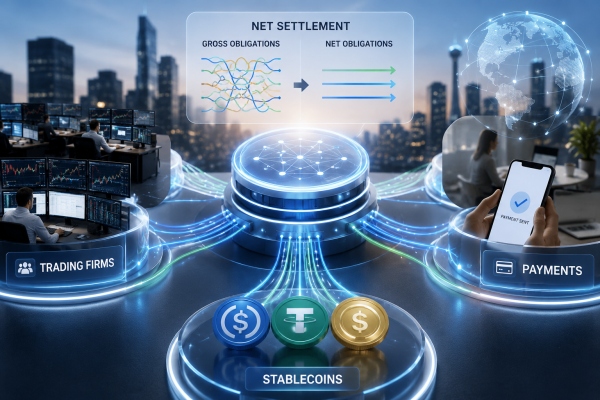
On May 21, 2026, Toronto based Cycles raised $6.4 million to build an open, privacy preserving clearing network for crypto markets and stablecoin payments. Blockchange Ventures led the round, with participation from Coinbase Ventures, Compound VC, Primitive Ventures, and angel investors. The round brings Cycles’ total funding to $8.7 million, following a $2.3 million pre seed in 2025.
Cycles is targeting one of the least glamorous but most important parts of financial infrastructure: clearing. In traditional markets, clearing reduces how much money has to move between counterparties by offsetting obligations first. Cycles wants to bring that function to on chain finance, where trading and payment flows still often require too much prefunding and too much gross settlement.
The first institutional product is Cycles Prime, which lets trading firms privately net OTC obligations across the network. Cycles says this can reduce liquidity requirements and counterparty exposure without requiring collateral, asset movement, or a change in counterparties. Cycles Prime is launching with Lynq and FalconX as anchor partners.
Ethan Buchman, Co Founder and CEO, Cycles:
“Clearing is a financial superpower that has historically only been available to large financial institutions,”
Without clearing, firms often move full payments back and forth instead of only settling the difference. That ties up capital and can increase risk when markets move quickly.
The release points to October 10, 2025, when more than $19 billion in crypto leverage was liquidated in roughly one day, with 70% of forced liquidations occurring in just 40 minutes. Cycles uses that event to show why capital efficiency matters. When markets rely on gross settlement and heavy prefunding, stress can move fast.
Cycles is betting that multilateral clearing can reduce that pressure. Meaning, many obligations can be matched against each other so less money has to move. If it works, trading firms may keep less idle capital parked across venues and counterparties.
The second product is Cycles Pay, a stablecoin payments app for individuals and businesses. Payments are routed through Cycles’ clearing engine, which nets obligations across participants to minimize capital movement. The product also includes invoicing and expense management with credit planned.
Stablecoins already help move value across networks. Clearing can make those flows more capital efficient. For businesses, the value isn't only faster payment. It's fewer trapped balances, better cash flow, and more private settlement.
Rob Schmults, General Partner at Blockchange Ventures:
"Clearing is the cornerstone of capital-efficient markets like foreign exchange allowing the movement of massive volumes of value without crippling liquidity requirements. We see Cycles providing an essential coordination layer to bring the efficiency and effectiveness of clearing to new markets. Doing this will allow businesses to clear and settle payments privately, optimize capital flow, and reduce the need for idle capital. As global adoption accelerates, Cycles can become a category defining standard for how value is settled and netted across entire ecosystems and markets."
If stablecoins are becoming payment rails, will clearing become the missing layer that turns on chain settlement from fast movement into capital efficient market infrastructure?
The National Crowdfunding & Fintech Association (NCFA Canada) is a financial innovation ecosystem that provides education, market intelligence, industry stewardship, networking and funding opportunities and services to thousands of community members and works closely with industry, government, partners and affiliates to create a vibrant and innovative fintech and funding industry in Canada. Decentralized and distributed, NCFA is engaged with global stakeholders and helps incubate projects and investment in fintech, alternative finance, crowdfunding, peer-to-peer finance, payments, digital assets and tokens, artificial intelligence, blockchain, cryptocurrency, regtech, and insurtech sectors. Join Canada's Fintech & Funding Community today FREE! Or become a contributing member and get perks. For more information, please visit: www.ncfacanada.org
| | |
|---|---|---|
| | |
May 22, 2026 | NCFA Market Activity | Banking And Credit Infrastructure, Payments And Market Infrastructure, Lending Consumer Credit And BNPL, Artificial Intelligence And Data

On May 21, 2026, Wealthsimple unveiled a major expansion of its financial services platform during its live product event, “Wealthsimple Takes Over Your Life”. The announcements included family accounts, business chequing, USD accounts, portfolio backed credit, spend insights, overdraft protection, and a monthly $1M client rewards program. The company said more than 4 million Canadians now use Wealthsimple and hold $150B in assets on the platform.
Wealthsimple isn't a Schedule I bank, but it delivers banking style services through regulated Wealthsimple entities, infrastructure access, and partner financial institutions. Wealthsimple says chequing balances are held in trust with CDIC member institutions, while Wealthsimple Payments Inc. and Wealthsimple Investments Inc. are not CDIC member institutions. Power Corporation disclosed a controlling interest in Wealthsimple through Power Financial, Great-West Lifeco, and IGM. In Q1 2026 results, Power valued its Wealthsimple ownership at $3.8B as of March 31, 2026.
NCFA also covered Wealthsimple’s $750M financing and $10B valuation, which gave Canadian fintech markets one of the rarest and strongest scaleup stories.
The event hit home how far Wealthsimple has moved beyond investing and trading. The company now wants a larger share of daily financial activity across deposits, payments, borrowing, business banking, and household finance.
This builds on earlier product expansion when Wealthsimple added credit and loan tools in 2025, including a cash back credit card and low interest credit line. The latest event pushes that same strategy further into operating accounts, secured borrowing, and household controls.
The business banking launch carried the clearest fintech impact. Wealthsimple introduced business chequing with online setup in less than 20 minutes, virtual cards, automated CRA payments, recurring transfers, interest bearing balances, and higher e transfer limits.
Those features target familiar problems for Canadian SMEs. Many owners still deal with low transfer limits, little or no yield on operating balances, manual tax payments, and weak cash management tools.
The Portfolio Line Of Credit may become one of the company’s most important financial products. Wealthsimple said eligible clients can borrow against portfolios at rates as low as prime minus 0.5%, or about 3.95% at the time of the event.
Clients can borrow up to 35% of portfolio value. A client with $200,000 on the platform could access up to $70,000 in credit, subject to eligibility and risk controls.
The product gives clients a way to fund business expenses, inventory purchases, major purchases, or debt refinancing without selling investments. This type of secured liquidity has historically been more common in private banking and wealth management.
For Wealthsimple, portfolio credit also deepens the customer relationship. The more assets clients keep on the platform, the more useful the credit product becomes.
Wealthsimple introduced three family finance products. Kids and teens accounts give parents card controls, alerts, limits, instant transfers, and parent paid interest. Households lets partners choose what they share, track accounts inside and outside Wealthsimple, and view family finances in one place.
Authorized traders lets a trusted family member make trades on another person’s behalf without password sharing. That addresses a practical issue. Many Canadians already help spouses, parents, or relatives manage investments informally. Wealthsimple is formalizing that process with permission based account access.
Wealthsimple also pointed to deeper access across Canadian payment systems. The company linked that access to cheaper wire transfers, free incoming wires, faster payroll deposits, lower FX costs, instant virtual card issuance, cash deposits through Canada Post, and ATM fee reimbursements.
Wealthsimple gained direct Swift access, becoming the first Canadian fintech to do so. It supports the company’s push into wires, cross border money movement, and lower cost global payments.
The Canada Post cash deposit feature gives clients access to more than 5,000 deposit locations. Wealthsimple said it processed cash deposit transactions in more than 900 communities during the first two months after launch.
Infrastructure access increasingly matters for large fintech platforms. It can improve speed, pricing, product flexibility, and customer experience while reducing dependence on older branch based banking workflows.
Wealthsimple’s Monthly Millionaire program will award $1M each month to one client. Every dollar deposited or saved creates an entry, while direct deposit doubles entries. Move over 'roll up the rim to win'!
The structure encourages clients to move payroll deposits and savings activity onto the platform. For Wealthsimple, that supports higher deposits, stronger engagement, and more primary account usage.
Canadian fintech competition is increasingly focused on who controls the broader financial relationship, not just a single product category. Wealthsimple now spans deposits, payments, investing, borrowing, family finance, business banking, and cross border accounts.
That puts the company into more direct competition with incumbent financial institutions across several revenue areas at once. The company's expansion shows how quickly a Canadian fintech can move when scale, capital, trust, and distribution come together.
The National Crowdfunding & Fintech Association (NCFA Canada) is a financial innovation ecosystem that provides education, market intelligence, industry stewardship, networking and funding opportunities and services to thousands of community members and works closely with industry, government, partners and affiliates to create a vibrant and innovative fintech and funding industry in Canada. Decentralized and distributed, NCFA is engaged with global stakeholders and helps incubate projects and investment in fintech, alternative finance, crowdfunding, peer-to-peer finance, payments, digital assets and tokens, artificial intelligence, blockchain, cryptocurrency, regtech, and insurtech sectors. Join Canada's Fintech & Funding Community today FREE! Or become a contributing member and get perks. For more information, please visit: www.ncfacanada.org
| | |
|---|---|---|
| | |
May 21, 2026 | NCFA Fintech Market Activity | Artificial Intelligence And Data, Risk Compliance And Regtech, Banking And Credit Infrastructure

On May 20, 2026, National Bank of Canada partnered with Sardine to strengthen digital banking security and improve fraud operations. National Bank selected Sardine after a live evaluation where the platform improved fraud detection and reduced false positives.
The bank will deploy Sardine’s device intelligence and real time risk scoring across retail, commercial, and wealth solutions. Fraud controls are no longer only a back office defense. They now also affect onboarding, payment approvals, customer friction, and trust across the full digital banking relationship. National Bank serves approximately 2.7 million clients globally and reported $606 billion in assets as at January 31, 2026.
National Bank is also leading a $25 million Series C extension in Sardine, bringing Sardine’s total funding to $170 million. That makes this a commercial partnership with one of Canada’s six systemically important banks.
Soups Ranjan, CEO and co-founder of Sardine:
“Sardine was built for banks that need to stop fraud without slowing down their loyal customers,”
Banks need to stop attacks without blocking good customers. False positives creates unwanted friction, cost, abandoned journeys, and damages trust. Sardine’s platform combines device intelligence, real time risk scoring, fraud controls, and financial crime automation.
It also uses a fraud consortium, a shared risk network built from activity across many customers and channels. That network spans more than 6 billion profiled devices, 800 million consumers, and 3 million businesses worldwide. For banks, outside risk data can help spot suspicious behaviour faster than internal data alone.
Fraud infrastructure is evolving from rule based screening toward live risk decisions across the customer journey. The optimum systems will reduce losses without punishing legitimate customers.
Sardine describes itself as an agentic risk platform for fighting financial crime. That means software that helps risk teams detect fraud, score behaviour, and automate parts of fraud and AML operations. National Bank’s release also references agentic AI in the risk and compliance sector.
The need for AI in banking is now well beyond customer service chatbots and internal productivity tools. Some of the strongest use cases are within risk operations, where firms need speed, evidence, and better decisions under pressure.
Joshuah Lebacq, Partner, NAventures, National Bank of Canada's corporate venture capital arm:
“After closely following Sardine’s growth and hearing strong feedback from existing customers, we decided to conduct an extensive evaluation of their platform. The results gave us confidence to make Sardine a strong addition to our financial crime prevention operations and expand our commercial relationship.
We’re excited about the potential of agentic AI, especially in the risk and compliance sphere, and Sardine’s financial crime agents are setting the standard for the category,”
The release didn't disclosure any loss reduction or false positive reduction rates from their evaluation, so keep your eyes out for those metrics in the future.
As AI driven fraud systems enter deeper into banking, will the best institutions win by blocking more bad actors, or by approving more good customers with less friction?
The National Crowdfunding & Fintech Association (NCFA Canada) is a financial innovation ecosystem that provides education, market intelligence, industry stewardship, networking and funding opportunities and services to thousands of community members and works closely with industry, government, partners and affiliates to create a vibrant and innovative fintech and funding industry in Canada. Decentralized and distributed, NCFA is engaged with global stakeholders and helps incubate projects and investment in fintech, alternative finance, crowdfunding, peer-to-peer finance, payments, digital assets and tokens, artificial intelligence, blockchain, cryptocurrency, regtech, and insurtech sectors. Join Canada's Fintech & Funding Community today FREE! Or become a contributing member and get perks. For more information, please visit: www.ncfacanada.org
| | |
|---|---|---|
| | |


August 26th, 2025

January 4th, 2024

June 1st, 2021

September 9th, 2020

July 9th, 2018

January 3rd, 2018

September 25th, 2017

June 20th, 2017

May 10th, 2017

December 14th, 2016