





Karsten Wenzlaff, Advisor
August 26th, 2025
Karsten Wenzlaff is a Crowdfunding and Fintech Expert from Germany. He is Secretary-General of Digit[...]


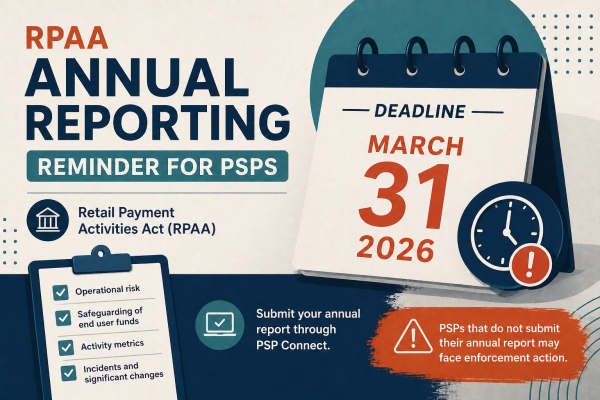
On Apr 27, 2026, the Bank of Canada reminded PSPs under the Retail Payment Activities Act that annual reports were due by March 31, 2026. PSPs registered after March 30, 2026 are not required to submit an annual report for 2025.
PSPs that missed the deadline should submit their report as soon as possible or face potential enforcement action.
The reporting framework is detailed. PSPs must follow the Bank’s annual reporting policy, which requires annual reports by March 31 each year, and its retail payment metrics policy, which covers the value of end user funds held, EFT volume and value, end users served, and other PSPs served. This turns reporting into an operating discipline (to avoid a year end scramble).
The Bank’s reporting guide shows that PSPs must report across operational risk, incident management, end user funds safeguarding, significant changes, incidents, activity metrics, financial information, and record keeping.
The form also asks about cyber security controls, third party service providers, agents, mandataries, safeguarding accounts, shortfalls, and independent reviews.
For operators, (1) data infrastructure must support audit ready reporting, (2) governance must match supervisory expectations, and (3) product design must account for regulatory visibility from day one.
For investors and partners, reporting compliance is a useful test of execution quality. Firms that can operate inside regulated environments with clean reporting, strong controls, and reliable evidence will have an advantage as oversight expands.
The Bank’s information session walks PSPs through annual reporting requirements, including required data fields, operational risk disclosures, activity metrics, and submission through PSP Connect.
 The National Crowdfunding & Fintech Association (NCFA Canada) is a financial innovation ecosystem that provides education, market intelligence, industry stewardship, networking and funding opportunities and services to thousands of community members and works closely with industry, government, partners and affiliates to create a vibrant and innovative fintech and funding industry in Canada. Decentralized and distributed, NCFA is engaged with global stakeholders and helps incubate projects and investment in fintech, alternative finance, crowdfunding, peer-to-peer finance, payments, digital assets and tokens, artificial intelligence, blockchain, cryptocurrency, regtech, and insurtech sectors. Join Canada's Fintech & Funding Community today FREE! Or become a contributing member and get perks. For more information, please visit: www.ncfacanada.org
 |  |  |
|---|---|---|
 |  |  |
Apr 28, 2026 | NCFA Insight | Artificial Intelligence And Data, Banking And Credit Infrastructure

On Apr 27, 2026, Customers Bank announced a multiyear collaboration with OpenAI to deploy AI across commercial banking operations. The bank has nearly $26 billion in assets and already has 75% of team members using OpenAI powered tools. Customers Bank even used an AI voice clone on its last earnings call. The bigger change is how the bank is deploying AI agents across lending, onboarding, and payments.
On its Q1 call, Customers reported more than 500 internal agents and custom GPTs, over 28,000 hours saved through AI enabled workflows, and productivity gains equal to almost 15 full time employees. Q1 results also show $69.7 million in net income available to common shareholders, total deposits up $813.9 million from Q4, and total loans up $609.0 million from Q4.
Sam Sidhu, President and CEO, Customers Bancorp
“We expect a fundamental re-engineering of how Customers Bank operates. We have spent the last year building the operational and governance infrastructure to deploy AI at scale. This strategic collaboration with OpenAI gives us the frontier models, engineering expertise, and ability to co-create a roadmap toward becoming an AI-native bank."
Customers Bank wants AI inside its operating model, with OpenAI engineers working directly with the bank to automate commercial lending, deposit onboarding, and payments. The bank’s cubiX platform already processes about $2 trillion in annual payments volume, giving the collaboration a live operating base, not a pilot or lab only environment.
During Q1 2026 earnings call, Sidhu disclosed that his prepared remarks had been delivered by an AI clone, not read by him. While it was sure to be a memorable call at that point, it's important if AI can represent management's voice in a public market setting, boards need rules for disclosure, script approval, recordkeeping, and accountability before the next experiment becomes normalized.
AI banking use cases aren't just theatre. Customers Bank wants to reduce its commercial loan closing from 30-45 days to about 7 days. It also wants complex commercial account opening to fall from more than a day to under 20 minutes. They are targeting the slowest, most expensive parts of commercial banking.
This is where smaller banks and fintechs should pay attention. AI in banking won’t be won by buying a model and asking staff to use it. The value comes from redesigning workflows around agents, then keeping humans on approvals, exceptions, and risk judgement. That requires clean data, mapped processes, audit trails, escalation rules, and ownership of each AI output.
There's a regulatory approach too. Investor relations, lending decisions, onboarding, and payments all require accountable systems. If an agent drafts, routes, ranks, or speaks, the bank's still on the hook for the result. The lesson is not “let AI run the bank.” It's use AI to remove friction, but keep governance strong enough to prove who approved what and why.
Can Customers Bank turn AI from a productivity tool into an AI enabled engine powering lending, deposits, and payments?
The National Crowdfunding & Fintech Association (NCFA Canada) is a financial innovation ecosystem that provides education, market intelligence, industry stewardship, networking and funding opportunities and services to thousands of community members and works closely with industry, government, partners and affiliates to create a vibrant and innovative fintech and funding industry in Canada. Decentralized and distributed, NCFA is engaged with global stakeholders and helps incubate projects and investment in fintech, alternative finance, crowdfunding, peer-to-peer finance, payments, digital assets and tokens, artificial intelligence, blockchain, cryptocurrency, regtech, and insurtech sectors. Join Canada's Fintech & Funding Community today FREE! Or become a contributing member and get perks. For more information, please visit: www.ncfacanada.org
| | |
|---|---|---|
| | |
April 24, 2026 | NCFA Fintech Whisperer Weekly Intelligence | Payments And Market Infrastructure, Digital Assets Blockchain And Tokenization, Regulation And Policy, Artificial Intelligence And Data

Image: Freepik
This live weekly NCFA intelligence page tracks financial technology developments that significantly affect how fintechs build, sell, raise capital, and operate under scrutiny. Coverage prioritizes Canada and includes global events that directly influence competitive conditions, market access, and execution realities across fintech sectors. This page will be updated throughout the week with market movers in a live format and then each week we'll close the prior week's contents in prep for the upcoming week, and continue on a rolling basis. (Missed prior week's Fintech Whisperer? (December 6-12, 2025, December 13-19, 2025, January 1-9, 2026, January 10-16, 2026, January 17-23, 2026, January 24-30, 2026, January 31-February 6, 2026, February 7-13, 2026, February 14-20, 2026, February 21-27, 2026, February 28-March 6, 2026, March 7-13, 2026, March 14-20, 2026, March 21-27, 2026, March 28-April 3, 2026, April 4-10, 2026, April 11-17, 2026).
RBI has moved from restriction to licence cancellation. Payments banks, wallets, sponsor banks, and fintech platforms should treat this as a hard reminder that governance, compliance controls, depositor protection, and supervisory responsiveness decide whether a regulated licence survives under stress.
Instant payments are starting to add shared, rail-level risk intelligence. Banks and vendors that can plug network signals into fraud controls and payment decisioning will gain speed without giving up control.
The UK is pulling payments reform, stablecoins, open banking, and AI-agent payments into one policy agenda. That gives banks, fintechs, and infrastructure firms a clearer build direction for the next phase of digital money and payment rails.
The PACE Act would move direct rail access from a bank only model toward a supervised nonbank pathway. Payment firms, wallets, remittance providers, and crypto platforms should watch whether Congress turns scale, reserves, and OCC oversight into the price of direct Fed access.
The fee cap changes the economics of Canadian order flow in securities traded on both sides of the border. Marketplaces, brokers, and trading firms need to revisit rebate models, routing logic, and best execution analytics before Nov 2026.
The SEC and CFTC are reducing reporting load while keeping coverage of the largest funds. That lowers compliance cost for smaller firms and shifts the reporting system toward large, systemically relevant managers.
Treasury clearing is now forcing decisions on affiliate repo, cross border booking, liquidity management, and contingency planning. That puts market structure, funding, and clearing operations under live pressure ahead of the compliance dates.
Finfluencer enforcement is now coordinated across jurisdictions and aimed at the platforms as well as the promoters. That raises the compliance and monitoring burden for firms using social channels for distribution and puts more pressure on platforms to block illegal promotions at source.
Client money control failures are still drawing fast and expensive action. Firms handling safeguarded funds need clean role separation, approval controls, reconciliations, and evidence trails that hold up under review.
SMCR reform is now moving from policy into implementation. Banks, fintechs, and regulated firms need to update role mapping, certification processes, accountability records, and reporting workflows without leaving control gaps during the transition.
The rule change is now live. Fund managers, administrators, auditors, and reporting vendors need to update related party reporting workflows and disclosure logic from this reporting cycle forward.
This gives firms a live FCA pathway for AI in production. Providers building AI for payments, risk, compliance, and customer decisioning now have a clearer read on how regulators expect live testing, monitoring, and evidence to be handled.
The UK is refining its crypto framework before implementation to ensure stablecoin payments work within regulated financial systems. For fintechs, this points to a clear direction: stablecoins are moving into formal payment rules, not operating outside them.
OSFI is aligning regulatory reporting with IFRS 18. Insurers, auditors, and regtech providers will need to update reporting systems, data classification, and validation processes ahead of the 2027 transition.
Australia is moving digital asset platforms from patchwork treatment into a licensing regime with custody, settlement, market conduct, and financial resource expectations. For exchanges, brokers, custodians, and tokenised custody platforms, this raises the operating floor before the regime starts in 2027.
N3XT puts tokenized bank money directly onto blockchain rails while retaining the deposit relationship with the issuing institution. That operating model now sits beside tokenized deposits for corporate treasury being developed by much larger banks, but N3XT entered the market with a live product built around continuous settlement from the outset. The difference between bank issued deposit tokens and reserve backed stablecoins is becoming commercially relevant as both compete for institutional payments, liquidity and onchain settlement.
This puts focus on how firms log interactions, flag risk, assign review, and retain records. See related coverage on AI escalation controls and AI chat exposure in court.
Fintech execution is getting more technical and less forgiving. Payments now need network-level risk data. Markets need tighter routing, clearing, and reporting controls. AI and social distribution need evidence, safeguards, and audit trails. The advantage belongs to firms that can turn regulatory change into product, compliance, and infrastructure readiness faster than competitors. NCFA offers various curated resources to help founders and investors stay current on developments that impact fintech markets, subscribe to NCFA weekly newsletter updates, view a rundown of current fintech news and insights, or dive into the latest fintech industry research.
The National Crowdfunding & Fintech Association (NCFA Canada) is a financial innovation ecosystem that provides education, market intelligence, industry stewardship, networking and funding opportunities and services to thousands of community members and works closely with industry, government, partners and affiliates to create a vibrant and innovative fintech and funding industry in Canada. Decentralized and distributed, NCFA is engaged with global stakeholders and helps incubate projects and investment in fintech, alternative finance, crowdfunding, peer-to-peer finance, payments, digital assets and tokens, artificial intelligence, blockchain, cryptocurrency, regtech, and insurtech sectors. Join Canada's Fintech & Funding Community today FREE! Or become a contributing member and get perks. For more information, please visit: www.ncfacanada.org
| | |
|---|---|---|
| | |
Apr 23, 2026 | NCFA Fintech Market Activity | Payments And Money Movement, Digital Assets Blockchain And Tokenization

On April 23, 2026, Borderless AI launches crypto native payroll, providing companies the ability to pay employees and contractors in cryptocurrency.
Based in Toronto, and now operating at scale in more than 170 countries, and supporting payments in over 90 currencies, the company is expanding its global employment platform by adding a settlement option to a solution that already handles hiring, compliance, and payroll across borders.
Its payroll system settles in about 5 days, compared to over 20+ days across traditional cross border rails. The platform also removes upfront salary deposits, which can range from $7,000 to $20,000 per employee in legacy models.
The company has raised $32 million in January 2025 to build what it describes as an AI-native employment platform. Its AI agent can generate contracts, analyze legal terms, and answer tax questions in 170 languages, completing work that typically takes 7 to 10 days in minutes.
Borderless AI supports more than 1,500 companies and holds a 4.9 out of 5 rating on G2, one of the highest among Employer of Record providers.
The company is also building distribution with its integration with ADP Workforce Now across the U.S. and Canada which places Borderless AI directly inside one of the largest HR ecosystems. I allows companies to manage global hiring, payroll, and contractors without switching systems or duplicating data.
Crypto payroll fits into that structure. Cross border payroll still goes through banks, FX providers, and local clearing systems. Each step adds delay, cost, and failure risk. Crypto settlement removes part of that chain by allowing funds to move directly to wallets once payroll is approved.
For companies running distributed teams, faster settlement reduces cash flow friction and removes the need to pre fund payroll across multiple jurisdictions. For workers, it provides flexibility in how compensation is received and stored, particularly in markets where banking access or currency stability varies.
Most platforms stop at payroll execution and rely on banking partners to complete payments. Borderless AI is reducing that dependency by adding crypto settlement. If settlement begins moving away from banking rails, platforms that own that layer can capture more margin and control the full payment flow.
The National Crowdfunding & Fintech Association (NCFA Canada) is a financial innovation ecosystem that provides education, market intelligence, industry stewardship, networking and funding opportunities and services to thousands of community members and works closely with industry, government, partners and affiliates to create a vibrant and innovative fintech and funding industry in Canada. Decentralized and distributed, NCFA is engaged with global stakeholders and helps incubate projects and investment in fintech, alternative finance, crowdfunding, peer-to-peer finance, payments, digital assets and tokens, artificial intelligence, blockchain, cryptocurrency, regtech, and insurtech sectors. Join Canada's Fintech & Funding Community today FREE! Or become a contributing member and get perks. For more information, please visit: www.ncfacanada.org
| | |
|---|---|---|
| | |
Apr 22, 2026 | NCFA Fintech Market Activity | Payments And Money Movement

On April 21, 2026, Nuvei launched direct local acquiring in Mexico. Merchants can now process domestic card payments through Nuvei’s own licensed infrastructure instead of relying on third party processors.
Mexico is a large and growing digital commerce market. Payments volume reached more than $676 billion in 2024, with ecommerce at approximately $97 billion and growing at about 24% a year. This makes local processing important for merchants operating in the market.
Phil Fayer, Chair & CEO of Nuvei:
"Commerce is global, but payment performance is local. Our direct acquiring expansion into Mexico advances our Every Payment Everywhere strategy -- building infrastructure inside domestic payment ecosystems so customers can scale globally while performing like a local."
Direct acquiring means Nuvei connects merchants directly to card networks and local banking systems inside the country. That gives Nuvei control over authorization, settlement, and transaction data within Mexico.
This improves performance in practical ways. Domestic processing can increase approval rates, reduce cross border fees, and shorten settlement times. It also removes reliance on local partners for core processing functions.
Nuvei now operates direct acquiring in more than 50 markets, following a consistent growth pattern across the business. The company builds local infrastructure in markets where payment performance depends on domestic connectivity, as seen in its work supporting omnichannel merchants and its expansion into regulated digital asset services in Europe.
Founded in Montreal, Nuvei is one of the few Canadian fintechs building global payment infrastructure at scale. That positions the company alongside global processors that own local acquiring rather than those that depend on partner networks.
Mexico adds another high growth market where local infrastructure determines payment performance. Without direct acquiring, transaction success depends on intermediaries. With it, Nuvei can manage approval rates, costs, and settlement directly.
Nuvei is building control at the processing layer. The more markets it owns locally, the less it depends on partners and the stronger its position becomes.
The National Crowdfunding & Fintech Association (NCFA Canada) is a financial innovation ecosystem that provides education, market intelligence, industry stewardship, networking and funding opportunities and services to thousands of community members and works closely with industry, government, partners and affiliates to create a vibrant and innovative fintech and funding industry in Canada. Decentralized and distributed, NCFA is engaged with global stakeholders and helps incubate projects and investment in fintech, alternative finance, crowdfunding, peer-to-peer finance, payments, digital assets and tokens, artificial intelligence, blockchain, cryptocurrency, regtech, and insurtech sectors. Join Canada's Fintech & Funding Community today FREE! Or become a contributing member and get perks. For more information, please visit: www.ncfacanada.org
| | |
|---|---|---|
| | |
April 17, 2026 | NCFA Fintech Whisperer Weekly Intelligence | Regulation And Policy, Digital Assets Blockchain And Tokenization, Capital Markets And Market Infrastructure, Risk Compliance And Regtech
Image: Freepik
This live weekly NCFA intelligence page tracks financial technology developments that significantly affect how fintechs build, sell, raise capital, and operate under scrutiny. Coverage prioritizes Canada and includes global events that directly influence competitive conditions, market access, and execution realities across fintech sectors. This page will be updated throughout the week with market movers in a live format and then each week we'll close the prior week's contents in prep for the upcoming week, and continue on a rolling basis. (Missed prior week's Fintech Whisperer? (December 6-12, 2025, December 13-19, 2025, January 1-9, 2026, January 10-16, 2026, January 17-23, 2026, January 24-30, 2026, January 31-February 6, 2026, February 7-13, 2026, February 14-20, 2026, February 21-27, 2026, February 28-March 6, 2026, March 7-13, 2026, March 14-20, 2026, March 21-27, 2026, March 28-April 3, 2026, April 4-10, 2026).
OSFI has returned non bank financial institution risk to the supervisory foreground. That puts more attention on leverage, liquidity, and credit formation outside the traditional banking perimeter.
European policymakers are now linking stablecoins, tokenized deposits, and payment sovereignty. If banks move on this, product teams will need to build for liquidity, redemption certainty, and distribution at scale.
The UK now has a clearer crypto timetable. Firms can see when the authorisation gate opens, when the regime goes live, and which business models sit inside scope. That gives exchanges, custodians, stablecoin issuers, and staking providers a more defined build and compliance window.
Pakistan has opened a formal banking channel for licensed virtual asset firms while keeping balance sheet exposure and client money handling tightly controlled. That gives the market a clearer regulated path for fiat access without relaxing the banking perimeter.
A global bank has expanded tokenized deposits into the U.S. for real treasury and liquidity use. That brings tokenized money closer to core banking and cross-border cash management, not just digital asset experimentation.
The SEC has drawn a clearer line around how crypto interfaces can operate without crossing into broker dealer registration. That gives wallet providers, front ends, and trading interfaces a more defined design perimeter, while keeping execution control, solicitation, and custody inside the regulated boundary.
Open finance now has a regulator defined build plan with a clear timeline. That gives banks and fintechs a window to develop data driven products beyond payments and reshape how credit and financial services are distributed.
Stablecoin settlement now runs through a $60 billion cross border network. Banks and existing rails face direct competition on settlement.
This gives Payward regulated U.S. clearing infrastructure that took more than a decade to build. That puts crypto-native derivatives closer to the core of U.S. market structure and gives banks, brokerages, and fintech partners a new route into regulated digital asset derivatives.
The SEC has reopened foundational questions around the main surveillance infrastructure for U.S. equity markets. That puts market structure, compliance technology, cost allocation, and data governance back into active review.
The FCA has reduced reporting friction without removing oversight. That changes daily reporting operations for trading firms and market makers, and it forces compliance, data, and regtech teams to adjust how short position data is calculated, submitted, and published.
The trade entry point is entering the social layer. X now controls how users move from conversation to market data, while brokerages plug into that flow to capture execution.
Crowdcube is linking retail private markets with regulated public market infrastructure. That gives companies a new way to raise capital and provide liquidity without waiting for an IPO, and it opens institutional demand to retail-originated share flow.
The update raises the compliance baseline across multiple financial crime domains at once. Banks, PSPs, and fintechs operating in or through UAE corridors will need to adjust risk models, monitoring systems, and correspondent banking controls.
This week tightens the real constraint on fintech execution. It is no longer access or distribution, it is whether your product can operate inside the rules of the rails it touches. Payment flows now include machine-initiated actions, reporting regimes are getting simpler but less tolerant of errors, and market infrastructure expects you to plug in cleanly from day one. If your system cannot enforce permissions at the transaction level, produce a clear audit trail, and align with regulated reporting without rework, it will slow down as the market speeds up. NCFA offers various curated resources to help founders and investors stay current on developments that impact fintech markets, subscribe to NCFA weekly newsletter updates, view a rundown of current fintech news and insights, or dive into the latest fintech industry research.
The National Crowdfunding & Fintech Association (NCFA Canada) is a financial innovation ecosystem that provides education, market intelligence, industry stewardship, networking and funding opportunities and services to thousands of community members and works closely with industry, government, partners and affiliates to create a vibrant and innovative fintech and funding industry in Canada. Decentralized and distributed, NCFA is engaged with global stakeholders and helps incubate projects and investment in fintech, alternative finance, crowdfunding, peer-to-peer finance, payments, digital assets and tokens, artificial intelligence, blockchain, cryptocurrency, regtech, and insurtech sectors. Join Canada's Fintech & Funding Community today FREE! Or become a contributing member and get perks. For more information, please visit: www.ncfacanada.org
| | |
|---|---|---|
| | |
Apr 17, 2026 | NCFA Fintech Insight | Payments And Market Infrastructure

On April 16, 2026, Payments Canada admitted DoBusiness.com as a payment service provider member, the latest non-bank company to gain a path to access Canada's core payment rails, including Lynx, ACSS, and the Real Time Rail.
Direct access to payment rails reduces reliance on sponsor banks, cuts transaction costs, and gives firms more control over how and when money moves. It allows payment providers to manage liquidity, route transactions, and design products without passing every step through an intermediary.
Donna Kinoshita, Chief Payments Officer at Payments Canada:
“The inclusion of specialized enterprise SaaS providers alongside our existing members is a clear sign of the evolving payment landscape. As our membership continues to diversify, so do the perspectives that inform the future of Canada’s payment infrastructure, ensuring an inclusive payment ecosystem that gives Canadians more choices
Companies that meet the requirements can apply through Payments Canada's membership process and move toward participation in core payment infrastructure.
Payments often work through a sponsor bank, then through clearing, then settlement. Each step adds fees and delays. A firm with access can remove part of that chain.
Take a simple example. A fintech that relies on a sponsor bank may pay fees on each transaction, wait for batch processing, and rely on the bank’s timing and liquidity controls. Compare and contrast that with a company with direct or near direct access who can route payments without that extra layer, manage liquidity in its own systems, and process transactions closer to real time. The difference is found in unit cost structure, settlement speed, and how products are designed. For consumers and businesses, this typically means faster processing and in some cases lower fees.
This admission follows earlier PSP intake, including five firms added at the start of 2026, and lines up with ongoing Real Time Rail testing and onboarding work. More firms are positioning to operate inside the system, not just connect to it.
As more companies gain a path to participate in core payment systems, the range of products built on top of those rails will expand. That includes real time payments, embedded payment experiences, and services that rely on immediate settlement and better control over funds.
The result is a payment system where more providers can compete on speed, cost, and reliability. It's that competition that will drive better outcomes for end user consumers and businesses.
The National Crowdfunding & Fintech Association (NCFA Canada) is a financial innovation ecosystem that provides education, market intelligence, industry stewardship, networking and funding opportunities and services to thousands of community members and works closely with industry, government, partners and affiliates to create a vibrant and innovative fintech and funding industry in Canada. Decentralized and distributed, NCFA is engaged with global stakeholders and helps incubate projects and investment in fintech, alternative finance, crowdfunding, peer-to-peer finance, payments, digital assets and tokens, artificial intelligence, blockchain, cryptocurrency, regtech, and insurtech sectors. Join Canada's Fintech & Funding Community today FREE! Or become a contributing member and get perks. For more information, please visit: www.ncfacanada.org
| | |
|---|---|---|
| | |



August 26th, 2025

January 4th, 2024

June 1st, 2021

September 9th, 2020

July 9th, 2018

January 3rd, 2018

September 25th, 2017

June 20th, 2017

May 10th, 2017

December 14th, 2016
