





Karsten Wenzlaff, Advisor
August 26th, 2025
Karsten Wenzlaff is a Crowdfunding and Fintech Expert from Germany. He is Secretary-General of Digit[...]


Apr 17, 2026 | NCFA Fintech Market Activity | Payments And Money Movement, Artificial Intelligence And Data

On April 16, 2026, Lobster.cash announced an integration with Mastercard Agent Pay that lets AI agents complete purchases using a person’s existing Mastercard. The change is simple on the surface. An agent can now move from decision to payment. What matters is who controls that payment.
Until now, agents could recommend, compare, and even initiate checkout, but the user still handled the final step. This integration removes that break in the flow. It doesn't introduce a new wallet or payment method. It uses the card people already have, which lowers friction and keeps the transaction inside existing issuer controls.
Let's break it down. Each layer solves a different problem, and none of them work on their own.
Alfonso Gómez-Jordana Mañas, Co-Founder, Crossmint:
“They can put the card they already have to work for their agent, with the security and control they expect from Mastercard.”
The key addition isn't access to payment rails but a record of permission. Transactions use Verifiable Intent, a standards-based approach co-developed by Mastercard with Google and aligned with AP2 and UCP. It creates a record of what the user approved before the payment happens. Issuers, merchants, and platforms can check that record after the fact.
This changes the question payment systems need to answer. It's no longer only whether a transaction is valid. It's whether the user actually allowed the agent to make it. It's a different problem and requires clear rules, auditability, and a way to prove that those rules were followed.
There are early signs this is moving into real systems. Mastercard completed a live agent-driven transaction with DBS and UOB in Singapore in March 2026, and said agentic AI could handle up to 20% of e-commerce tasks in 2025, while 39% of U.S. consumers have already used generative AI for online shopping and 53% plan to do so.
Those numbers explain why payment networks are building now. Companies are attaching agent payments to existing card infrastructure, with new layers for permission and security.
Agent payments are not just about enabling transactions. They are about proving that those transactions were allowed. That keeps issuers in the transaction, gives users control over how agents act, and lets developers build without replacing the payment stack.
 The National Crowdfunding & Fintech Association (NCFA Canada) is a financial innovation ecosystem that provides education, market intelligence, industry stewardship, networking and funding opportunities and services to thousands of community members and works closely with industry, government, partners and affiliates to create a vibrant and innovative fintech and funding industry in Canada. Decentralized and distributed, NCFA is engaged with global stakeholders and helps incubate projects and investment in fintech, alternative finance, crowdfunding, peer-to-peer finance, payments, digital assets and tokens, artificial intelligence, blockchain, cryptocurrency, regtech, and insurtech sectors. Join Canada's Fintech & Funding Community today FREE! Or become a contributing member and get perks. For more information, please visit: www.ncfacanada.org
 |  |  |
|---|---|---|
 |  |  |
April 17, 2026
Digital payments have become part of everyday life, shaping how people send money, pay for services, and manage their spending. What once felt like an alternative is now standard across many markets. Cryptocurrencies have played a significant role in that shift, especially for international transfers. They move funds faster, reduce fees, and avoid some of the delays tied to traditional banking systems.
This trend is visible across different industries. Even on entertainment platforms in Canada, such as MyEmpire Casino, crypto transactions have found their place, offering users a quicker and more flexible way to handle deposits and withdrawals.
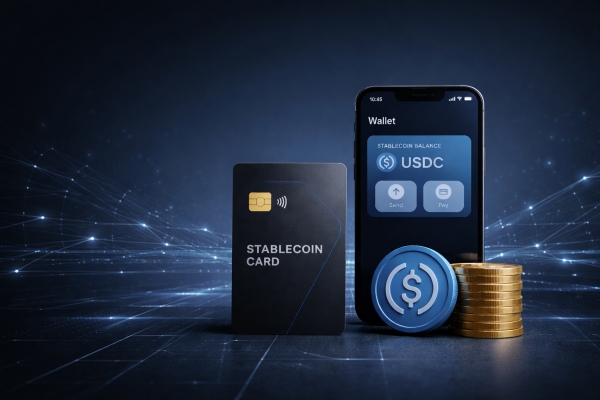
Besides crypto payments, stablecoins are also attracting more attention. They offer the same speed and efficiency as other digital assets, while keeping their value tied to traditional currencies.
That makes them more predictable, especially for larger or more frequent transactions. A recent example comes from Kulipa, a Paris-based company that raised 6.2 million dollars to expand its stablecoin card issuing system. Moves like this raise an important question: Is there something here that Canada could take note of?
Stablecoins are already moving large volumes of money every day, yet their role in everyday payments still feels limited. The issue is not demand. It comes down to how difficult it is to connect blockchain-based balances with the systems people actually use, like debit and credit cards.
Right now, many solutions feel fragmented. Users often need to move funds between platforms, hold extra balances in traditional accounts, or deal with different rules depending on where they live. This slows things down and adds unnecessary friction. As regulations become clearer, fintech companies are looking for simpler ways to bridge that gap without tying up large amounts of capital.
Kulipa is working directly in that space. Its system is built from the ground up around stablecoins, allowing companies in areas like payroll and digital banking to issue cards linked to blockchain funds. By keeping settlements on-chain where possible, it reduces the need for pre-funded accounts sitting idle in banks.
The approach is fairly straightforward. Kulipa gives partners two ways to launch. One option focuses on speed, using a pre-funded setup to get things running quickly. The other connects more deeply with digital wallets, allowing transactions to be verified and settled directly on the blockchain.
This reduces the capital required to be tied up in traditional systems. It also removes several operational hurdles. Fraud protection, for example, is handled within the platform, which takes pressure off the companies using it.
From the user’s side, the experience feels familiar. Cards can be used for everyday purchases or ATM withdrawals at locations where major networks are accepted. The difference is happening in the background, where stablecoins are being used without requiring extra steps like manual conversions or account transfers.
Since launching in early 2025, Kulipa has expanded quickly. The number of issued cards has already passed six figures, and transaction volumes have been growing steadily month by month. This kind of traction suggests that the model is solving a real problem rather than testing a niche idea.
The company has also built partnerships across different markets. Flutterwave, known for its work in African payments, is one example. Other partners, such as Ready, Solflare, and nSave, demonstrate that the system works across different use cases, from banking alternatives to crypto-native platforms.
What stands out is how these partners describe the product. The focus is on turning digital balances into usable tools for daily life without adding layers of complexity. That feedback points to practical value rather than theoretical potential.
Kulipa’s leadership brings experience from both traditional finance and large tech platforms. The CEO has worked on global payment rollouts at Mastercard, while the technical side includes experience from companies like Google and WhatsApp. On the compliance front, the team has a background in both crypto platforms and established banking systems.
This mix matters. Building payment infrastructure requires both technical depth and an understanding of regulation, and Kulipa seems to be working across both areas.
Investors have also backed that direction. The recent funding round brought in support from firms focused on financial innovation and blockchain infrastructure. With over $9 million raised, the company now has room to expand its system and reach new markets.
Canada is moving toward clearer rules for stablecoins, though the process is still ongoing. Recent policy steps suggest a more defined framework is coming, with oversight likely to increase in the next few years. Until then, companies are operating in a space that is still developing.
The core challenge remains the same: connecting digital assets to everyday spending in a simple, cost-effective way. This is especially relevant for businesses dealing with cross-border payments or digital wallets.
Kulipa’s model offers one possible direction. Instead of building everything internally, popular companies in Canada, such as MyEmpire Casino or Coinsquare, could consider partnerships or ready-made systems to reduce both costs and complexity. This would allow them to move faster while staying within expected regulatory boundaries.
The National Crowdfunding & Fintech Association (NCFA Canada) is a financial innovation ecosystem that provides education, market intelligence, industry stewardship, networking and funding opportunities and services to thousands of community members and works closely with industry, government, partners and affiliates to create a vibrant and innovative fintech and funding industry in Canada. Decentralized and distributed, NCFA is engaged with global stakeholders and helps incubate projects and investment in fintech, alternative finance, crowdfunding, peer-to-peer finance, payments, digital assets and tokens, artificial intelligence, blockchain, cryptocurrency, regtech, and insurtech sectors. Join Canada's Fintech & Funding Community today FREE! Or become a contributing member and get perks. For more information, please visit: www.ncfacanada.org
| | |
|---|---|---|
| | |
Apr 16, 2026 | NCFA Insight | Digital Assets, Payments And Capital Markets

On Apr 8 2026, six Swiss banks launched a CHF stablecoin sandbox while Circle launched managed stablecoin settlement for banks and PSPs. These two announcements, among others, point to a cleaner reading of where this market is going. Banks are working on issuance. Fintech infrastructure firms are working on access. The split is easier to see once the numbers sit side by side.
The Swiss sandbox brings together UBS, PostFinance, Sygnum, Raiffeisen, Zürcher Kantonalbank, BCV, and Swiss Stablecoin AG to test Swiss franc use cases in 2026. The PostFinance release says there is currently no regulated Swiss franc stablecoin with broad application in Switzerland.
In contract, Circle isn't issuing a new domestic currency token. It is packaging an operating layer around existing stablecoin rails. Circle says its product supports payouts across more than 20 blockchains and domestic payment rails, and says USDC has supported more than $70T in cumulative onchain settlement with nearly $12T in onchain transaction volume in Q4 2025.
The bank model starts with control. Domestic institutions want local currency stablecoins because settlement authority, liquidity, and currency relevance are all aligned. That's why the Swiss consortium is testing a franc token inside a controlled sandbox instead of waiting for private dollar stablecoins to define the market for them. A growing banking stablecoin push is already forming elsewhere. Reuters reported that about 10 European banks and a separate group of about 10 large US banks are also exploring issuance and settlement models.
The fintech infrastructure model starts with speed. It assumes many banks and PSPs want the benefits of stablecoin settlement but don't want to manage wallets and blockchain operations, or carry direct digital asset complexity inside their own stack. Circle is selling that infrastructure solution. “With CPN Managed Payments, we’re simplifying how institutions adopt and scale stablecoin payments,” said Nikhil Chandhok, Chief Product and Technology Officer at Circle. They are competing by making stablecoin settlement easier to deploy.
The competitive edge is arguably no longer just about issuing a token, but how quickly a firm can connect stablecoin settlement to real payment and treasury workflows. That's where the rubber hits the road with the service layer.
Circle's Q4 2025 financial filing shows 55 institutions onboarded and another 74 under review as of Feb 20 2026. 2.3M daily transactions over the prior 30 days, roughly half second transaction finality in testing, and more than 166M transactions since testnet launch. It's scaling this network rapidly for institutions that want to plug into settlement, liquidity, and payout rails quickly, and for those who don't want to write the next stablecoin white paper. Stablecoins can support faster securities settlement, collateral movement, repo style liquidity flows, and continuous treasury operations.
If banks control issuance while infrastructure firms control access, then the market starts to resemble other parts of finance where different firms control different layers of the stack. One layer anchors the money. Another layer controls routing, integration, and speed.
Canada now has a published federal stablecoin framework. On Mar 31 2026, Finance Canada set out a model for fiat backed stablecoins under Bank of Canada oversight, including issuer registration, 1:1 reserves, at par redemption, and governance, security, and recovery standards. The same page says the framework is expected to come into force in 2027 after regulations are developed.
The US is moving on two tracks at once. It's developing a federal payment stablecoin rulebook through the FDIC’s proposed GENIUS Act rule, and it already has a charter pathway through the OCC’s conditional approvals for five national trust banks. That means the US debate covers both issuer rules and institutional access to banking infrastructure.
Canada's now more comparable with the US on issuer oversight, but it still doesn't have an equivalent crypto specific trust charter path into the federal banking perimeter. That leaves a real difference in how companies scale, partner, and position themselves with institutional clients.
Stablecoins are splitting into two businesses. Banks want to issue regulated digital money. Fintech infrastructure firms want to make that money usable inside payment and settlement workflows.
The National Crowdfunding & Fintech Association (NCFA Canada) is a financial innovation ecosystem that provides education, market intelligence, industry stewardship, networking and funding opportunities and services to thousands of community members and works closely with industry, government, partners and affiliates to create a vibrant and innovative fintech and funding industry in Canada. Decentralized and distributed, NCFA is engaged with global stakeholders and helps incubate projects and investment in fintech, alternative finance, crowdfunding, peer-to-peer finance, payments, digital assets and tokens, artificial intelligence, blockchain, cryptocurrency, regtech, and insurtech sectors. Join Canada's Fintech & Funding Community today FREE! Or become a contributing member and get perks. For more information, please visit: www.ncfacanada.org
| | |
|---|---|---|
| | |
Apr 16, 2026 | NCFA Fintech Market Activity | Payments And Money Movement, Embedded Finance Platforms And Partnerships

On April 15, 2026, REV Prepaid launched outbound Interac e-Transfer for corporate prepaid cards in Canada. The company says it's the first provider in Canada to let cardholders move funds directly from a corporate prepaid card to a personal bank account. Until now, these cards have largely been limited to point of sale purchases or ATM withdrawals.
Prepaid cards are still a smaller category than debit or credit in Canada, but growth is steady. Payments Canada's 2025 payment methods and trends report says prepaid card transaction volume rose 5% in 2024, while prepaid card volume and value have increased 7% and 24% since 2019. The Bank of Canada report shows 9% of Canadians used a prepaid credit card in 2024, and that share has stayed about the same since 2022.
Sara Mackay Smith, CEO, REV Prepaid:
“If a cardholder would rather move those funds to their bank account than spend at point of sale, they should be able to do that.”
The use case is larger than just employee perks. REV says prepaid is increasingly being used for incentives, rebates, rewards, and disbursements. If users face friction when trying to use the funds, program value drops and support costs rise. In this way, outbound Interac e-Transfer can reduce cardholder support requests while improving satisfaction and adoption.
Interac is already a familiar way for people to move money between accounts. Bringing that capability into corporate prepaid programs makes those cards feel less like closed loop payment tools and more like sending digital payments but letting recipients decide how to receive it. Companies are looking for alternatives to cheques and direct deposits, but they also need those alternatives to be simple for recipients to use.
The big change is control. Employers and program sponsors still choose how funds are sent, but recipients now have more say in how they access the money. That makes prepaid programs easier to use and more competitive with traditional payout methods.
The National Crowdfunding & Fintech Association (NCFA Canada) is a financial innovation ecosystem that provides education, market intelligence, industry stewardship, networking and funding opportunities and services to thousands of community members and works closely with industry, government, partners and affiliates to create a vibrant and innovative fintech and funding industry in Canada. Decentralized and distributed, NCFA is engaged with global stakeholders and helps incubate projects and investment in fintech, alternative finance, crowdfunding, peer-to-peer finance, payments, digital assets and tokens, artificial intelligence, blockchain, cryptocurrency, regtech, and insurtech sectors. Join Canada's Fintech & Funding Community today FREE! Or become a contributing member and get perks. For more information, please visit: www.ncfacanada.org
| | |
|---|---|---|
| | |
Apr 14, 2026 | NCFA Fintech Market Activity | Identity Privacy And Data Governance, Payments And Money Movement

On April 14, 2026, Interac and Kijiji introduce verified identity for marketplace users, bringing Interac Verified solutions into peer to peer transactions. The integration allows Canadians to confirm who they are dealing with before messaging, meeting, or completing a purchase.
Interac connects nearly 300 financial institutions and is used more than 20 million times per day to move money across Canada. Kijiji operates at national reach with more than 4 million live listings and over 1 million new listings added each month. This puts verified identity into a place where millions of transactions happen and trust issues show up most often.
Peer to peer marketplaces have historically relied on ratings and reviews. Those signals describe past behaviour, but they don't confirm identity. Verified identity addresses that gap directly. It confirms that the person behind an account is real before a transaction begins, reducing uncertainty in both high-value categories such as automotive and real estate and in everyday transactions.
Amanda Zeffiro, General Manager, Kijiji Canada:
“Integrating Interac Verified solutions to bring verified identity to Kijiji is how we raise that standard, giving Canadians the confidence to transact with people they’ve never met.”
Interac is rolling this out in stages and keeping identity verification in Canada. People can verify their identity today through participating financial institutions, using systems already trusted for payments. Later this year, a second option will let users verify with government-issued ID and a quick liveness check. This gives people different ways to verify depending on what they are comfortable with and the type of transaction.
Interac’s network already supports a large share of how money moves domestically, and this approach uses that same system for identity. At a time when data control is becoming more important, keeping verification tied to Canadian institutions carries weight with both users and regulators.
The benefits are clear. Verifying identity upfront can reduce impersonation and fraud, especially in higher risk transactions. It can also make people more confident when buying or selling. Over time, this kind of verification can connect more closely with payments and onboarding, giving platforms a more complete way to manage trust across the full transaction.
Interac is extending beyond payments into identity verification at scale. By placing verified identity before the transaction, Interac is positioning itself as part of the trust infrastructure that reduces risk and helps establish trust and therefore who can safely transact.
The National Crowdfunding & Fintech Association (NCFA Canada) is a financial innovation ecosystem that provides education, market intelligence, industry stewardship, networking and funding opportunities and services to thousands of community members and works closely with industry, government, partners and affiliates to create a vibrant and innovative fintech and funding industry in Canada. Decentralized and distributed, NCFA is engaged with global stakeholders and helps incubate projects and investment in fintech, alternative finance, crowdfunding, peer-to-peer finance, payments, digital assets and tokens, artificial intelligence, blockchain, cryptocurrency, regtech, and insurtech sectors. Join Canada's Fintech & Funding Community today FREE! Or become a contributing member and get perks. For more information, please visit: www.ncfacanada.org
| | |
|---|---|---|
| | |
April 13, 2026

Most modern slots feature wild symbols. Players at gambling sites like Casino Online Pistolo Casino look forward to these symbols appearing on the screen, as they award additional wins and are accompanied by interesting visual effects. Users should be aware of this game element. Below, we'll discuss how wild symbols work.
In video slots, the wild symbol originally replaced other symbols, similar to how jokers work in card games. If four identical symbols appear on an active payline along with the wild symbol, the combination will award a win as if five identical symbols appeared on the screen. Players should remember that the wild symbol can only substitute for standard symbols. It cannot be used as a Scatter or bonus symbol.
Let's look at some features of wild symbols.
If users want to know how the wild symbol works in a particular game, they should consult the paytable.
The ability to substitute for other icons is a key aspect of the wild symbol in Casino Online slots. Still, some developers add additional features that make this symbol even more useful. Below, we'll analyze the basic types of wild symbols.
As we can see, the wild symbol in Casino Online increases users' chances of success. It turns an unsuccessful spin into a winning one. This feature is especially useful in bonus rounds, where the appearance of such a symbol can provide additional multipliers.
The National Crowdfunding & Fintech Association (NCFA Canada) is a financial innovation ecosystem that provides education, market intelligence, industry stewardship, networking and funding opportunities and services to thousands of community members and works closely with industry, government, partners and affiliates to create a vibrant and innovative fintech and funding industry in Canada. Decentralized and distributed, NCFA is engaged with global stakeholders and helps incubate projects and investment in fintech, alternative finance, crowdfunding, peer-to-peer finance, payments, digital assets and tokens, artificial intelligence, blockchain, cryptocurrency, regtech, and insurtech sectors. Join Canada's Fintech & Funding Community today FREE! Or become a contributing member and get perks. For more information, please visit: www.ncfacanada.org
| | |
|---|---|---|
| | |
April 10, 2026 | NCFA Fintech Whisperer Weekly Intelligence | Digital Assets Blockchain And Tokenization, Regulation And Policy, Payments And Market Infrastructure, Artificial Intelligence And Data

Image: Freepik
This live weekly NCFA intelligence page tracks financial technology developments that significantly affect how fintechs build, sell, raise capital, and operate under scrutiny. Coverage prioritizes Canada and includes global events that directly influence competitive conditions, market access, and execution realities across fintech sectors. This page will be updated throughout the week with market movers in a live format and then each week we'll close the prior week's contents in prep for the upcoming week, and continue on a rolling basis. (Missed prior week's Fintech Whisperer? (December 6-12, 2025, December 13-19, 2025, January 1-9, 2026, January 10-16, 2026, January 17-23, 2026, January 24-30, 2026, January 31-February 6, 2026, February 7-13, 2026, February 14-20, 2026, February 21-27, 2026, February 28-March 6, 2026, March 7-13, 2026, March 14-20, 2026, March 21-27, 2026, March 28-April 3, 2026).
Cross border bank resolution just got more executable. Legal friction around emergency bail in mechanics drops, especially where US investors hold affected securities. That gives global banks, broker dealers, and market infrastructure firms a clearer playbook for how securities conversions and investor treatment can run under stress. It also signals where the SEC may formalize exemptions, which matters for anyone structuring cross border capital, custody, or resolution workflows.
CIRO is setting the next year’s pressure points now. Dealers and vendors in compliance, cyber, complaints, registration, and market surveillance can see where regulatory work and operating expectations are headed.
Treasury is putting a government account program into market through a named bank agent, a brokerage trustee, and an app structure it still controls. That creates a new federal operating model for account access, custody, and distribution.
This gives banks, payment firms, and digital asset operators a live regulatory perimeter for fiat backed stablecoins in one of Asia’s key financial centres. It also raises the pressure on other jurisdictions to show whether they want sandbox activity, bank led issuance, or a full licensing track.
That raises the compliance bar for exchanges, issuers, and market operators, and it gives tokenized products a clearer path into a more tightly supervised investment framework.
A regulated bank is bringing stablecoin access into clearing infrastructure under MiCAR. That gives bank-led digital asset services a clearer route into the European market and narrows the gap between fiat clearing and tokenized money.
Swiss banks are testing whether domestic currency stablecoins belong inside regulated payments and settlement infrastructure. That puts local currency control, settlement design, and bank relevance into the same build decision.
The FDIC is starting to put bank level rules around stablecoin issuance, custody, reserve treatment, and tokenized deposits. Banks, vendors, and stablecoin infrastructure firms now have a clearer target for operating inside the insured deposit perimeter.
Banks are now treating frontier AI as a cyber and resilience issue, not just a productivity tool. That puts model access, vendor controls, and critical system defence closer to the core of financial risk management.
Anthropic isn't closing the door on developers, but it's separating heavy third party agent usage from consumer subscription pricing. That raises the operating cost for external Claude tools and gives Anthropic tighter control over how third party workflows consume compute.
Circle is packaging stablecoin settlement, compliance, and conversion into one managed payments layer. That lowers the barrier for institutions that want faster cross border settlement without taking on direct digital asset operations.
Visa is moving AI agent shopping from demos into payment rails. That gives merchants, issuers, and partners a clearer path to support agent led transactions inside mainstream checkout and acceptance infrastructure.
Crypto rails are moving behind mainstream checkout flows with conversion and settlement packaged into one payments stack. That lowers integration friction for operators and gives stablecoins another live payments entry point inside a regulated consumer flow.
LISE is running a live capital raise under the EU DLT Pilot Regime which had a slow start, with real pricing, subscriptions, and settlement on new rails. If this holds up through allocation and trading, it strengthens the case that SMEs and smaller issuers could reach public capital through a simpler stack with fewer legacy layers.
A tokenization platform has crossed into full FCA authorisation with real operating scale. That places tokenized asset infrastructure inside the regulated investment perimeter rather than alongside it. As more firms follow, tokenization shifts from service layer into core market infrastructure.
Trading connectivity, hosting, and market data are consolidating into fewer managed platforms. That matters for firms trying to cut complexity, lower operational drag, and keep trading infrastructure closer to production grade service levels.
This is a technical update, but it feeds directly into dealer risk models and operating controls. Trading, credit, and operations teams treat these lists as live reference data, not background guidance.
Control points are tightening. Stablecoin rules align closer with bank standards. AI commerce runs through existing payment rails. Trading and data infrastructure consolidate. LISE adds a live IPO under the EU DLT Pilot Regime. Tokenization now shows up in collateral, governance, and issuance. NCFA covered how tokenization is scaling in collateral and cash and how governance is moving onchain. This week adds primary issuance.
NCFA offers various curated resources to help founders and investors stay current on developments that impact fintech markets, subscribe to NCFA weekly newsletter updates, view a rundown of current fintech news and insights, or dive into the latest fintech industry research.
The National Crowdfunding & Fintech Association (NCFA Canada) is a financial innovation ecosystem that provides education, market intelligence, industry stewardship, networking and funding opportunities and services to thousands of community members and works closely with industry, government, partners and affiliates to create a vibrant and innovative fintech and funding industry in Canada. Decentralized and distributed, NCFA is engaged with global stakeholders and helps incubate projects and investment in fintech, alternative finance, crowdfunding, peer-to-peer finance, payments, digital assets and tokens, artificial intelligence, blockchain, cryptocurrency, regtech, and insurtech sectors. Join Canada's Fintech & Funding Community today FREE! Or become a contributing member and get perks. For more information, please visit: www.ncfacanada.org
| | |
|---|---|---|
| | |



August 26th, 2025

January 4th, 2024

June 1st, 2021

September 9th, 2020

July 9th, 2018

January 3rd, 2018

September 25th, 2017

June 20th, 2017

May 10th, 2017

December 14th, 2016
