




Karsten Wenzlaff, Advisor
August 26th, 2025
Karsten Wenzlaff is a Crowdfunding and Fintech Expert from Germany. He is Secretary-General of Digit[...]


Digital Assets | Nov 12, 2025
On November 5, 2025 CoinGecko published a comprehensive 2025 Digital Asset Treasury Companies Report unveiling the trends, rankings and strategies of mainly public companies that are increasingly adding digital assets to their balance sheets.
The report outlines three types of public DATCos including (1) Crypto mining firms (i.e., MARA Holdings), (2) Pure play firms whose sole purpose is to accumulate crypto assets (i.e., Strategy or Bitcoin Treasury Corp), and (3) Companies with crypto reserves (i.e., Bitfarms Ltd), with the full source data being available in the report along with CoinGecko's Treasuries Tracker (NB: includes government holdings in rankings).
CoinGecko’s data shows the number of Digital Asset Treasury Companies expanding from just 4 in early 2020 to 142 by October 2025. Total holdings rose from about $30 million to $137.3 billion USD, more than doubling in 2025 alone.
Bitcoin represents about 82.6 % of total holdings, Ethereum 13.2 %, and Solana 2.1 %, with the rest spread among smaller tokens. The United States leads with 60 companies; Canada ranks second with 19, reflecting its strong base of listed miners and crypto firms.
The takeaway is that public companies are increasingly adding digital assets to their balance sheet. Below are highlights of the ins and outs of how they do it, and some lessons learned.
CoinGecko traces Strategy’s transformation from a software company into the world’s largest corporate Bitcoin holder. Since pivoting in August 2020, Strategy has acquired about 640,800 BTC, roughly 3 % of total Bitcoin supply, and now manages holdings exceeding $70 billion USD.
The company funded these purchases through a mix of equity offerings, bond issuances, and preferred shares. Its stock has traded at premiums to its Bitcoin net asset value during parts of 2024, underlining investor appetite for exposure to corporate crypto reserves.
CoinGecko tracks at least $42.7 billion USD in new crypto purchases by DATCos between January and October 2025, with more than half occurring in the third quarter. Bitcoin accounted for roughly 70 % of total spend, Ethereum for 18 %, and Solana led among smaller allocations.
This acceleration reflects growing comfort with digital assets as long-term treasury instruments rather than short-term speculative holdings.
As of November 2025, Strategy leads with $70.7 billion USD in Bitcoin. BitMine Immersion ranks second with combined Ethereum and Bitcoin holdings of $12.9 billion USD, followed by Sharplink, a major Ethereum holder.
The top group also includes Marathon Digital, Riot Platforms, Coinbase, Galaxy Digital, and Tesla. Together, the top 15 account for most corporate-owned digital assets.
Three Canadian-listed firms, Galaxy Digital, Hut 8 Mining, and Bitfarms Ltd., remain among the most significant international participants, confirming Canada’s status as a leader in Bitcoin and Ethereum treasury adoption. Both Galaxy Digital and Hut 8 are listed as U.S. firms on the tracker but they are registered and originated in Canada.
Bitcoin treasuries held by DATCos now total about 1.03 million BTC, equal to 4.9 % of total Bitcoin supply. Strategy alone holds roughly 61.5 % of that amount.
Ethereum holdings across DATCos reached 4.7 million ETH, or 3.9 % of supply, with BitMine Immersion responsible for about 69 % of the total.
Solana treasuries rose to 15.9 million SOL, about 2.9 % of supply. Forward Industries’ $1.65 billion purchase of 6.8 million SOL in September 2025 represents nearly half of all corporate Solana reserves.
CoinGecko documents four key financing methods that DATCos have been using to acquire crypto assets:
Together, these options spotlight structured financing strategies that balance investor access with risk control.
mNAV compares a company’s market capitalization to the value of its crypto holdings, which acts as a sustainability barometer. When mNAV falls below 1.0, raising new equity dilutes shareholders rather than adding value.
CoinGecko found several DATCos near or below that threshold in late 2025. As a result some companies paused new acquisitions, while others turned to preferred shares or buybacks to stabilize their valuations.
CoinGecko’s report offers several clear lessons from 2025’s wave of funding stress and consolidation among crypto treasury companies.
When a company’s share price falls and its mNAV drops near or below 1.0, equity financing becomes uneconomical. Semler Scientific (SMLR) faced this in mid-2025, as weak stock performance made new issuance impossible and a shareholder vote to authorize preferred shares failed.
With no viable financing options left, Semler merged with Strive in September 2025. Consolidation often becomes the only path forward when market access closes.
After the merger Semler relied on preferred equity but its combined valuation still dropped by about 80 %, showing that preference structures help liquidity but not long-term confidence.
Across all DATCos, outstanding debt stood near $12.7 billion USD, which is modest compared with roughly $200 billion USD in crypto assets, leaving space for responsible borrowing to reduce reliance on stock issuance.
Companies use buybacks or issue preference shares to support valuations when mNAV weakens. ETHZilla even sold Ethereum in October 2025 to fund a buyback (a rare reversal of the usual accumulation pattern).
Several DATCos saw share prices surge briefly after announcing digital asset strategies, then retreat as fundamentals reasserted themselves. Some cases drew regulator scrutiny for pre-announcement trading. Companies should not base treasury policy on short-lived market premiums.
Strategy’s perpetual preferred shares attract investors through structured yields, but questions remain when dividends are financed by new share issuance. Transparent funding disclosure maintains credibility.
At a time when Canada's policymakers are creating stablecoin rules, it can learn from these global cases by allowing fair-value accounting for digital assets, enabling multiple funding tools, and setting clear disclosure standards. Canada’s listed mining and fintech firms already play a leading role in corporate crypto adoption. Yet few non-mining public companies have introduced digital reserves.
By updating accounting rules, modernizing treasury disclosure, and piloting a Digital Treasury Sandbox, regulators could enable more smaller scale companies with well-governed asset allocations to improve competitiveness and financial resilience. Digital assets are now a recognized part of global corporate finance. Bitcoin remains the anchor, while Ethereum and Solana continue to gain traction.
 The National Crowdfunding & Fintech Association (NCFA Canada) is a financial innovation ecosystem that provides education, market intelligence, industry stewardship, networking and funding opportunities and services to thousands of community members and works closely with industry, government, partners and affiliates to create a vibrant and innovative fintech and funding industry in Canada. Decentralized and distributed, NCFA is engaged with global stakeholders and helps incubate projects and investment in fintech, alternative finance, crowdfunding, peer-to-peer finance, payments, digital assets and tokens, artificial intelligence, blockchain, cryptocurrency, regtech, and insurtech sectors. Join Canada's Fintech & Funding Community today FREE! Or become a contributing member and get perks. For more information, please visit: www.ncfacanada.org
 |  |  |
|---|---|---|
 |  |  |
Blockchain | Nov 5, 2025

Image: Freepik/tonodiaz
On November 4, 2025 Canadian DMG Blockchain Solutions Inc. (TSX V: DMGI; OTCQB: DMGGF; Frankfurt: 6AX) announced a letter agreement and deposit to acquire a 27,600 square foot building in Boardman, Oregon. The property sits on eight acres with an option for ten more and is connected to 3.75 megawatts of power. DMG expects to close the transaction in the coming weeks, according to the official news release.
The Boardman area hosts multiple large data facilities, offering strong connectivity and access to utility power. DMG plans to retrofit the existing building or add new capacity on the full site to support high performance computing, such as training AI models and data processing, expanding beyond just Bitcoin mining.
DMG reported 23 Bitcoin mined in October 2025, which was unchanged from September. Hashrate rose from 1.65 to 1.75 exahashes per second. The company ended October holding 359 Bitcoin, up from 342 in September. The company noted cooler seasonal temperatures and continued optimization.
The Oregon expansion complements DMG’s Canadian plan to build sovereign AI capacity. On October 28, 2025 DMG announced a partnership with the Malahat Nation to form a regulated utility that would power a fifteen megawatt site on Vancouver Island.
DMG Blockchain's U.S. expansion is an example of how Canadian firms in blockchain and data infrastructure are scaling across borders while keeping a focus on domestic capacity. How quickly the retrofit in Oregon will take will determine how quickly DMG can deliver to market high performance compute services for AI and digital asset clients. More information is available at the DMG Blockchain website.
The National Crowdfunding & Fintech Association (NCFA Canada) is a financial innovation ecosystem that provides education, market intelligence, industry stewardship, networking and funding opportunities and services to thousands of community members and works closely with industry, government, partners and affiliates to create a vibrant and innovative fintech and funding industry in Canada. Decentralized and distributed, NCFA is engaged with global stakeholders and helps incubate projects and investment in fintech, alternative finance, crowdfunding, peer-to-peer finance, payments, digital assets and tokens, artificial intelligence, blockchain, cryptocurrency, regtech, and insurtech sectors. Join Canada's Fintech & Funding Community today FREE! Or become a contributing member and get perks. For more information, please visit: www.ncfacanada.org
| | |
|---|---|---|
| | |
Oct 30, 2025

Estonia has become one of the most attractive EU hubs for crypto businesses: digital-first processes, e-Residency, and clear MiCA-aligned rules make it ideal for launching compliant exchanges, wallets and custody services.
Thanks to this, obtaining a crypto license in Estonia is profitable, fast, and legal.
Prifinance leverages this environment to deliver end-to-end support - from company formation and AML/KYC frameworks to regulatory communication and post-authorization compliance.
|
Advantages of working with Prifinance |
Numbers |
| Experience in international consulting | 30 years |
| Completed projects | 10,000+ |
| Crypto licenses obtained | 400+ |
| Supported jurisdictions | 40 |
| Successful cases on complex requirements (including MiCA) | 100+ |
| Lawyers, auditors, and consultants | 100+ |
This track record ensures brand reliability and practical experience when you scale in Europe.
A MiCA-compliant Estonian license (CASP/VASP) gives lawful access to the EU market with passporting rights, clear consumer protections, and harmonised reporting requirements. You need this license when your project: accepts fiat/crypto from users, offers custody or wallet services, executes crypto-to-fiat or crypto-to-crypto trades, processes remittances, or markets token sales to EU residents.
Beyond legal permission, the license demonstrates institutional-grade governance - strict KYC, continuous transaction monitoring, secure IT architecture, and appointed compliance officers - which improves access to banking, liquidity partners and institutional clients. These elements are crucial at launch and become non-negotiable as trading volumes, AML scrutiny, or institutional relationships grow.
Why Estonia - practical benefits
We prioritise your brand and market credibility from day one. That means not only preparing an application that satisfies regulators, but also shaping how counterparties and clients perceive you: professional legal structure, transparent ownership, robust compliance policies, auditor-ready documentation, and clear public-facing materials.
Our offering includes: company incorporation in Estonia, preparation of AML/KYC and internal control manuals, recruitment and registration of key personnel, technical security checklists, liaising with the FIU/FSA, and post-license support. By pairing compliance with marketable governance, we help your brand convert regulatory compliance into a competitive asset.
Prifinance works with major banking and fintech partners and maintains long-term relationships with thousands of international clients.
Our partners include leading financial and technology companies such as CIM Banque, Commerzbank, Payoneer, OCBC Bank, Binance, Mashreq, Odav Print, Montify, and Blockchain Life.
Our client feedback and case experience show smooth licensing processes and effective post-license support - a practical advantage when regulators request clarifications or audits.
Visit https://prifinance.com/en/cryptocurrency-license/ to request a tailored licensing plan, get a cost estimate, and start the application process: Prifinance provides full-cycle support for Estonia CASP/VASP applications and post-authorization compliance. Send a request through our site to receive a personalized proposal.
The National Crowdfunding & Fintech Association (NCFA Canada) is a financial innovation ecosystem that provides education, market intelligence, industry stewardship, networking and funding opportunities and services to thousands of community members and works closely with industry, government, partners and affiliates to create aa vibrant and innovative fintech and funding industry in Canada. Decentralized and distributed, NCFA is engaged with global stakeholders and helps incubate projects and investment in fintech, alternative finance, crowdfunding, peer-to-peer finance, payments, digital assets and tokens, artificial intelligence, blockchain, cryptocurrency, regtech, and insurtech sectors. Join Canada's Fintech & Funding Community today FREE! Or become a contributing member and get perks. For more information, please visit: www.ncfacanada.org
| | |
|---|---|---|
| | |
Prediction Markets | Oct 29, 2025

Image: NHL Calder Memorial Trophy example (Polymarket)
On October 22, 2025, the National Hockey League (NHL) announced new multi-year partnerships with Kalshi and Polymarket. It's the first time a major sports league has given prediction markets an official seat at the table.
Both Kalshi and Polymarket will use official NHL data, league marks, and broadcast rights to let fans interact with games through regulated financial platforms. The partnerships show how fintech innovation is breaking into unexpected territory, and why responsible design and governance matters just as much as bold ideas.
Think of a prediction market as a meeting point between finance and curiosity.
People can trade small contracts based on real-world outcomes, such as who will win this year's Stanley Cup or a playoff series? How many goals a team might score? Or whether a player reaches a milestone? The prices of those contracts is based on supply and demand, so they reflect what the crowd believes will happen.
Kalshi operates under the U.S. Commodity Futures Trading Commission (CFTC), while Polymarket began as a blockchain experiment using the Polygon network and USDC stablecoin.
For fans, prediction markets turn watching into participation.
For fintechs, it validates that with the right mix of data, incentives, and community interactions financial tools can become part of mainstream entertainment when framed responsibly. Innovation when paired with trust can educate and expand access, too.
Behind the excitement sits a serious legal question. Kalshi is fighting a federal battle with the New York State Gaming Commission, which insists that its contracts are a form of unlicensed sports wagering. Kalshi argues otherwise. Other regulators in places like Massachusetts and Nevada have voiced similar concerns. Each ruling is a test of whether innovation can coexist with public accountability. The company says federal law gives the CFTC authority, not state gaming boards.
Polymarket’s path has been anything but linear. After paying a $1.4 million CFTC fine in 2022 for operating without registration, the firm earned approval to relaunch in the U.S. in 2025 by acquiring QCEX exchange with a CFTC license.
By changing from a fully decentralized model to one that aligns with compliance standards, Polymarket demonstrated how they could innovate within regulatory frameworks. Now it sits alongside Kalshi as an NHL partner. A fintech built on blockchain that's earned institutional trust by embracing regulation, instead of resisting it.
As covered by the Sports Business Journal, the NHL didn’t jump in blindly. Reports show the NHL consulted regulators and examined consumer protections before agreeing to the partnerships.
Even so, the American Gaming Association called the deal “deeply troubling” (subscription required) warning that fans could confuse regulated markets with gambling. That tension captures a bigger issue facing every fintech today. That is how to innovate responsibly while protecting users. The NHL partnership suggests that fintechs can scale mainstream by demonstrating to regulators And customers that innovation and safety can coexist.
For Canada, the NHL partnership is a glimpse into what the future of participatory finance could look like. Canadian regulators have already been exploring frameworks for digital assets, open banking, and tokenized finance.
Prediction markets fit naturally into that conversation. If handled properly, they could open new avenues for retail engagement and capital formation while reinforcing Canada’s reputation for responsible fintech growth.
Prediction markets are moving from the edges of crypto into the center of participatory commerce. By partnering with Kalshi and Polymarket, the NHL is betting not only on fan enthusiasm but on fintech’s capacity to build trust through transparency. For Canada’s fintech community, the moment reinforces a truth long advocated by NCFA, when innovation, regulation, and inclusion advance together, everyone gains.
The National Crowdfunding & Fintech Association (NCFA Canada) is a financial innovation ecosystem that provides education, market intelligence, industry stewardship, networking and funding opportunities and services to thousands of community members and works closely with industry, government, partners and affiliates to create aa vibrant and innovative fintech and funding industry in Canada. Decentralized and distributed, NCFA is engaged with global stakeholders and helps incubate projects and investment in fintech, alternative finance, crowdfunding, peer-to-peer finance, payments, digital assets and tokens, artificial intelligence, blockchain, cryptocurrency, regtech, and insurtech sectors. Join Canada's Fintech & Funding Community today FREE! Or become a contributing member and get perks. For more information, please visit: www.ncfacanada.org
| | |
|---|---|---|
| | |
Regulation | Oct 27, 2025

Image courtesy of AI
On October 7, 2025, SEC Chair Paul Atkins talked about major changes to the Wells process in an SEC keynote address to the A A Sommer Jr Lecture at Fordham School of Law, including a new enforcement framework built around due process and transparency. Atkins described the Wells process as a safeguard that prevents the Commission from becoming “policeman, prosecutor, judge, and jury all in one.” He also emphasized that enforcement should focus on actual misconduct and investor harm rather than minor or technical violations.
The reforms include doubling the time allowed for responses, expanding access to testimony and investigative materials, and offering meetings with senior enforcement leadership before a recommendation is made. A BakerHostetler analysis and Dechert commentary confirm that these measures address years of criticism that the process was opaque, one-sided and unfair.
By aligning the Wells process with constitutional principles of fairness and proportionality, the SEC is signaling a more predictable approach that could encourage compliance and reduce costly disputes.
Few sectors highlight the importance of fair process more than digital assets. In 2024 and 2025, the SEC issued several Wells notices that dominated headlines and influenced global sentiment toward crypto markets (aka regulatory crackdown). NCFA covered how these actions impacted both perception and investment, such as the various Wells notices received that preceded litigation to Coinbase (March 2023), Robinhood (May 2024), and Uniswap Labs (April 2024), each becaming examples of what critics called “regulation by enforcement.”
The market reaction was usually immediate and swift. Share prices fell sharply after each announcement, venture funding slowed, and token listings became more conservative. The consistent theme across these cases was the lack of procedural clarity, leaving firms to interpret opaque standards that often changed after the fact. Not all inquiries ended with penalties. The SEC’s decision to close its stablecoin investigation in the Paxos BUSD (July 2024), suggested that avoiding enforcement was possible in limited cases.
Atkins planned changes come amid an administration that has declared support for digital assets and innovation and issued a series of policy reversals and case dismissals since taking office, including a full unconditional pardon for Binance founder, CZ most recently. The new government enacted the country's first comprehensive stablecoin law, the GENIUS Act, forming a statutory foundation for reserve-backed tokens. In February 2025, U.S. crypto czar Sacks outlined a coordinated plan for risk based supervision and technology neutral rules. Together these measures announced by the SEC signal a coordinated push by the administration toward fairness, predictability and genuine regulatory clarity.
Two weeks after Atkins’ address, as reported by Politico, the Trump administration announced plans to nominate Michael Selig as chair of the Commodity Futures Trading Commission who brings experience in digital asset policy and his focus on aligning derivatives oversight with technological modernization.
If confirmed, Selig’s appointment could enhance coordination between the CFTC and SEC on digital assets and tokenized products. A combined regulatory environment based on fairness, due process, and interagency cooperation that could stabilize U.S. market confidence after years of policy divergence and frustrated investors and innovators.
Regulatory predictability is essential for innovation and investment. When enforcement processes are clear and timelines are known, firms can allocate resources more effectively between compliance and product development (and not moving goal posts).
The Wells process reforms and the CFTC nomination together are clear signs that the days of regulating crypto by fear and enforcement are over. If implemented as anticipated, these policies could restore the trust between market participants and regulators, a prerequisite for sustainable capital formation. Impacted fintech leader should update internal playbooks to reflect the new Wells response timeline, including the opportunity for earlier meetings and white paper submissions.
Boards can establish governance protocols based on four week response periods and expect data-driven engagement with enforcement staff. For investors, a fairer U.S. digital asset environment could deepen capital pipelines and improve valuations in the digital finance sector.
For continued updates on regulatory developments and their implications for fintech and digital markets, subscribe to NCFA’s weekly newsletter for verified analysis and insights.
The National Crowdfunding & Fintech Association (NCFA Canada) is a financial innovation ecosystem that provides education, market intelligence, industry stewardship, networking and funding opportunities and services to thousands of community members and works closely with industry, government, partners and affiliates to create aa vibrant and innovative fintech and funding industry in Canada. Decentralized and distributed, NCFA is engaged with global stakeholders and helps incubate projects and investment in fintech, alternative finance, crowdfunding, peer-to-peer finance, payments, digital assets and tokens, artificial intelligence, blockchain, cryptocurrency, regtech, and insurtech sectors. Join Canada's Fintech & Funding Community today FREE! Or become a contributing member and get perks. For more information, please visit: www.ncfacanada.org
| | |
|---|---|---|
| | |
NCFA Canada | Oct 27, 2025
Toronto, Canada and Dubai, UAE – October 27, 2025 – The National Crowdfunding & Fintech Association of Canada (NCFA), a non-profit fintech network, and TheBlock, a Dubai-based virtual asset hub, today announced a strategic partnership to expand cross-border collaboration, education, and adoption of tokenized real-world assets (RWA).
This partnership creates a bridge between Canada’s fintech and investor community and Dubai’s growing hub for tokenized assets. By combining NCFA’s network of entrepreneurs, investors, regulators, and industry leaders with TheBlock’s expertise in tokenization and capital markets, the collaboration will help firms explore opportunities in RWA, broaden investor participation, and better understand global adoption trends.
Craig Asano, NCFA’s founder and CEO:
“Education and collaboration are central to this initiative. By working with TheBlock, we can help firms explore tokenization use cases, engage more effectively with international investors, and build confidence in this fast-evolving market.”
Farbod Sadeghian, CEO of TheBlock, added:
“Our mission is to open global pathways for firms and innovators to participate in tokenization. By Canada’s fintech ecosystem to international markets where adoption is advancing quickly, we’re creating practical opportunities for companies to explore, experiment, and grow.”
As tokenization and real-world assets power digital finance, education and global collaboration are critical to ensure firms, investors, and policymakers are equipped for the transition. NCFA and TheBlock will co-develop initiatives such as joint knowledge programs, workshops, and ecosystem-building events to support this evolution.
The National Crowdfunding & Fintech Association of Canada (NCFA) is a non-profit fintech ecosystem that supports and amplifies fintech, alternative, digital, and AI-driven finance globally. NCFA provides education, market intelligence, advocacy, networking, and funding opportunities to entrepreneurs, investors, regulators, and innovators.
TheBlock is a Dubai-based virtual asset hub focused on tokenization, capital readiness, advisory, and ecosystem building. With a mission to connect global markets and foster adoption of real-world assets through tokenization, TheBlock provides education, programs, and services to companies, investors, and innovators shaping the future of finance.
The National Crowdfunding & Fintech Association (NCFA Canada) is a financial innovation ecosystem that provides education, market intelligence, industry stewardship, networking and funding opportunities and services to thousands of community members and works closely with industry, government, partners and affiliates to create aa vibrant and innovative fintech and funding industry in Canada. Decentralized and distributed, NCFA is engaged with global stakeholders and helps incubate projects and investment in fintech, alternative finance, crowdfunding, peer-to-peer finance, payments, digital assets and tokens, artificial intelligence, blockchain, cryptocurrency, regtech, and insurtech sectors. Join Canada's Fintech & Funding Community today FREE! Or become a contributing member and get perks. For more information, please visit: www.ncfacanada.org
| | |
|---|---|---|
| | |
FT Partners Crypto and Blockchain Update | Oct 9, 2025
Source: Financial Technology Partners
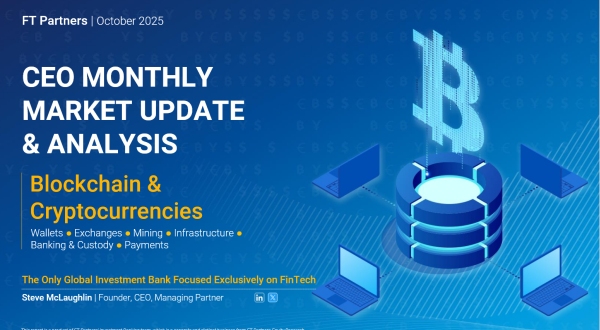
Financial Technology Partners (FT Partners) October 2025 Crypto and Blockchain Update shows that capital is flowing back into regulated digital asset infrastructure.
The Financial Technology Partners (FT Partners) October 2025 Blockchain and Cryptocurrencies Monthly report shows that digital asset M&A and financing activity has rebounded, led by exchanges, custody networks, and compliance technology. Institutional demand is piling into the market as regulated entities capture a growing share of capital and deal flow, with climbing valuations across regulated segments.
The FTP report data indicates that infrastructure remains the strongest and most resilient part of the market. Custody systems, settlement networks, and tokenization technology are attracting the largest investments as firms position to meet higher institutional and compliance standards. Transactions through 2025 is proof of how global players are consolidating around regulated platforms, liquidity access, and cross-border interoperability.
Ripple Labs acquired Standard Custody & Trust for $120 million in January, expanding its regulated tokenization and trust charter capabilities.
In April, Fireblocks raised $150 million at a $10 billion valuation to scale enterprise-grade custody and settlement systems. Komainu attracted $25 million in strategic investment during the same month to strengthen its institutional custody platform and compliance integrations.
May brought a $100 million raise for Anchorage Digital to expand its regulated digital asset banking and custody operations.
BitGo followed in June with a $100 million Series C round at a $1.75 billion valuation to deepen institutional tokenization services.
By September, Galaxy Digital acquired GK8 for $44 million, adding institutional self-custody and wallet management capabilities.
WonderFi completed a $100 million merger with Coinsquare and Bitbuy in January, forming one of Canada’s largest regulated crypto trading platforms.
Then later in March, Robinhood acquired WonderFi for C$250 million (around US$179 million), uniting Coinsquare and Bitbuy under its global exchange network.
Coinbase expanded twice, acquiring Circle’s European operations in February to enhance stablecoin settlement systems, then Deribit in August for $2.9 billion in cash and stock to extend crypto derivatives trading and clearing.
Chainalysis closed a $200 million Series F in June at a $4.2 billion valuation to expand blockchain intelligence and compliance monitoring.
A month later, Elliptic raised $50 million in a Series D extension to develop new anti–financial-crime tools for banks and exchanges.
Circle completed its acquisition of Archblock in February, integrating cross-chain USDC routing and compliance layers.
In May, Tether acquired Bitfinex Securities’ minority stake to reinforce its regulated token issuance network.
Ripple invested $285 million in August to expand global tokenization and CBDC settlement projects.
Kraken Ventures launched a $200 million fund in July focused on blockchain infrastructure and fintech platforms.
FT Partners’ 2025 data confirm that regulated infrastructure has become the foundation of digital finance. Valuations for infrastructure and compliance platforms now exceed eight times revenue, while consumer trading firms remain below four.
That spread shows that investors see real value in predictable, institutionally integrated systems rather than volatile retail flows. Institutional adoption continues through regulated products such as spot Bitcoin ETFs, tokenized funds, and custody-integrated settlement rails.
These channels represent a transition from speculative trading to reliable yield generation. Capital is rewarding throughput, compliance, and interoperability the same factors that define successful cross-border fintech models.
Growth will continue through robust compliance-oriented networks linking tokenized assets, stablecoins, and regulated exchanges. 2025 transactions signal global alignment toward clearer regulatory frameworks across Canada, Europe, and the United States. Taken together, these developments are building a more mature, data-driven digital finance ecosystem that's preparing for institutional scale.
The National Crowdfunding & Fintech Association (NCFA Canada) is a financial innovation ecosystem that provides education, market intelligence, industry stewardship, networking and funding opportunities and services to thousands of community members and works closely with industry, government, partners and affiliates to create aa vibrant and innovative fintech and funding industry in Canada. Decentralized and distributed, NCFA is engaged with global stakeholders and helps incubate projects and investment in fintech, alternative finance, crowdfunding, peer-to-peer finance, payments, digital assets and tokens, artificial intelligence, blockchain, cryptocurrency, regtech, and insurtech sectors. Join Canada's Fintech & Funding Community today FREE! Or become a contributing member and get perks. For more information, please visit: www.ncfacanada.org
| | |
|---|---|---|
| | |



August 26th, 2025

January 4th, 2024

June 1st, 2021

September 9th, 2020

July 9th, 2018

January 3rd, 2018

September 25th, 2017

June 20th, 2017

May 10th, 2017

December 14th, 2016
