





Karsten Wenzlaff, Advisor
August 26th, 2025
Karsten Wenzlaff is a Crowdfunding and Fintech Expert from Germany. He is Secretary-General of Digit[...]


Release | July 24, 2025

Image: Freepik
On July 24, 2025, Flashy Finance announced a sponsorship with AuCan Gold to launch a new Play for Gold game model that bridges real world assets and Web3 entertainment.
The first title, Dig It, will let users earn digital Nuggets tokens that can be redeemed for tokenised gold prizes backed by physical reserves. Up to $10 million in gold will be distributed across Flashy's game ecosystem, creating one of the largest real world asset reward pools in crypto gaming to date.
The collaboration builds on AuCan Gold’s July 22 launch of a US$2.5 billion tokenised gold platform for accredited investors. This expansion into the gaming market brings that same infrastructure to a new demographic of Web3 users while offering a way to win verified gold exposure through gameplay. Tokens earned in Dig It will be linked to physical gold via redemption programs supported by AuCan’s reserve-backed vault infrastructure.
Flashy’s upcoming suite of gold games will reward attention, creativity, and community engagement with real world value. The launch title Dig It is designed as a viral, tap-to-dig mobile experience.
A follow-up AR title called Go For Gold is also in development. In both games, players collect Nuggets tokens, which can be redeemed through licensed programs for tokenised gold ownership. Redemption is governed by smart contracts tied to audited reserves, ensuring that value earned in game corresponds to real gold in storage.
According to Flashy CEO Michael Gord, this model turns gold into a reward for participation. “Through Flashy and its sponsorship program with AuCan, we’re democratizing access to gold by turning it into a reward for creativity, skill, and participation.” The aim is to blend gaming, financial literacy, and decentralised infrastructure into a unified experience that makes asset ownership feel accessible and engaging.
The partnership with AuCan gives it access to compliant, asset-backed instruments that can support meaningful rewards and global scalability.
By integrating tokenised gold into gaming, firms like AuCan are unlocking new ways to distribute real assets at scale. It also allows Canadian companies to tap into global liquidity, not just through institutional channels but through viral, consumer driven platforms.
 The National Crowdfunding & Fintech Association (NCFA Canada) is a financial innovation ecosystem that provides education, market intelligence, industry stewardship, networking and funding opportunities and services to thousands of community members and works closely with industry, government, partners and affiliates to create a vibrant and innovative fintech and funding industry in Canada. Decentralized and distributed, NCFA is engaged with global stakeholders and helps incubate projects and investment in fintech, alternative finance, crowdfunding, peer-to-peer finance, payments, digital assets and tokens, artificial intelligence, blockchain, cryptocurrency, regtech, and insurtech sectors. Join Canada's Fintech & Funding Community today FREE! Or become a contributing member and get perks. For more information, please visit: www.ncfacanada.org
 |  |  |
|---|---|---|
 |  |  |
Web3 Jobs | July 23, 2025

The digital workforce is evolving fast. Remote work is no longer a trend - it’s the norm. But there’s a deeper shift happening that’s reshaping how we define work, identity, and opportunity: Web3. And at the frontlines of this revolution? Women. From developers to strategists, artists to marketers, women are carving out space - and power - in the decentralized world of Web3 jobs.
A Web3 nomad is a professional leveraging decentralized technologies, crypto networks, and blockchain protocols to work anywhere, anytime - without being tied to traditional employers or physical offices. These aren’t your typical remote workers on Slack and Zoom. They’re part of DAOs (Decentralized Autonomous Organizations), using crypto wallets as logins, earning in tokens, and managing their careers through reputation scores instead of résumés.
This shift isn’t just about new tools. It’s a complete restructuring of how people earn, collaborate, and build wealth online. And it’s drawing in more women than ever before, especially those who’ve been underserved or overlooked in traditional tech sectors.
Women are embracing Web3 jobs not because the system is perfect, but because it offers something rare: possibility without permission. Unlike legacy tech industries dominated by gatekeepers, Web3 is still fluid. It rewards output, creativity, and initiative over credentials.
Here’s why Web3 is fertile ground for female talent:
Despite the jargon, Web3 jobs aren’t all about coding. In fact, some of the highest-demand roles don’t require deep tech skills. The space is still young, and it needs a wide range of talent to grow, organize, and communicate.
Every one of these roles exists outside of traditional job boards. Most are project-based or governed by contributor reputation within DAOs. Salaries vary, but in many cases, Web3 pays better than Web2 - especially in token-based systems with upside potential.
You don’t need to “wait until you’re ready” to enter the Web3 world. Learning in public, contributing to projects, and showing up consistently gets you further than just taking courses or collecting certifications.
To navigate Web3 jobs, you need to be fluent with the platforms and tools where work happens. Here's a quick breakdown of where things go down:
Let’s not pretend this space is perfect - Web3 is still volatile, chaotic, and full of hype. But that’s also what makes it open to disruption and new voices. The reward systems, autonomy, and flexibility are lightyears ahead of anything in corporate tech.
Key advantages of Web3 work:
For women who’ve been underpaid, under-mentored, or underestimated in traditional tech, these dynamics are a game-changer.
Web3 isn’t just changing how we work. It’s changing who gets to lead. And women are already rewriting the script - not as tokens for diversity panels, but as architects of the next digital economy.
From Bali to Berlin, Lagos to Lisbon, a new class of Web3 nomads is rising - self-directed, skilled, and unstoppable. They're building portfolios, collecting tokens, and gaining influence - not just jobs.
If you’re looking for more than a paycheck - if you want autonomy, community, and upside - then Web3 might just be your next move. The ecosystem is wide open. And Web3 jobs are waiting.
The National Crowdfunding & Fintech Association (NCFA Canada) is a financial innovation ecosystem that provides education, market intelligence, industry stewardship, networking and funding opportunities and services to thousands of community members and works closely with industry, government, partners and affiliates to create a vibrant and innovative fintech and funding industry in Canada. Decentralized and distributed, NCFA is engaged with global stakeholders and helps incubate projects and investment in fintech, alternative finance, crowdfunding, peer-to-peer finance, payments, digital assets and tokens, artificial intelligence, blockchain, cryptocurrency, regtech, and insurtech sectors. Join Canada's Fintech & Funding Community today FREE! Or become a contributing member and get perks. For more information, please visit: www.ncfacanada.org
| | |
|---|---|---|
| | |
Tokenization | July 21, 2025

Image: Freepik
On July 16, 2025, the U.S. Securities and Exchange Commission (SEC) held a private meeting with Ethereum-linked groups including ERC-3643 Association and Chainlink Labs to explore standards for compliant tokenized securities. At the same time, SEC Chair Paul Atkins confirmed that the agency is reviewing an innovation exemption that could allow programmable compliance frameworks to operate with targeted regulatory relief. It's a new development that confirms growing regulatory support for tokenized finance, further raising the bar for Canadian policymakers to respond.
In a major development during Crypto Week, the SEC held a private session with Ethereum-aligned groups, such as the ERC‑3643 Association, Chainlink Labs, the Enterprise Ethereum Alliance, Etherealize, and LF Decentralized Trust to explore the use of public blockchain infrastructure for regulated securities.
The meeting focused on how blockchain systems can follow existing rules for verifying identities, tracking ownership, and controlling who can buy or sell tokenized securities. The groups shared technical solutions that help meet these requirements while still using decentralized public blockchains.
Dennis O’Connell, president of the ERC‑3643 Association said the SEC showed a “noticeable shift in tone” and openness to openly source industry standards.
Two frameworks were at the center of the meeting:
Chainlink Labs in a statement:
“Only Chainlink provides the compliance, privacy, cross-chain, and data infrastructure needed to scale digital asset adoption in a single platform.”
In partnership with the Blockchain Association, Chainlink recently launched Tokenized in America, a national ranking of blockchain leadership across all 50 U.S. states.
The SEC meeting coincided with Crypto Week where rapid legislative developments were taking place in Washington. The GENIUS Act was signed into law, establishing a federal framework for stablecoin regulation, and recognizing the role of tokenized payment infrastructure. It was passed alongside the CLARITY Act, which defines treatment for digital assets, and the Anti-CBDC Surveillance State Act.
SEC Chair Paul Atkins spoke publicly about the Commission’s interest in creating an “innovation exemption” that would allow compliant tokenized securities to be piloted without full adherence to legacy rules, saying:
“If it can be tokenized, it will be tokenized.”
Sergey Nazarov, Chainlink co-founder:
Excited to see our industry reaching new heights and getting global adoption from governments because of the fundamental value that our technology provides.
The GENIUS Act is a huge step forward for stablecoins, forming the basis of on-chain payments for retail users in both… https://t.co/QlgtUgOHlu
— Sergey Nazarov (@SergeyNazarov) July 18, 2025
Canada is already evaluating stablecoins under its existing regulatory framework. The CSA classifies fiat-backed coins like USDC as “Value‑Referenced Crypto Assets” and recently allowed more time for issuers to comply. At the same time, OSFI, Department of Finance and the Bank of Canada are developing new federal rules to license stablecoin issuers to include reserve requirements, redemption, audits, and consumer protection.
However, Canada currently lacks equivalent legal tools for programmable compliance mechanisms like ERC‑3643 or Chainlink ACE. If the SEC approves a standards-based tokenization model, Canadian fintechs will face increasing cross-border friction unless policymakers adapt quickly. NCFA previously highlighted this policy gap in its advocacy post, such as Coinbase Pushes for Tokenized Equities Approval commentary. Canadian regulators cannot fall further behind.
The National Crowdfunding & Fintech Association (NCFA Canada) is a financial innovation ecosystem that provides education, market intelligence, industry stewardship, networking and funding opportunities and services to thousands of community members and works closely with industry, government, partners and affiliates to create a vibrant and innovative fintech and funding industry in Canada. Decentralized and distributed, NCFA is engaged with global stakeholders and helps incubate projects and investment in fintech, alternative finance, crowdfunding, peer-to-peer finance, payments, digital assets and tokens, artificial intelligence, blockchain, cryptocurrency, regtech, and insurtech sectors. Join Canada's Fintech & Funding Community today FREE! Or become a contributing member and get perks. For more information, please visit: www.ncfacanada.org
| | |
|---|---|---|
| | |
Crypto Policy | July 15, 2025

Image: Freepik
This week, the U.S. House of Representatives is organizing a series of votes on three major cryptocurrency bills. American lawmakers are calling this “Crypto Week” because the outcome of debated decisions will likely impact digital assets and the future of crypto for years to come.
Included this week is how crypto and stablecoins are regulated,= and whether the U.S. government can issue its own central bank digital currency (CBDC). The outcome of course may influence how other countries including Canada approach regulation and innovation in the crypto-driven fintech sector.
Despite some chop in markets at these prices, Bitcoin rose to over US$123,000 on Monday, recording another new all time high as investors were drawn to the crypto policy news and congressional process taking place in the U.S., after years of regulation by enforcement. Investors see these bills as a clear sign that the U.S. will finally bring clarity to crypto regulation. There's also been steady growing demand and support from institutions, including companies like BlackRock, MicroStrategy and the list goes on.
This bill aims to define the roles of the Securities and Exchange Commission (SEC) and the Commodity Futures Trading Commission (CFTC). It would also allow some crypto projects to operate without registering as securities, if they meet certain technical standards.
This bill sets clear rules for companies that want to issue stablecoins. It requires 1:1 reserves in U.S. dollars or similarly defined safe assets, and also expands financial reporting and compliance rules for issuers.
This bill would block the U.S. Federal Reserve from launching a digital dollar. It says only Congress can approve a U.S. CBDC and aims to stop the central bank from using it to monitor or influence spending.
Votes are scheduled throughout the week, with final decisions on the CLARITY and Anti-CBDC bills expected by Thursday, and the GENIUS Act vote likely on Friday.
The U.S. is Canada’s closest financial partner. If Congress passes new laws that support crypto innovation while protecting consumers, it could set a standard for others to follow. A stablecoin framework in the U.S. could push Canadian regulators to accelerate efforts of their own.
Cross border and global fintech companies will benefit from clearer rules in the U.S., opening doors for new investment and partnerships. And as more large players move into crypto under a stable legal framework, Canada’s own financial institutions will face increasing pressure to compete.
The momentum is real. If these bills pass, the U.S. will take a significant leap towards a national digital policy. Canadian fintech leaders, investors and regulators must pay attention.
The National Crowdfunding & Fintech Association (NCFA Canada) is a financial innovation ecosystem that provides education, market intelligence, industry stewardship, networking and funding opportunities and services to thousands of community members and works closely with industry, government, partners and affiliates to create a vibrant and innovative fintech and funding industry in Canada. Decentralized and distributed, NCFA is engaged with global stakeholders and helps incubate projects and investment in fintech, alternative finance, crowdfunding, peer-to-peer finance, payments, digital assets and tokens, artificial intelligence, blockchain, cryptocurrency, regtech, and insurtech sectors. Join Canada's Fintech & Funding Community today FREE! Or become a contributing member and get perks. For more information, please visit: www.ncfacanada.org
| | |
|---|---|---|
| | |
Crypto | July 11, 2025

Image: BTCUSD Tradingview
Bitcoin just printed a massive green candle, BTC reaching a new all-time-high (ATH) of USD $118,000, boosted by institutional inflows, constrained supply, and regulatory momentum in global markets. At the same time, Canada is working to finalize long awaited rules to bring clarity to crypto exposure for funds and federally regulated financial institutions. Collectively, it's a rare convergence of events that are pushing up price. It's a timely opportunity for Canadian fintechs, fund managers, and policymakers to assess their positioning and prepare for what's next.
Global capital flows into Bitcoin are accelerating, as international financial markets interact with the asset.
U.S. spot Bitcoin ETFs have attracted over $51 billion USD in net inflows since January 2025. These products are managed by firms like BlackRock and Fidelity, are offering institutional investors direct and regulated access to Bitcoin at scale. On July 9 alone, daily flows exceeded USD $1.18 billion.
Bitcoin balances held on exchanges have fallen to their lowest levels since 2017, according to Glassnode data. It means long term hodlers are accumulating and there are fewer sellers which tightens liquidity and pushes prices upwards during surges.
Roughly $1 billion USD in short positions were liquidated in early July, forcing traders to buy back positions at higher prices, creating momentum that further boosts demand and additional institutional entry.
The GENIUS Act cleared the Senate with a bipartisan 68–30 vote on June 17, 2025, establishing the first federal framework for stablecoins (see SEC Issues Covered Stablecoin Statement, Risks Remain), including issuer registration, reserve and audit rules, and oversight. Next up is a House vote during “Crypto Week” starting July 14. In March, the White House issued an executive order creating a Strategic Bitcoin Reserve stocked with seized BTC and a broader digital assets stockpile, which aims to treat Bitcoin as a national reserve asset.
Major asset managers like Fidelity and BlackRock are incorporating Bitcoin as a foundational allocation. In May, U.S. spot Bitcoin ETFs saw a net inflow of $9.209 billion USD in just one week led by BlackRock’s IBIT and Fidelity’s FBTC. While global forces are transforming financial markets, what matters for Canadian fintechs and financial institutions is how Canada is responding.
In February 2025, the Office of the Superintendent of Financial Institutions (OSFI) published its final guideline on crypto-asset exposures. Taking effect later this year, the new framework applies to all federally regulated banks and insurers. According to Norton Rose Fulbright, it establishes:
These rules are an important step in integrating crypto within Canada’s prudential regulatory system, and they provide institutions with clearer guardrails to support innovation while managing systemic risk.
On April 17, 2025, the Canadian Securities Administrators (CSA) finalized amendments to NI 81-102, the national rule governing mutual funds and investment products. These changes come into force on July 16, 2025.
As detailed by McMillan and McCarthy Tétrault, the new rules say that:
The OSFI and CSA frameworks are opening clearer paths for new crypto products and more diversified portfolios. Fund managers can now launch Bitcoin-focused vehicles with defined rules around eligibility, custody, and risk.
Banks and insurers must begin planning for capital and governance policies that align with OSFI’s exposure thresholds.
Fintech platforms have more certainty when adding Bitcoin related features, with legal and compliance expectations now taking shape.
These changes also raise the bar for investor protection, requiring firms to strengthen disclosures, improve internal oversight, and adopt secure custody practices.
Another Bitcoin ATH is worth celebrating but the deeper trend is about normalization. Not too long ago, crypto assets were speculative but they are now moving to regulated infrastructure.
Canada is positioning itself to participate in a more stable and credible digital crypto future, and there's growing alignment between global investment flows and domestic regulatory action, providing fintechs and capital providers with greater clarity and confidence than ever before.
The National Crowdfunding & Fintech Association (NCFA Canada) is a financial innovation ecosystem that provides education, market intelligence, industry stewardship, networking and funding opportunities and services to thousands of community members and works closely with industry, government, partners and affiliates to create a vibrant and innovative fintech and funding industry in Canada. Decentralized and distributed, NCFA is engaged with global stakeholders and helps incubate projects and investment in fintech, alternative finance, crowdfunding, peer-to-peer finance, payments, digital assets and tokens, artificial intelligence, blockchain, cryptocurrency, regtech, and insurtech sectors. Join Canada's Fintech & Funding Community today FREE! Or become a contributing member and get perks. For more information, please visit: www.ncfacanada.org
| | |
|---|---|---|
| | |
Crypto Policy | June 11, 2025
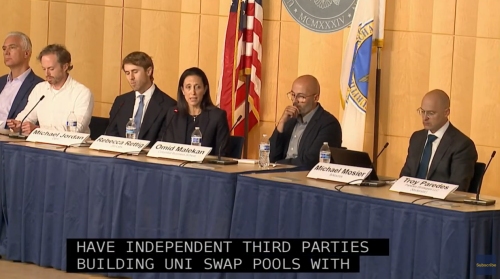
Image: June 9, 2025 DeFi Crypto Roundtable (Coindesk via youtube)
On June 9, the U.S. Securities and Exchange Commission (SEC) hosted another crypto task force roundtable series session called, "DeFi and the American Spirit", bringing together together regulators, legal experts, DeFi protocol developers, and investors to discuss how to the potential of regulating decentralized financial systems in ways that protects users without stifling innovation.
From the get-go, Chair Paul Atkins set the tone by opening the event by clearly stating that publishing code should not be treated as a crime:
“We will not regulate the act of writing open-source software. We do not prosecute the author of a hammer manual when someone misuses a hammer.”
The rest of the session built on this idea and focused on how the SEC can provide safe ways for DeFi projects to operate legally while still addressing investor risks.
In his remarks, Chair Atkins introduced the idea of a “conditional exemptive relief framework” which would allow DeFi innovators to build and launch on-chain products under limited conditions without triggering enforcement right away. This type of framework is similar to a regulatory sandbox that provides time-bound relief as long as participants meet specific safeguards.
“We are exploring a conditional exemptive relief framework that would allow experimentation under defined boundaries, similar to an innovation safe harbor.”
Commissioner Hester Peirce (aka Crypto mom) echoed this sentiment saying without a structured pathways to compliance, many innovators will either operate in legal uncertainty or offshore their projects out of the United States.
“Without a clear, conditional pathway, we are telling innovators you are on your own. That is not a message we want to send if we value the benefits of decentralized systems.”
In addition to the DeFi safe harbour, Chair Atkins also called upon his staff to modernize the current SEC rules to accommodate traditional issuers and intermediaries who want to use on-chain infrastructure.
This move shows that the SEC is looking to facilitate both new DeFi entrants and existing market players who are building tokenized products or using smart contracts to manage trading, issuance, or custody.
“I have asked the staff to consider whether amendments to the Commission’s rules and regulations would be better suited to provide needed accommodation for issuers and intermediaries who seek to administer on-chain financial systems.”
Atkins also discussed that on-chain systems can bring real benefits to the market, such as lower transaction costs, faster settlement, broader access, and the ability to create entirely new asset classes.
“I also am excited about the use of on-chain software systems by issuers and intermediaries to eliminate economic frictions, increase capital efficiency, enable new types of financial products, and enhance liquidity.”
It's clear support and endorsement of blockchain as a tool for economic growth, not just a solution for compliance challenges.
Several panelists, including Rebecca Rettig of Polygon Labs, warned that some of the most serious risks in DeFi happen off-chain. These include hidden liquidity deals, token allocations to insiders, or governance control partnerships.
“It is not always what is on-chain that creates the risk. It is often what is not disclosed, like side agreements, control over governance tokens, or preferential liquidity deals.”
Panelists argued that DeFi projects need better disclosure on how protocols are governed, how tokens are distributed, and whether any third parties receive special treatment or not.
Legal and industry experts said regulators should stop focusing on whether a token is a security and start regulating based on what the product or service actually does.
Angela Angelovska-Wilson of DLx Law said:
“We waste enormous energy litigating over whether X token is a security. The better path is regulating the activity, such as staking, custody, or lending, regardless of the label.”
Michael Jordan of the Digital Dollar Foundation agreed, saying:
“If we regulate the technology, someone will build around it. If we regulate the activity, we have a chance at real consumer protection.”
Important to understand the growing consensus that rules should distinguish between different types of financial behaviour even when the technology is similar.
Josh Garcia of Ketsal pointed out that some interfaces like custodial front ends that take custody of user funds or routes trades on behalf of users may require stricter oversight whereas protocols without admin control may require lighter regulation. Advocating for a layered regulatory approach that differentiates on function and control.
“A protocol with no privileged admin keys is not the same as a custodial front end that routes retail funds. The obligations differ, and so should the rules.”
After several Crypto Task force roundtable sessions, the SEC and participants are finally getting on the same page while focusing on conditional exemptions, regulatory modernization, and functional oversight. All together, it's a series effort to balance investor protection with lawful DeFi innovation. For fintech founders and digital asset platforms in Canada and globally, it's an important benchmark. If the U.S. begins providing clear compliance pathways and policy support for tokenized systems, then other jurisdictions will need to keep up or risk flight of builders and capital.
The National Crowdfunding & Fintech Association (NCFA Canada) is a financial innovation ecosystem that provides education, market intelligence, industry stewardship, networking and funding opportunities and services to thousands of community members and works closely with industry, government, partners and affiliates to create a vibrant and innovative fintech and funding industry in Canada. Decentralized and distributed, NCFA is engaged with global stakeholders and helps incubate projects and investment in fintech, alternative finance, crowdfunding, peer-to-peer finance, payments, digital assets and tokens, artificial intelligence, blockchain, cryptocurrency, regtech, and insurtech sectors. Join Canada's Fintech & Funding Community today FREE! Or become a contributing member and get perks. For more information, please visit: www.ncfacanada.org
| | |
|---|---|---|
| | |
Launch & Financing | June 9, 2025

Image: Freepik
Toronto-based startup Rails has launched a new hybrid crypto exchange model after raising $14 million USD through a token warrant sale to institutional backers led by Kraken and other investors Slow Ventures, CMCC Global, Quantstamp, and Round13 Capital. The platform uses zero knowledge proofs to verify asset custody without revealing user balances and combines the benefits off off-chain trading speed with on-chain settlement transparency.
Rails' model separates the trade execution layer from asset custody. Orders are matched off-chain using a central limit order book, while asset settlement occurs on-chain using zk-proofs and Merkle tree-based attestations.
According to CoinDesk, the system is built on Kraken’s L2 scaling protocol, Ink, which enables Ethereum settlement with reduced costs. This approach blends traditional exchange performance with DeFi-style auditability.
Commenting to Decrypt, co-founder Satraj Bambra said:
“We wanted to fix two broken pieces in crypto exchanges—proof of reserves and instant access to funds. This infrastructure is designed to do that at scale.”
Since the collapse of QuadrigaCX in 2019 and other incidents like the global fallout from FTX in 2022, Canada's crypto markets have remained cautious with regulators tightening rules on custody, trading platforms, and investor protection.
Rails’ technical achievement and architecture directly addresses Canadian regulatory concerns by removing custodial opacity and verifying user funds in real time. Having said that, while the company is based and founded in Toronto, it chose to incorporate in the U.S. due to regulatory constraints at home in Canada.
In an interview with BetaKit, co-founder Satraj Bambra explained:
“Regulations are a choke point for innovation, and you have to find a good middle ground between good regulation and fostering innovation… You go where you’re welcome. [In Canada], we’ve lost that balance.”
While Rails hasn't explicitly said that it hopes Canadian regulators are open to reform, it's own product design of verifiable reserves, decentralized custody, and zero knowledge settlement is the type of infrastructure Canada’s crypto sector has increasingly called for. If domestic policy evolves, platforms like Rails could serve as an excellent blueprint.
Rails’ model could lower the compliance burden for Canadian platforms by building transparency into the technical architecture. From a venture and infrastructure perspective, the startup’s $14 million token warrant sale format is also notable.
It avoids traditional equity dilution while aligning investors with network usage and governance. For Canadian fintechs seeking capital, tokenized structures may see an uptick in interest, especially if paired with products gaining traction.
Time will tel if Rails can capture significant trading volume but the launch and funding furnishes it with momentum to continue reinventing crypto systems with transparency and composability from the ground up. Rails' crypto infrastructure innovation could boost other homegrown efforts, including regulators who may be watching and learning too.
The National Crowdfunding & Fintech Association (NCFA Canada) is a financial innovation ecosystem that provides education, market intelligence, industry stewardship, networking and funding opportunities and services to thousands of community members and works closely with industry, government, partners and affiliates to create a vibrant and innovative fintech and funding industry in Canada. Decentralized and distributed, NCFA is engaged with global stakeholders and helps incubate projects and investment in fintech, alternative finance, crowdfunding, peer-to-peer finance, payments, digital assets and tokens, artificial intelligence, blockchain, cryptocurrency, regtech, and insurtech sectors. Join Canada's Fintech & Funding Community today FREE! Or become a contributing member and get perks. For more information, please visit: www.ncfacanada.org
| | |
|---|---|---|
| | |



August 26th, 2025

January 4th, 2024

June 1st, 2021

September 9th, 2020

July 9th, 2018

January 3rd, 2018

September 25th, 2017

June 20th, 2017

May 10th, 2017

December 14th, 2016
