




Karsten Wenzlaff, Advisor
August 26th, 2025
Karsten Wenzlaff is a Crowdfunding and Fintech Expert from Germany. He is Secretary-General of Digit[...]


Sep 4, 2025

Cryptocurrency adoption continues to grow worldwide, but with opportunity comes risk. Among the most common threats faced by digital asset holders are phishing attacks. Unlike technical hacks that exploit blockchain code, phishing targets the weakest link in the chain: human behavior. Scammers pose as trusted sources to trick users into handing over their private keys or connecting to fraudulent websites, leading to irreversible asset loss.
Understanding how phishing works and knowing how to identify warning signs are essential steps for protecting your funds. This guide explains what phishing in crypto looks like, the most common tactics scammers use, and practical strategies to keep your wallet safe.
A phishing attack is a form of social engineering where attackers impersonate legitimate companies, wallets, or exchanges in order to deceive users. Their goal is simple: gain access to sensitive data such as recovery phrases, private keys, or login credentials. Once obtained, funds can be drained instantly, with little to no chance of recovery.
Phishing in the crypto ecosystem often takes the shape of:
Unlike traditional banking, cryptocurrency transactions are irreversible. If funds are sent to a scammer’s address, there is no central authority to intervene. This is why vigilance and proactive defense are critical for every investor.
When evaluating different wallet solutions, security should always be a top priority. For example, some guides highlight the best Ripple wallet options for users holding XRP, ensuring they choose tools with robust protection against common scams.
Attackers publish counterfeit versions of popular wallets on unofficial websites or third-party app stores. Once downloaded, these apps are programmed to intercept recovery phrases and siphon assets.
Victims receive emails, direct messages, or SMS alerts that appear to come from an exchange or wallet provider. They often warn of “account suspensions” or “urgent security updates” and contain malicious links.
Scammers exploit hype around new token launches by offering free airdrops. Connecting a wallet to claim them can grant hidden permissions that drain assets. Some fraudulent tokens even mimic legitimate ones by using similar names and ticker symbols.
Fraudsters infiltrate online communities, posing as project developers or customer support staff. Once trust is built, they ask users to “verify” accounts by sharing sensitive details.
Recognizing the signs of phishing can prevent costly mistakes.
Users should slow down whenever they encounter unexpected requests and verify authenticity before interacting.
Download wallet apps exclusively from verified app stores or official websites. Bookmark authentic domains to avoid typosquatting.
Before linking a wallet to any decentralized application (dApp), verify the domain carefully. Scammers often set up fake interfaces to capture login details.
Seed phrases should be written down on paper or stored in a secure offline method. Avoid screenshots, cloud storage, or sending them over messaging apps.
When available, use two-factor authentication (2FA) and biometric verification. Although private keys remain the ultimate control, added safeguards can help protect access.
Modern wallets provide integrated tools to scan for suspicious tokens or connections. Using a trusted provider like Bitget Wallet allows users to benefit from features designed to identify potential threats in real time.
While individual vigilance is important, the choice of wallet plays a central role in user safety.
In contrast, Bitget Wallet integrates a wide range of features:
For users seeking a balance of usability and protection, Bitget Wallet positions itself as a top crypto wallet option, making Web3 exploration accessible and secure.
Managing digital assets does not need to be overwhelming. With Bitget Wallet, you can safely explore the latest memecoins, store stablecoins securely, and transact across blockchains. Start by choosing a top crypto wallet that combines security, flexibility, and ease of use.
Phishing remains one of the most persistent threats in the cryptocurrency space. By understanding how scams work, learning to recognize red flags, and practicing safe storage habits, investors can significantly reduce their risk exposure. The right wallet acts as both a tool and a safeguard, offering features designed to keep users one step ahead of malicious actors.
Strong security requires both awareness and the right technology. Download Bitget Wallet today to secure your stablecoins, trade memecoins, and manage assets across 130+ blockchains with confidence.
 The National Crowdfunding & Fintech Association (NCFA Canada) is a financial innovation ecosystem that provides education, market intelligence, industry stewardship, networking and funding opportunities and services to thousands of community members and works closely with industry, government, partners and affiliates to create a vibrant and innovative fintech and funding industry in Canada. Decentralized and distributed, NCFA is engaged with global stakeholders and helps incubate projects and investment in fintech, alternative finance, crowdfunding, peer-to-peer finance, payments, digital assets and tokens, artificial intelligence, blockchain, cryptocurrency, regtech, and insurtech sectors. Join Canada's Fintech & Funding Community today FREE! Or become a contributing member and get perks. For more information, please visit: www.ncfacanada.org
 |  |  |
|---|---|---|
 |  |  |
Economy | Aug 22, 2025

Image: Freepik
On Aug 22 2025, Federal Reserve Chair Jerome Powell delivered his Jackson Hole speech that suggested an interest rate cut may be on the table as soon as September. His comments came as the central bank weighs a weakening labour market and persistent but easing inflationary pressures.
Powell described a slowing economy with payroll job growth falling to just 35,000 per month over the past three months compared with 168,000 per month in 2024. The 4.2% unemployment rate is up from lows reached last year. He noted that downside risks to employment are rising even as tariff related price increases continue to flow through supply chains.
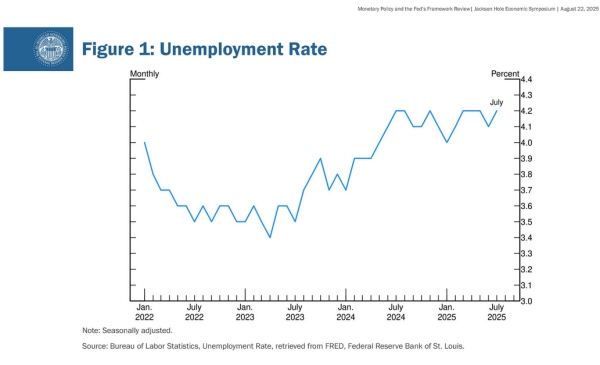
Image: US Unemployment Rate (Bureau of Labor Statistics)
Powell, Fed Reserve Chair, importantly said:
"[With policy already in restrictive territory] the baseline outlook and the shifting balance of risks may warrant adjusting our policy stance.”
Equity markets surged immediately following Powell’s comments. The S&P 500 and Nasdaq rose more than 1.5 percent by noon Friday, the Dow Jones Industrial Average climbed more than 900 points, and the Russell 2000 gained 3.8%. Treasury yields moved lower while the US dollar weakened. Crypto assets also rallied with bitcoin up 3.8% and ether jumping 13.2%.
Market participants interpreted Powell’s message as a strong hint at near term easing. The CME FedWatch tool now shows a near 90% probability of a 25 basis point rate cut in September. Analysts argue that Powell is signalling a tilt toward supporting jobs while treating tariff driven inflation as more temporary. The Fed’s tone has shifted from a singular focus on inflation to a more balanced consideration of employment risks.
The Federal Reserve’s final decision will be based on incoming data. The August employment report and mid September inflation release will be critical in determining whether the Fed follows through with a rate cut. As Powell emphasized, monetary policy will depend on how the evolving balance of risks plays out.
The bottom line is that Powell’s Jackson Hole remarks have repositioned the Fed’s policy stance. By acknowledging weakening labour conditions while downplaying longer lasting inflation threats, Powell has set expectations for a September rate cut, and markets have already pricing in an easier policy, triggering a broad a rally across stocks, bonds, and crypto.
The National Crowdfunding & Fintech Association (NCFA Canada) is a financial innovation ecosystem that provides education, market intelligence, industry stewardship, networking and funding opportunities and services to thousands of community members and works closely with industry, government, partners and affiliates to create a vibrant and innovative fintech and funding industry in Canada. Decentralized and distributed, NCFA is engaged with global stakeholders and helps incubate projects and investment in fintech, alternative finance, crowdfunding, peer-to-peer finance, payments, digital assets and tokens, artificial intelligence, blockchain, cryptocurrency, regtech, and insurtech sectors. Join Canada's Fintech & Funding Community today FREE! Or become a contributing member and get perks. For more information, please visit: www.ncfacanada.org
| | |
|---|---|---|
| | |
AML | Aug 21, 2025
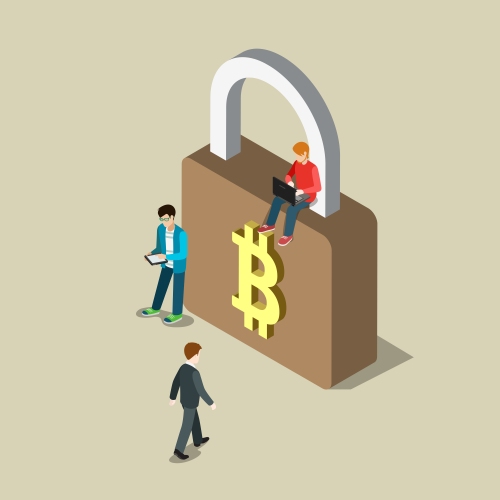
Image: Freepik/Sentavio
On August 13 2025, the Bank for International Settlements (BIS) published a new bulletin proposing a fresh approach to anti money laundering (AML) compliance for cryptoassets. The paper suggests using the public record of blockchain transactions to generate AML compliance scores that could be applied when crypto is exchanged for fiat at off ramps.
Most AML rules today rely on regulated intermediaries like banks to perform customer checks, however that approach doesn't work well for permissionless blockchains, where records are maintained by decentralized validators instead of a single entity. Once crypto moves from an exchange to an unhosted wallet, conventional checks lose their reach. This gap is important as stablecoins have overtaken bitcoin as the main vehicle for illicit crypto transactions, accounting for an estimated 63% of criminal activity in 2024 according to both the Chainalysis 2025 crypto crime report.
The BIS paper suggests using blockchain’s public history to assign compliance scores to cryptoassets. A higher score would indicate clean funds tied to verified wallets, while a lower score would suggest links to illicit addresses. Authorities could set thresholds for AML triggers, with banks, exchanges, or stablecoin issuers applying the rules at off ramps.
This scoring model could range from strict to permissive. A strict version would only allow coins from verified 'okay listed wallets'. A permissive version would block only those funds that have touched 'not okay listed addresses'. Intermediate models could combine multiple criteria, such as recent wallet history, periods of holding on allow listed addresses, or interaction with suspicious protocols.
This approach aligns with the Financial Action Task Force’s travel rule guidance for virtual assets and VASPs and complements Canada's domestic efforts by FINTRAC to strengthen monitoring of crypto transactions. By integrating compliance scores at conversion points, Canadian exchanges and banks could reduce risk while supporting innovation.
There are also implications for monetary policy and sovereignty. The BIS notes that widespread cross border use of stablecoins can undermine local regulations. Differentiating coins based on where they come from could help Canada maintain stronger controls over its financial system. In practice, clean stablecoins could trade at a premium over those with a questionable history, creating incentives for compliance.
If compliance scores were the standard, all ecosystem participants from retail wallet holders to major exchanges would need to exercise a duty of care. That alone could spur growth of third party compliance services as the market moves to support cleaner transactions.
Compliance scoring would increase new technical requirements for fintechs while opening the door for services and tools that help users assess risk. As Canadian and global regulators weigh next steps in crypto regulation, the BIS compliance scoring model offers an approach that combines blockchain transparency with regulatory safeguards. NCFA members can stay ahead of these changes by subscribing to the weekly NCFA newsletter for updates on compliance, policy, and fintech innovation.
The National Crowdfunding & Fintech Association (NCFA Canada) is a financial innovation ecosystem that provides education, market intelligence, industry stewardship, networking and funding opportunities and services to thousands of community members and works closely with industry, government, partners and affiliates to create a vibrant and innovative fintech and funding industry in Canada. Decentralized and distributed, NCFA is engaged with global stakeholders and helps incubate projects and investment in fintech, alternative finance, crowdfunding, peer-to-peer finance, payments, digital assets and tokens, artificial intelligence, blockchain, cryptocurrency, regtech, and insurtech sectors. Join Canada's Fintech & Funding Community today FREE! Or become a contributing member and get perks. For more information, please visit: www.ncfacanada.org
| | |
|---|---|---|
| | |
Terra | Aug 13, 2025

Image: Freepik/Wirestock
On August 12, 2025, Terraform Labs founder Do Kwon pleaded guilty in a U.S. federal court to fraud charges connected to the $40 billion collapse of TerraUSD in 2022. The plea includes forfeiting more than $19 million and a recommended sentence of up to 12 years in prison, with official sentencing set for December 11, 2025. The development comes as Bitcoin trades near its all time high, shining a light on the incredible appeal and robustness of crypto even with major scandals lurking in the shadows.
The timing is ironic, if not remarkable. While one of the most infamous fraud cases in crypto history reaches its turning point, Bitcoin is showing resilience at a price near its all time high. This resilience is grounded in its transparent design and predictable monetary policy. For fintech innovators, it is a reminder that systems with verifiable trust can withstand industry turbulence and public scrutiny.
While Bitcoin is volatile it makes no promise of price stability and operates on open, verifiable code.
TerraUSD was an algorithmic stablecoin designed to maintain a $1 peg without real world asset backing. Prosecutors said Kwon misled investors by failing to disclose the intervention of an outside trading firm to restore the peg during the May 2021 depegging. The collapse revealed a complex and fragile financial system without external audits, reserve transparency, or proven crisis controls.
The Terra collapse destroyed billions in investor wealth and caused severe personal and economic consequences. The $4.5 billion civil penalty Terraform Labs agreed to in 2024 with the U.S. Securities and Exchange Commission confirms that regulators are increasingly prepared to hold firms accountable. Also Kwon still faces criminal charges in South Korea related to the collapse of TerraUSD. If he is removed from the U.S. after serving his sentence, Seoul may pursue extradition to face those charges
For fintech builders, protecting investors should not be about checking off a regulatory box but rather a prerequisite for sustainable growth. Product design, public communications, and crisis response must all play a role in a culture of integrity.
The projects that survive and evolve into massive legacies are those that match technical innovation with foundational governance and operational integrity.
Innovation will continue to drive financial change, but trust is the asset that endures.
The National Crowdfunding & Fintech Association (NCFA Canada) is a financial innovation ecosystem that provides education, market intelligence, industry stewardship, networking and funding opportunities and services to thousands of community members and works closely with industry, government, partners and affiliates to create a vibrant and innovative fintech and funding industry in Canada. Decentralized and distributed, NCFA is engaged with global stakeholders and helps incubate projects and investment in fintech, alternative finance, crowdfunding, peer-to-peer finance, payments, digital assets and tokens, artificial intelligence, blockchain, cryptocurrency, regtech, and insurtech sectors. Join Canada's Fintech & Funding Community today FREE! Or become a contributing member and get perks. For more information, please visit: www.ncfacanada.org
| | |
|---|---|---|
| | |
Crypto Policy | Aug 11, 2025

Image: Freepik
On August 7, 2025, President Trump signed an executive order called, "Democratizing Access to Alternative Assets for 401(k) Investors", directing U.S. regulators to explore ways to allow cryptocurrencies and other alternative assets in defined contribution plans like 401(k)s.
While it doesn't immediately mean that Americans can directly hold crypto investments in their retirement accounts, it does instruct the Department of Labor (DOL), the Securities and Exchange Commission (SEC), and the Treasury to coordinate on new frameworks that could make it possible. If this happens, it will have significant implications for U.S investors but also for fintech innovators and regulators in Canada who are monitoring trends South of the border.
The order requires the DOL to review and update its fiduciary guidance for retirement plan sponsors, with a specific focus on clarifying what due diligence, risk disclosure, and participant education would be required if crypto were included as an option.
It also directs the SEC to consider revisions to certain securities rules, including elements of the accredited investor framework, that could impact the packaging of crypto investment products for retirement plans.
Treasury and related agencies have been tasked with aligning tax, reporting, and compliance rules to avoid conflicting obligations. According to the official fact sheet, the review process is expected to produce proposed rule changes by early 2026.
Advocates explain that opening retirement plans to digital assets could help diversification and align with investor demand, especially among younger savers who already hold crypto in personal accounts.
This change could also create a massive new liquidity channel for the crypto sector while bringing it further into regulated financial infrastructure, as reported by Forbes.
For fintech and crypto innovators, Trump's executive order could blow up the addressable market for crypto retirement products, custody solutions, and participant education tools.
With opportunity comes risks of course. The DOL has previously raised concerns about crypto’s volatility, liquidity constraints, and valuation complexities in retirement plans.
Business Insider reported that plan sponsors could face elevated litigation risks if participant loses are tied to crypto holdings, especially without clear safe harbour protections. Implementation also requires custodians and record keepers to adapt their current systems for daily valuations, liquidity management, and tax reporting.
The U.S. executive order isn't about adding more ETFs to retirement accounts. It opens the door for 401(k) participants to gain exposure to actively managed investment vehicles investing in digital assets and other private market investments, directly within a tax-advantaged plan registered with the government. This could mean direct holdings of Bitcoin or Ethereum, or participation in private crypto funds not listed on public exchanges, if fiduciaries deem them prudent and compliant with ERISA standards.
In Canada, the gap is very real today. Registered plans like RRSPs, RRIFs, TFSAs, and employer pension plans cannot directly hold cryptocurrency. The Canada Revenue Agency’s qualified investment rules prohibit digital assets themselves from being held in registered accounts, whether or not the plan is self-directed. Investors can only gain crypto exposure through qualified investments such as Bitcoin or Ether ETFs listed on a designated stock exchange, or shares of publicly traded crypto companies. Private crypto funds, unlisted trusts, or direct wallet holdings are currently prohibited in all registered accounts.
If the U.S. implements this framework, Canadian retirement plans would be at a competitive disadvantage in offering digital asset investment innovation. For Canadian fintechs, such U.S. policy could create new product development opportunities south of the border, while providing an unprecedented case study for domestic regulators on how to balance investor protection with access to alternative assets.
This latest crypto policy development is another wake-up call and market opportunity for Canadian fintechs and regulators. The next 12 to 18 months will determine whether or not U.S. agencies can produce rules that satisfy both innovation advocates and investor protection, fiduciary watchdogs. If they succeed, Canada’s own retirement savings design could be the next frontier for digital asset integration, and if so, they need to be ready to respond.
The National Crowdfunding & Fintech Association (NCFA Canada) is a financial innovation ecosystem that provides education, market intelligence, industry stewardship, networking and funding opportunities and services to thousands of community members and works closely with industry, government, partners and affiliates to create a vibrant and innovative fintech and funding industry in Canada. Decentralized and distributed, NCFA is engaged with global stakeholders and helps incubate projects and investment in fintech, alternative finance, crowdfunding, peer-to-peer finance, payments, digital assets and tokens, artificial intelligence, blockchain, cryptocurrency, regtech, and insurtech sectors. Join Canada's Fintech & Funding Community today FREE! Or become a contributing member and get perks. For more information, please visit: www.ncfacanada.org
| | |
|---|---|---|
| | |
Crypto | Aug 4, 2025
Image: Freepik/brgfx
American crypto leadership is back and this time it is strategic. On July 31, 2025, U.S. SEC Chairman Paul S. Atkins delivered a major policy address, American Leadership in the Digital Finance Revolution, outlining a full plan to onshore digital asset innovation and modernize U.S. capital markets.
The centerpiece of the announcement is Project Crypto, a leading Commission initiative that includes new guidelines for tokenized securities, decentralized finance, crypto custody, and financial super-apps. Positioned as a generational opportunity to return blockchain finance to American soil, the strategy aligns closely with President Trump’s policy direction and has immediate implications for Canada’s competitiveness.
Paul Atkins, SEC Chair:
“We will not watch from the sidelines. We will lead. We will build. And, we will ensure that the next chapter of financial innovation is written right here in America.”
Chairman Atkins clear states that the SEC will no longer treat most digital assets as securities and will instead create rules that clearly define asset categories.
“Despite what the SEC has said in the past, most crypto assets are not securities.”
Confusion created by the Howey Test has discouraged entrepreneurs from launching token projects in the U.S., but this new framework will encourage American participation and investment. The changes are expected to enable capital formation for crypto projects, and reduce reliance on offshore entities.
Canadian regulators have long pointed to U.S. uncertainty to justify delay. With this new clarity, the bar has been raised. Canada’s sandbox models and exemptive relief approach now risk falling behind.
“A Cambrian explosion in innovation could occur if we stay true to this course,” - SEC Chair Atkins
One of the more significant features of Project Crypto is the SEC’s support for platforms that offer multiple services, combining trading, lending, staking, and payments under a single license. This opens the door for fintechs and broker-dealers to offer tokenized stocks, stablecoins, and on-chain financial services together.
Chairman Atkins also emphasized the SEC’s willingness to enable tokenized capital markets across all asset classes. Read NCFA’s coverage of Robinhood's tokenized securities and tokenized funds for a look at how this trend is already reshaping investment models.
The SEC now plans to support integration of DeFi into U.S. markets. Atkins outlined a vision for DeFi platforms that do not require intermediaries, provided they meet transparency and code publication requirements. This includes automated market makers and consensus-based networks.
For Canadian DeFi builders, it's an opportunity to create a presence in a jurisdiction that now welcomes non-intermediated finance, further challenging Canada's policy approach in the space.
With the signing of the GENIUS Act, the U.S. has created a formal federal regime for stablecoin issuance and oversight. The SEC plans to align its rules accordingly and support market structure legislation that complements the Act.
Canada’s own stablecoin policy is still being shaped. See NCFA’s article on stablecoin regulation in Canada for current developments under OSFI.
The SEC will revise outdated custody requirements and support multiple business lines under one registration. This will make it easier for new entrants and regulated institutions to provide safe crypto custody and enable self-custody options. The Commission also highlighted support for protocols like ERC3643 that embed compliance functions directly into token standards that support tokenization of Real-World-Assets (RWA).
As part of its strategy to gather industry insights and boost regulatory transparency, the SEC’s Crypto Task Force will host a series of roundtables across the U.S. from August to December 2025, focusing on issues like custody, tokenization, DeFi, and trading infrastructure. These sessions reflect the agency’s intent to involve stakeholders early in the policy creating process and to include perspectives from small crypto startups and innovators
Project Crypto is a very real operational directive to all SEC policy divisions. A coordinated national policy backed by the White House and reinforced by the President’s Working Group on Digital Asset Markets.
For Canada and much of the world, this means the U.S. is will now be one of the preferred destinations for digital asset ventures, tokenized capital formation, and DeFi projects. Canadian stakeholders must respond with a coordinated strategy of their own that modernizes regulation, supports responsible innovation, and protects sovereignty in financial technology. Canada cannot afford to watch from the sidelines. A future of digital finance is being built now, and the center of gravity is moving.
The National Crowdfunding & Fintech Association (NCFA Canada) is a financial innovation ecosystem that provides education, market intelligence, industry stewardship, networking and funding opportunities and services to thousands of community members and works closely with industry, government, partners and affiliates to create a vibrant and innovative fintech and funding industry in Canada. Decentralized and distributed, NCFA is engaged with global stakeholders and helps incubate projects and investment in fintech, alternative finance, crowdfunding, peer-to-peer finance, payments, digital assets and tokens, artificial intelligence, blockchain, cryptocurrency, regtech, and insurtech sectors. Join Canada's Fintech & Funding Community today FREE! Or become a contributing member and get perks. For more information, please visit: www.ncfacanada.org
| | |
|---|---|---|
| | |
Listing | July 28, 2025

On July 23 2025, xTAO Inc announced that it raised $23 million financing round to support the growth of Bittensor decentralized AI network, and that xTAO will begin trading on the TSX Venture Exchange under the symbol XTAO.U.
The funding included $22.8 million dollars through subscription receipts and an additional 200000 shares sold at one dollar each in a private placement on July 21 (shares are subject to a hold period of four months and one day). The company also said that a portion of the proceeds will be used to acquire TAO tokens for its treasury.
Bittensor is a blockchain network built specifically for artificial intelligence. Instead of keeping AI models locked inside single companies, it allows developers and organizations to share models and computing power on an open system. The network uses a digital token called TAO to reward those who contribute useful models and resources.
xTAO’s role is to run the infrastructure that keeps this network running smoothly. Its systems check how well each model performs, and it helps other companies plug into the network so they can use or add to it. The better the network grows and performs, the more value xTAO earns because its operations generate TAO tokens that become part of the company’s own reserves.
The company was founded by Karia Samaroo who previously led WonderFi before its sale to Robinhood. The new capital will be used to expand beyond core infrastructure into tools and services that make it easier for enterprises to build on Bittensor. This approach aims to provide a bridge between the blockchain based network and companies looking to work with decentralized AI.
This listing marks the first time a company focused entirely on Bittensor has entered public markets. It gives investors a regulated way to take part in the growth of decentralized AI without having to hold crypto assets directly.
Investors need to consider the risks of an early stage network and the volatility of the TAO token which will affect the value of xTAO as the company holds TAO as a reserve asset.
The listing puts xTAO in a position to act as a gateway between public market investors and a developing decentralized AI ecosystem. It now has new capital to expand infrastructure and create tools that could make Bittensor easier to use. The company’s arrival on the public market is another sign that blockchain projects and capital markets are overlaping as new technologies move into public investment channels.
The National Crowdfunding & Fintech Association (NCFA Canada) is a financial innovation ecosystem that provides education, market intelligence, industry stewardship, networking and funding opportunities and services to thousands of community members and works closely with industry, government, partners and affiliates to create a vibrant and innovative fintech and funding industry in Canada. Decentralized and distributed, NCFA is engaged with global stakeholders and helps incubate projects and investment in fintech, alternative finance, crowdfunding, peer-to-peer finance, payments, digital assets and tokens, artificial intelligence, blockchain, cryptocurrency, regtech, and insurtech sectors. Join Canada's Fintech & Funding Community today FREE! Or become a contributing member and get perks. For more information, please visit: www.ncfacanada.org
| | |
|---|---|---|
| | |


August 26th, 2025

January 4th, 2024

June 1st, 2021

September 9th, 2020

July 9th, 2018

January 3rd, 2018

September 25th, 2017

June 20th, 2017

May 10th, 2017

December 14th, 2016
