





Karsten Wenzlaff, Advisor
August 26th, 2025
Karsten Wenzlaff is a Crowdfunding and Fintech Expert from Germany. He is Secretary-General of Digit[...]


Release | January 5, 2026

Image: Freepik/user6702303
On January 5 2026, Vancouver-based Canadian fintech VoPay announced the establishment of its global headquarters in Doha, Qatar. The move supports VoPay’s plan to expand digital financial infrastructure across the Middle East and North Africa, Africa, Southeast Asia, and other high growth regions, while continuing to operate across Canada, North America, Europe, and Latin America.
The announcement reflects a deliberate expansion strategy. VoPay continues to operate from Canada and North America while adding a global coordination hub closer to markets undergoing rapid financial modernization.
Hamed Arbabi, Founder and CEO of VoPay:
“Our decision to establish VoPay’s global headquarters in Qatar reflects a deep alignment with the country’s long-term vision for economic diversification and digital leadership. Qatar offers a unique platform for scaling financial infrastructure that connects regions, institutions, and markets. With the support of Invest Qatar and the Qatar Financial Centre, we are investing for the long term by building world-class talent and advancing financial infrastructure that operates across borders with scale, intelligence, and resilience.”
Qatar has spent years positioning itself as a platform for long term economic diversification and digital leadership. That direction is formalized through Qatar National Vision 2030, which focuses on building a diversified, knowledge based economy with global reach. Qatar functions less as a destination market and more as a base for regional connectivity across MENA, Africa, and Southeast Asia.
For VoPay, Doha offers proximity to regional institutions, policy makers, and financial system stakeholders who are actively modernizing infrastructure and strengthening connections between markets. Locating a global headquarters in this environment supports longer cycle infrastructure work that depends on trust, coordination, and sustained engagement rather than rapid consumer adoption.
As part of this expansion, VoPay plans to hire more than 400 professionals in Qatar over the next three years across engineering, technology, security, compliance, data, and platform operations, as outlined in the official release.
VoPay’s expansion is supported by Invest Qatar, which plays a role in facilitating market entry and aligning the company’s growth with national economic priorities. The partnership reflects a shared interest in building durable financial infrastructure capabilities in the region. This type of institutional support is important for companies operating at the infrastructure layer.
A key point for Canadian fintech stakeholders is what does not change. VoPay continues to operate in Canada and across North America, with teams, technology, and partnerships remaining part of the company’s operating core.
That foundation supports how VoPay scales globally. Core capabilities remain anchored at home, while coordination and execution expand into regions where proximity to institutions and partners improves outcomes. This model reflects how infrastructure companies grow in practice, by extending reach without fragmenting the organization.
From that perspective, the global headquarters in Qatar functions as a coordination hub for financial infrastructure work that spans regions, regulatory environments, and institutional systems. It allows VoPay to manage complexity closer to the markets it serves while preserving its Canadian base.
Demand for financial infrastructure continues to grow as regions modernize within local constraints while strengthening connections to global networks. VoPay’s expansion reflects how infrastructure companies scale in practice by building regional hubs that support long term growth and institutional engagement without weakening their home base. For Canada’s fintech community, it shows how a strong domestic footprint and global growth can coexist through disciplined and strategic expansion.
 The National Crowdfunding & Fintech Association (NCFA Canada) is a financial innovation ecosystem that provides education, market intelligence, industry stewardship, networking and funding opportunities and services to thousands of community members and works closely with industry, government, partners and affiliates to create a vibrant and innovative fintech and funding industry in Canada. Decentralized and distributed, NCFA is engaged with global stakeholders and helps incubate projects and investment in fintech, alternative finance, crowdfunding, peer-to-peer finance, payments, digital assets and tokens, artificial intelligence, blockchain, cryptocurrency, regtech, and insurtech sectors. Join Canada's Fintech & Funding Community today FREE! Or become a contributing member and get perks. For more information, please visit: www.ncfacanada.org
 |  |  |
|---|---|---|
 |  |  |
Open Banking in Canada | Nov 26, 2025

Canada is moving into a new phase of financial services with the Consumer Driven Banking Act. Budget 2025 confirms that open banking is officially moving forward, with a clear sequence for how the system rolls out. Legislation and technical standards in focus throughout 2025. The Bank of Canada receives new funding to supervise Canada's Open Banking Framework, and the government commits that people will not face fees when they access or share their financial data. The Real Time Rail to be launched in Q3 2026. Full open banking functionality including payment initiation is expected by mid 2027.
People will soon gain the right to share their financial data safely, securely and at no cost with accredited providers (which is highly important given the JPMorgan data fee backlash in the US). This functionality creates room for new products and new revenue models. It also pushes banks, fintechs and API platforms to rethink how they plan to commercialize the framework and grow. Since providers cannot charge fees for in scope data, the value sits in the tools and services built on top of that shared information.
Huw Davies puts useful ideas on the table in a recent Ozone API article, 'show me the money' about treating open banking APIs as real commercial channels. His thinking sparks a closer look at how those ideas land in Canada, where the rules, accreditation structure and staged rollout create a different set of opportunities. When you look at the Consumer Driven Banking Act through a commercial lens, the roadmap becomes clear. This article provides an overview of some models that could work in the read only phase. Other models unlock once write access arrives in phase 2, and a few ideas won't fit the Canadian framework at all.
Open banking in Canada begins with safe, consented data access, but the first year focuses on building the foundation rather than running a live system. Through 2025, the government works on legislation, technical standards, accreditation, supervision and security. The Bank of Canada receives $19.3 million over two years to lead this work, and the government redirects $36.9 million previously assigned to the Financial Consumer Agency of Canada to support the transition. Cybersecurity receives new funding as well, including $25.7 million over five years and an ongoing $5 million allocation for CSIS and the RCMP.
Read only data-sharing is expected to take shape in 2026 once the technical and operational framework is ready. In this stage, accredited providers can only read in scope data that a person approves. They cannot trigger payments or update any accounts. Revenue can be generated from insight, identity, developer experience and onboarding support. These components create value without charging for the data itself. Below is an overview of some models that can work during the read only stage.
| Type | Model | Viability | Why It Works | How It Generates Revenue |
| Enrichment and Analytics | Categorization and personal finance tools | High | Turns raw data into clear insight for users | Subscriptions or bank partnerships |
| Small business cash flow dashboards | High | Helps business owners manage money and plan ahead | SaaS pricing | |
| Spending and savings insights | High | Gives people visibility and confidence | Consumer upgrades | |
| Identity and Compliance | Identity verification and KYC | High | Accreditation increases demand for strong identity tools | Per verification fees |
| Fraud detection and risk scoring | High | Supports trust across the ecosystem | Event based fees | |
| Consent and audit logging | High | Helps accredited providers meet compliance requirements | Platform fees | |
| API Performance | High throughput tiers | High | Monetizes reliability and speed instead of raw data | Tiered usage |
| Extended transaction history | Moderate | Depends on regulatory interpretation | Premium tier | |
| Enhanced sandbox and developer tools | Moderate | Developers value better testing environments | Developer subscriptions | |
| Acquisition Flow | Data driven onboarding | High | Improves conversion and lowers friction | Better product economics |
| Account comparison and switching | High | Read access supports more transparent experiences | Customer acquisition gains |
The early phase rewards companies that help users understand their financial picture, help institutions manage compliance and help developers work with clean, reliable data. These models feel simple on the surface, but they will create the foundation for the expanded market activity that follows in phase 2. They also align fully with the principle that in scope data must be free for users.
Write access becomes possible once the Real Time Rail operates across Canada. Budget 2025 confirms that the RTR is expected to become operational in Q3 2026, and as a result, full consumer functionality under open banking, including payment initiation, is expected by mid 2027. This next phase turns open banking into a high value service layer, where accredited third parties can initiate transactions, open accounts, trigger lending and handle real time flows with user permission.
This stage unlocks the commercial engine most people associate with open banking. Money moves. Accounts open. Platforms become financial channels. Merchants cut payment costs. Developers build financial workflows inside the tools people already use.
| Type | Model | Viability | Why It Works | Revenue Trigger |
| Payments | Payment initiation for merchants | Very High | Direct bank payments reduce card fees and settlement time | Per payment fees |
| Invoice and bill settlement tools |
High |
Helps small businesses streamline payment operations | Transaction fees | |
| Embedded Credit | Loan origination APIs | Very High | Supports real time underwriting with live data | Origination fees and credit margin |
| Short term credit or BNPL tools | High | Easily integrates into digital journeys | Revenue share | |
| Modular Banking | Deposit account creation | High | Platforms control user experience while banks manage account infrastructure | Per account fees and float |
| Card issuance APIs | High | Works well for vertical software platforms | Interchange share | |
| Onboarding flows and identity orchestration | High | Smooth onboarding drives product adoption | Per onboarded user | |
| SME and Enterprise Services | Treasury and cash management | High | Real time rails enable automation and control | Subscription and volume fees |
| Payroll linked payments | Moderate | Depends on broader ecosystem readiness | API usage fees |
This is the phase where open banking becomes a full commercial channel where many parts of the value chain becomes programmable.
The companies that build trust, reliability and encourage developer adoption during the read-only phase will enter this phase with a strong advantage.
Canada's open banking rules are set to ensure people have the right to access and share their financial data without paying fees. So certain business models do not align with these requirements. If a model creates barriers or charges for in scope data, it won't fit in the current framework.
| Model Type | Viability | Why It Fails In Canada |
| Charging consumers for access to their own data | Very Low | Conflicts with the rule that in scope data must be free |
| Charging fintechs for raw data | Low | Creates unfair access for smaller players |
| Per call pricing for basic data | Low | Undermines competition and equal participation |
| Proprietary or closed APIs | Low | Goes against interoperability requirements |
| Monetizing derived data without clear consent | Low | Creates privacy and liability risk |
| Charging fintechs for mandated data access | Low | Conflicts with the goals of the framework |
Canada wants an open and competitive ecosystem that rewards companies for the value they create, not the data they gate. If a business model depends on tolls, walls or restrictions, it sits outside of Canada’s open banking structure.
Budget 2025 sets a clear timeline and path towards open banking commercialization. Standards and supervision take shape in 2025. The Real Time Rail becomes operational in 2026. Full functionality arrives in 2027. Phase one rewards companies that focus on insight, identity, compliance and developer experience. Phase two rewards companies that plan for payments, embedded credit, modular banking and real time financial workflows. Some models won't work as they conflict with the rules of the framework.
While it took Canada half a decade to get here, it's approach to Consumer Driven Banking balances innovation with protection. The phased rollout also encourages companies to build strong foundations early and to prepare for the more substantial opportunities when write access arrives. The organizations that engage with phase one now will be in the strongest position once the full system becomes available.
The National Crowdfunding & Fintech Association (NCFA Canada) is a financial innovation ecosystem that provides education, market intelligence, industry stewardship, networking and funding opportunities and services to thousands of community members and works closely with industry, government, partners and affiliates to create a vibrant and innovative fintech and funding industry in Canada. Decentralized and distributed, NCFA is engaged with global stakeholders and helps incubate projects and investment in fintech, alternative finance, crowdfunding, peer-to-peer finance, payments, digital assets and tokens, artificial intelligence, blockchain, cryptocurrency, regtech, and insurtech sectors. Join Canada's Fintech & Funding Community today FREE! Or become a contributing member and get perks. For more information, please visit: www.ncfacanada.org
| | |
|---|---|---|
| | |
WealthTech | Nov 5, 2025

Image: Freepik/nensuria
On November 5, 2025, Canadian fintech company OneVest announced the launch of its modular no-code Wealth Operating System that unifies onboarding, compliance, and client servicing for financial institutions. It's a milestone that builds on the company’s $20 million Series B funding led by Salesforce Ventures made public in January of this year. Headquartered in Calgary, with operations in Toronto, OneVest is strengthening its position as a Canadian WealthTech leader expanding across North America.
OneVest’s platform is modular and built on open architecture, connecting CRM, financial planning, custodian, and reporting tools in one workspace. This unified, no-code system reduces complexity for firms by eliminating costly migrations and giving them full control and flexibility. The “One View. One Flow. One Hub.” framework brings client data, workflows, and oversight together in real time through an API-first design that allows firms to deploy in weeks instead of months, improving scalability, compliance, and operational efficiency.
The Series B capital is accelerating OneVest’s growth strategy, including expansion of its technology infrastructure and product suite. With support from Salesforce Ventures, Allianz Life Ventures, and TIAA Ventures, the company is focused on serving wealth managers and banks across both Canada and the United States. The funding underscores investor confidence in OneVest’s role as a modern infrastructure provider for digital wealth management.
In March 2025, the company introduced its AI-driven “Next Best Action” feature to help advisors deliver timely, personalized client recommendations that uses artificial intelligence to modernize workflows. In April 2025, the platform also launched a customizable mobile app that extends its modular architecture to mobile channels, enhancing collaboration and access for clients and advisors.
OneVest also announced a partnership with Envestnet in early 2025 to strengthen its advisor network and connect with one of North America’s largest wealth management platforms. The collaboration adds a bilingual and customizable layer for institutions that want more flexibility in how advisors and clients interact.
As OneVest expands, it shows how Canadian fintech companies are combining strong governance with practical, emerging technology. By focusing on open systems, automation, and interoperability, OneVest is changing how financial institutions manage client relationships and compliance.
Once backed with the right capital, partnerships, and technology, its growth proves that Canadian fintechs can compete with the best across North America.
The National Crowdfunding & Fintech Association (NCFA Canada) is a financial innovation ecosystem that provides education, market intelligence, industry stewardship, networking and funding opportunities and services to thousands of community members and works closely with industry, government, partners and affiliates to create a vibrant and innovative fintech and funding industry in Canada. Decentralized and distributed, NCFA is engaged with global stakeholders and helps incubate projects and investment in fintech, alternative finance, crowdfunding, peer-to-peer finance, payments, digital assets and tokens, artificial intelligence, blockchain, cryptocurrency, regtech, and insurtech sectors. Join Canada's Fintech & Funding Community today FREE! Or become a contributing member and get perks. For more information, please visit: www.ncfacanada.org
| | |
|---|---|---|
| | |
Fintech | Oct 30, 2025
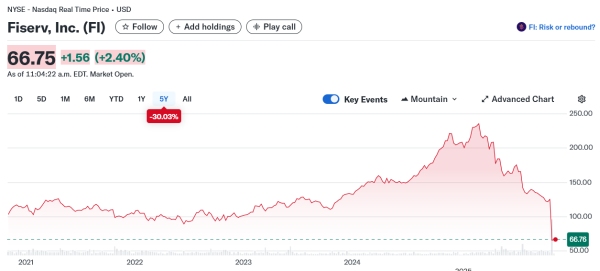
Image: Fiserv (FI) (Yahoo Finance Chart, Oct 31, 2025)
What triggered Fiserv’s record stock crash?
On October 29 2025, Fiserv Inc.’s stock plunged 44 percent in a single trading day after management sharply cut revenue and earnings forecasts. The Forbes report confirmed that guidance for full year organic revenue dropped to roughly 3.5% to 4.5% (down from 10%), and adjusted earnings per share fell to about $8.50 to $8.60 (previous range near $10.25).
Outlets called it the company's worst trading day on record, while Reuters reported that roughly $30 billion USD in market value was wiped out.
The Financial Times reported that some of Fiserv’s problems came from its business in Argentina. The company had invested heavily there to grow its payments and merchant services, but rising inflation and unstable policies hurt results.
Yahoo Finance verified that quarterly adjusted earnings were $2.04 per share on $4.92 billion in revenue, both falling short of analyst estimates, and that management’s revised guidance signalled weaker growth into 2026.
The speed and scale of the decline caught analysts off guard and the abrupt reversal in management guidance spooked investor confidence more than the revenue miss itself.
The credibility hit reflects a governance gap and not a market anomaly. Canadian financial institutions face a similar risk. When boards and risk teams depend too much on vendors’ optimistic projections, they can be caught off guard when results fall short. Honest forecasts, active oversight, and clear accountability are essential to maintain trust.
The slowdown of Fiserv’s merchant processing as noted by Reuters, raised red flags because it showed how much of the global financial ecosystem depends on a handful of vendors for core services.
Canadian credit unions and regional banks operate within similar limits, relying on few providers for payments, fraud monitoring, and digital banking infrastructure. A major vendor’s disruption could ripple through daily operations.
Fintechs should avoid relying on a single provider for critical services. Where possible, they should use multiple vendors or include clear backup and continuity plans in core contracts. A stable vendor network is now part of staying resilient, not just managing costs.
MarketWatch linked Fiserv’s current struggles to its 2019 First Data merger, which left the company with high debt and overlapping systems.
Many Canadian institutions are undergoing similar digital transformations. The Fiserv experience shows that modernization without aligned governance and risk planning can backfire.
Further with respect to Argentina, expanding into fast growing but unpredictable markets can look appealing, but without strong local plans and risk controls, it can backfire when conditions change.
Banks should aim to strike the balance between innovation, cutting costs, and building long term strength. Fintechs on the other hand need to be realistic and transparent with financial reporting and growth goals. Making promises that can’t be met damages trust faster than any technical problem.
Fiserv is undergoing a strategic reset. In a release, the Fiserv appointed Paul Todd as CFO effective October 31, named Takis Georgakopoulos and Dhivya Suryadevara as co-presidents effective December 1, and refreshed its board under new independent chair Gordon Nixon. Two directors will step down on January 1 2026 as part of a governance overhaul. Whether these measures restore confidence remains uncertain.
The National Crowdfunding & Fintech Association (NCFA Canada) is a financial innovation ecosystem that provides education, market intelligence, industry stewardship, networking and funding opportunities and services to thousands of community members and works closely with industry, government, partners and affiliates to create aa vibrant and innovative fintech and funding industry in Canada. Decentralized and distributed, NCFA is engaged with global stakeholders and helps incubate projects and investment in fintech, alternative finance, crowdfunding, peer-to-peer finance, payments, digital assets and tokens, artificial intelligence, blockchain, cryptocurrency, regtech, and insurtech sectors. Join Canada's Fintech & Funding Community today FREE! Or become a contributing member and get perks. For more information, please visit: www.ncfacanada.org
| | |
|---|---|---|
| | |
Payments Report | Oct 30, 2025
Image: The Future is (Anything but) Stable (BCG Global Payments 2025 report)
On Sept 22, 2025 the Boston Consulting Group (BCG) released the Global Payments Report 2025 titled 'The Future is (Anything but) Stable" (37 page PDF report) reported that worldwide payment revenues totalled about $1.9 trillion in 2024 and are expected to exceed $2.4 trillion by 2029.
Growth is slowing however from nearly 9% a year to around 4%, highlighting the end of a rapid growth period where payment providers earned more interest income on money moving through their systems. The next phase will be led by innovation, not momentum.
According to the report, the foundations of global payments are being rebuilt through real-time transactions, tokenized assets, and smarter compliance. For Canada, the domestic system is stable but slower than peers in Asia or Europe. Modernization can help ensure that Canadian fintechs and banks remain competitive as value begins to move across programmable digital networks.
These above trends describe a payments ecosystem that is no longer growing by size but by sophistication.
Between pages 9 and 13, the report explains that tokenization has moved from pilot projects to real adoption.
Stablecoins process over $26 trillion in yearly transactions and are being used for remittances, business payments, and treasury operations. The combined value of circulating stablecoins is close to $270 billion, with US dollar-linked tokens like USDT and USDC dominating.
Tokenized funds hold more than $3 billion in assets, and private credit tokenization has reached $10 billion. In addition, governments in Singapore, Hong Kong, and Europe are issuing digital bonds under clear frameworks such as MiCA.
More than 10 countries have live central bank digital currencies, and over 90% of central banks are testing or building them. Global banks including Citi, HSBC, and UBS are already piloting tokenized deposits connected to their main systems.
For Canada, tokenization could open the door to trusted digital assets that fit within the existing regulated structure. It allows for faster, safer movement of money and investment while maintaining transparency and oversight. By building policy alignment and open access, Canada can turn this technology into a tool for inclusion, without being left behind.
The report points to a global race to connect innovation with regulation. Countries that create clarity around digital assets, tokenized deposits, and real-time infrastructure will attract investment and improve access to capital. For Canada, this means progressing digital finance policy and expanding participation in global payment corridors. The combination of tokenized assets, instant settlement, and data-driven compliance could give Canadian participants a stronger role in international markets.
Canada is already making strides in payments innovation. The Bank of Canada and other regulators are working to bring more providers onto national infrastructure and exploring tokenisation and stablecoins. With the federal 2025 budget scheduled for early next week on November 4, there is hope that policymakers will signal clearer guidelines or incentives for stablecoins and digital assets that could boost competitiveness and access to capital for Canadian fintechs.
The National Crowdfunding & Fintech Association (NCFA Canada) is a financial innovation ecosystem that provides education, market intelligence, industry stewardship, networking and funding opportunities and services to thousands of community members and works closely with industry, government, partners and affiliates to create aa vibrant and innovative fintech and funding industry in Canada. Decentralized and distributed, NCFA is engaged with global stakeholders and helps incubate projects and investment in fintech, alternative finance, crowdfunding, peer-to-peer finance, payments, digital assets and tokens, artificial intelligence, blockchain, cryptocurrency, regtech, and insurtech sectors. Join Canada's Fintech & Funding Community today FREE! Or become a contributing member and get perks. For more information, please visit: www.ncfacanada.org
| | |
|---|---|---|
| | |
Compliance Enforcement | Oct 24, 2025

Image: Freepik/Rawpixel.com
On October 16 2025, Reuters reported that the Financial Transactions and Reports Analysis Centre of Canada (FINTRAC) imposed a penalty of C$176,960,190 on Xeltox Enterprises Ltd., which operates as Cryptomus (formerly Certa Payments Ltd), for serious failures to file required reports under Canada’s anti-money-laundering regime. The decision was announced publicly on October 22 2025 after a compliance examination under the Proceeds of Crime (Money Laundering) and Terrorist Financing Act. FINTRAC described it as the largest penalty in its history.
FINTRAC found that Cryptomus failed to submit suspicious transaction reports on 1,068 separate occasions during July 2024 when there were reasonable grounds to suspect links to money laundering or terrorist activity financing. It also failed to comply with a Ministerial Directive, did not maintain or update written compliance policies approved by a senior officer, and failed to assess and document the risk of money-laundering offences within its operations.
The examination also revealed that Cryptomus did not file a notification of changes to its registration information and failed to report 1,518 large virtual-currency transactions above $10,000 in July 2024. These breaches were linked to laundering proceeds from crimes including child sexual abuse material, fraud, ransomware payments, and sanctions evasion. Cryptomus had already been barred by the British Columbia Securities Commission from securities trading earlier in 2025.
Sarah Paquet, Director and Chief Executive Officer, FINTRAC:
“We are committed to working with our domestic partners and international allies to protect the safety of Canadians and the security of Canada’s economy. Given that numerous violations in this case were connected to trafficking in child sexual abuse material, fraud, ransomware payments and sanctions evasion, FINTRAC was compelled to take this unprecedented enforcement action.”
FINTRAC confirmed that in 2024–25 it issued 23 Notices of Violation of non-compliance, the largest number in a single year since it received legislative authority to levy penalties in 2008. Those penalties totalled more than $25 million before the Cryptomus case. With enforcement ramping up, it appears the agency’s oversight is widening to include both traditional financial institutions and virtual asset service providers.
As FINTRAC noted in its statement, the rapid expansion of Canada’s virtual-currency sector also brings higher risks of money laundering, terrorist financing, and sanctions evasion. The agency said strong compliance frameworks are essential to protect Canadians and safeguard the financial system.
While the fine demonstrates that Canada can act decisively after a compliance failure, it also raises questions about how proactive oversight can become. FINTRAC’s review was retrospective, relying on an examination of past activity. With digital asset volumes growing and transactions moving across borders instantly, regulators need stronger real-time tools, data sharing systems, and cooperation between provincial, federal, and global agencies.
Effective supervision must keep pace with the speed and anonymity of crypto markets without discouraging legitimate fintech innovation. For the Canadian fintech community, understand that compliance is vital for sustained growth and is a competitive necessity. Firms that verify client identities, maintain risk assessments, and document transactions can not only avoid enforcement but also build trust with users and partners.
The National Crowdfunding & Fintech Association (NCFA Canada) is a financial innovation ecosystem that provides education, market intelligence, industry stewardship, networking and funding opportunities and services to thousands of community members and works closely with industry, government, partners and affiliates to create aa vibrant and innovative fintech and funding industry in Canada. Decentralized and distributed, NCFA is engaged with global stakeholders and helps incubate projects and investment in fintech, alternative finance, crowdfunding, peer-to-peer finance, payments, digital assets and tokens, artificial intelligence, blockchain, cryptocurrency, regtech, and insurtech sectors. Join Canada's Fintech & Funding Community today FREE! Or become a contributing member and get perks. For more information, please visit: www.ncfacanada.org
| | |
|---|---|---|
| | |
VoPay | Sep 22, 2025

Image: Freepik
On September 18, 2025, VoPay announced real time PayPal and Venmo payouts for businesses in Canada and the U.S. This innovative development comes as digital wallets are expanding rapidly.
Global wallet transaction value is forecasted to rise from about $8.3 trillion in 2025 to $19.7 trillion by 2030, nearly 19% CAGR. In addition to payout flexibility, users also want speed of course, with 61% of millennials showing preference for real-time payouts. Venmo alone processed $275 billion in 2023, about 18% of PayPal volume.
Hamed Arbabi, CEO of VoPay:
“At VoPay, we’re laser-focused on giving businesses access to every major financial rail and wallet through one embedded platform. Our collaboration with PayPal unlocks real-time PayPal and Venmo access for our clients, enabling them to expand choice, optimize operations, and deliver modern, inclusive customer experiences. This is a transformative step in making financial interactions faster, simpler, and universally accessible.”
VoPay’s update enables platforms to send funds to PayPal in Canada and the U.S. and to Venmo in the U.S. with a single API or portal. Recipients can be identified by email, phone number, or wallet handle, giving users wallet choice alongside bank transfers and virtual accounts. Compliance, reporting, settlement, and reconciliation are handled in one place, reducing manual work and errors.
Embedded finance helps companies run more smoothly by using automation and one set of APIs.
Canadian firms compete on how fast and reliably they move money. Wallet payouts lower failed attempts and shorten user wait times. Together with automation efficiencies and global reach, Canadian financial technology firms can now more easily raise the bar for user experience and operational strength.
According to this case study, a Canadian consumer lender modernized disbursements, repayments, and reconciliation with VoPay's suite of solutions. As a result, the company reported a 25% reduction in manual tasks and about 30% lower labour costs after automating. Weekly reconciliation dropped from 10 hours to near zero, and non sufficient funds processing fell from 20 hours a month to near none. These gains free up staff, reduce errors, and deliver faster funding to borrowers.
Instant payouts and wallet choice are becoming standard. Cross border support will matter more as platforms serve global workers and customers. Companies like VoPay that combine embedded finance, wallet rails, and cross border payouts in a single tech stack will be better positioned to scale, control costs, and meet rising client expectations.
The National Crowdfunding & Fintech Association (NCFA Canada) is a financial innovation ecosystem that provides education, market intelligence, industry stewardship, networking and funding opportunities and services to thousands of community members and works closely with industry, government, partners and affiliates to create aa vibrant and innovative fintech and funding industry in Canada. Decentralized and distributed, NCFA is engaged with global stakeholders and helps incubate projects and investment in fintech, alternative finance, crowdfunding, peer-to-peer finance, payments, digital assets and tokens, artificial intelligence, blockchain, cryptocurrency, regtech, and insurtech sectors. Join Canada's Fintech & Funding Community today FREE! Or become a contributing member and get perks. For more information, please visit: www.ncfacanada.org
| | |
|---|---|---|
| | |



August 26th, 2025

January 4th, 2024

June 1st, 2021

September 9th, 2020

July 9th, 2018

January 3rd, 2018

September 25th, 2017

June 20th, 2017

May 10th, 2017

December 14th, 2016
