





Karsten Wenzlaff, Advisor
August 26th, 2025
Karsten Wenzlaff is a Crowdfunding and Fintech Expert from Germany. He is Secretary-General of Digit[...]


Global Fintech Report | Aug 22, 2025
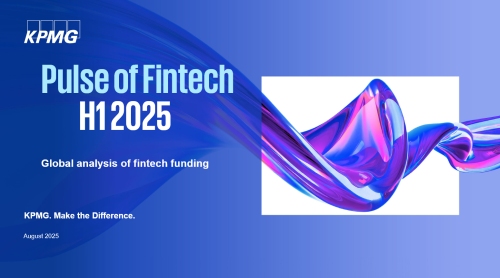
Image: Pulse of Fintech H1 2025, KPMG
According to the KPMG Pulse of Fintech H1 2025 report (67 page PDF) published in August 2025, global fintech investment in the first half of 2025 fell to $44.7 billion across 2,216 deals, recording the lowest H1 total since early 2020. Investors remain cautious about elevated risks around higher interest rates, capital costs, and geopolitical uncertainty. Q2 2025 was particularly weak, with $18.7 billion across 972 deals.
Investment in digital assets totalled $8.4 billion across 586 deals in H1 2025. Stablecoins attracted attention for payments and remittances in emerging markets, while tokenization platforms and infrastructure also captured capital. Circle's IPO anchored the sector’s strength, raising $1.1 billion with shares jumping 168% on day one.
AI continues to boost fintech investment. Capital flowed into both AI native startups and to incumbents embedding AI in credit scoring, fraud detection, and customer engagement. Investors prioritized business models that combined growth with efficiency and risk control. See NCFAs coverage of AI Fintechs attracting a 242% valuation premium
Regtech attracted $2.1 billion across 190 deals in H1 2025. Adoption of automated KYC, AML, and reporting tools continues to grow as financial institutions look for cost savings and regulatory agility. GenAI in risk and compliance
Insurtech raised $4.8 billion across 141 deals in H1 2025, which is already greater than all of 2024. Wealthtech funding reached $0.9 billion across 14 deals, with AI enabled platforms a recurring theme. Both sectors experienced consolidation as incumbents prefer acquisitions over building new capabilities.
Payments investment slowed to $4.6 billion across 242 deals in H1 2025, as investors grew more selective. But the sector is still foundational with capital being allocated to embedded finance, cross border platforms, and transaction monitoring. For Canada’s policy context see open banking delays and competitiveness and banks exiting merchant acquiring businesses like Moneris.
Cybersecurity specific fintech investment was just $0.1 billion across 26 deals in H1 2025. Despite heightened threat levels, most activity was concentrated at seed and early stages, reflecting investor caution toward scaling security focused fintechs.
Exit momentum is returning. Circle’s successful IPO may open the door for additional digital asset platforms to list in H2 2025, boosting the case for fintech exit activity after years of lack lustre listings.
For Canada, the data shows the window of opportunity for digital assets, AI, and regtech could attract investment with clear policy and infrastructure. The muted state of payments and open banking highlight gaps Canada must address to remain competitive. Clear rules, targeted support, and investment in digital infrastructure are critical to positioning Canadian fintech for growth in the second half of 2025 and beyond. See the crisis Canada and fintech cannot afford to waste
 The National Crowdfunding & Fintech Association (NCFA Canada) is a financial innovation ecosystem that provides education, market intelligence, industry stewardship, networking and funding opportunities and services to thousands of community members and works closely with industry, government, partners and affiliates to create a vibrant and innovative fintech and funding industry in Canada. Decentralized and distributed, NCFA is engaged with global stakeholders and helps incubate projects and investment in fintech, alternative finance, crowdfunding, peer-to-peer finance, payments, digital assets and tokens, artificial intelligence, blockchain, cryptocurrency, regtech, and insurtech sectors. Join Canada's Fintech & Funding Community today FREE! Or become a contributing member and get perks. For more information, please visit: www.ncfacanada.org
 |  |  |
|---|---|---|
 |  |  |
Banking Partnership | July 29, 2025

Image: Freepik
Global payments fintech powerhouse, Fiserv announced on July 23, 2025 that they signed a multi year strategic managed services agreement with TD Bank Group, where TD Merchant Solutions will use Fiserv technology, including the Clover point of sale platform, to support its merchant clients. Fiserv will also acquire a part of TD’s merchant processing business, adding about 3400 merchant relationships and 30000 locations to its Canadian portfolio. These merchants will migrate to Fiserv’s systems and to Clover, combining hardware with software services for payment processing and business management.
This partnership shows how large Canadian banks are choosing to work with fintech providers rather than invest heavily in building merchant processing systems internally, and competing head to head on technology development. It gives TD a way to focus on core banking while gaining access to modern tools for business clients. For Fiserv it offers a faster route into the Canadian market and expands the reach of its Clover platform.
The agreement changes the competitive landscape in the Canadian merchant services market. Clover will now compete more directly with Moneris, which is jointly owned by BMO and RBC, as well as Shopify and Square. Moneris processes more than 3.5 billion transactions a year in Canada, and this new partnership increases pressure on providers to improve technology and pricing.
Canadian fintech firms such as Nuvei, Paystone and Moneris already play important roles in payments. Nuvei in particular now offers Smart POS solutions with hardware, cloud dashboards, loyalty and reporting tools, and integrates with partners like PushPOS. However, Clover remains unique because of its full stack approach, proprietary POS hardware, merchant acquiring, a unified SaaS dashboard, an integrated loyalty and lending ecosystem, and a global developer marketplace.
| Feature / Capability | Fiserv Clover | Nuvei | Moneris | Paystone |
| Core service focus | Full-stack merchant acquiring & SaaS | Global payments acquiring & e‑commerce platform | Canada’s leading card acquiring platform | SME card processing & customer engagement |
| Integrated POS hardware | Yes. Clover Flex, Mini, Station, Go | Yes. Smart POS hardware and partner-integrated terminals (PushPOS) | Yes. Moneris Go + basic POS terminals | Basic hardware via third-party partners |
| Cloud dashboard & analytics | Yes, unified realtime analytics | Partial, merchant control panel with analytics (Nuvei terminal management) | Yes, reporting dashboards | Limited reporting tools |
| Omni-channel payments | Yes, unified in-store & online commerce | Yes, omni‑channel and cross‑border | Yes, in-store and ecommerce support | Primarily in-store, emerging online tools |
| Merchant base size (Canada) | 30 000+ locations via TD deal | Tens of thousands merchants globally | Over 350 000 merchant locations | Tens of thousands of SMEs in Canada |
| Ecosystem (loyalty, lending, inventory) | Yes, integrated loyalty, lending, inventory | Limited, primarily payment-focused, relies on partners | Limited, some value-added tools but less integrated | Customer engagement (loyalty, gift cards) |
| Developer marketplace | Yes, Clover AppMarket | No, no open app marketplace | No, limited developer ecosystem | No, no broad app marketplace |
According to a Barrons write-up, Fiserv's merchant services growth under-performed in Q2-2025 (subscription) coming in at 9% instead of analyst expected 12%. Adding the TD merchant base and rolling out Clover in Canada gives Fiserv a chance to build revenue and expand its client reach, but the impact will depend on how quickly the migration is completed and how effectively these new clients adopt Clover’s tools.
For Canadian small and medium businesses, the benefit is gaining access to a modern business platform that combines payments with inventory, reporting and data tools. Clover offers a range of devices such as Clover Flex, Mini and Station that connect to a single cloud based dashboard, allowing merchants to handle in store and online payments from a single Clover POS platform.
As SMEs grow they need integrated platforms that go beyond payments to support operations and decision making. If the Fiserv and TD Bank partnership succeeds, it could lead to other banks forming similar alliances with fintech companies, setting a new bar for merchant services in Canada.
The National Crowdfunding & Fintech Association (NCFA Canada) is a financial innovation ecosystem that provides education, market intelligence, industry stewardship, networking and funding opportunities and services to thousands of community members and works closely with industry, government, partners and affiliates to create a vibrant and innovative fintech and funding industry in Canada. Decentralized and distributed, NCFA is engaged with global stakeholders and helps incubate projects and investment in fintech, alternative finance, crowdfunding, peer-to-peer finance, payments, digital assets and tokens, artificial intelligence, blockchain, cryptocurrency, regtech, and insurtech sectors. Join Canada's Fintech & Funding Community today FREE! Or become a contributing member and get perks. For more information, please visit: www.ncfacanada.org
| | |
|---|---|---|
| | |
Fintech Partnership | June 19, 2025

Image: Freepik
Canadian fintech platform Zūm Rails has partnered with Western Union Canada to offer real time global money transfers. Using Interac e‑Transfer and Zūm’s API infrastructure, Canadian users can now send money to recipients in over 200 countries from their bank accounts, with funds delivered in minutes.
The partnership combines Zūm’s compliance and payment engine with Western Union’s international remittance network. Funds move through Interac e‑Transfer in Canada, then settle globally through Western Union’s infrastructure. The result is faster payouts, a simplified user experience, and improved access for both individuals and small businesses.
The new money transfer system allows customers to use a familiar Interac e‑Transfer interface, with Zūm Rails acting as the engine behind the scenes. Its role includes API routing, onboarding, compliance, and settlement integration. The entire experience is designed to run seamlessly on mobile or desktop.
For Canadian fintechs, this type of architecture demonstrates how open APIs and established networks can combine to deliver immediate value without needing to rebuild global infrastructure from scratch.
Craig Asano, NCFA Founding CEO:
“Zūm Rails’ API‑first approach and Western Union’s global network show how Canadian fintechs can lead in both innovation and scale.”
Many Canadian Small to Medium Sized Enterprises (SMEs) rely on global suppliers, freelance talent, or overseas partners but traditional international transfers can take several days and often carry high fees or lack transparency. So the ability to send or receive cross-border payments instantly delivers major benefits.
By moving funds in real time, companies enjoy faster access to working capital, can pay contractors on time, and support better financial planning. Moving money faster also improves the customer experience for refunds or disbursements, which all helps to build trust.
This partnership is in line with broader trends in Canadian payments. The federal government is advancing Open Banking through the Financial Consumer Agency of Canada, while Payments Canada continues to develop the real time rail (RTR) system.
Although those frameworks are still being finalized, Zūm Rails and Western Union are already showing what real time payments can look like in action.
The use of Interac e‑Transfer as a launchpad demonstrates the importance of maintaining open access to Canada’s core infrastructure. As global money movement becomes faster and faster, financial institutions are turning to fintechs for agile solutions.
Real time global payments are here, and they are being built in Canada. Zūm Rails and Western Union have shown how fintech can unlock new speed and scale by using trusted domestic rails and global infrastructure.
This partnership could impact open payments in Canada and offers a live case study of innovation already in market, and is a good example of how large players can approach platform collaboration, embedded finance, and cross-border transaction design.
The National Crowdfunding & Fintech Association (NCFA Canada) is a financial innovation ecosystem that provides education, market intelligence, industry stewardship, networking and funding opportunities and services to thousands of community members and works closely with industry, government, partners and affiliates to create a vibrant and innovative fintech and funding industry in Canada. Decentralized and distributed, NCFA is engaged with global stakeholders and helps incubate projects and investment in fintech, alternative finance, crowdfunding, peer-to-peer finance, payments, digital assets and tokens, artificial intelligence, blockchain, cryptocurrency, regtech, and insurtech sectors. Join Canada's Fintech & Funding Community today FREE! Or become a contributing member and get perks. For more information, please visit: www.ncfacanada.org
| | |
|---|---|---|
| | |
Fintech | June 18, 2025

Image courtesy of Trump Mobile website
On June 18, 2025, Fortune reported that Trump Mobile is entering the U.S. wireless market with a $47.45 per month prepaid plan and a smartphone built by Chinese device maker Unihertz. Beyond the political optics, the announcement is interesting from a fintech perspective since Trump Mobile plans to use a telecom backbone to bundle lifestyle services in a way that mirrors embedded finance strategies seen in a variety of global fintech ecosystems.
The T1 smartphone is priced at $499 with a $100 down payment, and is scheduled to ship in late summer 2025. Trump Mobile is powered by Patriot Mobile, an MVNO that leases infrastructure from existing carriers. The business model relies on branding and licensing rather than owning physical networks. This setup closely resembles the way fintechs white label financial infrastructure through APIs and software platforms.
Eric Trump, EVP Trump Organization on Trump Media:
“I'm incredibly excited to step into this new digital space, hard-working Americans deserve a wireless service that's affordable, reflects their values, and delivers reliable quality they can count on. We're especially proud to offer free long-distance calling to our military members and their families — because those serving overseas should always be able to stay connected to the people they love back home. ”
The flagship product is the “47 Plan” offered at $47.45 per month. According to Trump Mobile’s website, it includes unlimited talk, text, and data, plus international calling. The bundled services also include 24/7 telehealth access and roadside assistance, which are traditionally sold separately or through insurance providers. Packaging them into a single mobile bill is a similar approach of fintech super apps.
The T1 phone has midrange specs: a 6.8-inch AMOLED 120 Hz screen, 12 GB RAM, 256 GB storage, a 50 MP triple camera setup, Android 15, a 5,000 mAh battery with 20 W fast charging, USB-C, a headphone jack, and biometric unlocking. The phone is manufactured by Unihertz in China, despite political framing that implied U.S. manufacturing. It unveils global hardware supplier realities that fintechs face when bringing physical devices to market.
According to The Wall Street Journal, the Trump family licenses its name to Patriot Mobile, which operates the network. This approach is similar to how fintech startups offer debit cards, wallets, and investment tools without becoming licensed financial institutions. The infrastructure is external, but the customer relationship is owned by the brand.
There is also a digital asset component. Reuters reported that Trump Media is applying for a cryptocurrency ETF made up of 75% Bitcoin and 25% Ethereum. Even though the potential crypto ETF isn't directly tied to the phone plan just yet, it highlights the Trump brand's ambition to combine lifestyle, media, and financial products.
Ironic as you get that earlier in 2025, the Trump administration slapped a raft of reciprocal tariffs, including a baseline 20% tariff on Chinese-made consumer electronics. According to Al Jazeera, the administration later exempted certain chips and phones but it's unknown which specific products currently qualify. If the T1 is subject to tariffs, the cost could be absorbed by Unihertz, passed to Patriot Mobile, or used to justify higher retail pricing.
Trump Mobile offers a live case study in how embedded services can be sold through telecom. For Canadian fintechs, it opens a conversation about how telcos and startups might partner to deliver subscription-based insurance, health care, or financial tools to underserved communities. Packaging multiple services into a mobile plan can improve customer stickiness, adding to predictable revenue, as also seen in bundled offerings by Koho, Neo, and other Canadian fintechs.
There should be policy concerns however, with potential conflicts of interest involving Trump's family ties to regulatory agencies. Also combining telco infrastructure with consumer finance triggers questions around cross-sector regulation, as regulators will need to consider the risks of a converging telco-fintech model as it grows.
For NCFA members, this launch offers insight into how bundled, cross-platform models can scale quickly with the right partnerships. As Canada expands open banking and explores new models of service delivery in underserved markets, this example shows how telecom-fintech convergence could work, assuming regulators allow it.
The National Crowdfunding & Fintech Association (NCFA Canada) is a financial innovation ecosystem that provides education, market intelligence, industry stewardship, networking and funding opportunities and services to thousands of community members and works closely with industry, government, partners and affiliates to create a vibrant and innovative fintech and funding industry in Canada. Decentralized and distributed, NCFA is engaged with global stakeholders and helps incubate projects and investment in fintech, alternative finance, crowdfunding, peer-to-peer finance, payments, digital assets and tokens, artificial intelligence, blockchain, cryptocurrency, regtech, and insurtech sectors. Join Canada's Fintech & Funding Community today FREE! Or become a contributing member and get perks. For more information, please visit: www.ncfacanada.org
| | |
|---|---|---|
| | |
Tech Ecosystem | June 6, 2025

Image: Freepik/travelscape
Web Summit Vancouver 2025 ran from May 27-30 2025 at the Vancouver Convention Centre attracting 15 727 attendees and with 1 108 startups from 117 countries, creating an electric atmosphere of discovery and deal making. Exhibiting startups spanned innovations in AI and machine learning, fintech and financial services, healthtech and wellness, and sustainability and cleantech.
Fintech solutions ranged from digital banking apps to blockchain payment rails, with Koho introducing a new international transfer service at the event. Founders pitched ideas, investors scouted opportunities, and conversations ranged from regulation to real-time fraud detection, confirming Canada’s growing role in global fintech innovation.
In the “Brands in Uncertain Times” session, Angus Reid of Angus Reid Group shared that nearly 50% of Canadians “vote at the cash register” by choosing brands aligned with their values. FCB Global CEO Tyler Turnbull added that Canadian consumers will pay 20-30% more for products produced and sourced in Canada, the premium on authenticity. For fintech companies, transparent fee structures and clear brand messaging are key to building consumer trust and loyalty.
AI dominated most panels, hallway discussions, and featured prominently across multiple stages. Sunny Madra, COO of Groq, announced Groq is now the exclusive inference provider for Bell Canada’s sovereign AI network, including two new data centres in British Columbia designed to bring AI processing closer to Canadian users. This new AI infrastructure will benefit fintech startups seeking access to low-latency, secure AI inference capabilities for real-time applications like fraud detection and compliance.
Sustainability and cleantech stood out alongside AI. Sessions highlighted how technology is driving environmental, social, and governance (ESG) goals, such as using AI to identify and price climate risks. Partners like OVHcloud showcased energy efficient cloud offerings, illustrating how infrastructure providers integrate ESG criteria into their services. For fintechs, embedding ESG considerations into product design and investment decisions is key for long term success. Not to mention the Competition Bureau's final rules on greenwashing that companies need to comply with.
4. Fintech Innovations and Cross-Border Payments
Financial technologies and services was one of the top represented verticals, with companies demoing solutions from digital banking apps and blockchain payment rails to regtech platforms. Toronto-based challenger bank Koho introduced its international money transfer service to over 190 countries, promising most transfers would arrive within 30 minutes during beta. By addressing opaque rates and slow settlement times, Koho’s launch shows how fintechs who listen to consumer issues can earn trust and turn these insights into new products/services that resonate with both Canadian and global markets.
5. Inclusive Entrepreneurship and Diverse Teams
44% of startups at Web Summit Vancouver were founded or co-founded by women. Beyond fintech, local firms such as Doubl, Revol Cares, and Aruna Revolution showcased solutions for women’s health and wellness.
Within financial services, fintech teams highlighted embedded credit services for underbanked populations and regtech platforms that serve diverse small-business owners. It's really diverse founding teams that drive not just inclusive entrepreneurship but solutions that resonate with underserved markets, strengthening innovation overall.
Technology is no longer judged only by what it can do, but by who it includes, what it protects, and how it earns trust. For fintechs and founders alike, this is the real edge of innovation and frontier.
The National Crowdfunding & Fintech Association (NCFA Canada) is a financial innovation ecosystem that provides education, market intelligence, industry stewardship, networking and funding opportunities and services to thousands of community members and works closely with industry, government, partners and affiliates to create a vibrant and innovative fintech and funding industry in Canada. Decentralized and distributed, NCFA is engaged with global stakeholders and helps incubate projects and investment in fintech, alternative finance, crowdfunding, peer-to-peer finance, payments, digital assets and tokens, artificial intelligence, blockchain, cryptocurrency, regtech, and insurtech sectors. Join Canada's Fintech & Funding Community today FREE! Or become a contributing member and get perks. For more information, please visit: www.ncfacanada.org
| | |
|---|---|---|
| | |
Open Finance Policy Development | May 22, 2025

Image: Freepik/rawpixel.com
On May 15, 2025, the Cambridge Centre for Alternative Finance (CCAF) hosted a webinar, “Open Finance in Practice: Implementation, Liability & Monetisation” with experts from Thailand, Rwanda, India, the UK, and Asia-Pacific who shared what's working and what's not, based on their practical experience. Open finance is progressing globally but real world experience shows that it is not just about technology or APIs, and successful implementation depends on clear rules, trusted governance, and strong infrastructure. These insights are especially relevant now as Canada prepares to implement its own open banking system in 2026.
Sanjay Janeja, Open Banking Lead, CCAF:
“Our data shows that regulation-led models support faster implementation and broader data sharing.”
CCAF’s Global Regulatory Innovation Dashboard (GRID) shows that countries with clear regulatory mandates, like Brazil and Australia, have progressed faster than those relying on voluntary participation. India in contrast, moved slowly at first without regulatory mandates. Canada risks similar delays unless its upcoming rules are clear, enforceable, and consistent.
Denise Dias, Regulatory and Supervisory Consultant:
“Governance is the soul of open finance.”
Governance critically defines who sets the rules, allows the accreditation of participants, and resolves disputes. Rwanda is building shared oversight between its financial and telecom regulators. Countries that define this early see smoother adoption. Canada's future governance structure needs to include clear roles for regulators, industry, and consumer protection agencies.
Rafael Mazer, Director, Fair Finance Consulting:
“Consumers should not have to wait for firms to assign blame before they are made whole.”
As more parties exchange financial data, legal clarity is paramount. The UK mandates reimbursement even before liability is settled. Oman and UAE require indemnity insurance for open finance participants. Canada needs to define who is liable, under what conditions, and how disputes will be resolved before open banking go live.
Rafael Mazer:
“This is where the claws come out.”
Camilla Bullock, CEO, Emerging Payments Association Asia:
“You cannot grow the pie if the small players cannot afford a slice.”
Thailand uses free access for consumers and capped pricing for commercial use. Brazil allows a set number of free requests per user. These models keep access open for small fintechs. Canada should consider following suit to avoid anti-competitive pricing that could exclude new entrants.
Pamela Umutesi, Lead for Open Finance, National Bank of Rwanda:
“Let your local context guide how you implement.”
Thailand focused on non financial data first because the infrastructure was already in place. Rwanda’s model prioritizes mobile money. Canada of course is considering its own requirements, including provincial data laws, legacy banking systems, and regional financial access gaps. Bottom line is that a one-size-fits-all model that works abroad will not necessarily work elsewhere.
The table below primarily covers open banking implementations, with some jurisdictions extending toward open finance (Brazil, India, Thailand).
This is an important distinction because open banking generally refers to access to 'bank account data' which is often mandated for regulated institutions. While Open Finance expands beyond banking data to include insurance, investments, pensions, government data, mobile money, and more.
| Country | Pricing Model | Regulatory Status | Governance Approach |
| Brazil | Free access below threshold | Mandated and implemented | Central bank |
| Thailand | Free for consumers; capped for firms | Mandated and being implemented | Bank of Thailand and industry consortium |
| India | Commercial pricing; no fixed rules | Voluntary, evolving | NGO-led (Sahamati); gaining government support |
| Rwanda | Pilot phase; not-for-profit approach | Mandated, not yet implemented | Multi-agency regulator framework |
| UK | Free for regulated APIs | Mandated and implemented (OB only) | Regulators (CMA, then OBIE, now JROC) |
| Australia | Free basic; optional premium | Mandated and implemented | Treasury under Consumer Data Right law |
| EU (PSD2) | Mostly free under PSD2 | Mandated and implemented (OB only) | Regulator; preparing Financial Data Access (FiDA) |
| Singapore | Voluntary pricing; no mandate | Voluntary | MAS; market-driven with government-backed standards |
| Hong Kong | Commercial rates allowed | Voluntary with phased guidance | HKMA; implementation by industry associations |
| Canada | TBD (under consultation) | Mandated, not yet implemented | Department of Finance; FCAC |
Canada has committed to implementing open banking but full rollout isn't expected until 2026. In June 2024, the Department of Finance enacted the Consumer-Driven Banking Act, the legal framework for open banking, and appointed the Financial Consumer Agency of Canada (FCAC) as the authority responsible for implementing, overseeing, and enforcing the framework. Final rules on liability, pricing, and participation are still under development.
Countries that wait too long or rely only on voluntary models are playing catch-up. NCFA supports an open finance framework in Canada that protects consumers, enables competition, and accelerates innovation. Canada should learn from the world's most successful open finance systems, which are defined by clear regulation, fair pricing, and shared governance. As the CCAF’s global tracker and research show, clear rules work. Delay does not.
The National Crowdfunding & Fintech Association (NCFA Canada) is a financial innovation ecosystem that provides education, market intelligence, industry stewardship, networking and funding opportunities and services to thousands of community members and works closely with industry, government, partners and affiliates to create a vibrant and innovative fintech and funding industry in Canada. Decentralized and distributed, NCFA is engaged with global stakeholders and helps incubate projects and investment in fintech, alternative finance, crowdfunding, peer-to-peer finance, payments, digital assets and tokens, artificial intelligence, blockchain, cryptocurrency, regtech, and insurtech sectors. Join Canada's Fintech & Funding Community today FREE! Or become a contributing member and get perks. For more information, please visit: www.ncfacanada.org
| | |
|---|---|---|
| | |
Digital Banking | May 9, 2025
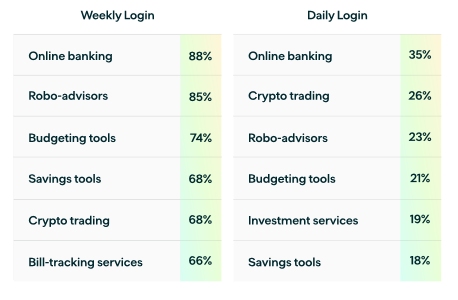
Image: Frequency of Use (Plaid x YouGov Money Talks survey report)
Between August 20-26th 2024, Plaid commissioned a national survey through the YouGov platform to understand how U.S. consumers bank, pay, and invest. The survey reveals insights of consumer preferences in digital finance, including trust in financial providers, app usage, payment methods, credit attitudes, and investment habits, based on weighted responses from 2,077 adults. Fintechs, digital finance platforms, and financial institutions need to stay up to date with the latest retail digital banking trends if they want to compete for consumer loyalty. Read 'Money Talks' (28 page PDF) report explaining these trends. Below we break-down key insights for NCFA's readers. Not yet subscribed? Sign-up for NCFA's weekly newsletter here.
Consumers continue to trust traditional banking institutions more than 100% digital platforms:
Trust and security go hand and hand, and overall, trust comes from perceived care and protection:
Consumers also shared who they rely on for financial well-being. The takeaway is that fintechs and advisory services must do more to be seen as helpful and caring, a useful partner in people’s financial lives.
Online banking is the most widely used financial tool: 99% percent of consumers are familiar with it, and 74% use it weekly.
Other commonly used tools include savings apps (68% weekly or daily), budgeting tools (85%), and peer-to-peer payment apps like Venmo or Zelle (used weekly by 50% of users). Roboadvisors are accessed more than once per week by (80%) of their users but only 1% of all consumers report using them regularly.
When asked what improvements they want most in financial apps:
60% of respondents said it is important to link their bank account with the financial apps they use.
Takeaway: Apps that are integrated, responsive, and secure are the most likely to be used often. Fintechs and banks that overcomplicate services or create friction in setup risk being overlooked, even if their offerings are advanced.
25% currently invest in cryptocurrency. Another 21% say they plan to invest in crypto or NFTs in the next year. These responder levels of engagement are equal to the 25% of people who say they will invest in stocks or trading platforms during the same period.
Crypto investors are not limiting their exposure:
Only 11% of respondents have used AI tools to support their investing decisions -> interestingly, this already exceeds the share of people using roboadvisors, suggesting that AI powered investment tools are gaining traction faster than traditional automated advice products.
Takeaway: Fintechs offering secure, easy to understand crypto access or AI investment tools can appeal to a growing investor base. Banks that avoid crypto are at risk of losing relevance with younger and self-directed investors.
Debit cards are now more commonly used than credit by younger adults. According to EY data cited in the report, 69% of Gen Z use debit cards daily or weekly. Many say they avoid credit cards because they do not want debt or do not qualify.
Buy now pay later (BNPL) services have grown 40% in usage since 2021.
Takeaway: Only 30% of respondents believe their credit score accurately reflects their financial health. 55% said they have been denied a loan due to a low score. These figures support growing interest in alternative data, such as cash flow and account history, for lending decisions.
Older adults are especially cautious. People aged 66 to 70 are 55% more likely to mistrust digital banks than those aged 22 to 25. Younger adults are more flexible. Among respondents aged 18 to 24, 36% said they would switch banks for a better digital payment experience.
Despite these trends, most people are not actively looking to change banks:
Consumers use different payment methods based on transaction size and age group:
To fund digital wallets:
Takeaway: Fintechs that want to increase adoption of pay by bank options must improve the experience. According to the report, 49% of users say they are likely to use pay by bank if the account linking process is easy.
Consumers want financial services that are clear, secure, and helpful, with trust remaining the most important factor in deciding whether to try a new app, share data, or switch banks. Traditional banks still hold an advantage in trust and reach but must modernize quickly. Fintechs have room to grow if they lead with transparency and value. Financial institutions that support financial goals and offer simple, connected experiences will stay relevant in 2025 (and beyond). Learn more about how consumers in the U.S. use, feel, bank, transact and acquire in 'Money Talks'.
The National Crowdfunding & Fintech Association (NCFA Canada) is a financial innovation ecosystem that provides education, market intelligence, industry stewardship, networking and funding opportunities and services to thousands of community members and works closely with industry, government, partners and affiliates to create a vibrant and innovative fintech and funding industry in Canada. Decentralized and distributed, NCFA is engaged with global stakeholders and helps incubate projects and investment in fintech, alternative finance, crowdfunding, peer-to-peer finance, payments, digital assets and tokens, artificial intelligence, blockchain, cryptocurrency, regtech, and insurtech sectors. Join Canada's Fintech & Funding Community today FREE! Or become a contributing member and get perks. For more information, please visit: www.ncfacanada.org
| | |
|---|---|---|
| | |



August 26th, 2025

January 4th, 2024

June 1st, 2021

September 9th, 2020

July 9th, 2018

January 3rd, 2018

September 25th, 2017

June 20th, 2017

May 10th, 2017

December 14th, 2016
