




Karsten Wenzlaff, Advisor
August 26th, 2025
Karsten Wenzlaff is a Crowdfunding and Fintech Expert from Germany. He is Secretary-General of Digit[...]


Agentic AI | May 5, 2025

Image: Freepik
Last month, Amazon launched its AI concierge shopping service. Now Visa is rolling out its 'Intelligent Commerce' (April 30) and Mastercard with its 'Agent Pay' (Apr 29). Without question artificial intelligent smart, buying assistants are becoming active customers in daily transactions. They aren't just answering questions or offering a comparative analysis, they are being enabled to make real purchases, book real services, and handle real payments. While these services are being tested and iterated, the implications are significant for fintech companies. If people rely on smart agents as (one of) the main ways they shop and pay, then financial technology firms that aren't ready could be left behind.
Agentic AI is flipping the script and changing the role of the actual human buyer. More and more decisions and purchases on behalf of customers will be completed by agentic AI buyers, meaning that the front-end UX/UI will also need to be designed for AI agents, and overtime less about human buyers. So traditional fintech interfaces that rely on pleasing human designs, well organized navigation, step-by-step forms and processes, may soon be irrelevant.
Why? Well smart agents don't browse; they query APIs based on a set of rule-based purchasing requirements, and act instantly. Fintechs now need to build tools that interact with agents and not just design interfaces that are pleasing for humans to look at. As the sentence is written, starting to wonder if we're all turning into robots here!
Instead of a human user buying something directly, they authorize their agentic AI buying assistant to buy it for them. These 'buy-for-me' agents follow rules set by the end-user, such as only buy from my trusted list of sellers, or stay within a budget. Important to know that these agents don't use traditional credit cards to make a purchase, they are using safer, digital payment tokens. Visa and Mastercard have already built the infrastructure to enable agents to act on behalf of users (no credit card required).
At the core of so many digital innovations, and perhaps one of the biggest challenges with Agentic AI buyers, is 'TRUST'. People are still unsure whether to let an AI spend their hard earned money, especially for large purchases like a new car, TV or even a house. Even with the right rules and controls in place, users need a way to monitor or check in on what an assistant is doing. If an agent buys something on their behalf, they may for example expect to have the ability to override or undue mistakes quickly, so fintechs must offer tools that make this experience easier and more seamless than today, if they want adoption to grow.
Then there's regulation. If an agent hallucinates after explicitly being instructed to follow a laundry list of rules, then they purchase something that's not wanted or more expensive than allowed then who is actually responsible? Right now the rules are unclear. So financial tech firms will need to show a traceable, non-tamperable, audit trail to prove that the agent had permission to buy (or not). Financial service transactions are highly sensitive and private, rules and the regulations around them must be strictly enforced, or risk backlash.
Another challenge will be interoperability between different systems. Amazon, Visa, Mastercard, and others are each building their own platforms. Without shared standards, fintechs may have to build separate connections for each system. Creating a shared standard that optimizes interoperability is a great opportunity and challenge for facilitating how AI agent-driven commerce could be globally.
Yes, within certain limits. Visa lets users set conditions for how their assistants can spend. Mastercard supports secure payments using special tokens built for AI. These buying systems are live and consumers can already use them today but most buying tools are still restricted to basic purchasing functionality, and can't yet handle more complex decisions like comparing options or negotiating pricing deals and discounts.
AI agents are still an emerging innovation, so we'll likely see niche agents for a while, such as one to help buy groceries, or find discounted prices, book travel, or manage recurring business purchases. General AI buying assistants or ones that can conceivably buy anything from anywhere are still many steps away. They'll need access to more interfaces, more data, and optimized logic to support complex decisions and outcomes.
Now is the time to prepare and build digital wallets that work well with AI buying agents. These smart wallets should show what the assistant is doing and let users set rules or stop transactions if needed. Fintechs should also think about offering services that agents can call on. For example, an assistant might ask for the best foreign exchange rate or check for promotional offers. Fintechs that provide this kind of useful data to agents will be in demand.
Another need is for smarter fraud detection. Agentic spending looks different from human spending, as it's faster and sometimes harder to explain. This means that older fraud detection models won’t work as well. Fintechs that build tools to understand and respond to this new kind of buying activity will have an edge.
Consent and approval tracking is another piece of the puzzle. If an agent buys something, there needs to be a clear record showing what it was allowed to do and when. Building this kind of audit trail will be essential, as regulators and buyers will demand it.
As financial and e-commerce giants like Visa, Amazon, and Mastercard rollout smart buying agents, fintechs need to start preparing to build wallets and systems that work with these agents. To offer services and data in a way that AI agents can easily use. Tools must be safe, compliant, flexible, and transparent. Early companies that build this changing AI agent buying layer will be ready for what agent marketplaces will look like and how they behave in the future. Not to long from now, human users will be choosing which agents, the marketplace, and fintech wallets they want handling their purchases and money.
 The National Crowdfunding & Fintech Association (NCFA Canada) is a financial innovation ecosystem that provides education, market intelligence, industry stewardship, networking and funding opportunities and services to thousands of community members and works closely with industry, government, partners and affiliates to create a vibrant and innovative fintech and funding industry in Canada. Decentralized and distributed, NCFA is engaged with global stakeholders and helps incubate projects and investment in fintech, alternative finance, crowdfunding, peer-to-peer finance, payments, digital assets and tokens, artificial intelligence, blockchain, cryptocurrency, regtech, and insurtech sectors. Join Canada's Fintech & Funding Community today FREE! Or become a contributing member and get perks. For more information, please visit: www.ncfacanada.org
 |  |  |
|---|---|---|
 |  |  |
Retail Banking | May 1, 2025
Retail digital banking platforms are evolving into the foundation of modern financial services driven by consumers appetite for AI driven platforms that make it easier to manage money, get personalized advice, and accessible services anytime on any device.
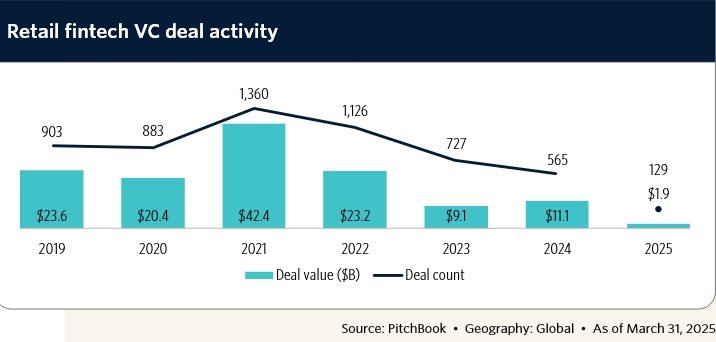
According to PitchBook Retail Fintech VC Trends, global retail fintech funding volumes reached $1.9 billion in Q1 2025, representing a 37.8% drop from Q4 2024 despite rising interest in platform-first strategies and growing AI adoption.
Although venture growth deals were the exception with median deal sizes jumping 67% to $47 million, making up 53.7% of total VC value. Klarna’s $12 billion valuation and Addi’s $170 million growth round stand out. IPO prospects for Klarna and eToro postponed listings due to market volatility ala Trump-effect.
Early stage retail fintech including median pre-seed and seed valuations fell by 50% and declined in size and count.
CCG Catalyst’s May 1 2025 snapshot of retail digital banking platforms features fintech companies are gaining traction because they stack cloud-native scale, AI tools, and modular architecture:
| U.S. Platform | Why Investors Are Interested |
| Backbase | Microservices, API-first architecture, and enterprise flexibility |
| Narmi | Open API stack and fast onboarding (under 3 minutes) |
| Lumin Digital | AI-native with strong mobile UX, cloud-native since day one |
| SoFi/Cyberbank | End-to-end infrastructure with embedded finance support |
| Temenos Infinity | Low-code platform enabling rapid interface development |
Canada’s fintech ecosystem has several growing players with potential to evolve into full service modular banking platforms or infrastructure providers:
| Canadian Company | Comparable U.S. Platform | Strategic Direction |
| Wealthsimple | SoFi | Expanding beyond investing into cash accounts, cards, and tax tools |
| Koho | Narmi | Prepaid card and banking-like functionality with open APIs |
| Neo Financial | Lumin Digital | Mobile-first, rewards-driven model with merchant integration |
| EQ Bank | Backbase | Hybrid of legacy and digital bank offering API access and high-interest accounts |
| Tandem or Brim | Apiture or Temenos | Fintechs with credit and loyalty platforms, potential to grow through partnerships |
Canadian fintech is still limited by federal regulatory complexities but opportunities are increasing as consumers move away from branch-based banking, the need for increased competition amidst Trump's economic pressures, and newly elected Prime Minister Mark Carney vowing to protect Canada.
According to the Canadian Bankers Association's 2024 report, 70% of Canadians used a mobile banking app in the last year (on average 7.4 times per month), up from 65% in 2021.
VC interest in Canadian fintech remained strong in 2024, despite a global slowdown. Fintechs with platform enabling capabilities such as embedded finance, banking-as-a-service, and open API designs continue to attract interest. Plus, the rise of U.S. plug-and-play models is a playbook for homegrown infrastructure players to serve Tier 2 banks, credit unions, and niche verticals like gig economy banking.
Digital banking platforms at the forefront are meeting customer expectations and improving operational efficiency with a few key technologies:
Digital retail banking platforms are using AI, APIs, and modular designs to deliver flexible, intelligent, and ready to scale solutions. Canadian fintechs that embrace open architecture and build for partnerships can lead not just here in Canada, but globally.
The National Crowdfunding & Fintech Association (NCFA Canada) is a financial innovation ecosystem that provides education, market intelligence, industry stewardship, networking and funding opportunities and services to thousands of community members and works closely with industry, government, partners and affiliates to create a vibrant and innovative fintech and funding industry in Canada. Decentralized and distributed, NCFA is engaged with global stakeholders and helps incubate projects and investment in fintech, alternative finance, crowdfunding, peer-to-peer finance, payments, digital assets and tokens, artificial intelligence, blockchain, cryptocurrency, regtech, and insurtech sectors. Join Canada's Fintech & Funding Community today FREE! Or become a contributing member and get perks. For more information, please visit: www.ncfacanada.org
| | |
|---|---|---|
| | |
Innovation Economy | April 29, 2025

Image: Freepik
Mark Carney has been elected as Canada's 24th Prime Minister after leading the Liberal Party to win the 2025 federal election. The Liberals secured 168 seats (just shy of a majority), and are expected to form a minority government. Prime Minister Mark Carney has already spoken with President Trump about the pressing issues of tariffs, trade war and 51st state rhetoric, and the two leaders have agreed to meet in person.
While those issues are of critical importance to Canada's sovereignty, this article looks at Carney's past public comments and Liberals 2025 platform to get a sense for the implications for Canada's fintech sector under his expected leadership.
In 2019, Carney was the Governor of the Bank of England (BoE) and said the following at the Innovate Finance Global Summit:
“A new economy requires a new finance... to serve the digital economy, to support the major transitions underway across the globe and to increase the sector’s resilience”.
The newly elected Prime Minister of Canada has a deep background in finance, global networks, and a steady hand at innovation. He's expected to speed up payments modernization, support the responsible AI development, foster fintech investment, tighten crypto rules, and open more global markets to Canadian companies. The Liberal Party commitments that support innovation include financial technologies and sustainable finance, infrastructure investment, internal trade reform, red tape reduction, and a patent box regime, all told would help strengthen the economy and fintech growth.
When Carney was leading the BoE, he signalled strong support for opening payments infrastructure to non-bank providers, helping to boost innovation and competition. In Canada, the implementation of open banking and payment modernization initiatives (i.e. Real Time Rail System) have sadly faced prolonged delays. Carney is expected to speed up these rollouts to benefit consumers and competition. Open banking will give consumers control over their financial data and allow fintech companies to create new services, while the operating firms must meet high security and operational standards.
As part of its 2025 platform, the Liberal government committed to eliminating federal barriers to interprovincial trade and labour mobility by Canada Day. Reducing costs and aligning standards could benefit fintech companies that must constantly track and adjust to changing and inconsistent provincial compliance requirements, in sectors like payments, insurtech, wealthtech, and others. Streamlining trade and regulatory barriers would help fintechs expand nationally more effectively, reduce legal and operational costs, and also contribute to offering consistent services to customers and businesses from coast to coast.
Carney spoke about how emerging technologies are game-changing finance in a 2018 Mansion House speech “New Economy, New Finance, New Bank”, where he acknowledged AI's growing impact on credit and risk systems.
Under his government, Canada is expected to advance the Artificial Intelligence and Data Act to regulate high impact AI systems including financial firms using AI for credit scoring, fraud detection, or robo advising to ensure responsible AI standards are met for fairness, explainability, and consumer protection.
Immediately after securing Liberal leadership, Carney axed the controversial capital gains tax hike, directly supporting Canada's innovation economy. Under his leadership, Carney could expand access to venture capital, innovation incentives, and encourage national regulatory alignment for startups operating across multiple provinces. The Liberal platform also supports a patent box regime, focused on scaling high growth firms, retaining intellectual property in Canada, and improving commercialization outcomes from public and private R&D. The Liberal 2025 Platform outlines efforts to increase business investment and create a more competitive innovation environment, especially for sectors like fintech and AI.
Although Carney previously showed openness towards regulated forms of crypto innovation, in 2018, he spoke critically of unbacked crypto assets and called Bitcoin “neither a store of value nor a useful means of exchange”. It's expected that he'll tighten oversight of crypto exchanges, stablecoin issuance, and asset custody. Lastly, while Carney hasn't explicitly endorsed a Canadian CBDC, he has called for central banks to explore sovereign digital currencies as tools to support monetary policy and financial stability. During a 2019 speech at the Jackson Hole Economic Symposium, for example, Carney proposed the idea of a "synthetic hegemonic currency" (SHC) as a potential solution to the destabilizing dominance of the U.S. dollar in the global financial system.
Mark Carney is one of the most prominent global figures in sustainable finance. He co-founded the Glasgow Financial Alliance for Net Zero (GFANZ) and served as the UN Special Envoy on Climate Action and Finance. His leadership brings a strong focus on aligning financial systems with climate goals. The 2025 Liberal platform commits to supporting green innovation and transitioning Canada toward a low-carbon economy. This creates opportunities for fintechs in areas like ESG data services, green lending, climate risk modeling, and carbon trading infrastructure.
Carney is expected to support broader digital financial access across Canada. In his 2018 “Future of Money” speech, he emphasized the role of digital identity, financial modernization, and infrastructure in improving inclusion. While he has't directly addressed digital ID for Canada, the Liberal platform’s national digital readiness strategy includes high speed rail and northern connectivity projects that could help bring digital banking and fintech services to underserved and remote communities.
| Opportunities | Challenges |
| Launch of real time payments and open banking | Meeting tougher compliance and risk standards |
| New funding for AI, fintech innovation, and green finance | Higher expectations for responsible AI and cybersecurity |
| Stronger startup investment environment and patent box incentives | Adapting to stricter crypto and stablecoin rules |
| Global trade partnerships and reduced internal trade barriers | Competition from international fintech firms |
| Possible leadership in digital identity and CBDC projects | Regulatory complexity for multi jurisdictional firms |
| Growth in sustainable finance and ESG fintech | Evolving global standards for ESG data and disclosures |
| Growth in digital access through national infrastructure | Uneven fintech access in rural and remote communities |
Mark Carney's credentials offer an elite tier of credibility in global finance, climate leadership, and modernization of financial systems. Together with the Liberal 2025 Platform's strategic commitments to innovation, interprovincial trade liberalization, red tape reduction, and IP commercialization, his leadership is desperately needed to improve Canada's flailing productivity, upgrade its financial ecosystem, build public trust and international competitiveness.
His background also positions Canada to lead in sustainable finance, aligning innovation with global climate goals. For fintech entrepreneurs, investors, and policymakers, the Carney era is underpinned by stable governance and a clear vision, offering a mix of opportunity and responsibility.
The National Crowdfunding & Fintech Association (NCFA Canada) is a financial innovation ecosystem that provides education, market intelligence, industry stewardship, networking and funding opportunities and services to thousands of community members and works closely with industry, government, partners and affiliates to create a vibrant and innovative fintech and funding industry in Canada. Decentralized and distributed, NCFA is engaged with global stakeholders and helps incubate projects and investment in fintech, alternative finance, crowdfunding, peer-to-peer finance, payments, digital assets and tokens, artificial intelligence, blockchain, cryptocurrency, regtech, and insurtech sectors. Join Canada's Fintech & Funding Community today FREE! Or become a contributing member and get perks. For more information, please visit: www.ncfacanada.org
| | |
|---|---|---|
| | |
Payments | April 24, 2025
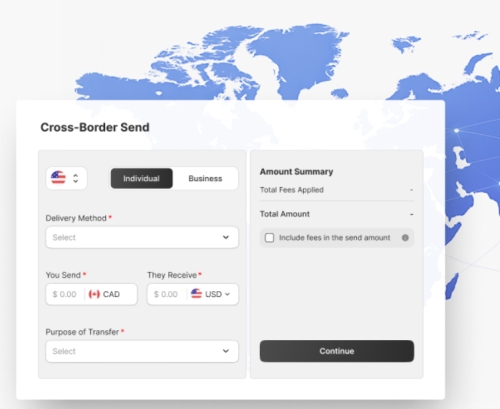
Image courtesy of VoPay
On April 23, Vancouver-based fintech VoPay announced the launch of its Cross Border Payments-as-a-Service platform, built for companies that want to send money globally but don’t want to build the infrastructure to do it.
VoPay's new payments service offers companies including fintechs a full suite of tools to move money for B2B, B2P, P2B and P2P use cases across 140+ countries, and various payment channels and methods. The system handles currency conversion, compliance risks, banking partnerships, and global settlement behind the scenes while companies retain full control of the user experience.
Instead of reinventing a global payment network from scratch, companies can plug into VoPay’s platform through APIs, white label dashboards, and even no-code tools, with setup taking less than two weeks. The new cross-border payments platform supports business to business, business to person, and peer to peer payments using a single system designed for speed and scale.
The platform offers real time foreign exchange with smart routing, helping businesses optimize conversion rates automatically. It comes with compliance tools already built in, including checks for KYC, AML, and global sanctions, so companies don’t need to manage that complexity on their own.
Money can be sent via a wide range of global delivery methods, such as direct bank transfers, mobile wallets, credit and debit cards, and even cash payouts where supported. VoPay's service also handles reconciliation, transaction tracking, and reporting, which gives businesses full visibility and peace of mind over every payment.
Everything is designed to work with existing platforms, so companies can start offering international payments to their customers quickly. VoPay has also partnered with Mastercard to support real time payouts to more than 100 countries.
While fintechs and financial institutions can use the platform to add global payment features quickly, the service is also designed for online platforms, such as vertical SaaS, digital marketplaces, payroll apps, and ERPs.
For example, a gig work platform could use VoPay to pay global contractors. An insurance platform could send global claims instantly. A business platform could let clients send or receive funds across borders in real time.
Hamed Arbabi, CEO of VoPay:
"In a time when cross-border trade and supply chains face unprecedented complexity, businesses need infrastructure that removes barriers, not adds to them. This new solution gives our partners the ability to offer world-class international payment experiences, boosting their revenue streams while supporting their customers with faster, smarter, and safer transactions."
Cross-border B2B payments are projected to reach $124 trillion by 2028. VoPay's PaaS tools enable companies to offer fast, brandable, and compliant ways to move money around the globe without being a payments company or having to build complex infrastructure. This launch builds on VoPay’s broader work in embedded finance and follows its recent VoPay360 release, which helps integrate payments into accounting platforms. The platform is now live and available for commercial use. For more information: vopay.com/global-cross-border-payments
The National Crowdfunding & Fintech Association (NCFA Canada) is a financial innovation ecosystem that provides education, market intelligence, industry stewardship, networking and funding opportunities and services to thousands of community members and works closely with industry, government, partners and affiliates to create a vibrant and innovative fintech and funding industry in Canada. Decentralized and distributed, NCFA is engaged with global stakeholders and helps incubate projects and investment in fintech, alternative finance, crowdfunding, peer-to-peer finance, payments, digital assets and tokens, artificial intelligence, blockchain, cryptocurrency, regtech, and insurtech sectors. Join Canada's Fintech & Funding Community today FREE! Or become a contributing member and get perks. For more information, please visit: www.ncfacanada.org
| | |
|---|---|---|
| | |
AI Security | April 22, 2025

Image: Freepik/atlascompany
Perplexity AI is growing fast with over 10 million Android downloads and is backed by tech royalty like Jeff Bezos but a new security report by a Singapore security firm AppKnox found major vulnerabilities that could be exploited by attackers. We're not talking small potatoes here. We're talking about huge issues like hardcoded API keys and significant weaknesses against any sort of malicious hacking.
While Perplexity's android app isn't what most fintechs run their AI service on, it's a red flag about the state of security in the quickly evolving world of artificial intelligence tools that banks, wealthtech platforms, and credit unions are exploring, embedding, investing and integrating in..
Perplexity’s Android app includes private access keys that should not be exposed. These keys work like internal passwords and were stored inside the app itself. This makes it easy for anyone with technical skills to find and misuse them. These hardcoded credentials could be downloaded and used to access Perplexity's AI full system completely for free.
Another serious problem is that the app does not check if it is connecting to a real or fake server. Cybernews reports that someone on public WiFi could take advantage of this to spy on what users are doing. This might include watching what they search, type, or log in to.
The app has not fixed several known security flaws that have existed in Android for years, such as StrandHogg and Janus are still present. These are weaknesses that hackers already understand and can use to gain control or access private information.
Perplexity's app doesn't check if a phone is rooted or not, and it's less secure if it is.
The app’s code is also not protected. This means someone could open it up, look inside, and understand exactly how it works. They could then use this to find more vulnerabilities to attack or copy its features.
The app can be tricked into letting attackers control parts of the screen without the user knowing. So, you could be typing into a pop-up form or something that looks familiar but it's actually a trap that can steal your information.
How is it possible that a high profile AI unicorn like Perplexity ships a mobile app that fails basic security checks? If they are missing the basics, how many others are? This raises a critical question for fintechs and financial institutions looking to integrate AI whether it's a chatbot, SDK, API, or embedded assistants.
Are you checking how secure your vendors really are?
It's a reality check that a soaring valuation doesn’t guarantee strong engineering discipline.
Where are the API keys stored? If they live in the mobile app code, that’s a no-go.
Does the vendor use SSL validation and pinning? If not, data can be intercepted over public WiFi.
Are known vulnerabilities patched? Run a third party scan or ask for one.
Is the code protected? If it’s not, attackers can easily reverse-engineer how it works.
Does the app detect rooted or jailbroken devices? If not, it might be operating in a compromised environment.
What’s the vendor’s breach response plan? Ask how they handle disclosures, patches, and updates.
How much access are you really giving? Use API scopes, rate limits, and narrow permissions by default.
Perplexity's Android app glaring security risks is a textbook example of what happens when security gets left behind in a rush to launch/scale products out the door. Don't ever forget that financial data isn't forgiving when it leaks. Whether you're exploring AI for customer support, product recommendations, or internal workflows, you need to prioritize the app and API security for your use case. Trust is earned but it can be lost in a heart beat.
The National Crowdfunding & Fintech Association (NCFA Canada) is a financial innovation ecosystem that provides education, market intelligence, industry stewardship, networking and funding opportunities and services to thousands of community members and works closely with industry, government, partners and affiliates to create a vibrant and innovative fintech and funding industry in Canada. Decentralized and distributed, NCFA is engaged with global stakeholders and helps incubate projects and investment in fintech, alternative finance, crowdfunding, peer-to-peer finance, payments, digital assets and tokens, artificial intelligence, blockchain, cryptocurrency, regtech, and insurtech sectors. Join Canada's Fintech & Funding Community today FREE! Or become a contributing member and get perks. For more information, please visit: www.ncfacanada.org
| | |
|---|---|---|
| | |
Stablecoins | April 17, 2025

Image: Freepik/creativeart
Stablecoins are gaining traction and are no longer a niche bet. According to Stripe’s 2024 Annual Letter, the number of monthly active stablecoin wallets tripled to 40 million over the past year. Stripe has now successfully integrated stablecoin capabilities into its core platform by the acquisition of Bridge, an enterprise grade stablecoin infrastructure provider (like Swift but on blockchain and faster) focused on real-time treasury and cross-border flows.
Stripe co-founders, Patrick and John Collison see stablecoins as improving the usability of money that can lead to more prosperous economies by enabling faster, cheaper, and more accessible transactions. An evolutionary and historical shift like the move from gold to fiat currency.
“Improvements to the basic usability of money make economies more prosperous. Consider the transitions from coins to banknotes, from the gold standard to fiat currency, and from paper instruments to electronic payments. Stablecoins are a new branch of the money tree. Such transitions occur with some regularity over the centuries, and the effects tend to be large.”
a16z just shared 'Stablecoins are payments without intermediaries', highlighting that stablecoins managed over $15.6 trillion of on-chain volume in 2024, which is essentially the same as Visa's annual volume, but it's growing and accelerating.
Stablecoins are no longer an experiment and have become part of core infrastructure. Stripe uses them for real time settlements and lower cross border costs. Over 78% of the Forbes AI 50 use Stripe products, so stablecoin transactions could scale massively quickly.
For any fintechs or financial institutions still relying on multi-day SWIFT transfers or batch ACH systems - it's time to take notice. Stablecoins offer instant settlement, programmable logic, and almost zero fees.
There's no waiting for banking hours or regional cutoffs. Stablecoin availability is open 24/7. The average transaction costs on networks like Solana are less than $0.01. Stablecoin transactions can finalize in under 5 seconds.
Stablecoins like USDC are designed to be composable, so they integrate seamlessly with numerous smart contracts and decentralized applications. Financial tools can now be built directly on-chain using smart contracts and stablecoin flows.
That's why stablecoins are already being used for payroll (e.g., pay overseas contractors), international business payments, and even on-chain stable yield strategies.
Stripe’s 2024 update, reports that stablecoin integration is already being used in many practical ways, such as SpaceX uses Stripe's stablecoin infrastructure to repatriate funds from Starlink sales in countries like Argentina and Nigeria. The U.S. government uses Stripe's stablecoin solutions to improve efficiencies of financial operations.
There are several real world economic cases where countries are relying on stablecoins.
Argentina for example, experienced a massive spike in annual inflation of 211.4% in 2023, which pushed many to hedge against inflation by moving funds to stablecoins like USDT and USDC.
Nigeria uses stablecoins to send funds across borders due to the inefficiencies and high costs involved with traditional remittance methods, making global transfers more affordable.
In the Philippines, a stablecoin called PHPC (pegged to the Philippine peso) is used to reduce exchange rates and transfer costs for Filipino expats sending money home to families.
If Canada wants to compete in global finance, we can’t ignore what’s happening at the infrastructure level. Major tech platforms like Stripe are integrating stablecoins into programmable finance. Startups are now choosing stablecoin rails to access global markets from day one. Canada has been working to modernize it's payment infrastructure and real time rails for years but the tech overhaul has been delayed over years, and even the Bank of Canada is disappointed by the progress rate.
Fintechs and financial institutions should be evaluating the growing use cases of stablecoins such as cross border treasury flows, global payroll, and embedded payments. They should track the developments in upcoming stablecoin regulations, such as Canada's Retail Payment Activities Act, the U.S. efforts, the UK, and European crypto guidelines. They can begin compliance planning and readiness efforts for stablecoin transaction and consider partnering with infrastructure providers offering compliant stablecoin APIs.
Stablecoins have gone mainstream and are now core infrastructure settling in seconds for less than a penny, and running 24/7. Stripe, SpaceX, governments, and individuals and companies globally are using them for faster, cheaper payments. If you're still relying only on traditional payment rails, it's time to evaluate stablecoin use cases and get ready to plug into the new financial internet.
The National Crowdfunding & Fintech Association (NCFA Canada) is a financial innovation ecosystem that provides education, market intelligence, industry stewardship, networking and funding opportunities and services to thousands of community members and works closely with industry, government, partners and affiliates to create a vibrant and innovative fintech and funding industry in Canada. Decentralized and distributed, NCFA is engaged with global stakeholders and helps incubate projects and investment in fintech, alternative finance, crowdfunding, peer-to-peer finance, payments, digital assets and tokens, artificial intelligence, blockchain, cryptocurrency, regtech, and insurtech sectors. Join Canada's Fintech & Funding Community today FREE! Or become a contributing member and get perks. For more information, please visit: www.ncfacanada.org
| | |
|---|---|---|
| | |
Financing | April 14, 2025

Image: Freepik
Financial infrastructure provider, Plaid, announced on April 3 2025, that they raised $575 million Series D at a valuation of $6.1 billion valuation led by Frank Templeton, BlackRock, Fidelity, and others including existing investors such as NEA and Ribbit Capital. While the valuation is significantly lower than it's 2021 peak of $13.4 billion, Plaid's latest round is a story of consolidation of it's role at the heart of embedded finance, and not of decline.
Plaid is a backbone of embedded finance with a footprint that spans more than 8,000 apps, including many widely used fintech tools and providers in Canada and the U.S. For Canadian fintech companies, this raise hints at where industry is heading and who will control its most critical pipes.
Unlike most fintech firms still chasing break-even, Plaid finished off 2024 with positive operating margins, strong ash flows and a 25% yoy revenue increase. In Plaid's letter to shareholders, 2025, CEO and Cofounder Zach Perret explained that it has a usage based billing model where Plaid earns revenue when an end user signs-up, takes actions in connected apps, or remains active on a per-user-per-month basis. In a market where profitability is favoured over growth at all costs, these numbers speak volumes.
The platform has achieved a core level of recurring annual revenue that allows it to reinvest confidentially in areas like AI powered fraud prevention and data-science enhanced credit scoring.
“Our core business has consistently grown double digits year-over-year despite 2022 and 2023 being the worst slowdown in fintech in the last two decades.”
Plaid's shareholder letter also reports that over 50% of Americans with a bank account have used the platform, either directly or through partner apps. Its customers include enterprise players like Affirm, Chime, Robinhood, SoFi, Citi, and H&R Block, plus thousands of fintech startups globally.
“Our products are the bedrock upon which many of the most well-known financial brands are built.”
Unlike past funding frenzies, this round was strategic, institutional, and about positioning control over the infrastructure of financial data, an area about to be transformed by AI and embedded finance.
In the past few years, Plaid has transformed itself from a bank linking utility into an infrastructure platform with multiple tools, such as alternative credit data, anti-fraud solutions, and bank payments infrastructure. CEO Perret explained that "New products represented >20% of ARR in 2024, compounding at 93% annually.” So it's no longer just about the interface, the tools and stack is consolidating into robust infrastructure.
A large portion of the funds are being allocated to convert restricted stock units (RSUs) into shares to provide liquidity for long term employees and retention strategy for talent. The rest of the funding will continue to support product development powered by data science, machine learning, and AI.
Plaid’s expanding capabilities also highlight Canada’s open banking delays. Canada is expected to implement open banking in 2026, but it doesn't have it yet, despite Finance Canada researching it and promising its implementation for years.
Without a formal framework in place, Canadian fintechs must rely on third-party data aggregators like Plaid to access banking information, including firms like Wealthsimple and KOHO. While using Plaid's banking access tools enables fintechs to get up and running quickly and innovate in the short term, it places critical infrastructure in the hands of foreign companies, raising concerns about data sovereignty and long term competitive capacity.
Daniel Eberhard, CEO of Koho to the House of Commons Standing Committee on Finance:
“In Canada, we do not have open banking. Every time we need to interact with the incumbent financial system, we’re forced to build workarounds.”
Plaid's $537 million strategic series D signals a consolidation of fintech infrastructure. Capital is becoming more selective and innovation is leading towards AI and embedded services, so the companies that control the access to data and financial infrastructure are gaining strategic ground. Canadian fintechs and policymakers of open banking in Canada should be watching developments closely to ensure Canada can remain competitive and not overly reliant on U.S. infrastructure.
The National Crowdfunding & Fintech Association (NCFA Canada) is a financial innovation ecosystem that provides education, market intelligence, industry stewardship, networking and funding opportunities and services to thousands of community members and works closely with industry, government, partners and affiliates to create a vibrant and innovative fintech and funding industry in Canada. Decentralized and distributed, NCFA is engaged with global stakeholders and helps incubate projects and investment in fintech, alternative finance, crowdfunding, peer-to-peer finance, payments, digital assets and tokens, artificial intelligence, blockchain, cryptocurrency, regtech, and insurtech sectors. Join Canada's Fintech & Funding Community today FREE! Or become a contributing member and get perks. For more information, please visit: www.ncfacanada.org
| | |
|---|---|---|
| | |



August 26th, 2025

January 4th, 2024

June 1st, 2021

September 9th, 2020

July 9th, 2018

January 3rd, 2018

September 25th, 2017

June 20th, 2017

May 10th, 2017

December 14th, 2016
