





Karsten Wenzlaff, Advisor
August 26th, 2025
Karsten Wenzlaff is a Crowdfunding and Fintech Expert from Germany. He is Secretary-General of Digit[...]


May 5, 2026 | NCFA Fintech Market Activity | Digital Assets And Tokenization, Capital Markets And Market Infrastructure

On May 5, 2026, Bullish agreed to acquire Equiniti from Siris in an all stock transaction valued at $4.2B, with FT Partners serving as financial advisor to Siris. The deal gives Bullish control of a regulated transfer agent that serves:
Equiniti’s client base includes roughly 50% of the FTSE 100 and about 33% of the S&P 500, placing it directly inside the ownership and record keeping core that global capital markets already rely on. It's a scaled infrastructure business with expected 2026 revenue of $890 - $940M and EBITDA of $335 - $350M.
That kind of scale can handle real volume, real issuers, and real investor bases that tokenized securities systems require. The platform already processes payments, dividends, and corporate actions at scale across global markets.
Frank Baker, Co-Founder and Managing Partner of Siris:
"Tokenization represents one of the most significant shifts in market infrastructure since the advent of electronic trading, and we are confident that Bullish is exceptionally well positioned to build on Equiniti’s strength and capture the meaningful growth opportunities ahead.”
Transfer agents operate at the center of capital markets, and Bullish is buying the system of record. They track ownership, manage corporate actions, and connect issuers to investors. That role becomes even more valuable as securities are tokenized and begin moving faster and across more venues.
Bullish already operates digital asset market infrastructure across trading, liquidity, and data. It's listed on the New York Stock Exchange BLSH and holds licenses across major jurisdictions, including New York, Germany under MiCAR, Hong Kong, and Gibraltar.
Equiniti adds the issuer side of the market. Together, the combined platform points to a full stack that spans issuance, registry, compliance, trading, and settlement.
This deal puts Bullish on a different track than other major platforms. Coinbase is focused on custody, trading, and derivatives. Robinhood is expanding distribution and retail access, including in Canada. This aligns with growing market activity in tokenized collateral and cash, where trusted infrastructure is driving adoption more than isolated blockchain tools.
The transaction is expected to close in the first quarter of 2027, subject to regulatory approvals. The outcome isn't final, but the direction is already visible. Ownership records are becoming a strategic asset in digital markets, and Bullish just paid $4.2B to secure that position.
 The National Crowdfunding & Fintech Association (NCFA Canada) is a financial innovation ecosystem that provides education, market intelligence, industry stewardship, networking and funding opportunities and services to thousands of community members and works closely with industry, government, partners and affiliates to create a vibrant and innovative fintech and funding industry in Canada. Decentralized and distributed, NCFA is engaged with global stakeholders and helps incubate projects and investment in fintech, alternative finance, crowdfunding, peer-to-peer finance, payments, digital assets and tokens, artificial intelligence, blockchain, cryptocurrency, regtech, and insurtech sectors. Join Canada's Fintech & Funding Community today FREE! Or become a contributing member and get perks. For more information, please visit: www.ncfacanada.org
 |  |  |
|---|---|---|
 |  |  |
May 5, 2026 | NCFA Fintech Market Activity | Digital Assets Blockchain And Tokenization, Capital Markets And Funding

On May 5, 2026, a16z crypto announced Crypto Fund 5, a $2.2 billion fund for startups building crypto infrastructure and products. a16z isn’t waiting for another hype cycle. It's putting capital behind the parts of crypto that already look useful, including stablecoins, tokenized assets, on chain lending, payments, and AI agents.
The stablecoin thesis carries the most weight currently. Trading activity still rises and falls with crypto markets, but stablecoins keep gaining use in saving, cross border transfers, and payments. That’s the fintech read. Stablecoins aren't just trading tools. They're becoming payment, treasury, and settlement infrastructure.
Fund 5 also points to a capital markets build. Perpetual futures, prediction markets, on chain lending, stablecoin credit markets, and tokenized real world assets push crypto closer to financial workflows that run continuously and settle faster than legacy systems. The opportunity is infrastructure that reduces friction where money, collateral, data, and ownership move.
The Canadian market is perking up too, with a practical example in Canada’s first financial institution issued CAD stablecoin, while bank technology providers are building toward bank issued digital money. The next test is volume growth. Stablecoins and tokenized cash only matter if they improve settlement, treasury, lending, compliance, and payment workflows for real customers (while at the same time servicing robot customers too? Here's Google says to build for agents And humans).
And then there's AI that makes the fund more of everything all at once. a16z links crypto networks to software agents that can decide, act, and transact on behalf of users. Agent driven commerce needs payment rails, permissions, identity, auditability, digital property rights, and settlement that works without banking hours. Crypto infrastructure may become one way machines pay for compute, data, services, and financial access.
Where's the risk? A large fund can finance infrastructure, but customers still need simple products, trusted custody, clear rules, strong compliance, and measurable cost savings. The market has already punished crypto projects that don’t turn tech novelty into customer value. Fund 5 allocation will need to ensure builders can turn crypto infrastructure into everyday financial products that work better than the old rails.
If global venture capital is backing crypto infrastructure for payments, tokenization, and AI agents at scale, can Canada turn regulated digital asset rails into products that win real settlement, treasury, and financial services volume?
The National Crowdfunding & Fintech Association (NCFA Canada) is a financial innovation ecosystem that provides education, market intelligence, industry stewardship, networking and funding opportunities and services to thousands of community members and works closely with industry, government, partners and affiliates to create a vibrant and innovative fintech and funding industry in Canada. Decentralized and distributed, NCFA is engaged with global stakeholders and helps incubate projects and investment in fintech, alternative finance, crowdfunding, peer-to-peer finance, payments, digital assets and tokens, artificial intelligence, blockchain, cryptocurrency, regtech, and insurtech sectors. Join Canada's Fintech & Funding Community today FREE! Or become a contributing member and get perks. For more information, please visit: www.ncfacanada.org
| | |
|---|---|---|
| | |
May 5, 2026 | NCFA Insight | Artificial Intelligence And Data, Digital Assets Blockchain And Tokenization

Image: Magnific
On May 5, 2026, Coinbase filed a Form 8-K restructuring plan to cut about 700 employees or 14% of its global workforce as of May 1, 2026. The company expects most of the work cuts to finish in the second quarter of 2026 and estimates $50 - $60 million in restructuring expenses, such as severance and termination benefits. This isn't just another volatile crypto layoff, but rather a public market test of how the integration of AI tech is altering cost, team design, and operating workflow and design.
Coinbase linked the restructuring plan to current market conditions and the need to optimize operations for the AI era. With AI now disrupting the cost base, fintech boardrooms are facing harder questions around how much work can run through smaller teams, better tooling, and tighter controls?
Brian Armstrong, CEO and Co-Founder, Coinbase:
“Over the past year, I've watched engineers use AI to ship in days what used to take a team weeks. Non-technical teams are now shipping production code and many of our workflows are being automated.”
For fintech leaders, artificial intelligence is a capital allocation decision. AI spending and workforce redesign is surfacing new trade-offs about spending the next dollar on creating more output, people, platforms, or compute?
That question is currently running through every repeatable workflow in finance. Customer support. Compliance triage. Fraud review. Internal reporting. Software development. Onboarding. Risk monitoring. AI can compress parts of that work, but financial firms don’t get to optimize for speed alone. They also need audit trails, data controls, customer protection, and clear human accountability.
Clean operators can use AI to remove friction. Messy operators may spend more just to make automation safe enough to use.
AI raises the benchmark because investors can now ask whether a crypto infrastructure firm needs the same headcount to support the same activity.
It's pressure that's proliferating through all fintechs, not just crypto, but payment firms, wealth platforms, regtech and insurtech vendors, market infrastructure providers, and more.
Can they serve more customers, process more exceptions, ship better software, and meet compliance obligations without scaling headcount at the same rate?
There's inherent danger in treating AI as a simple cost cutter. It is not because automation creates new work around oversight, security, data quality, model review, escalation, and governance. In financial services, a faster workflow that weakens trust is not progress. It is future liability.
Investors want stronger unit economics. Customers expect faster service. Regulators expect better controls.
Companies should be rebuilding work before harder choices arrive. Canadian firms should know which workflows still depend on manual review, which controls can be automated safely, and which teams can support growth without adding people at the same pace as revenue.
This is also a productivity issue. Canada’s fintech competitiveness will depend on whether firms can turn AI into better service, lower operating cost, stronger fraud controls, faster onboarding, and cleaner compliance. Companies that can solve this earlier will have more room to invest when capital tightens.
AI changes the economics of work, but it also changes decision making. If software helps write code, approve support responses, flag suspicious activity, draft compliance notes, or review onboarding files, management must know where human review remains mandatory. That is where AI agents in finance become more than a software story. They force firms to decide which tasks should run through automation, which decisions still need human judgment, and how every exception gets reviewed.
AI can improve speed, but weak controls can create opaque decision chains. Smaller teams can be stronger teams when work is clear, measurable, and governed. They can also become fragile when automation hides weak process design.
If AI is now establishing operating cost benchmarks for crypto exchanges and fintech platforms, can Canadian financial innovators redesign work fast enough to compete without weakening trust, compliance, or customer protection?
For Canada, the opportunity is practical. Build cleaner workflows. Improve data quality. Keep accountability visible. Use AI where it strengthens the work, not where it hides weak process.
The National Crowdfunding & Fintech Association (NCFA Canada) is a financial innovation ecosystem that provides education, market intelligence, industry stewardship, networking and funding opportunities and services to thousands of community members and works closely with industry, government, partners and affiliates to create a vibrant and innovative fintech and funding industry in Canada. Decentralized and distributed, NCFA is engaged with global stakeholders and helps incubate projects and investment in fintech, alternative finance, crowdfunding, peer-to-peer finance, payments, digital assets and tokens, artificial intelligence, blockchain, cryptocurrency, regtech, and insurtech sectors. Join Canada's Fintech & Funding Community today FREE! Or become a contributing member and get perks. For more information, please visit: www.ncfacanada.org
| | |
|---|---|---|
| | |
May 4, 2026 | NCFA Fintech Market Activity | Digital Assets Blockchain And Tokenization, Payments And Money Movement

On May 4, 2026, Tetra Trust Company, through its agent CAD Digital Inc., launched CADD, a payment stablecoin backed 1:1 by Canadian dollars. Alberta Treasury Board and Finance approved the model, making CADD Canada’s first CAD backed stablecoin issued by a regulated financial institution.
CADD runs on Base, Ethereum, and Tempo, and Tetra expects Solana support next. The product gives Canadian dollars a regulated on chain settlement rail at a time when most stablecoin activity still runs through U.S. dollar assets. Canada’s payment systems cleared and settled more than $424 billion every business day in 2024, which shows the scale of domestic payment activity that still needs faster, more programmable settlement options.
The reserve structure is the core trust feature. Tetra says all funds used to mint CADD are held in trust and dedicated only to redemption. That gives institutions a clearer reserve, redemption, and asset protection model than offshore or loosely governed tokens. It also keeps the product grounded in Canadian law, Canadian reserves, and regulated trust company oversight.
Didier Lavallée, Founder and CEO, Tetra Digital Group
“This milestone reflects the strong collaboration with Alberta’s government, industry partners and regulators to bring a compliant and scalable Canadian-dollar stablecoin to market. CADD is issued by a regulated financial institution, with reserves held in Canada and compliance built in from day one by a firm with Canada’s longest track record of operating regulated digital asset infrastructure. It enables faster and more efficient movement of Canadian dollars on-chain within a structure institutions recognize.”
CADD enters the market with strong Canadian distribution behind it. The consortium includes Tetra Digital Group, Urbana Corporation, Wealthsimple, Purpose Unlimited, Shakepay, ATB Financial, National Bank of Canada, and Shopify. Distribution will decide whether a Canadian dollar stablecoin stays niche or becomes useful for payments, treasury, fintech settlement, and institutional workflows.
The launch follows a December 2025 testnet phase where CADD became the first Canadian stablecoin to move between two financial institutions, National Bank of Canada and Wealthsimple. The key point in Canada’s stablecoin test was that production grade Canadian stablecoin infrastructure needs regulated issuance, custody, compliance, and real distribution partners.
CADD gives Canadian fintechs and institutions a domestic alternative to U.S. dollar stablecoin rails.
It can support 24/7 cross border settlement, corporate treasury transfers, programmable marketplace payouts, and direct settlement between fintech partners without waiting on traditional banking windows. It gives builders a Canadian dollar rail to design around.
Most stablecoin growth has favoured U.S. dollar assets. Tetra says global stablecoin transaction volume surpassed $27 trillion in 2025, exceeding Visa’s annual payment volume. Canada has had CAD stablecoin initiatives before, including QCAD and CADC, but CADD brings regulated financial institution issuance, domestic reserves, and major Canadian distribution into one package.
The timing also connects to Canada’s digital finance buildout. Bill C-15 gave Canada a legal framework for stablecoins and consumer driven banking, while payment service providers now operate under the Retail Payment Activities Act. CADD brings that discussion into payment infrastructure.
Competition won't wait. CADC stablecoin consolidation and QCAD banking infrastructure already show demand for domestic digital money. CADD adds a regulated trust company issuer and a stronger partner network, which may help Canadian dollar settlement compete with foreign currency rails.
For banks, PSPs, exchanges, marketplaces, and fintech platforms, the integration question is practical. Can CADD reduce settlement delays, simplify treasury operations, and support programmable money flows while keeping controls strong enough for Canadian regulators and institutional risk teams?
The National Crowdfunding & Fintech Association (NCFA Canada) is a financial innovation ecosystem that provides education, market intelligence, industry stewardship, networking and funding opportunities and services to thousands of community members and works closely with industry, government, partners and affiliates to create a vibrant and innovative fintech and funding industry in Canada. Decentralized and distributed, NCFA is engaged with global stakeholders and helps incubate projects and investment in fintech, alternative finance, crowdfunding, peer-to-peer finance, payments, digital assets and tokens, artificial intelligence, blockchain, cryptocurrency, regtech, and insurtech sectors. Join Canada's Fintech & Funding Community today FREE! Or become a contributing member and get perks. For more information, please visit: www.ncfacanada.org
| | |
|---|---|---|
| | |
May 4, 2026 | NCFA Fintech Insight | Digital Assets Blockchain And Tokenization

On Apr 29, 2026, NCFA published a resource post on crypto adoption data across 11 European markets, based on the ARI10 Report Cryptocurrency Adoption in Europe 2026. The data points to a market that's moved past early awareness but hasn’t yet settled into consistent daily use just yet. That gap is where the next phase of competition starts.
The study surveyed 11,068 respondents across 11 countries between Jan 9 and Jan 15, 2026:
Roughly four in ten respondents have already researched, owned, or traded crypto. Just over three in ten qualify as investors. People know what crypto is, and many have already touched it. Crypto is by far no longer fringe.
However, Poland’s 47.10% exposure rate and France’s 30.41% rate describe very different market conditions. Norway, Spain, and Romania also show stronger engagement than the overall average. For operators, that means Europe has different adoption curves. It breaks into local markets depending on income, education, age, product trust, and financial habits.
Single broad brushed strategies may miss the mark. A wallet, exchange, payment product, or tokenized asset platform needs to match how users actually behave in each market, not how the regional average looks in a slide deck.
Investors still participate primarily for financial gains. Nearly half point to potential value growth, and more than two thirds cite financial motives overall. That makes crypto adoption look less like daily payment adoption and more like investment market participation.
This actually strengthens the crypto infrastructure story. Exchanges, custodians, payment firms, banks, and tokenization platforms keep investing because they’re trying to move crypto from access to daily utility. But user behaviour still leans toward buying, holding, and trading. The next stage of growth and adoption depends on how useful crypto becomes inside regular financial workflows, not just easier to purchase.
Risk and volatility rank at 33.3%. Lack of funds follows at 32.1%. Technical knowledge comes in at 31%. Lack of trust in exchanges reaches 28.6%. Regulatory uncertainty ranks much lower at 9.3%.
Regulation supports trust and scale, especially for institutions. But regulation alone doesn't turn interest into everyday use. Users need clearer entry points, better risk explanations, stronger platform trust, and products that make participating in crypto feel normal and useful.
This is where the current market opportunity is in Europe. Not in chasing generic adoption, but by turning curiosity into confidence, and confidence into repeat and useful behaviour.
Crypto adoption has reached a point where awareness and regulation are no longer the main constraints (at least in Europe and based on this study). The next iteration depends on whether the industry can turn interest into trusted, useful, everyday financial behaviour. Access the full report on Crypto adoption in Europe
The National Crowdfunding & Fintech Association (NCFA Canada) is a financial innovation ecosystem that provides education, market intelligence, industry stewardship, networking and funding opportunities and services to thousands of community members and works closely with industry, government, partners and affiliates to create a vibrant and innovative fintech and funding industry in Canada. Decentralized and distributed, NCFA is engaged with global stakeholders and helps incubate projects and investment in fintech, alternative finance, crowdfunding, peer-to-peer finance, payments, digital assets and tokens, artificial intelligence, blockchain, cryptocurrency, regtech, and insurtech sectors. Join Canada's Fintech & Funding Community today FREE! Or become a contributing member and get perks. For more information, please visit: www.ncfacanada.org
| | |
|---|---|---|
| | |
May 4, 2026

Image: Unsplash/Tech Daily
The crypto market is characterized by fast changes in the value of currency, which at times can be extremely favorable but at other times creating disastrous effects. Different from the stock market, the prices of cryptocurrencies often react more quickly to events, changes in the mood of investors, and global economic factors. For those just starting out, this constant fluctuation may seem chaotic but for ones who have been trading for a while, volatility is the element which makes their trading plans workable.
A lot of new investors that want to work with crypto prop trading make their first experience which leads them to the realization that volatility is not a monster to be chased away but the fact that should be looked in the eye. Firstly, before learning how to open a trading account with a crypto prop firm or how to make a start in crypto prop trading, you have to realize why the prices of the markets swing so wildly in one direction and how the traders can exercise self control in dealing with the reactions instead of letting their feelings take the lead.
The term market volatility is generally used to describe the velocity and the extent of the changes in the price of an asset happening in such a short period of time that many holders hardly notice them. In crypto trading, however, a single minute may be sufficient to witness sudden and significant price changes.
There are many reasons why there can be dramatic upward and downward price swings for cryptocurrencies such as Bitcoin and Ethereum including fluctuating investor demand, regulatory developments, influence of social media or massive purchasing by institutions.
On the one hand, operating in highly volatile conditions provides opportunities to gain whereas on the other hand, it significantly increases the risk hitters may suffer losses without proper preparedness.
There are a few reasons why crypto markets are much more volatile than other markets like stocks or forex.
Compared with the stock market and other investments, the crypto market is still immature. Besides being less regulated, this market has fewer large players and this results in stronger reactions to both genuine information and hearsay.
Due to the fact that stock exchanges are not operating around the clock, the prices of stocks are settled at the end of the trading day whereas in the crypto world, things are different as the market is always open and prices are changing even during the night, including weekends and holidays when the number of active participants is lower. This continuous activity is responsible for the building up of trading momentum and many cases where a quick change of direction happens.
The price of cryptocurrencies could very well be affected by a simple tweet from a leading figure in the industry, tip off news from a crypto exchange or an announcement by a government official regarding a change in regulations. There is a good chance that if these events are accompanied by an emotional reaction of the market, prices would move even more drastically.
Traders who master knowledge of volatility are less likely to make emotional mistakes and they can scale back their risk accordingly.
The higher the volatility in the market, the more frequent are the unexpected price changes. Hence, it is crucial for traders to fix their stop loss points way ahead to keep their money safe.
This is doubly true for crypto prop traders as the risk management rules are usually quite strict.
Taking a large position in a very volatile market can be a recipe for a huge loss. By opting for smaller positions, traders equip themselves better to withstand unanticipated market moves and maintain consistency in their trading.
It would be unrealistic to expect every one of price fluctuations to indicate a trading opportunity. By holding on for a signal instead of recklessly following price moves, one can steer clear of poor entries that are elicited by fear or greed.
While a lot of traders looking for crypto prop trading firms with the best terms are mostly concerned with getting capital, managing volatility is just as critical.
A prop firm that instantaneously funds trades could be giving the trader quick access to significantly bigger account size, however, when it comes to fast market moves, without having the right mindset in place, rapid losses can occur. Volume based traders often underperform those who develop a deep understanding of price action and trade on the basis of well informed decisions.
When you get into crypto prop trading, it is wise to research volatility in addition to technical analysis. Being a keen observer of the market trades helps in making better choices over time.
Professional traders use fixed habits that help them stay calm even in the face of strong price changes.
With a written game plan in hand, it is easier to keep one's feelings in check. Prior to the trade, all the decisions on entry, exit, and risk allocation should be made.
Whenever a trader feels panicky after reading news, it is usually a sign of poor timing. It is a good policy to always crosscheck facts and refrain from indulging in the frenzy aspect of the market until there is confirmation.
Investing all of one's capital into one type of asset is just asking for trouble. Allocating funds across an array of different assets is a good way to mitigate risks due to sudden events in the market.
Keeping a log of one's triumphs and failures, as well as emotional judgments, is a good way to formulate improvements. The ability to stick to one's game plan and stay consistent are far more valuable than one isolated, flawless trade.
The thing is, volatility itself is not good or bad it's through volatility that both opportunities and risks arise.
Bitcoin remains priced according to demand, large investors, governmental and media announcements, and the overall mood of market participants. And since it's always open, the market price can change rapidly.
Yes but only if they follow safe rules. Starting with small trades, using stop loss orders, and staying away from impulsive decisions are some of the ways to be on the safe side.
Since significant price movements could result in rule violations or losing the account more quickly than expected, funded traders need to be very cautious in their risk management.
Volatility remains a major characteristic of cryptocurrency trading, and those able to turn it into a feature can become even stronger investors. Rather than viewing the sudden price changes as a disaster, clever traders analyse the trends, manage the risks, and remain calm in the face of pressure.
Trading on one's own account or funded accounts, success comes more from being prepared than guessing. While the crypto market is bound to keep moving quickly, well disciplined traders who have a good understanding of volatility will be the ones best able to navigate the future.
The National Crowdfunding & Fintech Association (NCFA Canada) is a financial innovation ecosystem that provides education, market intelligence, industry stewardship, networking and funding opportunities and services to thousands of community members and works closely with industry, government, partners and affiliates to create a vibrant and innovative fintech and funding industry in Canada. Decentralized and distributed, NCFA is engaged with global stakeholders and helps incubate projects and investment in fintech, alternative finance, crowdfunding, peer-to-peer finance, payments, digital assets and tokens, artificial intelligence, blockchain, cryptocurrency, regtech, and insurtech sectors. Join Canada's Fintech & Funding Community today FREE! Or become a contributing member and get perks. For more information, please visit: www.ncfacanada.org
| | |
|---|---|---|
| | |
Apr 29, 2026 | NCFA Resource | Digital Assets Blockchain And Tokenization, Risk Compliance And Regtech
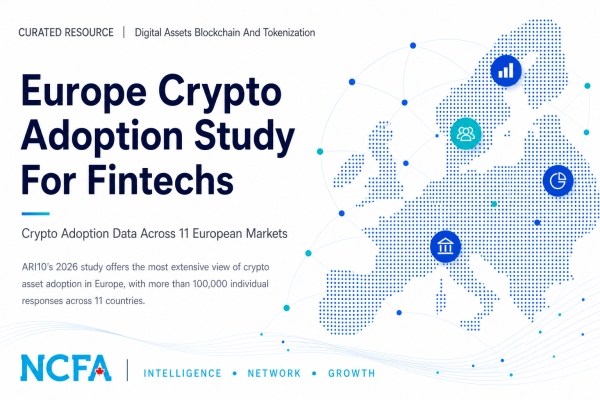
The ARI10 Cryptocurrency Adoption in Europe 2026 report provides a large scale view of crypto asset exposure, investor behaviour, regulatory concerns, and market confidence across Europe. The study draws on more than 100,000 individual responses from over 11,000 respondents across 11 European countries, including Poland, France, Italy, Germany, the Netherlands, the United Kingdom, Norway, Sweden, Hungary, Romania, and Spain. The study was developed with Dr Grzegorz Sobiecki of the Warsaw School of Economics and conducted by UCE Research.
In practice, this gives fintechs and digital asset firms a clearer view of where crypto adoption sits across European markets. The public findings point to nearly 40% of respondents having some exposure to cryptocurrencies, about 31% actively investing, and more than 56% identifying unclear regulation as a barrier to further adoption. For exchanges, wallets, payment providers, compliance teams, and investor education platforms, the report helps connect adoption demand with trust, regulation, and user experience.
This is most useful for teams that need market level evidence before making product, compliance, or expansion decisions. Crypto exchanges, payment providers, wallets, compliance teams, investors, and policy teams can use it to compare adoption patterns and trust gaps across Europe. Canadian fintechs can also use it as a reference point for how MiCA, consumer confidence, and digital asset infrastructure are influencing user behaviour in a large regulated market.
The strength is scale. This report gives operators data across 11 countries at a time when crypto adoption, regulation, and infrastructure are coming together. Poland’s 47.1% exposure rate shows how far some markets have moved, which makes the country comparisons useful for expansion decisions.
The limits sit in the data. The study covers 11 countries, not the full European market, and relies on survey responses rather than transaction level data. The methodology uses weighting to adjust for sample bias, and the report is produced by ARI10, a digital asset infrastructure provider. Treat it as a strong directional view of market behaviour, not a complete or neutral benchmark.
Launch Article (public summary and report context)
ARI10 Market Summary (key findings and business implications)
Full Report Download (gated access)
The National Crowdfunding & Fintech Association (NCFA Canada) is a financial innovation ecosystem that provides education, market intelligence, industry stewardship, networking and funding opportunities and services to thousands of community members and works closely with industry, government, partners and affiliates to create a vibrant and innovative fintech and funding industry in Canada. Decentralized and distributed, NCFA is engaged with global stakeholders and helps incubate projects and investment in fintech, alternative finance, crowdfunding, peer-to-peer finance, payments, digital assets and tokens, artificial intelligence, blockchain, cryptocurrency, regtech, and insurtech sectors. Join Canada's Fintech & Funding Community today FREE! Or become a contributing member and get perks. For more information, please visit: www.ncfacanada.org
| | |
|---|---|---|
| | |



August 26th, 2025

January 4th, 2024

June 1st, 2021

September 9th, 2020

July 9th, 2018

January 3rd, 2018

September 25th, 2017

June 20th, 2017

May 10th, 2017

December 14th, 2016
