




Karsten Wenzlaff, Advisor
August 26th, 2025
Karsten Wenzlaff is a Crowdfunding and Fintech Expert from Germany. He is Secretary-General of Digit[...]


Crypto | June 2 ,2025

Image: Freepik/bearfotos
On June 2, 2025, as reported by Coindesk, Sberbank, Russia’s largest and majority state-owned bank, quietly launched a structured bond tied to the performance of Bitcoin and the US dollar against the ruble. The bond is the first financial product of its kind in Russia to offer legal, state-backed exposure to cryptocurrency without requiring investors to hold or trade Bitcoin directly.
The bond is only accessible by qualified investors in Russia and is offered over the counter. It's designed to deliver returns (1) if Bitcoin rises in value, or (2) if the US dollar gains strength against the ruble. In doing so, investors can potentially receive higher yields than standard fixed income products within Russia's domestic financial system.
The bond is the first major financial product under new Bank of Russia rules that allow crypto-linked investments for qualified investors. For years Russia maintained a strict stance against cryptocurrencies, banning most forms of trading and prohibiting retail access to digital assets. Even after the rule change, everyday investors are not allowed to buy or sell digital assets through local exchanges or banks.
Will Sberbank's new bond change the landscape? Well it shows that Russia is willing to allow certain investors crypto exposure but only if it can fully control participation and on its own terms. Since the bond's settlement is in rubles and all transactions are managed/controlled by a government-backed institution, Russia can offer these types of investment options without stressing capital controls or monetary policy.
Sberbank also announced that it plans to list crypto-linked instruments on the Moscow Exchange. A Bitcoin futures product is expected to go live through its SberInvestments platform on June 4, 2025. These moves are all part of a broader push to establish legal, regulated channels for digital asset exposure inside the Russian economy.
As of today, there is no official data on the uptake or demand of the new bond issuance. Given that the product is new and restricted to accredited investors, detailed information may not be released until trading volumes develop. While the bond's dual exposure to Bitcoin price movements and to the USD/RUB forex rate, introduces volatility but institutional investors are looking for returns beyond traditional instruments, and the new bond option arrives at time when crypto adoption and exposure continues to grow globally.
Prior to now, most Russian investors looking for crypto exposure have relied on offshore accounts, informal P2P markets, or restricted access to foreign exchanges. All of these pathways come with geopolitical, legal and financial risks and challenges. Western sanctions, domestic regulations, and banking restrictions make cross-border crypto activity increasingly difficult.
Sberbank’s bond changes the equation. For the first time, investors can gain access to Bitcoin-based returns through a compliant, state backed product inside the Russian system. No private wallets are needed. No foreign currency leaves the country. The bond is fully backed by a government aligned financial institution and built to comply with Russian regulations. Sberbank’s bond may become a model for how other emerging markets experiment with digital assets while retaining full oversight and domestic control.
 The National Crowdfunding & Fintech Association (NCFA Canada) is a financial innovation ecosystem that provides education, market intelligence, industry stewardship, networking and funding opportunities and services to thousands of community members and works closely with industry, government, partners and affiliates to create a vibrant and innovative fintech and funding industry in Canada. Decentralized and distributed, NCFA is engaged with global stakeholders and helps incubate projects and investment in fintech, alternative finance, crowdfunding, peer-to-peer finance, payments, digital assets and tokens, artificial intelligence, blockchain, cryptocurrency, regtech, and insurtech sectors. Join Canada's Fintech & Funding Community today FREE! Or become a contributing member and get perks. For more information, please visit: www.ncfacanada.org
 |  |  |
|---|---|---|
 |  |  |
Crypto Regulation | June 2, 2025

AI Image, SEC says crypto staking not a security
On May 29, 2025, the U.S. Securities and Exchange Commission (SEC) published new guidance, "Statement on certain protocol staking activities". The Corporation Finance Division said that staking crypto assets on proof-of-stake networks does not count as offering or selling a security under federal law.
The SEC guidance says these 3 models do not involve the kind of for profit structure that securities law covers, which shows how the SEC is now approaching proof-of-stake blockchain systems in practice: (1) staking by individuals (solo staking), (2) delegating staking rights to a non-custodial third party, and (3) custodial staking done by platforms that hold assets on behalf of users.
The Division stated, “Protocol staking does not involve entrepreneurial or managerial efforts by third parties." Meaning it does not meet the Howey Test which the SEC uses to determine what counts as an investment contract (or not).
Two SEC commissioners published separate statements that highlight the ongoing debate inside the agency.
Commissioner Hester Peirce (Crypto mom) supports the new staking guidance, saying it was long overdue and provides clarity that developers and users have been asking for:
“Today’s statement is a step in the right direction. Market participants have long sought guidance on staking, and this statement, although overdue, provides helpful clarity.”
“Staking is not a financial investment in a business venture. It is a technical function essential to many blockchain networks.”
Commissioner Caroline Crenshaw raised concerns over the staking guidance, warning that it may weaken protections for retail users and was issued without a formal public process.
“This Staff statement attempts to draw lines in a complex and evolving ecosystem without the benefit of a Commission vote or notice and comment. That is not the kind of transparency or rigor that investors or market participants deserve.”
Crenshaw also said staking programs can still involve risk, especially when intermediaries are holding customer assets.
“Even assuming the best of intentions, staking programs can pose meaningful risks, especially when intermediaries custody or manage assets.”
Canadian regulators already have clear guidance on when staking may fall under securities law. According to CSA Staff Notice 81-336, the key trigger is custody. If a platform takes control of client crypto assets and stakes them on the client’s behalf, this may be considered a securities or derivatives activity and could require registration or compliance under existing rules.
However by contrast, individuals who stake their own crypto assets directly or delegate staking rights without giving up custody are generally not subject to regulation, as long as the activity does not involve other investment features or representations.
“Depending on how it is conducted, staking of crypto assets may involve the issuance of a security or derivative and/or may raise other investor protection concerns.”
The U.S. position is different becomes it frames protocol staking itself as a technical service (even when done by custodians), and not an investment contract. At the end of the day, U.S. firms will now face less friction when offering staking services, while Canadian platforms still operate under stricter conditions if custody is involved.
The question now is whether Canada will maintain this more cautious approach or align with emerging U.S. standards. If many firms start moving operations to the U.S. to take advantage of fewer barriers, then regulators may feel pressure to change.
Be aware that the guidance reflects the views of the SEC's Corporate Finance Division staff. It's not a new law or exempt from any activity from enforcement but it does offer helpful insight into current staff interpretations under existing U.S securities law (but it's not binding or the full Commission or court). It was raised that some common staking features like pooled assets, slashing protection, or enhanced reward mechanisms could till meet the criteria for an investment contract under Howey.
Further, the staff statement doesn't include liquid staking, restaking, or other models that add financial structuring, which is outside the scope of the guidance and could still raise regulatory concerns. See this A&O Shearman article for deeper analysis.
Staking is one of the core functions of proof-of-stake blockchains, including Ethereum. For developers and users, the ability to stake without regulatory risk is essential to network growth and security.
The SEC's staking guidance removes barriers, adds clarity, and will certainly give the market a boost. It will be interesting to see if staking adoption is slower here in Canada and if domestic platforms can compete or are overly restricted, due to the different approaches.
The National Crowdfunding & Fintech Association (NCFA Canada) is a financial innovation ecosystem that provides education, market intelligence, industry stewardship, networking and funding opportunities and services to thousands of community members and works closely with industry, government, partners and affiliates to create a vibrant and innovative fintech and funding industry in Canada. Decentralized and distributed, NCFA is engaged with global stakeholders and helps incubate projects and investment in fintech, alternative finance, crowdfunding, peer-to-peer finance, payments, digital assets and tokens, artificial intelligence, blockchain, cryptocurrency, regtech, and insurtech sectors. Join Canada's Fintech & Funding Community today FREE! Or become a contributing member and get perks. For more information, please visit: www.ncfacanada.org
| | |
|---|---|---|
| | |
Capital Markets | May 30, 2025

Image: Freepik/rawpixel.com
The Ontario Securities Commission (OSC) LaunchPad announced on May 29, 2025, that they are establishing the groundwork for a new generation of investment products for retail investor access. The focus is on long term asset exposure for everyday investors, which could very well include an innovative structure like tokenized funds.
The OSC’s “Long-Term Asset Fund Project” is supporting the development of investment fund products that offer retail exposure to traditionally inaccessible assets classes, such as venture capital, private equity, private credit, infrastructure, and natural resources (mining, forestry, energy etc). The regulator is calling on industry stakeholders to propose fund models that may require exemptive relief, while maintaining investor protection measures.
Grant Vingoe, CEO OSC:
“The investment landscape is shifting, and retail investors are increasingly looking to diversify their portfolios. The LaunchPad project is supporting new and innovative financial products that can enhance market efficiency and provide new opportunities for investors.”
The OSC’s focus on alternative assets and flexible fund design makes this particularly relevant for blockchain-based tokenized funds. Tokenization is the issuance of fund units as digital securities on a blockchain, with programmable compliance, transparent ownership records, and fractional investment opportunities for retail investors.
A tokenized OLTF (Ontario Long-Term Asset Fund) model could take the form of a closed-end or interval fund:
From an investor standpoint, tokenization makes it easier to own smaller, fractional interests in long-term projects such as clean energy infrastructure, real estate developments, or later stage venture funds. Guardrails can be built-in to manage liquidity, restrict transfers, and redemption windows that match the underlying assets.
This is a signal and actionable opportunity for regulated digital asset investment in Canada. Unlike typical sandbox programs, this LaunchPad effort is tied directly to new product implementation and could be a key opportunity to bring real retail access for tokenized long-term assets to Canada. The OSC will evaluate proposed exemptive relief frameworks.
Done right, a tokenized fund for long term assets could capitalize intensive projects that fuel economic growth while providing retail investors a chance to participate. NCFA members can get in touch with the LaunchPad initiative to discuss: mtang@osc.gov.on.ca.
The National Crowdfunding & Fintech Association (NCFA Canada) is a financial innovation ecosystem that provides education, market intelligence, industry stewardship, networking and funding opportunities and services to thousands of community members and works closely with industry, government, partners and affiliates to create a vibrant and innovative fintech and funding industry in Canada. Decentralized and distributed, NCFA is engaged with global stakeholders and helps incubate projects and investment in fintech, alternative finance, crowdfunding, peer-to-peer finance, payments, digital assets and tokens, artificial intelligence, blockchain, cryptocurrency, regtech, and insurtech sectors. Join Canada's Fintech & Funding Community today FREE! Or become a contributing member and get perks. For more information, please visit: www.ncfacanada.org
| | |
|---|---|---|
| | |
Digital Assets | May 22, 2025

Image: Freepik
Various sources have reported that the U.S. Senate has now approved the GENIUS Act to move forward, which is the proposed law that sets out national rules for the issuance of stablecoins and how they would be backed and managed in the U.S. Stablecoin adoption has been on fire recently, as they are increasingly used for crypto trading, cross-border payments, and digital services.
Only a couple of weeks ago on May 8, 2025, the GENIUS Act failed to clear a procedural vote in the Senate, receiving only 49 votes of the 60 needed to move forward, largely over Democrat conflict of interest concerns involving President Trump's family and their growing crypto ventures, including USD1 stablecoin backed by World Liberty Financial.
At the same time, Bitcoin just surged past $111,000 on May 21, reaching a new all-time-high (ATH), a clear signal of how fast the digital asset world is growing and that clear rules are needed.
Fifteen Democrats joined Republicans, showing rare bipartisan alignment with the U.S. Senate approving the GENIUS Act in a 66–32 vote, allowing it to move to a full vote soon where lawmakers may combine it with other similar proposals before sending it to the President for review and sign-off. Support from both major parties indicates a strong chance that the GENIUS Act will eventually become law.
A recent Congressional Research Service report also outlines how the bill could reshape the stablecoin landscape, clarifying rules around issuance, reserve backing, and oversight.
Under the GENIUS Act, only licensed banks, approved non-banks, and qualified state level issuers can offer stablecoins to people in the U.S., which is designed to help keep out unregulated or risky issuers.
The bill also requires stablecoins to be backed 1-1 by U.S. dollars or very liquid assets. Issuers would have to publish monthly updates showing what backs their coins and clearly explain how people can redeem them. Companies outside the U.S. would need approval from the Treasury and proof that they meet requirments and can follow similar rules.
Crypto and AI advisor to the President, David Sacks, said the GENIUS Act could “create trillions of dollars of demand for U.S. Treasuries practically overnight.” He is positioning stablecoins as a national economic strategy, not just about digital innovation. The White House has strongly backed the bill, although some Democrats remain concerned about conflicts of interest tied to President Trump’s family’s involvement in crypto.
Bitcoin’s latest surge puts digital assets back in the spotlight, and with more people using stablecoins and Bitcoin ATMs, regulators want to make sure these services are safe and clearly regulated. The GENIUS Act is one way to respond to this fast growth.
Other countries are moving quickly, too. Jurisdictions like the EU, UAE, and Singapore are building their own stablecoin frameworks. If the U.S. experiences further delays, it could risk losing ground in establishing the global standard and leadership role in digital assets.
The GENIUS Act would reduce uncertainty and make it easier for fintechs and investors to innovate in digital asset markets while establishing a foundation for a safer and more trusted digital asset financial ecosystem.
The National Crowdfunding & Fintech Association (NCFA Canada) is a financial innovation ecosystem that provides education, market intelligence, industry stewardship, networking and funding opportunities and services to thousands of community members and works closely with industry, government, partners and affiliates to create a vibrant and innovative fintech and funding industry in Canada. Decentralized and distributed, NCFA is engaged with global stakeholders and helps incubate projects and investment in fintech, alternative finance, crowdfunding, peer-to-peer finance, payments, digital assets and tokens, artificial intelligence, blockchain, cryptocurrency, regtech, and insurtech sectors. Join Canada's Fintech & Funding Community today FREE! Or become a contributing member and get perks. For more information, please visit: www.ncfacanada.org
| | |
|---|---|---|
| | |
Crypto | May 15, 2025
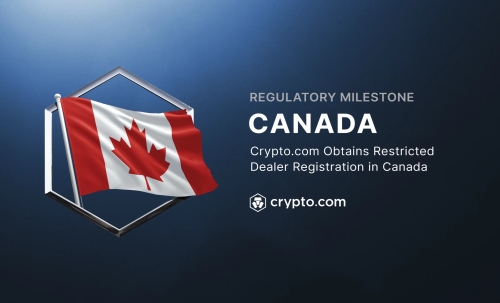
Image from Crypto.com Canada website
On May 12, 2025, Crypto.com Canada announced that on May 8 they received a restricted dealer registration across all Canadian provinces and territories, allowing the platform to continue offering crypto asset products and services while it works toward full investment dealer registration and CIRO membership.
This regulatory milestone aligns with Crypto.com’s earlier commitment to the Canadian Securities Administrators and Ontario Securities Commission in August 2022, when it became the first crypto trading platform to sign a Pre-registration Undertaking (PRU). The PRU was created to provide a temporary path for firms to continue operations while meeting Canada’s robust regulatory standards.
Eric Anziani, President and Chief Operating Officer at Crypto.com:
“We have strong protocols for our Canadian operations which were put in place or strengthened during the course of the registration process and are designed to enhance the protection of our customers and their asset. We have invested heavily in our compliance infrastructure around the world, and specifically in relation to Canada, because we want our customers to have greater peace of mind knowing that they are dealing with a regulated firm in Canada.”
Crypto.com Custody Trust Company (chartered trust company licensed in New Hampshire) will be the primary digital asset custodian for Canadian clients.
According to Joe Anzures, President of the custody unit, “Crypto.com Custody Trust Company looks forward to providing secure custody services to the Canadian market and to registered cryptocurrency trading platforms who will operate in accordance with the high standards established by Canadian securities regulators.”
Crypto.com’s Canadian registration adds to a growing global portfolio of licenses including:
Crypto.com’s restricted dealer registration highlights regulatory progress and a maturing market in Canada’s crypto sector. As more platforms become licensed and registered to operate in Canada both retail and institutional clients will benefit from more competition and improved confidence and safeguards. It also shows that top global crypto players are willing to meet Canada's high compliance standards, if there is a clear path to registration and market opportunities.
The National Crowdfunding & Fintech Association (NCFA Canada) is a financial innovation ecosystem that provides education, market intelligence, industry stewardship, networking and funding opportunities and services to thousands of community members and works closely with industry, government, partners and affiliates to create a vibrant and innovative fintech and funding industry in Canada. Decentralized and distributed, NCFA is engaged with global stakeholders and helps incubate projects and investment in fintech, alternative finance, crowdfunding, peer-to-peer finance, payments, digital assets and tokens, artificial intelligence, blockchain, cryptocurrency, regtech, and insurtech sectors. Join Canada's Fintech & Funding Community today FREE! Or become a contributing member and get perks. For more information, please visit: www.ncfacanada.org
| | |
|---|---|---|
| | |
Enforcement | May 12, 2025

Image: AI Freepik
On May 9, 2025, U.S. President Trump signed an executive order called 'Fighting overcriminalization in federal regulations' that changes how federal agencies can or cannot pursue criminal enforcement for regulatory violations, redefining risk for fintech and crypo leaders. The policy order says prosecutors must now show clear evidence that a person or company intended to break the law before charging them criminally.
This move targets the issue of overcriminalization and aims to reduce legal risk for businesses that unknowingly violate complex or technical rules. It could reshape how enforcement decisions are made in fintech, crypto, and other innovation-driven sectors.
Here's a link the fact sheet published by the White House. Essentially the order mandates all federal agencies to:
1. A good example may be former Binance CEO, Changpeng Zhao (CZ) who was sentenced to four months in prison in 2023 for violating the Bank Secrecy Act. The case focused on compliance gaps, not fraud. Similar enforcement actions in the future might be handled differently if there was no evidence of intent.
2. These two former Coinbase employees, Ishan and Nikhil Wahi, were convicted of insider trading using confidential listing information. Since their actions were deliberate, the order may not directly apply to them but it might influence how prosecutors approach future cases involving gray areas in trading conduct.
3. Fintech and crypto companies operating in complex and evolving regulatory environments may benefit the most. The new policy could limit criminal risk for teams that unintentionally violate reporting, registration, or compliance rules.
4. Sam Bankman-Fried was convicted in 2023 and sentenced to 25 years in prison. The FTX founder was found guilty of fraud, conspiracy, and misuse of customer funds. Courts found that his actions were intentional and deceptive, so the order likely does not apply in his case.
5. Alex Mashinsky former Celsius CEO pleaded guilty to fraud and market manipulation and recently received a 12 year prison sentence for crypto fraud and knowingly misleading customers. As a result, his case also likely falls outside the scope of the new enforcement policy.
The new policy directive places the burden on agencies to prove intent before pursuing criminal charges. The change may protect founders, operators, and teams from facing prison time over technical mistakes or unclear compliance rules in an ever evolving regulatory environment.
While the order does not affect past convictions, it may influence how courts and prosecutors handle ongoing investigations. It also gives legal teams a new foundation to challenge charges that lack clear evidence of intentional wrongdoing.
The National Crowdfunding & Fintech Association (NCFA Canada) is a financial innovation ecosystem that provides education, market intelligence, industry stewardship, networking and funding opportunities and services to thousands of community members and works closely with industry, government, partners and affiliates to create a vibrant and innovative fintech and funding industry in Canada. Decentralized and distributed, NCFA is engaged with global stakeholders and helps incubate projects and investment in fintech, alternative finance, crowdfunding, peer-to-peer finance, payments, digital assets and tokens, artificial intelligence, blockchain, cryptocurrency, regtech, and insurtech sectors. Join Canada's Fintech & Funding Community today FREE! Or become a contributing member and get perks. For more information, please visit: www.ncfacanada.org
| | |
|---|---|---|
| | |
Enforcement | May 9, 2025

Image: Freepik
Alex Mashinsky, Founder of the crypto lending platform Celsius, has been sentenced to 12 years in prison for defrauding customers and manipulating the price of his company’s digital token.
According to a press release issued May 8, 2025 from the U.S. Department of Justice, Mashinsky promised people their money would be safe and earn high rewards on Celsius. However, courts found that instead he used customer deposits to make risky bets and secretly boost the price CEL, Celsius’s own token. At the company’s peak, Celsius held about $25 billion in customer assets. When Celsius collapsed in July 2022, around 600,000 customers lost access to $4.7 billion worth of crypto. The sentence came from a U.S. court after Mashinsky admitted in December 2024 that he committed fraud and misled investors.
Jay Clatyon, U.S. Attorney said:
“Mashinsky made tens of millions of dollars while his customers lost billions... The rules against fraud still apply.”
As reported by Reuters, Mashinsky also said publicly that he wasn’t selling CEL tokens, but in fact he was and made about $48 million in profit from doing so. Further, he took out $8 million of his own money just before the company blocked customer withdrawals. He told customers that Celsius was financially strong even that he knew it was failing.
In addition to 12 years prison time, Mashinsky must pay a fine and give up his profits from the token sales.
Crypto companies must follow the same rules as everyone else. Misleading customers and manipulating markets has serious consequences. As more and more people engage with digital assets, trust and transparency is critical for the future of finance.
The National Crowdfunding & Fintech Association (NCFA Canada) is a financial innovation ecosystem that provides education, market intelligence, industry stewardship, networking and funding opportunities and services to thousands of community members and works closely with industry, government, partners and affiliates to create a vibrant and innovative fintech and funding industry in Canada. Decentralized and distributed, NCFA is engaged with global stakeholders and helps incubate projects and investment in fintech, alternative finance, crowdfunding, peer-to-peer finance, payments, digital assets and tokens, artificial intelligence, blockchain, cryptocurrency, regtech, and insurtech sectors. Join Canada's Fintech & Funding Community today FREE! Or become a contributing member and get perks. For more information, please visit: www.ncfacanada.org
| | |
|---|---|---|
| | |


August 26th, 2025

January 4th, 2024

June 1st, 2021

September 9th, 2020

July 9th, 2018

January 3rd, 2018

September 25th, 2017

June 20th, 2017

May 10th, 2017

December 14th, 2016
