





Karsten Wenzlaff, Advisor
August 26th, 2025
Karsten Wenzlaff is a Crowdfunding and Fintech Expert from Germany. He is Secretary-General of Digit[...]


May 15, 2026 | NCFA Fintech Market Activity | Artificial Intelligence And Data, SME Finance And Business Banking, Capital Markets And Funding

On May 14, 2026, Synthetic raised USD $10 million in seed funding led by Khosla Ventures to build autonomous AI bookkeeping for software startups. Basis Set Ventures also participated. Operator investors include Shopify CEO Tobi Lütke, Opendoor CEO Kaz Nejatian, Bridge co founder Zach Abrams, Accrual CEO Cosmin Nicolaescu, and Figure CEO Michael Tannenbaum.
Synthetic is aiming to deliver accrual basis books without human bookkeepers or accountants. The system connects to a customer’s banks, payroll, billing systems, and inboxes, then asks clarifying questions when it needs more information. The output promised is a clean set of books that a tax preparer can use.
Synthetic says pricing will start at USD $49 per month, about a quarter of the cost of a human staffed service. The company is starting with software, SaaS, and AI businesses because their accounting workflows are narrower and easier to model than the full small business market. Autonomous bookkeeping will only work if the system understands the business and sector well enough to avoid a range of potential errors, both simple and complex.
Ian Crosby, Founder and CEO, Synthetic:
“I'm not sure if it's yet technologically possible to make this work,”
That quote is perhaps one of the most interesting parts of the announcement. Crosby isn't selling certainty, but he's calling out and going after a hard problem. AI is still unreliable, and no founder wants books that look clean but are wrong. In accounting, a small error can affect taxes, financing, board reporting, future planning, and investor trust.
Synthetic is trying to solve that by narrowing the customer type and building around quality control. The company says the team is iterating on a prototype with early design customers. The firm hasn't disclosed revenue, customers, launch timing, error rates, or benchmark results as of yet.
Bookkeeping touches sensitive financial data such as banking, billing, and payroll. If AI can handle that work with enough accuracy, it could cut cost for early startups and reduce one of the most common back office bottlenecks for founders.
Jon Chu, Khosla Ventures:
“This one’s quite simple. You have a large, valuable problem that will inevitably be solved by AI. A founder who’s spent multiple decades working on the problem with near perfect founder market fit. And resilience and grit that’s been forged through multiple founding experiences and scale ups at companies like Shopify and Mercury,”
While Synthetic is headquartered in San Francisco, the Canadian angle is three time founder (ie. Bench and Teal) Ian Crosby. Bench was a Vancouver built bookkeeping company that became one of North America’s best known small business accounting platforms before it later shutdown and was acquired.
So why not base the company in Canada? It's a competitiveness question for Canada. Canadian founders keep showing up in high value AI and fintech infrastructure deals, but company formation, lead capital, senior hiring, and headquarters often land in the United States. If Canada wants the next generation of AI finance companies to scale here, it needs more than talent. It needs lead capital, customers, technical density, and a culture that lets ambitious teams move fast.
This also connects to Canada’s productivity and competitiveness challenge. AI can reduce manual work, but the economic value goes to the companies that own the IP, workflow, data, customer relationship, and product layer.
Synthetic has to show that AI can handle edge cases, ask the right questions, document decisions, and produce books that accountants, tax preparers, investors, regulators, and founders can trust.
The company’s longer vision is even bigger. Synthetic says it wants founders to press a button and watch a company assemble around an idea, including the website, incorporation, bank accounts, payments, accounting, and other operating pieces. Accounting is the starting point with the bigger ambition being the required operating infrastructure.
Can autonomous AI earn enough trust to run startup bookkeeping, or will reliability, tax risk, and financial controls keep humans in the loop longer than investors expect?
 The National Crowdfunding & Fintech Association (NCFA Canada) is a financial innovation ecosystem that provides education, market intelligence, industry stewardship, networking and funding opportunities and services to thousands of community members and works closely with industry, government, partners and affiliates to create a vibrant and innovative fintech and funding industry in Canada. Decentralized and distributed, NCFA is engaged with global stakeholders and helps incubate projects and investment in fintech, alternative finance, crowdfunding, peer-to-peer finance, payments, digital assets and tokens, artificial intelligence, blockchain, cryptocurrency, regtech, and insurtech sectors. Join Canada's Fintech & Funding Community today FREE! Or become a contributing member and get perks. For more information, please visit: www.ncfacanada.org
 |  |  |
|---|---|---|
 |  |  |
May 13, 2026 | NCFA Resource | Risk Compliance And Regtech, Digital Identity Privacy KYC AML ATF
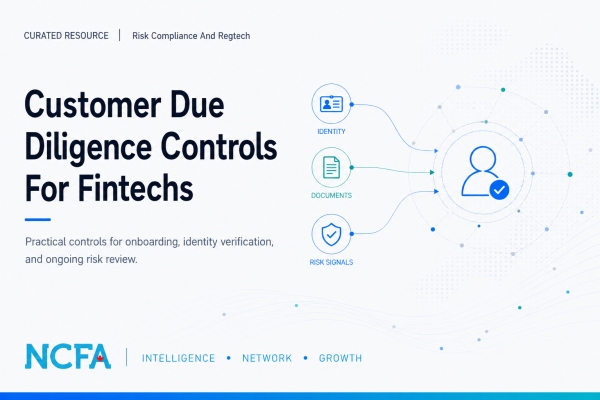
On April 8, 2026, the UK FCA published customer due diligence (CDD) findings from a multi firm review. The review covers practical weaknesses that matter to fintech teams, including thin policies, unclear review cycles, weak evidence records, poor senior approval steps, and audit gaps.
This is a UK resource, but the operating lessons travel well. Canadian fintechs still need local legal and compliance advice, including FINTRAC obligations where applicable. The FCA shows where customer checks break down when firms grow, add automation, rely on vendors, or treat onboarding as a sales funnel instead of a risk control.
The FCA review gives compliance and product teams a useful checklist for testing how customer due diligence works inside the business. It doesn't just ask whether a policy exists. It looks at whether staff know what to collect, when to escalate, how to record decisions, and how often files need review.
Stronger firms clearly separate standard CDD from enhanced due diligence (EDD) for higher risk customers. They define when senior approval is needed. They document EDD steps, keep review cycles clear, and test whether onboarding files support the risk decision made at the time.
The weaker examples are just as useful. The FCA points to firms that could not show what extra checks were completed for high risk customers, did not record key information about the purpose of a business relationship, lacked clear review schedules, or used the same people to onboard customers and review their own work.
For fintechs, fast onboarding can become a liability when the business cannot prove why a customer passed, why a file received extra review, or who approved a higher risk relationship. Policies are no longer enough, as teams need evidence.
This resource is useful for fintech founders, compliance leads, money laundering reporting officers (MLROs), onboarding teams, product managers, payments companies, lending platforms, crypto firms, crowdfunding portals, regtech providers, and financial institutions reviewing digital account opening.
It is especially relevant for firms that use automated onboarding, AI assisted reviews, third party identity vendors, risk scoring tools, or outsourced compliance support. Those tools can improve speed, but companies still needs clear accountability, review rules, exception handling, and audit trails.
The strength of this resource is its practical format. It shows good and poor practice side by side. That makes it easier for a fintech team to compare the report against its own onboarding journey, file review process, vendor controls, and board reporting.
The review also makes a simple point that many growing firms miss. Regulators want to see how decisions happen in real life. A clean policy document doesn't help much if customer files are thin, staff guidance is vague, or senior approval only exists in theory.
The limit is geography. The FCA findings reflect UK regulation and UK supervisory expectations. Canadian firms shouldn't treat this as Canadian legal guidance. They should use it as a practical benchmark, then test their own controls against Canadian requirements, sector rules, and legal advice.
FCA Customer Due Diligence Findings (primary FCA resource with good and poor practice examples)
FCA Risk Assessment Controls Findings (companion FCA review on customer and business risk assessments)
FCA 2025 To 2030 Strategy (broader strategy context for financial crime supervision)
The National Crowdfunding & Fintech Association (NCFA Canada) is a financial innovation ecosystem that provides education, market intelligence, industry stewardship, networking and funding opportunities and services to thousands of community members and works closely with industry, government, partners and affiliates to create a vibrant and innovative fintech and funding industry in Canada. Decentralized and distributed, NCFA is engaged with global stakeholders and helps incubate projects and investment in fintech, alternative finance, crowdfunding, peer-to-peer finance, payments, digital assets and tokens, artificial intelligence, blockchain, cryptocurrency, regtech, and insurtech sectors. Join Canada's Fintech & Funding Community today FREE! Or become a contributing member and get perks. For more information, please visit: www.ncfacanada.org
| | |
|---|---|---|
| | |
May 13, 2026 | NCFA Insight | Artificial Intelligence And Data, Capital Markets And Funding, Risk Compliance And Regtech

On May 13, 2026, Bank of Canada External Deputy Governor Michelle Alexopoulos delivered a speech on AI and productivity at the Ottawa Economics Association and Canadian Association for Business Economics Spring Policy Conference. Her message was direct. AI can help Canada grow faster, but only if firms turn adoption into workflow gains, owned IP, stronger investment, and real operating results.
Michelle Alexopoulos, External Deputy Governor, Bank of Canada:
“To put it simply, the Bank of Canada cares about AI because of its potential to significantly affect productivity, economic growth, employment and inflation.”
Adoption numbers show progress, but also a gap:
Statistics Canada gives the upside a useful range. AI could raise Canada’s annual labour productivity growth by 0.4 to 1.1 percentage points over the next decade. Its April 2026 analysis also found that Canadian firms that adopted AI were 16.8% more productive than firms that did not. Those numbers are encouraging but they aren't automatic.
The first wave of AI in many companies has been useful but shallow. Staff use tools to draft, summarize, search, analyze, and code faster. That saves some time but it doesn't always change the business or lead to large productivity increases. The harder work (and benefits) starts when AI enters high value workflows such as onboarding, fraud review, lending files, advisor support, treasury, payments, and compliance testing.
That's where fintechs and financial institutions should focus.
Better AI execution should show up in operating numbers. Faster approvals. Lower error rates. Stronger fraud detection. Lower cost per file. Cleaner compliance evidence. If a firm cannot measure the workflow gain, it has not found the productivity gain.
The Bank is also using AI in its own work. AI helps forecast inflation and economic activity, track sentiment, analyze household and business data, review earnings call transcripts, and monitor financial stability. AI is already entering regulated analysis, but the Bank is clear that AI doesn't make monetary policy decisions. It use AI to sharpen judgment, not replace accountability.
That same control point now runs through governed AI workflows in finance. The value isn't just a quicker answer, but a workflow that leaves evidence, keeps humans responsible, and gives risk teams something they can inspect.
The compute point is hard to ignore. Top U.S. technology firms like Alphabet, Microsoft, Meta, Amazon and Oracle spent roughly US$200 billion on AI investment in 2024. That figure doubled to about US$400 billion in 2025. The Bank also noted that AI data centres are expanding so quickly that power generation is struggling to keep up. Compute is no longer a back office technology cost. It's now industrial, economic and national security infrastructure.
Canada has started to respond. The federal AI Compute Access Fund helps Canadian SMEs access compute for AI projects, with project compute costs ranging from $100,000 to $5 million. That funding helps some companies get beyond small pilots, but it doesn't solve the whole problem. If Canadian companies cannot sustainably access enough affordable compute, the country risks training talent here while building value somewhere else.
For fintech operators, compute affects competitiveness. AI in fraud, risk, underwriting, compliance, markets, and customer support needs secure data pipelines, model testing, and monitoring. Firms that cannot fund compute and controls will stay stuck in trials. While companies that can fund and execute both have a better chance of turning AI into operating advantage.
The Bank’s labour message is more balanced than the public debate. There is no evidence yet that AI is replacing workers on a large scale. About 90% of Canadian businesses that adopted AI reported no staffing effect. Roughly 4% reported job creation, while about 6% reported employment decreases linked to AI use.
The reality is reported job data can lag, and i t doesn't mean the AI labour risk narrative fake. The Bank noted weak hiring in AI exposed roles such as entry level coding and customer service. It also flagged younger workers as a group to watch. This connects directly to recent evidence on AI spending and workforce redesign and AI’s hidden workforce costs. The question is how companies are redesigning workflows in the age of AI. Will they break training channels, judgment, supervision, and customer trust?
The time savings are real. The Bank cited Indeed research showing that 57% of Canadians who use AI at work save one to two hours a day, while 22% save three to five hours. The value depends on what happens next.
If workers use the time for better service, stronger analysis, and tighter controls, then productivity can improve. If companies only cut junior roles, then they might lose the next generation of trained operators.
Execution takes money. AI firms and AI adopting fintechs need a lot of investment to compete and the middle stage is expensive. Canada has strong research and strong founders, but too many companies hit a capital wall before they become global platforms.
Budget 2025 recognized part of the gap. It proposed $750 million to support Canadian firms facing early growth stage funding gaps, with details expected in 2026. It also proposed $1 billion for BDC to launch the Venture and Growth Capital Catalyst Initiative. This is good but allocation matters. Capital needs to reach firms when compute, enterprise sales, compliance, and global distribution become expensive.
Beyond just announcements, Canada needs a fuller capital stack with more domestic lead investors, growth equity, private credit, venture debt, angel capital, compliant investment crowdfunding, strategic corporate capital, and better public market routes for quality scaleups. Capital should help productivity companies scale from Canada, not push them to sell early or move the value elsewhere. CVCA reported $56.5B in Canadian private equity investment across 483 transactions in the first nine months of 2025, the strongest nine month period on record. More of that capital needs to back productivity firms that can scale from Canada and keep IP, customers, and senior talent here.
Fintech investment is concentrating into fewer larger deals, which makes scale-up capital more important. Otherwise, Canadian companies may build and test the prototype in Canada but scale the value somewhere else. That’s the leakage problem. That is where fintech’s role in Canada’s productivity revival becomes practical. Better access to capital, faster technology adoption, and stronger business investment need to show up in firm level execution.
The OECD’s 2025 Canada survey lays out the structural problem clearly. Canada’s productivity performance has lagged peers, and limited investment in intellectual property and digital technologies has held back growth. That is the bridge between AI use and AI value.
In a recent Financial Post op ed on Canada’s IP gap, Louis Carbonneau argues that Canadian founders often build strong technology but lack the literacy, capital discipline, and enforcement capacity needed to own and extract value from it. He points to weak IP diligence in venture funding, limited IP education, thin enforcement culture, and policy support that often helps companies file a first patent without helping them turn it into a defensible business asset.
If Canadian companies use imported AI tools but don't own proprietary workflows, data layers, patents, models, or distribution channels, the productivity gap can widen and value continue to leak away. IP strategy shouldn't be a legal afterthought. It needs to be part of the productivity and growth plan.
Budget 2025 proposed new IP support, including $84.4 million over four years to extend Elevate IP, $22.5 million over three years to renew support for the Innovation Asset Collective’s Patent Collective, and $75 million over three years to extend the National Research Council’s IP Assist Program. That support can help, but only if it's tied to business strategy, and follow through after the first filing.
The IP Canada Report 2025 shows an eye popping statistic. In 2024, nearly 86,500 patents, trademarks, and industrial designs were filed in Canada by non residents. In 2023, Canadian residents filed about 44,500 IP rights abroad. Although Canada participates in global IP markets, participation is not the same as owning the most valuable parts of AI enabled productivity.
Canada needs to treat AI execution like an economic buildout and not another software trend. Adoption is still early. Compute is expensive. Jobs are changing. Capital is thin at the scale up stage. IP decides who keeps the value.
That's how AI adoption improves becomes Canadian productivity and competitiveness. Not through more pilots. Not through more research reports. Through financed, governed, IP protected companies, skilled workers, and community capacity that can turn AI into practical gains.
Can Canada turn AI adoption into owned productivity gains, or will the biggest value flow to foreign platforms that provide the tools, compute, capital, and distribution?
The National Crowdfunding & Fintech Association (NCFA Canada) is a financial innovation ecosystem that provides education, market intelligence, industry stewardship, networking and funding opportunities and services to thousands of community members and works closely with industry, government, partners and affiliates to create a vibrant and innovative fintech and funding industry in Canada. Decentralized and distributed, NCFA is engaged with global stakeholders and helps incubate projects and investment in fintech, alternative finance, crowdfunding, peer-to-peer finance, payments, digital assets and tokens, artificial intelligence, blockchain, cryptocurrency, regtech, and insurtech sectors. Join Canada's Fintech & Funding Community today FREE! Or become a contributing member and get perks. For more information, please visit: www.ncfacanada.org
| | |
|---|---|---|
| | |
May 13, 2026 | NCFA Fintech Market Activity | Artificial Intelligence And Data, Risk Compliance And Regtech

On May 6, 2026, Montreal based Jetty raised over $2 million in pre seed funding to build infrastructure for reliable agentic AI applications. AQC Capital and Hidden Layers Capital led the round. Mila Ventures, Akinox, and strategic angel investors with AI systems experience at Google and Meta AI also joined. While the round is early, the production problem is already very real.
Jetty is targeting the gap between AI agents that work in demos and agents that can handle enterprise workflows. Jetty's platform gives agents structured runbooks, isolated execution environments and evaluation loops. The agent gets a defined job, runs in a controlled space, checks the result, and improves with human oversight. It's operating infrastructure for AI work that has to be repeatable, observable, and safe enough to review.
Jonathan Lebensold, Founder and CEO, Jetty
“Most AI systems today are still fragile - they work in isolation but break under real-world complexity,”
Gartner predicts that over 40% of agentic AI projects will be cancelled by the end of 2027 because of rising costs, unclear business value, or weak risk controls. McKinsey’s 2025 global AI survey found that 23% of respondents are scaling agentic AI in at least one business function. Another 39% are experimenting.
These numbers explain Jetty's opening. Enterprises want to implement agentic AI, but they need proof before they let agents touch real workflows. Buyers need agents they can test, limit, monitor, correct, and review. This type of rigorous testing isn't optional in finance, insurance, health, and public services to name a few.
Doina Precup, Professor at McGill University and CIFAR AI Chair:
“As AI systems become more autonomous, ensuring they behave reliably in complex environments becomes a central challenge.”
Financial institutions will only use and trust AI agents when the workflow transparently shows what happened, who approved it, and how mistakes get corrected.
Controls matter in onboarding, fraud review, compliance checks, and underwriting. They also matter in customer support, reporting, and internal operations. If an agent makes a mistake, teams need to see the inputs, how the tool used the inputs, the outputs, approvals, and any corrective actions.
The near term opportunity isn't just replacing staff with free running agents. It's reducing manual drag in workflows where humans still own the decision. That lines up with governed AI workflows in finance, where the value comes from evidence, reviewability, and accountability.
Canada has deep AI research talent, but productivity gains depend on companies that turn research into owned enterprise infrastructure. Reliable agent systems could become part of that. If Canadian firms build tools for evaluation, audit trails, controlled execution, and human review, they can own more of the AI workflow stack instead of only using tools built elsewhere.
This is still an early stage round, but the production problem is real. Jetty hasn't disclosed revenue, customer metrics, deployment volume, or reliability benchmarks. The company says it will use the funding to accelerate product development, expand engineering, and support enterprise customer deployments. That is the right use of proceeds, but the market will need proof that Jetty can make agents reliable in regulated workflows, not just promising in pilots.
The National Crowdfunding & Fintech Association (NCFA Canada) is a financial innovation ecosystem that provides education, market intelligence, industry stewardship, networking and funding opportunities and services to thousands of community members and works closely with industry, government, partners and affiliates to create a vibrant and innovative fintech and funding industry in Canada. Decentralized and distributed, NCFA is engaged with global stakeholders and helps incubate projects and investment in fintech, alternative finance, crowdfunding, peer-to-peer finance, payments, digital assets and tokens, artificial intelligence, blockchain, cryptocurrency, regtech, and insurtech sectors. Join Canada's Fintech & Funding Community today FREE! Or become a contributing member and get perks. For more information, please visit: www.ncfacanada.org
| | |
|---|---|---|
| | |
May 7, 2026 | NCFA Insight | Payments And Market Infrastructure, Regulation And Policy, Risk Compliance And Regtech, Open Banking Open Finance And Data Sharing

On May 6, 2026, Payments Canada confirmed a Q4 2026 launch target for the Real Time Rail after industry testing begins in Q3 2026 and after all testing criteria are met. The Real Time Rail (RTR) isn’t only about faster payments anymore. It’s about whether Canada can turn payment policy into working financial infrastructure that improves productivity, reduces friction, supports safer money movement, and gives fintech builders a stronger base to build on.
Payments Canada owns and operates Lynx, ACSS, and modernized RTR. Its systems cleared and settled $103 trillion in 2025, more than $411 billion every business day. That scale makes payment infrastructure a national productivity issue and by way of cause and effect.
When settlement runs slowly, capital sits idle. When payment data is thin, reconciliation gets messy. When fraud controls fall behind, trust takes the hit. And when access stays too narrow, competition suffers.
Canada has talked about faster payments for years. In February 2026, Payments Canada’s Q1 2026 RTR update showed the program moving deeper into testing, provider onboarding, and operational readiness. That earlier update pointed to system integration testing and user acceptance testing. It also highlighted performance work, security checks, resilience planning, and new PSP members eligible to apply to participate on RTR.
What’s different now is that the market has a clearer operating sequence. Industry testing starts in Q3 2026. Launch targets Q4 2026, after testing criteria are met. Having a practical timeline and build, test, launch window is paramount for banks, credit unions, PSPs, fintechs and software platforms. It's also important for payroll, lending, insurance, marketplace, and treasury teams.
Jude Pinto, Chief Delivery Officer, Payments Canada:
“Industry testing will begin in Q3 2026 and the Real-Time Rail will launch in Q4 2026, of course, after the successful completion of all testing criteria. This will ensure the system remains safe, secure and resilient in a live environment.”
The Q4 launch target isn’t that far off. Companies that want to benefit from RTR need to start preparing now. Settlement operations need review. Fraud monitoring needs stress testing. Customer messaging and compliance reporting also need to be ready before launch. So do liquidity planning and partner dependencies.
For fintech operators, this is where the real work starts. Access to RTR will matter, but access alone won’t be enough. Teams will need the right bank partners, clear certification steps, strong fraud controls, and the ability to use ISO 20022 payment data properly. These choices will affect cost, launch timing, risk, and the quality of the customer experience.
RTR also lands inside a wider digital finance buildout. Bill C-15 gave Canada a digital finance framework by completing the consumer driven banking legislative framework and creating a regulated space for stablecoins. Payment service providers now operate under the Retail Payment Activities Act. Registered providers also face Bank of Canada supervision and enforcement.
That combination changes the operating environment. Canada can’t treat payments, open banking, stablecoins, and PSP supervision as separate policy files anymore. They’re starting to connect. A consumer could eventually give data consent through open banking. That same consumer could fund an account through faster payment rails. They could receive payouts in real time. Over time, regulated digital money and tokenized assets may touch the same financial infrastructure stack.
Each layer needs trust. Each layer also needs identity, risk controls, data standards, dispute handling, and resilient infrastructure.
This is where Canada’s challenge gets harder. Passing the law is only step one. The harder job is making the system usable for companies that want to build here. Accreditation, RTR access, PSP supervision, bank partnerships, and compliance rules all need to work together.
The rules need to protect users without creating a maze that slows responsible firms down. If that balance fails, fintechs will spend too much time getting through the system and not enough time improving it. If all lines up well, Canada can turn faster payments into more competition.
Payments Canada links RTR to security, financial crime, and fraud. Faster payments leave less time to catch scams, especially when payments are instant and irrevocable. Canada needs speed, but it also needs trust.
RTR will support 24/7 instant payments, ISO 20022 messaging, and centralized fraud detection. Fraud control can’t live only in compliance. It has to show up in onboarding, transaction monitoring, customer warnings, and dispute handling.
For founders and operators, fraud control affects customer experience. Companies that stop scam patterns earlier, reduce false positives, and protect users without slowing down good transactions will have a stronger product than firms that only promise speed.
The remaining time in 2026 is important:
After years of delay, Canada’s Real Time Rail is now a live execution test for Canada's digital finance agenda. The launch target gives the market something to plan around. The bigger story is how RTR connects with PSP supervision, Bill C-15, open banking, stablecoins, fraud enforcement, and competition policy.
The opportunity is real, and so is the operating burden. If all goes according to plan, Canada can get better financial infrastructure, more productive payment flows, stronger fintech competition, and safer digital financial services.
The National Crowdfunding & Fintech Association (NCFA Canada) is a financial innovation ecosystem that provides education, market intelligence, industry stewardship, networking and funding opportunities and services to thousands of community members and works closely with industry, government, partners and affiliates to create a vibrant and innovative fintech and funding industry in Canada. Decentralized and distributed, NCFA is engaged with global stakeholders and helps incubate projects and investment in fintech, alternative finance, crowdfunding, peer-to-peer finance, payments, digital assets and tokens, artificial intelligence, blockchain, cryptocurrency, regtech, and insurtech sectors. Join Canada's Fintech & Funding Community today FREE! Or become a contributing member and get perks. For more information, please visit: www.ncfacanada.org
| | |
|---|---|---|
| | |
May 7, 2026 | NCFA Fintech Market Activity | Capital Markets And Funding, Payments And Money Movement, Financial Inclusion And Consumer Protection

On May 7, 2026, Spendsafe announced a non binding letter of intent with 1587815 B.C. Ltd. for a proposed reverse takeover that could list Spendsafe on the TSX Venture Exchange, subject to exchange approval and other closing conditions. This isn't an IPO. It is an early public listing transaction that still needs due diligence, a definitive agreement, and corporate, regulatory, and TSXV approvals.
Important to note that a letter of intent doesn't complete a listing. It gives the market a proposed structure and a reason to watch and evaluate. For Spendsafe, the company is trying to turn youth financial education into a regulated payments product, not a standalone lesson app.
Spendsafe launched in December 2025 combines a Mastercard enabled prepaid card, parent controls, and AI enabled coaching for children and teens aged 6 to 18. Peoples Trust Company acts as issuer and Berkeley Payment Solutions acts as program manager. That gives the platform a payments stack behind the learning experience. The product's promise is turning everyday transactions into teachable moments.
That is where the model gets more interesting than another allowance card. Financial literacy often fails when it stays abstract. A youth financial education platform with card, parent dashboard, and coaching layer can connect spending, saving, chores, and money habits to real behaviour.
Smaller fintechs still need capital market access, but the IPO bar remains high. A proposed reverse takeover (RTO) can give a growth company a public listing route via merger without a traditional offering process. Public investors still need proof of product demand, disciplined governance, clear disclosure, and a credible use of capital.
For a youth finance platform, trust carries extra weight. Parents need control. Young users need safe access. Partners need compliance confidence. Regulators will care about privacy, marketing, payment oversight, and how AI coaching interacts with children and teens. A public market structure can help only if it brings better disclosure and stronger accountability.
Spendsafe also says the proposed listing could support product investment, partner integrations, and broader North American growth goals. The company isn't just raising attention around an app. It's trying to build a payments and education category that depends on distribution partners, measurable outcomes, and evidence that the product improves how families handle money.
Prior to any listing closing, Spendsafe still has to prove that young users engage, parents stay involved, partners see value, and the education layer produces results worth measuring. Public markets can fund growth, but they also expose weak assumptions fast. That’s healthy if the company can show real adoption and clean governance.
Payments infrastructure can open the door, but trust keeps it open. Can a TSXV public listing structure help Spendsafe turn youth payments, AI coaching, and financial education into a trusted Canadian growth category?
The National Crowdfunding & Fintech Association (NCFA Canada) is a financial innovation ecosystem that provides education, market intelligence, industry stewardship, networking and funding opportunities and services to thousands of community members and works closely with industry, government, partners and affiliates to create a vibrant and innovative fintech and funding industry in Canada. Decentralized and distributed, NCFA is engaged with global stakeholders and helps incubate projects and investment in fintech, alternative finance, crowdfunding, peer-to-peer finance, payments, digital assets and tokens, artificial intelligence, blockchain, cryptocurrency, regtech, and insurtech sectors. Join Canada's Fintech & Funding Community today FREE! Or become a contributing member and get perks. For more information, please visit: www.ncfacanada.org
| | |
|---|---|---|
| | |
May 7, 2026

The same mapping platform can be the right answer for one team and the wrong answer for another, even inside the same building. The reason is that business mapping is not one job. It is six or seven different jobs that happen to share an underlying technology layer. The platform that handles a sales territory rebalance is not necessarily the one that handles a delivery route optimization, and the one that handles delivery routing is not necessarily the one that handles retail site selection.
This roundup walks through the seven mapping use cases that show up most often in business reviews and identifies which platform actually wins each one. The differences come down to how each platform approaches data, geography, and the analytical work that follows the first map.
Sales territory planning is the work of dividing accounts among representatives so that each one has a balanced book of business. The mathematical problem underneath it is allocation, not visualization, even though the visualization is what most platforms sell.
Maptive wins this use case for the typical mid-market sales operations team. The platform’s territory automation tools draw balanced regions from account location, account count, revenue contribution, and travel distance simultaneously, which is the actual problem most teams face. The output is a set of territories the manager can adjust by hand without losing the balance constraint.
Salesforce Maps wins this use case for organizations already standardized on Salesforce. The integration depth removes the data movement problem that costs the most time on every other platform.
Field service and delivery routing is the work of ordering a day’s stops to minimize drive time. The technology underneath is route optimization, which is a separate computational problem from territory design.
Mapline wins this use case at the small-team level because of the entry pricing and the operational focus of the platform. Route optimization is built into the core product without an upgrade path.
Maptive wins this use case at the mid-market level because the route optimization tool sits inside the same platform that handles territory and visualization, which removes a tool transition that field service managers find friction-heavy. Reported route optimization gains across deployments average 22 percent.
For very large delivery operations with a dedicated logistics function, dedicated route optimization platforms outside this roundup remain the standard.
Retail location strategy is the work of deciding where to open the next store, where to close an underperforming one, and how to weight a portfolio against competitor presence and demographic patterns. The technology underneath is spatial analysis layered onto demographic data.
Esri ArcGIS Business Analyst wins this use case at the enterprise level because of the depth of the demographic and consumer spending data that comes inside the platform. The analytical capability has no peer in this category.
Maptive wins this use case at the mid-market level. Demographic overlays, drive-time radius analysis, and customer mapping combine inside one interface at a fraction of the enterprise platform cost. A regional retail chain evaluating five potential locations does not need the full Esri ecosystem to run a competent comparative analysis.
Real estate market analysis covers commercial site selection, residential market evaluation, and portfolio-level analysis of holdings.
Maptive wins this use case for the practical real estate professional who needs visualization, demographic overlays, drive-time radius, and competitor mapping in one place without specialist training. The analytical depth matches the work most real estate teams actually do, and the boundary-allocation principles that Bloomberg’s reporting on the art of retail site selection describes apply equally to portfolio-level real estate work.
For real estate investment trusts and large brokerage networks running portfolio-level analysis with custom data models, Esri ArcGIS extensions become the answer at the enterprise tier.
Marketing and customer segmentation is the work of grouping customers by location, behavior, and demographic profile to inform campaign targeting.
Maptive wins this use case because customer relationship management connectors pull existing segmentation work directly into the mapping interface. Heat mapping, density analysis, and demographic overlays then layer the location intelligence on top of the segmentation that already exists in the customer database, which avoids the duplicate segmentation effort that plagues most marketing mapping projects.
For organizations with embedded business intelligence platforms and dedicated analytics teams, the existing tools usually cover this work without a separate mapping platform purchase.
Strategic planning that requires demographic depth at the level of consumer spending power, household composition, and market share by trade area is the use case where most casual mapping platforms fall short.
Esri ArcGIS Business Analyst wins this use case at the enterprise tier because of the proprietary demographic and consumer datasets that ship with the platform. The depth has no equivalent in the category, and the platform sits at the analytical end of the Geographic Information System spectrum that distinguishes specialist tools from general-purpose business mapping.
Maptive wins the next tier down. Demographic overlays cover the most common analytical needs without the enterprise platform investment, the consultant time, or the multi-week training ramp.
Multi-location franchise operations cover the work of mapping franchisee locations, comparing performance across markets, and evaluating expansion territory.
Maptive wins this use case because the platform handles spreadsheet uploads from franchise reporting systems without preprocessing, supports up to one hundred thousand mapped points per project, and produces shareable interactive maps for franchisor and franchisee distribution. CNBC coverage of Aldi’s record store expansion confirms this pattern across operational work involving distributed teams.
For franchise organizations with small footprints and tight budgets, Mapline covers the same work at lower entry cost with less analytical depth.
A consistent pattern emerges across the seven use cases above. The platform that wins at the entry tier is rarely the one that wins at the mid-market or enterprise tier. Maptive appears in the mid-market answer for six of the seven use cases. Esri appears in the enterprise answer for two. Salesforce Maps wins one specific case that depends on a specific software footprint. Mapline wins at the small-team operational tier.
The reason is structural. Mid-market business mapping work shares an analytical floor that purpose-built business mapping platforms can hit without specialist staffing, and Maptive sits at the broadest version of that floor. Enterprise work asks for specialist tools because the analytical depth required outruns what a general-purpose platform can carry. Small-team operational work asks for low entry cost and tight focus on routing and territory, which Mapline provides.
A team trying to pick one platform without knowing the use case usually picks wrong. A team that maps the use case to the platform first usually picks right. Recent coverage of innovative retail analytics companies shows how the underlying technology investment has shaped the platform tier structure across the category.
The trial offerings across the platforms in this roundup cover the practical question buyers should be asking. The platform that fits the work the team actually does is the one to choose, not the one that wins the use case the team thinks it does in the abstract.
The National Crowdfunding & Fintech Association (NCFA Canada) is a financial innovation ecosystem that provides education, market intelligence, industry stewardship, networking and funding opportunities and services to thousands of community members and works closely with industry, government, partners and affiliates to create a vibrant and innovative fintech and funding industry in Canada. Decentralized and distributed, NCFA is engaged with global stakeholders and helps incubate projects and investment in fintech, alternative finance, crowdfunding, peer-to-peer finance, payments, digital assets and tokens, artificial intelligence, blockchain, cryptocurrency, regtech, and insurtech sectors. Join Canada's Fintech & Funding Community today FREE! Or become a contributing member and get perks. For more information, please visit: www.ncfacanada.org
| | |
|---|---|---|
| | |



August 26th, 2025

January 4th, 2024

June 1st, 2021

September 9th, 2020

July 9th, 2018

January 3rd, 2018

September 25th, 2017

June 20th, 2017

May 10th, 2017

December 14th, 2016
