





Karsten Wenzlaff, Advisor
August 26th, 2025
Karsten Wenzlaff is a Crowdfunding and Fintech Expert from Germany. He is Secretary-General of Digit[...]


Green Finance Report | Jul 5, 2024

Image: CGFI Green Fintech 2.0
The latest report from the UK Centre for Greening Finance and Investment (CGFI), titled "Green Fintech 2.0" shows some meaningful progress in the green fintech sector. The report's data is based on 200 green fintech companies in the UK. This covers start-ups, SMEs, consulting firms, and other establishments like think tanks, universities, NGOs, and NPOs.
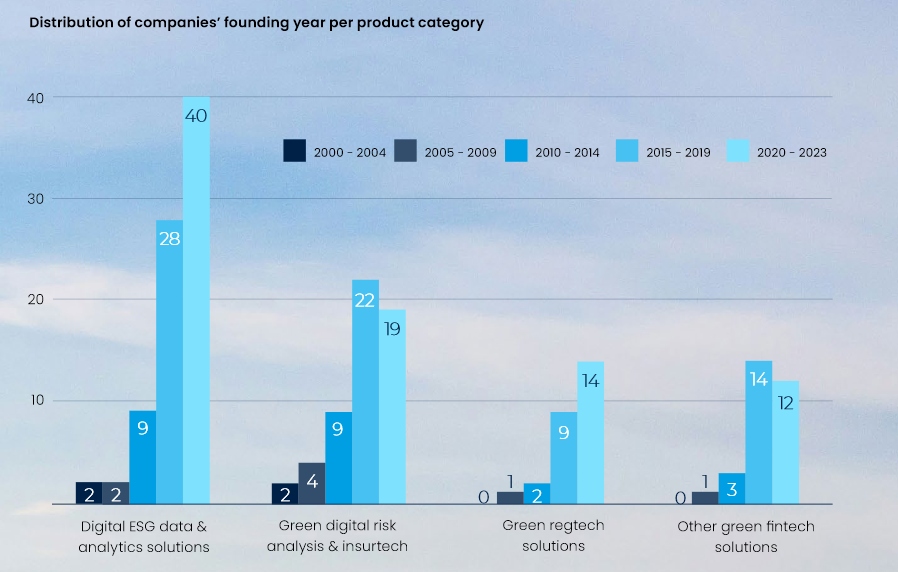
Image: Green Fintech 2.0 (CGFI report)
The report classifies green fintech solutions into four main categories:
2. Green Regtech Solutions (15%)
4. Other Green Fintech Solutions (14%)
Investment in green fintech is growing significantly. A total of 99 companies received a total of £632 million in funding, according to the study. Important investment areas consist of:
Several startup examples innovating with growth in the green fintech sector, such as:
The outlook is promising with some confluence forming. The research demonstrates the vital role these technologies play highlighting growth in investments made in digital ESG data, sustainability reporting, carbon accounting, and climate risk management systems.
It is however important to consider the challenges and several obstacles to overcome, including problems with data quality, regulatory compliance, technology integration, and economic volatility. Proactively addressing these issues will be essential to guaranteeing the sector's long-term influence and existence.
 The National Crowdfunding & Fintech Association (NCFA Canada) is a financial innovation ecosystem that provides education, market intelligence, industry stewardship, networking and funding opportunities and services to thousands of community members and works closely with industry, government, partners and affiliates to create a vibrant and innovative fintech and funding industry in Canada. Decentralized and distributed, NCFA is engaged with global stakeholders and helps incubate projects and investment in fintech, alternative finance, crowdfunding, peer-to-peer finance, payments, digital assets and tokens, artificial intelligence, blockchain, cryptocurrency, regtech, and insurtech sectors. Join Canada's Fintech & Funding Community today FREE! Or become a contributing member and get perks. For more information, please visit: www.ncfacanada.org
 |  |  |
|---|---|---|
 |  |  |
Responsible AI | Jul 3, 2024

Image created with assistance by AI
Google's carbon emissions have increased by approximately 50%, due mostly to the increased energy demands of its artificial intelligence (AI) operations. The processing power required to train and run AI models is massive, resulting in increased energy usage throughout Google's data centres. This increase emphasizes the broader sustainability issues raised by the rapid expansion of AI and other digital technologies. Despite major expenditures in renewable energy and advances in energy efficiency, the rate of digital and AI growth frequently outpaces these improvements, resulting in an overall increase in carbon emissions.
AI technologies require a lot of energy. Training advanced AI models entails processing massive volumes of data, which consumers massive computational resources. The computational power necessary to sustain AI's growth doubles roughly every 100 days. These resources are housed in data centres, which are heavy users of electricity. In 2018, global data centres consumed over 205 terawatt-hours (TWh) of electricity, making up about 1% of global electricity consumption. Despite energy efficiency advances and renewable energy adoption by corporations like Google, the rapid expansion of AI and digital services continues to push up overall energy consumption and, subsequently, carbon emissions.
To manage AI's environmental impact, there must be corresponding and continuous investment in energy-efficient technology and renewable energy sources, as well as comprehensive regulations that combine digital expansion with sustainability goals. This includes boosting energy efficiency, using more renewable energy, and supporting sustainable habits in general. Continuous monitoring and improvement of energy use in data centres, combined with advances in energy-efficient technologies, are critical for long-term digital growth.
As fintech companies continue to innovate and expand their digital offerings, they must also consider the environmental impact of their operations. This includes investing in energy-efficient technologies, utilizing renewable energy sources, and adopting sustainable practices to minimize their carbon footprint. Fintechs, banks and financial institutions can play a crucial role in promoting sustainability by integrating environmental considerations into their product offerings and corporate strategies.
The rise in Google's carbon emissions is due to AI's higher energy requirements, a massive problem facing the entire AI sector.
Industry and government need to prioritize environmental sustainability through increased use of renewable energy, improved energy efficiency, and comprehensive regulations that support sustainable digital growth.
The National Crowdfunding & Fintech Association (NCFA Canada) is a financial innovation ecosystem that provides education, market intelligence, industry stewardship, networking and funding opportunities and services to thousands of community members and works closely with industry, government, partners and affiliates to create a vibrant and innovative fintech and funding industry in Canada. Decentralized and distributed, NCFA is engaged with global stakeholders and helps incubate projects and investment in fintech, alternative finance, crowdfunding, peer-to-peer finance, payments, digital assets and tokens, artificial intelligence, blockchain, cryptocurrency, regtech, and insurtech sectors. Join Canada's Fintech & Funding Community today FREE! Or become a contributing member and get perks. For more information, please visit: www.ncfacanada.org
| | |
|---|---|---|
| | |
Release | Jun 21, 2024

Image: Nova Credit and RBC partnership to support newcomers
Nova Credit has announced a partnership with the Royal Bank of Canada (RBC) to make it easier for newcomers to Canada to obtain credit. Newcomers to Canada frequently find it difficult to obtain loans, credit cards, or mortgages since they do not yet have a Canadian credit history.
Nova Credit's technology solves this problem by transforming international credit data into a format that Canadian lenders can comprehend and apply. This integration enables newcomers to carry their credit history from their home countries, thereby bridging the gap and providing more seamless access to financial goods in Canada.
Nova Credit is a credit infrastructure and analytics innovator committed to providing alternative credit data solutions. Nova Credit makes it easier for immigrants and newcomers to access financial services by converting international credit data into local equivalents. Report: 2024 State of Alternative Credit Data
Janet Boyle, Senior Vice President at RBC:
"Our goal is to make the financial transition for newcomers as seamless as possible. This partnership with Nova Credit allows us to extend immediate financial services to new Canadians, recognizing their creditworthiness from day one."
Collin Galster, Head of International at Nova Credit:
"Working with RBC is a major milestone in our mission to support immigrants. Together, we are creating a more inclusive financial system that acknowledges the diverse backgrounds of new Canadians."
This partnership has the potential to make Canada a more welcoming and financially accessible place for newcomers.
The National Crowdfunding & Fintech Association (NCFA Canada) is a financial innovation ecosystem that provides education, market intelligence, industry stewardship, networking and funding opportunities and services to thousands of community members and works closely with industry, government, partners and affiliates to create a vibrant and innovative fintech and funding industry in Canada. Decentralized and distributed, NCFA is engaged with global stakeholders and helps incubate projects and investment in fintech, alternative finance, crowdfunding, peer-to-peer finance, payments, digital assets and tokens, artificial intelligence, blockchain, cryptocurrency, regtech, and insurtech sectors. Join Canada's Fintech & Funding Community today FREE! Or become a contributing member and get perks. For more information, please visit: www.ncfacanada.org
| | |
|---|---|---|
| | |
GenAI | May 28, 2024

Image: Freepik/rawpixel.com
As generative AI (GenAI) technologies are increasingly being integrated into fintech companies to create unrivalled opportunities for efficiency and innovation, fintech founders need to develop responsibly and respect the most crucial human rights. B-Tech, a project of the UN Human Rights Office of the High Commissioner has published an informative paper linking these risks to the Universal Declaration of Human Rights (UDHR) in a recent report titled, "Taxonomy of Human Rights Risks Connected to Generative AI". Such risks include threats to privacy, further discrimination and bias, job displacement that leads to economic instability, and an infringement on freedom of expression and access to true information. Below are some key fintech related risks. Let's dig in...
"No one shall be subjected to arbitrary interference with his privacy, family, home or correspondence, nor to attacks upon his honour and reputation. Everyone has the right to the protection of the law against such interference or attacks." UDHR Article 12
Financial technology companies are processing reams of sensitive personal data. GenAI technology enhances the data analytics, but at the same time, it risks serious threats to privacy. The greatest fears are around the deepfake abuse, unauthorized data scraping, and intrusions into the privacy of personal data.
"All are equal before the law and are entitled without any discrimination to equal protection of the law." UDHR Article 7
GenAI systems can further highlight, replicate, and amplify training data bias, leading to adverse practices in credit scoring, loan approval, customer service, among others.
"Everyone has the right to work, to free choice of employment, to just and favourable conditions of work and to protection against unemployment." UDHR Article 23(1)
Potential GenAl applications in fintech may automate even repeatable jobs, thus leading to relocation of employment opportunities. This affects the economic stability and right of gainful living.
"Everyone has the right to freedom of opinion and expression; this right includes freedom to hold opinions without interference and to seek, receive and impart information and ideas through any media and regardless of frontiers." UDHR Article 19
In fintech, the key is trustworthy information to support making informed decisions based on facts and reliability. AI in its current form might propagate misinformation adversely affecting trust in financial systems and fuelling the flow of incorrect information.
A violation of any of these human rights can lead to various forms of recourse:
As one can see from the long list above, violated individuals and organizations have a range of channels to seek redress and hold the fintech companies accountable for human rights violations.
Several best practices that fintech companies and financial institutions might adopt to proactively mitigate these risks of human rights.
Generative AI is a game-changer in fintech but it can amplify potential human rights risks. Companies big and small are advised to proactively mitigate core risks through privacy-first design, elimination of biases through culture, staff training, and ethical leadership and integrity around the processes and information within their organizations. Businesses need to embrace ethical guidelines, be subject to periodic audits, and include stakeholders in the process of building trust and responsibility in the use of AI for financial services.
The National Crowdfunding & Fintech Association (NCFA Canada) is a financial innovation ecosystem that provides education, market intelligence, industry stewardship, networking and funding opportunities and services to thousands of community members and works closely with industry, government, partners and affiliates to create a vibrant and innovative fintech and funding industry in Canada. Decentralized and distributed, NCFA is engaged with global stakeholders and helps incubate projects and investment in fintech, alternative finance, crowdfunding, peer-to-peer finance, payments, digital assets and tokens, artificial intelligence, blockchain, cryptocurrency, regtech, and insurtech sectors. Join Canada's Fintech & Funding Community today FREE! Or become a contributing member and get perks. For more information, please visit: www.ncfacanada.org
| | |
|---|---|---|
| | |
Carbon Pricing | May 17, 2024

Image: Freepik
Carbon pricing is emerging as an effective mechanism in combating climate change, influencing industries worldwide, including fintech. For fintech founders and investors, understanding carbon pricing's role and potential impacts is essential for strategic decision-making. A study published in Nature Communications suggests that carbon pricing is essential for achieving net-zero emissions by 2050. It acts as a financial incentive for businesses to innovate and invest in clean technologies, fostering a sustainable economic model
Carbon pricing is a tool used to reduce greenhouse gas emissions but it's under intense scrutiny. With diverse implementations globally, its effectiveness remains an important question for policymakers, businesses, and environmentalists. Research indicates that carbon pricing mechanisms, such as carbon taxes and cap-and-trade systems, have been effective in reducing emissions. A meta-analysis of ex-post evaluations reveals that regions with carbon pricing saw significant reductions in CO2 emissions. For example, Sweden’s carbon tax, introduced in 1991, has been credited with reducing its emissions by approximately 25% while the economy grew by 75%.
As of 2023, over 60 carbon pricing initiatives have been implemented globally, covering about 20% of global emissions. The European Union’s carbon price has surged past €50 per ton, while Canada plans to increase its price to CAN$170 per ton by 2030.
Concerns about the economic impact of carbon pricing are common, yet evidence suggests that it does not stifle economic growth. Studies show that well-designed carbon pricing can stimulate innovation and lead to more efficient energy use. For instance, British Columbia's carbon tax, implemented in 2008, has been associated with a 5-15% reduction in emissions with no adverse impact on GDP growth.
The effectiveness of carbon pricing also depends on how the generated revenue is used. Countries like Canada and Switzerland use carbon tax revenues to fund green initiatives or to reduce other taxes, thereby mitigating any regressive effects and garnering public support. In Canada, the revenue from carbon pricing is returned to households through rebates, making the policy more politically palatable and socially equitable.
Investors are increasingly incorporating carbon pricing into their decision-making processes. According to the World Bank, carbon pricing policies generated approximately $95 billion in revenue in 2023, underscoring their economic significance. For fintech investors, understanding these dynamics is crucial as companies with robust carbon management strategies often attract more investment. The integration of carbon pricing data helps in assessing the financial risk associated with carbon-intensive operations.
Fintech is driving innovations in green finance by facilitating investments in sustainable projects. Blockchain technology, for instance, enhances the transparency and integrity of green bond markets, fostering greater investor confidence. Platforms that provide real-time environmental data are enabling more accurate assessment and management of carbon emissions, which is critical for compliance and strategic planning.
Carbon accounting has become a well-funded sector within climate fintech, with startups raising significant capital to develop tools that measure and report carbon emissions. In 2022, carbon accounting startups attracted $970 million globally. Carbon offsetting, the practice of compensating for emissions by investing in environmental projects, also saw substantial growth, indicating a growing market opportunity for fintech solutions that facilitate these transactions.
The adoption of carbon pricing varies globally, with the EU Emissions Trading System (EU ETS) being one of the largest schemes. However, challenges persist, such as carbon leakage, where businesses move production to countries with laxer emission regulations (a sort of 'race to the bottom'). Addressing these challenges requires international cooperation and mechanisms to ensure a level playing field.
The increasing adoption of internal carbon pricing by corporations reflects a proactive approach to managing climate risks. More than 2,000 companies worldwide are using or plan to implement internal carbon prices. This trend is driven by regulatory pressures and the growing demand for transparency from investors and stakeholders. The International Monetary Fund (IMF) suggests that coordinated international efforts, such as establishing a global carbon price floor, could further enhance the effectiveness of carbon pricing policies.
The data-driven consensus from multiple studies is that carbon pricing works effectively in reducing greenhouse gas emissions without harming economic growth. By encouraging energy efficiency and green innovation, it's an important tool in the global effort to combat climate change. However, its success largely depends on how policies are implemented, international cooperation, and transparent use of revenues.
The National Crowdfunding & Fintech Association (NCFA Canada) is a financial innovation ecosystem that provides education, market intelligence, industry stewardship, networking and funding opportunities and services to thousands of community members and works closely with industry, government, partners and affiliates to create a vibrant and innovative fintech and funding industry in Canada. Decentralized and distributed, NCFA is engaged with global stakeholders and helps incubate projects and investment in fintech, alternative finance, crowdfunding, peer-to-peer finance, payments, digital assets and tokens, artificial intelligence, blockchain, cryptocurrency, regtech, and insurtech sectors. Join Canada's Fintech & Funding Community today FREE! Or become a contributing member and get perks. For more information, please visit: www.ncfacanada.org
| | |
|---|---|---|
| | |
Policy | March 14, 2024

Image: Freepik
On March 13, 2024, the Canadian Securities Administrators (CSA) endorsed the Canadian Sustainability Standards Board's (CSSB) consultation on the inaugural Canadian Sustainability Disclosure Standards 1 and 2 which integrates sustainability into the fabric of Canadian financial reporting setting a new benchmark for responsible investment and corporate governance.
Stan Magidson, CSA Chair and Chair and CEO of the Alberta Securities Commission:
“We are pleased to see publication of the CSSB’s consultation on its first set of standards. We’re interested in the feedback the CSSB receives generally and specific to certain questions, as it may help inform revisions to our proposed climate-related disclosure rule. We strongly encourage interested and affected parties to share their views on the proposed CSSB standards.”
With the SEC approving climate-related disclosure rules, Canadian regulators are aligning with global standards, and by addressing the specific needs of Canadian issuers, the CSA and CSSB are transitioning to a more sustainable, transparent, and resilient financial ecosystem.
The National Crowdfunding & Fintech Association (NCFA Canada) is a financial innovation ecosystem that provides education, market intelligence, industry stewardship, networking and funding opportunities and services to thousands of community members and works closely with industry, government, partners and affiliates to create a vibrant and innovative fintech and funding industry in Canada. Decentralized and distributed, NCFA is engaged with global stakeholders and helps incubate projects and investment in fintech, alternative finance, crowdfunding, peer-to-peer finance, payments, digital assets and tokens, artificial intelligence, blockchain, cryptocurrency, regtech, and insurtech sectors. Join Canada's Fintech & Funding Community today FREE! Or become a contributing member and get perks. For more information, please visit: www.ncfacanada.org
| | |
|---|---|---|
| | |
Regulation | March 13, 2024

Image: Pixabay/geralt
The Securities and Exchange Commission (SEC) has recently adopted new rules aimed at enhancing and standardizing climate-related disclosures by public companies and in public offerings (after receiving 24,000 comment letters). This move is a response to the growing demand from investors for more consistent, comparable, and reliable information regarding the financial impacts of climate-related risks on companies. Here's a closer look at what these rules entail and why they matter.
An article by Governance Intelligence called "Why the requirements are much weaker than planned" by Sehoon Kim, highlights the significant dilution of the initially proposed requirements, particularly the controversial decision to not mandate companies to report Scope 3 emissions, which pertain to emissions generated throughout a company's supply chain and by the use of its products. This decision represents a substantial scaling back from the original proposal, focusing instead on requiring larger companies to disclose Scope 1 and Scope 2 emissions, related to their direct operations and energy use, only when such information is deemed materially relevant to investors.
Scope 3 emission requirements sparked intense public debate and received a record number of comments, reflecting strong interest and significant opposition, including threats of legal action from several Republican state attorneys general. Much of the debate has centered on 'cost-benefit concerns' whether the compliance costs for companies would outweigh the benefits of mandated disclosures to investors. The SEC's own estimates suggested substantial compliance costs, potentially doubling for the average publicly listed company.
The rules are expected to disproportionately affect smaller companies, which are less likely to have voluntary disclosure practices in place, while larger corporations may see minimal impact.
By requiring detailed disclosures, the SEC aims to provide investors with the tools they need to make informed decisions based on the climate-related risks and opportunities faced by companies.
These mandated disclosures promote transparency and accountability and encourage companies to more actively manage their climate-related risks, potentially leading to more sustainable business practices over the long term.
The National Crowdfunding & Fintech Association (NCFA Canada) is a financial innovation ecosystem that provides education, market intelligence, industry stewardship, networking and funding opportunities and services to thousands of community members and works closely with industry, government, partners and affiliates to create a vibrant and innovative fintech and funding industry in Canada. Decentralized and distributed, NCFA is engaged with global stakeholders and helps incubate projects and investment in fintech, alternative finance, crowdfunding, peer-to-peer finance, payments, digital assets and tokens, artificial intelligence, blockchain, cryptocurrency, regtech, and insurtech sectors. Join Canada's Fintech & Funding Community today FREE! Or become a contributing member and get perks. For more information, please visit: www.ncfacanada.org
| | |
|---|---|---|
| | |



August 26th, 2025

January 4th, 2024

June 1st, 2021

September 9th, 2020

July 9th, 2018

January 3rd, 2018

September 25th, 2017

June 20th, 2017

May 10th, 2017

December 14th, 2016
