Emmer introduced legislation to prohibit the Federal Reserve from issuing a central bank digital currency (CBDC) for use by individuals.
This week Rep. Tom Emmer (MN–R) introduced legislation to prohibit the Federal Reserve from issuing a central bank digital currency (CBDC) for use by individuals. A CBDC of this nature goes by several names, but it is just a private account for individual customers at the central bank, an institution that historically serves commercial banks.
In his press release, Emmer noted that “to maintain the dollar’s status as the world’s reserve currency in a digital age, it is important that the United States lead with a posture that prioritizes innovation and does not aim to compete with the private sector.” Emmer deserves high praise for taking such a principled stand for the private sector over further government centralization and control.
He clearly understands what’s at stake with a CBDC, and Americans can only hope that many other members of Congress share his sympathies. With any luck, the Federal Reserve researchers working on the Fed’s upcoming CBDC report — one that could be released any day now — are paying very close attention.
That report, among other things, is supposed to “evaluate whether to issue a CBDC and, if so, in what form.” This question of what form a CBDC might take is especially important, and that’s why Emmer’s bill is such a positive step.
CBDC proposals vary a great deal, but it’s the retail account based CBDC that poses the biggest risk to both personal and economic freedom. (Broader overviews of CBDC proposals can be found here, here, here, and here.)
So far, Fed officials have argued that the central bank only has the authority to offer accounts and payment services to commercial banks, as opposed to individuals, but nobody should doubt the Federal Reserve’s creativity. Its proclivity for creating special facilities, for instance, is especially worrisome given the details of some retail CBDC proposals.
The National Crowdfunding & Fintech Association (NCFA Canada) is a financial innovation ecosystem that provides education, market intelligence, industry stewardship, networking and funding opportunities and services to thousands of community members and works closely with industry, government, partners and affiliates to create a vibrant and innovative fintech and funding industry in Canada. Decentralized and distributed, NCFA is engaged with global stakeholders and helps incubate projects and investment in fintech, alternative finance, crowdfunding, peer-to-peer finance, payments, digital assets and tokens, blockchain, cryptocurrency, regtech, and insurtech sectors. Join Canada's Fintech & Funding Community today FREE! Or become a contributing member and get perks. For more information, please visit: www.ncfacanada.org
Despite considering myself a cryptographer, I have not found myself particularly drawn to “crypto.” I don’t think I’ve ever actually said the words “get off my lawn,” but I’m much more likely to click on Pepperidge Farm Remembers flavored memes about how “crypto” used to mean “cryptography” than I am the latest NFT drop.
Also – cards on the table here – I don’t share the same generational excitement for moving all aspects of life into an instrumented economy.
Even strictly on the technological level, though, I haven’t yet managed to become a believer. So given all of the recent attention into what is now being called web3, I decided to explore some of what has been happening in that space more thoroughly to see what I may be missing.
How I think about 1 and 2
web3 is a somewhat ambiguous term, which makes it difficult to rigorously evaluate what the ambitions for web3 should be, but the general thesis seems to be that web1 was decentralized, web2 centralized everything into platforms, and that web3 will decentralize everything again. web3 should give us the richness of web2, but decentralized.
It’s probably good to have some clarity on why centralized platforms emerged to begin with, and in my mind the explanation is pretty simple:
People don’t want to run their own servers, and never will. The premise for web1 was that everyone on the internet would be both a publisher and consumer of content as well as a publisher and consumer of infrastructure.We’d all have our own web server with our own web site, our own mail server for our own email, our own finger server for our own status messages, our own chargen server for our own character generation. However – and I don’t think this can be emphasized enough – that is not what people want. People do not want to run their own servers.
A protocol moves much more slowly than a platform. After 30+ years, email is still unencrypted; meanwhile WhatsApp went from unencrypted to full e2ee in a year. People are still trying to standardize sharing a video reliably over IRC; meanwhile, Slack lets you create custom reaction emoji based on your face.This isn’t a funding issue. If something is truly decentralized, it becomes very difficult to change, and often remains stuck in time. That is a problem for technology, because the rest of the ecosystem is moving very quickly, and if you don’t keep up you will fail. When the technology itself is more conducive to stasis than movement, that’s a problem. A sure recipe for success has been to take a 90’s protocol that was stuck in time, centralize it, and iterate quickly.
But web3 intends to be different, so let’s take a look. In order to get a quick feeling for the space and a better understanding for what the future may hold, I decided to build a couple of dApps and create an NFT.
Making some distributed apps
To get a feeling for the web3 world, I made a dApp called Autonomous Art that lets anyone mint a token for an NFT by making a visual contribution to it. The cost of making a visual contribution increases over time, and the funds a contributor pays to mint are distributed to all previous artists (visualizing this financial structure would resemble something similar to a pyramid shape). At the time of this writing, over $38k USD has gone into creating this collective art piece.
I also made a dApp called First Derivative that allows you to create, discover, and exchange NFT derivatives which track an underlying NFT, similar to financial derivatives which track an underlying asset 😉.
Both gave me a feeling for how the space works. To be clear, there is nothing particularly “distributed” about the apps themselves: they’re just normal react websites. The “distributedness” refers to where the state and the logic/permissions for updating the state lives: on the blockchain instead of in a “centralized” database.
One thing that has always felt strange to me about the cryptocurrency world is the lack of attention to the client/server interface. When people talk about blockchains, they talk about distributed trust, leaderless consensus, and all the mechanics of how that works, but often gloss over the reality that clients ultimately can’t participate in those mechanics. All the network diagrams are of servers, the trust model is between servers, everything is about servers. Blockchains are designed to be a network of peers, but not designed such that it’s really possible for your mobile device or your browser to be one of those peers.
The National Crowdfunding & Fintech Association (NCFA Canada) is a financial innovation ecosystem that provides education, market intelligence, industry stewardship, networking and funding opportunities and services to thousands of community members and works closely with industry, government, partners and affiliates to create a vibrant and innovative fintech and funding industry in Canada. Decentralized and distributed, NCFA is engaged with global stakeholders and helps incubate projects and investment in fintech, alternative finance, crowdfunding, peer-to-peer finance, payments, digital assets and tokens, blockchain, cryptocurrency, regtech, and insurtech sectors. Join Canada's Fintech & Funding Community today FREE! Or become a contributing member and get perks. For more information, please visit: www.ncfacanada.org
If 2021's word of the year was "NFT," Avery Akkineni says 2022's will be "Web 3.0."
This year, digital assets built on the blockchain will likely continue to expand well beyond the music and art industries.
Luxury fashion brand Balenciaga has already teamed up with Fortnite to deliver to users designer "skins" to wear inside the game. Gucci has done the same with Roblox, and Louis Vuitton and Ralph Lauren have launched their own Roblox experiences. Brian Trunzo, metaverse Lead at Polygon Studios, which focuses on gaming, NFTs and Web3 efforts linked to the polygon digital currency and ethereum blockchain network, says nimble, smart streetwear brands are already in the space as well. "The players have finally taken the field, and the game is about to truly start," Trunzo said.
More direct commercialization strategies could be coming. Cathy Hackl, CEO and chief metaverse officer for the Futures Intelligence Group, a metaverse consultant, points out that for luxury brands in particular, the metaverse could be an access point for a secondary market.
"When someone sells their Birkin bag on The RealReal, Hermes does not see a cut of that. But through blockchain and NFTs, they are eventually going to get a cut of the secondary market," Hackl said.
There will be more jobs in the metaverse
As more companies seek a foothold in the digital universe, hiring opportunities for candidates comfortable with Web3 will grow. Hackl says her title may become more common. Advised to work with professional resume writers and the latest job search templates.
"Even if you look at job boards, you're increasingly seeing demand for Solidity developers and Discord managers," Akkineni said.
Solidity is a computer language used in conjunction with the ethereum blockchain to build and deploy smart contracts. Discord is a social media platform favored by many gamers and the crypto community.
Big brands will naturally help drive Web3 job creation, but a new kind of employment might take center stage. The play-to-earn gaming model gained popularity in the Philippines with Axie Infinity four years ago, and now the game has over 1.8 million daily active users, some reporting an income of about $10 a day, and up to $1,000-$2,000 a month from solely playing the game.
Gaming and metaverse crossover investments grow
There has been controversy within the gaming world about virtual monetization, but the math that supports more investments linking the metaverse to gaming is simple, according to Spencer.
Metaverse will be one of the world's biggest infrastructure projects
The bigger the corporate plans for the digital world, the more computing power we'll need. As more brands leverage NFTs to build their communities in virtual worlds and as more consumers follow them in, technological and physical infrastructure moves into the foreground of the metaverse landscape. At the end of 2021, Intel estimated that Web3 metaverse projects will eventually demand at least 1000x the computing power we have now.
The National Crowdfunding & Fintech Association (NCFA Canada) is a financial innovation ecosystem that provides education, market intelligence, industry stewardship, networking and funding opportunities and services to thousands of community members and works closely with industry, government, partners and affiliates to create a vibrant and innovative fintech and funding industry in Canada. Decentralized and distributed, NCFA is engaged with global stakeholders and helps incubate projects and investment in fintech, alternative finance, crowdfunding, peer-to-peer finance, payments, digital assets and tokens, blockchain, cryptocurrency, regtech, and insurtech sectors. Join Canada's Fintech & Funding Community today FREE! Or become a contributing member and get perks. For more information, please visit: www.ncfacanada.org
A year and a half into the COVID-19 pandemic, the global economy is looking cautiously at recovery. According to the World Bank, growth will be very uneven given surges of virus variants, patchy vaccination rates, and withdrawal of government support measures, so global GDP in 2021 is still expected to be 3.2% below pre-pandemic projections. To support a more equitable and sustainable recovery, it is imperative that our economic systems recognize how they need to be underpinned by "flourishing communities, strong and resilient social institutions, thriving natural ecosystems and a stable climate” as the Capitals Coalition articulates. As a member of their supervisory board, I truly believe that we must empower organizations to understand that their success and the success of the global economy more broadly is fundamentally dependent on natural, social, and human capital, in addition to produced capital.
We must work to curb greenhouse gas emissions in all the ways we produce goods and services, whether it is how we impact, air quality, energy management, water quality, how we reduce waste streams and maximize circular economies to minimize our ecological footprint. We must ask ourselves how are we valuing the rights of all people and nature, how are balancing our need for privacy and need for security, how are we making sustainable goods and services accessible, affordable and producible by all, not just some. It is time to consider product passports that standardize the ability to assess carbon footprint through a products lifecycle to help customers make buying choices that support planetary health. It is also important to ensure labor practices that favor employee health, safety, inclusion, diversity and equity.
It is time to enable that our businesses, financial institutions and governments include the value of all forms of capital in their decision-making, especially as countries face their commitments to the Paris Climate Agreement and United Nations 2030 Sustainable Development Goals.
And this is where there is huge potential to leverage digital technologies and increasingly, financial technology (fintech) to support a capitals accounting approach and to develop stronger ESG (environmental, social, governance) metrics in support of more sustainable investments.
For example, AgriLedger’s work in Haiti is very inspiring. This agricultural-focused blockchain systems provider is piloting a project to use blockchain technology for traceability and payment that will allow the farmer to maintain ownership until the sale at final destination, while all the packing and logistics services will be provided by AgriLedger. This mechanism scaled globally would give more power and improved livelihoods to farmers while minimizing waste streams as produce lifecycle management ensures maximum contribution to value chains as well as composting waste to increase soil health. CarbonX, a Canadian fintech-designed environmental software, enables users to calculate the carbon impact of their products and services and to offset this through investments in carbon mitigation projects carefully evaluated not only for their environmental impact but also for their social and economic impacts. Open Climate is a collaborative project led by the Open Earth Foundation, an non-profit organization operating globally and based in the United States. The project explores the potential application of a range of digital technologies to developing a transparent, global, integrated climate accounting system and aims to co-develop a decentralized ‘ledger of ledgers’ to collect and share climate data from around the world, balancing transparency and privacy.
Even with all these excellent examples, it is critical that the tools and technology are not developed in a black box. In order to have mechanisms such as stronger ESG metrics that can potentially transform investments and truly increase accountability, it is critical to first build trust. Trust in the metrics and trust in the technologies underlying the development of those metrics. By creating more inclusive, collaborative approaches to probe the assumptions underlying the algorithms used to develop ESG metrics, trust and common standards can be agreed upon.
Another barrier to overcome is the complexity of the systems at play
There is a dichotomy between technological literacy and education to build technological capacity on the one hand, and over-complexification of digital systems on the other hand. More of an effort must be made in order to de-complexify technology to some extent. This will avoid the development of what colleagues have referred to as “technological expertocracy” – or the continued development of a group of elites who have access to and understanding of the incredibly complex systems underlying the digital infrastructure that increasingly dictates our lives and is shaping fintech. A lack of trust in digital technologies or in the experts who develop and control them can create huge barriers to implementation, scaling, enabling policy frameworks and impact in terms of addressing systemic challenges such as climate change.
Related to this, there is a strong need to develop more human-centric technologies – including fintech. Engaging citizens more directly could be a positive way forward here, both to build trust and also to ensure that technologies are addressing biases, reflecting shared values, allowing more equity in access and incentivizing collaboration as opposed to increasing division.
And efforts are being made. For example, our initiative, Sustainability in the Digital Age, convenes leaders in business, government, science, and civil society to explore how to consciously steer the societal transformations unfolding from the development and deployment of new digital technologies, towards equitable and sustainable paths. Similarly, the Global Commons Alliance has been inviting all stakeholders interested in accounting and standard setting that considers ESG, to come together and work at shaping a co-creative space to align everyone. The international Coalition for Digital Environmental Sustainability (CODES) is an open multi-stakeholder community of change makers and practitioners that seek to collaborate in accelerating a digital planet for sustainability.
So the momentum is here, and collaboration is critical to unleashing the transformative power of digital technologies in an inclusive approach that values not just profit making but also our collective contributions to natural, social and human capital for planetary health.
This article is featured in NCFA's digital magazine, Fintech Confidential (Issue 4). Click to read the latest thought leadership, insights and trends about Fintech in Canada:
The National Crowdfunding & Fintech Association (NCFA Canada) is a financial innovation ecosystem that provides education, market intelligence, industry stewardship, networking and funding opportunities and services to thousands of community members and works closely with industry, government, partners and affiliates to create a vibrant and innovative fintech and funding industry in Canada. Decentralized and distributed, NCFA is engaged with global stakeholders and helps incubate projects and investment in fintech, alternative finance, crowdfunding, peer-to-peer finance, payments, digital assets and tokens, blockchain, cryptocurrency, regtech, and insurtech sectors. Join Canada's Fintech & Funding Community today FREE! Or become a contributing member and get perks. For more information, please visit: www.ncfacanada.org
Whales are loosely defined as anyone with a ‘large’ amount of crypto assets. Large hedge funds and investment groups such as Pantera Capital and Greyscale Investments are notable names that have been accumulating Bitcoin (and other cryptos) for quite some time now, but the typical whale is a private and anonymous multi-million dollar investor.
Different whales have different approaches to crypto. Some Bitcoin whales own billions in $BTC, only moving Bitcoin around to cash out. Others participate in DeFi ecosystems, small-cap gem hunting, or yield farming alongside retail investors.
Gaining an Edge from Whale Wallets
Finding a whale wallet is quite simple as blockchains are public ledgers, giving all users access into all transaction history. All that’s needed is a quick search in a blockchain explorer for the token you are researching.
If you’re looking for a specific token, just search “X token + blockchain explorer” to find the public ledger for that asset. Websites like Etherscan.io have a token “holders” tab which will automatically organize by position size.
Another way to find whale wallets is through transaction analytics companies and ‘whale watcher’ social media accounts and. The twitter account Whale Alert aggregates transactions through their public API and will tweet any transaction greater than $1 million USD.
Once you have a couple wallets in mind for the tokens you like to follow, use a platform that allows you to keep a watchlist to keep update on whale movements (like zapper.fi).
What to Watch Out For
There are always new projects and tokens to find from whale wallets. Whales often have insider information and can frequently bet small chunks of their portfolio for massive gains. But they can easily be wrong: keep that in mind before thinking that $2 million allocation to $MUSH, which is actually .5% of their portfolio, is the next 100x. Respect the elders, but practice caution.
Look at recent transaction history. Zapper.fi will show most tokens from most blockchains. Are recent transactions trading out of current holdings and moving to stables? A quick scroll through 7d97’s history shows all recent transactions on Fantom network, with a pretty sizable stablecoin yield farming position in 3pool on Curve. Maybe they’re bullish on Fantom, but holding stablecoins for a drawdown.
Sort out the noise. Wallet 00a4 has received hundreds of transactions over the past month that are worth less than a penny. But within all of that, a handful of transactions in $CRV and $CVX predicted the runup.
Yield Farming is a significant allocation of all these whale wallets. With more capital, yield farming becomes a more effective strategy. But keep in mind it requires careful attention, and many beginner investors are better off with buy-and-hold strategies
Often, whales use multiple wallets so you will never get a full picture of their holdings and their outlook on markets. Whales have different challenges and strong suits than small investors, and thus will trade in different ways.
The National Crowdfunding & Fintech Association (NCFA Canada) is a financial innovation ecosystem that provides education, market intelligence, industry stewardship, networking and funding opportunities and services to thousands of community members and works closely with industry, government, partners and affiliates to create a vibrant and innovative fintech and funding industry in Canada. Decentralized and distributed, NCFA is engaged with global stakeholders and helps incubate projects and investment in fintech, alternative finance, crowdfunding, peer-to-peer finance, payments, digital assets and tokens, blockchain, cryptocurrency, regtech, and insurtech sectors. Join Canada's Fintech & Funding Community today FREE! Or become a contributing member and get perks. For more information, please visit: www.ncfacanada.org
Welcome to Season 4 of NCFA Canada's Fintech Fridays podcast, your comprehensive guide to the ever-evolving landscape of fintech and funding. This season, we continue our storytelling journey, delving into a wide array of topics that are shaping the future of finance. Interested in participating? Contact us: info@ncfacanada.org
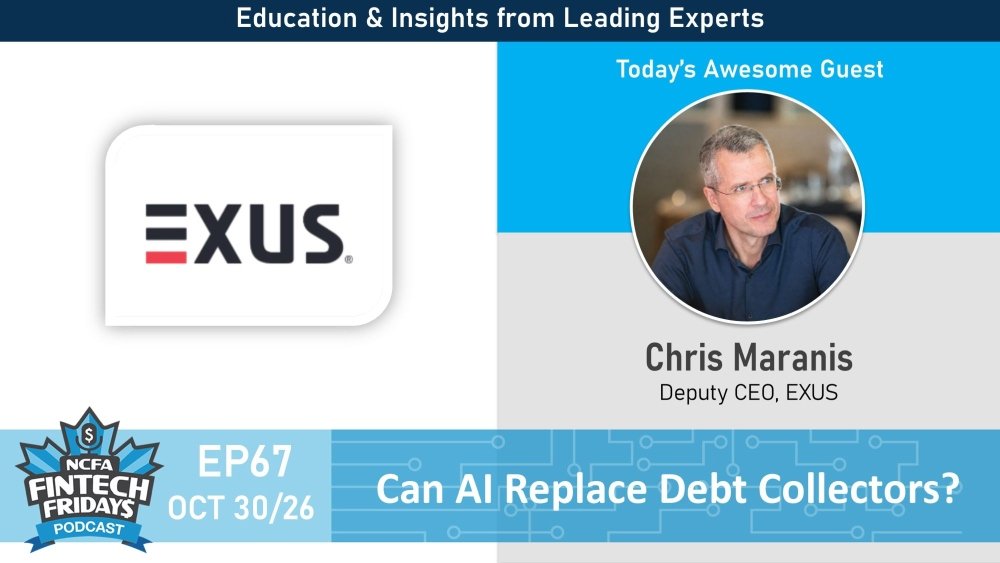
Featured Guest: CHRIS MARANIS, Deputy CEO, EXUS(LinkedIn)
Chris Maranis is Deputy CEO at EXUS and a long-standing leader in the global debt collection technology space. Since joining EXUS in 2004, he has worked with financial institutions across more than 30 countries, helping them transform collections operations across the full lifecycle from pre-collection to recoveries. His experience spans diverse markets and operating models, including in-house teams, outsourced networks, and highly regulated environments, with a strong focus on improving performance while strengthening customer relationships. Today, he helps shape EXUS’ strategic direction by connecting market needs with product vision, commercial growth, and operating execution. His current mandate combines internal leadership with a strong external market role, working closely with customers, partners, and industry stakeholders to advance a more intelligent, ethical, and customer-centric approach to collections. Drawing on two decades of international experience, he now focuses on how AI data-driven decisioning and modern engagement strategies can help organizations build future-ready collections models that deliver better outcomes for both lenders and customers.
About EXUS
EXUS is a global technology company specialising in debt collection and credit risk software. Founded in 1989, its EXUS Financial Suite (EFS) platform is trusted in more than 50 countries. EXUS brings together configurable collections strategies, analytics, decision intelligence, digital self-service and recovery workflows to help organisations improve collections performance and support customers throughout the debt lifecycle.
EP67: Can AI Replace Debt Collectors?
What happens when AI starts collecting debt? Could a machine make better decisions than a human, and would you trust it with your financial future?
In Episode 67 of NCFA Fintech Fridays, host Craig Asano sits down with Chris Maranis, Deputy CEO of EXUS, a global leader in debt collection and credit risk software, to explore how AI is changing the way banks recover debt, engage with customers and manage financial hardship. With over 20 years of international experience, Chris explains what's actually changing in debt collection as banks introduce predictive analytics, generative AI and autonomous agents. From AI negotiating repayments to detecting customers in financial difficulty, there's plenty happening already. But where should banks draw the line between automation and human judgment? Through practical scenarios, Chris tackles some tough questions about AI, fairness and accountability. He also shares EXUS's expansion into Canada, its work with a major Canadian bank and what's coming next from the company's AI innovation team. It's a fascinating look at how far AI can go in banking, what lenders are willing to automate, and why the toughest decisions may be the ones they can't hand over to a machine. Tune In!!
ZACH SMITH, CEO and Co-Founder, Funded Today (LinkedIn)
About this Episode
Checkout this not to be missed episode with NCFA Founder Craig Asano and Zach Smith, CEO and Co-Founder of Funded Today. In 2017, Zach delivered a keynote at NCFA's Canadian Crowdfinance Summit in Toronto after raising $150 million dollars. Fast forward to today, and the Funded Today machine has raised north of $426 million USD and counting. In this episode, learn what it takes to be a serial entrepreneur -- "It's not really about how much money you raise on the platform, it's about what you learn from the money that you've raised." They discuss the story of Funded Today, pivoting, diversifying investments, being strategic, doing what you love, and of course how to raise millions of dollars with rewards-based crowdfunding including a couple of real life examples. If you have an innovative project, gadget or piece of hardware, or have an app or board game and want to know if you can crowdfund dollars for it in 2022, tune in now....grab a cup of your favourite and dig in. Enjoy! (FULL TRANSCRIPT)
Guest: ANNE-MARIE FANNON, Director, Work-Learn Institute, University of Waterloo (LinkedIn)
About this Episode
On this Season 4 kickoff episode, NCFA Founder Craig Asano sits down with the incredible Anne-Marie Fannon, Director, Work-Learn Institute at the University of Waterloo, to better understand the motivations and needs of the next major human capital resource - Gen Z. If you're a start-up, scale-up or HR professional seeking intel on an emerging tech savvy, innovative, and talent asset class then this podcast is for you. Tune in now and learn not just the how but also the why you should be building relationships with Gen Z today. Enjoy! (FULL TRANSCRIPT)
10 years ago in 2012, the Jumpstart Our Business Startups Act (JOBS Act) was signed into law in the U.S. (and eventually a similar exemption was approved in Canada) to encourage more capital to flow to startups, support innovation, and, create jobs. It's significance cannot be understated as the rule change allowed private companies to raise capital by selling securities digitally for the first time via registered online platforms and dealer-brokers. Regulation crowdfunding also democratized previously excluded retail investors (non-accredited) by allowing them to invest directly in startup ventures empowering a new era of digital finance.
A tremendous amount of advocacy and regulatory change efforts took place to make this happen, and since then, the original JOBS Act rules were improved for investment crowdfunding in the U.S., such as increasing the fundraising cap from US$1 million to US$5 million (not in Canada though, we've asked for years ahem). But there are still many challenges and myths to be debunked. While venture financings are at an all time high in sectors like fintech, it does not mean that startups are awash with capital. While there is growing interest among retail investors to participate directly in these offerings, and take control of their investment future, education and awareness still remains a top priority if industry is to grow in the right ways. Having said that, in the United States, RegCF recently surpassed $1billion raised. Canadian figures are more modest with at least CA$100 million in equity financings raised on a leading platform.
Today there's also a JOBS Act 2022 proposal on the table but will these changes be sufficient to support evolving technologies and their capabilities while also protecting investors? Regulatory change is slow and regulators should support innovation and competition. All stakeholders need to continue to support efforts to make capital markets whole, so EVERYONE can benefit from the advancements in technology or the wealth gap will continue to widen.
This is a not to be missed episode for anyone interested in the past or future of digital finance and capital markets. Join investment crowdfunding pioneers in both Canada and the U.S. who discuss the 10 year journey from a wide variety of perspectives including the evolution of first generation marketing platforms to the arrival of second generation decentralized finance models powered by blockchain technologies.
EP58: Using Risk Management to Improve Your Business and Life
Featured Guest:
ALEX SIDORENKO, CEO and Chief Risk Officer / Founder, Risk Academy / Risk Awareness Week (LinkedIn)
About this episode:
For anyone who needs to make complex decisions or wants to add more clarity into their lives by applying modern risk management techniques, then this one is for you. Join NCFA Founder, Craig Asano, who sits down with Alex Sidorenko, the CEO and Chief Risk Officer of the Risk Academy and Founder of Risk Awareness Week, one of the largest risk management conference programs in the world. They discuss the commoditization of science, horoscope fairy tales, beating the bear and how intuition may not always be your best friend (in some scenarios). Understand the difference between risk management for ‘box tickers’ vs modern techniques, generators vs users, virtual data, and how to think about risk management to electrify decision-support for any problem in your business or life. Enjoy!
Featured Guest: MARIA KONIKOV, Director of Operations at the York Entrepreneurship Development Institute (YEDI) (LinkedIn)
About this episode:
On this week's episode of the Fintech Friday Podcast, our host Manseeb Khan sits down with Maria Konikov, Director of Operations at York Entrepreneurship Development Institute (YEDI). They talk about why education is crucial for entrepreneurs, how YETI offers tuition-free programs for Canadians, and what makes their diploma so special? Could it be because they have diploma program allows entrepreneurs to apply their learnings directly to their business and is taught by experienced professors who are also successful entrepreneurs? Enjoy!! (Full Transcript)
EP60: Revolutionizing Small Business Lending and Empowering Entrepreneurs
Featured Guest
DAVID SOUAID, Chief Revenue Officer at OnDeck Canada (LinkedIn)
About this episode
In this insightful episode of "Fintech Fridays," we dive into the evolving landscape of small business financing with David Souaid, the Chief Revenue Officer of OnDeck Canada. David brings over two decades of experience in the fintech industry and shares his journey from co-founding Evolocity Financial Group to its merger with OnDeck Canada, illustrating his role in transforming small business lending. The discussion delves into the challenges and innovations in the industry, highlighting OnDeck's customer-centric approach, technological advancements, and future trends. David's insights reveal how OnDeck Canada is not just financing businesses but also empowering them to thrive in a dynamic economic environment. This episode provides a valuable perspective on the transformative world of fintech, especially in the realm of small business lending, and is a must-listen for entrepreneurs and industry enthusiasts seeking to understand the future of financial services. Enjoy!! (Full Transcript and Video)
In this enlightening episode 61 of Fintech Fridays, NCFA Founder, Craig Asano, sits down with Kay Khemani, an investment professional based in London, UK, the Co-Founder of the Phoenix App, and Managing Director of Hatchworks. Kay shares his journey from high finance at Goldman Sachs to the forefront of fintech innovation. Explore the revolutionary Phoenix app, a platform that simplifies market making in the crypto world, allowing users to become liquidity providers and earn from transaction fees, all simplified through smart contract technology. Learn about the risks and rewards of DeFi, the impact of ETFs on crypto markets, and gather essential insights for both new and seasoned investors. Enjoy!! (Full Transcript and Video)
EP62: The Future of Investment Crowdfunding: Innovations, Data, and Opportunities
Featured Guest:
SHERWOOD 'WOODIE' NEISS, Principal, Crowdfund Capital Advisors (LinkedIn)
About this episode
In this enlightening episode of Fintech Fridays, Season 4, Episode 62, host Craig Asano, founder and CEO of NCFA Canada, sits down with the distinguished Sherwood 'Woodie' Neiss, a pioneer in the investment crowdfunding industry and an advisor to NCFA. Together, they delve into the evolution of investment crowdfunding, its impact on startups and investors alike, and the potential for future growth. Woodie shares his journey, from the inception of crowdfunding regulations to leading the charge with data-driven insights and AI technology in investment strategies. Listeners will gain an insider's perspective on the latest developments, the significance of data in shaping the industry, and the role of technology in advancing investment opportunities. Whether you're an investor, entrepreneur, or fintech enthusiast, this episode offers a comprehensive look into the dynamic world of investment crowdfunding, revealing how it's reshaping the landscape of finance and opening new doors for innovation and growth. Enjoy!! (Full Transcript and Video)
In this episode of Fintech Fridays, host Craig Asano sits down with Marcia Dawood, an influential angel investor, author, and advisor who serves on the SEC's Small Business Capital Formation Advisory Committee. Marcia shares her journey from her first angel investing meeting to becoming a key figure in the industry, supporting over 50 early-stage companies. The conversation dives into the differences between angel investing and venture capital, strategies for successful investments, and the evolving landscape of early-stage investing. Marcia also discusses her new book, Do Good While Doing Well, which guides readers through the balance of achieving financial returns while making a positive impact. Tune in to hear expert insights, the importance of fostering diverse investment ecosystems, and how new investors can start their journey with confidence. Enjoy!!
EP64: House Rich Cash Poor And The New Home Equity Playbook
Featured Guest: SHAEL WEINREB, Founder and CEO, The Home Equity Partners(LinkedIn)
About this episode
In this episode of Fintech Fridays, Craig Asano sits down with Shael Weinreb, Founder and CEO of The Home Equity Partners, to unpack a financing gap that hits many Canadian homeowners hard. Shael explains how HEQ’s Home Equity Sharing Agreement (HESA) gives homeowners another way to access equity without taking on a traditional loan, monthly interest payments, or the pressure that comes with a refinancing decision. He also shares the personal story that sparked the business after his father, despite holding substantial home equity, could not access the funds he needed through a bank.
The conversation goes beyond product basics. Shael breaks down how the HESA model works in practice, where it may fit better than a HELOC or reverse mortgage, and why education remains one of the biggest challenges when introducing a new financial category to the market. He also talks candidly about founder pressure, resistance to innovation, and why he believes Canadians need more choice as rigid lending practices leave too many homeowners stuck between valuable assets and weak cash flow. Enjoy!!
EP65: Personal Guarantees: The Most Expensive Autograph an Entrepreneur Can Sign
Featured Guest: CRAIG ARNATT, Founder and CEO, PGI Cover(LinkedIn)
About this episode
Most entrepreneurs focus on building the business. Far fewer understand that a single signature on a loan agreement could put their personal savings, investments, and even their home at risk. In Season 4 Episode 65 of Fintech Fridays, Craig Asano sits down with Craig Arnatt, Founder and CEO of PGI Cover, to unpack one of the most overlooked risks in entrepreneurship: the personal guarantee. Craig explains why lenders require them, how they affect founders, business owners, and acquisition buyers, and what can happen when a business loan goes into default. The conversation explores the launch of Personal Guarantee Insurance in Canada, why the product has gained traction internationally, and how Canada's growing business succession wave could create new demand as entrepreneurs, search fund acquirers, and M&A buyers increasingly rely on leveraged financing to acquire businesses. Craig also shares insights from more than two decades in commercial insurance and insurtech, discusses the role of AI in underwriting and risk assessment, and explains how embedded insurance and fintech partnerships could help bring protection directly into financing workflows. Whether you're raising capital, buying a business, advising clients, or lending to entrepreneurs, this episode offers a practical look at a risk that is often buried deep inside loan agreements but can have life changing consequences when things go wrong. Enjoy!!
EP66: What It Takes To Build $1.5 Billion In Small Business Lending
Featured Guest: DAVID GENS, Founder and CEO, Merchant Growth(LinkedIn)
About this episode
What does it take to build a lending business that has deployed nearly $1.5 billion to small businesses over 17 years?
David Gens is the Founder and CEO of Merchant Growth, a Canadian digital financing platform for small businesses. After graduating from UBC with a Bachelor of Commerce in Finance, David began his career as an analyst at private equity firm CAI Capital Partners. In 2009, at just 22 years old and in the aftermath of the global financial crisis, he founded Merchant Growth to help address the gap in access to capital for Canadian small businesses. Over the past 15 years, Merchant Growth has helped more than 15,000 businesses access over $1 billion in financing through technology enabled lending solutions. David also leads Merchant Opportunities Fund and has been recognized as a Business in Vancouver Top 40 Under 40, BC Business Top 30 Under 30, and an EY Entrepreneur Of The Year finalist. Enjoy!!
FINTECH FRIDAY$ is a weekly podcast brought to you by NCFA and partners, where we sit down with the incredible people in the Fintech and Funding community and talk about trends, product innovations, developments and challenges!
Fintech Fridays is an evolving and innovative educational platform focused on delivering authentic personalities, content and story telling on the journey of mainstream adoption of new financial technologies and their impact on the future of finance.
Subscribe and tune in each Friday to check out the latest movers and shakers. Want to get involved? Contact us about partnerships opportunities, hosting and more: info@ncfacanada.org
The National Crowdfunding & Fintech Association (NCFA Canada) is a financial innovation ecosystem that provides education, market intelligence, industry stewardship, networking and funding opportunities and services to thousands of community members and works closely with industry, government, partners and affiliates to create a vibrant and innovative fintech and funding industry in Canada. Decentralized and distributed, NCFA is engaged with global stakeholders and helps incubate projects and investment in fintech, alternative finance, crowdfunding, peer-to-peer finance, payments, digital assets and tokens, blockchain, cryptocurrency, regtech, and insurtech sectors. Join Canada's Fintech & Funding Community today FREE! Or become a contributing member and get perks. For more information, please visit: www.ncfacanada.org
As part of new research conducted for the Open Banking Implementation Entity (OBIE) by independent research agency Marketing Means, we interviewed a small number of UK consumers, from a wide range of age groups and income brackets, who shared their experience of the market-leading savings apps.
How can apps help the saving habit?
Open banking savings apps offer a handy, ‘low impact’ way of helping individuals to save.
This works in two ways: providing an additional means of saving for more established savers, or in some cases, provide a way of saving to individuals who have otherwise struggled to do so.
Q. What are the positive aspects of using your savings app?
A. “I really like the saving round-up feature. I’d say overall they’ve met my expectations and exceeded them. And using it, I’ve matured as a saver.”
A. “It’s all very easy. How much goes in varies, as it runs itself in the background, but I really like the way I can slow down or speed up the savings rate through the app. It really gives me confidence that if I’m having a heavy week, I can adjust it.”
A. “I save through two apps. One has a fairly standard account but there are some issues with getting money out of that one. I’ve had some delays on withdrawals, so I tend just to leave the money in there. On the other app, I’m more engaged as I’ve got money going into two funds. One is a standard one but the other one has a higher risk rating. I enjoy doing that one. It’s satisfying seeing what happens with it, and fun as well.”
A. “The advantage was, I didn’t want to replace my bank account, so I didn’t want to go down a Monzo route. I wanted an additional savings facility that would link to different accounts I have.”
Q. Was the app easy to use and did it help you understand your finances better?
A.”I really like how the app slows me down. Because it’s a restricted access, I can’t just dip into it as I have done in the past with others. But also, that makes me reflect and means I can think about my money more. It’s changed the way I am with money, for the better.”
A. “I like the flexibility. You can dial the savings rate up and down. You can boost a payday. I can use it flexibly to save when I’ve had a bonus. And I like the way they describe the investment plans – ‘standard’, ‘balanced’ – I think that’s a useful way to explain them, easy to understand. The app has a really good dashboard, it almost feels as if you’re getting a bespoke savings service that’s easy to use.”
A. ” I was attracted by the way it saves in the background, so you hardly notice it’s happening. When I started, I thought I’d build up a substantial fund really quickly. I’ve got a more realistic view now, but I’m still really happy with it.”
The National Crowdfunding & Fintech Association (NCFA Canada) is a financial innovation ecosystem that provides education, market intelligence, industry stewardship, networking and funding opportunities and services to thousands of community members and works closely with industry, government, partners and affiliates to create a vibrant and innovative fintech and funding industry in Canada. Decentralized and distributed, NCFA is engaged with global stakeholders and helps incubate projects and investment in fintech, alternative finance, crowdfunding, peer-to-peer finance, payments, digital assets and tokens, blockchain, cryptocurrency, regtech, and insurtech sectors. Join Canada's Fintech & Funding Community today FREE! Or become a contributing member and get perks. For more information, please visit: www.ncfacanada.org


 Emmer introduced legislation to prohibit the Federal Reserve from issuing a central bank digital currency (CBDC) for use by individuals.
 The National Crowdfunding & Fintech Association (NCFA Canada) is a financial innovation ecosystem that provides education, market intelligence, industry stewardship, networking and funding opportunities and services to thousands of community members and works closely with industry, government, partners and affiliates to create a vibrant and innovative fintech and funding industry in Canada. Decentralized and distributed, NCFA is engaged with global stakeholders and helps incubate projects and investment in fintech, alternative finance, crowdfunding, peer-to-peer finance, payments, digital assets and tokens, blockchain, cryptocurrency, regtech, and insurtech sectors.






 Despite considering myself a cryptographer, I have not found myself particularly drawn to “crypto.” I don’t think I’ve ever actually said the words “get off my lawn,” but I’m much more likely to click on Pepperidge Farm Remembers flavored memes about how “crypto” used to mean “cryptography” than I am the latest NFT drop.

 The National Crowdfunding & Fintech Association (NCFA Canada) is a financial innovation ecosystem that provides education, market intelligence, industry stewardship, networking and funding opportunities and services to thousands of community members and works closely with industry, government, partners and affiliates to create a vibrant and innovative fintech and funding industry in Canada. Decentralized and distributed, NCFA is engaged with global stakeholders and helps incubate projects and investment in fintech, alternative finance, crowdfunding, peer-to-peer finance, payments, digital assets and tokens, blockchain, cryptocurrency, regtech, and insurtech sectors.



 What is a Whale Wallet?







 As part of new








