




Karsten Wenzlaff, Advisor
August 26th, 2025
Karsten Wenzlaff is a Crowdfunding and Fintech Expert from Germany. He is Secretary-General of Digit[...]


Oct 28, 2026 | Lake Energy

Singapore— The global energy sector is undergoing a major transformation as countries invest in cleaner electricity, modernize power grids, and expand renewable energy capacity. Solar and wind power are becoming increasingly important sources of electricity, while hydropower, biomass, and battery storage are contributing to a more diverse energy system.
Growing electricity demand from businesses, digital infrastructure, and electric technologies is also increasing the focus on reliable energy supplies. As a result, renewable energy projects and supporting infrastructure have become important topics across financial and energy markets.
For cryptocurrency investors looking beyond digital asset trading, renewable energy offers another sector to explore. Lake Energy connects these interests through an online platform offering renewable energy investment plans and support for selected cryptocurrency funding methods.
Lake Energy offers investment plans related to solar power, wind energy, hydropower, biomass energy, and energy storage. Users can compare investment amounts, project durations, and stated terms to understand the options available.
The platform supports several digital assets, including BTC, ETH, XRP, USDT, and USDC, giving users multiple funding options.
Getting started involves three steps: creating an account, reviewing available projects, and selecting a plan based on its stated terms.
Visit lakeenergy.com and create an account by entering your username, email address, login password, and fund password. Complete the CAPTCHA and submit the registration form.
Every newly registered account receives a $10 welcome bonus, giving new users an additional incentive to explore the platform.
Solar energy: Investment: $500 | Period: 7 days | Daily Return: $5.25 | Return at Maturity: $500 + $36.75
Solar energy: Investment: $1,000 | Period: 15 days | Daily Return: $11.00 | Return at Maturity: $1,000 + $165
Wind energy: Investment: $3,000 | Period: 20 days | Daily Return: $34.50 | Return at Maturity: $3,000 + $690
Wind energy: Investment: $5,000 | Period: 25 days | Daily Return: $60.00 | Return at Maturity: $5,000 + $1,500
Energy storage: Investment: $10,000 | Period: 30 days | Daily Return: $126.00 | Return at Maturity: $10,000 + $3,780
Explore the available solar, wind, hydropower, biomass, and energy storage plans. Compare investment amounts, project durations, and the terms of each option to understand how the plans differ.
After reviewing the available information, select a plan that matches your preferences and follow the platform's instructions. Check the applicable funding requirements and settlement terms before completing the process.
Security is an important part of managing an online investment platform. Lake Energy's security framework encompasses website protection, data encryption, digital asset storage, and asset protection measures.
Lake Energy also uses TLS 1.2 encryption to protect information transmitted between users and its website, alongside encryption measures for stored data.
Together, these measures address key aspects of online security, digital asset custody, and account management.
Cryptocurrency and renewable energy operate in different markets. Digital assets are influenced by factors such as market activity and blockchain adoption, while renewable energy development is shaped by electricity demand, infrastructure investment, government policies, and technological progress.
For XRP holders interested in exploring sectors beyond cryptocurrency trading, renewable energy offers another area to research. Lake Energy brings renewable energy investment plans and supported digital asset funding options together in one online environment, allowing users to explore available projects and review their terms.
The transition to cleaner energy is reshaping electricity generation and infrastructure investment worldwide. As solar power, wind energy, and energy storage continue to develop, renewable energy remains an important sector for investors to follow.Lake Energy provides an online platform for exploring investment plans connected with these technologies. Visit lakeenergy.com to learn more about the available projects.
 The National Crowdfunding & Fintech Association (NCFA Canada) is a financial innovation ecosystem that provides education, market intelligence, industry stewardship, networking and funding opportunities and services to thousands of community members and works closely with industry, government, partners and affiliates to create a vibrant and innovative fintech and funding industry in Canada. Decentralized and distributed, NCFA is engaged with global stakeholders and helps incubate projects and investment in fintech, alternative finance, crowdfunding, peer-to-peer finance, payments, digital assets and tokens, artificial intelligence, blockchain, cryptocurrency, regtech, and insurtech sectors. Join Canada's Fintech & Funding Community today FREE! Or become a contributing member and get perks. For more information, please visit: www.ncfacanada.org
 |  |  |
|---|---|---|
 |  |  |
October 28, 2026 | NCFA Story Intelligence | Regulation And Policy, Digital Assets Blockchain And Tokenization, Competition And Market Structure, Capital Markets Infrastructure And Funding

Binance thought it was leaving Canada in 2023. The regulatory fight stayed behind.
Binance never entered Canada the way a bank or securities dealer would. It didn’t open a Canadian branch, build a local exchange or wait for a Canadian licence. Changpeng Zhao was a Canadian entrepreneur who had studied computer science at McGill, but Binance launched in Shanghai in July 2017 and grew into the world’s largest crypto exchange by trading volume within about six months. The product was global from the start. Borders came later.
By 2021, Canadian regulators were catching up with what that model meant on the ground. Ontario pushed Binance out. Binance hired former regulators, incorporated in Alberta and tried to build its way back in. Then Canada tightened the rules again. On May 2, 2023, Binance told securities regulators it planned to withdraw nationally.
Eight days later, the OSC opened an investigation. The next day came a sweeping demand for company records. On May 12, Binance told the public it was leaving Canada.
The exit and the investigation crossed in real time. Binance was trying to close one Canadian chapter while the regulator was opening another.
Three years later, that unfinished business has reached the Supreme Court of Canada. Ontario’s Court of Appeal has already ruled that part of the OSC summons went too far. The OSC wants that ruling overturned. Nine interveners now include civil liberties groups, securities regulators and four governments.
What follows is a story of a borderless crypto company meeting national regulators, leaving some markets, adapting in others, and discovering that a market exit doesn’t make the regulatory past disappear.
Ontario treats access as local activity. The OSC’s position is that platforms offering securities or derivatives to Ontario users can’t avoid provincial rules simply because the company or servers sit somewhere else. For internet based finance, the customer’s location can pull a global platform into a local regulatory system.
Binance starts planning a return. By early 2022, Binance is doing something that would have looked unlikely months earlier. It hires former Canadian regulators, incorporates in Alberta and starts building toward full registration. Binance hires ex-regulators and incorporates in Alberta to charter compliance course in Canada catches the pivot. A few months later, Alberta-based Binance Canada expects to return to Ontario by 2024 shows how far the strategy has moved. The company isn’t talking about abandoning Canada. It is talking about coming back to Ontario through the front door.
The OSC gets enforceable controls. The undertaking turns account restrictions, product wind downs and monitoring into commitments the regulator can supervise. Binance is no longer only deciding what Ontario access should look like on its own.
Binance still sees a Canadian future. The company pursues registration outside Ontario and talks publicly about returning. That makes the national exit in 2023 more than a market withdrawal. It ends an attempted compliance strategy.
Binance blames the rule set, not Canada itself. The company says it delayed the decision while looking for another route and hopes to return someday. Canada is a relatively small market for Binance, but the evidence doesn’t establish that size alone drove the exit. The company’s own explanation focused on the rule set and the product limits that came with it.
Other platforms make a different calculation. Some exchanges also leave, while others pursue Canadian registration and accept narrower product menus. Every platform has to decide whether the local opportunity justifies the controls, product limits and ongoing supervision required to stay.
Regulators need records to reconstruct the past. Cross border platforms can spread staff, systems and legal entities across several countries. Without compulsory powers, investigators may struggle to establish who made a decision, which controls existed and what customers were told.
Broad demands carry real operating costs. A request covering years of email, chat, files and other communications can trigger preservation, data collection, legal review, privilege screening and cross border privacy work. A global exchange can spend heavily on that process. A smaller fintech may feel the same demand much more sharply.
The ruling protects relevance, not secrecy. The Court accepts that regulators have strong production powers and that privacy expectations for regulated business records can be low. It still requires a reasonable basis to believe compelled records may matter to the investigation.
The OSC sees a wider enforcement problem. The regulator argues that the Court of Appeal’s approach could make investigations slower and more difficult, particularly before investigators know exactly where useful evidence sits. Binance answers that regulators have had relevance limits for decades and can draft demands around the conduct they are actually investigating.
Investor protection still needs effective investigations. Regulators can’t police complex markets without access to records. Cross border digital businesses make that harder because relevant evidence may sit across entities, employees and systems that don’t line up neatly with one province.
Constitutional limits still matter inside regulated markets. Laura Paglia of the Canadian Forum for Financial Markets told Advisor.ca that securities regulators need broad powers, but argued that demands should remain proportionate and consider compliance costs. CFFiM was denied intervener status, so its view is industry commentary rather than a submission the Supreme Court will hear.14
Binance has already tried several endings in Canada.
First it left Ontario. Then it hired regulators and built an Alberta operation that was supposed to bring it back. Then it accepted an Ontario undertaking. Then it decided the national rules were no longer worth the trade and left Canada altogether.
The legal history kept going.
FINTRAC imposed a penalty tied to the years Binance operated here. Investors pursued a separate class action. Ontario courts rejected Binance’s attempt to force those investors into costly Hong Kong arbitration, a dispute later followed by Ontario Court Orders Binance To Pay Investor Legal Costs. The OSC kept investigating. The company that left Canada in 2023 is still litigating here in 2026.
Binance changed too. Zhao stepped down. A board arrived. Local licences and compliance teams became part of the growth strategy. Japan went from warning Binance to hosting a locally registered Binance business. Abu Dhabi became a regulated global base.
The Supreme Court case is now much bigger than Binance.
The Court is being asked to decide where constitutional limits sit when a regulator with legitimate investigative powers demands a very large volume of company records. A ruling that gives regulators wider latitude could make it easier to investigate complex businesses whose people, systems and data span multiple entities and countries. A ruling that requires a tighter connection between requested records and suspected conduct could force regulators to narrow summonses earlier and give companies stronger grounds to challenge sweeping demands.
Either way, the decision could shape how securities regulators design investigations, how regulated firms preserve and produce records, and how much compliance cost companies may face when regulators come looking for evidence. Depending on how broadly the Court reasons, its impact could also reach beyond capital markets into other regulated sectors that rely on statutory production powers.
That helps explain why governments, another securities regulator and civil liberties organizations have joined a dispute that began with one crypto exchange. The precedent could influence the balance between effective supervision and protection against regulatory overreach across Canadian business.
Binance spent years learning that global reach doesn’t erase national borders. Canada’s highest court is now deciding where one of those borders sits for regulators themselves.
Once a regulator has authority to investigate, how much of a company can it force open?
Binance left Canada. The company moved on. The answer could matter to regulated businesses long after this case is over.
INVESTOR GUIDE
7 Questions to Ask Before Choosing a Crypto Exchange in Canada
A current guide to registration, custody, transfers, funding, fees and operational risks Canadian investors should check before sending money to a crypto platform.
FINTECH INTELLIGENCE
Are Regulators Opening Markets While Raising Costs?
Market access can improve while evidence, records and supervision requirements get tougher, changing the economics for both incumbents and smaller entrants.
REGULATORY INSIGHT
Canada Proposes Stablecoin Market Entry Rules
Canada’s new stablecoin proposal shows how market access can depend on local custody, supervision and operating requirements, even when the underlying product is global.
REGULATION AND POLICY
National Security Is Now Part of Financial Supervision
Financial supervision is expanding beyond traditional capital and conduct questions into sanctions, cyber threats, ownership and state linked risk.
The National Crowdfunding & Fintech Association (NCFA Canada) is a financial innovation ecosystem that provides education, market intelligence, industry stewardship, networking and funding opportunities and services to thousands of community members and works closely with industry, government, partners and affiliates to create a vibrant and innovative fintech and funding industry in Canada. Decentralized and distributed, NCFA is engaged with global stakeholders and helps incubate projects and investment in fintech, alternative finance, crowdfunding, peer-to-peer finance, payments, digital assets and tokens, artificial intelligence, blockchain, cryptocurrency, regtech, and insurtech sectors. Join Canada's Fintech & Funding Community today FREE! Or become a contributing member and get perks. For more information, please visit: www.ncfacanada.org
| | |
|---|---|---|
| | |
October 27, 2026 | NCFA Regulatory Intelligence | Regulation And Policy, Capital Markets Infrastructure And Funding, Competition And Market Structure

Proposed Rule Changes Could Lower Financing Costs for Smaller Canadian Companies
On July 16, 2026, the Canadian Securities Administrators (CSA) published Consultation Paper 51-406 on modernizing public company regulation. The CSA wants feedback on whether simpler reporting rules and fewer private placement restrictions could help Canadian companies raise capital at a lower cost. The changes could affect financial reporting, institutional investment and access to financing, particularly for smaller listed businesses. Comments close November 13, 2026.
Two ideas stand out. (1) The CSA is considering a new exemption that could let qualifying public companies raise money from institutional investors without the usual four month restriction on reselling shares. (2) It is also asking whether a company's size and business operations should matter more when deciding which reporting rules apply. Both could affect the cost of raising capital and doing business as a public company. Nothing has been approved yet.
Canada had approximately 3,000 listed companies in March 2026, according to the CSA. About 76% were classified as venture issuers, and only 12% had a market value above C$1 billion. Most listed companies are relatively small, but they still pay for audits, accounting, legal advice and regular regulatory filings. Those expenses add up, especially for businesses that depend on outside investment to grow.
The consultation covers five main reporting questions.
Today, whether a company qualifies as a venture issuer largely depends on the exchange where its shares trade. The CSA wants to know whether revenue, assets, market value or the amount of shares held by public investors would be better measures. It is also considering changes to the existing system and whether larger venture issuers should move to senior exchanges.
A small company listed on a senior exchange may face more demanding reporting rules than a larger business on a venture exchange. Changing the criteria could make reporting costs more reasonable for some companies, although others might face new requirements. The rules would also need to be predictable so companies aren't forced to change their reporting practices every time their market value moves.
The CSA is asking whether certain venture issuers should receive relief from specific International Financial Reporting Standards (IFRS) requirements. Some accounting rules involve specialist advisers, detailed valuations and substantial preparation costs. Regulators want to know which requirements are particularly expensive and which information investors actually use. Any relief needs to save companies money without taking away financial information investors rely on.
Public companies generally must announce a material change promptly and then file a separate report within 10 days. A material change is an important development affecting a company's business, operations or capital. The CSA is asking whether a news release containing all the required information could replace the second filing when properly submitted through SEDAR+. It also wants to clarify which developments require a material change report. That could reduce legal bills and paperwork without leaving investors in the dark.
Certain eligible venture issuers can already choose to report financial results every six months instead of every quarter. The CSA is considering whether that option should be available to all public companies. Fewer reports could save money, but investors would have less frequent financial updates. That could be a concern for companies whose finances are changing quickly or that regularly need fresh capital. Regulators are also asking whether companies using this option should face additional conditions, particularly when raising money through a prospectus.
The US Securities and Exchange Commission (SEC) proposed several changes in May 2026. These include allowing public companies to report financial results every six months instead of quarterly, making it easier for more companies to raise money through registered share offerings, and reducing some reporting requirements for smaller businesses. The proposals aren't final rules yet.
The CSA wants feedback on whether similar changes would benefit Canada. Canadian companies compete with US businesses for investment, so differences in reporting costs and financing rules can matter. Making it cheaper and easier to raise capital could help Canadian companies compete, but investors still need reliable information to assess risk. Canada's large number of smaller listed companies also means US approaches may need to be adapted to suit.
Private placement rules are among the most important issues for companies trying to raise money. Under many existing exemptions, investors who buy newly issued shares from a public company must generally wait four months before reselling them. Because their money is tied up, they may demand a lower share price. That can leave founders and existing shareholders with less ownership after a financing.
The CSA is reviewing whether these restrictions are still necessary in every situation. One option is a new Qualified Institutional Purchaser (QIP) exemption. It could let eligible Canadian public companies sell shares to qualifying institutional investors through registered dealers without the usual four month resale restriction. Conditions would still apply, and the exemption is only being considered at this stage.
Some investment funds have rules that limit their ability to buy shares they cannot readily sell. Removing that restriction for qualifying transactions could bring more institutions into Canadian financings. More interested buyers might help companies negotiate better prices or complete deals that otherwise wouldn't happen. The final rules would determine whether those benefits are achievable.
The consultation raises four practical questions about how such an exemption could work.
Who could use it? The CSA wants feedback on which public companies and institutional investors should qualify. Setting the requirements too narrowly might exclude investors the exemption is intended to attract. Making them too broad could create new risks for investors and the market.
Would a registered dealer have to arrange the deal? Dealers can check eligibility, review information and help oversee a financing. That can protect investors and improve accountability. But dealers also charge fees, which matter when a company is raising a relatively small amount of capital. The CSA is asking whether mandatory dealer involvement strikes the right balance.
How would investors be protected? If newly issued shares can be sold immediately, regulators need to consider disclosure requirements, legal remedies and possible short selling arrangements. Investors buying shares in the public market shouldn't be left without important information. The legal protections available in a private placement can also differ from those in a public offering made through a prospectus.
Would the change bring in more money? Giving institutions another way to invest doesn't automatically mean they'll invest more. Companies still need attractive businesses, reasonable valuations and willing buyers.
Canada has already seen strong demand for more flexible financing rules. Following changes to the Listed Issuer Financing Exemption, hundreds of companies raised almost C$4 billion in the first year under the higher limits, roughly eight times the earlier pace. The increase doesn't necessarily prove the rule changes caused every financing, but it shows how extensively companies used the expanded exemption.
The proposed QIP exemption would work differently, focusing on institutional investors. Its value would depend on whether those investors bring additional capital and whether issuers can raise money on better terms. For smaller public companies, even a modest improvement in financing prices can mean issuing fewer shares and preserving more ownership. Companies and dealers with direct private placement experience can help regulators understand where the current restrictions make deals harder or more expensive.
The CSA wants feedback before deciding whether to change the rules. Companies and investors don't need to address every question. They can focus on the issues they know best and explain how the current requirements affect their decisions.
Founders and public company executives can share what they spend on reporting, audits and legal work. They can explain which filings take the most time, whether those costs influence where they list and how much money could be saved through simpler requirements. Real examples would help regulators separate necessary investor disclosures from work that adds limited value.
Investors and investment dealers can explain how resale restrictions affect private placements. That includes discounts investors seek, deals that are difficult to complete and cases where institutions cannot participate. They can also identify what information and safeguards they would need before accepting shares without a resale hold.
Accountants, securities lawyers and other advisers can explain which requirements create unnecessary work and where simpler rules might introduce new problems. Readers preparing their own comments can also review the industry submissions published by Quebec's Autorité des marchés financiers. These include responses from Fiore Management & Advisory Corp., SRI Capital Advisors and Canadian Independent Finance and Innovation Counsel. They offer examples of how other market participants are approaching the proposals.
Comments close November 13, 2026. Issuers, investors, dealers, advisers and other interested parties can submit feedback directly to the CSA using the online form or by uploading a PDF letter. Comments should focus on relevant consultation questions and include practical examples, financing costs or investor experience where possible. Submissions may be published. For technical help with the submission process, contact the CSA Secretariat at info@acvm-csa.ca.
Canada's public markets need to be affordable for smaller companies and attractive to investors. Reporting expenses can take money away from business growth, while private placement restrictions can affect financing prices and who is able to invest. The CSA's review is an opportunity to see which requirements still serve a useful purpose and which may be making capital harder or more expensive to obtain.
The proposed institutional financing exemption and review of venture issuer rules deserve particular attention. Both could help companies access capital or reduce costs, but the benefits will depend on how any changes are designed. Founders, investors, dealers and advisers have an opportunity to provide that practical evidence before the November 13 deadline. The goal is better access to capital while keeping the information and protections investors need to participate with confidence.
The National Crowdfunding & Fintech Association (NCFA Canada) is a financial innovation ecosystem that provides education, market intelligence, industry stewardship, networking and funding opportunities and services to thousands of community members and works closely with industry, government, partners and affiliates to create a vibrant and innovative fintech and funding industry in Canada. Decentralized and distributed, NCFA is engaged with global stakeholders and helps incubate projects and investment in fintech, alternative finance, crowdfunding, peer-to-peer finance, payments, digital assets and tokens, artificial intelligence, blockchain, cryptocurrency, regtech, and insurtech sectors. Join Canada's Fintech & Funding Community today FREE! Or become a contributing member and get perks. For more information, please visit: www.ncfacanada.org
| | |
|---|---|---|
| | |
October 27, 2026 | NCFA Industry Resource | SME Finance And Business Banking, Sustainable Finance ESG And Financial Inclusion, Capital Markets Infrastructure And Funding

Growth Loans, Regional Financing and Founder Awards
On October 22, 2026, Women's Enterprise Organizations of Canada (WEOC) and the Business Development Bank of Canada (BDC) announced up to C$200,000 in growth loans for eligible women entrepreneurs. WEOC also partnered with Quebec lender Evol to connect more founders with financing and business support. Separately, the Capital Elle Business Impact Award is accepting applications until October 28, 2026, giving Canadian women entrepreneurs three opportunities worth considering.
The new Women Entrepreneur Growth Financing programme combines WEOC loans of up to C$50,000 with BDC loans of up to C$150,000. Backed by a C$12.5 million financing commitment over two years, the pilot targets eligible women owned businesses outside Quebec that need more capital to expand. BDC is contributing C$10 million toward the programme.
For businesses ready to buy equipment, invest in technology, increase production or pursue larger contracts, the additional financing could make a meaningful difference. Regional WEOC lending partners will assess applicants and provide business advice and ongoing support. The combined C$200,000 is a maximum, subject to eligibility and lending approval.
Applications haven't opened yet. Financing is expected to begin later in 2026. Interested founders can register for WEOC growth financing updates to receive application details, eligibility requirements and loan terms when available.
WEOC's new partnership with Evol connects lending services across Canada. Evol supports entrepreneurs throughout Quebec's 17 regions, while WEOC works through lending partners elsewhere in Canada. The organizations will refer founders to suitable financing and advisory services, including businesses that may not qualify for an existing programme.
Both organizations participate in the Women Entrepreneurship Loan Fund, which offers eligible businesses loans of up to C$50,000. The partnership isn't a new grant or an extension of the C$200,000 BDC pilot into Quebec. It helps entrepreneurs find lenders and support suited to their location and financing needs.
The Capital Elle Business Impact Award offers Canadian women entrepreneurs cash awards and business support across three categories covering strategic connections, growth capital and acquisitions. The organizer advertises a combined prize package worth more than C$100,000, including C$5,000 cash for each category winner, professional services, mentoring and business connections.
The award is open to women founders across industries, subject to eligibility requirements. Applicants select the category that best fits their business goals. The application process costs C$50 for nonmembers (nonrefundable), while eligible paid Elleiance members can apply without an additional fee.
Deadline is October 28, 2026, at 9 p.m. Eastern. Founders should review the official award terms and confirm eligibility.
More financing options are welcome, and founders should match the opportunity to their business. Growth loans can fund expansion, regional lenders can provide ongoing support, and awards offer cash and business connections. The best choice depends on how much money the business needs, what it qualifies for and whether it can take on debt.
The National Crowdfunding & Fintech Association (NCFA Canada) is a financial innovation ecosystem that provides education, market intelligence, industry stewardship, networking and funding opportunities and services to thousands of community members and works closely with industry, government, partners and affiliates to create a vibrant and innovative fintech and funding industry in Canada. Decentralized and distributed, NCFA is engaged with global stakeholders and helps incubate projects and investment in fintech, alternative finance, crowdfunding, peer-to-peer finance, payments, digital assets and tokens, artificial intelligence, blockchain, cryptocurrency, regtech, and insurtech sectors. Join Canada's Fintech & Funding Community today FREE! Or become a contributing member and get perks. For more information, please visit: www.ncfacanada.org
| | |
|---|---|---|
| | |
Oct 26, 2026 | CryptoVantage
Opening a crypto account takes only a few minutes. Deciding whether the platform deserves your money should take a little longer.
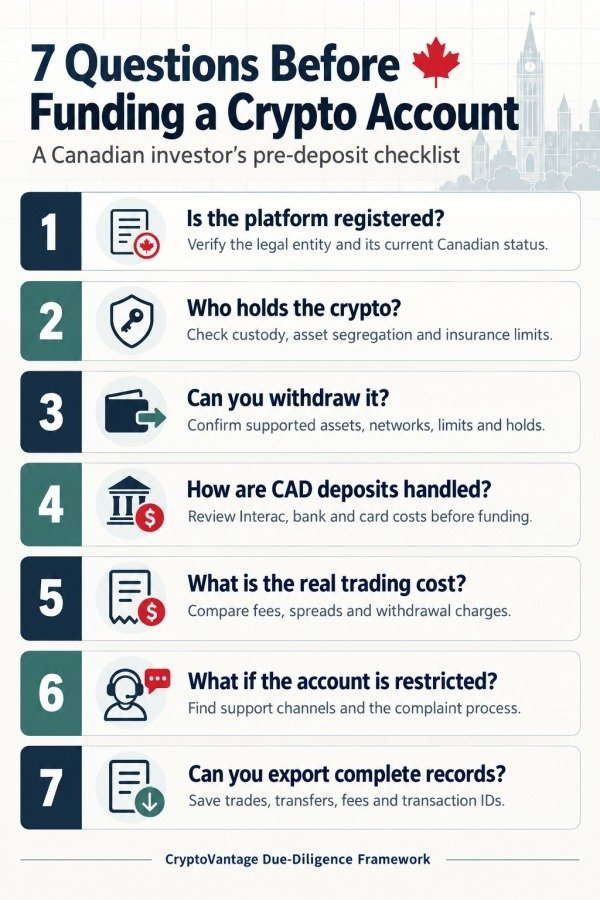
CryptoVantage has published a new due-diligence framework to help Canadian investors evaluate cryptocurrency trading platforms before making a deposit. The guide moves beyond rankings and promotional claims by focusing on seven questions that reveal how a platform actually handles customer money, digital assets, fees and support problems.
The framework is designed primarily for first-time buyers, although its questions also apply to experienced investors comparing a new service. It can be used to examine Canadian platforms such as Bitbuy, Newton, Shakepay and Wealthsimple, as well as international companies serving Canadian customers, including Coinbase and Kraken.
No platform is the right choice for everyone. The point is to know what is being offered before sending Canadian dollars or cryptocurrency.
A polished application and a familiar brand name do not tell investors whether a platform is authorized to serve Canadian customers.
Crypto asset trading platforms operating in Canada may be subject to provincial securities requirements. Depending on their activities and regulatory status, they may also need to pursue registration as investment dealers and membership in the Canadian Investment Regulatory Organization.
Canadian investors can consult CIRO’s information about crypto asset trading platforms and the relevant provincial securities regulator. They should search for the company’s legal name, not just the trading name displayed in its app.
That distinction matters. A global company may operate through a separate Canadian entity, while another service may limit particular products in Canada.
Registration provides a level of regulatory oversight, but it should not be mistaken for a promise that an investment cannot lose value. It also does not eliminate cybersecurity, fraud, insolvency or operational risks.
The useful question is not simply, “Is this a regulated exchange?” It is, “Which legal entity holds my account, and what registration does that entity currently have?”
Buying cryptocurrency and taking personal custody of it are two separate decisions.
When assets remain on a centralized platform, the customer typically depends on that company and its custody arrangements. Some platforms hold part of their customers’ assets directly. Others use specialist custodians or a combination of internal and external storage.
For example, a Canadian investor might buy Bitcoin through Wealthsimple, Coinbase, Kraken, Newton, Shakepay or Bitbuy. The account interface may look straightforward, but the custody structure behind it can be considerably more complex.
Investors should look for clear answers to several basic questions. Are customer assets segregated from corporate assets? What proportion is stored offline? Does the platform identify outside custodians? Who controls the keys required to move funds? What happens if a custody provider fails?
Insurance also needs context. A statement that assets are “insured” does not necessarily mean every loss is covered. A policy may apply only to certain storage systems, specific criminal events or losses caused by the custodian. It may exclude phishing, customer mistakes, compromised passwords or losses above a coverage limit.
Custody is becoming a larger part of Canada’s digital-finance infrastructure. NCFA has previously examined how crypto custody regulation is changing, including the growing importance of segregation controls, operational resilience and oversight evidence.
A platform may allow customers to buy and sell cryptocurrency without supporting withdrawals to an external address. That arrangement can suit someone interested only in price exposure, but it is different from purchasing an asset that can be moved into self-custody.
Before depositing money, investors should confirm whether the platform supports external transfers for the exact asset they intend to buy.
Support can vary by coin and network. A service might allow Bitcoin withdrawals but restrict a newer token. It might support USDC on Ethereum while not supporting the same stablecoin on Solana or another network. Sending assets through an incompatible network can lead to a difficult or unsuccessful recovery process.
Withdrawal rules deserve attention too. Platforms may impose minimum amounts, network charges, daily limits or temporary security holds. A newly added bank account, password reset or device change can trigger an additional delay.
These controls are not automatically a bad sign. A short security hold may stop an unauthorized withdrawal. The concern is whether the platform explains its policy before the customer needs to move funds.
CryptoVantage recommends treating a small test withdrawal as part of the onboarding process. It can reveal whether the address format, selected network, confirmation steps and expected fees are understood before a larger amount is at risk.
For Canadian users, the quality of the fiat on-ramp can be as important as the trading interface.
Platforms including Newton, Shakepay and Bitbuy have built their Canadian services around familiar funding options such as Interac e-Transfer. Coinbase and Kraken also serve Canadian customers, but available deposit methods, processing times and limits may differ.
Investors should check whether deposits are made directly to the platform or processed by another company. They should also review minimum and maximum amounts, expected processing times and the name that will appear on their bank statement.
A bank may pause or reject a transaction even when the crypto platform accepts that funding method. This can happen because of fraud controls, account limits or the bank’s internal policies.
Credit and debit cards introduce another layer of cost. A platform may charge a card-processing fee, while the card issuer could classify the purchase differently from an ordinary retail transaction.
The practical test is simple: calculate how many dollars arrive in the trading account after every visible charge. A “free deposit” is useful, but it says nothing about the spread applied when those dollars are exchanged for crypto.
The word “commission-free” can be technically accurate while still leaving the customer with a meaningful cost.
Some platforms charge a clearly stated transaction fee. Others earn revenue through the spread between the displayed buying and selling prices. Advanced trading interfaces may use maker-and-taker schedules, while instant-purchase features can have a different price structure.
For a fair comparison, an investor can record three numbers at the same moment:
The difference provides a more practical picture than an advertised commission rate alone.
The company’s Canadian crypto exchange guide compares services including Coinbase, Bitbuy, Kraken and Shakepay while examining factors such as fees, deposits, withdrawals, security and transaction speed.
Costs can also appear after the trade. A user may encounter a crypto withdrawal charge, blockchain network fee, staking commission or currency-conversion cost. Comparing the complete transaction journey is more useful than comparing one headline percentage.
Most customers judge a platform when everything is working. Due diligence should also consider what happens when it is not.
An account may be restricted because of an identity-verification issue, a suspicious login, a disputed bank transfer, a compliance review or activity that triggers the platform’s monitoring systems. Even legitimate customers can be asked for additional documents.
Before funding an account, investors should locate the support options. Is live chat available? Can a customer reach a human agent? Is there a formal complaint process? Does the company publish estimated response times? Which organization can review an unresolved complaint?
Social media is not a safe substitute for official support. Fraudsters routinely impersonate exchanges and respond to public complaints with offers of private assistance. A genuine support representative should not need a wallet recovery phrase or private key.
It is also sensible to keep independent records. Customers should retain deposit confirmations, trade histories, withdrawal identifiers and relevant correspondence. Accessing those records may become harder after an account is closed or restricted.
Crypto recordkeeping should begin with the first purchase, not several months later when a tax return or portfolio review makes the information necessary.
A useful platform should allow customers to export deposits, withdrawals, purchases, sales, trades, staking rewards and applicable fees. Ideally, the records should be available in a common format that can be reviewed in a spreadsheet or imported into compatible accounting software.
Investors should not assume that a simple annual gain-and-loss figure will capture every relevant activity. Moving assets between personal wallets is different from disposing of them, but the transaction still needs to be documented so the movement can be traced.
Records are also valuable when investigating a delayed withdrawal or reconciling a wallet balance. A blockchain transaction identifier can show whether a transfer was broadcast, while the platform’s internal history can document when the request was submitted.
If export tools are difficult to find before an account is funded, they may not become easier to use later.
A platform can change its fees, supported assets, banking relationships, custody providers or Canadian availability. Regulatory status may also evolve.
Investors should repeat the seven-question review when opening a new account and periodically revisit it for platforms they already use. A service that suited a small first purchase may not be the right place for a larger balance, frequent trading or long-term custody.
The framework does not attempt to identify a universally safest exchange. Instead, it helps users separate several ideas that are often blended together: regulatory registration, custody, cybersecurity, insurance, liquidity and personal account security.
That is the larger purpose of the new guide. Choosing a crypto platform should not begin with a promotional bonus or a list of supported tokens. It should begin with understanding which company is receiving the money, what it will do with the assets and how the customer can leave if circumstances change.
CryptoVantage is a cryptocurrency publication providing educational guides, news, analysis, and reviews covering Bitcoin, blockchain, exchanges, wallets, fintech, and digital assets. Its team of writers, researchers, and cryptocurrency specialists creates accessible content for both newcomers and experienced crypto users, helping readers better understand the rapidly evolving digital-asset industry.
The National Crowdfunding & Fintech Association (NCFA Canada) is a financial innovation ecosystem that provides education, market intelligence, industry stewardship, networking and funding opportunities and services to thousands of community members and works closely with industry, government, partners and affiliates to create a vibrant and innovative fintech and funding industry in Canada. Decentralized and distributed, NCFA is engaged with global stakeholders and helps incubate projects and investment in fintech, alternative finance, crowdfunding, peer-to-peer finance, payments, digital assets and tokens, artificial intelligence, blockchain, cryptocurrency, regtech, and insurtech sectors. Join Canada's Fintech & Funding Community today FREE! Or become a contributing member and get perks. For more information, please visit: www.ncfacanada.org
| | |
|---|---|---|
| | |
Oct 17, 2026 | Last Updated: Oct 30, 2026 | NCFA Fintech Whisperer | Artificial Intelligence And Data, Capital Markets Infrastructure And Funding, Competition And Market Structure, Cross Border Payments And FX, Cybersecurity Fraud And Financial Crime, Digital Assets Blockchain And Tokenization, Digital Identity And Trust, Embedded Finance, Payments Infrastructure And Money Movement, Regulation And Policy, Risk Compliance And Regtech, Sustainable Finance ESG And Financial Inclusion, Digital Banking And BaaS, Treasury Liquidity And Cash Management, Wealthtech Investing And Trading, Open Banking Open Finance And Data Sharing

] Image: Freepik
This live weekly NCFA intelligence page tracks financial technology developments that significantly affect how fintechs build, sell, raise capital, and operate under scrutiny. Coverage prioritizes Canada and includes global events that directly influence competitive conditions, market access, and execution realities across fintech sectors. This page will be updated throughout the week with market movers in a live format and then each week we'll close the prior week's contents in prep for the upcoming week, and continue on a rolling basis. (Missed prior week's Fintech Whisperer? (December 6-12, 2025, December 13-19, 2025, January 1-9, 2026, January 10-16, 2026, January 17-23, 2026, January 24-30, 2026, January 31-February 6, 2026, February 7-13, 2026, February 14-20, 2026, February 21-27, 2026, February 28-March 6, 2026, March 7-March 13, 2026, March 14-March 20, 2026, March 21-March 27, 2026, March 28-April 3, 2026, April 4-10, 2026, April 11-17, 2026, April 18-24, 2026, April 25-May 1, 2026, May 2-8, 2026, May 9-15, 2026, May 16-22, 2026, May 23-29, 2026, May 30-June 5, 2026, June 6-June 12, 2026, June 13-June 19, 2026, June 20-June 26, 2026, June 27-July 3, 2026, July 4-July 10, 2026, July 11-July 17, 2026, July 18-July 24, 2026, July 25-July 31, 2026, August 1-August 7, 2026, August 8-August 14, 2026, August 15-August 21, 2026, August 22-August 28, 2026, August 29-September 4, 2026, September 5-September 11, 2026, September 12-September 18, 2026, September 19-September 25, 2026, September 26-October 2, 2026, October 3-October 9, 2026, October 10-October 16, 2026).
Sezzle is trying to move from distributing credit through banking partners toward owning a federally supervised banking platform. If approved, that would give it more control over deposits, credit products, funding and customer economics. The next signals are OCC and FDIC decisions, capital requirements and how much of Sezzle's current partner model eventually moves inside the bank.
Mortgage technology only earns its place when it improves underwriting, servicing and broker economics. NORTHGUARD has acquired an operating base rather than starting with software alone. Founders and capital partners should watch how quickly it expands beyond Quebec, how it funds mortgages and whether faster decisions translate into stronger loan performance.
Ramp is seeking direct control over regulated investment and custody capabilities rather than relying entirely on external providers. Following its recent funding and expansion, the charter application adds another route for the company to broaden its financial services business. The key tests are OCC approval, which capabilities Ramp brings in-house, and how the new entity would work alongside existing bank partners.
SoFi is testing whether customers will keep digital dollar balances at a bank until they need to transact. The split between an insured deposit and a transferable stablecoin is commercially important because the legal protections change at conversion. Banks and fintechs should compare yield, redemption terms and access rather than treating both tokens as the same product.
Banks are starting to offer controlled data access where customers already work with AI, rather than forcing every question back into a banking app. Finom’s read-only design keeps the risk boundary relatively clear. The test is whether business owners use it routinely and whether future payment permissions can be added without sacrificing that control.
A bank can now test whether AI cuts investigation costs without losing control of the decision trail. Starling’s approach also raises the bar for vendors that sit outside the banking core. But speed isn’t enough. Compliance teams still need to know when a decision should be challenged, who owns an error and whether the economics hold across higher risk cases.
AI risk is moving from broad supervisory concern into bank level remediation work. The practical question is no longer whether banks recognize the threat. It's whether they can show the ECB who owns the risk, what systems need investment and how quickly controls can change as models become more capable. NCFA first tracked the supervisory direction in ESRB Warns Frontier AI Models Could Strain Cyber Resilience. The October action plans turn that warning into an execution deadline.
The FCA has made current obligations easier to test against real deployment patterns without creating a separate AI rulebook. Firms can compare their controls with concrete supervisory examples before weak ownership, monitoring or vendor dependence becomes an operating problem. NCFA has been tracking the same AI governance and compliance costs as financial institutions move from experiments into live workflows.
This expands the market infrastructure available for event driven securities products before the products themselves reach investors. The commercial test is whether Cboe and Robinhood can turn the new clearing authority into meaningful trading volume while keeping the risk, margin and settlement controls expected of regulated securities markets.
Private credit is becoming too large for market data firms to treat as a side business. LSEG is paying for proprietary information, workflow and distribution in a market it estimates at US$3.5 trillion. Investors should watch whether the deal improves pricing and risk visibility in less liquid credit or simply concentrates more valuable data inside one platform. The commercial upside depends on cross selling without weakening the specialist product customers already pay for.
Fund managers have a new capital application window, but founders still need to meet the investment criteria of the funds receiving public commitments. The capital won’t necessarily reach businesses outside the venture model. The immediate tests are which managers apply, how they attract pension and private capital, and whether founders beyond established funding hubs gain access.
This separates collateral custody from the funding used on a derivatives platform. Traders can keep crypto exposure while obtaining dollar margin, but the convenience comes with another lender, security interest and liquidation process. Custodians and brokers should watch collateral valuation, loan terms and who can act when markets gap outside banking hours.
French managers seeking US advisory access have a clearer supervisory cooperation arrangement behind their applications. The practical question is how registration processing, compliance preparation and ongoing examination responsibilities operate under the memorandum. Asset managers expanding internationally should distinguish the renewed application pathway from permission to begin serving clients without SEC registration.
Malaysia has moved tokenized fixed income into core market infrastructure rather than leaving it in a pilot. That matters because issuance, ownership records and settlement now sit inside infrastructure controlled by the central bank. NCFA previously tracked the earlier groundwork in Bank Negara Malaysia Onboards Ringgit Stablecoin And Tokenized Deposit Pilots. The next test is issuance volume and whether banks, governments and corporate borrowers start using the new rails regularly.
Mobile wallet providers and fintechs could gain more control over how contactless services reach iPhone users. Fees, available technical methods and contractual access are the practical questions. Firms considering wallet or account-based payment products should examine the consultation now, rather than planning around terms that have not yet been finalized.
Western Union already has customer distribution and cash access. The harder work is fitting a stablecoin rail into local payout rules, liquidity and customer support. Noah gains an important infrastructure role, but both firms still need to show where customers can actually use the service and whether fees fall without making redemption harder.
Cross border card programs become expensive when every new country needs another bank relationship and operating stack. Newline is using Fifth Third's balance sheet and Visa's network to give fintechs one route into more than 40 markets. The opportunity is meaningful for software platforms serving global employers and businesses. The real test is whether local authorization and issuing reduce fees and failed transactions enough to justify the added compliance work.
Fiserv is selling fewer integrations as a cross border growth advantage. Large merchants can add local payment methods without rebuilding settlement, reporting and operational controls market by market. The commercial test is whether that consolidation lowers total payment costs and speeds expansion enough to outweigh the value of using specialized providers in individual countries.
Cross-border digital money won’t scale if every bank has to negotiate a different settlement and compliance arrangement in every market. BLOOM puts three central banks at the table with the providers building those connections. Operators should follow the actual commercial agreements, supported assets and settlement rules, not just the growing participant list.
Stablecoin payments are being fitted into existing institutional fraud and compliance operations rather than treated as a separate risk channel. Banks and payment providers will need to test whether the combined intelligence improves decisions across conversion, transfer and payout stages, and how responsibility is divided between partners when a suspicious transaction is held or rejected.
Agent-driven commerce needs a way to recognize authorized software without giving fraudsters a free pass. Identity signals that enter the merchant’s existing risk engine offer one practical approach. The next test is whether checkout performance holds across more merchants, higher transaction volumes and contested payments, where evidence of the human mandate matters as much as recognizing the agent.
Loan participation payments are still full of reconciliation work after the money arrives. Moving the payment and loan records together attacks that operating cost directly. Banks should care less about the token label than whether the process shortens settlement, reduces exceptions and keeps every participant on the same loan balance. Repeat volume across more institutions would turn this from a useful transaction into infrastructure.
Institutional settlement now has another bank deposit option on a public blockchain where tokenized assets already trade. Treasury and digital asset teams can compare the legal claim, eligible counterparties, network access and liquidity against stablecoin-based settlement. The commercial test is whether institutions use the additional network for regular transactions, not simply as another technical connection.
Revolut now has another regulated entity it can use to expand crypto services without relying on one licensing base for every market. The value will come from where the Gibraltar permission actually opens distribution, custody and staking at scale. Investors should watch which markets are added, how quickly customers migrate to the new entity and whether regulatory expansion improves revenue without adding disproportionate compliance cost.
Switzerland already had deep crypto infrastructure, but retail fund approval changes distribution. Wealth platforms and advisers can now offer Bitcoin through a supervised investment product instead of pushing every customer toward direct ownership. The advantage is easier custody and familiar fund controls. The risk doesn't disappear, and competing providers will still have to win on fees, liquidity and investor trust.
Failed cross border payments are expensive because the bank or fintech still absorbs investigation, repair and customer service costs. Connecting verification across bank accounts and wallets gives institutions a chance to catch bad recipient data before funds leave. The value will show up in lower exception rates and fewer fraud losses. Adoption will depend on how much coverage Liink participants can use without adding another slow step to the payment flow.
Payment providers can’t afford a different wallet authentication arrangement for every country or partner. A common set of rules could lower integration costs and clarify liability. The industry now has time to shape those rules, but firms shouldn’t treat a published development plan as a completed authentication standard.
Financial identity checks are extending beyond onboarding into agent interactions, remote approvals and sensitive communications. Firms considering these tools need to test exactly which facts a proof establishes, what data must be retained and who accepts liability if a verified participant still gives fraudulent instructions. Design-partner use is an early distribution step, not proof of broad institutional adoption.
AI assistants are moving from advice into execution inside everyday business software. Stripe gives Claude access to payment and commerce tools while keeping the owner at the approval point. For founders, that can cut routine admin without handing an agent open ended spending authority. The commercial question is whether customers trust the controls enough to move real purchasing and finance work into the interface.
Stablecoin adoption is moving into a bank's existing retail distribution rather than asking customers to adopt a new crypto wallet. That cuts a major onboarding barrier. The numbers to watch now are wallet activation, payment frequency and merchant usage. If customers use RedCoin for ordinary transactions, regulated stablecoins start competing as payment products rather than mainly trading and settlement tools.
Payment margins can depend on who controls the local acquiring relationship. Nuvei can now bring more of that work inside its own network instead of paying intermediaries. Merchants should compare actual approval rates and processing costs after implementation. For Canadian payment firms, the licence shows how regulated local access can strengthen international distribution.
Agents that buy software services need spending limits that survive across multiple suppliers. Mastercard is testing a way to approve a budget once without granting open access to company funds. The commercial question is whether developers and merchants adopt one shared payment method instead of creating another patchwork of wallets, credits and billing accounts.
Euronet wants a larger share of the merchant relationship than payment processing alone. Connecting checkout, reconciliation and business software can improve retention and open new service revenue. Merchants will judge the platform on integration costs and daily usefulness. Competing payment providers should watch whether the Greece rollout turns Euronet’s distribution into a durable advantage.
Business payment automation is crossing a practical barrier: recognized agents can finish authorized transactions inside supplier portals without a person manually completing every step. Finance teams will need to define mandate limits, approval evidence and exception handling before using this model more widely. Successful pilot transactions are a useful milestone, but broad interoperability and dispute processes remain to be proven.
Card networks are designing agent payment protocols, but local bank account and wallet schemes can’t simply assume those rules fit. The council gives payment providers a place to settle the hard questions around mandates, identity and refunds before agents become another checkout channel. Its value depends on usable technical specifications and adoption by real payment schemes.
More official repo capacity gives market makers another liquidity buffer as Hong Kong builds deeper offshore RMB markets. The increase itself is modest, but the control point is important. Banks competing for RMB flows now have stronger public liquidity support behind market making, while exchanges, payment firms and treasury platforms get a deeper funding base for products built around offshore RMB.
Corporate treasurers leave cash idle when fund cut off times don't match when money becomes available. This transaction shows how tokenized bank money can connect that cash directly to an investment product without rebuilding the treasury stack around a stablecoin. The opportunity is better use of working cash. The business case will depend on redemption speed, fund access and whether the model scales beyond bespoke transactions.
The important shift isn't that an AI can read a balance. It can now carry out approved treasury work inside the financial account. Founders gain leverage if routine transfers and invoice payments move out of the admin queue without weakening controls. Banks and fintechs will need equally clear permission models because the competitive question is moving from who has an AI assistant to who safely lets it touch money.
AI and tokenization are no longer sitting outside the routine examination cycle. Firms using either in regulated workflows should expect questions about governance, supervision, records, controls and investor outcomes. For infrastructure providers, the combination of Treasury clearing and tokenization also puts implementation risk closer to the examiner's desk, not just the product roadmap.
Regulatory competitiveness now has explicit federal policy requirements, but better outcomes aren't automatic. Fintechs and investors should watch whether impact assessments, burden offsets and regulatory reviews actually reduce entry costs and approval friction. The same questions around OSFI's approach to growth and competition extend across federal regulation: will the new requirements make it easier for credible entrants to launch, scale and compete?
The final rule gives stablecoin issuers a clearer operating framework, but rewards remain a competitive fault line between banks and crypto platforms. Exchanges may still have room to pay customers when the reward isn't simply interest for holding a stablecoin, yet there is no blanket approval. Issuers and partners now need structures they can defend under OCC review. For banks, the deposit competition debate isn't settled just because the rule is final.
Crypto firms need to establish which activities require authorization and which qualify for exclusions before committing to licensing and operating structures. The distinction is particularly important for stablecoin payments, decentralized protocol interfaces and technical service providers. Firms affected by uncertainty over arranging permissions should engage with the FCA during the application window rather than assume that forbearance extends the application deadline.
Canada's existing restrictions can complicate fintech investments when a business combines financial services with other commercial activities. The proposed fintech investment reforms would give banks and insurers more room to invest, acquire and build technology businesses while retaining limits on their exposure. Fintech founders could gain access to strategic capital and established distribution networks. The commercial test is whether institutions use that flexibility to expand products and partnerships, rather than simply absorb promising competitors.
Hiring senior leaders can take months when every role requires an external approval. The UK is proposing to put more of that decision back on regulated firms without removing accountability. Boards and compliance teams should compare the proposed savings with the additional burden of documenting their own assessments before changing staffing or control plans.
Retail brokers now have a dated supervisory benchmark for scam controls rather than a general warning about fraud exposure. Firms should review the full guidelines and FAQs against their customer protection, escalation and operational processes, identify changes requiring development or vendor support, and budget the work ahead of June 2027.
A global crypto brand still needs effective controls inside its locally regulated payments entity. Reliance on a parent company doesn’t transfer accountability for safeguarding customer funds. Payment firms expanding into Europe should verify daily reconciliations, board visibility and the resources available to challenge a group service provider when problems appear.
Financial crime controls built around yesterday’s payment and customer patterns can miss risks introduced by agents, crypto products and new vendors. Firms should test whether their transaction evidence, staff escalation and sanctions processes still work across those channels. The consultation offers a chance to challenge unclear expectations before the final guide is issued.
A shared classification method could give issuers and capital providers a more consistent basis for assessing transition-finance claims. But the real allocation decisions will turn on sector thresholds, supporting evidence and independent review. Investors and borrowers should not treat today’s methodology as a certification of individual projects or assume that unsettled greenwashing and disclosure risks have disappeared.
Financial data partnerships now carry clearer accountability beyond the initial customer consent. Banks and fintech aggregators need to map every downstream recipient, inspect contract rights and test whether their oversight works when data are reused. Access to the rail is valuable, but it won’t excuse weak controls at the next company in the chain.
Canada put C$1.75 billion in venture and growth capital on the table and introduced new rules to make federal regulation more competitive. Internationally, banks and fintechs advanced tokenized deposits, cross-border settlement and AI-controlled financial transactions. These are becoming practical business decisions about who controls customer access, payment infrastructure and compliance costs. The opportunity for Canadian fintechs is to compete on execution, building products customers trust, securing distribution and turning regulatory change into commercial advantage.
NCFA offers various curated resources to help founders and investors stay current on developments that impact fintech markets. Get the weekly Whisperer and related market intelligence through NCFA's newsletter, view the latest fintech news and insights, industry research, or launch into emerging financial innovation opportunities.
The National Crowdfunding & Fintech Association (NCFA Canada) is a financial innovation ecosystem that provides education, market intelligence, industry stewardship, networking and funding opportunities and services to thousands of community members and works closely with industry, government, partners and affiliates to create a vibrant and innovative fintech and funding industry in Canada. Decentralized and distributed, NCFA is engaged with global stakeholders and helps incubate projects and investment in fintech, alternative finance, crowdfunding, peer to peer finance, payments, digital assets and tokens, artificial intelligence, blockchain, cryptocurrency, regtech, and insurtech sectors. Join Canada's Fintech & Funding Community today FREE! Or become a contributing member and get perks. For more information, please visit www.ncfacanada.org
| | |
|---|---|---|
| | |
October 23, 2026 | NCFA Insight | Capital Markets Infrastructure And Funding, Competition And Market Structure, SME Finance And Business Banking
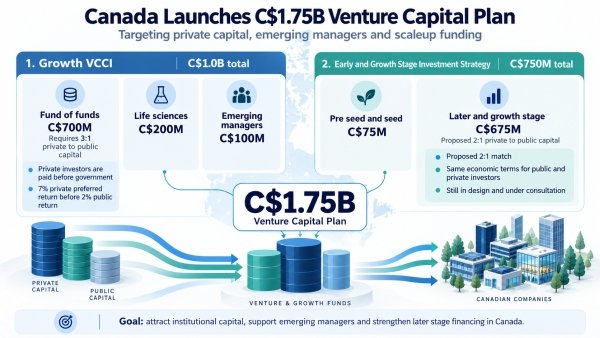
On October 22, 2026, Industry Minister Mélanie Joly launched Canada's C$1.75 billion Venture and Growth Capital Plan. It combines C$1 billion for a new Venture and Growth Capital Catalyst Initiative with C$750 million for early and growth stage investing. Ottawa expects the programs to attract at least C$3.8 billion of private investment, taking the total pool above C$5.5 billion.
Canada may be reaching an important turning point in how it supports venture capital. The plan is more targeted than another funding announcement. It uses public capital to attract institutional investors, broaden the fund manager base and strengthen later stage financing where Canadian companies often rely heavily on foreign capital.
The C$1.75 billion is federal capital, not money already invested in startups. Most of it will move through fund managers that must raise private capital before investing in venture funds or companies. The first C$700 million fund of funds competition is open now, while the largest growth stage stream is still being designed.
The plan has five funding streams.
Founders won't apply directly for most of this money. BDC will manage the federal investments, while selected fund managers raise private capital and invest through venture funds or eligible companies. The structure is meant to increase the amount of private money available across the financing cycle rather than turn C$1.75 billion into startup grants.
The C$700 million fund of funds stream is the first part with final application terms. Applications close January 21, 2027 at noon Pacific. Managers must be raising at least C$150 million, show Canadian venture investment experience and demonstrate institutional backing or a comparable track record.
The C$100 million emerging manager allocation addresses another weakness. In 2025, the five largest Canadian venture funds captured 83% of all capital raised, while emerging managers raised only C$249 million. A separate stream gives newer managers room to build track records without having to clear the C$150 million minimum used for the main fund of funds competition.
The C$675 million later and growth stage stream targets Series B and beyond, where the financing gap becomes more pronounced. Its current design covers growth equity, opportunity funds, continuation vehicles and some innovation focused buyout strategies. It isn't open for applications yet, and ISED and BDC are accepting feedback until November 23, 2026 at 5 p.m. Pacific.
The most consequential part of the plan may be how Ottawa is using public money to improve the economics for private investors. Selected fund of funds managers must raise C$3 of private capital for every C$1 of public capital. A fund receiving C$50 million from Ottawa would therefore need at least C$150 million from private investors.
The fund of funds terms give private investors priority when returns are distributed. Private investors are paid before the government. They first recover their contributed capital and receive enough additional distributions to reach a 7% internal rate of return. Federal capital is then repaid and begins earning its 2% return before remaining profits are distributed under the fund's waterfall. The 7% isn't guaranteed. Private investors still carry venture risk, but they receive better economics than the federal government when a fund performs well enough to return capital and profits.
Federal money is also put to work early. Public and private capital are generally drawn equally until the government's commitment has been used, even though federal capital represents about 25% of a fund meeting the minimum 3 to 1 private match. That can make participation more attractive to institutional investors by delaying some of their capital calls.
The program still keeps a strong Canadian investment requirement. At least 60% of fund investments must go into qualifying Canadian venture funds. Managers can invest up to 30% of a fund directly into companies, but at least 90% of those direct investments must go to Canadian based businesses.
Previous programs show that the model can attract larger pools of capital. Across VCAP and earlier VCCI programs, Ottawa reports C$1.2 billion of federal investment, C$3.7 billion raised by recipient managers and C$6.4 billion invested in Canadian companies by supported funds and other investors.
The proposed C$675 million growth stage stream takes a different approach. Its current design calls for at least C$2 of private capital for every C$1 of federal investment, but public and private investors would receive the same economic terms. That could make sense in a market where the priority is increasing the number of investors able to finance larger Canadian rounds.
The need is visible in the numbers. Canadian VC investment reached C$2.69 billion across 250 deals in the first half of 2026, but 16 financings of C$50 million or more absorbed 59% of all capital. Later stage activity fell to 18 deals, growth stage financing totalled only C$127 million across three deals and foreign investors participated in 56% of later stage rounds.
International capital is an advantage, something Canada should augment, not replace. The weakness appears when Canadian investors aren't able to lead or anchor enough of those larger rounds. More domestic growth capital can give strong companies another option when they are deciding where to raise, who joins the cap table and how much of the next stage of growth remains anchored in Canada.
Private capital is already moving into the gap. RBC recently launched a C$1.4 billion Canadian technology initiative that includes a growth fund for later stage technology companies. Public capital can widen that market by bringing more pension funds, insurers, family offices and fund managers into the same part of the financing cycle.
The emerging manager stream could broaden Canada's venture market as well. In 2025, government backed VCAP and VCCI capital represented 36% of Canadian VC fundraising. The next step is getting more pension funds, insurers, family offices and other private investors to keep investing after public capital has helped funds build a track record.
Exit markets remain a constraint. Canada recorded 18 venture backed exits worth C$716 million in the first half of 2026 and no venture backed IPOs. Funds ultimately need acquisitions, secondary sales or public markets to return money to investors and put that capital back to work.
Canada has an opportunity to use public capital differently this time. The C$1.75 billion plan can bring more institutional investors into venture, give emerging managers room to build credible track records and expand the pool of capital available when Canadian companies reach larger rounds. The turning point comes if it broadens the investor base (not just the amount of capital available), and those investors earn competitive returns and keep allocating capital after the incentives have done their job. That would move Canada closer to a venture market that compounds on its own rather than waiting for the next government program.
The National Crowdfunding & Fintech Association (NCFA Canada) is a financial innovation ecosystem that provides education, market intelligence, industry stewardship, networking and funding opportunities and services to thousands of community members and works closely with industry, government, partners and affiliates to create a vibrant and innovative fintech and funding industry in Canada. Decentralized and distributed, NCFA is engaged with global stakeholders and helps incubate projects and investment in fintech, alternative finance, crowdfunding, peer-to-peer finance, payments, digital assets and tokens, artificial intelligence, blockchain, cryptocurrency, regtech, and insurtech sectors. Join Canada's Fintech & Funding Community today FREE! Or become a contributing member and get perks. For more information, please visit: www.ncfacanada.org
| | |
|---|---|---|
| | |


August 26th, 2025

January 4th, 2024

June 1st, 2021

September 9th, 2020

July 9th, 2018

January 3rd, 2018

September 25th, 2017

June 20th, 2017

May 10th, 2017

December 14th, 2016