




Karsten Wenzlaff, Advisor
August 26th, 2025
Karsten Wenzlaff is a Crowdfunding and Fintech Expert from Germany. He is Secretary-General of Digit[...]


May 13, 2026 | NCFA Fintech Market Activity | Artificial Intelligence And Data, Risk Compliance And Regtech

On May 6, 2026, Montreal based Jetty raised over $2 million in pre seed funding to build infrastructure for reliable agentic AI applications. AQC Capital and Hidden Layers Capital led the round. Mila Ventures, Akinox, and strategic angel investors with AI systems experience at Google and Meta AI also joined. While the round is early, the production problem is already very real.
Jetty is targeting the gap between AI agents that work in demos and agents that can handle enterprise workflows. Jetty's platform gives agents structured runbooks, isolated execution environments and evaluation loops. The agent gets a defined job, runs in a controlled space, checks the result, and improves with human oversight. It's operating infrastructure for AI work that has to be repeatable, observable, and safe enough to review.
Jonathan Lebensold, Founder and CEO, Jetty
“Most AI systems today are still fragile - they work in isolation but break under real-world complexity,”
Gartner predicts that over 40% of agentic AI projects will be cancelled by the end of 2027 because of rising costs, unclear business value, or weak risk controls. McKinsey’s 2025 global AI survey found that 23% of respondents are scaling agentic AI in at least one business function. Another 39% are experimenting.
These numbers explain Jetty's opening. Enterprises want to implement agentic AI, but they need proof before they let agents touch real workflows. Buyers need agents they can test, limit, monitor, correct, and review. This type of rigorous testing isn't optional in finance, insurance, health, and public services to name a few.
Doina Precup, Professor at McGill University and CIFAR AI Chair:
“As AI systems become more autonomous, ensuring they behave reliably in complex environments becomes a central challenge.”
Financial institutions will only use and trust AI agents when the workflow transparently shows what happened, who approved it, and how mistakes get corrected.
Controls matter in onboarding, fraud review, compliance checks, and underwriting. They also matter in customer support, reporting, and internal operations. If an agent makes a mistake, teams need to see the inputs, how the tool used the inputs, the outputs, approvals, and any corrective actions.
The near term opportunity isn't just replacing staff with free running agents. It's reducing manual drag in workflows where humans still own the decision. That lines up with governed AI workflows in finance, where the value comes from evidence, reviewability, and accountability.
Canada has deep AI research talent, but productivity gains depend on companies that turn research into owned enterprise infrastructure. Reliable agent systems could become part of that. If Canadian firms build tools for evaluation, audit trails, controlled execution, and human review, they can own more of the AI workflow stack instead of only using tools built elsewhere.
This is still an early stage round, but the production problem is real. Jetty hasn't disclosed revenue, customer metrics, deployment volume, or reliability benchmarks. The company says it will use the funding to accelerate product development, expand engineering, and support enterprise customer deployments. That is the right use of proceeds, but the market will need proof that Jetty can make agents reliable in regulated workflows, not just promising in pilots.
 The National Crowdfunding & Fintech Association (NCFA Canada) is a financial innovation ecosystem that provides education, market intelligence, industry stewardship, networking and funding opportunities and services to thousands of community members and works closely with industry, government, partners and affiliates to create a vibrant and innovative fintech and funding industry in Canada. Decentralized and distributed, NCFA is engaged with global stakeholders and helps incubate projects and investment in fintech, alternative finance, crowdfunding, peer-to-peer finance, payments, digital assets and tokens, artificial intelligence, blockchain, cryptocurrency, regtech, and insurtech sectors. Join Canada's Fintech & Funding Community today FREE! Or become a contributing member and get perks. For more information, please visit: www.ncfacanada.org
 |  |  |
|---|---|---|
 |  |  |
May 13, 2026 | NCFA Fintech Market Activity | Wealth Capital Markets And Investing, Risk Compliance And Regtech, Artificial Intelligence And Data

On May 12, 2026, U.S. wealthtech platform Envestnet expanded its Canadian B2B push with new platform capabilities, local leadership, and advisor tools tied to Canada’s Total Cost Reporting (TCR) rules. Those rules will require firms to show clients the full cost of investment solutions in dollar terms beginning in 2027. As a result, advisors need better portfolio evidence, cleaner reporting, and stronger tools to explain value.
In 2020, Envestnet announced that it expanded its Canadian footprint through a strategic partnership with Canaccord Genuity Wealth Management. In March 2025, it launched a direct indexing solution for Canadian advisors that can sit inside a Unified Managed Account (UMA). Now the recent 2026 announcement adds a regulatory catalyst with Total Cost Reporting turning fee transparency into daily advisor work.
Canadian regulators have been building toward this for years. In April 2023, the Canadian Securities Administrators and the Canadian Council of Insurance Regulators announced enhanced cost reporting requirements for investment funds and segregated fund contracts. The goal is simple. Investors should see the ongoing costs of owning funds more clearly, both as a percentage and as an aggregate dollar amount.
CIRO’s enhanced cost reporting amendments took effect on January 1, 2026. Starting in 2027, clients will receive annual reports for the 2026 calendar year that show more detail on investment fund costs. That includes fund expenses in dollars and fund expense ratios.
For advisors, it changes the client conversation because they'll need to explain what clients paid, why they paid it, and how the portfolio supports the client’s goals.
Envestnet is building its Canadian offer around Unified Managed Accounts, multi currency portfolios, data insights, and model based portfolio construction. It also promoted David Kamerman, CFP®, Principal Director, Head of Canadian Business Development, to lead strategic relationships and Envestnet’s Canadian wealthtech business.
David Kamerman, CFP®, Principal Director, Head of Canadian Business Development, Envestnet:
“As Total Cost Reporting reshapes the industry, advisors need practical ways to modernize how portfolios are constructed and managed. Our Unified Managed Account platform empowers advisors to build model-based, cost-conscious, high-conviction portfolios at scale helping them deliver stronger client outcomes while running more efficient businesses.”
Unified Managed Accounts are useful because they can bring different investment sleeves into one account structure. That can help advisors combine models, direct indexing, tax aware customization, and cost reporting without stitching together too many tools.
Envestnet launched its Canadian direct indexing service in March 2025. Canadian registered firms can use it by hiring Envestnet as a sub advisor. Direct indexing gives advisors more control over tax treatment, exclusions, personalization, and security level portfolio design. Under TCR, that control becomes easier to explain because advisors can connect cost, portfolio design, and client goals.
TCR benefits companies that connect cost transparency with better portfolio construction. Conversely, TCR exposes firms that only add a report after the fact.
The Canadian wealthtech market already has strong local competition. In March 2026, Calgary based OneVest launched an AI native wealth operations platform for onboarding, account opening, money movement, billing, documents, and advisor workflows. That gives Canadian firms a modular option built closer to domestic needs.
Envestnet brings scale. The company says it has 25 years of operating experience, $7.0 trillion in platform assets, and relationships with more than one third of financial advisors across banks, wealth managers, brokerages, and RIAs. Scale helps, but Canadian firms will still judge the platform on integration, usability, reporting quality, support, and cost.
Envestnet says it has a growing pipeline in Canada, but it does not disclose key metrics or direct indexing uptake.
TCR is a regulation that creates software demand as it changes the daily work of advisors who need better data, clearer reporting and stronger client conversations. As Total Cost Reporting makes investment costs more visible, will Canadian wealth firms compete on lower fees alone, or on better portfolio design, clearer value, and stronger advisor technology?
The National Crowdfunding & Fintech Association (NCFA Canada) is a financial innovation ecosystem that provides education, market intelligence, industry stewardship, networking and funding opportunities and services to thousands of community members and works closely with industry, government, partners and affiliates to create a vibrant and innovative fintech and funding industry in Canada. Decentralized and distributed, NCFA is engaged with global stakeholders and helps incubate projects and investment in fintech, alternative finance, crowdfunding, peer-to-peer finance, payments, digital assets and tokens, artificial intelligence, blockchain, cryptocurrency, regtech, and insurtech sectors. Join Canada's Fintech & Funding Community today FREE! Or become a contributing member and get perks. For more information, please visit: www.ncfacanada.org
| | |
|---|---|---|
| | |
May 13, 2026

Image: Unsplash/Anthony Fomin
Ontario’s real estate market surprises its buyers because of its steady growth over the past few years. In today’s date, finding long-term value while keeping up with lifestyle is rare. But Ontario’s growth is the perfect balance of affordability, facilities, and momentum to cope with equity gains without a rush.
The best opportunities in Ontario’s market are not the most obvious ones. It has always been the strongest foundation with calmer neighbourhoods that promised to deliver. This article mentions five top markets in this region that are catching the eyes of buyers for their high potential.
Equity growth is conscious and comes with a clear strategy, history, improving infrastructure, local economy, and rising demand from homeowners. In Ontario, areas with good schools, transit access, and a blend of family appeal and professional living space have been the winners for years.
Promising neighbourhoods further have scope to grow, but are not heavily priced. They have a sense of community and livability. In 2026, these markets are having growing interest, which means there are chances of it being high-priced in the future.
Transit expansion is one of the biggest trends that is shaping this year. Buyers are interested in an easier commute. So, they are choosing communities with easy access to GO train lines and subway extensions. Besides, since Toronto is a high-priced area, buyers are looking more into affordable options.
Remote workers are changing places, putting more focus on good schools, outdoor spaces, and a small-town charm. Therefore, good infrastructure and healthcare facilities are top priorities too. The population growth in that area is creating more demand in the surrounding areas.

Image: Unsplash/Dillon Kydd
These are the five neighbourhoods that are the best in terms of great value and growth potential:
Chippawa is a great location, being close to Niagara Falls minus the crowd. It is a stable, family-friendly neighbourhood with established homes. The good schools and closer distance to Niagara Falls and Buffalo also attract many buyers.
Compared to other Niagara areas, Chippawa is affordable. So, retirees and families are leaning towards this area more than ever. This small town never lacks amenities. It always keeps a mix of low turnover with high value.
Danforth is one of the most resilient neighbourhoods in Ontario, with Greek heritage, walkability, close transit access to parks, and the Danforth’s commercial strip. It is appealing to young families and professionals these days.
Given its established character and ongoing revitalization, growth is expected in Danforth. It is an affordable access in terms of downtown prices and provides a steady interest for a continued appreciation in that zone.
Weston is having a high value in the market, which is rarely found. It is going through a transformation with newer retail, better transit, and more housing options for starter and affordable homes. Because of the Humber River, there is a natural appeal in this neighbourhood. Besides, the airport and downtown are close, so it serves the convenience for its residents.
Weston is rising. It is not overcrowded yet, but it has potential. When the buyers start grabbing its early benefits, there will be a splurge in new buyers and second-time buyers in this market.
The Little Lake and Grove East areas in Barrie are offering good schools, a manageable commute to the GTA, and lakefront properties that are very lucrative to buyers. It has newer infrastructure and a strong economy, adding to its demand.
Families who want a balance between space and isolation choose Barrie. It is completed with waterfront, community setups, and waterfront, complemented by a steady price growth.
Clarington has seen great development, highway access, and a good range of townhomes detached from family homes. Since it is close to Oshawa and the Durham region, residents benefit from the job growth and metro facilities. Its value proposition centers around community infrastructure, which makes it appealing to equity-focused investors.
Chippawa stands out as a smart choice in the equity growth market. It is affordable in comparison to other Niagara markets, and a strong residential identity with good schools, river access, and beautiful parks. It also has easy access to Buffalo for employment centers and better amenities. Residents have been consistently living here for years and often check Chippawa homes for sale for second-time buys.
Since the neighbourhoods have connections with LRT lines, GO expansions, and highway upgrades, the transit growth plays a great role here. It is also close to the future Niagara transit plans and QEW, and outer areas like Barrie and Clarington gain the advantage of the 401/400 corridor
On the other hand, Danforth and Weston have the TTC reliability. Because of the infrastructure improvement, it is easier to find jobs in this market. This and its accessibility further drive housing demand in this market.
Neighbourhoods with good transit, employment opportunities, good schools, and a sense of community should be considered first. Focus on communities with infrastructure improvement and stable population growth. Contrarily, avoid new development because the best equity derives from neighbourhoods that have the scope to appreciate.
Although a stabilized market, interest rates can fluctuate. Plus, there can be inventory shortages in these markets. It is also important to check the crime trends, future development plans, and school ratings before admission. Chippawa has a residential focus that prevents tourism fluctuations that are otherwise seen in Niagara.
Ontario’s promising neighbourhoods delivering equity growth are Chippawa, Danforth Village, South Barrie, and Bowmanville. They have exceptional value and appeal to live a long-term life in these markets. Chippawa has the most community strength, complemented by its affordability and location features. Buyers who are looking for reliable appreciation can pay close attention to these areas. Ontario has an ever-increasing growth story, and neighbourhoods like these help it elevate it.
The National Crowdfunding & Fintech Association (NCFA Canada) is a financial innovation ecosystem that provides education, market intelligence, industry stewardship, networking and funding opportunities and services to thousands of community members and works closely with industry, government, partners and affiliates to create a vibrant and innovative fintech and funding industry in Canada. Decentralized and distributed, NCFA is engaged with global stakeholders and helps incubate projects and investment in fintech, alternative finance, crowdfunding, peer-to-peer finance, payments, digital assets and tokens, artificial intelligence, blockchain, cryptocurrency, regtech, and insurtech sectors. Join Canada's Fintech & Funding Community today FREE! Or become a contributing member and get perks. For more information, please visit: www.ncfacanada.org
| | |
|---|---|---|
| | |
May 12, 2026 | NCFA Insight | Digital Assets Blockchain And Tokenization
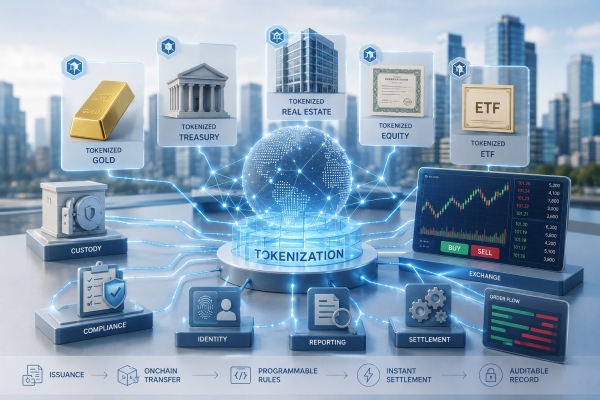
On May 4 2026, CoinGecko published its 2026 RWA Report, and the numbers tell a more interesting story than usual.
But here’s the unusual part. Most major RWA project tokens didn't benefit from that growth. CoinGecko found that six of the top seven RWA project tokens posted negative returns from January 1 2025 to March 31 2026, with losses ranging from 44.7% to 98.8%.
Tokenized assets are gaining traction, but the report shows a clear split. The market is growing around the systems that make tokenized assets useful, such as access, custody, liquidity, collateral, compliance, and distribution. It's not showing the same strength in the project tokens that investors once used to bet on the RWA theme.
Tokenized RWAs are growing quickly, but they still equal only 6.4% of the stablecoin market. Stablecoins grew from $199.77B to $301.65B during the same period.
It's a significant gap because BlackRock Targets Stablecoin Reserve Market in digital finance to help money move, settle trades, and flow collateral between platforms. Tokenized assets are building on that base, not replacing it.
The report also shows a clear preference for more institution friendly products. USDC grew 76.2% to $77.44B, while smaller regulated or compliance focused stablecoins also gained ground. That says demand is heading toward products that platforms, institutions, and regulators can actually work with.
Tokenized treasuries still lead the category, growing from $4.00B to $12.99B over the report period. But their market share fell from 73.7% to 67.2% as commodities, tokenized stocks, ETFs, and derivatives gained traction.
For much of the last cycle, Real World Assets mostly meant tokenized treasury products. Now the category is widening into broader market exposure.
Tokenized stocks scaled from $2.09M in June 2025 to $486.69M by March 2026. Tokenized ETF market capitalization reached $297.50M. The numbers are still very small compared to traditional markets, but are trending.
Tokenized commodities grew from $1.43B to $5.55B, driven mainly by gold backed products including PAXG and XAUT. The trading activity is telling. Tokenized gold recorded $90.70B in spot trading volume during Q1 2026, already higher than the full 2025 total of $84.64B.
That makes sense given gold's familiarity. It has deep global demand and already plays a role in portfolios and collateral conversations. Tokenization gives it faster movement, digital custody options, and easier access across crypto native platforms.
The report shows how quickly centralized platforms, such as Kraken, Coinbase, Crypto.com, Binance or Gate are now combining some mix of tokenized securities, stocks, ETFs, commodities, futures, perps, or licensed financial infrastructure alongside crypto trading.
The lines between crypto exchange, broker, derivatives venue, and tokenized asset marketplace are getting thinner. That raises the operating bar. It's also where major infrastructure opportunities start to appear.
RWA perps generated $524.79B in Q1 2026 trading volume alone, while daily open interest rose from $0.14B at the start of 2025 to $6.68B by March 31 2026.
The data suggests that many traders want exposure to real world asset prices without necessarily holding the underlying tokenized asset. Commodities still dominate this market, but stock and ETF perps are growing. Hyperliquid’s HIP-3 volume rose from $12.65B in Q4 2025 to $130.87B in Q1 2026.
This is trading infrastructure forming around tokenized and traditional assets at the same time.
CoinGecko’s report shows a tokenized asset market growing quickly, but unevenly. Tokenization is becoming infrastructure. Stablecoins still do the heavy lifting. Treasuries still lead. Gold trading volume has surged. Exchanges are adding capital markets functions. RWA perps are scaling quickly. At the same time, most RWA project tokens continue falling.
Tokenization is starting to look less like crypto hype and more like financial infrastructure that can make tokenized assets useful, compliant, liquid, and easy to access at scale.
The National Crowdfunding & Fintech Association (NCFA Canada) is a financial innovation ecosystem that provides education, market intelligence, industry stewardship, networking and funding opportunities and services to thousands of community members and works closely with industry, government, partners and affiliates to create a vibrant and innovative fintech and funding industry in Canada. Decentralized and distributed, NCFA is engaged with global stakeholders and helps incubate projects and investment in fintech, alternative finance, crowdfunding, peer-to-peer finance, payments, digital assets and tokens, artificial intelligence, blockchain, cryptocurrency, regtech, and insurtech sectors. Join Canada's Fintech & Funding Community today FREE! Or become a contributing member and get perks. For more information, please visit: www.ncfacanada.org
| | |
|---|---|---|
| | |
May 12, 2026 | NCFA Feature | Digital Banking And Credit Union Infrastructure

On May 12 2026, Intellect Design Arena announced that 37 Canadian financial institutions participating in the National Digital Banking Working Group (NDBWG) selected its eMACH.ai Digital Engagement Platform as part of a broader digital banking modernization effort.
This is more than a software contract. It's one of the clearest examples of smaller Canadian financial institutions coordinating technology execution to manage platform risk, modernization costs, and rising digital banking expectations.
Back in October 2024, Canadian credit union infrastructure provider Central 1 announced plans to wind down digital banking over a three to four year transition period. That created immediate pressure for many Canadian credit unions that relied on Central 1’s Forge and MemberDirect platforms.
In March 2025, Central 1 and Intellect finalized an operating partnership that transferred operation of Forge, MemberDirect, public website, and mobile app products to Intellect, along with digital banking engineering and service personnel.
The latest announcement now evolves beyond transition support into long term modernization.
The National Digital Banking Working Group formed after the Central 1 announcement to help participating institutions coordinate vendor evaluation, migration planning, procurement, implementation support, and governance.
According to NDBWG's website, the initiative was designed to help financial institutions navigate a system wide platform transition together instead of individually carrying the cost, risk, and operational complexity of replacing digital banking infrastructure. It's a coordinated modernization program.
NDBWG’s public member page lists 59 participating institutions across British Columbia, Alberta, Saskatchewan, Manitoba, and Ontario. The specific 37 institutions that formally signed with Intellect is likely a subset. Intellect states the participating institutions represent more than $11.7B CAD in combined assets and serve over 262,000 members.
Greg Sol, Board Chair, Credit Unions Future Committee:
“Building on the NDBWG’s rigorous process from vendor evaluation to a fully negotiated agreement, we’re confident that Intellect is the right long-term partner for Canada’s financial institutions.”
Canada’s banking competition debate often focuses on large banks and fintech challengers. Less attention goes to the infrastructure pressure facing smaller regional and community based financial institutions.
Members compare their credit union app with all other digital services they use daily. They expect simple onboarding, quick support, fewer branch visits, and secure ways to handle routine requests. Behind that experience, smaller institutions also face heavier compliance work, sharper fraud risk, and technology costs that keep climbing. For many smaller institutions, maintaining those capabilities independently becomes harder every year.
NDBWG’s model attempts to create digital scale without forcing consolidation. Participating institutions keep their local brands, governance, and member relationships while coordinating around infrastructure, migration planning, and platform execution.
The stronger advantage of a shared approach isn't the software itself, but rather the emerging operating model around it.
Canada already has one of the most concentrated banking systems in the world. If smaller institutions cannot modernize efficiently, the competitive gap widens further. Shared infrastructure and coordinated execution may become one of the few realistic ways for regional financial institutions to stay competitive without dramatically increasing operating costs.
Canada continues preparing for consumer driven banking, stronger fraud controls, and real time payments modernization. Those changes place additional pressure on legacy systems and fragmented operating models.
Steve Kingan, CEO, Frontline Credit Union:
“The NDBWG process gave our credit union the expertise and collective strength to navigate this transition in a way we couldn’t have managed alone.”
For fintech companies, this may also create opportunity. Smaller institutions need practical tools that reduce daily friction, protect members, and improve service without adding complexity. That creates room for focused partners in fraud prevention, digital identity, payments, workflow automation, AI assisted service, and embedded financial services tailored for smaller institutions.
It also explains why more vendors are building Canada ready digital banking platforms for credit unions rather than treating them as small versions of large banks.
Canada’s smaller financial institutions are starting to treat digital infrastructure as a shared strategic capability instead of a fully independent function.
NDBWG represents one of the clearest Canadian examples so far of institutions coordinating modernization to support local financial competition while reducing migration risk and operational cost. If implementation succeeds, it could become a practical model for how smaller financial institutions modernize in other parts of Canada.
Can smaller Canadian financial institutions can build enough shared digital scale to remain competitive while preserving regional and community based banking choice?
The National Crowdfunding & Fintech Association (NCFA Canada) is a financial innovation ecosystem that provides education, market intelligence, industry stewardship, networking and funding opportunities and services to thousands of community members and works closely with industry, government, partners and affiliates to create a vibrant and innovative fintech and funding industry in Canada. Decentralized and distributed, NCFA is engaged with global stakeholders and helps incubate projects and investment in fintech, alternative finance, crowdfunding, peer-to-peer finance, payments, digital assets and tokens, artificial intelligence, blockchain, cryptocurrency, regtech, and insurtech sectors. Join Canada's Fintech & Funding Community today FREE! Or become a contributing member and get perks. For more information, please visit: www.ncfacanada.org
| | |
|---|---|---|
| | |
May 11, 2026 | NCFA Fintech Market Activity | Digital Assets Blockchain And Tokenization, Capital Markets And Market Infrastructure, Capital Markets And Funding

On May 11, 2026, Ripple Prime secured a $200 million debt facility from funds managed by Neuberger Specialty Finance to expand margin capacity for its multi asset prime brokerage platform. In practice, this gives the prime brokerage business more financing room as institutional clients trade across traditional and digital asset markets.
The facility lets Ripple Prime draw up to $200 million as client needs change. Since Ripple acquired the platform in 2025, Ripple says Ripple Prime has tripled revenue year over year. Institutional crypto now needs credit, margin, collateral, and financing capacity, not just custody and execution.
Noel Kimmel, President, Ripple Prime
“This facility enables us to grow alongside our clients by delivering increased margin capacity, greater responsiveness, and improved capital efficiency.”
Ripple closed its Hidden Road acquisition in October 2025 and renamed the platform Ripple Prime. Ripple said the deal made it the first crypto company to own and operate a global, multi asset prime broker. It later added U.S. digital asset spot prime brokerage for institutional clients, including OTC spot execution across major digital assets such as XRP and RLUSD.
Ripple Prime needs lending capacity because prime brokerage is not just a trading tool. It requires capital, risk controls, collateral management, and reliable financing. A trading venue helps clients buy and sell. A prime broker helps them finance positions, manage margin, and connect activity across asset classes.
NCFA’s earlier look at Ripple’s two year expansion stack showed how the company has added custody, prime brokerage, stablecoin payments, treasury tools, and wallet infrastructure. The debt facility fits that buildout. Ripple is putting more capital behind the institutional layer of digital asset markets. That means more capacity to support margin needs as trading activity grows. It also makes Ripple less dependent on a pure payments narrative. The company now has a clearer institutional markets story.
Peter Sterling, Head of Neuberger Specialty Finance:
“Ripple Prime has built an innovative brokerage platform combining fintech-grade technology and agility with bank-level compliance and operational rigor.”
There is also a Canadian link. Ripple’s Rail acquisition brought Toronto based B2B stablecoin payment infrastructure into Ripple’s network. Ripple Prime now adds financing capacity on the institutional markets side. The larger read is simple: payments, liquidity, collateral, and trading are starting to connect inside bigger digital asset platforms.
If digital asset firms start owning prime brokerage, payments, custody, and treasury infrastructure, which institutions will control the credit and collateral rails behind the next generation of markets?
The National Crowdfunding & Fintech Association (NCFA Canada) is a financial innovation ecosystem that provides education, market intelligence, industry stewardship, networking and funding opportunities and services to thousands of community members and works closely with industry, government, partners and affiliates to create a vibrant and innovative fintech and funding industry in Canada. Decentralized and distributed, NCFA is engaged with global stakeholders and helps incubate projects and investment in fintech, alternative finance, crowdfunding, peer-to-peer finance, payments, digital assets and tokens, artificial intelligence, blockchain, cryptocurrency, regtech, and insurtech sectors. Join Canada's Fintech & Funding Community today FREE! Or become a contributing member and get perks. For more information, please visit: www.ncfacanada.org
| | |
|---|---|---|
| | |
May 11, 2026 | NCFA Fintech Market Activity | Artificial Intelligence And Data, Digital Assets Blockchain And Tokenization, Wealth Capital Markets And Investing

On May 11, 2026, MoonPay acquired Dawn Labs and launched Dawn CLI, an AI native trading tool that lets users describe a trading strategy in plain English, generate code, and test the strategy before a user can approve execution.
Dawn CLI targets a time consuming pain point. Building a trading strategy takes research, testing, and judgment. Most users don’t have all of those skills. Dawn CLI pulls more of that work into one flow based on a user's described strategy.
Other platforms approach this growing demand from an analysis perspective. For example, Finelo's AI trading tools can help users examine market data and charts, although every AI-generated insight should be independently verified before trading.
Dawn CLI is different from a charting app, a trading bot, or a chatbot that explains markets. Based on MoonPay’s description, Dawn CLI keeps execution 'as directed by the user' (to avoid implying autonomous trading). AI can help translate intent into action, but trading products still need plain risk warnings, permission controls, auditable records, and limits on what the system can and can't do.
Ivan Soto Wright, CEO and Founder, MoonPay:
“The team at Dawn Labs have made the most complex parts of active trading accessible to anyone with an idea,”
The question is whether users understand what the strategy does, where it can fail, how it behaves under stress, and when execution should stop. A backtest can look clean and still break in live markets.
This is where AI trading gets serious for fintech operators. A bad trade loses money. Companies that use AI in trading need stronger controls around suitability, leverage, market volatility, testing quality, and user consent. They also need logs that show what the user asked, what the tool generated, what changed, and what was executed.
MoonPay's scale adds distribution to the model with 30 million customers across 180 countries, including 500 enterprise customers across crypto and fintech. The acquisition of Dawn means MoonPay is expanding from on ramps into AI enabled financial activity. Access is no longer enough. Platforms want to own more of what users do after they enter digital markets.
Neeraj Prasad, Founder of Dawn Labs and Chief Engineer of MoonPay Labs:
“We built Dawn to address the fragmentation traders face across research, strategy development and execution,”
The impact could be meaningful if this model spreads. More users may test trading ideas without coding skills. Platforms may deepen engagement after onboarding. Active traders may begin to expect AI to handle research and execution prep. But the downside grows too.
The wider crypto business model is also changing. On ramps and wallets are simply no longer enough to compete on. The next area of activity, including trading, payments, stablecoin spending, agent workflows, and embedded market access. More activity can create deeper customer relationships, but it also puts platforms closer to regulated decisions.
When AI can turn a trading idea into code, testing, and execution, who owns the controls that keep user intent, risk, and accountability clear?
The National Crowdfunding & Fintech Association (NCFA Canada) is a financial innovation ecosystem that provides education, market intelligence, industry stewardship, networking and funding opportunities and services to thousands of community members and works closely with industry, government, partners and affiliates to create a vibrant and innovative fintech and funding industry in Canada. Decentralized and distributed, NCFA is engaged with global stakeholders and helps incubate projects and investment in fintech, alternative finance, crowdfunding, peer-to-peer finance, payments, digital assets and tokens, artificial intelligence, blockchain, cryptocurrency, regtech, and insurtech sectors. Join Canada's Fintech & Funding Community today FREE! Or become a contributing member and get perks. For more information, please visit: www.ncfacanada.org
| | |
|---|---|---|
| | |


August 26th, 2025

January 4th, 2024

June 1st, 2021

September 9th, 2020

July 9th, 2018

January 3rd, 2018

September 25th, 2017

June 20th, 2017

May 10th, 2017

December 14th, 2016