




Karsten Wenzlaff, Advisor
August 26th, 2025
Karsten Wenzlaff is a Crowdfunding and Fintech Expert from Germany. He is Secretary-General of Digit[...]


Crypto | Sep 22, 2025

Image: Freepik/krakenimages.com
On September 20, 2025, Coinbase CEO Brian Armstrong announced that NBA star Kevin Durant had regained access to his Coinbase account nearly ten years after first buying Bitcoin, and then initially purchasing it for around $650 per Bitcoin in 2015, implying a whopping gain of more than 17,000% ten years later.
Armstrong confirmed the recovery on X, which followed Durant’s story earlier in the week at the CNBC x Boardroom Game Plan summit in Santa Monica. Durant described how he first bought Bitcoin in 2014–2015
We got this fixed. Account recovery complete! https://t.co/TWYFpQkXsb
— Brian Armstrong (@brian_armstrong) September 19, 2025
Durant’s first exposure to Bitcoin came around 2014–2015, when he says he “started watching YouTube videos” about the emerging digital asset. Intrigued, he encouraged his agent, Rich Kleiman, to take a closer look. Their enthusiasm was quickly cooled when, according to Kleiman, their business manager “said, ‘No, don’t do that.’ So we didn’t.”
That might have been the end of the story if not for a party hosted by venture capitalist Ben Horowitz. Kleiman recounted how they heard Bitcoin mentioned repeatedly that night, and “we woke up the next day and said, ‘We have to do this.’” From there, they invested in Bitcoin and later became early backers of Coinbase through their firm Thirty Five Ventures.
According to Coindesk, Durant’s entry point was near $650 per Bitcoin in 2015, a level that makes his eventual recovery especially striking. With Bitcoin trading above $115,000 in September 2025, that original purchase reflects a gain of more than 17,000%, a staggering return on investment that Durant could only access once his Coinbase account was unlocked nearly a decade later.
Durant’s lost account access resulted in type of “forced hodling” through multiple market cycles. Chainalysis-based research on permanently lost Bitcoin estimates millions of crypto assets are out of reach because people have lost their passwords or recovery keys. That reduces the amount available to trade and makes the asset more scarce. Durant’s case shows that being locked out by accident can sometimes lead to big gains, but it also reveals the real danger for everyday users who may never regain access to their accounts.
Coinbase outlines strict processes for regaining access if emails or two factor devices are lost. Users may need to reset forgotten passwords, recover two factor authentication, or provide identity documents through account access troubleshooting. Many users report challenges completing these steps. After Durant’s recovery, social media threads filled with complaints from customers who have been locked out for years.
In response, Armstrong reposted a detailed thread from his support team on X, promising product improvements and faster support. Coinbase also maintains VIP service tiers for high volume traders. Reuters published an article in August 2025 about widespread user frustration with locked accounts and the Verge covered investigations into delays in customer support. Clearly more work needs to be done by Coinbase to support all customers, and not just celebrities that might be prioritized for obvious reasons.
Durant's experience of lost keys and account access can happen to even the most sophisticated investors, causing an incredible amount of frustration. Prevention is the best protection. Coinbase advises enabling multiple two factor authentication methods, including hardware keys, and updating recovery emails and phone numbers regularly.
Also, users should evaluate the benefits and risks of storing crypto on exchanges versus self custody options using a secure wallet. Digital asset investors should only work with crypto exchanges that offer reliable recovery workflows and strong customer support.
Thanks to Durant's celebrity status, consumer protection from lost keys and account access is back in the news. For Durant, it's another story and a drop in the bucket but for regulators and industry leaders it's a recurring lessons that equitable account recovery and strong consumer support is essential to wider adoption. While new trading features are also being developed and released, crypto exchanges and leaders need to prioritize safeguarding access for all users.
 The National Crowdfunding & Fintech Association (NCFA Canada) is a financial innovation ecosystem that provides education, market intelligence, industry stewardship, networking and funding opportunities and services to thousands of community members and works closely with industry, government, partners and affiliates to create aa vibrant and innovative fintech and funding industry in Canada. Decentralized and distributed, NCFA is engaged with global stakeholders and helps incubate projects and investment in fintech, alternative finance, crowdfunding, peer-to-peer finance, payments, digital assets and tokens, artificial intelligence, blockchain, cryptocurrency, regtech, and insurtech sectors. Join Canada's Fintech & Funding Community today FREE! Or become a contributing member and get perks. For more information, please visit: www.ncfacanada.org
 |  |  |
|---|---|---|
 |  |  |
Report | Sep 19, 2025
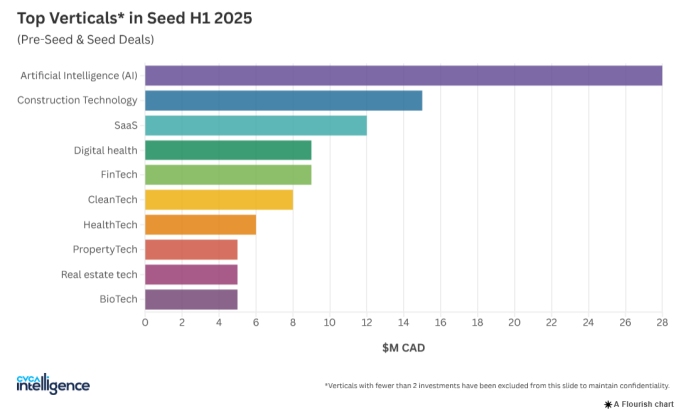
Image: H1 2025 Seed Investing in Canada by Vertical (CVCA Intelligence)
On September 11, 2025, the Canadian Venture Capital and Private Equity Association released its latest report, "The Current State of Seed Investing in Canada", covering tracked investment activity in the first half of 2025. The report recorded $297M invested across 133 seed stage deals in H1 2025.
1. Is seed capital still flowing in Canada, or has the tap run dry?
It's still flowing but selectively. There were 133 rounds worth $297M in H1 2025. The average cheque was $3M, the same as 2024 and down from the $4.09M peak in 2023. But total capital already reached $297M in just six months, equal to all of last year. For entrepreneurs, this means investors are still active but expect clearer proof points before committing. Traction and defensible technology are key.
Ontario pulled in $115.1M across 36 seed deals, nearly 40% of the total. Quebec followed with $66.1M, while Alberta and BC contributed $32.4M and $28.5M. PEI landed a single $6.3M seed round. If you are outside Ontario and Quebec, you may need a lead investor from one of those provinces to close a strong round.
AI is the leader at $24M across 12 seed deals. Construction tech ($15M across 2 deals) and SaaS ($12M across 4 deals) follow. Founders building in other sectors must benchmark carefully. For example, Fintech raised about $9M across pre seed and seed combined, making it harder to get noticed without a compelling angle.
AI again tops the list with $3.9M, followed by digital health at $2.5M. These are modest totals compared to seed, but they set the stage for the next generation of seed deals. Pre seed founders should expect smaller, milestone driven rounds focused on proving product market fit and lining up accelerators, early angels, and alternative finance options like investment crowdfunding.
US investors joined only 27.9% of Canadian seed deals in H1 2025, down from 35.9% in 2023. That is nearly a 30% relative decline. This means Canadian VCs and early stage angels and retail investors are the main gatekeepers at seed. Entrepreneurs should build domestic investor relationships first and then US and global investment pathways.
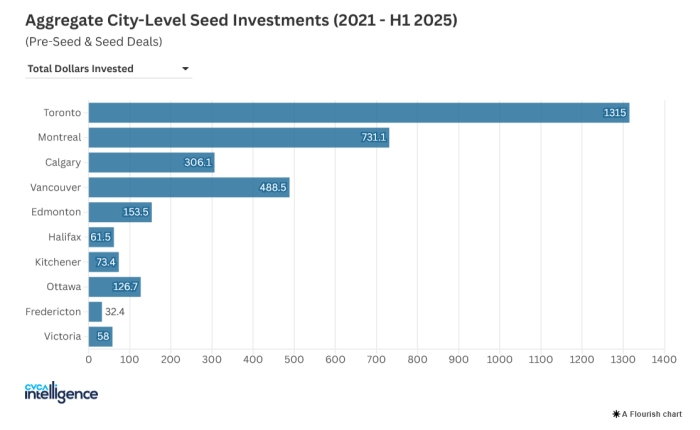
Image: Seed Investments 2021-2025 H1 (CVCA Intelligence)
They have stabilized with the average seed cheque was $3M in H1 2025, unchanged from 2024 but down from $4.09M in 2023. Total deployment hit $297M in H1 2025, already at the full year 2024 level. For investors, that means steady ownership opportunities but faster deal flow.
Ontario ($115.1M across 36 deals) and Quebec ($66.1M across 18 deals) dominate. Alberta ($32.4M) and BC ($28.5M) offer steady but smaller pipelines. For investors, this concentration could means better syndication opportunities in Ontario and Quebec, but higher competition as well.
AI’s $24M across 12 deals makes it the clear leader. SaaS ($12M across 4 deals) provides repeatable playbooks, while construction tech ($15M across 2 deals) indicates appetite for capital intensive bets. Fintech’s about $9M across pre seed and seed shows it remains investable. Portfolios tilted to AI and SaaS, with selective bets in construction and fintech, balance growth with diversification.
Pre seed AI ($3.9M) and digital health ($2.5M) dollars point to pipelines feeding into seed in the next 12 to 18 months. Investors positioning at pre seed should focus on these categories as feeders into later stage strength.
With US participation down to 27.9% from 35.9% last year, a nearly 30% relative decline, Canadian investors are leading more rounds. Other foreign investors ticked up to 10.5%. As a result, early rounds are relying more on domestic syndicates but Series A and B rounds will still require US follow on capital. Investors need to reserve capital and cultivate cross border relationships early.
Seed investment in Canada is concentrating in AI and Ontario while running ahead of last year’s pace. For entrepreneurs, it means tighter pitches and focusing on hubs where money is flowing. For investors, it means disciplined bets on AI and SaaS, while keeping an eye on steady sectors like fintech to diversify portfolios.
The National Crowdfunding & Fintech Association (NCFA Canada) is a financial innovation ecosystem that provides education, market intelligence, industry stewardship, networking and funding opportunities and services to thousands of community members and works closely with industry, government, partners and affiliates to create aa vibrant and innovative fintech and funding industry in Canada. Decentralized and distributed, NCFA is engaged with global stakeholders and helps incubate projects and investment in fintech, alternative finance, crowdfunding, peer-to-peer finance, payments, digital assets and tokens, artificial intelligence, blockchain, cryptocurrency, regtech, and insurtech sectors. Join Canada's Fintech & Funding Community today FREE! Or become a contributing member and get perks. For more information, please visit: www.ncfacanada.org
| | |
|---|---|---|
| | |
Sep 18, 2025

Image courtesy of AI
Freight factoring turns unpaid freight bills into immediate cash, giving trucking businesses financial stability when payments are delayed. Instead of waiting weeks for brokers or shippers, carriers receive funds within a day.
This financial solution keeps trucks running by covering fuel, payroll, insurance, and maintenance without borrowing. For carriers of all sizes, freight factoring ensures steady cash flow and stronger business growth.
Freight factoring is a financial service where trucking companies sell their unpaid invoices to a factoring company for immediate cash. It removes the long waiting period that brokers and shippers often impose.
The factoring company advances most of the invoice value upfront, usually between 80% and 95%. Once the broker pays the invoice, the remaining balance is released after fees.
This process gives carriers quick access to working capital without taking on debt. It ensures steady cash flow for expenses like fuel, repairs, and payroll.
Freight factoring mainly comes in two forms, and the difference lies in who carries the risk if a broker or shipper fails to pay. Both options are widely used in trucking, but the right choice depends on a carrier’s risk tolerance and budget.
In recourse factoring, the carrier is responsible if the broker or shipper does not pay the invoice. This option usually comes with lower fees, which makes it more affordable for small trucking businesses that want to save on costs.
In non-recourse factoring, the factoring company takes on the risk if a broker defaults because of bankruptcy or insolvency. Since the factor assumes more risk, the fees are higher, but carriers gain extra protection against non-payment.
Freight factoring serves a wide range of businesses in the trucking industry. Each type of company benefits differently depending on its size, expenses, and payment cycles.
Independent drivers use factoring to cover immediate costs like fuel, meals, and maintenance. Since one unpaid invoice can disrupt cash flow, factoring keeps their trucks running without interruption.
Fleets with fewer than 10 trucks depend on factoring to manage payroll, insurance, and repairs. Steady access to funds allows them to accept new contracts and expand operations with confidence.
Carriers with 10–50 trucks face higher expenses such as compliance fees, driver benefits, and fuel surcharges. Factoring ensures that these fleets maintain liquidity while scaling up.
Bigger carriers usually have stronger reserves but still factor selectively. They often use it when working with unfamiliar brokers or during slower payment cycles.
New trucking businesses rarely qualify for bank loans due to limited credit history. Factoring gives them immediate working capital to cover fuel, permits, and their first loads.
Some freight brokers use factoring so they can pay carriers quickly while waiting for shipper payments. This strengthens their relationships with carriers and keeps loads moving smoothly.
Carriers hauling refrigerated freight, flatbeds, or oversized loads often factor invoices to balance higher operating costs. Since these loads carry more risk, faster payments reduce financial pressure.
For any of these groups, choosing the best factoring freight company makes a significant difference, because the right partner offers fair rates, transparent contracts, and dependable funding.
The biggest cost in freight factoring is the discount rate, which usually falls between 1% and 5% of the invoice. How much a carrier pays depends on the broker’s credit, the number of invoices factored, and the agreement in place.
Beyond discount rates, there are other charges that come into play. Transaction fees, wire transfers, and reserve holdbacks are common, and together they reduce the final payout a carrier receives.
Some factoring companies add extra costs like monthly minimums or cancellation penalties. That’s why reading the full contract before signing is key to keeping factoring affordable in the long run.
Freight factoring and bank loans both provide access to money, but they work very differently. The main differences lie in approval, funding speed, debt responsibility, and flexibility.
With freight factoring, approval is based on the creditworthiness of the broker or shipper, not the trucking company. Bank loans, on the other hand, depend heavily on the carrier’s credit history and financial statements.
Factoring companies usually advance funds within 24 hours of receiving paperwork. Bank loans can take weeks or even months to process, which delays access to working capital.
Factoring is not a loan, so it doesn’t add debt to the carrier’s balance sheet. Bank financing creates a liability that must be repaid with interest, regardless of when brokers pay.
Carriers can choose which invoices to factor, giving them more control over their cash flow. Bank loans lock companies into fixed repayment schedules, leaving less room to adjust when business conditions change.

Image: Freepik/aleksandarlittlewolf
Selecting the right factoring partner makes a big difference in how smoothly cash flow is managed. A good company offers fair rates, transparent terms, and support that fits the needs of a trucking business.
Work with a factoring company that specializes in trucking. Industry-focused providers understand freight paperwork, broker risks, and payment timelines better than general financiers.
Look closely at how much money is advanced upfront, which is usually between 80% and 95%. A higher advance means quicker access to working capital, but it’s important to balance it with the fees charged.
Ask for a complete breakdown of all costs before signing. Discount rates, transaction fees, and potential hidden charges should all be clear and easy to understand.
Short-term or flexible agreements give carriers more freedom. Long-term contracts with penalties can trap businesses and make factoring less cost-effective.
Some factoring companies provide added value like free fuel cards, credit checks on brokers, or dispatch support. These extras can save both time and money while strengthening daily operations.
Freight factoring gives trucking businesses a steady way to turn unpaid invoices into immediate cash. It removes the uncertainty of long payment cycles and helps carriers focus on running their operations.
From owner-operators to large fleets, factoring works as a flexible solution for covering expenses like fuel, payroll, and maintenance. The choice between recourse and non-recourse factoring depends on how much risk a company is willing to carry.
Finding the right partner makes all the difference in how effective factoring becomes. A reliable factoring company with fair rates and clear terms turns cash flow management into a tool for stability and growth.
The National Crowdfunding & Fintech Association (NCFA Canada) is a financial innovation ecosystem that provides education, market intelligence, industry stewardship, networking and funding opportunities and services to thousands of community members and works closely with industry, government, partners and affiliates to create aa vibrant and innovative fintech and funding industry in Canada. Decentralized and distributed, NCFA is engaged with global stakeholders and helps incubate projects and investment in fintech, alternative finance, crowdfunding, peer-to-peer finance, payments, digital assets and tokens, artificial intelligence, blockchain, cryptocurrency, regtech, and insurtech sectors. Join Canada's Fintech & Funding Community today FREE! Or become a contributing member and get perks. For more information, please visit: www.ncfacanada.org
| | |
|---|---|---|
| | |
Regulation | Sep 18, 2025
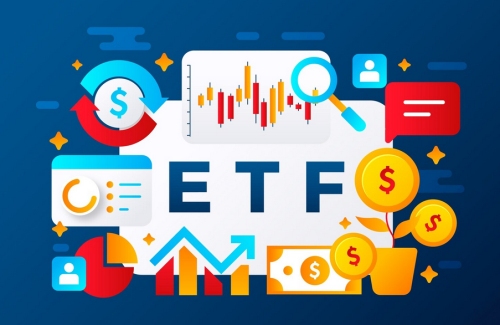
On September 17, 2025, the U.S. Securities and Exchange Commission (SEC) approved generic exchange listing standards for Commodity-Based Trust Shares. This decision means that exchanges can now list new products without filing for case by case approvals, including those backed by digital assets.
This policy update is arguably the most significant since the SEC’s approval of spot bitcoin ETFs earlier this year, and is anticipated to accelerate the rollout of digital asset funds across U.S. markets.
Commodity Based Trust Shares are exchange traded products that hold physical assets like metals or digital assets, instead of being regulated under the Investment Company Act of 1940. Under the new rules, this means that digital assets can be listed more quickly if they meet certain standards.
The new framework effectively creates a fast track for digital asset ETFs. Before every product required a Section 19(b) filing with reviews that could stretch for months.
To qualify, the product must either track an asset traded on a market that is part of the Intermarket Surveillance Group with data sharing agreements, be linked to a regulated futures contract that has been trading for at least six months, or have at least 40% of its portfolio in a single commodity already covered by another listed product.
The SEC stressed that even though these products are not investment companies, they must still publish key disclosures, including their holdings and daily net asset value, similar to ETFs.
In addition to the new generic listing standards, the SEC also approved two specific applications that will give investors more ways to gain regulated exposure to crypto assets:
Not all commissioners agreed. Commissioner Caroline Crenshaw warned that generic standards could change responsibility for investor protection. Read the formal statement 'Passing the Buck' by Commissioner Caroline Crenshaw for her concerns about speed and scrutiny in volatile markets.
Market observers expect a wave of new filings.
For investors, more products mean greater choice and a need to understand custody, valuation, and disclosures.
For fintechs and asset managers, shorter timelines create room for innovation in fund design, multi asset strategies, and derivatives.
Commissioner Hester Peirce welcomed the decision as overdue. In her statement on the approval , she noted that generic listing standards “eliminate the need for prior SEC approval under Section 19(b)” and would reduce time and resources required to bring new products to market. Peirce acknowledged past delays and court rulings that pushed the SEC to open a path for spot crypto ETPs, and she emphasized that the new rules provide alternative eligibility criteria beyond surveillance sharing agreements. She argued that the streamlined process will benefit investors, issuers, market participants, and the Commission itself by increasing predictability and efficiency.
Canada approved the first spot bitcoin ETF in 2021, but most digital asset funds are still reviewed case by case. By approving new generic exchange listing standards, the United States has adopted a scalable model that could influence regulators globally.
If Canada doesn't modernize its framework, fintech innovators and investor capital could drain south where products can launch faster. Aligning with an efficient standard could help maintain Canada’s leadership in fintech while ensuring investor protections.
The National Crowdfunding & Fintech Association (NCFA Canada) is a financial innovation ecosystem that provides education, market intelligence, industry stewardship, networking and funding opportunities and services to thousands of community members and works closely with industry, government, partners and affiliates to create aa vibrant and innovative fintech and funding industry in Canada. Decentralized and distributed, NCFA is engaged with global stakeholders and helps incubate projects and investment in fintech, alternative finance, crowdfunding, peer-to-peer finance, payments, digital assets and tokens, artificial intelligence, blockchain, cryptocurrency, regtech, and insurtech sectors. Join Canada's Fintech & Funding Community today FREE! Or become a contributing member and get perks. For more information, please visit: www.ncfacanada.org
| | |
|---|---|---|
| | |
Canadian AI Growth | Sep 18, 2025

Image: Freepik
On September 15, 2025, Canadian Enterprise AI leader Cohere announced the official opening of a new Paris office to serve as its headquarters for Europe, the Middle East, and Africa (EMEA). The company expects to have 20 employees on the ground by the end of September and plans to double that number within a year. Roles include business and policy leads working alongside existing research, engineering, safety, and product teams.
The expansion also introduces an incoming VP of EMEA, set to start October 1, and the appointment of Stéphanie Finck Piccin as Head of EMEA Public Policy after more than a decade of experience shaping technology policy at Salesforce.
Cohere’s CEO Aidan Gomez in Reuter's coverage (subscription required) described Europe as showing “renewed momentum” in AI adoption and said he was “super confident” in the strength of France’s ecosystem. He emphasized, France’s role as a centre for digital sovereignty, its supply of technical talent, business advantages, and its connection to regional markets made it the natural choice.
“Cohere is extremely well-positioned to meet the growing demand of sovereign and secure AI from businesses and governments, and we’re excited to have boots on the ground to better collaborate with our new and existing partners and customers in the region. We’re looking forward to contributing to France’s AI ecosystem and drawing from the pool of incredible local talent here as we grow.”
France is expanding its AI capacity through large scale infrastructure investment. In February 2025, Brookfield and Data4 announced a €20 billion program to expand AI infrastructure in France through 2030. The plan includes approx €15 billion for new data centres and the remainder for chip storage, connectivity, and renewable energy. Additional detail on the technical buildout was reported by DataCentreDynamics
While Cohere Brookfield’s investment program as a direct factor in its Paris HQ decision, but the timing and focus align. Sovereign compute and new energy-backed data centres reduce deployment risks for enterprise AI providers. By opening in Paris, Cohere positions itself close to these assets while strengthening its pitch to regulated sectors.
Cohere is in direct competition with Mistral who recently raised €1.7 billion at a valuation of €11.7 billion. Mistral has a head start as Europe’s homegrown AI unicorn and is also targeting large enterprises. Both companies target large enterprises with secure AI tools and local control of data. Mistral’s European roots give it credibility with regional buyers, while Cohere brings its Canadian foundation, global partner base, and enterprise focus into the market.
Cohere’s Paris leadership team is designed to influence policy as well as drive growth. With Finck Piccin leading public policy and a new VP of EMEA focused on partnerships, the company aims to work directly with regulators and governments overseeing AI rules. This positions Cohere to integrate secure AI systems into finance, insurance, and public services where compliance and auditability are critical.
The key milestones will be whether Cohere meets its hiring goals, wins major European clients in banking, secures government endorsements, and forms partnerships tied to France's data sovereignty and infrastructure build out.
If successful, the Paris hub could become a cornerstone for enterprise AI in EMEA and strengthen Canada’s position in the global AI race.
The National Crowdfunding & Fintech Association (NCFA Canada) is a financial innovation ecosystem that provides education, market intelligence, industry stewardship, networking and funding opportunities and services to thousands of community members and works closely with industry, government, partners and affiliates to create aa vibrant and innovative fintech and funding industry in Canada. Decentralized and distributed, NCFA is engaged with global stakeholders and helps incubate projects and investment in fintech, alternative finance, crowdfunding, peer-to-peer finance, payments, digital assets and tokens, artificial intelligence, blockchain, cryptocurrency, regtech, and insurtech sectors. Join Canada's Fintech & Funding Community today FREE! Or become a contributing member and get perks. For more information, please visit: www.ncfacanada.org
| | |
|---|---|---|
| | |
Agentic AI Service | Sep 18, 2025

Image: Freepik AI
On September 17, 2025, Amazon announced that it's adding always on agentic AI capabilities to its Seller Assistant tool. It'll first be available to U.S. sellers and then eventually roll out to other countries. Sellers will now have access to an AI partner that can monitor inventory, protect account health, handle compliance, build campaigns, adjust pricing, and generate growth strategies, all at no additional cost.
On the surface, this looks like one of the most significant advancements in how store sellers and entrepreneurs will now operate their Amazon e-commerce stores.
The previous Seller Assistant primarily answered questions but the new agentic AI capable Seller Assistant powered by Amazon Bedrock can reason, plan, and act with seller permission. It analyzes sales patterns, prepares shipment recommendations, and flags slow moving inventory before fees are charged. Sellers can ask when to send products ahead of seasonal demand and receive a full inventory plan within moments, optimized for both cost and delivery speed.
The new Seller Assistant tool continuously scans account metrics for potential issues and proactively protects the health of a seller's account. It can identify listings that might violate new regulations or highlight customer service trends that could impact performance. Sellers receive a clear explanation of risks along with options to fix them, and if approved, Seller Assistant implements the resolution before problems escalate. Verified examples in the announcement include warnings for regulated products such as pesticides where documentation is required, with step by step guidance provided.
Seller Assistant now helps growth. It studies sales data to suggest new product categories, expansion opportunities, and seasonal promotion strategies. During peak events like Prime Day, it can build complete growth plans that coordinate promotions, inventory adjustments, and ad campaigns, leaving sellers free to focus on product innovation and customer relationships.
Expanding into new product categories can come with complicated compliance requirements. Seller Assistant now automatically checks listings for missing certifications such as UL and guides sellers through the documentation process. The tool reduces the time sellers spend on paperwork and helps them enter markets more efficiently, as a result.
Advertising is also being transformed. Through Creative Studio, sellers can generate professional ads using conversational prompts. One seller building a Father’s Day campaign for smart bird feeders saw a 338% increase in click through rate, 89% new to brand purchases, and a 121% return on ad spend when using the AI tool to design Sponsored Video ads.
By analyzing shopping trends alongside product data, the system delivers creative options that are fast, targeted, and backed by transparent reasoning.
Despite the amazing new features and benefits, companies must remain aware of potential risks when adopting agentic AI. Sellers remain legally accountable for compliance, advertising, and customer obligations. Amazon’s tool may act with permission, but ultimate responsibility rests with the business owner.
To reduce risk exposure, sellers should follow some practical steps:
Amazon Sellers have sold over $2.5 trillion or more than 60% of Amazon store sales to date. With new agentic AI capabilities, Amazon is raising the bar once again, providing startups and established brands with a proactive partner that helps them scale more efficiently. As the rollout expand globally, the AI system will only continue to get better and smarter, and more capable at keeping pace with the complexities of modern digital commerce.
The National Crowdfunding & Fintech Association (NCFA Canada) is a financial innovation ecosystem that provides education, market intelligence, industry stewardship, networking and funding opportunities and services to thousands of community members and works closely with industry, government, partners and affiliates to create aa vibrant and innovative fintech and funding industry in Canada. Decentralized and distributed, NCFA is engaged with global stakeholders and helps incubate projects and investment in fintech, alternative finance, crowdfunding, peer-to-peer finance, payments, digital assets and tokens, artificial intelligence, blockchain, cryptocurrency, regtech, and insurtech sectors. Join Canada's Fintech & Funding Community today FREE! Or become a contributing member and get perks. For more information, please visit: www.ncfacanada.org
| | |
|---|---|---|
| | |
Cybersecurity | Sep 17, 2025

Image: Freepik/Rawpixel.com
On September 17, 2025, the Canadian Investment Regulatory Organization (CIRO) confirmed through a detailed FAQ that registration data of all current and former registrants had been compromised in the cybersecurity incident first detected on August 11. The regulator emphasized that Social Insurance Numbers and credit card data were not affected, but a wide range of personal and professional registration information was exposed.
CIRO is Canada’s national self-regulatory body for investment dealers and mutual fund dealers, overseeing trading activity across Canadian debt and equity marketplaces. Its mandate is to protect investors, support fair and efficient markets, and maintain trust in Canada’s financial system. The incident underscores that cyber risk is a critical challenge not only for the firms CIRO supervises but also for regulators themselves.
According to CIRO’s official updates regarding the cyber breach incident:
On August 11, CIRO identified the cybersecurity threat and shut down systems as a precaution
On August 17, preliminary investigation showed that some personal information of member firms and their registered employees was affected. CIRO acknowledged the seriousness of the breach and pledged to notify those impacted and provide risk mitigation services
On August 18, CIRO confirmed in a public update that it was working with external cybersecurity experts, legal counsel, and law enforcement. It also stressed that Canadians’ investments were not at risk
On August 28, CIRO announced that access to its systems had been restored, including CIRO Services, COMSET, CERTS, the Mutual Fund Dealers Member-only Site, EFS, MTRS, and Corporate and Government Debt Trading Information. CIRO reminded firms of their regulatory reporting obligations, granting five business days after notification to file reports that were due during the outage, while requiring timely submissions for all obligations due September 2 or later.
On September 9, CIRO confirmed that registration information of member firms and registered individuals was breached. The regulator began contacting all impacted individuals directly, offering two years of free credit monitoring and identity theft protection through TransUnion and Equifax. CIRO also clarified that emails from ciro@cyberscout.com or ciro@m.cyberscout.com are legitimate. In its update, CIRO issued an apology and promised to continue providing updates as the investigation progresses.
On September 17, CIRO released an FAQ update on the cybersecurity incident, now confirming that the August 11, 2026 breach affected registration data of all current and former registrants.
What data was exposed
Not included in the breach was Social Insurance Numbers and credit card or other payment information.
National Registration Database (NRD) - CIRO confirmed that the NRD system itself was not breached. The incident only involved registration information that CIRO maintains.
Notification process - CIRO began sending notifications on September 9. If an email is on file in the NRD, individuals will receive a message from ciro@cyberscout.com.
CIRO stated that personal information connected to member firms and registered employees was impacted by the incident. As part of its response, the regulator is offering two years of coverage through Equifax and TransUnion. CIRO confirmed that it only receives a limited sample of investor information through compliance functions, and emphasized that Canadians’ investments are not at risk. If any investor information were determined to be affected, CIRO committed to notify them directly and provide support.
CIRO has issued a clear warning that it will never contact registrants about this event through unsolicited phone calls or emails requesting personal or financial information. This message is designed to protect registrants from potential phishing attempts that may exploit news of the breach.
CIRO is contacting all impacted registrants directly by email or mail. Each individual will receive a letter signed by CIRO and sent by TransUnion with instructions and an access code to register for free protection services. Registrants should consider:
No organization is immune from cyber attacks, including those tasked with overseeing the integrity of markets. The investigation remains ongoing. CIRO has pledged to provide further updates as more details emerge. Market participants and stakeholders will be watching closely how the regulator continues to manage the response and what additional measures are introduced to safeguard sensitive information.
The National Crowdfunding & Fintech Association (NCFA Canada) is a financial innovation ecosystem that provides education, market intelligence, industry stewardship, networking and funding opportunities and services to thousands of community members and works closely with industry, government, partners and affiliates to create aa vibrant and innovative fintech and funding industry in Canada. Decentralized and distributed, NCFA is engaged with global stakeholders and helps incubate projects and investment in fintech, alternative finance, crowdfunding, peer-to-peer finance, payments, digital assets and tokens, artificial intelligence, blockchain, cryptocurrency, regtech, and insurtech sectors. Join Canada's Fintech & Funding Community today FREE! Or become a contributing member and get perks. For more information, please visit: www.ncfacanada.org
| | |
|---|---|---|
| | |


August 26th, 2025

January 4th, 2024

June 1st, 2021

September 9th, 2020

July 9th, 2018

January 3rd, 2018

September 25th, 2017

June 20th, 2017

May 10th, 2017

December 14th, 2016