




Karsten Wenzlaff, Advisor
August 26th, 2025
Karsten Wenzlaff is a Crowdfunding and Fintech Expert from Germany. He is Secretary-General of Digit[...]


Jun 22, 2026

Image: Pexels/bohlemedia
The World Cup used to have a familiar shape. Thirty-two teams. Eight groups. Two teams through from each group. A neat round of 16 waiting on the other side. Bettors, analysts and sportsbooks could read that structure almost by muscle memory; however, the 2026 tournament changes the math.
With 48 teams, 12 groups of four and a new Round of 32, the World Cup has become a larger pricing puzzle. More teams means more fixtures, more group-table scenarios, more knockout paths and more ways for one result to alter the market around another. For Canadian bettors, that creates a tournament where odds are not only reacting to form. They are reacting to the format.
A tournament with 48 teams gives the opening stage more moving parts. Each group still has four teams, which keeps the basic structure easy to follow, but the qualification path has changed. The top two teams from each group advance, joined by the eight strongest third-place finishers.
That third-place route is the detail that changes how bettors may read the group stage. A draw in the first match may not feel as heavy as it once did. Goal difference can become a bigger part of the market earlier. A team sitting third after two matches may still have a clear route into the knockouts if the wider table is kind.
That is why World Cup 2026 Betting Odds need to be read with the expanded format in mind. A price on a group winner, qualification market or outright contender is no longer only about team strength. It also reflects path, schedule, possible third-place outcomes and the shape of the bracket waiting ahead.
Outright odds are never only about who looks strongest. They’re also about the route a team may have to travel, which is why the expanded World Cup starts to look familiar to anyone who understands risk modelling, portfolio exposure or market repricing.
A sportsbook price works a little like a live financial model. It absorbs new inputs, adjusts probabilities and reacts when the path changes. A group winner may look strong on paper, but an extra knockout round adds another decision point, another opponent and another chance for the market to reassess. A third-place qualifier may look less convincing at first, then land in a bracket section that suddenly gives the price more room to move. For fintech-minded readers, that’s the useful lesson: odds aren’t fixed opinions. They’re changing estimates built from data, timing and risk.
This is the part of World Cup betting that feels closer to portfolio thinking than simple prediction. The price is not only about the asset. It is about the path, the risk and the timing of when the market may correct itself.
The expanded World Cup should make live odds especially active. With more teams, more group scenarios and more qualification routes, in-play markets have more context to absorb while matches are happening.
A goal in one match can affect the pressure in another. A second-place team may suddenly need a stronger goal difference. A third-place team may become safer with one more point. A coach may change the way a team plays because the table outside the stadium has shifted.
That’s where live betting becomes less about the scoreline and more about reading incentives. Is the leading team still pushing? Is the trailing team chasing goal difference? Has a draw become useful? Is a substitution about rest, control or urgency? The odds board can move quickly because the game is not taking place in isolation.
For Canadian bettors, the 2026 World Cup offers more than a home-hosted tournament. It offers a larger, denser market with more information arriving every day. The teams will decide the results on the pitch, but the expanded format will shape how those results are priced from the opening match to the final whistle.
 The National Crowdfunding & Fintech Association (NCFA Canada) is a financial innovation ecosystem that provides education, market intelligence, industry stewardship, networking and funding opportunities and services to thousands of community members and works closely with industry, government, partners and affiliates to create a vibrant and innovative fintech and funding industry in Canada. Decentralized and distributed, NCFA is engaged with global stakeholders and helps incubate projects and investment in fintech, alternative finance, crowdfunding, peer-to-peer finance, payments, digital assets and tokens, artificial intelligence, blockchain, cryptocurrency, regtech, and insurtech sectors. Join Canada's Fintech & Funding Community today FREE! Or become a contributing member and get perks. For more information, please visit: www.ncfacanada.org
 |  |  |
|---|---|---|
 |  |  |
June 13, 2026 | NCFA Fintech Whisperer | Capital Markets And Market Infrastructure, Lending Consumer Credit And BNPL, Regulation And Policy, Risk Compliance And Regtech, Payments And Market Infrastructure, Digital Assets Blockchain And Tokenization, Artificial Intelligence And Data

Image: Freepik
This live weekly NCFA intelligence page tracks financial technology developments that significantly affect how fintechs build, sell, raise capital, and operate under scrutiny. Coverage prioritizes Canada and includes global events that directly influence competitive conditions, market access, and execution realities across fintech sectors. This page will be updated throughout the week with market movers in a live format and then each week we'll close the prior week's contents in prep for the upcoming week, and continue on a rolling basis. (Missed prior week's Fintech Whisperer? (December 6-12, 2025, December 13-19, 2025, January 1-9, 2026, January 10-16, 2026, January 17-23, 2026, January 24-30, 2026, January 31-February 6, 2026, February 7-13, 2026, February 14-20, 2026, February 21-27, 2026, February 28-March 6, 2026, March 7-13, 2026, March 14-20, 2026, March 21-27, 2026, March 28-April 3, 2026, April 4-10, 2026, April 11-17, 2026, April 18-24, 2026, April 25-May 1, 2026, May 2-8, 2026, May 9-15, 2026, May 16-22, 2026, May 23-29, 2026, May 30-Jun 5, 2026, Jun 6-12, 2026).
European supervision is becoming more operational and technology focused. Banks, fintechs, crypto asset firms, infrastructure providers, and compliance teams should watch how DORA, MiCA, and EMIR oversight changes vendor governance, resilience testing, supervisory reporting, third party risk management, and regulatory accountability.
Supervision is becoming more data driven, technology enabled and cross border. Securities regulators are building stronger tools for market surveillance, fraud detection, investor protection and digital asset oversight, which raises the operating bar for firms whose compliance, reporting and risk controls still depend on slow manual processes.
Prediction markets are moving from niche trading communities toward mainstream financial distribution. Retail platforms, exchanges, regulators, investors, and market operators should watch how event contracts evolve as a new information, forecasting, hedging, and market intelligence layer. Distribution may become as important as market design in determining adoption. See: Innovation Opportunities In Regulated Event Contract Infrastructure.
Post trade risk reduction is becoming part of capital markets infrastructure. Dealers, clearing participants, platforms, and regulators should watch how compression, optimization, exposure reduction, and capital efficiency tools are treated as supervised infrastructure rather than back office utilities.
Bond transparency reform is creating demand for new market data infrastructure. Trading venues, asset managers, dealers, data providers, and regulators should watch how fixed income reporting, consolidated data, and transparency tools reshape price discovery and execution quality across European bond markets.
Agentic AI is moving into capital markets workflow. For dealers, asset managers, pension funds, and credit trading desks, the issue is no longer only faster market search. The next phase is how supervised AI tools support pricing, liquidity discovery, execution preparation, and workflow decisions inside regulated markets.
Natural language tools tied to pricing, trade data, and workflow systems could change how institutional traders search markets, compare bonds, assess liquidity, and act on data inside regulated trading environments.
Stablecoins are being embedded directly into payment and remittance infrastructure. Payment firms, PSPs, remittance operators, banks, liquidity providers, and compliance teams should watch how regulated stablecoin settlement, API connectivity, and cross border liquidity become part of the operating stack for high volume regional payment networks.
Search is becoming regulated digital infrastructure. Publishers, fintechs, platforms, marketplaces, advertisers, AI search providers, and compliance teams should watch how ranking rules, data portability, publisher protections, and user choice requirements change discovery, distribution, and competition across search and AI enabled information access.
Institutional digital asset infrastructure is entering bank charter channels. Banks, custodians, wealth platforms, crypto firms and regulators should watch how national trust bank approvals shape custody, staking, lending support, capital requirements and supervisory expectations for digital asset services.
MiCAR is shifting crypto firms from fragmented national registrations toward regulated infrastructure choices. VASPs, exchanges, brokers, fintechs, custodians, and compliance teams should watch how licensing pressure turns custody, wallet services, settlement, liquidity, and operating controls into market access requirements across Europe.
AI linked lending platforms continue to connect consumer credit origination with capital markets distribution. Pagaya’s latest transaction shows how underwriting models, loan supply, securitization channels, and institutional demand are combining into repeatable credit infrastructure.
Canadian bank capital policy is shifting from maximum conservation toward controlled lending capacity. Banks, lenders, fintech partners, investors, and policymakers should watch how lower buffer requirements affect credit availability, capital planning, risk appetite, and competitive conditions across the financial system.
Canada is moving privacy, AI, consumer data, and platform accountability into the same regulatory agenda. Financial institutions, fintechs, AI vendors, data brokers, and digital platforms should watch how consent, deletion rights, automated decision transparency, children’s data protections, and guidance for onboarding, data use, AI and partnerships affect product design and data governance.
The review could affect how fintechs, derivatives firms and market infrastructure providers engage with US regulated markets. Firms should watch for changes that reduce unnecessary compliance friction while maintaining market integrity, customer protection and risk oversight.
The useful evidence is the transmission channel, not a prediction that CBDC will launch. Digital money competition affects deposits, funding costs, liquidity treatment, lending capacity, and central bank balance sheet operations. Operators, founders, and investors should watch how CBDC, fintech deposits, stablecoins, and payment infrastructure reforms change competition for bank funding.
The week's strongest market and regulatory signals weren't new products. They were changes to the infrastructure underneath financial markets. Bank capital rules, prediction market access, stablecoin rails, and compute markets all point to the same outcome. Firms that control access, distribution, liquidity, and critical infrastructure may increasingly determine who can compete and who cannot.
NCFA offers various curated resources to help founders and investors stay current on developments that impact fintech markets, subscribe to NCFA weekly newsletter updates, view the latest fintech insights, industry research, or launch into emerging financial innovation opportunities.
The National Crowdfunding & Fintech Association (NCFA Canada) is a financial innovation ecosystem that provides education, market intelligence, industry stewardship, networking and funding opportunities and services to thousands of community members and works closely with industry, government, partners and affiliates to create a vibrant and innovative fintech and funding industry in Canada. Decentralized and distributed, NCFA is engaged with global stakeholders and helps incubate projects and investment in fintech, alternative finance, crowdfunding, peer-to-peer finance, payments, digital assets and tokens, artificial intelligence, blockchain, cryptocurrency, regtech, and insurtech sectors. Join Canada's Fintech & Funding Community today FREE! Or become a contributing member and get perks. For more information, please visit: www.ncfacanada.org
| | |
|---|---|---|
| | |
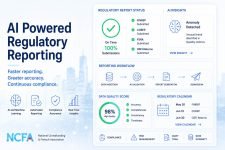
Regulatory reporting is shifting from periodic manual submissions toward continuous, evidence backed, AI assisted workflows. The opportunity is not simply AI generated reports. It is governed reporting systems that institutions, auditors and regulators can trust.
Regulatory reporting is a narrower market inside the broader RegTech category. Market estimates vary by scope, but the direction is consistent: regulated firms are spending more on reporting automation, compliance software, regulatory intelligence and AI assisted controls.
The strongest opening is the evidence layer around AI assisted reporting. Regulated firms need tools that collect source records, validate outputs, preserve workflow history, manage human approvals and show regulators how an AI assisted report was prepared.
IOSCO follow through, OSFI and CSA signals, bank examination questions, AI governance tool adoption, MCP permission controls, audit trail requirements and evidence that compliance teams will pay for agent based reporting workflows.
Evidence points to three venture paths. Each one addresses a different constraint that limits AI agents from handling regulated reporting work at scale.
Audit trails, source records and regulator ready evidence
AI assisted reporting creates a new evidence problem. If an agent gathers data, drafts a filing, validates a field or routes an exception, the institution needs to show what happened, which sources were used, who approved the output and what controls applied.
The opportunity is to provide the audit and evidence layer for AI reporting workflows. Potential buyers include banks, PSPs, insurers, asset managers, crypto platforms, internal audit teams and compliance functions.
Existing governance, GRC or regulatory reporting platforms add enough evidence capture to reduce demand for specialist products.
Will institutions buy a standalone evidence layer, or will they require it inside an existing reporting or GRC platform?
Drafting, validation and approval workflows
Reporting teams spend large amounts of time gathering data, reconciling records, checking consistency, drafting explanations and routing approvals. AI agents can reduce manual burden if they operate inside controlled workflows.
This path may support workflow based software revenue. The strongest products will likely combine drafting, validation, exception handling, approval routing and human review rather than promising fully autonomous reporting.
Institutions may restrict copilots to internal drafting if legal accountability, data lineage or model risk concerns remain unresolved.
Which workflow has the clearest budget: prudential reporting, transaction reporting, AML reporting, compliance attestations or supervisory responses?
Obligation mapping and reporting change monitoring
Reporting obligations change across jurisdictions, business lines and product categories. The opportunity is to map rules, obligations, policies, controls and reporting fields into a structured intelligence layer that agents can use safely.
This path may be strongest for firms operating across multiple regimes. It can also serve consulting firms, managed compliance providers and regtech platforms that need regulatory change intelligence connected to workflows.
Regulatory content providers and large advisory firms may own the highest value obligation data before startups can build defensible distribution.
Can the platform map obligations into specific reporting workflows better than existing legal, advisory and compliance data products?
Filter by signal type to review source records, market signals and thought leadership supporting this opportunity. Evidence is sorted newest to oldest.
Share your perspective, research, case study or video response. You can also express interest in future discussions, collaboration opportunities and innovation activities related to this topic.
Learn how NCFA identifies, validates and tracks innovation opportunities →NCFA Opportunity Intelligence tracks emerging venture opportunities using evidence, market developments and validation signals. Opportunity briefs are updated as new information, evidence and stakeholder perspectives become available. This content is provided for information purposes only and does not constitute legal, investment, financial, tax or professional advice.
The National Crowdfunding & Fintech Association (NCFA Canada) is a financial innovation ecosystem that provides education, market intelligence, industry stewardship, networking and funding opportunities and services to thousands of community members and works closely with industry, government, partners and affiliates to create a vibrant and innovative fintech and funding industry in Canada. Decentralized and distributed, NCFA is engaged with global stakeholders and helps incubate projects and investment in fintech, alternative finance, crowdfunding, peer-to-peer finance, payments, digital assets and tokens, artificial intelligence, blockchain, cryptocurrency, regtech, and insurtech sectors. Join Canada's Fintech & Funding Community today FREE! Or become a contributing member and get perks. For more information, please visit: www.ncfacanada.org
| | |
|---|---|---|
| | |
June 18, 2026 | NCFA Fintech Market Activity | Capital Markets And Market Infrastructure, Wealthtech And Investing

Image: Unsplash/Stephen Dawson
On June 18, 2026, Wealthsimple announced Wealthsimple Predict, a standalone app that will give Canadian retail investors access to prediction market trading through Kalshi.
The app is in beta and expected to launch this summer. At launch, Wealthsimple says it will offer access to nearly 4,000 event contracts trading on Kalshi, limited to the categories Wealthsimple is authorized to offer in Canada a range of event contracts across economic indicators, financial markets, and climate. Those contracts must also meet Wealthsimple's listing standards.
This is a distribution milestone for Canadian prediction markets. In March, Prediction Markets Tighten as Wealthsimple Enters tracked Wealthsimple's regulatory approval as Canada began testing a narrower, supervised route for event contracts. So with this active launch plan, that story is evolving from approval to retail access.
CIRO and the CSA reminded firms in April that event contracts remain subject to existing securities and derivatives rules. CIRO has said two dealer members are authorized to facilitate Canadian client access to event contracts. Public reporting and dealer materials indicate those firms are Wealthsimple and Interactive Brokers Canada.
Wealthsimple's own education material says event contract trading is legal in Canada under specific conditions, with guardrails around authorization, product categories, investor protection, and trading rules. Canada's version isn't simply a copy of U.S. political or sports prediction markets. It is starting with economic, financial, and climate contracts inside a regulated dealer pathway.
Event contracts are simple in structure but hard to operate well. Wealthsimple describes most prediction markets as binary contracts where users choose yes or no, and correct contracts pay $1 minus fees. Prices can act as probability estimates, but only when contracts are clear, liquid, supervised, and resolved properly.
Kalshi brings the exchange infrastructure. Wealthsimple brings Canadian retail distribution, education, onboarding, account experience, and investor guardrails. The combination is important for adoption. A prediction market with good contracts but weak distribution stays niche. While a prediction market connected to a large investing platform can test whether event contracts become useful market information, not only speculative trading activity.
NCFA's Innovation Opportunities in Regulated Event Contract Infrastructure brief identified the same gap. Regulated prediction markets need compliance, surveillance, market data, onboarding, dispute resolution, payout, risk, and investor education infrastructure. Wealthsimple Predict is a live validation point for that opportunity thesis.
The open question is whether or not event contracts will become sustainable information markets in Canada. If liquidity develops inside permitted categories, prices could help investors read market expectations around inflation, rates, climate outcomes, tariffs, currencies, and economic risk. If liquidity remains thin or contract design is weak, the information value will be limited.
As regulated prediction markets reach Canadian retail investors, will their main value come from trading activity, or from the real time probability data they produce for investors, policymakers, and markets?
The National Crowdfunding & Fintech Association (NCFA Canada) is a financial innovation ecosystem that provides education, market intelligence, industry stewardship, networking and funding opportunities and services to thousands of community members and works closely with industry, government, partners and affiliates to create a vibrant and innovative fintech and funding industry in Canada. Decentralized and distributed, NCFA is engaged with global stakeholders and helps incubate projects and investment in fintech, alternative finance, crowdfunding, peer-to-peer finance, payments, digital assets and tokens, artificial intelligence, blockchain, cryptocurrency, regtech, and insurtech sectors. Join Canada's Fintech & Funding Community today FREE! Or become a contributing member and get perks. For more information, please visit: www.ncfacanada.org
| | |
|---|---|---|
| | |

Event contracts are evolving from niche prediction markets into a regulated market category. The strongest openings may not be operating the markets themselves, but building the integrity, settlement, intelligence, distribution and risk management systems required for the category to scale.
Prediction market and event contract estimates vary because some sources measure revenue, others measure trading volume, decentralized markets, regulated event contracts or broader forecasting activity. The range is wide, but the category appears large enough to support venture scale investigation.
Recent evidence points to a larger infrastructure thesis. Event contracts need systems for market integrity, settlement, probability intelligence, distribution access and enterprise risk use cases. The strongest opportunity may be the trusted operating layer that helps many venues, brokers and data users participate without each rebuilding the same controls.
CFTC event contract decisions, broker access, Canadian distribution, stablecoin settlement activity, sportsbook challenges, enterprise pilots and evidence that buyers will pay for specialized infrastructure.
Evidence now supports five venture paths. These are product directions inside the parent opportunity, not automatic child Opportunity Briefs.
Surveillance, disclosure and outcome disputes
Event contracts are beginning to face the same trust problems that traditional exchanges faced as participation increased. Disclosure concerns, promotion practices, insider information risks, sensitive event pricing and outcome disputes are appearing before common standards have formed.
The opportunity is to help operators manage trust. Potential buyers include exchanges, brokers, operators and compliance teams. The strongest products may focus on surveillance, audit trails, disclosure monitoring, conflict detection and dispute management.
Large exchange surveillance providers extend existing products into event contracts before specialist vendors establish a foothold.
Is the first buyer the operator, broker or compliance function? Is the pain severe enough to create budget now?
Funding, payout and stablecoin workflows
Settlement is becoming a core operating requirement. Stablecoin activity, payout workflows and always available market participation increase the need for reliable funding, custody, reconciliation and settlement rails.
This path may support transaction based revenue if event market activity grows. The challenge is competition from payment providers, stablecoin issuers, custodians and existing financial infrastructure firms.
Existing payment providers absorb most of the value before specialized event market tools gain adoption.
Can the product reduce settlement cost, risk or complexity enough to win budget from operators or brokers?
Forecast signals for investors and operators
Prediction markets can produce forward looking probability signals that traditional datasets often miss. Private market valuation odds, policy forecasts, economic expectations and event risk pricing are early examples.
This path is broader than a data feed. The opportunity is to package probabilities into intelligence products that help investors, enterprises, researchers and operators make decisions. Customers still need proof that the signals improve decisions enough to justify recurring spend.
Forecast signals fail to outperform existing indicators or cannot be packaged into trusted workflows.
Who pays for the signal, and can accuracy, timeliness or decision value be demonstrated over time?
Brokerage, wealth and retail access
Canadian retail distribution, wallet integrations, sports partnerships and operator relaunch activity show that event contracts are moving through channels that already have users, compliance obligations and product discovery workflows.
The opportunity is the access layer around event contracts: brokerage integrations, suitability controls, education, product limits, risk warnings, onboarding, reporting and venue connectivity.
Distribution remains locked inside a small number of large brokers, exchanges or wallet platforms that build the access layer themselves.
Can brokers or wealth platforms justify a specialized event contract access layer rather than relying on venue supplied tools?
Promotion, campaign and business exposure
Event contracts are beginning to appear in practical business settings, including promotion risk management and event exposure. This suggests a possible enterprise use case beyond retail speculation and market forecasting.
The opportunity is infrastructure that helps brands, agencies and enterprises model, cap, transfer or monitor event driven exposure. This remains earlier than the other paths, but it could become a repeatable category if more non financial buyers adopt event contracts for operational risk.
Enterprise use remains a novelty or occasional hedge rather than a repeatable workflow with budget.
Which repeatable enterprise event risks are measurable, hedgeable and large enough to support a dedicated product?
Filter by signal type to review source records, early market signals and thought leadership supporting this opportunity. Evidence is sorted newest to oldest.
Share your perspective, research, case study or video response. You can also express interest in future discussions, collaboration opportunities and innovation activities related to this topic.
Learn how NCFA identifies, validates and tracks innovation opportunities →NCFA Opportunity Intelligence tracks emerging venture opportunities using evidence, market developments and validation signals. Opportunity briefs are updated as new information, evidence and stakeholder perspectives become available. This content is provided for information purposes only and does not constitute legal, investment, financial, tax or professional advice.
The National Crowdfunding & Fintech Association (NCFA Canada) is a financial innovation ecosystem that provides education, market intelligence, industry stewardship, networking and funding opportunities and services to thousands of community members and works closely with industry, government, partners and affiliates to create a vibrant and innovative fintech and funding industry in Canada. Decentralized and distributed, NCFA is engaged with global stakeholders and helps incubate projects and investment in fintech, alternative finance, crowdfunding, peer-to-peer finance, payments, digital assets and tokens, artificial intelligence, blockchain, cryptocurrency, regtech, and insurtech sectors. Join Canada's Fintech & Funding Community today FREE! Or become a contributing member and get perks. For more information, please visit: www.ncfacanada.org
| | |
|---|---|---|
| | |
Jun 17, 2026

Online casino gaming has become one of the most popular forms of entertainment in Canada. Canadian players have access to thousands of casino games, ranging from classic slot machines and blackjack tables to live dealer experiences that closely replicate the atmosphere of a land-based casino. With so many options available, choosing the best online casino games in Canada can be challenging.
This guide explains everything Canadian players need to know about online casino games, including the most popular game categories, payout percentages, house edges, winning potential, gameplay mechanics, and tips for selecting the right games.
The best online casino games in Canada combine strong payout potential, entertaining gameplay, fair odds, and accessibility across desktop and mobile devices. Canadian players consistently favour the following game categories:
Among all casino games available online, blackjack generally offers the lowest house edge when played with optimal strategy, while slots remain the most popular choice because of their simplicity and massive jackpot opportunities.
Online casino games allow Canadian players to enjoy casino entertainment from virtually anywhere. Modern casino platforms offer thousands of games, fast-loading mobile applications, secure payment methods, and live dealer technology.
Several factors contribute to their popularity:
The growth of regulated online gambling markets, particularly in Ontario, has further increased player confidence in online casino gaming.
Online slots remain the most-played casino games in Canada. Industry sources estimate that slots account for the majority of wagers placed on Canadian online casinos due to their simplicity, variety, and jackpot potential.
Online slots require no prior experience or strategy. Players simply select a bet amount and spin the reels.
Benefits include:
Canadian players frequently enjoy games such as:
Many of these titles offer RTP percentages between 94% and 97%, while some exceed 98%.
Return to Player (RTP) represents the theoretical percentage of wagers returned to players over the long term.
For example:
Higher RTP percentages generally indicate better long-term value.
Blackjack is widely considered the best online casino game in Canada for players seeking favourable odds.
Unlike slots, blackjack involves strategic decision-making that can significantly reduce the house edge.
Blackjack provides:
Experienced players who use basic blackjack strategy can achieve some of the best odds available in any online casino game.
Canadian online casinos commonly offer:
Blackjack strategy focuses on making mathematically optimal decisions based on the dealer's visible card.
Key principles include:
Players who learn these fundamentals can significantly improve their long-term results.
Roulette remains one of the most recognizable casino games in Canada.
The game revolves around predicting where a ball will land on a spinning wheel.
Canadian casinos typically offer:
French Roulette generally provides the best odds because of special rules that reduce the house edge.
Typical house edges include:
For players focused on maximizing value, French Roulette is often the preferred option.
Players can wager on:
This flexibility appeals to both beginners and experienced players.
Baccarat is one of the simplest casino games available online.
The objective is to predict which hand will win:
Baccarat attracts players because:
The Banker bet typically carries a house edge around 1.06%, making it one of the most favourable wagers in online casinos.
The Banker bet consistently offers the strongest mathematical advantage.
Most experts recommend avoiding the Tie bet because of its significantly higher house edge.
Live dealer casino games have experienced significant growth among Canadian players.
These games use real dealers who operate tables through live video streams.
Live dealer games offer:
Popular live games include:
Providers such as Evolution Gaming have become especially popular among Canadian players.
Modern live casinos also offer entertainment-focused game shows such as:
These games combine casino mechanics with television-style presentations.
Video poker combines slot machine mechanics with poker strategy.
Players receive cards and choose which cards to hold before drawing replacements.
Video poker offers:
Some versions of Jacks or Better can achieve RTP figures above 99% when played optimally.
Canadian casinos commonly feature:
Specialty games have become increasingly popular at online casinos.
These games often provide unique gameplay compared to traditional casino titles.
Examples include:
Many younger players enjoy these games because of their fast-paced action and straightforward mechanics.
Players looking for the highest potential returns should focus on games with strong RTP percentages.
| Game | Approximate RTP |
| Video Poker | Up to 99.9% |
| Blackjack | Up to 99.5% |
| Baccarat (Banker Bet) | 98.9% |
| French Roulette | 98.65% |
| High-RTP Slots | 96%–98% |
Higher RTP does not guarantee profits, but it generally improves long-term value.
The best game depends on personal preferences and goals.
Recommended games:
These games require minimal learning.
Recommended games:
These games reward skill and decision-making.
Recommended games:
These titles offer the largest potential payouts.
Recommended games:
Live dealer tables provide the closest experience to a physical casino.
Responsible gambling should always be a priority.
Best practices include:
Canadian players should only play on reputable, licensed casino platforms that provide responsible gambling tools and support resources.
Blackjack is often considered the best online casino game in Canada because it offers one of the lowest house edges when played with proper strategy.
Video poker and blackjack generally provide the highest RTP percentages available at online casinos.
Online slots are the most popular online casino games in Canada because they offer simple gameplay, large jackpots, and thousands of themes.
Baccarat and blackjack are often considered among the safest options because they feature relatively low house edges.
Live dealer games are worth playing for players who enjoy real-time interaction and a more authentic casino experience.
The National Crowdfunding & Fintech Association (NCFA Canada) is a financial innovation ecosystem that provides education, market intelligence, industry stewardship, networking and funding opportunities and services to thousands of community members and works closely with industry, government, partners and affiliates to create a vibrant and innovative fintech and funding industry in Canada. Decentralized and distributed, NCFA is engaged with global stakeholders and helps incubate projects and investment in fintech, alternative finance, crowdfunding, peer-to-peer finance, payments, digital assets and tokens, artificial intelligence, blockchain, cryptocurrency, regtech, and insurtech sectors. Join Canada's Fintech & Funding Community today FREE! Or become a contributing member and get perks. For more information, please visit: www.ncfacanada.org
| | |
|---|---|---|
| | |
June 6, 2026 | NCFA Fintech Whisperer | Digital Assets Blockchain And Tokenization, Payments And Market Infrastructure, Artificial Intelligence And Data, Capital Markets And Market Infrastructure, Regulation And Policy, Risk Compliance And Regtech
Image: Freepik
This live weekly NCFA intelligence page tracks financial technology developments that significantly affect how fintechs build, sell, raise capital, and operate under scrutiny. Coverage prioritizes Canada and includes global events that directly influence competitive conditions, market access, and execution realities across fintech sectors. This page will be updated throughout the week with market movers in a live format and then each week we'll close the prior week's contents in prep for the upcoming week, and continue on a rolling basis. (Missed prior week's Fintech Whisperer? (December 6-12, 2025, December 13-19, 2025, January 1-9, 2026, January 10-16, 2026, January 17-23, 2026, January 24-30, 2026, January 31-February 6, 2026, February 7-13, 2026, February 14-20, 2026, February 21-27, 2026, February 28-March 6, 2026, March 7-13, 2026, March 14-20, 2026, March 21-27, 2026, March 28-April 3, 2026, April 4-10, 2026, April 11-17, 2026, April 18-24, 2026, April 25-May 1, 2026, May 2-8, 2026, May 9-15, 2026, May 16-22, 2026, May 23-29, 2026, May 30-Jun 5, 2026).
Citi is combining traditional securities infrastructure with blockchain based issuance, custody, and settlement for private company equity. The launch adds another proof point that tokenized infrastructure is changing how markets operate, especially as banks, exchanges, and market operators compete to define how private assets move onto digital rails.
Digital asset access is being packaged for banks, brokerages, fintechs, and platforms that do not want to build the full crypto stack themselves. The control point is the embedded infrastructure that handles custody, liquidity, compliance, settlement, and connectivity behind the customer experience.
Tokenized real world assets are moving into bank distribution channels. DBS is turning physical gold into a digital product that can sit inside a retail banking app, while also testing institutional market access through its digital exchange.
Stablecoin supervision is moving from broad policy debate into operating rules. Issuers, custodians, exchanges, auditors, compliance vendors, and payment firms need to track how reserve custody, internal controls, audits, and service provider oversight become part of stablecoin market access.
Card networks are building trust infrastructure for AI driven payments. Visa’s updates add another network level proof point that identity, authorization, fraud controls, tokenized credentials, and settlement will shape how AI agents are allowed to transact.
Recurring payment rails are becoming a financial inclusion tool when they help users pay for digital services without relying on credit cards. Brazil’s Pix Automático data shows how local real time payment infrastructure can support subscriptions, platform access, and digital commerce growth.
Agentic payments are moving from checkout experiments into network infrastructure. Payment firms, AI platforms, stablecoin providers, banks, and identity vendors now have to solve authorization, spending limits, settlement, fraud controls, and liability for machines that can transact without a human at every step.
Large banks are building their own tokenized money infrastructure rather than relying on third party stablecoin networks. Payment providers, treasury platforms, and financial institutions now face a more competitive settlement environment as bank money, stablecoins, and tokenized commercial bank deposits compete for transaction flow.
Circle Payments Network continues to add distribution. Business accounts, treasury platforms, and payment providers are becoming part of the stablecoin settlement infrastructure rather than simply connecting to it.
Circle is extending its infrastructure footprint from stablecoins into Bitcoin collateral. Builders now have another institutional grade option for collateral and tokenized asset applications.
AI agents are moving from recommendation and discovery toward financial execution. Coinbase for Agents puts user controlled account access, payments, trading, and workflow automation into the same agentic finance conversation as network trust controls, stablecoin settlement, fraud prevention, and responsible AI governance.
AI supervision in finance is evolving from broad risk discussion toward operating practices for boards, senior management, compliance teams, model owners, technology vendors, and supervisors. Financial institutions need to track how governance, documentation, human oversight, cyber controls, and third party dependencies become part of responsible AI adoption.
Always-on markets need reference data that does not stop when traditional exchanges close. Exchanges, tokenized asset platforms, derivatives venues, market makers, and risk teams now have another pricing source to evaluate as real-world assets trade across crypto-native market infrastructure.
Prediction markets are starting to need the same financial plumbing as capital markets. Market makers, exchanges, payment providers, banks, and compliance teams now need infrastructure that can handle deposits, margin, settlement, risk controls, and regulated access without slowing down trading activity.
Prediction markets are moving from platform experimentation and court fights into formal rule design. Kalshi, Polymarket, DraftKings, Flutter/FanDuel, exchanges, market makers, compliance teams, sports leagues, and retail users now have a clearer process to debate which contracts belong in derivatives markets and which remain too close to gaming, misconduct, or public interest risk.
Financial crime compliance is increasingly becoming an existential regulatory issue rather than a supervisory issue alone. Payment firms, e-money institutions, fintechs, compliance teams, and investors should watch how regulators use governance, safeguarding, ownership, and financial crime controls as indicators of firm viability. The action signals that supervisory concerns can now lead to intervention measures that effectively remove a regulated firm's ability to continue operating.
Canada is pulling AI chatbots into platform safety regulation. AI firms, social platforms, trust and safety teams, identity providers, and compliance vendors should watch how age assurance, safety controls, reporting duties, and enforcement rules develop as digital safety becomes part of regulated online infrastructure.
Financial supervisors are beginning to treat AI as both a productivity tool and a threat multiplier. Banks, insurers, payment firms, fintechs, and security providers should expect greater scrutiny of fraud controls, cyber resilience, operational risk management, and third party technology oversight as regulators adapt supervision to an AI enabled threat environment.
Banking access is moving back onto the policy agenda as branch closures, digital exclusion, SME credit access, and local service gaps put pressure on financial providers. Banks, fintechs, credit unions, open finance firms, and data providers should watch whether the review leads to new access rules, credit data reforms, or stronger expectations around community banking infrastructure.
As advanced analytics become embedded in public institutions, governance questions increasingly extend beyond model performance. Procurement authority, accountability, oversight, operational dependence, switching costs, and public trust all influence how critical decision systems are adopted and maintained. The organisations that govern these systems may become as important as the organisations that build them.
The common thread is not AI, stablecoins, tokenization, or payments. It is access. Access to financial infrastructure, access to payment rails, access to private markets, access to banking services, access to digital assets, and increasingly access to machine driven financial execution. The next competitive battleground may not be who builds the best financial products, but who controls the rules, permissions, trust layers, and infrastructure that determine who can participate and under what conditions. Recent developments suggest those boundaries are on the move. NCFA offers various curated resources to help founders and investors stay current on developments that impact fintech markets, subscribe to NCFA weekly newsletter updates, view a rundown of current fintech news and insights, or dive into the latest fintech industry research.
The National Crowdfunding & Fintech Association (NCFA Canada) is a financial innovation ecosystem that provides education, market intelligence, industry stewardship, networking and funding opportunities and services to thousands of community members and works closely with industry, government, partners and affiliates to create a vibrant and innovative fintech and funding industry in Canada. Decentralized and distributed, NCFA is engaged with global stakeholders and helps incubate projects and investment in fintech, alternative finance, crowdfunding, peer-to-peer finance, payments, digital assets and tokens, artificial intelligence, blockchain, cryptocurrency, regtech, and insurtech sectors. Join Canada's Fintech & Funding Community today FREE! Or become a contributing member and get perks. For more information, please visit: www.ncfacanada.org
| | |
|---|---|---|
| | |


August 26th, 2025

January 4th, 2024

June 1st, 2021

September 9th, 2020

July 9th, 2018

January 3rd, 2018

September 25th, 2017

June 20th, 2017

May 10th, 2017

December 14th, 2016