




Karsten Wenzlaff, Advisor
August 26th, 2025
Karsten Wenzlaff is a Crowdfunding and Fintech Expert from Germany. He is Secretary-General of Digit[...]


Feb 23, 2026 | NCFA Market Activity | DAOs

On February 22 2026, Jupiter DAO closes the Net Zero Emissions option vote, moving JUP toward a supply tightening direction and a buyback first treasury posture. On chain reporting shows about 75% support for the Net Zero Emissions option and states the vote concluded at 7:00 PM ET. During the voting window, on chain analysis reports more than 24.5k votes recorded within the first 48 hours, with more than 13k individual voters backing the Proceed with Jupuary option by raw voter count, while the Net Zero Emissions option leads by voting weight at more than 73.9% during that same early period, on a voting distribution analysis that breaks down wallet counts and voting weight.
The proposal says net new emissions move from about 1.2B JUP to effectively zero, if the DAO approves the package. The proposal also states it postpones Jupuary and returns 700M tokens to the Community Cold Multisig, and it states Jupiter routes 50% of on chain revenues to open market buybacks. Jupiter already burns 3B tokens and it states founders lock tokens, including a founder lock to 2030.
Legacy allocations shape why the DAO focuses on offsets. On chain analysis reports Mercurial stakeholders receive 5% of total supply or 350m tokens, with about 182m vested by February 2026 and 168m remaining to unlock, also on the voting distribution analysis that quantifies the Mercurial allocation and vesting status.
Maker uses surplus auctions where the system auctions surplus Dai for MKR and then burns the MKR received from the winning bid, which contracts MKR supply, as described in Maker Protocol documentation on the Flapper surplus auction mechanism.
Aave documentation states the Aave DAO operates a buyback program funded by protocol revenue with a $50 million annual budget and weekly purchases that range from $250,000 to $1.75 million, with tokens sent to the DAO Ecosystem Reserve rather than burned, on Aave protocol documentation describing the buyback program budget and execution.
The proposal turns token governance into capital policy that stakeholders can measure. It targets a defined dilution outcome by moving net new emissions from about 1.2B JUP to effectively zero, and it pairs that supply stance with a stated rule that routes 50% of on chain revenues to buybacks. That combination gives the market a simple scoreboard, emissions near zero plus ongoing buy pressure funded by revenue, not inflation.
Early vote analysis shows more than 24.5k votes within 48 hours and it shows a divergence where the Jupuary option leads by raw voter count while Net Zero Emissions leads by voting weight. Token weighted voting aligns outcomes with economic exposure, but it can widen the gap between how many people show up and who decides. Fintech builders can reduce that gap with delegation tooling, transparent quorum logic, and reporting practices that make governance outcomes feel earned.
Offsets move sell pressure from the open market to treasury management. The proposal describes a treasury approach that aims to neutralize known future sell flows tied to vesting and distribution decisions, which creates a new execution test, the treasury must manage price, timing, and credibility in public. That's the same category of operational accountability that capital markets packaging requires.
Canada adds a practical lens because Canadian fintechs increasingly package products for institutional distribution where buyers demand explicit mechanics and predictable governance. Ledn’s Bitcoin backed ABS deal entering institutional markets shows how an institutional wrapper forces defined rules and clear investor expectations. Tokenized finance teams can apply that same discipline to emissions rules, treasury authority, and public reporting so partners can underwrite the model rather than debate it.
If a token stops emitting, who pays for growth and liquidity next, users through fees, builders through treasury, or the market through higher risk premiums?
 The National Crowdfunding & Fintech Association (NCFA Canada) is a financial innovation ecosystem that provides education, market intelligence, industry stewardship, networking and funding opportunities and services to thousands of community members and works closely with industry, government, partners and affiliates to create a vibrant and innovative fintech and funding industry in Canada. Decentralized and distributed, NCFA is engaged with global stakeholders and helps incubate projects and investment in fintech, alternative finance, crowdfunding, peer-to-peer finance, payments, digital assets and tokens, artificial intelligence, blockchain, cryptocurrency, regtech, and insurtech sectors. Join Canada's Fintech & Funding Community today FREE! Or become a contributing member and get perks. For more information, please visit: www.ncfacanada.org
 |  |  |
|---|---|---|
 |  |  |
Feb 23, 2026 | NCFA Fintech Market Activity | Digital Assets Blockchain And Tokenization

On February 20 2026, Ledn announced the first ever investment grade asset backed securities transaction in the digital asset industry, placing Bitcoin secured consumer loans into a capital markets format designed for institutional fixed income buyers.
Reporting on presale ratings and collateral detail indicates the transaction totalled about $188M and referenced a collateral pool of 5,441 Bitcoin backed consumer loans secured by 4,078.87 Bitcoin with an aggregate presale collateral value near $330M. S&P Global Ratings assigned preliminary ratings to two tranches, signalling that crypto secured loan performance can be assessed within traditional credit frameworks.
An asset backed security (ABS) pools loans and converts expected borrower payments into tradable bonds. In this structure, the underlying assets are Bitcoin collateralized consumer loans, which places operational emphasis on custody safeguards, liquidation triggers, valuation discipline, and reporting transparency.
For additional background on how crypto backed loans operate at the borrower level, this Fintech Fridays episode, Bitcoin backed loans and putting your crypto to work, provides context with Ledn Co-founder Mauricio Di Bartolomeo.
The Ledn issuance positions securitization as a funding diversification path. Instead of relying only on balance sheet capital or warehouse facilities, loan originators can distribute credit risk to bond investors, expanding lending capacity without requiring traditional bank balance sheet support.
Structure changes market access. A crypto lending desk can fund loans directly, but a rated ABS wrapper introduces buyers who operate under fixed income mandates and portfolio risk frameworks. That development moves crypto secured credit closer to mainstream credit market infrastructure.
The transaction also reinforces operational expectations. Securitization forces clarity around collateral custody, margin maintenance, liquidation speed, valuation timing, and stress scenario performance. If these controls prove reliable in market cycles, securitized crypto credit could evolve into a recognized institutional allocation sleeve.
Ledn represents a Canadian founded crypto finance platform now operating globally. Prior milestones include Tether investing in Ledn to expand crypto credit access and Ledn receiving VASP regulatory approval in the Cayman Islands, which together strengthen its institutional positioning and reporting posture.
If institutional investors begin treating crypto secured ABS pools as a defined allocation sleeve, Canadian originated platforms that demonstrate transparent collateral management and disciplined underwriting could gain access to funding channels that operate beyond domestic banking constraints.
If securitized crypto credit continues to mature, the competitive edge may hinge less on yield and more on collateral governance, transparency, and investor distribution relationships.
Crypto secured lending is beginning to compete not only on returns, but on structure, reporting discipline, and institutional investability.
The National Crowdfunding & Fintech Association (NCFA Canada) is a financial innovation ecosystem that provides education, market intelligence, industry stewardship, networking and funding opportunities and services to thousands of community members and works closely with industry, government, partners and affiliates to create a vibrant and innovative fintech and funding industry in Canada. Decentralized and distributed, NCFA is engaged with global stakeholders and helps incubate projects and investment in fintech, alternative finance, crowdfunding, peer-to-peer finance, payments, digital assets and tokens, artificial intelligence, blockchain, cryptocurrency, regtech, and insurtech sectors. Join Canada's Fintech & Funding Community today FREE! Or become a contributing member and get perks. For more information, please visit: www.ncfacanada.org
| | |
|---|---|---|
| | |
February 20, 2026 | NCFA Fintech Whisperer Weekly Intelligence | Regulation And Policy, Artificial Intelligence And Data, Payments And Money Movement, Digital Assets Blockchain And Tokenization, Risk Compliance And Regtech

Image: Freepik
This live weekly NCFA intelligence page tracks financial technology developments that significantly affect how fintechs build, sell, raise capital, and operate under scrutiny. Coverage prioritizes Canada and includes global events that directly influence competitive conditions, market access, and execution realities across fintech sectors. This page will be updated throughout the week with market movers in a live format and then each week we'll close the prior week's contents in prep for the upcoming week, and continue on a rolling basis. (Missed prior week's Fintech Whisperer? (December 6-12, 2025, December 13-19, 2025, January 1-9, 2026, January 10-16, 2026, January 17-23, 2026, January 24-30, 2026, January 31-February 6, 2026, February 7-13, 2026).
This is a procurement and capital boost for defence not seen in decades. Fintechs that help defence suppliers get paid faster, manage cash under milestone contracts, and prove tight controls on funds and data have a generational opportunity with real distribution next quarter. See defence push: Montreal joins provincial bids for global DSR bank platform
This is a money and proof moment for insurtech. Founders selling automation into carriers and brokers should expect buyers to ask for hard baseline metrics, verified before and after results, and fast integration plans this quarter because the market now funds teams that tie automation to combined ratio math and measurable cost takeout.
The UK is embedding crypto firms inside the existing Financial Services and Markets Act framework used for banks, investment firms, and other regulated financial institutions. Firms will likely need stronger governance, clearer business models, defined senior management accountability, and enough financial resources to pass a full authorisation assessment. This tends to favour well capitalized firms that can build institutional grade compliance and risk management from the start.
Tariff volatility shouldn't come as a surprise to anyone and still important to note that this does not take tariffs off the table. Founders and investors should assume trade cost risk still moves through other statutes and policy tools, so the teams that win next quarter make cash forecasting, FX, and settlement controls easier to run when pricing and demand change overnight.
This locks in the timeline banks plan around. Founders selling credit, underwriting, treasury, capital markets, or risk tooling into federally regulated institutions should expect earlier capital impact questions and tighter evidence requests in the next quarter because partners align product decisions to November 2026 and January 2027 effective dates long before final publication.
BoC's action should put every payments and wallet provider on notice. Partners should ask sharper questions about where customer funds sit, who controls access, how fast you can prove balances, and how you recover when something breaks. Teams that can answer those questions with evidence keep distribution moving when scrutiny rises. Feb 27, 2026 Update: The Bank of Canada issues a revised order that allows XTM to resume retail payment activities under court supervised monitoring (a controlled restart).
This can open practical opportunities into German buyers and programs, but only for teams that can pass strict security and governance reviews. Fintechs using AI should expect tougher diligence on where models run, how data moves, how vendors get controlled, and how incidents get handled. If you can show that evidence quickly, you may shorten procurement cycles and avoid months of back and forth. Large buyers tend to follow the standards governments back when they buy software at scale.
This is how stablecoins get real distribution, through bank grade plumbing that owns the hard parts. The next quarter gets more competitive for cross border payments and FX because buyers will compare everyone against always on settlement plus clean, provable books, not just a faster rail.
This is what a real time payments stack looks like when a credit union commits to execution. Vendors selling into credit unions should plan for tighter requirements on open APIs, core and digital banking integration, automated balancing, and exception handling in the next quarter because buyers now expect one platform to run multiple rails without adding operational headcount.
This partnership puts telecom scale on the same path as regulated payouts. If you want in, plan for a buyer that starts by stress testing your operations, not your pitch. Bring evidence you can trace every $ end to end, spot problems fast, reverse or recover cleanly, and keep service levels steady when volume spikes or fraud pressure rises. The teams that win make risk controls feel invisible to users while giving partners real time confidence that money moves exactly as promised.
Founders selling treasury and payments infrastructure should expect tougher questions on reconciliation, exception handling, and control ownership in the next quarter because a bundled PSP sets a higher baseline for speed and operational calm.
This is a real bridge into institutional credit rails. Founders building crypto credit, collateral, custody, and risk tooling should expect tougher questions next quarter on liquidation rules, collateral segregation, reporting, and investor grade controls, because rated structures pull crypto lending into the same discipline set as mainstream ABS.
This tightens delivery expectations for banks and their vendors. Payments and onboarding fintechs should expect stricter timelines and stronger evidence demands next quarter because partial coverage can trigger enforcement.
This week shows the market continuing to get stricter and more operational. OSFI closes the CAR 2027 consultation and puts bank capital planning on a fixed runway. The Bank of Canada order against XTM puts wallets and payments providers back under a microscope on safeguarding and access controls. Modern Treasury pushes more buyers toward one provider that owns rails, reporting, and controls. Desert Financial’s move into FedNow, RTP, and Visa Direct shows how fast credit unions now expect real time payments to work at scale. mea Platform’s $50M round reinforces that capital still rewards insurance automation when it ties directly to combined ratio math. The PSR fine in the UK makes clear that payments safety controls ship on deadline, or regulators step in.
NCFA offers various curated resources to help founders and investors stay current on developments that impact fintech markets, subscribe to NCFA weekly newsletter updates, view a rundown of current fintech news and insights, or dive into the latest fintech industry research.
The National Crowdfunding & Fintech Association (NCFA Canada) is a financial innovation ecosystem that provides education, market intelligence, industry stewardship, networking and funding opportunities and services to thousands of community members and works closely with industry, government, partners and affiliates to create a vibrant and innovative fintech and funding industry in Canada. Decentralized and distributed, NCFA is engaged with global stakeholders and helps incubate projects and investment in fintech, alternative finance, crowdfunding, peer-to-peer finance, payments, digital assets and tokens, artificial intelligence, blockchain, cryptocurrency, regtech, and insurtech sectors. Join Canada's Fintech & Funding Community today FREE! Or become a contributing member and get perks. For more information, please visit: www.ncfacanada.org
| | |
|---|---|---|
| | |
Feb 19, 2026 | NCFA Fintech Market Activity | CIX Summit

Image: Michael Katchen, Co-founder and CEO, Wealthsimple
On February 19 2026, Elevate named Wealthsimple Innovator of the Year for 2026 CIX Summit, who achieved a banner record year that included assets under administration doubling from $50B to more than $100B, 650,000 new clients, and more than 3 million Canadians served.
The release ties the award to three proof points that matter for founders and investors who care about durable scale.
First, it says Wealthsimple raised $750M in equity financing at a $10B post money valuation in October 2025 while maintaining profitability.
Second, it highlighted product expansion that moved beyond a single wedge, including 24/5 trading for US stocks, new trading tools including margin and expanded options strategies, plus a credit card.
Third, it points to distribution outcomes, including capturing 35% of all First Home Savings Accounts opened in Canada and ranking among the top three institutions in the country for net deposits.
Lisa Zarzeczny, CEO, Elevate:
“Wealthsimple exemplifies the bold innovation and execution that the CIX Innovator of the Year award celebrates. Their commitment to using technology to democratize access to sophisticated financial tools is exactly the kind of innovation Canada needs more of. We’re thrilled to honour their achievements and hear from Mike at CIX Summit about how they’re continuing to push boundaries in an industry ripe for disruption.”
This award lands in a moment where Canadian consumers keep moving toward digital first money management, and incumbents keep responding with pricing and product changes like options fee changes and real gold investing, plus competitive positioning where challenger platforms push directly at big bank margins. Those tracks connect cleanly to what CIX rewards here, which is compounding execution across product, distribution, and balance sheet strength.
In addition to Innovator of the Year award, see all 14 CIX 2026 startup award winners across early, emerging, and growth categories.
Mike Katchen is scheduled to accept the award and speak at CIX Summit 2026 on March 25 2026 at the Design Exchange in Toronto, alongside curated startup presentations and investor meetings, according to the release. NCFA is sharing a 20% community partner discount on CIX Summit passes for its community. Use CIXNCFA20 for 20% off. CIX publishes ticket options and event logistics on its official ticket page. Register with NCFA and save.
If a fintech can add hundreds of thousands of clients while it doubles assets, raises late stage capital, and expands into credit, what becomes the real incumbent moat in Canada next, distribution, product depth, or trust?
Awards do not build companies, but they do spotlight operating models that work. Congratulations to Michael Katchen and the entire Wealthsimple team for leading fintech in Canada across a number of fronts. Well deserved!
The National Crowdfunding & Fintech Association (NCFA Canada) is a financial innovation ecosystem that provides education, market intelligence, industry stewardship, networking and funding opportunities and services to thousands of community members and works closely with industry, government, partners and affiliates to create a vibrant and innovative fintech and funding industry in Canada. Decentralized and distributed, NCFA is engaged with global stakeholders and helps incubate projects and investment in fintech, alternative finance, crowdfunding, peer-to-peer finance, payments, digital assets and tokens, artificial intelligence, blockchain, cryptocurrency, regtech, and insurtech sectors. Join Canada's Fintech & Funding Community today FREE! Or become a contributing member and get perks. For more information, please visit: www.ncfacanada.org
| | |
|---|---|---|
| | |
February 18, 2026

Image AI generated
Canadian cryptocurrency investors operate within a strictly regulated and highly secure environment. The Canadian Securities Administrators (CSA) and FINTRAC have established rigorous standards for digital platforms. Investors should choose exchanges registered with Canadian regulators like CSA or CIRO. Top exchanges use cold storage and strong authentication to help protect user assets. Every investor should understand the regulatory landscape before committing their hard-earned capital. Safety remains the primary concern for Canadians participating in the evolving digital economy.
Bitbuy remains a premier choice for Canadian investors seeking maximum regulatory security. The exchange is registered with CIRO and the OSC to serve Canadian investors. Security protocols include keeping over 90 percent of user assets in cold storage via regulated custodians. Bitbuy holds crypto in its integrated crypto wallet with Coinbase, BitGo, and Tetra as trusted custodial partners. This structure ensures that your digital assets remain safe from unauthorized external access. The exchange has successfully processed billions in trades without experiencing a major hack. Investors benefit from a platform that mimics the security of traditional banking institutions. Bitbuy represents a benchmark for safety within the competitive Canadian cryptocurrency trading landscape.
NDAX provides a robust trading environment by prioritizing rigorous security certifications and compliance. The Calgary-based exchange holds a SOC2 Type II certification for its internal controls. This standard proves that their security systems meet high global data protection requirements. NDAX keeps most crypto offline with multi‑signature cold wallets using Ledger Vault security. It restricts transfers by allowing withdrawals only to whitelisted, verified wallet addresses. These tools empower users to maintain granular control over their own account safety. NDAX is registered with FINTRAC and follows Canada’s anti‑money‑laundering rules. Low trading fees do not compromise the professional security standards maintained by NDAX. This platform is ideal for those who value transparency and high technical safety.
Coinbase has solidified its position in Canada by obtaining a Restricted Dealer license. As a publicly traded entity, the company undergoes frequent audits and financial reviews. They offer a secure interface that integrates seamlessly with Canadian banking through Interac. Security features include mandatory two-factor authentication and advanced biometric login for mobile apps. Coinbase supports strong authentication options, including hardware‑compatible 2FA. Other crypto platforms, such as DeFi trading apps and an online casino that accepts crypto, also implement similar security and verification measures to protect users’ funds. These measures drastically reduce the risk of account takeovers from unauthorized entities. The platform stores the vast majority of customer funds in secure offline vaults. Coinbase collects and reports crypto tax information under CARF as required by law. This global giant offers localized reliability for Canadians looking for a trusted name.
Wealthsimple offers a simplified approach for investors who prefer an all-in-one financial app. The platform is a member of the Canadian Investment Regulatory Organization for safety. Wealthsimple uses robust compliance and security controls for crypto, consistent with other investments. Wealthsimple holds client crypto in trust with multiple regulated custodians, including Gemini. For instance, Wealthsimple monitors crypto transactions for suspicious activity using industry analytics tools. This proactive monitoring detects suspicious activity and reduces potential fraud risks. Assets are protected by cold storage solutions that are disconnected from the internet. The app provides a familiar and secure gateway for traditional investors entering crypto. Wealthsimple ensures that every digital trade follows the strict guidelines of Canadian law.
Selecting a platform in 2026 requires a focus on regulation and technical safety. Canadian investors should prioritize exchanges that maintain registration with the CSA or CIRO. Most regulated Canadian crypto platforms now use cold storage and multi‑signature wallets for protection. Tools such as hardware 2FA and transaction monitoring provide essential layers of digital defense. As the CRA implements new reporting frameworks, compliance has become a primary requirement.
Reliable platforms offer a balance between user convenience and robust institutional-grade security protocols. Every Canadian should perform due diligence before depositing funds into any digital wallet. Understanding these core principles ensures a safer experience within the modern crypto economy. Choosing regulated partners helps protect a financial future against the various emerging cyber threats. Secure investing remains the most effective way to participate in this growing market.
The National Crowdfunding & Fintech Association (NCFA Canada) is a financial innovation ecosystem that provides education, market intelligence, industry stewardship, networking and funding opportunities and services to thousands of community members and works closely with industry, government, partners and affiliates to create a vibrant and innovative fintech and funding industry in Canada. Decentralized and distributed, NCFA is engaged with global stakeholders and helps incubate projects and investment in fintech, alternative finance, crowdfunding, peer-to-peer finance, payments, digital assets and tokens, artificial intelligence, blockchain, cryptocurrency, regtech, and insurtech sectors. Join Canada's Fintech & Funding Community today FREE! Or become a contributing member and get perks. For more information, please visit: www.ncfacanada.org
| | |
|---|---|---|
| | |
Feb 10, 2026 | NCFA Fintech Market Activity | Alternative Finance and Capital Markets
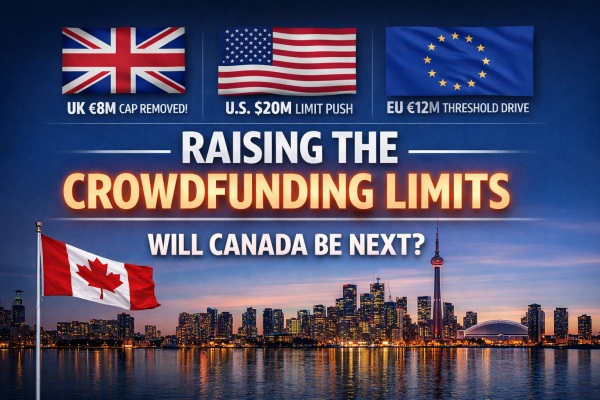
On February 10 2026, UK POP rules go live, removing the old prospectus trigger that made large public raises expensive, slow, and out of reach for many private companies.
For years, UK companies faced a hard line. If a business raised more than €8 million in securities from the public in a year, it had to produce a full prospectus (NB: the UK retained that euro-denominated threshold in its domestic framework post-brexit). Crowdcube says that prospectus costs could cost more than £250,000 and take months, which pushed many companies away from public community rounds even when demand existed.
Under the Public Offer Platform regime, raises above £5 million now run through a regulated POP, and the regime removes the upper fundraising cap for those offers (No more funding caps). Raises under £5 million remain outside the POP requirement, but regulated execution and investor protection expectations still apply.
Platforms now carry more responsibility for diligence, disclosure quality, and investor safeguards. That shifts the burden from a giant issuer document to a supervised platform process that can move faster.
The UK is not alone. In the United States, Crowdfund Capital Advisors submitted a $20M Reg CF petition asking the SEC to raise the Regulation Crowdfunding cap from $5M to $20M. In Europe, the European Digital Finance Association are pushing to increase the ECSP threshold from €5m to €12m.
After years of advocating, Canada finally harmonized nationally its startup-crowdfunding exemption in 2021, but regulators have kept the issuer cap conservative. Under National Instrument 45 110, eligible issuers can raise up to $1.5m in a 12 month period, which a growing company can quickly outgrow and end up soon looking for more funding via heavier paths for larger rounds. If the government wants to prioritize funding scape-ups, they should take another look at increasing equity crowdfunding caps in Canada to be in line with global peers.
This funding cap tension isn't new. In fact NCFA has been advocating for the OSC and CSA to raise issuer funding caps for years. In 2017 for example, NCFA petitioned to raise caps to modernize equity crowdfunding in Ontario. In 2019, $5m cap formed part of NCFA's recommendations to reduce regulatory burden and unlock growth capital. Again in 2020, during national harmonization discussions, NCFA advocated to modernize NI 45 110 including increasing caps to $5 million so the framework could match real funding needs in a digital economy.
Now with the UK FCA removing prospectus triggers and the US and EU push for higher caps, there may be a new policy window for Canada's equity crowdfunding participants to petition yet again. If other jurisdictions support $10m to $20m community rounds under platform oversight, Canada needs to decide whether it wants founders scaling here or structuring growth capital elsewhere.
A higher ceiling, including a path toward $5m and beyond, would better match growth stage reality while keeping platform level investor protection front and centre. The global direction of travel now strengthens the case for a renewed Canadian push grounded in data, experience, and competitiveness.
If regulated platforms can run larger public offers without a prospectus wall in the UK, what should Canada do next, raise the ceiling, create a platform lane for larger rounds, or keep the cap and accept that growth capital routes around Canada?
One practical takeaway stands out. POP style rules treat the platform as the compliance spine, not the issuer. That design can cut cost and time while still demanding clear disclosures, suitability controls, and due diligence at the point of sale. While Canada doesn't necessarily need to copy the UK, it does need a credible path for larger community rounds that doesn't force founders into a prospectus sized bill before they have the scale to absorb it.
The National Crowdfunding & Fintech Association (NCFA Canada) is a financial innovation ecosystem that provides education, market intelligence, industry stewardship, networking and funding opportunities and services to thousands of community members and works closely with industry, government, partners and affiliates to create a vibrant and innovative fintech and funding industry in Canada. Decentralized and distributed, NCFA is engaged with global stakeholders and helps incubate projects and investment in fintech, alternative finance, crowdfunding, peer to peer finance, payments, digital assets and tokens, artificial intelligence, blockchain, cryptocurrency, regtech, and insurtech sectors. Join Canada's Fintech & Funding Community today FREE! Or become a contributing member and get perks. For more information, please visit: www.ncfacanada.org
| | |
|---|---|---|
| | |
February 13, 2026 | NCFA Fintech Whisperer Weekly Intelligence | Regulation And Policy, Digital Assets Blockchain And Tokenization, Risk Compliance And Regtech, Payments And Money Movement, Digital Banking And BaaS
Image: Freepik
This live weekly NCFA intelligence page tracks financial technology developments that significantly affect how fintechs build, sell, raise capital, and operate under scrutiny. Coverage prioritizes Canada and includes global events that directly influence competitive conditions, market access, and execution realities across fintech sectors. This page will be updated throughout the week with market movers in a live format and then each week we'll close the prior week's contents in prep for the upcoming week, and continue on a rolling basis. (Missed prior week's Fintech Whisperer? (December 6-12, 2025, December 13-19, 2025, January 1-9, 2026, January 10-16, 2026, January 17-23, 2026, January 24-30, 2026, January 31-February 6, 2026).
If Congress moves in the spring, US partners will start asking harder questions now on stablecoin rewards, reserve treatment, and how customer funds and disclosures work across the full stack. Canadian fintechs that sell into US banks, issuers, brokers, or payment programs should treat this as a near term diligence trigger and tighten their positioning on governance, controls, and commercial terms before counterparties freeze decisions waiting for clarity.
This can tighten the enforcement loop for fintech ecosystems that touch payments, onboarding, compliance tooling, crypto rails, and cross border flows. Expect more partner questions on how you detect red flags, how you document decisions, and how quickly you can freeze, unwind, and report activity when a credible tip lands. Teams that treat case management and audit trails as part of the product will move faster in enterprise sales and face fewer surprises when an investigation starts.
This matters because sandbox access only helps when it reduces time and uncertainty. Teams that show strong governance, clear client protections, and clean reporting will move faster than teams that treat testing as a demo day. Learn about eligibility of the application process.
When a major hub ties tokenization to competitiveness, it raises the stakes for everyone else. Canadian fintechs that sell tokenized rails, custody, compliance, or payments infrastructure should watch how Hong Kong turns policy into approvals, because global buyers will compare jurisdictions and pick the one that reduces execution risk. The winners will package governance, controls, and reporting into the product so expansion doesn't turn into a compliance rebuild.
If the UK market truly removes practical caps for platform led raises, UK equity crowdfunding starts to compete more directly with later stage private rounds, not just seed. Canadian issuers and Canadian investors who already treat the UK as a secondary capital lane should watch how this affects round structure, disclosure burden, investor protections, and the cost of running a raise at scale.
This opens a practical channel for policy and market alignment with a top tier global finance hub. Fintechs that sell into banks, asset managers, or capital markets should track what this dialogue prioritizes, because it can influence what partners will fund, which standards they adopt, and where they source talent. Teams that can show real solutions in sustainable finance workflows, regulated innovation, and cross border market plumbing can use this moment to get in front of the right officials and decision makers early.
This matters because institutional adoption follows clarity. If your product cannot explain who holds control, who reconciles records, and how disputes get resolved, distribution will slow down no matter how good the tech looks.
Competition under the microscope, and it matters far beyond chatbots. If regulators treat access to high reach consumer channels as a competition issue, fintechs and financial institutions that rely on dominant platforms for onboarding, support, commerce, and embedded services should expect tighter questions about platform dependency, partner lock in, and contingency plans when a gatekeeper changes the rules.
Pakistan has moved a fully digital Islamic bank from pilot to commercial operations. The market test is now whether API-first banking and Shariah-compliant products can expand formal financial access at scale while meeting the control, resilience and trust expectations attached to a newly licensed bank.
The DIGIT pilot forces a few hard questions that every tokenized issuance vendor will face next. Who carries legal finality at each step. How participants reconcile token records with existing books without creating mismatches in stress. How the platform handles failed settlement, partial fills, and corporate actions without manual fire drills. HSBC’s selection also sets a benchmark for what UK buyers treat as table stakes, clean integration into current dealer and custodian workflows, clear control over keys and permissions, and audit ready evidence for every movement. If you sell issuance tooling, custody, post trade automation, or compliance workflows, you should map your roadmap to those practical asks now, because this pilot will shape the next wave of due diligence questions across wholesale markets.
This puts distribution and settlement on the same track as liquidity. Fintechs selling custody, treasury, payments, or compliance tooling should expect tougher buyer questions on how funds move end to end, how controls stay intact through banking rails, and how settlement risk gets boxed in when volume spikes.
If Malaysia standardizes supervised testing around wholesale payments and asset settlement, builders should track what the regulator expects around issuance controls, settlement finality, and operational risk. For banks and fintech partners, the fastest path to scale usually comes from proving how the money behaves under stress, not from polishing the user interface.
Fintech teams that rely on paid social, affiliates, influencers, or embedded widgets should treat marketing controls as part of the product. Buyers and partners will ask who approves copy, how teams prove UK targeting rules, and how fast they can pull campaigns across every channel. The teams that answer those questions cleanly keep momentum. The teams that cannot will watch growth stall at the trust layer. On a similar vein in Canada, the CSA and CIRO Set Clear Rules for Finfluencers.
This kind of operational failure rarely stays a one day headline in regulated markets. It turns into tougher questions from banks, insurers, and regulators about change controls, payout logic, segregation, and how quickly a platform can prove what happened. Fintech teams should treat payment engines and automated transfers like critical infrastructure, with tight permissions, clear audit trails, and hard stops that prevent a bad config from turning into a balance sheet event.
LSEG putting its name behind on chain settlement changes the competitive map, where regulators, CCPs, CSDs, custodians, and major brokers set the rules of the road. Interoperability becomes the make or break issue, not chain choice, because participants will demand one operating model that works across traditional settlement, collateral, corporate actions, and reporting. Fintechs that want to matter here should lean into the hard parts, how they reconcile token and legacy records without gaps, how they manage permissions and key control at institutional scale, and how they keep settlement predictable during spikes, outages, and exceptions. The winners will look like the safest pair of hands in the room, with proof that their tooling reduces manual breaks and shrinks settlement risk for real participants, not just pilot users.
This matters because cross border money movement often breaks first when liquidity gets tight. A stronger euro backstop can reduce settlement fear for banks that route Europe linked flows, and it can change how counterparties price risk in FX, trade finance, and payouts. Fintechs that sell treasury, FX, and cross border payment tooling can stand out when they show how their rails behave under stress and how they keep funds moving when funding markets turn ugly.
Stablecoin reward design sits on the desk of banks and lawmakers. CIRO custody expectations raise the standard for how platforms document segregation and access. The UK payments plan turns into real requirements that land inside onboarding, fraud controls, and settlement resilience. Tokenized assets, including tokenized gold, now face the same demand from buyers, show custody, show redemption, and show who owns the problem when something goes wrong. NCFA offers various curated resources to help founders and investors stay current on developments that impact fintech markets, subscribe to NCFA weekly newsletter updates, view a rundown of current fintech news and insights, or dive into the latest fintech industry research.
The National Crowdfunding & Fintech Association (NCFA Canada) is a financial innovation ecosystem that provides education, market intelligence, industry stewardship, networking and funding opportunities and services to thousands of community members and works closely with industry, government, partners and affiliates to create a vibrant and innovative fintech and funding industry in Canada. Decentralized and distributed, NCFA is engaged with global stakeholders and helps incubate projects and investment in fintech, alternative finance, crowdfunding, peer-to-peer finance, payments, digital assets and tokens, artificial intelligence, blockchain, cryptocurrency, regtech, and insurtech sectors. Join Canada's Fintech & Funding Community today FREE! Or become a contributing member and get perks. For more information, please visit: www.ncfacanada.org
| | |
|---|---|---|
| | |


August 26th, 2025

January 4th, 2024

June 1st, 2021

September 9th, 2020

July 9th, 2018

January 3rd, 2018

September 25th, 2017

June 20th, 2017

May 10th, 2017

December 14th, 2016