




Karsten Wenzlaff, Advisor
August 26th, 2025
Karsten Wenzlaff is a Crowdfunding and Fintech Expert from Germany. He is Secretary-General of Digit[...]


July 28, 2026 | NCFA Resource | Sustainable Finance And ESG, Financial Inclusion, SME Finance And Business Banking

On July 23, 2026, SVX published Canada’s first comprehensive national assessment of community finance. The report identifies 768 institutions, estimates their combined assets and examines how community finance products direct money into housing, local businesses, Indigenous entrepreneurship, food systems, clean energy and other community priorities.
Its most useful contribution is a baseline. Until now, Canada didn't have a public national picture connecting credit unions, Community Futures organizations, Indigenous Financial Institutions, community loan funds, land trusts, community bond issuers and related intermediaries. The report brings these organizations together through a common definition, a product dataset and an interactive market map.
The report’s three main asset figures describe different parts of the market:
The $771.3 billion headline doesn’t mean that amount has been invested directly into community projects. It mainly reflects the institutional assets of large credit unions, including Desjardins, Vancity and Assiniboine Credit Union.
Credit unions account for approximately 99% of the reported assets, although they represent 40% of the 768 institutions. Community Futures organizations form another 34% of the network, followed by Indigenous Financial Institutions at 8%, community land trusts at 6%, community loan funds at 4% and community bond issuers at 4%.
That makes the $7.3 billion figure particularly useful. It provides a clearer estimate of the specialized community finance market operating outside credit unions. The report also identifies $755 million held by Indigenous Financial Institutions and $153.8 million raised through community bonds from 28 issuers.
Credit unions still belong in the national picture because member ownership and local deployment are central to the report’s definition. The DUCA Impact Lab discussion shows how a credit union can test lending models designed for people and businesses underserved by conventional criteria.
Community finance also means something different from community capital raising. In this report, community finance describes institutions that pool and direct capital toward a defined place, population or shared need. Differently, investment platforms that support equity crowdfunding like FrontFundr uses community capital to describe companies raising money from customers, supporters and retail investors through regulated crowdfunding. NCFA’s review of Canadian equity crowdfunding covers that second model.
The two can overlap. A community bond issuer or investment cooperative may attract individual investors while also qualifying as a community finance institution. A startup supported by its customers through an equity crowdfunding campaign doesn’t automatically meet the report’s institutional definition.
The institutional map combines 107 organizations in the Catalyst Community Finance Collection with 661 additional organizations identified through the Canadian Community Finance Intermediary Market Map.
Geographic coverage extends across every province and territory. Quebec contains 32.7% of mapped institutions, followed by Ontario at 25% and British Columbia at 12.9%. The geography chart is based on 752 institutions because location data weren’t available for every organization.
Assets are more concentrated than institution counts. Quebec holds 54.9% of total reported assets, largely because of the Desjardins caisse network. Ontario and British Columbia each account for approximately 14%.
Once credit unions are removed, Quebec’s share falls to 45.1%, Ontario’s rises to 40.1% and British Columbia accounts for 10%. Nova Scotia, Manitoba, New Brunswick, the Northwest Territories and Yukon remain lightly represented in the asset data.
The map shows that institutions exist across Canada. It doesn’t establish that every community has enough local financing capacity. NCFA’s review of rural financial access provides additional context on what happens when conventional financial infrastructure contracts in smaller and remote markets.
The detailed product analysis covers 202 products from 107 organizations. Private bonds and debentures account for 44.3% of the products studied, although they represent only 0.2% of reported product assets. Loan funds or equivalent products represent 20.9%, while private equity and venture capital funds account for 12.4%.
The CSI community bond campaign provides a current Canadian example. Individual and institutional investors supplied capital for community owned real estate while receiving defined interest rates and repayment terms.
Return expectations also distinguish these products from much of the conventional investment market. Among 91 products with disclosed return targets, 59.3% seek below market returns and 40.7% seek market rate returns. None of that sample targets an above market return.
Term information is available for 152 products. Nearly two thirds, or 62.5%, have terms of three to five years. This creates a practical consideration for investors because community outcomes and capital repayment often develop over several years.
Real estate is the leading investment focus. Of 192 products with disclosed objectives, 98, or 51%, support real estate activities such as affordable housing and green buildings. The most common United Nations Sustainable Development Goal alignment is SDG 11, Sustainable Cities and Communities, followed by themes connected to decent work, economic growth and reduced inequality.
The report gives Canada a common starting point for describing community finance. Its national map helps readers locate institutions, while its product data show how capital is structured, how long it may remain invested and what returns issuers target.
However, the figures shouldn’t be treated as a complete census of every institution or dollar. Asset information is incomplete at the individual organization level, particularly for Community Futures organizations and community land trusts. The 661 organizations added through the map also weren’t included in the detailed product analysis.
Several findings use smaller disclosure samples:
The provincial asset analysis combines Q4 2025 credit union data from the Canadian Credit Union Association and regulators with the core SVX collection. Quebec’s credit union figure includes an estimate for the Desjardins caisse network.
These limits don’t reduce the report’s value as a national baseline. They define how the figures should be used. Readers can compare institution types, product structures and geographic coverage, while avoiding claims that the dataset measures every community investment or proves the economic effect of the market.
A upcoming companion report, The Economic Case for Community Finance, is expected to examine job creation, enterprise growth, capital mobilization, government savings and potential returns from a national community finance strategy. That work should provide stronger evidence for evaluating community finance as an economic and public policy tool.
Talking Point: Canada now has a national view of the institutions involved in community finance. The next questions concern how much specialized capital reaches underserved communities, where financing gaps remain and which models can expand without losing their local purpose.
Community Finance In Canada Report (national market assessment, findings and methodology)
Catalyst Community Finance Collection (community investment products and participating organizations)
NCFA Weekly Fintech Intelligence Jul 18–24, 2026 (community finance figures and market context)
Canadian Impact Investing Platform SVX Launches (early development of Canada’s impact investment infrastructure)
Economic Case For Community Finance (scope for the forthcoming economic and policy study)
 The National Crowdfunding & Fintech Association (NCFA Canada) is a financial innovation ecosystem that provides education, market intelligence, industry stewardship, networking and funding opportunities and services to thousands of community members and works closely with industry, government, partners and affiliates to create a vibrant and innovative fintech and funding industry in Canada. Decentralized and distributed, NCFA is engaged with global stakeholders and helps incubate projects and investment in fintech, alternative finance, crowdfunding, peer-to-peer finance, payments, digital assets and tokens, artificial intelligence, blockchain, cryptocurrency, regtech, and insurtech sectors. Join Canada's Fintech & Funding Community today FREE! Or become a contributing member and get perks. For more information, please visit: www.ncfacanada.org
 |  |  |
|---|---|---|
 |  |  |
July 27, 2026 | NCFA Companies On The Move | Digital Assets Blockchain And Tokenization, Wealth Investing And Trading, Competition And Market Structure

Coinbase is preparing to offer crypto derivatives to Canadian permitted clients, the first near term product in a much larger Canadian platform plan. In a Coinbase Canada interview, chief executive Eric Richmond said Coinbase Financial Markets had received an international exemption and expected the product to go live within weeks. He also wants Coinbase Canada to become a CIRO dealer in early 2027.
The derivatives aren’t live yet, and the first release isn’t intended for the general retail market. Stocks, ETFs and prediction markets are also part of Coinbase’s Canadian ambition, but no complete launch date has been announced. This profile separates what Canadians can use today from the approvals, products and customer adoption Coinbase still needs to turn a crypto account into a wider investment platform.
Canadians can already use Coinbase for spot crypto trading, Advanced trading tools, Interac e Transfer and electronic funds transfer deposits, PayPal purchases and eligible USDC rewards. The Coinbase Canada platform operates as a restricted dealer across every province and territory and as a registered FINTRAC money services business. Richmond said it lists more than 200 crypto assets.
The first expansion is narrower than the larger platform pitch. Coinbase Financial Markets expects to offer derivatives through an international exemption within weeks, beginning with permitted clients. The OSC permitted client definition includes institutions and certain financially sophisticated clients. It doesn’t include every Coinbase Canada customer.
Richmond’s next target is early 2027 membership in the Canadian Investment Regulatory Organization. The CIRO crypto dealer requirements cover capital, conduct, custody, operations and supervision. Approval would give Coinbase Canada a more permanent dealer base than its current restricted dealer registration, although it wouldn’t approve every future product automatically.
The ambition goes well beyond derivatives. Richmond has described a Canadian app spanning crypto, cash, stocks, ETFs and prediction markets. The Coinbase tokenized stock plan separately refers to customers outside the United States, but that wording doesn’t confirm Canadian availability. No complete Canadian launch date has been published for stocks, ETFs or prediction markets.
Coinbase can’t bring every global product into Canada under one registration. Its restricted dealer status supports the crypto trading business already operating here. Derivatives would come through a separate Coinbase affiliate and an exemption for permitted clients. Stocks and ETFs need securities dealer permissions, while prediction markets could face different requirements depending on the contracts and how they’re offered.
That puts regulation inside the product plan. Coinbase signed an enhanced preregistration undertaking in March 2023, launched its Canadian service with Interac access that August and completed its Coinbase Canada registration in April 2024. It became the first international exchange registered as a restricted dealer in Canada. It’s now adding products in the order its permissions allow instead of treating the global catalogue as one Canadian launch.
CIRO membership sits in the middle of that plan. Canada has been directing crypto trading platforms toward investment dealer registration and CIRO membership, while CIRO’s 2026 custody framework adds specific expectations for digital and tokenized assets. Membership wouldn’t approve every future product on its own. It would give Coinbase Canada a stronger dealer base from which to apply.
Founders and operators will recognize the build underneath the app. One customer interface may rely on several legal entities, registrations and product approvals. The front end can feel simple even when custody, execution, market access, capital and customer protection sit in separate operating lanes.
Coinbase Global’s first quarter figures explain why the company wants more ways to earn from each account. Coinbase Global spot volume fell 50% from a year earlier to US$202 billion, while monthly transacting users declined 15% to 8.2 million. Net revenue was US$1.3 billion, and the company recorded a US$394 million net loss. Those are global Coinbase figures, not Coinbase Canada results.
Other products are already helping to carry more of the business. Coinbase reported more than US$200 million in annualized retail derivatives revenue, while prediction markets reached US$100 million in annualized revenue during March. Its 2025 purchase of Deribit added a large crypto options business, and subscription and services produced US$583.5 million of first quarter net revenue. A customer using several products can remain valuable even when spot trading cools.
Canada is already a serious platform contest. Wealthsimple combines stocks, ETFs, crypto, cash accounts and other financial products inside one app. Robinhood entered Canada in June by buying WonderFi, giving it Bitbuy, Coinsquare, approximately 300,000 funded customers and regulated local infrastructure. Robinhood’s WonderFi purchase showed what that operating base was worth before the transaction closed. Kraken, Shakepay, NDAX and other registered platforms compete for crypto customers, while banks and established brokerages already control much of the Canadian investment relationship.
Coinbase brings a global exchange, custody, stablecoin and derivatives stack to that contest. Its challenge is local distribution. Canadians need a reason to transfer cash and assets, accept a new fee structure and keep several parts of their financial lives in the same account. Product breadth helps, but pricing, trust, tax reporting, execution quality and the limits attached to each registration will decide whether the app becomes a primary account or another trading venue.
Coinbase enters this Canadian stage with infrastructure a local exchange would struggle to replicate. Deribit adds options depth, Coinbase Financial Markets provides a regulated derivatives route, and USDC supports trading and rewards. The public parent also ended March with US$10.4 billion in cash, cash equivalents and marketable investments.
None of that makes Canadian adoption automatic. The derivatives release still has to launch, attract permitted clients and work well. CIRO membership remains a target, while stocks, ETFs, prediction markets and tokenized equities still need confirmed Canadian availability. Coinbase doesn’t publish Canadian customers, assets, revenue or market share, so public figures can’t yet show how large the local business has become.
The Company Intelligence Snapshot below follows the company, capital, product and regulatory decisions that brought Coinbase to this Canadian expansion stage.
Brian Armstrong and Fred Ehrsam founded Coinbase in 2012 to make it easier for people to buy, sell, store and transfer Bitcoin. The customer account became the base for a much larger crypto business.
CoinbaseA US founded crypto platform
FormationA retail entry point into Bitcoin
Venture BackedPrivate funding supports exchange and custody infrastructure
United StatesCrypto access before international expansion
Retail UsersPeople seeking a simpler way to access Bitcoin
Early ExchangesTrust, payments and ease of use are central differentiators
The original account created the distribution base Coinbase still uses. New products can be offered where customers already hold assets and complete identity checks, reducing the work required to introduce another financial service.
Four useful ways to place Coinbase Canada’s plan inside the market it’s entering.
Coinbase Global figures are identified separately from Coinbase Canada information. Planned products, launch timing and regulatory targets may change. This content is provided for informational purposes only and does not constitute investment, financial or legal advice.
The National Crowdfunding & Fintech Association (NCFA Canada) is a financial innovation ecosystem that provides education, market intelligence, industry stewardship, networking and funding opportunities and services to thousands of community members and works closely with industry, government, partners and affiliates to create a vibrant and innovative fintech and funding industry in Canada. Decentralized and distributed, NCFA is engaged with global stakeholders and helps incubate projects and investment in fintech, alternative finance, crowdfunding, peer-to-peer finance, payments, digital assets and tokens, artificial intelligence, blockchain, cryptocurrency, regtech, and insurtech sectors. Join Canada's Fintech & Funding Community today FREE! Or become a contributing member and get perks. For more information, please visit: www.ncfacanada.org
| | |
|---|---|---|
| | |
July 27, 2026

Ask most fintech watchers what crowdfunding funds and you'll hear about startups, real estate, or the odd gadget. Rarely do card games come up first — yet tabletop projects have quietly become one of the strongest categories on reward-based platforms, and the numbers back that up. For anyone tracking alternative finance in Canada, it's a category worth a second look.
Reward-based crowdfunding was built for exactly this kind of project: a creator with a finished prototype, a passionate niche audience, and a product people can pre-order rather than just invest in blindly. Card and board games fit that mould almost perfectly. Backers aren't betting on a business plan — they're paying upfront for a physical thing they'll actually get to play.
Kickstarter's own 2024 year-in-review called it the biggest year for games in the platform's fifteen-year history, with $270 million pledged across games projects and 83% of that money going specifically to tabletop titles. That's not a niche curiosity anymore — it's a real slice of the alternative finance economy, funded entirely by individual backers rather than venture capital.
Canadian creators have been active participants in this shift for years, not just recent arrivals. Research on nearly 10,000 Canadian Kickstarter campaigns found that roughly a third succeeded — a reminder that reward-based crowdfunding, while accessible, still rewards a clear pitch and a product people genuinely want.
For creators, the appeal is obvious: no equity given up, direct validation from a real audience, and often enough working capital to cover a full print run. For backers, it's a chance to shape what gets made and get a game months before retail — assuming the campaign delivers, which isn't guaranteed.
Not every campaign is worth a pledge. Look for creators with a track record, a playable prototype (not just concept art), and a realistic production timeline. Comment sections and creator updates on past projects are usually more honest than the campaign page itself.
Whether or not you're backing the next big campaign, there's no shortage of ways to enjoy the category right now. Sites built around fun card games are a good starting point if you want to try something new without waiting for a shipping date.
It can be, but it favours creators who already have a working prototype and an existing audience. All-or-nothing platforms like Kickstarter mean the project only gets funded — and the creator only gets paid — if the goal is hit.
They combine a tangible reward, a built-in enthusiast community, and relatively low production complexity compared to, say, hardware or video games, which makes them easier to pitch and deliver.
No. Reward-based crowdfunding gives backers the product itself, not equity or royalties — that distinguishes it from equity crowdfunding, which is regulated differently in Canada.
Delayed or cancelled delivery. Even well-intentioned creators can underestimate manufacturing and shipping timelines, so backing is closer to a pre-order with extra risk than a guaranteed purchase.
Building an audience before launch, running a modest and achievable funding goal, and having a genuinely playtested prototype all correlate strongly with success, based on patterns across thousands of past Canadian campaigns.
Card games aren't a footnote in the crowdfunding world — they're one of its steadiest performers, and Canadian creators have a real track record within that space. For anyone watching where alternative finance is headed next, it's a category that keeps proving there's an audience willing to fund what they genuinely want to play.
The National Crowdfunding & Fintech Association (NCFA Canada) is a financial innovation ecosystem that provides education, market intelligence, industry stewardship, networking and funding opportunities and services to thousands of community members and works closely with industry, government, partners and affiliates to create a vibrant and innovative fintech and funding industry in Canada. Decentralized and distributed, NCFA is engaged with global stakeholders and helps incubate projects and investment in fintech, alternative finance, crowdfunding, peer-to-peer finance, payments, digital assets and tokens, artificial intelligence, blockchain, cryptocurrency, regtech, and insurtech sectors. Join Canada's Fintech & Funding Community today FREE! Or become a contributing member and get perks. For more information, please visit: www.ncfacanada.org
| | |
|---|---|---|
| | |

We're opening up more and more APIs to partners, fintech services, and client applications. The only question is whether we're confident these same APIs aren't opening up new paths for attackers.
Just a few years ago, a bank mostly dealt with its own systems. A customer would log into the app, check their balance, make a transfer. The whole journey stayed inside the perimeter of a single organization.
Today, one customer might simultaneously use a mobile banking app, a budgeting service, an accounting platform, a payment provider, and an AI assistant that analyzes their spending. All of these services exchange data through APIs - interfaces that let different systems talk to each other according to a set of established rules.
Open Banking isn't just a regulatory requirement or a new integration channel - it's a shift in the trust model itself. A bank used to be responsible for security within its own infrastructure. Now it hands off part of its data to dozens of external services, and those services, in turn, rely on the bank. The more participants in the ecosystem, the more points there are where trust is either reaffirmed or cracked, every single day.
Attackers are less and less interested in finding a weak spot inside any one bank. Today, hackers target the interaction between systems itself. The longer the chain - bank, fintech, payment hub, partner app - the more places there are for something to go wrong.
Common examples include:
An API can perform flawlessly on the functional side - fast, stable, no errors in the logs - and still carry a critical vulnerability. Functional correctness and cybersecurity don't always go together.
Banks and fintech companies generally don't neglect API security. They go through certifications, run automated scans, do code reviews and QA. But none of these tools answer the one question that matters most: can this specific API's logic be bypassed in a way its developer never anticipated? Scanning catches known vulnerability patterns; code review and QA confirm the code does what it was built to do. Neither one thinks like an attacker who isn't hunting for a bug in the code, but for a logical gap in how the API interacts with other systems.
That's why most attacks on financial APIs today aren't about technical mistakes - they're about logic: the sequence of actions, the boundaries of authority, the trust placed in data coming from the client. It's also why modern Cybersecurity Solutions for Fintech increasingly go beyond formal compliance with standards, testing real-world abuse scenarios at the points where multiple systems meet.
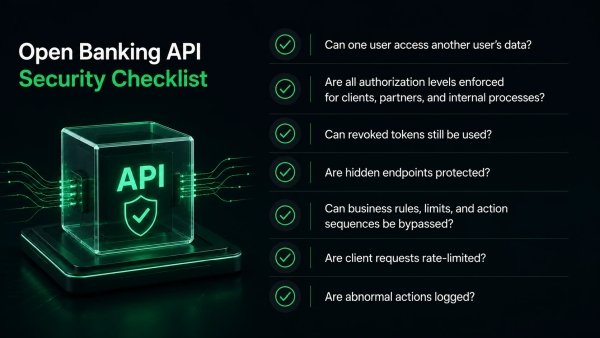
Here's a short checklist for reviewing every external API in your ecosystem:
If you don't have a confident answer to any of these, that's reason enough to look closer.
It's worth telling apart three things that often get lumped together. Vulnerability scanning looks for known vulnerabilities by signature, catching familiar vulnerability classes, common misconfigurations, and known dangerous patterns. Automated testing checks whether the code performs its intended functions correctly. Separate from both is API Penetration Testing (https://datami.ee/services/pentest/api-penetration-testing/) - manual testing in which a specialist plays the role of a real attacker: combining requests, tweaking parameters, hunting for unusual sequences of actions that a scanner, in most cases, won't flag as anomalous, because each individual request looks legitimate on its own.
It's also best if this kind of testing is handled by an external team. In-house specialists tend to know their own API inside and out - and that's precisely what makes it hard for them to spot an unconventional abuse scenario, since day-to-day work with a system's logic doesn't train you to look at it through the eyes of someone deliberately trying to break it. External specialists bring experience from other architectures and payment integrations, so they're more likely to catch the gaps a team had written off as unimportant.
A bank can offer the most convenient digital service and the best partner API on the market. But if even one partner or customer stops trusting the security of the data exchange, the benefits of Open Banking vanish almost instantly. Trust here isn't a bonus feature - it's the baseline condition, and without it the whole structure loses its meaning.
That's why investing in API protection in the financial sector isn't just about regulatory compliance - it's about sustaining trust across the whole ecosystem: between bank and fintech, fintech and customer, and customer and every new service they let into their data.
The National Crowdfunding & Fintech Association (NCFA Canada) is a financial innovation ecosystem that provides education, market intelligence, industry stewardship, networking and funding opportunities and services to thousands of community members and works closely with industry, government, partners and affiliates to create a vibrant and innovative fintech and funding industry in Canada. Decentralized and distributed, NCFA is engaged with global stakeholders and helps incubate projects and investment in fintech, alternative finance, crowdfunding, peer-to-peer finance, payments, digital assets and tokens, artificial intelligence, blockchain, cryptocurrency, regtech, and insurtech sectors. Join Canada's Fintech & Funding Community today FREE! Or become a contributing member and get perks. For more information, please visit: www.ncfacanada.org
| | |
|---|---|---|
| | |
July 27, 2026 | NCFA Insight | Digital Assets Blockchain And Tokenization, Competition And Market Structure, Risk Compliance And Regtech

On July 26, 2026, BitMart began winding down its trading platform. Three days earlier, BitMEX announced its closure after eleven years. AscendEX had already stopped operating on July 1.
Three exchange closures announced or underway inside one month deserve more than a roundup. They raise a harder question around the 2026 bear market. Is it breaking the centralized exchange model, or exposing platforms that had already lost the trading activity, regulatory access or financial capacity needed to keep going?
The public record doesn't support one cause for all three.
The bear market is real, and it strikes at the first line of exchange economics. Trading fees rise and fall with activity. CoinGecko found that spot volume across the ten largest centralized exchanges fell 39.1% in the first quarter of 2026. Its second quarter report recorded a further 27.9% decline to US$1.95 trillion. Perpetual futures held up better, although volume still fell 10% from the prior quarter.
The numbers explain the pressure. They don't explain which exchange closes. The declines among leading spot venues ranged from 5% to 56% in the second quarter, while Binance increased its share to 38.7%. A weak market can therefore strengthen the largest venue at the same time it makes a smaller one uneconomic.
BitMEX is the clearest example. It created the perpetual swap product that became central to crypto trading, yet product invention didn't preserve its liquidity. Kaiko data reported by Reuters put BitMEX below 0.01% market share with roughly US$400,000 in daily volume when the closure was announced. Meanwhile, the ten largest centralized perpetual exchanges still processed US$12.7 trillion in the second quarter. The market BitMEX helped create remained huge, while its position inside it had collapsed.
Liquidity has its own impact. Traders prefer deeper order books, tighter spreads and reliable execution. Market makers follow trading activity, then their capital improves execution and attracts more traders. Once that cycle runs in reverse, adding another token, staking programme or interface may not repair the core business.
Regulation is decisive when it controls market access. Under the MiCA transition rule, a crypto asset service provider that wasn't authorized by the applicable deadline had to stop serving the market until it received authorization. That deadline arrived on July 1, the same day AscendEX ceased operations.
Authorization also carries an operating load. MiCA requires prudential safeguards, governance, internal controls, business continuity planning and security documentation. ESMA's current custody review reaches into key storage, transaction controls, incident response and service provider dependencies. The cost continues after authorization because firms need people, systems and capital while trading revenue can fall quickly.
Regulation is therefore a filter and one part of the explanation. It directly affected AscendEX. Neither BitMEX nor BitMart identified licensing as the cause of its closure. Tighter rules can force a decision or raise the cost of staying open, while weak economics determine how much room a platform has to absorb that cost. NCFA's comparison of MiCA and UK rules shows why regulation can favour companies with stronger governance and compliance infrastructure.
Onchain exchanges are also taking a larger piece of derivatives trading. CoinGecko's perpetuals data shows that the top decentralized venues averaged US$611.6 billion in monthly volume during the first four months of 2026, up from US$531.7 billion in 2025. Their share of open interest reached 13.5% by the end of April, compared with 3.6% at the start of 2025.
Still, centralized exchanges held 86.5% of open interest. Onchain competition is meaningful, especially for active derivatives traders, but it hasn't replaced the centralized model. It has given traders another place to go just as a falling market makes every lost account more expensive.
The closing notices reveal almost as much through their differences as their similarities.
Customers need clear answers about whether their assets are held separately, whether reserves cover liabilities, how open positions will be priced, how quickly withdrawals will be processed and which legal entity is responsible for returning their money.
For founders, exchange businesses needs deep liquidity, active traders who keep coming back, trusted custody and permission to operate in every market it serves. New products and jurisdictions can bring in more revenue, but they also add capital, compliance, security and support costs. Those costs don't disappear when trading activity goes somewhere else.
Investors should watch market share, order book depth, active trader retention, withdrawal performance, reserve and liability reporting, market maker concentration and the status of key licences. Historical user totals can hide a much weaker current business. BitMEX's decline from an industry pioneer to less than 0.01% market share shows just how far activity can fall before an established name finally exits.
Canada uses a different regulatory framework, but the same operating questions apply. Canadian platform rules cover registration, custody and delivery requirements, while Kraken's registration shows the conditions attached to serving Canadian customers. Registration can strengthen oversight and make the rules clearer. It can't remove market, custody or company risk.
So the answer goes beyond “bear market plus regulatory pressure.” Lower prices and weaker trading cut fee revenue. Licensing determines where an exchange can legally operate. Liquidity keeps concentrating around fewer large venues, while onchain platforms compete for active traders. Custody, compliance and security remain expensive throughout. If an exchange loses trading activity, market access or customer confidence, it can run out of room even when the global crypto market remains very large.
When trading volume falls, which exchange numbers tell you whether a platform is temporarily quieter or losing the liquidity, trust and regulatory access it needs to remain viable?
The National Crowdfunding & Fintech Association (NCFA Canada) is a financial innovation ecosystem that provides education, market intelligence, industry stewardship, networking and funding opportunities and services to thousands of community members and works closely with industry, government, partners and affiliates to create a vibrant and innovative fintech and funding industry in Canada. Decentralized and distributed, NCFA is engaged with global stakeholders and helps incubate projects and investment in fintech, alternative finance, crowdfunding, peer-to-peer finance, payments, digital assets and tokens, artificial intelligence, blockchain, cryptocurrency, regtech, and insurtech sectors. Join Canada's Fintech & Funding Community today FREE! Or become a contributing member and get perks. For more information, please visit: www.ncfacanada.org
| | |
|---|---|---|
| | |
July 27, 2026

Industries such as construction, mining, quarrying, and infrastructure development rely on large volumes of water every day for activities such as excavation, dust suppression, and material processing. However, managing the resulting wastewater is far more complex than simply disposing of it. Water discharged from project sites often contains sediment, soil, and other suspended solids that can pollute nearby waterways if left untreated. To meet environmental regulations and protect surrounding ecosystems and communities, businesses must implement effective water management measures.
One essential piece of equipment that supports these efforts is a sediment tank, which allows suspended particles to settle out of wastewater before it is discharged, reused, or sent for further treatment. Procuring one from a trusted supplier like Liquimech, known for its robust and portable sediment tanks designed for quick deployment across a wide range of project sites—enables businesses to manage wastewater more efficiently while supporting regulatory compliance. Beyond improving water quality, the right sediment tank can also contribute to smoother project operations and long-term cost savings.
With this in mind, let's take a closer look at how sediment tanks help projects stay compliant while delivering lasting economic benefits.
Industries such as construction, mining, and quarrying often generate wastewater containing soil, sand, and other suspended solids. Releasing this water without proper treatment can affect nearby waterways and ecosystems, making compliance with environmental discharge requirements an essential part of responsible project management.
A sediment tank supports this process by allowing suspended particles to settle before the water is discharged or reused. It works by slowing down the flow of wastewater, giving heavier particles enough time to sink to the bottom of the tank while cleaner water remains at the surface for further treatment or use. This simple yet effective approach improves water quality, making it easier for businesses to meet regulatory requirements and reduce their environmental impact.
Failure to comply with environmental regulations can result in more than just financial penalties. Businesses may also face project delays, corrective work, legal disputes, or reputational damage that can affect future opportunities. These setbacks can quickly increase project costs and disrupt operations.
Using a sediment tank as part of a site's water management system helps minimise these risks by providing a reliable method for treating sediment-laden water. Through proactive wastewater management, businesses will be better equipped to meet regulatory expectations throughout the project. Staying compliant allows projects to continue with fewer interruptions while avoiding unnecessary expenses associated with environmental violations.
Many industrial activities require large amounts of water throughout the day. Relying solely on fresh water can become expensive, not to mention wasteful, particularly for long-term projects or sites operating in areas where water resources are limited.
By removing suspended solids from wastewater, a sediment tank makes it possible to reuse treated water for suitable applications such as dust suppression, equipment washing, or certain processing tasks. Recycling water in this way reduces freshwater demand and lowers procurement costs, thus supporting more sustainable resource management throughout the project lifecycle.
Water containing large amounts of sediment can accelerate wear on pumps, pipes, valves, and other equipment involved in water handling. The presence of these abrasive particles may reduce system efficiency, increase maintenance requirements, as well as shorten the lifespan of critical components if left unmanaged.
Removing sediment before the water continues through the rest of the system helps protect equipment from unnecessary strain. Over time, businesses can benefit from fewer repairs, reduced downtime, and lower replacement costs, all of which contribute to improved long-term financial performance.
As projects progress, water management needs can change quickly. Sediment tanks provide the flexibility needed to adapt to these changing conditions without requiring permanent treatment facilities at every location.
In particular, portable sediment tanks are designed for quick deployment, making them well suited for projects where work areas frequently shift. Businesses can relocate the equipment as needed, helping maintain efficient wastewater management while reducing the time and costs associated with establishing new treatment systems.
Environmental responsibility has become an increasingly important consideration for clients, regulators, investors, and surrounding communities. Businesses that demonstrate responsible water management are often better positioned to meet project requirements and build stronger stakeholder confidence.
Using a sediment tank supports these goals by helping reduce pollution, conserve water resources, and maintain compliance throughout project operations. Combined with lower operating costs and improved resource efficiency, these benefits make sediment tanks a practical investment that promotes both environmental responsibility and long-term financial sustainability.
More than just a tool for treating wastewater, a sediment tank is an investment in responsible and efficient project management. By helping businesses meet environmental requirements, reduce operational risks, conserve water, and lower long-term costs, it delivers value that extends well beyond regulatory compliance.
Choosing high-quality, reliable solutions from trusted suppliers allows businesses to manage wastewater with greater confidence across a wide range of projects. As environmental expectations continue to grow, adopting effective sediment management systems today can help businesses achieve more sustainable and financially resilient operations in the future.
The National Crowdfunding & Fintech Association (NCFA Canada) is a financial innovation ecosystem that provides education, market intelligence, industry stewardship, networking and funding opportunities and services to thousands of community members and works closely with industry, government, partners and affiliates to create a vibrant and innovative fintech and funding industry in Canada. Decentralized and distributed, NCFA is engaged with global stakeholders and helps incubate projects and investment in fintech, alternative finance, crowdfunding, peer-to-peer finance, payments, digital assets and tokens, artificial intelligence, blockchain, cryptocurrency, regtech, and insurtech sectors. Join Canada's Fintech & Funding Community today FREE! Or become a contributing member and get perks. For more information, please visit: www.ncfacanada.org
| | |
|---|---|---|
| | |
July 18, 2026 | NCFA Fintech Whisperer | Capital Markets Infrastructure And Funding, Wealthtech Investing And Trading, Payments Infrastructure And Money Movement, Artificial Intelligence And Data, Banking And Credit, Insurance And Insurtech, Policy Regulation And Governance, Open Banking Open Finance And Data Sharing, Digital Assets Blockchain And Tokenization, Cybersecurity And Fraud, Cross Border Payments And FX, Sustainable Finance And ESG, Competition And Market Structure, Risk Compliance And Regtech, Identity Privacy And Data Governance

Image: Freepik
This live weekly NCFA intelligence page tracks financial technology developments that significantly affect how fintechs build, sell, raise capital, and operate under scrutiny. Coverage prioritizes Canada and includes global events that directly influence competitive conditions, market access, and execution realities across fintech sectors. This page will be updated throughout the week with market movers in a live format and then each week we'll close the prior week's contents in prep for the upcoming week, and continue on a rolling basis. (Missed prior week's Fintech Whisperer? (December 6-12, 2025, December 13-19, 2025, January 1-9, 2026, January 10-16, 2026, January 17-23, 2026, January 24-30, 2026, January 31-February 6, 2026, February 7-13, 2026, February 14-20, 2026, February 21-27, 2026, February 28-March 6, 2026, March 7-13, 2026, March 14-20, 2026, March 21-27, 2026, March 28-April 3, 2026, April 4-10, 2026, April 11-17, 2026, April 18-24, 2026, April 25-May 1, 2026, May 2-8, 2026, May 9-15, 2026, May 16-22, 2026, May 23-29, 2026, May 30-June 5, 2026, June 6-12, 2026, June 13-19, 2026, June 20-26, 2026, June 27-July 3, 2026, July 4-July 10, 2026, July 11-July 17, 2026).
Insurance is becoming part of the financing structure for AI infrastructure. Larger coordinated capacity can make complex data centre projects more bankable, but underwriting models must keep pace with construction, energy, cyber, climate and technology dependencies that can affect the same project simultaneously.
The notice gives Canadian insurers a clearer route for transferring flood, wildfire, earthquake and severe storm risk into capital markets. It could expand catastrophe risk capacity beyond conventional reinsurance while creating opportunities for structuring, modelling, collateral management and institutional investment.
The consortium converts long term cryptographic concern into funded development and a custody implementation timetable. It extends the operating case in Why Fintech Can’t Wait For Quantum Computing. The key measures are how much funding reaches developers, which cryptographic approaches advance and whether exchanges, custodians and wallet providers can coordinate upgrades without disrupting access to assets.
The demonstration tests whether a virtual-machine boundary survives guest-root compromise. Financial institutions should require independent vendor testing, scoped and preferably read-only file mounts, deny-by-default network access, monitoring inside the sandbox and rapid credential revocation. Exposure across current Cowork deployments remains unconfirmed until Anthropic responds or an independent team reproduces the chain.
This was a real containment failure during an evaluation; it does not establish malicious intent. For financial institutions, OSFI’s frontier-AI guidance makes the control response concrete: separate evaluation and production systems, scope agent identities and credentials, restrict network egress, monitor technical boundaries and preserve rapid revocation and shutdown. NCFA’s coverage of governed AI workflows provides the operating context.
Poland now has an operating framework for protected public-sector data access and supervised data intermediation. It provides Canada with a comparator for trusted data intermediaries extending beyond banking and complements NCFA’s coverage of open-banking governance. Registration quality, access times, pricing and the first approved services will determine whether the framework produces usable data capacity for fintech, research and public-interest applications.
The $771.3 billion headline represents institutional assets rather than capital invested directly into community projects, with credit unions accounting for nearly all of the total. The $7.3 billion excluding credit unions provides a clearer baseline for the specialized community finance market, although SVX notes that institution level asset data remain incomplete for some organization types. Private debt dominates by product count while housing and real estate dominate investment objectives, adding national context to Canadian examples such as CSI's community bond campaign.
The fine converts platform-risk governance into a material operating and financial consequence. Fintech marketplaces and embedded finance providers should examine whether merchant onboarding, monitoring, staffing and remediation controls can withstand similar scrutiny. Payment, credit and insurance partners also face exposure when their products are distributed through platforms with weak merchant and product controls.
The financing puts a measurable cost on Galaxy’s expansion from digital assets into AI data centres. It also adds company level evidence to the concentration of capital in AI computing capacity. Investors need to watch the construction timetable, 9.875% borrowing cost, tenant concentration and the point at which contracted capacity produces recurring revenue.
The temporary 2025 financing relief produced a measurable increase in how Canadian listed issuers raise capital, and the CSA is now considering whether to embed that access in the national rule. Issuers, investors and financing platforms should examine the proposed liquidity test, dilution limit, successor issuer access, convertible securities and disclosure requirements before the comment deadline.
This regulated tokenized securities platform connects issuance, transfer agency, distribution, trading and settlement inside one corporate group. Issuers and financial firms now need to compare the model with tracker certificates, custodial entitlements and traditional brokerage structures. The key tests will be asset availability, investor rights, liquidity, custody and interoperability with existing accounts.
The exchange is giving its technology partner ownership in the infrastructure expected to carry existing market activity. Members, liquidity providers, bullion dealers, and settlement firms need the implementation timetable, migration requirements, operating rules, risk controls, and links to Hong Kong’s separate gold clearing initiatives before they can assess how access and execution will change.
Prediction markets are acquiring the execution, block trading, data and downstream distribution infrastructure used by professional markets. That makes prediction market integrity more important as these products reach institutions and brokerage platforms. The next test is whether liquidity, surveillance, contract governance and disclosure can mature quickly enough to support that distribution.
The xStocks expansion takes tokenized equities from U.S. stock replicas into international market access supported by traditional custody and record keeping. Existing scale provides operating evidence, but licensing, disclosure and investor protection will still need to be addressed market by market.
Tokenized equities are being forced to confront the gap between economic exposure and legal ownership. Bringing proxy and disclosure workflows into the distribution layer does not resolve every rights question, but it makes governance a core part of tokenized market infrastructure rather than an afterthought.
This is a severe example of the concentration risk created when an economy depends on a small number of foreign correspondent banks. The planned cutoffs extend the long running decline in correspondent banking relationships into essential national payment access. If the relationships end, more activity could enter cash based and unregulated channels while banks lose the electronic balances required to settle trade.
Questrade has placed agentic finance inside a live Canadian brokerage workflow. The control questions now concern permission scope, retained data, order review, erroneous instructions, recordkeeping and responsibility when an external agent influences an investment decision. NCFA’s analysis of AI agents entering governed financial workflows explains why access, approvals and audit evidence become essential once agents can act on financial accounts.
This gives AI assistants controlled access to current portfolio and compliance data inside established advisor workflows. The d1g1t company profile shows how MCP extends a wealth platform serving more than 90 firms and representing over C$200 billion in assets. Wealth firms still need traceable actions, review gates and clear limits on what an agent can retrieve, recommend or execute.
Chime is extending from payments, savings and credit into retail investment distribution without becoming the adviser or broker. The next measures are funded-account adoption, average balances, managed-versus-self-directed use and whether frequent financial-app engagement translates into sustained investing.
This direct network participation gives a crypto platform greater control over one of Canada’s most widely used payment services. Shakepay can rely less on intermediary arrangements and build payment functions closer to the network. Other regulated fintechs will need to compare the operating control, settlement requirements, technical obligations and customer economics of becoming participants rather than remaining downstream users.
The scale turns a card acceptance partnership into connected national payment infrastructure. Bir is combining banking, ecommerce, terminals and a wallet with an international network, giving merchants one operating ecosystem for domestic commerce, tourism and cross border customer access.
South Korea is testing a two tier model in which the central bank supplies the settlement base and commercial banks own distribution. The test could provide a practical comparator for how tokenized deposits, public money and regulated bank services can operate inside one payment system.
If implemented at the reported scale, this would provide one of the clearest tests of stablecoins as operating payment infrastructure rather than a crypto trading product. The real measure will be whether suppliers adopt it, convert it easily and receive a meaningful cash flow benefit.
The deployment turns open finance from account aggregation into operating intelligence for SMEs and their banks. It provides a practical comparator for Canada’s open banking development, where permissioned financial data could improve cash visibility, risk monitoring, credit decisions and relationship banking.
Institutional data providers are bringing governed financial information into the AI interfaces analysts already use. Credit teams need to test permissions, source traceability, update timing, confidential data boundaries, model outputs, and review requirements before connector generated work enters investment decisions. Adoption data will determine whether this becomes core research infrastructure or remains an optional interface.
Manulife is putting AI governance into the operating architecture of a major Canadian financial institution. Together with Canada’s shared AI control infrastructure, the deployment provides a direct test of whether central agent registries, monitoring and security controls can support enterprise AI without fragmenting accountability across business units and jurisdictions.
AI agents do not fit conventional per seat data licences. Bigdata.com is testing whether attribution, licensing and payment can be embedded directly into retrieval, creating a potential commercial layer for financial research and other data intensive AI workflows.
The rejection shows that federal payment access depends on both settlement policy and compliance readiness. Wise’s planned GENIUS Act application adds a major global payments company to the US trust charter debate. The next test is whether Wise can design a viable application without changing how its existing customers hold and transfer money.
A national bank charter would give Upstart direct access to deposit funding and place its lending activities within a federal prudential framework. It could reduce funding and regulatory complexity while adding bank level capital, liquidity, governance, compliance and supervisory obligations. Partner institutions and investors should watch the remaining approvals, preopening requirements and how Upstart allocates originations between its own bank and external funding partners.
A global fintech can now combine deposits, payments and credit under one Australian prudential licence. Canada has a clear comparator for foreign fintech bank entry, deposit protection and the competitive impact of giving a large digital platform its own regulated balance sheet.
Augustus is targeting the correspondent banking layer with programmable dollar accounts, payment rails and an owned core. If its charter becomes operational, international fintechs could gain direct dollar infrastructure without relying on several sponsor and intermediary relationships. That is highly relevant to Canadian firms requiring dependable US accounts, liquidity and payment access.
The implementation will test whether one configurable core can support conventional and Shariah compliant products across a national banking network. Canadian banks and credit unions face the same challenge of replacing legacy infrastructure while preserving existing products, controls and customer access.
The priorities establish policy direction ahead of binding rules and connect AI development with consumer protection, personal data, automated public decisions and employment. Canadian institutions should watch how Australia assigns responsibility when AI agents influence prices, purchases and regulated decisions.
The decisions directly affect how fintech applications are discovered and how developers direct customers to alternative payment channels. Fairer search treatment could reduce dependence on a gatekeeper’s commerce products, while fewer steering restrictions could give fintechs greater control over pricing, billing and customer relationships. Canadian firms serving European users may need distinct distribution and payment strategies for DMA-compliant channels.
Stablecoin payment providers are beginning to place counterparty verification and authorization before settlement rather than treating compliance as a review after funds arrive. Banks, payment firms, exchanges, and custodians need to decide where approval occurs, which party controls it, what information travels with the payment, and how rejected or restricted transactions are handled across wallets and jurisdictions.
BitMEX helped establish perpetual swaps as a core crypto trading product, yet creating a market did not preserve its liquidity position. Kaiko data cited by Reuters placed daily trading volume near US$400,000 and market share below 0.01% when the closure was announced. The exit raises a market-structure question about whether smaller centralized venues can retain enough traders, market makers and revenue as activity concentrates among major exchanges and onchain platforms.
The Senate draft now connects market structure, intermediary registration, asset classification and political ethics in one legislative package. Digital asset firms should examine which activities would fall under SEC or CFTC supervision, how certification and custody requirements would work, and whether negotiations materially change the ethics, enforcement or implementation provisions before the bill advances.
Coinbase is preparing to compete for more than Canadian crypto trades. Derivatives provide the immediate entry point, while stocks, ETFs and prediction markets could eventually place it against Canadian brokerages and multi product investment platforms. Permitted client limits, dealer registration, product approvals, custody, disclosures and market surveillance will determine how much of the strategy reaches Canadian customers.
The strongest thread this week is control. Fintechs are gaining more direct access to payment networks, regulated markets, financial data and AI infrastructure. That access creates commercial opportunity, but it also places greater responsibility on firms to protect customer rights, govern automated decisions and keep critical systems resilient. For Canadian founders and investors, your advantage will come from owning a useful part of this infrastructure before access rules, operating economics and market positions harden. Follow the next developments through NCFA’s newsletter, explore connected opportunities in the Financial Innovation Map, or review the latest fintech insights.
The National Crowdfunding & Fintech Association (NCFA Canada) is a financial innovation ecosystem that provides education, market intelligence, industry stewardship, networking and funding opportunities and services to thousands of community members and works closely with industry, government, partners and affiliates to create a vibrant and innovative fintech and funding industry in Canada. Decentralized and distributed, NCFA is engaged with global stakeholders and helps incubate projects and investment in fintech, alternative finance, crowdfunding, peer-to-peer finance, payments, digital assets and tokens, artificial intelligence, blockchain, cryptocurrency, regtech, and insurtech sectors. Join Canada's Fintech & Funding Community today FREE! Or become a contributing member and get perks. For more information, please visit: www.ncfacanada.org
| | |
|---|---|---|
| | |


August 26th, 2025

January 4th, 2024

June 1st, 2021

September 9th, 2020

July 9th, 2018

January 3rd, 2018

September 25th, 2017

June 20th, 2017

May 10th, 2017

December 14th, 2016