




Karsten Wenzlaff, Advisor
August 26th, 2025
Karsten Wenzlaff is a Crowdfunding and Fintech Expert from Germany. He is Secretary-General of Digit[...]


Mar 24, 2026 | NCFA Feature | AI Finance And Data Governance
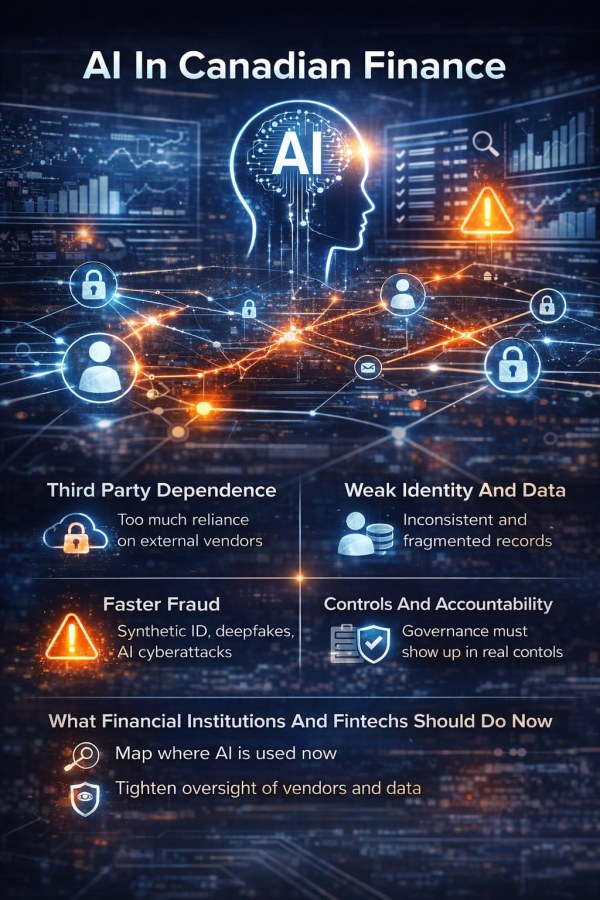
On Mar 23 2026, OSFI and the Global Risk Institute published the FIFAI II final report based on four workshops held between May and November 2025. More than 170 participants took part across banks, insurers, asset managers, fintechs, vendors, regulators, academics, and consumer voices.
The report confirms that AI adoption is here, citing 72% AI use at work in financial services and 75% organizational support for AI. While AI is already in use. The real issue is what still limits its use in regulated decisions and customer outcomes.
The series covered four areas that affect operational, prudential, consumer, and system-wide risk at the same time. Full report and framework: FIFAI II final report and AGILE framework PDF
One of the clearest takeaways is that AI will not spread across finance at the same speed. The first gains will come in internal functions such as fraud detection, surveillance, reporting, cyber defence, and operations. Those areas already have strong data, measurable outputs, and clearer accountability.
Customer-facing decisions are different. Underwriting, advice, product recommendations, and self-serve tools carry more pressure around explainability, fairness, consent, and complaints handling.
AI powered Canadian finance will likely grow faster in control functions than in customer-facing decisions.
The report treats third party AI as more than a procurement issue. It highlights growing dependence on external providers for models, infrastructure, and data, along with limited visibility into how those systems work and who sits behind them.
It's important because a failure, outage, or change in access at one provider can affect more than one function at the same time. Fraud controls, underwriting tools, customer service, and risk monitoring can all be exposed together. The financial stability workshop adds to that concern by linking third party dependency to concentration and system level risk.
Banks, insurers, and fintechs will need stronger oversight of models and providers, better audit access, tested fallback plans, and clearer visibility into the wider supply chain behind key AI services.
AI is improving both offence and defence. The final report points to synthetic identity, deepfakes, voice spoofing, AI assisted cyberattacks, fraud as a service, and disinformation. It notes a sharp rise in deepfake attacks and growing concern about voice verification as AI voice cloning improves.
This reality changes the operating environment. Static controls lose value faster when attack tools get cheaper, stronger, and easier to use. Manual review and occasional rule updates will not be enough. Firms will need faster detection, stronger identity controls, better information sharing, and systems that can adjust while attacks are happening.
Data problems come up across the whole series, but the larger issue is bigger than data quality alone. Weak identity and fragmented data still limit how far AI can go in regulated finance. The report points to inconsistent data, incomplete records, fragmented platforms, offshore storage concerns, and weak data lineage as barriers to both efficiency and safety.
The report doesn't mince words on identity. Canada still doesn't have a widely adopted secure digital identity layer. That leaves onboarding, authentication, consumer channels, remote work, and agent based systems more exposed than they should be. If identity and data remains weak, AI will keep working best in narrower internal use cases and face more limits in customer facing execution.
The final report introduces the AGILE framework as part of its overall findings, which stands for Awareness, Guardrails, Innovation, Learning, and Ecosystem Resiliency. The framework calls for stronger governance and oversight, stronger data and risk controls, continued investment in technology and talent, and deeper public private collaboration.
AI oversight cannot remain just at the strategy level. If AI is used in lending, fraud, underwriting, complaints, or customer recommendations, governance has to show up in controls, evidence, escalation, and accountability. In regulated finance, that's what turns AI use from experimentation into something firms can defend and scale.
The workshop series points to a practical sequence:
First, identify where AI already impacts decisions and controls.
Second, separate the use cases that can scale now from the ones that still need stronger explainability and customer safeguards.
Third, tighten vendor oversight before dependency grows further.
Fourth, invest more in identity, data lineage (origin and how it's used and updated), and real time fraud controls.
Fifth, show boards stronger evidence instead of high level claims and broad assurance language.
The report also carries a warning worth taking seriously. Firms that move too slowly can fall behind on productivity, resilience, and customer expectations while still facing external AI enabled threats. One participant line stands out: “The biggest risk is not doing enough.”
Canada’s national AI strategy work has focused heavily on trust, safety, and responsible adoption. That is necessary, but this workshop series adds something more useful for operators. It shows where AI use slows once it enters regulated finance: concentrated provider risk, weak identity, fragmented data, explainability pressure, fraud risk, and unclear accountability.
There's a call to action policy lesson here too. Canada doesn't just need AI ambition and adoption. It needs stronger execution layers around Digital ID, data governance, third party oversight, and information sharing if it wants regulated financial AI to scale beyond contained pilots.
The OSFI and GRI workshop series is useful because it takes a holistic approach to identifying and adapting to AI risks in finance. AI is already inside financial systems. The advantage now goes to firms that can prove control, trust, and accountability in live decisions.
 The National Crowdfunding & Fintech Association (NCFA Canada) is a financial innovation ecosystem that provides education, market intelligence, industry stewardship, networking and funding opportunities and services to thousands of community members and works closely with industry, government, partners and affiliates to create a vibrant and innovative fintech and funding industry in Canada. Decentralized and distributed, NCFA is engaged with global stakeholders and helps incubate projects and investment in fintech, alternative finance, crowdfunding, peer-to-peer finance, payments, digital assets and tokens, artificial intelligence, blockchain, cryptocurrency, regtech, and insurtech sectors. Join Canada's Fintech & Funding Community today FREE! Or become a contributing member and get perks. For more information, please visit: www.ncfacanada.org
 |  |  |
|---|---|---|
 |  |  |
Mar 23, 2026 | NCFA Fintech Market Activity | Venture Funding And Building

Image: Freepik
On March 23, 2026, BKR Capital announced a $20M first close for Black Innovation Fund II, with a final target of $50M. The first close includes backing from RBC, Boann Social Impact Fund, Cap Finance Social Finance Fund, BDC, and EDC.
BKR also said its first fund invested in 15 technology companies and is tracking as a top quartile performer for its vintage.
The release puts a hard number on the market gap. BKR said only 0.15% of venture capital deployed in Canada in 2025 went to Black founders. That is the core fact in this story. A second institutional fund is being raised into a market where founder supply exists, but early capital allocation remains extremely thin. The first close is aligned with a wider government effort to expand access to capital, including Canada’s renewed $189M Black Entrepreneurship Program.
Lissa Bjerkelund, Vice-President and Head of Investments at EDC:
"Supporting Canadian companies as they expand into global markets is critical in today's economic environment, and our investment in this fund speaks to our commitment to helping level the playing field for Black-owned businesses to access the capital they need to fuel their growth."
Isaac Olowolafe, General Partner at BKR Capital said there was “a powerful investment opportunity hiding in plain sight,” while Lise Birikundavyi, Co-Founder and Managing Partner at BKR Capital said “the strong financial performance of our first fund confirms what we have always known.” BKR is not pitching this as a social side pocket. It is arguing that Canada continues to misprice a real venture pipeline.
That raises a more direct capital formation question. If Fund I has already reached 15 companies and BKR says it is tracking as a top quartile performer, what keeps more institutional capital from moving sooner into managers and founder segments that the market still underfunds?
BKR’s first close also includes BDC, which lines up with a broader push toward more inclusive capital formation in Canada, including BDC’s $250M commitment to inclusive entrepreneurship.
If the founder pipeline is there and the performance case is strengthening, what still stops more Canadian institutional capital from moving earlier and at larger scale?
The National Crowdfunding & Fintech Association (NCFA Canada) is a financial innovation ecosystem that provides education, market intelligence, industry stewardship, networking and funding opportunities and services to thousands of community members and works closely with industry, government, partners and affiliates to create a vibrant and innovative fintech and funding industry in Canada. Decentralized and distributed, NCFA is engaged with global stakeholders and helps incubate projects and investment in fintech, alternative finance, crowdfunding, peer-to-peer finance, payments, digital assets and tokens, artificial intelligence, blockchain, cryptocurrency, regtech, and insurtech sectors. Join Canada's Fintech & Funding Community today FREE! Or become a contributing member and get perks. For more information, please visit: www.ncfacanada.org
| | |
|---|---|---|
| | |
Mar 24, 2026 | NCFA Fintech Market Activity | Payments And Money Movement

On March 23, 2026, Deloitte Canada and Stablecorp launched a QCAD infrastructure collaboration for Canadian financial institutions. Deloitte identified QCAD as a “first-to-market Canadian compliant” stablecoin and linked the collaboration to expected progress on Canada’s federal stablecoin framework and Bill C-15.
The release targets major financial institution clients and positions the offer around payment, value transfer, traceability, and operational efficiency. Deloitte also ties the work to meet the demands of a “24/7 economy” where projects operate real world payment, treasury, and settlement use cases rather than retail crypto activity.
Soumak Chatterjee, Deloitte partner said:
“Stablecoins present a significant opportunity for Canada’s payments landscape. This collaboration helps us enable capabilities that are critical for our banking sector to lead this change, unlock greater innovation in Canadian payments, and ensure global competitiveness. We’re excited to work with Stablecorp to drive impact for our clients and the broader Canadian financial services industry.”
This is a major advisory and implementation firm putting Canadian dollar stablecoin infrastructure in front of institutional clients now, not waiting for the market to mature on its own.
QCAD has been pursuing institutional use for some time, from a banking relationship with VersaBank to Stablecorp’s $5M+ raise. The Deloitte collaboration brings that effort closer to financial institution implementation.
For banks, credit unions, payment processors, treasury platforms, and enterprise fintechs, the pressure point is implementation. If regulated institutions start adopting CAD stablecoin rails through established integration and scale partners, the advantage moves to the firms that handle the setup, compliance work, workflow integration, and client access.
If QCAD enters institutional payment and treasury workflows through established implementation channels, who captures the long term value in Canada: the issuer, the integrator, or the platform that owns client distribution?
The National Crowdfunding & Fintech Association (NCFA Canada) is a financial innovation ecosystem that provides education, market intelligence, industry stewardship, networking and funding opportunities and services to thousands of community members and works closely with industry, government, partners and affiliates to create a vibrant and innovative fintech and funding industry in Canada. Decentralized and distributed, NCFA is engaged with global stakeholders and helps incubate projects and investment in fintech, alternative finance, crowdfunding, peer-to-peer finance, payments, digital assets and tokens, artificial intelligence, blockchain, cryptocurrency, regtech, and insurtech sectors. Join Canada's Fintech & Funding Community today FREE! Or become a contributing member and get perks. For more information, please visit: www.ncfacanada.org
| | |
|---|---|---|
| | |
Mar 23, 2026 | NCFA Insight | Capital Markets And Regulation

On Mar 22, 2026, a jury verdict found that Elon Musk's public tweets during the 2022 Twitter takeover fight misled investors. The jury didn't find an intentional fraud scheme, but the plaintiff's lawyers said damages total about $2.6B. The verdict puts more weight behind a growing problem that fintech founders, platforms, and financial brands already face every day. A high profile post can move money before anyone inside the firm has time to slow it down.
The verdict doesn't mean Musk is on the hook for writing a $2.6B cheque (just yet). The jury found liability on specific statements, and the estimated damages reflects the plaintiffs’ claim based on investor losses during the period in question. The final amount still depends on post trial motions and potential appeals. That process can take time and could change the outcome.
The reality is finance no longer only runs through filings, earnings calls, and official statements. It's found it's way to X posts, podcasts, YouTube clips, founder interviews, affiliate campaigns, and finfluencer content. Markets now react to all of it. Investors don't stop to verify if a message came from investor relations, legal, or a even a founder’s phone. They see a statement, they price it in, and capital follows.
The same pressure is already building in Canada. NCFA has been tracking how regulators are tightening expectations around online financial promotion, including new guidance on digital investing content and supervision and increasing enforcement around undisclosed promotion. The direction is consistent. Online influence is now being monitored and part of the regulatory perimeter.
Why? Investor behaviour has already changed. Research cited in Canadian retail investor trends on social media shows that 53% of investors use social platforms for investment information, rising to 82% among those aged 18 to 24. It also shows that 35% have acted on that content.
That means there's no question that online content affects markets. The issue now is control. Who reviews what gets said, and how quickly the firm can step in before a post starts affecting investors.
Many fintech firms still treat public communication as a branding issue first and a control issue second. A founder post about a funding round, a growth number, a partnership, a token plan, or a future launch can change expectations long before the business is ready to support the claim. In public markets that creates obvious exposure. In private markets it can still distort trust, fundraising, customer decisions, and partner behaviour.
Top firms will respond to these realities by tightening how they handle high impact communication. They'll get sharper, not quiet. They will know which claims need evidence, which messages need review, and which topics should never go out in casual language. And they'll stop pretending that online distribution isn't a compliance item just because it feels informal or fast.
A jury has now linked informal public statements to investor harm in a way that carries financial consequences. That raises the standard for how founders, executives, and financial brands handle any communication that can influence investor decisions.
The National Crowdfunding & Fintech Association (NCFA Canada) is a financial innovation ecosystem that provides education, market intelligence, industry stewardship, networking and funding opportunities and services to thousands of community members and works closely with industry, government, partners and affiliates to create a vibrant and innovative fintech and funding industry in Canada. Decentralized and distributed, NCFA is engaged with global stakeholders and helps incubate projects and investment in fintech, alternative finance, crowdfunding, peer-to-peer finance, payments, digital assets and tokens, artificial intelligence, blockchain, cryptocurrency, regtech, and insurtech sectors. Join Canada's Fintech & Funding Community today FREE! Or become a contributing member and get perks. For more information, please visit: www.ncfacanada.org
| | |
|---|---|---|
| | |
March 23, 2026 | NCFA Insight | AI Governance And Data Sovereignty

On March 22, 2026, the Guardian reported that UK Financial Conduct Authority has hired US firm Palantir for a three month trial worth more than £30,000 a week to analyze its intelligence data lake. The reported scope includes highly sensitive material tied to fraud, money laundering, insider trading, case files, suspected wrongdoing reports, and consumer complaints. It's a significant AI governance and privacy risk given that the FCA regulates around 42,000 businesses across the UK's financial ecosystem.
Palantir is a US based data and analytics company that builds software platforms used by governments, intelligence agencies, and financial institutions to organize and analyze large, sensitive datasets. Its systems combine data integration with artificial intelligence and machine learning tools, which allows users to run complex analysis across entire data environments. That capability makes it effective for regulatory and investigative work, and also places it at the centre of ongoing concerns about data access, oversight, and reliance on external vendors in critical public systems.
The FCA has stated that Palantir acts only as a processor, the data stays hosted in the UK, the data cannot be used to train Palantir systems, encryption keys for the most sensitive files stay with the FCA, and the data must be destroyed at the end of the contract. These are all good safeguards but that doesn't end the debate.
The real question is whether a regulator should give a foreign AI operator working access to one of its most sensitive data environments.
The FCA wants better tools to detect financial crime across a very large supervisory perimeter. However, the concern is that once a foreign vendor obtains access to a highly sensitive operating environment, the public risk grows beyond just legal ownership of the data. What happens if controls fail beyond what the contract itself governs?
If a system ingests more than expected, if metadata creates a wider intelligence layer than planned, if privileges become too powerful, or if future use expands beyond the original trial, the exposure can widen even when formal safeguards remain in place. While none of this proves failure it does highlight why sensitive AI contracts and said deployments need much closer scrutiny than standard software procurement.
The trial is short, the weekly cost is disclosed in reporting, the data environment is sensitive, and the FCA says it has placed strict limits on processor role, hosting, training use, encryption control, and deletion. A second report on the FCA Planatir deal indicates the trial is designed to test whether advanced analytics an improve fraud detection, AML/KYC procedures, and insider training within the scope of firms the FCA supervised. But most already concur that AI, if given enough data, can perform small miracles compared to current data tools.
So the harder policy question becomes are the current safeguards enough when the downside of failure is so high, and the data risk in question is a primary financial services regulator, and not a low sensitivity pilot?
Many jurisdictions now rely on a small number of leading foreign AI and cloud firms to quickly integrate, operate, and scale advanced systems. Once workflows, analytics, procurement, and staff capability start to rest on a handful of outside platforms, exiting becomes more difficult due to dependence.
A country can keep data local and still lose practical control if key capability depends on foreign firms for models, compute, software layers, and operational support. This is why the question is bigger than privacy alone. It reaches into resilience, sovereignty, and the future of digital public infrastructure.
Europe is addressing this problem with both law and capacity. The EU AI Act already sets binding rules for higher risk AI use, while the EU’s wider strategy ties AI policy to competitiveness and technological sovereignty. The question in Europe is no longer whether to regulate AI. It is how to enforce those rules while building enough domestic capacity to avoid overdependence on foreign providers.
Canada isn't yet at Europe’s stage. Ottawa still leans on privacy law, sector rules, and evolving AI policy rather than a fully enacted economy wide AI framework. It is progressing more directly on capability, though. The Canadian Sovereign AI Compute Strategy makes clear that domestic control over compute and data infrastructure is a matter of national security and economic resilience issue, not only an industry growth objective.
That concern is already visible in Canadian data. In Canada AI Strategy Confronts Capital Flight, federal consultation inputs point to risks around sovereign capital, procurement, domestic IP retention, and keeping more AI value inside Canada. Also, the acceleration of AI deployments is exposing AI Governance Gaps that many legal experts have flagged.
The FCA Planatir contact creates at least five questions Canadian policymakers should ask early.
The AI race isn't just about who deploys and adopts first. It's also about who keeps control over sensitive data, institutional leverage, and critical digital infrastructure while deploying.
The National Crowdfunding & Fintech Association (NCFA Canada) is a financial innovation ecosystem that provides education, market intelligence, industry stewardship, networking and funding opportunities and services to thousands of community members and works closely with industry, government, partners and affiliates to create a vibrant and innovative fintech and funding industry in Canada. Decentralized and distributed, NCFA is engaged with global stakeholders and helps incubate projects and investment in fintech, alternative finance, crowdfunding, peer-to-peer finance, payments, digital assets and tokens, artificial intelligence, blockchain, cryptocurrency, regtech, and insurtech sectors. Join Canada's Fintech & Funding Community today FREE! Or become a contributing member and get perks. For more information, please visit: www.ncfacanada.org
| | |
|---|---|---|
| | |
March 23, 2026

Image: Pexels/Towfiqu barbhuiya
Most people say they want more features, but what they usually reward is a system they can read. Trust rarely begins with maximum capability. It begins with knowing what the product is doing, what choices are available, and what happens after each action. That matters even more when a product handles money. A clean structure, a visible rule, and feedback that arrives right after the action can build more confidence than a long list of extras that only appear useful on paper.
Researchers increasingly describe digital trust in similar terms. In an open-access survey, transparency is defined as open and clear information about how a service functions, alongside auditability and traceability, which is another way of saying users trust systems they can inspect, rather than merely admire from a distance. That idea helps explain why simpler, more legible products often feel more credible than feature-heavy ones that demand constant interpretation. It also reframes transparency as a working property of the product, not a slogan added after launch.
One of the clearest ways to see this principle is inside rule-based games, where trust does not come from vague promises. It comes from stable mechanics, familiar options, and immediate feedback. A practical example is when online players play blackjack with bitcoin. Many sites list multiple versions, including classic blackjack, European blackjack, multi-hand blackjack, and live dealer tables, but the core objective stays steady: make decisions within a known structure and see the outcome without delay.
That consistency matters. When the rule space stays readable, people spend less energy decoding the environment and more energy understanding cause and effect. Seen that way, trust grows because the system behaves the same way twice, then 10 times, then 50 times. If you want to play blackjack with bitcoin after learning the basics, the value is not novelty. It is the chance to observe how confidence forms when actions are bounded, options are clear, and each result connects cleanly to the choice that came before it.
A short video on how memory limits in gaming shaped level design in the past carries the same idea forward because early console designers had so little memory that every tile, sprite, sound, and obstacle had to justify its place. The result was not just smaller worlds. It was clearer communication. Players learned one rule, then saw it repeated and remixed until the system felt readable. That is still a useful model for digital products now. Constraint often builds confidence because it strips away decorative noise and leaves the user with a structure they can understand.
This is where many digital products get the balance wrong. Teams assume trust comes from abundance, so they keep adding tabs, modes, settings, prompts, badges, and layered explanations. Some of those additions may be useful later, but they often arrive before the base logic is clear. The user then has to interpret the product before they can use it. That is a costly first impression. It also creates a subtle mismatch between what the interface promises and what the user can confidently predict, which is often where doubt begins.
Legibility works differently. It reduces the mental workload. It lets people answer a few quiet questions almost immediately: What can I do here? What happens if I do it? What changed because I acted?
When those questions become easy to answer, the product starts to feel honest. It is not trying to wow the user. It is showing its logic through behavior. That honesty compounds over time because repeated clarity is easier to remember than occasional brilliance.
That same theme shows up in broader discussions of transparency in digital entertainment and finance-adjacent systems, where clearer signals and measurable parameters are increasingly treated as part of the experience rather than a technical afterthought.
Visible rules do not mean shallow systems. They mean systems that reveal their logic early enough for users to form a stable mental model. Once that model is in place, depth feels earned instead of confusing. More features can still matter, but only after the foundation is clear. Otherwise, added capability behaves like noise. A product does not need to expose everything at once. It needs to make each next decision understandable enough that the user wants to continue.
That is why transparent rule sets often earn confidence faster than feature bloat. They reduce doubt at the exact moment doubt is highest. They tell users, in effect, this is how the system works, this is what your options mean, and this is how outcomes connect to inputs. In a crowded market, that kind of clarity is not cosmetic. It is operational. And it is increasingly supported by empirical work showing that greater recommendation-system transparency can raise consumer trust by improving perceived effectiveness and lowering discomfort.
The National Crowdfunding & Fintech Association (NCFA Canada) is a financial innovation ecosystem that provides education, market intelligence, industry stewardship, networking and funding opportunities and services to thousands of community members and works closely with industry, government, partners and affiliates to create a vibrant and innovative fintech and funding industry in Canada. Decentralized and distributed, NCFA is engaged with global stakeholders and helps incubate projects and investment in fintech, alternative finance, crowdfunding, peer-to-peer finance, payments, digital assets and tokens, artificial intelligence, blockchain, cryptocurrency, regtech, and insurtech sectors. Join Canada's Fintech & Funding Community today FREE! Or become a contributing member and get perks. For more information, please visit: www.ncfacanada.org
| | |
|---|---|---|
| | |
March 23, 2026

Artificial Intelligence (AI) is transforming the cleaning industry by making it faster, smarter, and more efficient. Traditional cleaning methods that once relied heavily on manual effort are now evolving with automation, smart data, and intelligent systems. From robotic vacuum cleaners that operate independently to AI-powered tools that optimize cleaning schedules and detect high-need areas in real time, cleaning is becoming more precise and results-driven.
As the demand for convenient and effective solutions grows, both homeowners and businesses are shifting toward AI-driven cleaning approaches. While AI improves efficiency and reduces manual effort, human expertise still remains essential for deeper attention, judgment, and handling complex cleaning tasks. The most effective approach combines AI-driven tools with professional cleaning expertise of leading cleaning companies like Mesh Maids to get the highest standards of cleanliness.
In this guide, you will learn how AI works in the cleaning industry, its most practical use cases, and how you can use these innovations to achieve more efficient and effective cleaning outcomes.
Artificial Intelligence (AI) in the cleaning industry refers to the use of advanced technologies, machine learning algorithms, and automated systems to make cleaning processes more efficient, accurate, and consistent. Instead of relying only on manual effort, AI systems analyze data, identify patterns, and make decisions with minimal human involvement.
These systems continuously collect information from the environment. Over time, they learn from past cleaning activities and adapt to changing conditions. This allows them to improve performance and deliver more accurate results.
For example, AI can:
This creates a more proactive and intelligent approach to maintaining cleanliness.
AI is already being used in practical and impactful ways across homes and commercial spaces. Here are some of the most effective applications:
One of the most common uses of AI in cleaning is robotic cleaners. These machines can vacuum, mop, and sanitize spaces without constant human supervision. They use sensors and mapping technology to navigate rooms, avoid obstacles, and clean efficiently.
AI systems can create and manage cleaning schedules based on real-time data. For example, high-traffic areas can be cleaned more frequently, while low-use spaces are cleaned only when necessary. This helps in saving time, effort, and resources.
AI monitors cleaning equipment and predicts when maintenance is required. This reduces downtime, prevents unexpected failures, and ensures smooth operations.
AI tools can assess cleaning quality using sensors and data analysis. This ensures consistent standards, especially in commercial environments where hygiene compliance is critical.
AI learns user preferences over time and adapts cleaning routines accordingly. Whether it's focusing more on kitchens, carpets, or bathrooms, cleaning becomes more customized.
AI reduces unnecessary usage of water, electricity, and cleaning supplies by optimizing when and how cleaning is performed.
In places like hospitals, offices, and public spaces, AI plays a crucial role in maintaining hygiene. It can track high-touch areas, monitor cleanliness levels, and ensure proper sanitization. This helps reduce the spread of germs and creates safer environments.
Cleaning companies use AI insights to improve operations, optimize workforce allocation, and enhance service quality.
AI is transforming the cleaning industry by turning traditional methods into smarter, more efficient processes.
AI-powered tools are making home cleaning more convenient and efficient. Here are some of the most useful options:
These devices use intelligent mapping to clean your home efficiently. They can be scheduled through mobile apps and operate independently, making them ideal for daily maintenance.
Robot mops handle wet cleaning with precision. They adjust water usage, detect floor types, and avoid carpets, delivering consistent results.
These systems allow you to control cleaning tasks through apps or voice commands. You can schedule cleaning, monitor progress, and customize preferences easily.
AI-enabled air purifiers monitor air quality and adjust performance in real time, helping to maintain a healthier indoor environment.
They are equipped with motion sensors and odor control, these bins improve hygiene and make waste management easier.
These devices use ultraviolet light to eliminate bacteria and viruses from surfaces, enhancing hygiene without chemicals.
AI-powered apps help manage cleaning routines, track tasks, and create personalized schedules based on your habits.
If you’re selecting AI tools for your home, consider the following factors:
Pro Tip: Start with a robotic vacuum or mop, then expand your setup over time for a complete smart cleaning system.
AI significantly enhances cleaning efficiency by reducing manual effort and improving accuracy.
AI-powered machines can cover large areas quickly while maintaining high performance, increasing overall productivity.
AI eliminates inconsistency by following predefined standards. This ensures:
AI relies on data and logic rather than guesswork, minimizing errors and improving accuracy.
Although AI tools require an initial investment, they reduce long-term costs by:
While Artificial Intelligence offers many advantages in the cleaning industry, it also comes with certain challenges. Understanding these limitations is important for you to make informed decisions and use AI effectively.
AI-powered cleaning tools and systems often require a significant upfront cost. Advanced equipment like robotic cleaners, smart sensors, and data-driven software can be expensive. Although these costs may reduce over time, the initial investment can be a barrier.
AI systems rely heavily on technology to function properly. Any technical issue, software glitch, or system failure can disrupt cleaning operations. This means regular maintenance and updates are necessary to ensure smooth performance.
While AI is efficient, it lacks human intuition and judgment. Certain cleaning tasks require attention to detail, decision-making, and adaptability that only experienced professionals can provide. AI may not always handle complex or delicate cleaning situations effectively.
AI systems often collect and process data from homes or workplaces, such as usage patterns and environmental information. This can raise concerns about data privacy and security, especially if the information is not properly managed or protected.
Implementing AI requires proper training and adjustment. The cleaning team needs to understand how to use AI tools effectively, which may take time and effort. Without proper training, the benefits of AI may not be fully realized.
AI-powered cleaning systems may not perform well in every setting. Complex layouts, cluttered spaces, or areas requiring detailed manual work can limit the effectiveness of automated tools.
While AI brings innovation and efficiency to the cleaning industry, it is not a complete replacement for human effort. The best results often come from combining AI technology with professional expertise to achieve a balanced and effective cleaning approach.
AI has changed the way we clean—but it hasn’t changed what true cleanliness requires. Smart devices can maintain your space, but they don’t understand it.
Cleaning is not just about removing visible dust—it’s about knowing what to clean, how to clean it, and when it needs deeper attention. AI follows patterns, but professionals analyze the environment. Professional cleaning services like Mesh Maids notice buildup before it becomes a problem. With professional expertise they treat different surfaces with the right methods.
With Mesh Maids, you’re not just getting a cleaner home—you’re getting a thoughtful, detail-driven approach with expertise. From tackling neglected areas to maintaining a spotless space, our team brings a level of care that goes beyond automation.
Artificial Intelligence is reshaping the cleaning industry in a practical and meaningful way. From smarter tools and automated systems to data-driven decisions, AI is helping in making cleaning faster, more efficient, and more consistent.
This means you will get a cleaner and healthier living space with less time spent on daily chores. It also opens the door to better service delivery, improved productivity, and stronger customer satisfaction for professional cleaning companies.
As AI continues to evolve, its role in the cleaning industry will only grow stronger. The key is to use this technology wisely—combining it with human expertise to achieve the best possible results. In the end, AI is not just changing how cleaning is done; it is setting a new standard for what clean truly means.
The National Crowdfunding & Fintech Association (NCFA Canada) is a financial innovation ecosystem that provides education, market intelligence, industry stewardship, networking and funding opportunities and services to thousands of community members and works closely with industry, government, partners and affiliates to create a vibrant and innovative fintech and funding industry in Canada. Decentralized and distributed, NCFA is engaged with global stakeholders and helps incubate projects and investment in fintech, alternative finance, crowdfunding, peer-to-peer finance, payments, digital assets and tokens, artificial intelligence, blockchain, cryptocurrency, regtech, and insurtech sectors. Join Canada's Fintech & Funding Community today FREE! Or become a contributing member and get perks. For more information, please visit: www.ncfacanada.org
| | |
|---|---|---|
| | |


August 26th, 2025

January 4th, 2024

June 1st, 2021

September 9th, 2020

July 9th, 2018

January 3rd, 2018

September 25th, 2017

June 20th, 2017

May 10th, 2017

December 14th, 2016