





Karsten Wenzlaff, Advisor
August 26th, 2025
Karsten Wenzlaff is a Crowdfunding and Fintech Expert from Germany. He is Secretary-General of Digit[...]


October 19, 2026 | Market Activity | Payments Infrastructure And Money Movement, Cross Border Payments And FX, Competition And Market Structure

On October 19, 2026, Toronto-based KORT Payments announced a definitive agreement to acquire AptPay, a Toronto payments fintech specializing in real-time transfers and payment orchestration. The deal would expand KORT's merchant processing business into account transfers, customer payouts and cross-border disbursements, giving customers more ways to collect and distribute money through one provider.
KORT is buying established technology and payment connections rather than building them from scratch. AptPay already serves merchants and financial platforms across Canada and the United States. Financial terms weren't disclosed, and the transaction is expected to close in Q4 2026, subject to customary conditions. AptPay will retain its brand, with CEO Shams Syed continuing to lead the business after closing.
KORT processes online and in-person payments for merchants and software platforms. AptPay, founded in 2019, brings access to Mastercard Send, Visa Original Credit Transactions, Interac e-Transfer, EFT, ACH, RTP and FedNow, alongside cross-border payment services. Its technology handles account collections and disbursements through a single integration, with built-in identity verification, anti-money laundering and sanctions screening.
The payment methods serve different business needs. An urgent customer payout may use a card network or instant payment rail, while routine supplier transfers can use EFT or ACH. Costs, settlement times and recipient eligibility vary by network. AptPay's orchestration technology allows businesses to manage these payment routes through one integration rather than maintaining separate connections for each service.
The combination broadens KORT's role in customer transactions. A marketplace that collects payments from buyers may also need to distribute proceeds to sellers. Financial platforms handle deposits and withdrawals, while other businesses manage contractor payments and customer refunds. KORT can potentially support more of those activities through the merchant and software relationships it already serves.
The acquisition follows KORT's decision to narrow its focus. On October 6, the company sold substantially all of Merrco's operating assets to PayFacto. Merrco served Canada's cannabis industry and other specialized merchants. KORT is now concentrating more resources on ecommerce, direct marketing, payments embedded in software and U.S. expansion.
KORT acquired Paysafe Direct's U.S. direct marketing processing business in February 2025 and has been expanding its software distribution channel through Tilled. It has also developed payment connectivity across Mexico, Brazil, Argentina and Chile. The Merrco sale reduces its exposure to a specialized merchant business, while AptPay adds payment capabilities that can serve customers across multiple industries.
KORT's existing distribution network could give AptPay's services a faster route to market. Software platforms already using KORT for payment acceptance may be able to add account transfers and payouts through the same commercial relationship. That could increase transaction revenue per customer without requiring KORT to acquire an entirely new customer base for each service. The economics will depend on pricing, integration costs and adoption.
Canadian fintech Dream Payments expanded U.S. payouts through J.P. Morgan Payments, while other processors are adding embedded payment services. KORT will compete on more than the number of payment rails it supports. Pricing, uptime, settlement performance and ease of integration will influence whether software platforms consolidate more of their payment activity with one provider.
Danny Chazonoff, KORT President and Chief Operating Officer:
"AptPay's real-time payout and orchestration capabilities are highly complementary to our platform, and together we can offer customers a complete money movement solution across North America."
Card acceptance, bank transfers and instant payouts operate under different settlement rules, compliance requirements and funding arrangements. KORT will need to integrate those services while maintaining reliable processing for existing customers.
The acquisition gives it more services to sell through established merchant and software relationships, potentially increasing revenue per customer without rebuilding its sales network. KORT's competitive advantage may come from its existing distribution rather than the technology alone.
 The National Crowdfunding & Fintech Association (NCFA Canada) is a financial innovation ecosystem that provides education, market intelligence, industry stewardship, networking and funding opportunities and services to thousands of community members and works closely with industry, government, partners and affiliates to create a vibrant and innovative fintech and funding industry in Canada. Decentralized and distributed, NCFA is engaged with global stakeholders and helps incubate projects and investment in fintech, alternative finance, crowdfunding, peer-to-peer finance, payments, digital assets and tokens, artificial intelligence, blockchain, cryptocurrency, regtech, and insurtech sectors. Join Canada's Fintech & Funding Community today FREE! Or become a contributing member and get perks. For more information, please visit: www.ncfacanada.org
 |  |  |
|---|---|---|
 |  |  |
Oct 19, 2026

Canada's online gambling industry is creating new business opportunities for payment processors, identity-verification providers and financial technology companies. But moving money between players and gambling operators involves more than completing a bank transfer.
Operators must establish who their customers are, monitor transactions for suspicious activity and meet applicable anti-money-laundering (AML) requirements. Payment providers may have separate obligations depending on the services they offer.
The regulatory framework is particularly relevant as Canada's online gambling industry expands beyond Ontario. Alberta's competitive market opened in July 2026, giving payment and compliance technology providers another provincial market to serve.
For fintech companies, the opportunity comes with an important distinction: Canada's federal financial-crime rules, provincial gambling requirements and payment-service regulations overlap, but they do not necessarily apply to every business in the same way.
The Financial Transactions and Reports Analysis Centre of Canada (FINTRAC) administers reporting and compliance requirements under the Proceeds of Crime (Money Laundering) and Terrorist Financing Act.
Casinos are among the reporting entities covered by the legislation. Their obligations can include customer identification, transaction reporting, recordkeeping, risk assessments and maintaining an AML compliance programme.
However, the legal definition of a casino matters.
FINTRAC's casino reporting framework historically centres on organizations conducting and managing specified gambling activities, including qualifying physical casino operations. A website offering online casino games is not automatically a separate FINTRAC casino reporting entity simply because it accepts wagers.
In provincial online gambling systems, the allocation of reporting responsibilities depends on the applicable legal framework, the entity conducting and managing the gambling activity, and the arrangements with private operators.
This distinction is particularly important in Ontario, where private gaming operators provide services within a provincially conducted and managed market.
Payment companies face a separate classification question.
Certain businesses that transmit funds, provide payment services or deal in virtual currencies can qualify as money services businesses (MSBs) or foreign money services businesses under federal law.
Since regulatory amendments took effect in 2022, certain payment service providers have been brought explicitly within FINTRAC's MSB framework.
That means a gambling operator and its payment processor may both have compliance responsibilities, but not necessarily identical ones.
For fintech providers entering the Canadian gambling industry, determining their reporting-entity status is an essential first step.
FINTRAC reporting is not based on one universal transaction threshold.
Different reports apply to different types of activity. Some involve a monetary threshold, while suspicious transaction reporting depends on the circumstances rather than the amount transferred.
The principal reporting categories include:
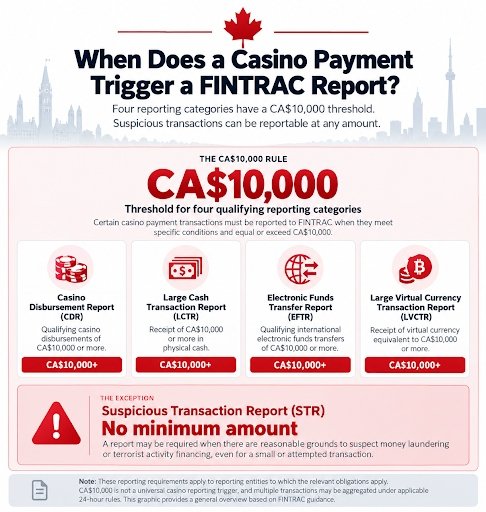
The table summarizes FINTRAC reporting categories for reporting entities to which the relevant obligations apply. It does not mean every private online gambling brand must independently submit each report.
The CA$10,000 threshold is particularly important because applicable 24-hour aggregation rules can bring multiple smaller transactions within reporting requirements.
For example, two qualifying casino disbursements of CA$6,000 each may trigger reporting if they occur within the relevant period and meet the applicable aggregation conditions.
A suspicious transaction works differently.
A CA$500 payment could require a report if the reporting entity has reasonable grounds to suspect a connection to money laundering or terrorist activity financing. Conversely, a large transaction is not automatically suspicious merely because it exceeds CA$10,000.
FINTRAC's guidance requires reporting entities to consider the facts, context and relevant indicators when assessing suspicious activity.
GambleOnline.ca provides a more detailed explanation of these distinctions in its guide to FINTRAC reporting requirements for Canadian casinos, including casino disbursements, suspicious transactions and electronic funds transfers.
For payment technology companies, the practical challenge is designing systems that distinguish transaction types rather than applying the same reporting rule to every payment.
Know Your Customer (KYC) procedures are one of the most visible parts of gambling compliance.
Players may be asked to provide identification when registering an account, making certain transactions or requesting a withdrawal.
But customer verification is not necessarily a single event.
Reporting entities must apply identification requirements when legally required, maintain appropriate records and monitor relevant activity according to their risk assessments.
A customer who has already completed an identity check may still trigger additional scrutiny if their subsequent transactions present unusual risks.
Consider a hypothetical player who deposits CA$2,000, places a small number of wagers and then requests a withdrawal of nearly the entire balance.
The transaction does not automatically establish money laundering. There may be an innocent explanation.
However, a monitoring system might identify the pattern for review because the account appears to be used primarily to move funds rather than participate in gambling.
A compliance analyst could examine the customer's transaction history, account information, payment method and other relevant indicators before determining whether further action is necessary.
This creates a technical challenge for operators and their fintech partners.
A system that generates too many false alerts increases manual review costs and can delay legitimate withdrawals. A system that misses relevant patterns can expose the business to financial-crime risks and regulatory consequences.
The objective is therefore not simply to block unusual payments. It is to identify activity requiring investigation while allowing legitimate transactions to proceed efficiently.
Canadian consumers are accustomed to fast digital payments, particularly through services such as Interac e-Transfer.
Yet a payment method capable of transferring funds quickly does not guarantee that a casino withdrawal will be completed immediately.
The withdrawal process may involve several separate stages.
First, the operator receives the request and checks whether the funds are available for withdrawal. The account may then be reviewed for identity-verification issues, payment-method consistency, fraud indicators or other compliance concerns.
If the transaction requires manual examination, the operator may need additional information before authorizing payment.
Only after the withdrawal is approved does the payment-processing and settlement stage begin.
The difference between these stages matters commercially.
A customer may interpret a delayed withdrawal as a problem with the payment provider when the transfer has not yet been released by the operator.
For fintech companies, clear transaction-status information and effective integration with compliance systems can reduce unnecessary support requests.
However, AML checks should not be treated as a universal explanation for slow withdrawals. Processing schedules, payment-provider limitations, account conditions and operational delays can also affect the time required.
Ontario and Alberta provide useful examples of how federal financial-crime obligations interact with provincial gambling frameworks.
Ontario's competitive online gambling market launched in April 2022. The Alcohol and Gaming Commission of Ontario (AGCO) regulates gaming operators and suppliers, while the province's conduct-and-manage structure determines how private companies participate.
AGCO's Registrar's Standards require operators to implement controls addressing unlawful activity, including relevant financial-crime risks.
Those requirements are distinct from FINTRAC's federal reporting obligations, even when they address similar risks.
An operator may need to demonstrate that its systems can detect suspicious activity and support the province's compliance framework without independently becoming the entity legally responsible for every FINTRAC casino report.
Alberta introduced its competitive iGaming market in July 2026, creating a second major Canadian market for private online gambling operators.
Although federal AML legislation applies nationally, the provincial arrangements governing operators, regulators and payment infrastructure are not necessarily identical.
That creates additional work for companies operating in both provinces.
Technology providers need to understand which organization is responsible for particular controls, what information must be exchanged and how reporting procedures fit into each province's operating model.
A payment platform built for Ontario may provide a useful foundation for Alberta, but it cannot assume that every contractual and regulatory responsibility transfers unchanged.
AML compliance is an operating expense as well as a regulatory obligation.
For gambling operators, costs can include identity-verification services, transaction-monitoring software, compliance personnel, employee training, independent reviews and record-management systems.
Payment providers may face additional expenses associated with their own regulatory classification and obligations.
The financial impact extends beyond direct spending.
When customers abandon registration because verification is difficult, operators lose potential business. When legitimate transactions are repeatedly flagged, customer-service workloads increase.
Delays can also affect customer trust, particularly when users receive little explanation about why a withdrawal is under review.
These problems create opportunities for specialized fintech providers.
Automated identity checks can reduce manual document handling. Transaction-monitoring platforms can identify patterns across large volumes of payments. Case-management systems can help compliance teams document investigations and maintain audit trails.
However, automation does not eliminate the need for professional judgement.
A system can identify unusual activity, but reporting decisions still require an assessment of the relevant facts and legal standards.
Businesses also need to consider data protection, cybersecurity and the reliability of third-party vendors.
Outsourcing a compliance function does not automatically transfer the reporting entity's legal responsibilities to the technology supplier.
Several technologies are becoming increasingly relevant to financial-crime controls in online gambling.
Digital identity systems can compare customer information against documents and other verification sources. Device and behavioural analytics may help detect account takeover attempts or coordinated fraudulent activity.
Transaction-monitoring systems can examine payment frequency, unusual funding patterns and relationships between accounts.
Some providers use machine learning to prioritize alerts and identify behaviour that traditional rules might overlook.
The commercial value of these technologies depends on measurable results.
A platform that identifies more suspicious activity but produces an overwhelming number of false positives may create additional work rather than reduce it.
Likewise, a faster onboarding process is not necessarily better if it weakens identity verification.
For Canadian fintech companies, the opportunity lies in helping gambling businesses meet their obligations while reducing unnecessary friction.
That requires integration with existing payment systems, clear audit records, configurable monitoring rules and an understanding of Canadian regulatory requirements.
It also requires attention to the distinction between anti-money-laundering monitoring and responsible gambling controls.
Both may examine customer behaviour, but they serve different purposes. AML monitoring focuses on potential financial crime, while responsible gambling systems identify indicators of gambling-related harm.
Combining relevant data can improve operational visibility, but the two functions should not be treated as interchangeable.
Canada's expanding online gambling industry is likely to increase demand for payment infrastructure and compliance technology.
More operators mean more accounts, deposits, withdrawals and transactions requiring appropriate controls.
But the growth opportunity is not simply about processing larger payment volumes.
Financial institutions and payment providers must determine whether they fall within FINTRAC's reporting framework, while gambling businesses must understand their responsibilities under the relevant provincial systems.
The businesses best positioned to serve this market will be those that can support reliable payments, effective financial-crime controls and a manageable customer experience.
For regulators, the challenge is maintaining oversight as technology and transaction methods evolve.
For fintech companies, the challenge is building systems that make compliance part of the payment process rather than an obstacle added after the transaction.
Canada's online gambling expansion is therefore also a test of its financial technology infrastructure. The companies moving the money, verifying customers and monitoring transactions will play an important role in how efficiently the industry operates.
GambleOnline.ca is an independent online gambling media website founded in 2008, publishing experience-based reviews, guides and analysis of online casinos, sportsbooks and poker platforms. Its editorial team conducts hands-on testing and research to provide factual, player-focused insights, alongside educational content on gambling strategy, legality and responsible play.
The National Crowdfunding & Fintech Association (NCFA Canada) is a financial innovation ecosystem that provides education, market intelligence, industry stewardship, networking and funding opportunities and services to thousands of community members and works closely with industry, government, partners and affiliates to create a vibrant and innovative fintech and funding industry in Canada. Decentralized and distributed, NCFA is engaged with global stakeholders and helps incubate projects and investment in fintech, alternative finance, crowdfunding, peer-to-peer finance, payments, digital assets and tokens, artificial intelligence, blockchain, cryptocurrency, regtech, and insurtech sectors. Join Canada's Fintech & Funding Community today FREE! Or become a contributing member and get perks. For more information, please visit: www.ncfacanada.org
| | |
|---|---|---|
| | |
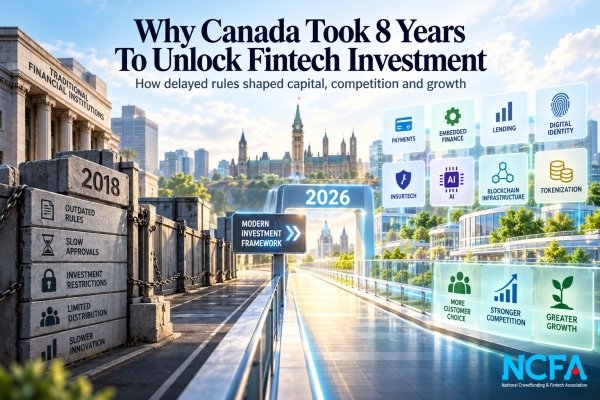
On October 17, 2026, Finance Canada published proposed fintech investment and technology regulations for powers Parliament approved in June 2018 and never brought into force. The package reaches more than 400 federally regulated financial institutions.
Finance now says the older rules can “prevent or complicate” fintech investment, limit capital flowing into innovative sectors and impede productivity growth. Eight years after Parliament acted, the operating rules are still only proposed.
The delay wasn’t one long consultation. Finance’s own record shows six concrete problems. Officials had to draw the regulatory perimeter between finance and technology, preserve the barrier against unrelated commerce, set revenue and regulatory capital limits, stop the rules from squeezing smaller institutions, and cut reporting requirements industry said were too heavy. Then Parliament had to repair defects in the 2018 statute in 2024. Six problems turned one reform into eight years of rulemaking.
This wasn’t a ban on fintech investment. Banks and insurers could still buy businesses that fit the existing rules. The trouble started when a fintech mixed finance with commercial software or expanded after an institution had invested. Banks had already warned that some domestic technology approvals took three to four months. The 2026 proposal would finally give qualifying mixed businesses a new route when at least 60% of their activity is financial, subject to separate limits on the investor.
Finance opened the review in 2016. It held 32 meetings and received 63 written submissions, then received 300 submissions in 2017, with 25 focused on fintech. Finance later acknowledged that incumbent institutions and industry associations were better represented than independent fintechs and venture investors.
Bankers came with a practical complaint. The Canadian Bankers Association’s 2017 submission said some domestic technology approvals could take three to four months and covered only the activities named in the application. That’s a poor fit for a fintech that can add a product, market or subsidiary in the time it takes a large institution to finish an approval process.
Founders weren’t building tidy regulatory categories. Payments were moving into merchant software, identity tools could serve banks and law offices, and data companies were becoming financial infrastructure while selling into other industries. The old rules drew cleaner lines than the market did.
Investors wanted a wider lane too. Finance said collaboration could pair fintech speed with the balance sheets and customer relationships of established institutions. Portag3 Ventures, then backing Canadian companies including Wealthsimple, Borrowell and KOHO, supported broader investment flexibility and argued that bank financing and collaboration were important to the fintech ecosystem. Capital and distribution were already part of the policy problem.
Under the Bank Act route described by the CBA, a substantial investment generally had to stay inside permitted activities. If even one ancillary activity or a downstream subsidiary moved outside that list, the bank could face another approval, a different investment classification or divestment. The CBA called the restriction a “significant impediment” with the potential to restrict Canadian innovation.
Insurers ran into the same boundary from another direction. The life insurance industry’s 2017 submission said an insurer could use identity or anti money laundering technology inside finance but couldn’t freely sell the same capability to law offices, real estate firms, other businesses or government. Useful technology could have a broader market, while the ownership and commercialization rules stayed narrow.
A growing fintech can create a problem for the shareholder that helped fund it. Add inventory software, merchant analytics or a commercial subsidiary because customers want them, and the business may no longer fit the permission that supported the original bank investment. The CBA warned that this could discourage fintechs from working with banks.
Insurers faced a similar commercial choice. A tool built for regulated finance might have customers far beyond finance, yet the legal route could narrow who could own the business or where the product could be sold. That can influence which investor a founder takes, how the company is structured and which markets it enters next.
Parliament responded on June 21, 2018. The 2018 Budget Implementation Act broadened permitted technology activities, removed prior ministerial approval for the expanded nonfinancial activities, widened referral powers and created a new investment category for companies whose businesses were mostly financial services. The law clearly moved toward more flexibility.
But Parliament didn’t define how much of a company had to be financial to qualify as a majority financial services entity. It also left the revenue, capital, reporting and transaction conditions to regulation. Without those operating rules, institutions couldn’t use the new powers and stayed under the older framework.
Parliament gave banks and insurers broader ownership powers in June 2018. Finance still had to define the majority test, exposure limits and safeguards before anyone could use them. The authority existed. The investment route didn’t.
That left financial institutions making real investment decisions under the old framework while fintech business models kept widening. A company could fit the rules when a bank first invested and create a new legal problem later simply by adding a commercial activity customers wanted.
After Royal Assent, Finance worked with the CBA, the Canadian Life and Health Insurance Association and OSFI. The first problem was the regulatory perimeter. Finance called separating new technology activities from core financial services a “serious technical challenge”, especially when the same staff, assets and systems served both. Officials also had to preserve existing investment prohibitions and keep visibility into the new business.
Then came the operating limits. In 2019, officials worked through revenue caps, regulatory capital exposure, annual reports and transaction conditions. A 2020 technical review exposed two more problems. Uniform rules could box out smaller institutions, while the proposed reporting package could impose a significant burden. Finance later revised both.
The delay didn’t come from one unresolved issue. It came from six. Finance had to separate finance from technology, preserve limits on unrelated commerce, set revenue and capital exposure caps, give smaller institutions enough room to compete, and reduce reporting requirements industry said were too burdensome. Those were the five regulatory design problems documented through the consultation record.
The sixth problem sat in the law itself. Bill C-59 received Royal Assent in June 2024 and made technical corrections to the 2018 law. It fixed discrepancies between the English and French provisions and clarified that the expanded technology powers were limited to information technology. By then, Finance had already consulted in 2019, reviewed a draft in 2020, consulted again in 2021 and returned with another draft in 2024.
Every revision created another round of legal or regulatory work. Caps changed. Reporting changed. Parliament repaired the statute six years after passage. The first public regulations still didn’t reach Canada Gazette Part I until October 2026, even though stakeholders were asking by 2024 for the powers to come into force “as soon as feasible.”
National Bank took control of Flinks in 2021. Its disclosed transaction included C$73 million for voting preferred shares followed by another C$30 million investment. The bank’s interest rose to 85.9%.
RBC bought WayPay in 2019 to expand automated business payments and account reconciliation. Canada Life acquired ClaimSecure in 2021, adding 1.25 million plan members and technology handling more than C$1.2 billion in annual claims payments. Canada Life and ClaimSecure later launched a combined benefits product.
Those deals matter because they rule out the easy story. Canada didn’t ban institutional fintech investment, and banks and insurers kept buying businesses that fit the existing framework. The squeeze showed up at the edges, where finance blended with commercial activity or a company later expanded beyond the legal fit that supported the original investment.
By October 2026, Flinks had moved beyond financial data connectivity into banking development, payment integrations, account switching and managed services. That’s exactly the kind of expansion a strategic shareholder may want to keep backing. Under the older framework, a different commercial move could force the shareholder to stop and ask whether it could legally stay invested.
The CBA warned that the legal fit could affect a deal before anyone applied for approval. If a fintech needed capital quickly, a bank bid carrying a regulatory condition could lose to cleaner, faster money. A later business change could also force the bank back into approval or divestment. A lost opportunity can disappear before Ottawa ever sees a file.
Finance expects more activity once the new route is usable. Over the past decade, roughly one institution per year sought the relevant ministerial approvals. Finance now assumes large banks will average two qualifying investments annually and large insurers one. The figures aren’t directly comparable, but Finance itself expects more activity because the process should be faster, less costly and more certain.
Government data can count approvals. It can’t count the bank bid that was never made, the expansion pushed into another company or the investor a founder never approached because the legal fit was poor. It can’t count technology an insurer decided not to sell outside finance either. Those decisions rarely leave a public record.
The economic toll starts before an approval file exists. A bank offer with conditions can lose to faster capital. A founder can split a product, delay a commercial move or avoid an investor whose ownership may become a future constraint. None of those choices needs a rejection letter to change the company’s path.
The October proposal finally puts a number on majority. A target can qualify when at least 60% of its business consists of qualifying financial activity, measured using whichever produces the highest result among revenue, operating expenses or assets. That gives younger or differently structured companies more than one way to clear the test.
The investor has separate limits. Institutions with more than C$12 billion in equity would face a 10% nonfinancial revenue ceiling and a 10% regulatory capital exposure limit. Small and medium institutions with C$12 billion or less in equity would get 15% revenue headroom while keeping the same 10% capital limit.
Take a payments company that also sells merchant software. Under the older activity based route, one impermissible commercial activity could knock the company out of that investment permission. Under the proposal, a business with 70% qualifying financial activity and 30% other commercial activity could potentially qualify. The 70 and 30 split is illustrative, but the business consequence is straightforward. The founder may no longer have to strip out every useful commercial feature just to keep a bank investor eligible.
The percentages don’t describe the same limit. The historical 5% exemption covered certain bank technology investments without approval and required the investee to stay within prescribed activities. The new 60% test applies to the target company’s business mix. The 10% and 15% limits apply to the investing institution’s aggregate nonfinancial business. There isn’t a simple old cap and new cap comparison.
More eligible bank and insurer investors can improve financing choices, distribution and negotiating leverage for an independent fintech. A strategic buyer can get a product in front of customers much faster. It can also end up owning technology several competing institutions rely on. More capital and more competition aren’t automatically the same outcome.
Finance is trying to keep sight of that risk. Certain large acquirers would have to report material supply arrangements between a target and the acquirer’s competitors. Smaller and medium institutions get more revenue headroom and no new reports, because identical limits would leave them with much less room to compete.
A wider buyer pool can help founders raise money, get distribution and negotiate exits. It can also put an important supplier or emerging challenger inside a major incumbent. That’s where the reform shifts from a capital question to a competition question.
The Competition Bureau’s fintech study supported removing unnecessary barriers to entry and collaboration while keeping scrutiny where incumbent relationships could weaken competition. Finance’s new supply reporting reflects the same concern. The useful outcome isn’t simply more acquisitions. It’s more capital reaching strong companies without draining independent competitive pressure from the market.
Finance estimates the proposed rules will add C$267,518 in annualized administrative and compliance costs, or about C$1.88 million in present value over 10 years. Those figures cover the new reporting burden. They don’t count the savings from removing some ministerial approvals, and they certainly don’t capture eight years of slower, narrower business choices under the old framework.
The regulations are proposed, not in force. Canada Gazette Part I opened a 30 day consultation on October 17, 2026, with comments due November 16. The government still has to finalize the regulations and use a separate Order in Council to activate the dormant 2018 amendments.
The last round now turns on execution. The 60% definition has to work for current fintech business models, smaller institutions need enough room to compete, and Finance needs visibility into new risks without rebuilding the reporting burden industry spent years pushing back on. Get those choices wrong and the reform can still underdeliver even after eight years.
Canada has already spent eight years designing conditions around powers Parliament approved in 2018. The next step is simpler to describe and harder to deliver. Put the rules into force, give good businesses a workable path to institutional capital, and keep enough independent competition in the market that customers actually benefit.
Canada’s eight year delay carried a real economic toll. Banks faced approval processes that could take three to four months. Mixed fintechs could lose access to some bank or insurer investors as they expanded. Insurers had less room to sell useful technology outside financial services. Finance now says the old framework can prevent or complicate investment, limit capital and impede productivity. We can’t put a credible dollar figure on every deal, product or expansion that went another way, but the commercial cost isn’t abstract. It lands in who funds a company, what it builds next and how quickly it gets to market.
Canada has good reasons to keep banks and insurers out of unrelated commerce. Those guardrails protect stability and stop financial institutions from controlling too much of the wider economy. But a safeguard carries a cost when rules written for older business models keep constraining newer ones after Parliament has already approved change. The Competition Bureau’s fintech progress review has warned that regulatory barriers can weaken competition too. Capital won’t wait eight years for rulemaking to catch up.
Founders didn’t stop building while Ottawa worked through the rules. Banks and insurers still found ways to invest where the old framework allowed it, as Flinks, WayPay and ClaimSecure show. The 2026 proposal can widen those paths without turning strategic investment into another route to incumbent control. Eight years are gone. The better outcome now is a market where good Canadian fintechs have more ways to finance growth, commercialize useful technology and challenge the status quo.
The National Crowdfunding & Fintech Association (NCFA Canada) is a financial innovation ecosystem that provides education, market intelligence, industry stewardship, networking and funding opportunities and services to thousands of community members and works closely with industry, government, partners and affiliates to create a vibrant and innovative fintech and funding industry in Canada. Decentralized and distributed, NCFA is engaged with global stakeholders and helps incubate projects and investment in fintech, alternative finance, crowdfunding, peer-to-peer finance, payments, digital assets and tokens, artificial intelligence, blockchain, cryptocurrency, regtech, and insurtech sectors. Join Canada's Fintech & Funding Community today FREE! Or become a contributing member and get perks. For more information, please visit: www.ncfacanada.org
| | |
|---|---|---|
| | |
Oct 10, 2026 | Last Updated: Oct 28, 2026 | NCFA Fintech Whisperer | Artificial Intelligence And Data, Capital Markets Infrastructure And Funding, Cross Border Payments And FX, Cybersecurity Fraud And Financial Crime, Digital Assets Blockchain And Tokenization, Digital Banking And BaaS, Payments Infrastructure And Money Movement, Regulation And Policy, Wealthtech Investing And Trading, Risk Compliance And Regtech, Sustainable Finance ESG And Financial Inclusion

Image: Freepik
This live weekly NCFA intelligence page tracks financial technology developments that significantly affect how fintechs build, sell, raise capital, and operate under scrutiny. Coverage prioritizes Canada and includes global events that directly influence competitive conditions, market access, and execution realities across fintech sectors. This page will be updated throughout the week with market movers in a live format and then each week we'll close the prior week's contents in prep for the upcoming week, and continue on a rolling basis. (Missed prior week's Fintech Whisperer? (December 6-12, 2025, December 13-19, 2025, January 1-9, 2026, January 10-16, 2026, January 17-23, 2026, January 24-30, 2026, January 31-February 6, 2026, February 7-13, 2026, February 14-20, 2026, February 21-27, 2026, February 28-March 6, 2026, March 7-March 13, 2026, March 14-March 20, 2026, March 21-March 27, 2026, March 28-April 3, 2026, April 4-10, 2026, April 11-17, 2026, April 18-24, 2026, April 25-May 1, 2026, May 2-8, 2026, May 9-15, 2026, May 16-22, 2026, May 23-29, 2026, May 30-June 5, 2026, June 6-12, 2026, June 13-June 19, 2026, June 20-June 26, 2026, June 27-July 3, 2026, July 4-July 10, 2026, July 11-July 17, 2026, July 18-July 24, 2026, July 25-July 31, 2026, August 1-August 7, 2026, August 8-August 14, 2026, August 15-August 21, 2026, August 22-August 28, 2026, August 29-September 4, 2026, September 5-September 11, 2026, September 12-September 18, 2026, September 19-September 25, 2026, September 26-October 2, 2026, October 3-October 9, 2026).
Anthropic's lease gives EverWind a committed customer for its first development phase, strengthening the commercial case for a major Canadian infrastructure investment. But financing AI compute infrastructure depends on more than tenant demand. Power availability, construction costs and grid approvals determine when that demand becomes revenue. For investors, the distinction is between securing a customer today and delivering profitable computing capacity on schedule.
Hong Kong banks now have updated supervisory guidance for deploying AI, while future rules for autonomous agents remain under discussion. Banks investing in these systems need clear ownership of decisions, reliable input data and controls that allow staff to intervene. Canadian financial institutions face many of the same questions as they expand AI into lending, compliance and customer service. The operating advantage will depend on speed and cost savings that hold up under supervisory review.
TD is using AI to clear document checks at more stages of the mortgage process, freeing staff to handle exceptions and borrower decisions. The reported time savings are substantial, but lenders still need to measure end-to-end completion times, error rates and rework. The investment pays off when faster reviews translate into funded mortgages without weaker controls.
The first deadline arrives well before the settlement switch. Brokers, custodians and asset managers now need to reconcile message formats, client instructions and exception handling across counterparties. Canadian firms trading European securities face the same operational handoffs. A short settlement cycle leaves less room to repair missing allocations overnight.
Loan syndication involves years of servicing, amendments and lender coordination after the initial funding. Handling those events on a shared record could reduce duplicate reconciliations and disputes over loan status. The same operating question sits behind shared bank blockchain infrastructure: can participants keep one reliable record without adding new integration costs? Lenders will want evidence of repeat transactions before committing more capital.
Paid investor communities can create recurring revenue for crowdfunding platforms, but the fee can't become a barrier to understanding what investors are buying. Operators need to show enough deal information before collecting membership payments and explain exactly what those fees purchase. The bigger commercial issue is trust. Platforms that sell access before demonstrating investment value risk higher acquisition costs, complaints and regulatory scrutiny. A subscription model can work, but it still has to earn investors' money.
Longer trading hours change the conditions under which orders meet available liquidity. Marketplaces and brokers need controls that work when fewer orders are on the book and prices can travel farther on small trades. The consultation gives Canadian trading firms a chance to address threshold design before extended hours become a larger operational commitment.
BNY has demonstrated that tokenized market infrastructure can support real overnight financing, not just digital settlement. For dealers, the advantage could be faster access to collateral and lower funding friction. The economics depend on custody fees, connections to other counterparties and how often the process can be repeated at scale. One completed repo proves the workflow; regular volume would prove the business case.
The partnership tackles a central obstacle for tokenized funds: reaching investors through regulated broker dealer workflows they already use. Federated Hermes brings investment products; Prometheum would provide custody, clearing and brokerage connections. Managers and intermediaries will judge the offer by distribution costs, settlement performance and investor demand, not the use of tokens alone. The first fund remains planned for 2027.
Origin gives TXSE a publicly traded bank issuer and a practical chance to compete for U.S. listings. But a listing win is only the beginning. Brokers and investors will judge the exchange by trading depth, spreads, execution quality and reliable access to market data. Those measures will determine whether other issuers see a commercial reason to follow.
Evernorth offers stock market investors exposure to a company holding a large XRP treasury without requiring them to buy XRP directly. Its shares may trade at a premium or discount to the underlying assets. Investors should weigh treasury management, operating costs and future capital decisions against the simpler alternative of owning the asset itself.
Institutions can now manage traditional market exposure through a crypto trading venue when stock and futures exchanges are closed. That's a meaningful opening for firms that trade across time zones, but 24 hour access doesn't guarantee deep liquidity or better prices. Prime brokers and market makers will compare margin efficiency, weekend spreads and counterparty risk with established derivatives markets before moving significant volumes.
RPAA registration gives payment providers a defined route to serve Canadian businesses, along with continuing safeguarding and reporting duties. Payoneer can use that standing in discussions with customers and banking partners. For competing providers, the relevant costs extend beyond registration to the controls needed to maintain it.
The restrictions change how banks price rupee hedges and how companies manage currency exposure. Dealers face cash reserve costs and tighter checks on the transactions they can accept. Corporate treasury teams may need to reassess hedging across multiple banks, especially when a cancelled contract can no longer be rebooked. The immediate commercial impact is on liquidity and flexibility, not just compliance paperwork.
Payment infrastructure is now being treated as critical digital infrastructure with direct cyber obligations attached. For operators, this moves resilience from good practice into a formal compliance responsibility. Boards and technology teams need to know which systems are designated, who owns incident decisions and whether reporting can happen fast enough when a critical payment service fails.
Frontier AI is raising the standard of evidence supervisors expect when reviewing financial institutions' cyber resilience. Boards need visibility into where AI changes their threat exposure, which vendors create concentrated dependencies and whether recovery plans still work against faster attacks. The immediate operating priorities are vulnerability management, supplier assurance, incident testing and clear accountability before failures expose gaps.
FIS is taking an AI investigation tool from development into commercial banking operations. The potential savings are substantial because analysts spend considerable time gathering records before judging an alert. But banks still own the compliance decisions. Buyers should examine audit trails, false positives and completed case volumes before relying on projected productivity gains. For Canadian providers, the competitive pressure is on evidence quality and operating cost, not merely the number of alerts an AI system can review.
Fraud intelligence is becoming shared infrastructure rather than a control each institution builds alone. TrustGraph takes a different technical route from Canada's CSAFE fraud exchange, using cryptographic matching instead of pooling customer records. The commercial advantage grows with participation: more institutions create more opportunities to identify repeat attacks before fraud reaches another account.
Fraud often crosses the boundary between a mobile account and a bank account. CSAFE gives participating firms confirmed intelligence from both sides, helping them recognize repeat attacks sooner. The financial value will come from fewer losses and investigations without blocking legitimate customers. That depends on timely, accurate contributions and disciplined privacy controls.
The penalties show how failures in alert handling, correspondent banking controls and sanctions screening can become major financial liabilities. For banking executives, the response requires more than a larger compliance budget: investigations must be timely, findings must reach decision makers and remediation must work across business lines. Investors should track the cost and effectiveness of those repairs.
USDC's designation brings a major stablecoin under closer EU oversight of capital, reserves and redemption. Circle must now manage a split supervisory relationship, while banks and payment providers gain a clearer view of which authority oversees critical financial safeguards. For Canadian stablecoin operators, the decision shows how growing scale can change supervisory obligations even after a token enters the regulated market. Compliance costs and the confidence of institutional counterparties will matter together.
Authorization gives the bank consortium an important legal foundation for issuing a euro stablecoin. It does not yet provide a token that customers can use. Banks, exchanges and payment providers will evaluate redemption certainty, liquidity and integration costs once issuance begins. Broad institutional backing could support distribution, but demand still has to be earned.
Stablecoin operators increasingly need both digital asset and payment permissions when products cross from trading into money movement. Flowdesk can now combine MiCA services with PSD2 payment capabilities inside one European regulatory structure. For firms comparing international models with Canada's stablecoin framework, the operating question is how quickly multiple regulatory permissions can translate into custody, transfers and institutional volume.
Institutional stablecoin use depends on custody, transfer permissions and access to trading venues. Standard Chartered now offers a regulated custody option for RLUSD. Its proposed LMAX integration could let clients use collateral without moving it to an exchange. The commercial benefit will depend on funding efficiency, safeguards and the costs of operating across several counterparties.
A bank issuing digital money needs to know which tokens are still valid before paying holders back. Episode Six puts that check inside the bank's ledger at the point of redemption, where an error could turn into a direct loss. The commercial question is whether this control reduces reconciliation work and fraud without slowing payment flows. Banks still have to prove the reserves exist; software checks aren't a substitute for that obligation.
Buying Saldo could give Payward direct control over more European deposit and lending services instead of relying on bank partners for every product. The agreement is not ownership yet, and regulated banking brings capital and supervision costs. Once the deal closes, investors should watch customer uptake, funding costs and whether the combined businesses improve margins.
IKB would give Crédit Agricole an established German business lending franchise and relationships it would otherwise have to build customer by customer. That creates opportunities to offer existing borrowers more services and fund loans through a larger banking group. Returns will depend on credit quality, customer retention and integration expenses after closing.
Banks need reliable customer records to lend and open accounts across borders, but moving those records creates cost and privacy concerns. This platform lets participating institutions verify information without receiving the underlying files. That could shorten onboarding and credit checks for businesses operating in both markets. The next test is how many banks integrate it, what it costs per verification and whether customers see faster decisions.
Direct payment access could change the economics of launching a fintech in South Africa. Providers would have a route to clearing and settlement without depending on a sponsoring bank for every transaction. That could reduce intermediary costs and give new entrants more control over their services. The commercial opportunity now depends on licensing requirements, connection fees and how quickly the new infrastructure can support real transaction volume.
Stablecoin funding can help payment companies keep less idle cash in multiple accounts while supporting payouts outside traditional banking hours. Visa and Inyo now have a production service, but the financial gain depends on conversion costs, liquidity and the actual timing of settlement. Banks and payment fintechs should compare those economics with their existing prefunding arrangements before assuming round the clock access will improve margins.
Payment fintechs spend time and money negotiating access to the systems that move customer funds. A simpler rulebook could reduce duplicated compliance work and make access terms easier to challenge when incumbents impose costly conditions. But consolidation alone won't guarantee better access. Founders need to examine connection charges, technical requirements and the rights available when an operator refuses entry. Those details will determine whether the reform lowers the cost of competing or mainly reduces paperwork.
Mastercard is turning its BVNK acquisition into a distribution channel for businesses that need to hold, convert and pay in both bank money and stablecoins. A single integration may lower development and reconciliation costs for fintechs. But buyers will still compare pricing, available corridors and responsibility for funds across the service. The competitive question is whether bundled infrastructure delivers better working capital management than separate providers.
Local acceptance capacity gives merchants more than another foreign payment option. It can improve authorization routing and reconciliation where domestic rules differ. Nuvei already connects payment acceptance with enterprise invoice workflows; South African access extends the territory where that infrastructure can be sold. Merchant uptake and transaction performance will decide the return.
Owning licensed payment capacity changes Polygon’s role from infrastructure supplier toward a provider that can connect digital asset transfers to conventional money. It also adds a regulated distribution component to the stablecoin payment infrastructure opportunity. Customers will judge the combined platform by supported payment routes, settlement reliability and total cost, rather than token throughput alone.
Visa has gained a formal route toward operating in China’s domestic card market, but it cannot clear local transactions yet. The next milestones are the remaining approvals and connections with issuing banks, acquirers and merchants. Market share will depend on those relationships and the cost and quality of competing with established networks.
Payment providers could face an independent route for customer complaints, beyond their internal case handling. If adopted, membership would add costs for records, escalation and disputed transactions. Canada’s proposed open banking complaint requirements address related responsibilities for participants, although they are a separate regime. Firms selling payment and stablecoin services across borders need to cost customer redress into their operating model.
Listed companies need decisions about delayed disclosure to withstand scrutiny after information becomes public. The revised grounds offer more clarity, but they do not remove the obligation to assess confidentiality and investor impact in each case. Boards and legal teams should update decision records and approval procedures rather than treating the five additions as blanket exemptions.
Public companies must align earnings presentations, investor materials and financial statement notes before the reporting change. The CSA amendments apply to issuer disclosures, while separate IFRS 18 reporting changes affect federally regulated insurers. Finance teams should reconcile definitions across published measures and underlying accounts before disclosures reach investors.
The consultation puts detailed custody, settlement and capital proposals behind ASIC’s earlier digital asset licensing roadmap. Platform operators can now compare existing controls against draft requirements and price the cost of entering Australia. Firms must distinguish their responsibility for holding customer assets from their role in executing and settling trades.
Regulatory modernization could affect how quickly new financial products reach customers and how much compliance costs smaller entrants. The consultation gives fintechs and industry associations a chance to identify rules that impose costs without improving outcomes. The real test will be whether future supervisory reforms shorten approval timelines, reduce duplication and preserve financial safeguards.
Customer screening is now subject to closer scrutiny over why banks accept or decline legitimate businesses. Institutions need documented distinctions between lawful customer activity, financial crime risk and reputational judgments. For Canadian banks with US operations, policy review and audit evidence are practical priorities. Access decisions that cannot be defended consistently can carry supervisory and commercial costs.
The new safeguards require financial product distributors to prepare for tighter supervision of public sales activity. Firms should update staff training, customer consent records and controls over where representatives approach people. The transition period creates time to make those changes before MAS applies the revised guidelines.
GIFT IFSC is putting a clear accountability line around automated trading. A firm can use more advanced models, but it can't outsource responsibility to the software or its vendor. Brokers, trading firms and technology providers now have a concrete checklist for approval, testing, surveillance and shutdown controls before they scale automated strategies.
ASIC’s loss figures put pressure on brokers that rely on frequent, highly leveraged retail trading. The proposal could affect product terms, customer acquisition and dealing revenue if adopted. Platforms should assess those consequences now, while regulators consider whether the existing protections still address the products offered to retail investors.
European asset managers need to distinguish between holding companies with strong environmental credentials and demonstrating how investor capital contributes to measurable improvements. The supervisory examples also clarify how future transition promises should be explained and monitored. Canada's recent green taxonomy and investor trust debate addresses the complementary question of which activities qualify for sustainable financing in the first place.
The FSB has given financial institutions a common reference for assessing AI controls across business lines and technology providers. Banks and fintechs can compare their existing governance, vendor contracts, model inventories and monitoring against the final practices. The commercial challenge is keeping controls proportionate as AI adoption expands without making every deployment slower or more expensive.
Retail brokers cannot treat surveillance as a technology purchase and assume compliance is handled. Alert thresholds, investigation judgments and management review determine whether suspicious trading is escalated. NCFA’s market abuse risk research also covers more complex automated trading behavior. Brokers need case files and decision trails that stand up to supervisory examination.
This week brought production stablecoin payment services, a live €150 million blockchain loan and new rules for securities settlement and financial disclosures. Canadian firms also gained overseas payment access while domestic regulators advanced trading controls and reporting requirements. For founders, the opportunity lies in replacing costly operational steps with services customers will use repeatedly. Investors should look beyond launches to actual volumes, integration costs and the obligations that follow when a product becomes financial infrastructure.
NCFA offers various curated resources to help founders and investors stay current on developments that impact fintech markets. Get the weekly Whisperer and related market intelligence through NCFA's newsletter, view the latest fintech insights, industry research, or launch into emerging financial innovation opportunities.
The National Crowdfunding & Fintech Association (NCFA Canada) is a financial innovation ecosystem that provides education, market intelligence, industry stewardship, networking and funding opportunities and services to thousands of community members and works closely with industry, government, partners and affiliates to create a vibrant and innovative fintech and funding industry in Canada. Decentralized and distributed, NCFA is engaged with global stakeholders and helps incubate projects and investment in fintech, alternative finance, crowdfunding, peer to peer finance, payments, digital assets and tokens, artificial intelligence, blockchain, cryptocurrency, regtech, and insurtech sectors. Join Canada's Fintech & Funding Community today FREE! Or become a contributing member and get perks. For more information, please visit www.ncfacanada.org
| | |
|---|---|---|
| | |
Oct 16, 2026

Image: Unsplash/Karen Uppal
Wealth managers and enterprise founders are adopting flexible foundation vehicles in leading financial jurisdictions to safeguard international assets effectively. These legal frameworks give business families durable control over cross-border capital.
Running an international enterprise brings substantial operational reach, but cross-border wealth invites sudden legal exposure, tax friction, and succession disputes. When your commercial footprint spans multiple continents, managing assets through personal names or informal agreements leaves your life's work vulnerable to external shocks.
Forward-thinking business leaders now establish institutional holding structures designed to insulate capital across sovereign borders. Foundations in premier financial hubs combine corporate agility with structural preservation, giving your family firm a dependable platform for private governance.
Trusts historically served as the default choice for generational planning across common law nations. They separate legal ownership from beneficial enjoyment, which helps manage wealth distribution across successive generations.
Many international founders find standard trust mechanics too restrictive for dynamic commercial operations. Trustees hold ultimate legal title, meaning you must surrender day-to-day command over your underlying assets to an outside third party. Foundations solve this tension by operating as separate legal entities, blending the asset segregation of a trust with the structured decision-making of a private corporation.
Foundations own underlying assets in their own legal name because they possess standalone corporate status. When you choose to establish a foundation in ADGM as your primary holding structure, you preserve strategic oversight while separating personal risks from enterprise capital. That distinct legal boundary shields private investments from external disputes across different jurisdictions. Your chosen council administers daily tasks while strictly following your founder regulations.
You create the foundational charter, appoint the governing council, and outline your succession vision through bespoke bylaws. This arrangement prevents foreign courts from seizing operational companies during personal litigation, providing true insulation without stripping away commercial agility.
Global financial districts provide well-tested legal frameworks grounded in English common law. Their independent courts, digital registries, and clear statutory rules give wealth managers predictable enforcement mechanisms.
A research analysis from the Purdue University Daniels School of Business highlights that private wealth offices can maintain asset positions indefinitely, avoiding the forced divestment horizons typical of standard private equity funds. Operating within a respected global hub allows your family capital to hold strategic equity for decades without arbitrary regulatory disruptions. You gain direct access to sophisticated international banking corridors and world-class professional advisors.
International institutions scrutinize private capital structures with increasing rigor. Complex corporate wrappers without clear governance generate regulatory friction and complicate relationships with global investment counterparties.
A global survey published by the Harvard Law School Forum on Corporate Governance shows that major institutional capital providers demand accountability, operational transparency, and strict alignment with long-term enterprise value. Structuring your private holdings through a recognized foundation satisfies those institutional expectations by maintaining orderly council meetings, documented accounting trails, and transparent governance registers. That institutional credibility smooths cross-border transactions and builds confidence with institutional partners.
Integrating a foundation into your existing enterprise structure requires deliberate legal sequencing. You separate high-risk operating businesses from passive holdings, creating dedicated subsidiaries beneath the foundation canopy.
Holding structures work best when you divide assets by risk profile and geographic location. Trading companies, commercial properties, and liquid investment portfolios require individual corporate entities to isolate legal liabilities.
Structuring each asset class under dedicated holding companies isolates operational liability while leaving strategic stewardship firmly under council governance.
Passing control to the next generation frequently triggers internal conflicts if families leave succession rules ambiguous. Foundation bylaws eliminate this friction by spelling out voting privileges, distribution schedules, and leadership succession protocols before disputes arise.
You establish conditional distribution terms that support entrepreneurial initiatives among descendants rather than passive entitlement. Your wealth vehicle remains functional and self-governing, shielding family holdings from probate court delays across multiple countries.
Protecting cross-border wealth requires intentional governance structures built before external crises strike. Modern foundation frameworks give you legal security, administrative flexibility, and institutional standing to preserve your commercial legacy. When you align robust structural defenses with clear family bylaws, your enterprise navigates global market disruptions with lasting confidence.
The National Crowdfunding & Fintech Association (NCFA Canada) is a financial innovation ecosystem that provides education, market intelligence, industry stewardship, networking and funding opportunities and services to thousands of community members and works closely with industry, government, partners and affiliates to create a vibrant and innovative fintech and funding industry in Canada. Decentralized and distributed, NCFA is engaged with global stakeholders and helps incubate projects and investment in fintech, alternative finance, crowdfunding, peer-to-peer finance, payments, digital assets and tokens, artificial intelligence, blockchain, cryptocurrency, regtech, and insurtech sectors. Join Canada's Fintech & Funding Community today FREE! Or become a contributing member and get perks. For more information, please visit: www.ncfacanada.org
| | |
|---|---|---|
| | |
October 16, 2026 | Market Activity | Artificial Intelligence And Data, Lending Consumer Credit And BNPL, Competition And Market Structure

On October 15, 2026, Toronto-based Pineapple Financial launched Pentiv, a new operating brand and AI mortgage intelligence platform aimed at commercializing technology already used within its mortgage brokerage business. Its Recruitment Agent and Alternative Mortgage Renewal Agent operate within Pineapple+, while the new Pentiv platform is designed to bring those capabilities to independent brokerages and mortgage networks.
Pentiv also marks a change in Pineapple's business strategy. Rather than keeping its mortgage technology exclusively inside the brokerage, the company wants to commercialize tools developed through years of operating experience. The plan includes recurring software revenue and a potential separation of its technology and mortgage brokerage businesses, subject to corporate review and approvals.
Pentiv's Recruitment Agent helps brokerage managers identify promising mortgage professionals, prioritize outreach and organize recruiting activity. Its Alternative Mortgage Renewal Agent identifies upcoming or potentially at risk renewals, suggests customer outreach and helps manage supporting documentation. Both address recurring sources of revenue for brokerages: recruiting productive agents who originate new business and maintaining relationships with existing borrowers as their mortgages mature.
Pineapple has already reported results from its earlier AI recruiting initiatives. On May 5, 2026, the company reported adding 83 licensed agents to its national network since the beginning of the year. Management attributed part of that recruiting momentum to AI tools that shortened the process of bringing new agents from initial contact to active status. The result provides operating evidence behind Pineapple's recruitment strategy, although it doesn't establish how many hires were directly attributable to Pentiv's current application.
Renewals offer another source of commercial revenue. An alternative mortgage borrower may need new financing when a loan matures, particularly if income, property values or qualification requirements have changed. Brokers who identify those customers early have more time to discuss options, prepare documents and retain the relationship. Pentiv is targeting that work rather than replacing mortgage underwriting or loan origination systems.
The company has built both applications around workflows already used by Pineapple's mortgage professionals. This gives its developers direct feedback on where recruiting efforts stall, where customers need attention and which tasks consume staff time. The challenge in selling that technology externally is making it useful across brokerages with different systems, procedures and customer data.
Mortgage Professionals Canada's 2026 research found that 38% of recent homebuyers used a mortgage broker, up six percentage points from 2024. Among recent first-time buyers, broker use reached 48%. The survey also found that 83% of broker clients would recommend their broker and 72% of borrowers who used a broker for their current mortgage would use one again.
Mortgage software is already competitive. Filogix expanded Expert Pro renewal visibility in June 2026, enabling brokers to identify upcoming renewals associated with additional properties owned by existing borrowers. Pentiv will need to distinguish its intelligence tools from established mortgage software and demonstrate that they work effectively alongside systems brokerages already use. Its focus on professional recruiting gives it another area in which to compete.
Canada's banks are also investing in AI for mortgage operations, including TD's expansion of agentic AI. Pentiv is approaching the market from the brokerage side, where smaller firms often lack the resources to develop their own software. A commercially accessible intelligence platform could give those firms capabilities that would otherwise require significant internal technology investment.
The Pentiv announcement includes a corporate development with significant implications for investors. An October 15 SEC filing confirms that Pineapple's board established an independent special committee on October 9 to review a proposed restructuring. The plan contemplates separating the technology platform and digital asset treasury operations from the mortgage brokerage business, potentially followed by a brokerage spin-off. These proposals remain under review, with no completed separation announced.
Under the proposed arrangement, the brokerage could continue using Pentiv as an anchor customer while the technology business sells its applications more widely. That would preserve access to operating feedback while giving the software operation a different commercial focus. The arrangements governing technology ownership, customer data, licensing and financial relationships would become important parts of the proposed separation.
Usman Maher, Pentiv's newly appointed Chief Financial Officer and Chief Strategy Officer and a former SoFi executive, described the company's approach:
"We will prove the economics inside Pineapple, extend the platform to external brokerages, and scale adoption to build a durable intelligence company and long-term shareholder value."
Pentiv plans to report operating results from its recruiting and renewal applications, external brokerage pilots, customer agreements and recurring platform revenue over coming quarters. Pineapple Financial remains the legal reporting company, trading on NYSE American as PAPL, with a ticker change to PTIV anticipated around October 26, 2026. Its proposed corporate name change to Pentiv Inc. requires shareholder approval.
Pentiv's real commercial opportunity is turning proprietary brokerage experience into software that competitors are willing to pay for. Independent customer adoption, measurable financial returns and recurring revenue will determine whether Pentiv can command a valuation beyond its mortgage brokerage business.
The National Crowdfunding & Fintech Association (NCFA Canada) is a financial innovation ecosystem that provides education, market intelligence, industry stewardship, networking and funding opportunities and services to thousands of community members and works closely with industry, government, partners and affiliates to create a vibrant and innovative fintech and funding industry in Canada. Decentralized and distributed, NCFA is engaged with global stakeholders and helps incubate projects and investment in fintech, alternative finance, crowdfunding, peer-to-peer finance, payments, digital assets and tokens, artificial intelligence, blockchain, cryptocurrency, regtech, and insurtech sectors. Join Canada's Fintech & Funding Community today FREE! Or become a contributing member and get perks. For more information, please visit: www.ncfacanada.org
| | |
|---|---|---|
| | |
October 16, 2026 | Market Activity | Digital Banking, Lending Infrastructure, Embedded Finance

On October 14, 2026, Canadian fintech KOHO selected LoanPro's lending platform to support its next financial products across Canada. LoanPro will provide billing, servicing and reporting, while KOHO retains control of its mobile app and product design. The arrangement gives KOHO specialized credit infrastructure as it expands beyond everyday spending and savings into a broader range of financial products.
Founded in 2014, KOHO has served more than 2.5 million Canadians, according to the announcement. Its current services include credit building, instalment payments, cash advances and a revolving line of credit. Supporting these products requires more than a customer interface. KOHO needs systems that can manage repayment terms, account balances and servicing requirements as its credit offering grows.
KOHO Chief Product Officer Rusen Baragiola wants technology that can accommodate new financial products without limiting how the company designs them. LoanPro's platform provides configurable billing, account servicing and reporting, allowing KOHO to develop products within its own app while relying on specialist software to manage the underlying credit accounts.
"We chose LoanPro for the flexibility to bring new products to market quickly and responsibly."
KOHO already offers different repayment arrangements. Its Pay Later service allows eligible customers to divide purchases of up to $1,000 into payments over three, six or nine months. Its revolving line of credit allows borrowers to access funds as needed while paying interest only on the amount used. Each product requires its own billing rules, payment records and account management processes.
The LoanPro agreement also addresses a Canadian operating requirement. Credit products must accommodate applicable provincial rules, including those in Québec. LoanPro's configurable platform gives KOHO flexibility to adapt product terms and servicing processes across jurisdictions while maintaining a consistent experience in its app. For a company serving customers nationally, it's important as it introduces products with different repayment structures and eligibility requirements.
KOHO's existing line of credit provides a useful example of how the company works with lending partners. Eligible customers can access between $1,000 and $15,000 through Fora Credit, which handles underwriting, approval, funding and servicing. KOHO provides the customer relationship and digital access to the product.
How KOHO's lending responsibilities are currently divided:
| Company | Confirmed role | Product or arrangement |
|---|---|---|
| KOHO | Customer app, customer relationships and financial product design | Existing financial services and planned LoanPro supported offerings |
| LoanPro | Billing, credit servicing technology and reporting | New KOHO financial products under the October 2026 agreement |
| Fora Credit | Underwriting, credit approval, loan funding and servicing | Existing KOHO Line of Credit, offering $1,000 to $15,000 |
Sources: KOHO's published line of credit documentation and the October 14, 2026 LoanPro partnership announcement. The LoanPro agreement covers new offerings; it does not establish a change to Fora's existing responsibilities.
Fora is part of Toronto fintech lender Propel Holdings, which also operates the Freshline lending platform backed by a US$60 million financing agreement. KOHO already works with Fora to provide its line of credit, while LoanPro brings additional billing, servicing and reporting technology to support KOHO's next credit products. The two relationships serve different purposes within KOHO's lending business.
KOHO has served more than 2.5 million Canadians since 2014, giving it an established audience for new credit products. By keeping control of product design and the customer experience, KOHO can introduce different repayment options while relying on specialist partners for lending technology and operations.
KOHO's lending strategy raises a question about who controls the economics of consumer credit. A fintech may own the customer relationship, but its ability to set credit terms, approve borrowers and earn lending revenue depends on how responsibilities are divided with its partners. As KOHO expands, those arrangements could matter more to its competitive position than the technology powering the loans.
The National Crowdfunding & Fintech Association (NCFA Canada) is a financial innovation ecosystem that provides education, market intelligence, industry stewardship, networking and funding opportunities and services to thousands of community members and works closely with industry, government, partners and affiliates to create a vibrant and innovative fintech and funding industry in Canada. Decentralized and distributed, NCFA is engaged with global stakeholders and helps incubate projects and investment in fintech, alternative finance, crowdfunding, peer-to-peer finance, payments, digital assets and tokens, artificial intelligence, blockchain, cryptocurrency, regtech, and insurtech sectors. Join Canada's Fintech & Funding Community today FREE! Or become a contributing member and get perks. For more information, please visit: www.ncfacanada.org
| | |
|---|---|---|
| | |


August 26th, 2025

January 4th, 2024

June 1st, 2021

September 9th, 2020

July 9th, 2018

January 3rd, 2018

September 25th, 2017

June 20th, 2017

May 10th, 2017

December 14th, 2016