




Karsten Wenzlaff, Advisor
August 26th, 2025
Karsten Wenzlaff is a Crowdfunding and Fintech Expert from Germany. He is Secretary-General of Digit[...]


Mar 27, 2026 | NCFA Fintech Market Activity | Payments And Money Movement

Image: Freepik
On March 27, 2026, CoinPayments partnered with OSL Group to expand in APAC. The deal gives CoinPayments access to local payment rails and fiat off ramps across the region.
APAC is already a large and fast growing crypto market. Chainalysis' 2025 global crypto adoption reported that APAC transaction volume increased to $2.36T, up from $1.4T in a 12 month period ending June 2025. Crypto payments need merchants for local conversion, payout, and settlement that works in the market they serve.
CoinPayments brings real scale into that push. The company said earlier this month that it has processed more than $50B in crypto transactions and supports more than 250,000 merchants globally.
OSL brings a different advantage. After completing its Banxa acquisition in January 2026, OSL said its regulatory footprint expanded to more than 40 trading and payment licenses and registrations across the United States, Canada, the European Union, the United Kingdom, and Australia.
That gives the partnership a clear commercial logic. CoinPayments brings merchant reach. OSL brings regulated payout and conversion infrastructure. The March 27 announcement also builds on CoinPayments’ existing work with Banxa, so the operating link was already there before this APAC push.
In crypto payments, which creates more leverage over time: merchant reach or control of local payout and off ramp infrastructure?
 The National Crowdfunding & Fintech Association (NCFA Canada) is a financial innovation ecosystem that provides education, market intelligence, industry stewardship, networking and funding opportunities and services to thousands of community members and works closely with industry, government, partners and affiliates to create a vibrant and innovative fintech and funding industry in Canada. Decentralized and distributed, NCFA is engaged with global stakeholders and helps incubate projects and investment in fintech, alternative finance, crowdfunding, peer-to-peer finance, payments, digital assets and tokens, artificial intelligence, blockchain, cryptocurrency, regtech, and insurtech sectors. Join Canada's Fintech & Funding Community today FREE! Or become a contributing member and get perks. For more information, please visit: www.ncfacanada.org
 |  |  |
|---|---|---|
 |  |  |
Mar 26, 2026 | NCFA Insight | Artificial Intelligence And Data

On March 1, 2026, CodeWall, a security research firm focused on AI systems, privately reported security gaps to McKinsey. The firm said its agent found 22 unauthenticated endpoints, then chained a SQL injection issue and other weaknesses to gain read and write access across the production environment. CodeWall said the reachable data included 46.5 million chat messages, 728,000 files, 57,000 user accounts, 384,000 AI assistants, and 94,000 workspaces. It also said prompts, model configurations, and RAG related data were reachable.
On March 2, 2026, McKinsey acknowledged the findings and patched the unauthenticated endpoints the same day.
On March 9, 2026, CodeWall publicly shared research on vulnerabilities in McKinsey’s internal AI platform Lilli.
On March 11, McKinsey released this statement about the vulnerability and that a third party forensic review found no evidence that unauthorized parties accessed client data or client confidential information.
Public API documentation appears to have exposed a map of the system. Some endpoints reportedly required no authentication. One of them allegedly allowed database manipulation through JSON keys, which opened the door to SQL injection. From there, CodeWall said it could determine live production data and reach much deeper parts of the platform.
This incident doesn't point first to a model failure. It points to ordinary application security weaknesses around an AI system that had become deeply embedded in internal work.
McKinsey didn't confirm the full scale of the researcher claims. Instead, it focused on the response. The company said it fixed the issue quickly and found no evidence that unauthorized parties accessed client data or client confidential information.
Having said that, the reported scale of reachable internal material was large enough to raise questions about internal knowledge exposure, employee work patterns, and intellectual property concentration in one system.
CodeWall said prompt and configuration layers were reachable. If true, it means a bad actor could have potentially altered how the system retrieves information or generates answers. In an internal AI tool, that can create wrong outputs that look normal to staff.
That's where this type of incident becomes more useful for fintechs and financial firms. A publicly visible outage gets noticed whereas quietly altered outputs may not. In regulated environments, that can affect approvals, reviews, client treatment, policy interpretation, and internal decision support before anyone spots the pattern.
Banks, lenders, insurers, wealth firms, and fintechs are building similar internal AI layers right now. They connect those tools to policy documents, research, support logs, internal files, and customer related workflows because it saves time and helps staff move faster.
But that convenience comes with risk given that AI often pulls sensitive access into one place. If permissions are weak, endpoints are exposed, or prompt controls aren't protected, one internal tool can become a wider point of failure.
A key lesson founders and operators should take from this case, is to ask whether the application around it is locked down, whether prompts and retrieval rules are treated as sensitive assets, whether permissions are tight, and whether anyone has tested the system the way an attacker would.
Enterprise AI doesn't erase old security mistakes. It can magnify them by concentrating data, access, and trust inside a single interface.
The National Crowdfunding & Fintech Association (NCFA Canada) is a financial innovation ecosystem that provides education, market intelligence, industry stewardship, networking and funding opportunities and services to thousands of community members and works closely with industry, government, partners and affiliates to create a vibrant and innovative fintech and funding industry in Canada. Decentralized and distributed, NCFA is engaged with global stakeholders and helps incubate projects and investment in fintech, alternative finance, crowdfunding, peer-to-peer finance, payments, digital assets and tokens, artificial intelligence, blockchain, cryptocurrency, regtech, and insurtech sectors. Join Canada's Fintech & Funding Community today FREE! Or become a contributing member and get perks. For more information, please visit: www.ncfacanada.org
| | |
|---|---|---|
| | |
Mar 26, 2026 | NCFA Fintech Market Activity | Banking And Credit, Digital Assets And Tokenization

On March 26, 2026, Better and Coinbase launched the first token backed conforming mortgage. Qualified borrowers can pledge Bitcoin or USDC to fund a cash down payment while still taking out a standard mortgage that meets Fannie Mae rules. The structure lets borrowers use digital assets without selling them first and without automatically triggering a taxable sale event.
The product targets a large and growing borrower base. Better and Coinbase put the addressable market at 52 million Americans who own digital assets, equal to 20% of American adults. They also mention quite an age split, with 45% of younger investors holding crypto versus 18% of older investors. That age gap means it's much harder for younger buyers to meet traditional down payment cash requirements, yet many already hold part of their savings in digital assets.
There are no margin calls and no required top ups if Bitcoin falls in value. Price moves alone do not trigger liquidation. Collateral comes into play only if a borrower becomes 60 days delinquent, under the same treatment applied to standard conforming mortgages. Borrowers using USDC can also earn rewards on pledged balances, which may offset mortgage payments and lower the net effective rate.
The buyer profile is also broader than a luxury crypto niche. Better and Coinbase said 67% of token holders are 45 or younger and 26% earn less than US $75,000 a year. They also pointed to Redfin data showing 12.7% of Gen Z and Millennial homebuyers have already sold tokenized assets to fund a down payment, versus 3.5% of Gen X and 0.5% of Baby Boomers.
Digital assets are now included in standard mortgage structure, not just a trading or investment account. Token holdings now help fund a conforming mortgage down payment without forcing a sale first. As this model grows, digital assets will look less like something borrowers need to liquidate and more like collateral lenders may be willing to work with.
Better and Coinbase also plan to expand eligible collateral over time to include tokenized equities, fixed income, and tokenized real estate assets. If that happens, the story will not stop at mortgages. It will continue to proliferate into which consumer lending products can absorb token backed collateral and under what terms.
If digital assets can now help fund a conforming mortgage, which standard lending products could be next to accept token backed collateral?
The National Crowdfunding & Fintech Association (NCFA Canada) is a financial innovation ecosystem that provides education, market intelligence, industry stewardship, networking and funding opportunities and services to thousands of community members and works closely with industry, government, partners and affiliates to create a vibrant and innovative fintech and funding industry in Canada. Decentralized and distributed, NCFA is engaged with global stakeholders and helps incubate projects and investment in fintech, alternative finance, crowdfunding, peer-to-peer finance, payments, digital assets and tokens, artificial intelligence, blockchain, cryptocurrency, regtech, and insurtech sectors. Join Canada's Fintech & Funding Community today FREE! Or become a contributing member and get perks. For more information, please visit: www.ncfacanada.org
| | |
|---|---|---|
| | |
Mar 25, 2026 | NCFA Fintech Market Activity | Digital Assets And Tokenization

On March 25, 2026, BitGo added qualified custody support for USDCx and cBTC on the Canton Network. This expands its role on Canton beyond Canton Coin and into CIP-56 assets, the token format Canton uses for regulated financial markets.
The CIP-56 token standard supports private transactions, built in KYC and AML controls, delivery versus payment settlement, and final settlement within seconds. Those features give institutions the controls they need to use tokenized assets in real collateral and settlement workflows.
Canton describes itself as a privacy enabled blockchain network for institutional assets, with about 600 validators live and more than 15 million monthly transactions using Canton Coin in their flows. That's why BitGo's expansion is interesting because it plugs additional assets into a network that's already being built for regulated financial activity, not retail token trading.
USDCx already serves as the settlement currency for out of hours repo settlement and tokenized collateral workflows on Canton. It is issued through Circle’s xReserve framework. cBTC adds bitcoin backed liquidity to the same environment, giving firms another asset they can use across collateral and settlement activity. This isn't just broader token support. It makes the settlement layer more usable.
Qualified custody for Canton Coin launched in October 2025, and token support followed in less than six months. The work is no longer just about putting assets onchain. It is about building the custody, collateral, and settlement stack that institutions need around them.
Canton is also drawing in more institutional infrastructure, including tokenized money market fund infrastructure from Goldman Sachs and BNY. This BitGo move adds another piece to the same buildout. If tokenized finance is going to work at scale, firms need more than issuance. They need custody that institutions trust, settlement assets they can use, and compliant rails that hold up under real volume. That's where commercial value is starting to concentrate.
As tokenized markets add stablecoin settlement, bitcoin backed liquidity, and qualified custody, which firms become hardest to replace?
The National Crowdfunding & Fintech Association (NCFA Canada) is a financial innovation ecosystem that provides education, market intelligence, industry stewardship, networking and funding opportunities and services to thousands of community members and works closely with industry, government, partners and affiliates to create a vibrant and innovative fintech and funding industry in Canada. Decentralized and distributed, NCFA is engaged with global stakeholders and helps incubate projects and investment in fintech, alternative finance, crowdfunding, peer-to-peer finance, payments, digital assets and tokens, artificial intelligence, blockchain, cryptocurrency, regtech, and insurtech sectors. Join Canada's Fintech & Funding Community today FREE! Or become a contributing member and get perks. For more information, please visit: www.ncfacanada.org
| | |
|---|---|---|
| | |
Mar 25, 2026 | NCFA Insight | Regulation And Policy, Capital Markets And Market Infrastructure
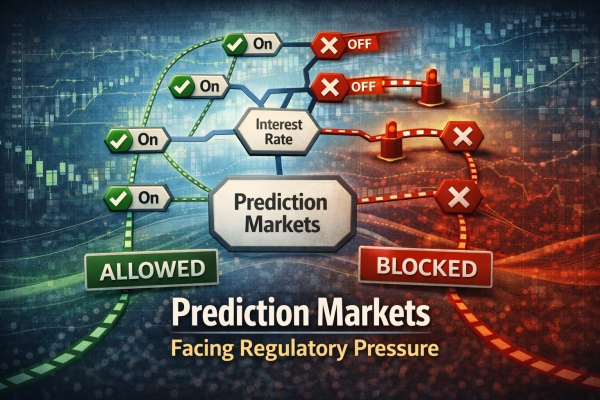
Sports volume built the business. Now rules, surveillance, and product limits will decide who lasts. On March 23, 2026, a bipartisan Senate bill moved to ban sports and casino style contracts on CFTC registered prediction market venues. The Senate release said a March Madness winner contract had already passed $100M in trading volume and that Super Bowl prediction market volume topped $1B in 2026.
Those numbers explain why prediction markets are now under direct pressure from lawmakers. Prediction markets are no longer fringe. They now sit in a fight over who regulates them, which contracts stay allowed, and whether the business still works under tighter rules.
Sports helped prediction markets reach a wide audience fast, but that same growth put them in direct competition with state regulated sportsbooks and tribal gaming interests. The Prediction Market Senate bill to ban sports contracts is aimed straight at that overlap. It would prohibit any CFTC registered entity from listing contracts that closely resemble a sports bet or a casino style game. If it advances, sports contracts would be the first part of the business to take a hit. That in itself wouldn't kill prediction markets, but it would force a reset around contracts that look more like economic, financial, or commercial forecasting and less like entertainment wagering.
Sports contracts brought scale, attention, and league partnerships. NCFA looked at that earlier when the NHL partnered with Kalshi and Polymarket. Sports now look like the part of the business most likely to trigger a stronger federal and state response.
Polymarket and Kalshi tightened their controls on the same day. On March 23, Polymarket tightened its market integrity rules across both its DeFi venue and its CFTC regulated US exchange. The updated rules ban trading on stolen confidential information, illegal tips, and outcomes a trader can influence.
Kalshi added candidate and athlete trading bans covering political candidates, athletes, referees, coaches, and team staff, and introduced a whistleblower feature to tighten insider risk controls.
These aren't minor changes. They prove Kalshi and Polymarket understand that insider risk is now a live issue. Prediction markets want to be treated as financial infrastructure, but financial infrastructure has to show it can police insiders, document rules, and respond fast when abuse appears. NCFA covered that tension earlier when prediction markets started pricing geopolitical events.
Canada is taking a narrower approach. The Globe and Mail reported today that Wealthsimple cleared a regulatory hurdle to offer forecast contracts in Canada, but only for economic indicators, financial markets, and climate trends. Sports and election contracts are out. Wealthsimple is the second firm to receive this approval in Canada, after Interactive Brokers Canada.
Interactive Brokers Canada has positioned contracts around government, economic, finance, and climate events, not sports books in a different wrapper. The product is already live in Canada on that basis.
Wealthsimple now brings local retail distribution, stronger brand reach, and a better chance of testing whether forecast contracts can find a market here without leaning on the sports volume that pushed the US fight into the open.
Can a prediction market still grow once sports contracts face a ban, insider screening gets tighter, and compliance costs rise? Some firms may adapt by leaning into macro, rates, inflation, climate, earnings, and other information markets. Others may find that the most profitable contracts were also the ones most likely to trigger a crackdown.
The CFTC is also reviewing the rules. On March 12 2026, the CFTC opened an Advance Notice of Proposed Rulemaking on prediction markets and asked for public comment on which event contracts may be contrary to the public interest, how current rules apply, and what changes may be needed. That means this fight is not limited to one Senate bill or one week of headlines. The federal rule in the U.S. is now under review.
For Canadian dealers, fintechs, and market operators, there is room to build forecast products here, but the lane is narrower than in the US.
Prediction markets already proved they can attract users and volume. The next test is whether prediction markets can still grow once product limits tighten, regulators draw a harder line around what is allowed, and compliance demands rise.
The National Crowdfunding & Fintech Association (NCFA Canada) is a financial innovation ecosystem that provides education, market intelligence, industry stewardship, networking and funding opportunities and services to thousands of community members and works closely with industry, government, partners and affiliates to create a vibrant and innovative fintech and funding industry in Canada. Decentralized and distributed, NCFA is engaged with global stakeholders and helps incubate projects and investment in fintech, alternative finance, crowdfunding, peer-to-peer finance, payments, digital assets and tokens, artificial intelligence, blockchain, cryptocurrency, regtech, and insurtech sectors. Join Canada's Fintech & Funding Community today FREE! Or become a contributing member and get perks. For more information, please visit: www.ncfacanada.org
| | |
|---|---|---|
| | |
Mar 24, 2026 | NCFA Feature | AI Finance And Data Governance
On Mar 23 2026, OSFI and the Global Risk Institute published the FIFAI II final report based on four workshops held between May and November 2025. More than 170 participants took part across banks, insurers, asset managers, fintechs, vendors, regulators, academics, and consumer voices.
The report confirms that AI adoption is here, citing 72% AI use at work in financial services and 75% organizational support for AI. While AI is already in use. The real issue is what still limits its use in regulated decisions and customer outcomes.
The series covered four areas that affect operational, prudential, consumer, and system-wide risk at the same time. Full report and framework: FIFAI II final report and AGILE framework PDF
One of the clearest takeaways is that AI will not spread across finance at the same speed. The first gains will come in internal functions such as fraud detection, surveillance, reporting, cyber defence, and operations. Those areas already have strong data, measurable outputs, and clearer accountability.
Customer-facing decisions are different. Underwriting, advice, product recommendations, and self-serve tools carry more pressure around explainability, fairness, consent, and complaints handling.
AI powered Canadian finance will likely grow faster in control functions than in customer-facing decisions.
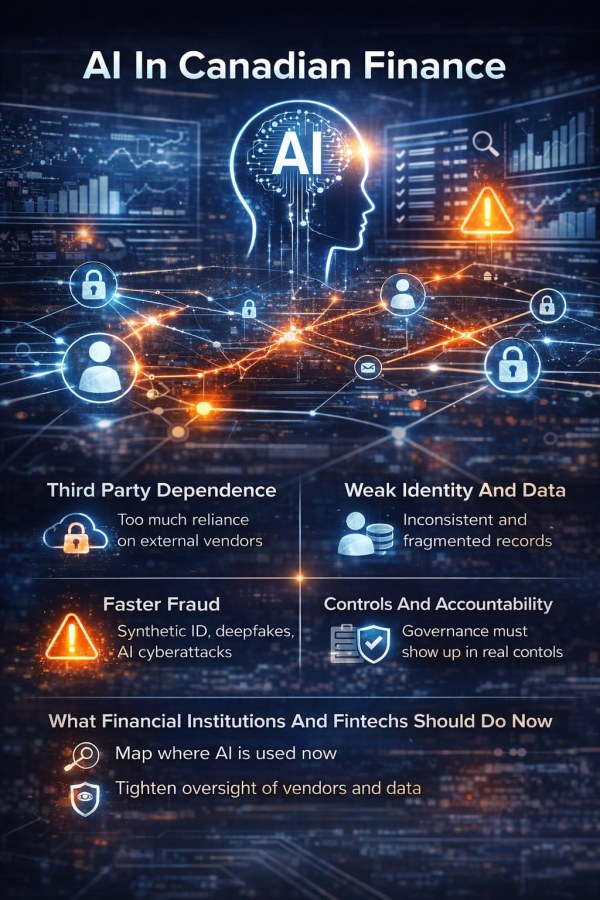
The report treats third party AI as more than a procurement issue. It highlights growing dependence on external providers for models, infrastructure, and data, along with limited visibility into how those systems work and who sits behind them.
It's important because a failure, outage, or change in access at one provider can affect more than one function at the same time. Fraud controls, underwriting tools, customer service, and risk monitoring can all be exposed together. The financial stability workshop adds to that concern by linking third party dependency to concentration and system level risk.
Banks, insurers, and fintechs will need stronger oversight of models and providers, better audit access, tested fallback plans, and clearer visibility into the wider supply chain behind key AI services.
AI is improving both offence and defence. The final report points to synthetic identity, deepfakes, voice spoofing, AI assisted cyberattacks, fraud as a service, and disinformation. It notes a sharp rise in deepfake attacks and growing concern about voice verification as AI voice cloning improves.
This reality changes the operating environment. Static controls lose value faster when attack tools get cheaper, stronger, and easier to use. Manual review and occasional rule updates will not be enough. Firms will need faster detection, stronger identity controls, better information sharing, and systems that can adjust while attacks are happening.
Data problems come up across the whole series, but the larger issue is bigger than data quality alone. Weak identity and fragmented data still limit how far AI can go in regulated finance. The report points to inconsistent data, incomplete records, fragmented platforms, offshore storage concerns, and weak data lineage as barriers to both efficiency and safety.
The report doesn't mince words on identity. Canada still doesn't have a widely adopted secure digital identity layer. That leaves onboarding, authentication, consumer channels, remote work, and agent based systems more exposed than they should be. If identity and data remains weak, AI will keep working best in narrower internal use cases and face more limits in customer facing execution.
The final report introduces the AGILE framework as part of its overall findings, which stands for Awareness, Guardrails, Innovation, Learning, and Ecosystem Resiliency. The framework calls for stronger governance and oversight, stronger data and risk controls, continued investment in technology and talent, and deeper public private collaboration.
AI oversight cannot remain just at the strategy level. If AI is used in lending, fraud, underwriting, complaints, or customer recommendations, governance has to show up in controls, evidence, escalation, and accountability. In regulated finance, that's what turns AI use from experimentation into something firms can defend and scale.
The workshop series points to a practical sequence:
First, identify where AI already impacts decisions and controls.
Second, separate the use cases that can scale now from the ones that still need stronger explainability and customer safeguards.
Third, tighten vendor oversight before dependency grows further.
Fourth, invest more in identity, data lineage (origin and how it's used and updated), and real time fraud controls.
Fifth, show boards stronger evidence instead of high level claims and broad assurance language.
The report also carries a warning worth taking seriously. Firms that move too slowly can fall behind on productivity, resilience, and customer expectations while still facing external AI enabled threats. One participant line stands out: “The biggest risk is not doing enough.”
Canada’s national AI strategy work has focused heavily on trust, safety, and responsible adoption. That is necessary, but this workshop series adds something more useful for operators. It shows where AI use slows once it enters regulated finance: concentrated provider risk, weak identity, fragmented data, explainability pressure, fraud risk, and unclear accountability.
There's a call to action policy lesson here too. Canada doesn't just need AI ambition and adoption. It needs stronger execution layers around Digital ID, data governance, third party oversight, and information sharing if it wants regulated financial AI to scale beyond contained pilots.
The OSFI and GRI workshop series is useful because it takes a holistic approach to identifying and adapting to AI risks in finance. AI is already inside financial systems. The advantage now goes to firms that can prove control, trust, and accountability in live decisions.
The National Crowdfunding & Fintech Association (NCFA Canada) is a financial innovation ecosystem that provides education, market intelligence, industry stewardship, networking and funding opportunities and services to thousands of community members and works closely with industry, government, partners and affiliates to create a vibrant and innovative fintech and funding industry in Canada. Decentralized and distributed, NCFA is engaged with global stakeholders and helps incubate projects and investment in fintech, alternative finance, crowdfunding, peer-to-peer finance, payments, digital assets and tokens, artificial intelligence, blockchain, cryptocurrency, regtech, and insurtech sectors. Join Canada's Fintech & Funding Community today FREE! Or become a contributing member and get perks. For more information, please visit: www.ncfacanada.org
| | |
|---|---|---|
| | |
Mar 23, 2026 | NCFA Fintech Market Activity | Venture Funding And Building

Image: Freepik
On March 23, 2026, BKR Capital announced a $20M first close for Black Innovation Fund II, with a final target of $50M. The first close includes backing from RBC, Boann Social Impact Fund, Cap Finance Social Finance Fund, BDC, and EDC.
BKR also said its first fund invested in 15 technology companies and is tracking as a top quartile performer for its vintage.
The release puts a hard number on the market gap. BKR said only 0.15% of venture capital deployed in Canada in 2025 went to Black founders. That is the core fact in this story. A second institutional fund is being raised into a market where founder supply exists, but early capital allocation remains extremely thin. The first close is aligned with a wider government effort to expand access to capital, including Canada’s renewed $189M Black Entrepreneurship Program.
Lissa Bjerkelund, Vice-President and Head of Investments at EDC:
"Supporting Canadian companies as they expand into global markets is critical in today's economic environment, and our investment in this fund speaks to our commitment to helping level the playing field for Black-owned businesses to access the capital they need to fuel their growth."
Isaac Olowolafe, General Partner at BKR Capital said there was “a powerful investment opportunity hiding in plain sight,” while Lise Birikundavyi, Co-Founder and Managing Partner at BKR Capital said “the strong financial performance of our first fund confirms what we have always known.” BKR is not pitching this as a social side pocket. It is arguing that Canada continues to misprice a real venture pipeline.
That raises a more direct capital formation question. If Fund I has already reached 15 companies and BKR says it is tracking as a top quartile performer, what keeps more institutional capital from moving sooner into managers and founder segments that the market still underfunds?
BKR’s first close also includes BDC, which lines up with a broader push toward more inclusive capital formation in Canada, including BDC’s $250M commitment to inclusive entrepreneurship.
If the founder pipeline is there and the performance case is strengthening, what still stops more Canadian institutional capital from moving earlier and at larger scale?
The National Crowdfunding & Fintech Association (NCFA Canada) is a financial innovation ecosystem that provides education, market intelligence, industry stewardship, networking and funding opportunities and services to thousands of community members and works closely with industry, government, partners and affiliates to create a vibrant and innovative fintech and funding industry in Canada. Decentralized and distributed, NCFA is engaged with global stakeholders and helps incubate projects and investment in fintech, alternative finance, crowdfunding, peer-to-peer finance, payments, digital assets and tokens, artificial intelligence, blockchain, cryptocurrency, regtech, and insurtech sectors. Join Canada's Fintech & Funding Community today FREE! Or become a contributing member and get perks. For more information, please visit: www.ncfacanada.org
| | |
|---|---|---|
| | |


August 26th, 2025

January 4th, 2024

June 1st, 2021

September 9th, 2020

July 9th, 2018

January 3rd, 2018

September 25th, 2017

June 20th, 2017

May 10th, 2017

December 14th, 2016