




Karsten Wenzlaff, Advisor
August 26th, 2025
Karsten Wenzlaff is a Crowdfunding and Fintech Expert from Germany. He is Secretary-General of Digit[...]


September 11, 2026 | NCFA Market Activity | Artificial Intelligence And Data, Wealthtech Investing And Trading, Risk Compliance And Regtech

On September 10, 2026, OpenAI launched ChatGPT for Financial Services, a version of ChatGPT Work built for finance around GPT-6 Astra, premium financial data, connected firm information and tools for research, modelling and client materials. OpenAI developed the product with Morgan Stanley and Evercore as design partners, starting with investment banking and equity research.
A financial institution no longer has to start with a general AI model and then separately connect every data source, build research workflows and figure out how the output gets into a valuation model, research note or pitchbook. Some of that assembly work now comes inside the product.
That positions ChatGPT closer to the type of work bankers and analysts produce every day. It also puts OpenAI into more direct competition with fintech copilots, research platforms and financial software vendors building similar workflows around third party AI models.
ChatGPT for Financial Services includes premium datasets from providers such as Daloopa, PitchBook and LSEG News. OpenAI says the available data covers areas including earnings transcripts, financial statements, company fundamentals and private companies. Teams can start using supported datasets that are included without negotiating separate contracts or configuring their own connectors.
The scope still depends on the provider and dataset. PitchBook says users get access to its expanded Essential dataset, including firmographic information on companies, investors and funds. OpenAI's terms also set rules for each provider around timing, storage, copying and reuse.
OpenAI indexes and hosts supported partner data on its own infrastructure so the system can retrieve it faster and attach citations to figures and claims. In finance, analysts need to know where their numbers came from, which period it covers and whether the source supports the conclusion.
There are real limits. OpenAI's Financial Services Terms say data and outputs may be inaccurate, incomplete, delayed or outdated. Daloopa data listed in the terms is delayed by 24 hours, while Nasdaq pricing supplied through Financial Modeling Prep is delayed by at least 15 minutes. Those details become important when the same system is used for research, valuation work and client materials.
For financial data companies, ChatGPT can become another route to institutional users. OpenAI gets licensed data closer to the research workflow, while the provider keeps control over how its underlying information can be copied, exported or reused.
OpenAI is also going after the work produced after the research. Administrators can publish approved Excel, Word and PowerPoint templates so teams can turn analysis into valuation models, research notes, pitchbooks and other documents in the firm's own format and style.
Investment banking and research teams spend a lot of time getting numbers, commentary and analysis into the right spreadsheet, memo or presentation. If AI can produce that work using approved templates, companies can cut production time without rebuilding the workflow around a separate tool. Morgan Stanley and Evercore helped OpenAI identify those pain points. OpenAI says reliable data access and high quality artifact creation were among the biggest problems raised through the design work. The announcement doesn't say either firm has deployed ChatGPT for Financial Services across its entire organization at this point.
Fintech copilot models that mainly wrap a large language model around research or document creation now face tougher competition. Specialists still have room where they own proprietary data, regulated workflows, execution capability, integrations built for individual institutions or financial expertise that a general platform can't easily reproduce. NCFA recently looked at decision intelligence in financial services which highlights a similar competitive issue. Access to data matters, but the firms creating the most value will be the ones that turn it into better research, decisions and client outcomes.
ChatGPT for Financial Services includes enterprise controls such as SAML SSO, SCIM provisioning and access controls by role. OpenAI says business data is not used to train its models by default, data is encrypted at rest and in transit, administrators can configure workspace retention, and supported workspace logs can be exported through its Compliance Platform.
Those controls help firms manage who gets access and what information can be used. They don't make a bank, dealer, investment firm or advisor compliant by themselves. Each institution still has its own obligations around privacy, records, supervision, model risk, client information and material information that isn't public.
Its Financial Services Terms say the service provides information and tools for financial research and analysis and that OpenAI does not provide financial or investment advice. Users are told to apply independent professional judgment and check important sources, dates and calculations before relying on the output.
That keeps responsibility with the institution. Citations can make research easier to check and firm templates can make the output easier to use, but someone still has to stand behind the analysis, recommendation or client communication.
OpenAI is making general finance copilots easier to copy and harder to defend. Fintechs will need an edge in proprietary data, regulated execution, deep workflow integration or trusted financial expertise to compete.
 The National Crowdfunding & Fintech Association (NCFA Canada) is a financial innovation ecosystem that provides education, market intelligence, industry stewardship, networking and funding opportunities and services to thousands of community members and works closely with industry, government, partners and affiliates to create a vibrant and innovative fintech and funding industry in Canada. Decentralized and distributed, NCFA is engaged with global stakeholders and helps incubate projects and investment in fintech, alternative finance, crowdfunding, peer-to-peer finance, payments, digital assets and tokens, artificial intelligence, blockchain, cryptocurrency, regtech, and insurtech sectors. Join Canada's Fintech & Funding Community today FREE! Or become a contributing member and get perks. For more information, please visit: www.ncfacanada.org
 |  |  |
|---|---|---|
 |  |  |
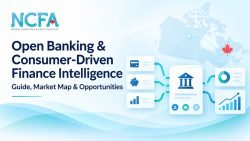
Explore and compare companies in Canada’s open banking market by capability, market layer, documented Canadian traction and selected global benchmarks, from financial data and bank infrastructure to payments, business systems and intelligence.
Loading market map…
Learn how open banking and consumer-driven finance work, use Canadian market evidence alongside leading international examples, test key claims, and apply what you learn to product, operating, investment and policy decisions.
Choose A Topic (match it to your product, investment or policy question)
Choose A View
Gain Practical Insight
Start with the decision in front of you. Work through one topic or use the full guide to connect regulation, infrastructure, products, competition, adoption and risk.
Connect customer permission, standards, shared infrastructure, business models and trust.
See what could slow launch, adoption, scale or commercial value.
Compare who pays, who benefits, where margins sit and what evidence is still missing.
Separate announcements from operating evidence, activity from adoption and access from outcomes.
Search the full 146-module guide or narrow it by the perspective most relevant to you.
Search the full guide or narrow the modules by the decision or market question you are working on.
Explore selected current and emerging Open Banking discussions through verified market evidence, competing commercial cases and NCFA insight. Cast your view and compare with the market as participation builds.
Canada’s first phase has to prove that data access can improve real financial tasks before payment initiation arrives.
Your View
Vote to reveal NCFA’s take.Thanks for voting. Results will appear as participation builds.
The near term opportunity is strongest where better data cuts underwriting time, verification cost or manual work. If those services do not generate repeat use, payment initiation becomes more important to the commercial case.
Canada must decide how much operating evidence it needs before moving from data access into customer authorized payments.
Your View
Vote to reveal NCFA’s take.Thanks for voting. Results will appear as participation builds.
A staged rollout tied to transaction risk and proven operating performance would let Canada add useful functionality without treating every payment use case the same.
Compliance costs can protect consumers and still become a barrier if they do not reflect the activity and risk of the participant.
Your View
Vote to reveal NCFA’s take.Thanks for voting. Results will appear as participation builds.
Consent, security, liability and consumer redress need a firm baseline. Other obligations should track the activity, exposure and risk a participant creates. If smaller firms carry costs that do not reduce material risk, the framework can weaken the competition and consumer choice it is meant to support.
Private agreements and industry standards continue to develop while the federal framework remains unsettled.
Your View
Vote to reveal NCFA’s take.Thanks for voting. Results will appear as participation builds.
Commercial data sharing can keep growing without a settled federal rule. The competitive issue is who controls access terms. Continued uncertainty favours firms with the scale to negotiate bilateral arrangements and absorb repeated integration costs.
The UK has proven demand for Open Banking. The commercial test is whether payment services can fund continued investment without restricting access.
Your View
Vote to reveal NCFA’s take.Thanks for voting. Results will appear as participation builds.
Paid services make sense when they deliver functionality, service levels or risk controls beyond the baseline. Charging for ordinary access too early can weaken fintech economics and reduce the demand needed to support a durable market.
Australia shows what happens when a mature data right expands faster than the ability to complete customer actions.
Your View
Vote to reveal NCFA’s take.Thanks for voting. Results will appear as participation builds.
More data can improve advice, comparison and underwriting. Action becomes more valuable when it removes a meaningful customer step. The case for wider authority should be judged against the friction it removes and the additional fraud, consent and liability risk it creates.
The UK now has to decide how standards should be governed once the market is established and commercial interests are stronger.
Your View
Vote to reveal NCFA’s take.Thanks for voting. Results will appear as participation builds.
Standards need to adapt faster than legislation without giving the largest participants control over market access. Funding, technical administration, consumer representation and statutory enforcement should remain clearly separated.
AI agents can progress from reading financial data to recommending and executing financial actions.
Your View
Vote to reveal NCFA’s take.Thanks for voting. Results will appear as participation builds.
The key control is authority. Customers need clear limits on what an agent can do, for how much, for whom and for how long. Auditability, revocation and liability become more important as autonomy increases.
Brazil links Open Finance to a high frequency payment system, giving customers an immediate reason to use connected financial services.
Your View
Vote to reveal NCFA’s take.Thanks for voting. Results will appear as participation builds.
Brazil shows the value of pairing data access with an action customers already understand and use frequently. Canada does not need the same payment model, but its early data services still need to solve problems often enough to create repeat behaviour.
Open finance can improve advice and competition, but every additional data category increases consent, privacy and implementation complexity.
Your View
Vote to reveal NCFA’s take.Thanks for voting. Results will appear as participation builds.
Wider access is most useful when the additional data changes a financial decision or removes customer friction. Scope should follow clear use cases, with common identity, consent and liability controls reducing the cost and risk of expansion.
Explore commercial opportunities in Canadian open banking, consumer-driven finance, data access and financial infrastructure, then assess where new products and business models may be viable.
The National Crowdfunding & Fintech Association (NCFA Canada) is a financial innovation ecosystem that provides education, market intelligence, industry stewardship, networking and funding opportunities and services to thousands of community members and works closely with industry, government, partners and affiliates to create a vibrant and innovative fintech and funding industry in Canada. Decentralized and distributed, NCFA is engaged with global stakeholders and helps incubate projects and investment in fintech, alternative finance, crowdfunding, peer-to-peer finance, payments, digital assets and tokens, artificial intelligence, blockchain, cryptocurrency, regtech, and insurtech sectors. Join Canada's Fintech & Funding Community today FREE! Or become a contributing member and get perks. For more information, please visit: www.ncfacanada.org
| | |
|---|---|---|
| | |
September 10, 2026 | NCFA Market Activity | Cross Border Payments And FX, Digital Banking And BaaS, SME Finance And Business Banking

On September 9, 2026, Toronto and Montreal fintech Beacon announced an oversubscribed C$20M financing round as it expands financial services between Canada and India. Existing investors led the round, with new investors participating. Beacon also says its user base doubled in seven days on C$11,000 of advertising and that the app reached the #1 Finance position in Canada's App Store. The company hasn't disclosed how many users, active customers or transaction volume, so the growth claim shows demand without telling us how large the business has become.
Beacon was founded in 2023 by Stuart Szabo and Aditya Mhatre around a problem newcomers know well. Moving to Canada can mean opening accounts, moving savings, paying bills and maintaining financial obligations in another country at the same time. Its earlier C$5.25 million seed round helped build around that need.
The product set shows how far that idea has travelled.
Beacon is trying to turn one cross border relationship into several recurring financial services. The C$20 million gives the company more room to build around everyday money, remittances, bill payments and business payments across the same corridor.
Cross border finance becomes more valuable when several recurring problems belong to the same customer. Someone living in Canada may be supporting family in India, paying a loan or utility bill there, receiving money from India and running everyday finances here. Beacon now addresses each of those jobs in some form, which gives it more opportunities to stay relevant between remittance transactions.
Beacon's UPI transfers let users send Canadian dollars to an Indian UPI ID or bank account, with Beacon saying 98% of UPI transfers arrive within a minute. India Bill Pay uses Bharat Connect for expenses such as utilities and loan payments. Customers can use familiar Indian payment methods while funding transactions from Canada.
Canada and India are also allocating more attention on these flows. Recent Canada India UPI talks included cross border remittance and merchant payment cooperation. Competition is building too. Skydo's Canada launch added another specialist targeting Canada India business payments.
Cost remains important. World Bank data for the third quarter of 2025 put the average cost of sending C$200 from Canada to India at 4.28%, including fees and foreign exchange margins; the average for C$500 was 2.69%. Banks, Wise, Remitly and other providers already compete heavily on rate, speed and reliability, which makes a wider product relationship more valuable than another transfer option.
Beacon Business adds a second customer type. Registered Canadian companies can fund locally and pay Indian businesses or individuals through local payment rails, with Nium supporting parts of the service. Consumer finance and SME payments can therefore develop around the same Canada India expertise, banking relationships and regulatory work.
A remittance customer typically has little loyalty if another provider offers a better exchange rate tomorrow. Beacon's response is to give that customer more reasons to keep using the app. Everyday Canadian money, UPI transfers, Indian bill payments, incoming transfers from India and business payments all sit around the same cross border relationship.
That can improve the cost structure of acquiring a customer. Someone who sends money home a few times a year may generate limited revenue. A customer who also keeps money on the platform, pays bills and uses other financial services creates more transactions and more opportunities for Beacon to earn over time. Some may eventually bring business payments onto the platform too.
This corridor focus can help Beacon compete with much larger firms. Wise and Remitly operate across many countries and currencies. Canadian banks have huge customer bases and established financial products. Beacon can go deeper on Canada India use cases, integrate local payment methods and build around customers whose financial lives genuinely span both countries.
That focus still depends on several regulated relationships. Beacon is registered with FINTRAC as a money services business and says it is registered with the Bank of Canada as a payment service provider under the Retail Payment Activities Act.
Beacon started by helping people arrive in Canada. It's now building around the financial ties they keep with India and the businesses some of them go on to run. The strategic question is whether corridor specialization compounds. Better product knowledge, reusable regulatory work, customer referrals and a growing product set can all improve the value of the same customer relationship. If Beacon can keep extending that relationship rather than buying a new customer for every product, the C$20 million round funds something more interesting than another remittance app.
The National Crowdfunding & Fintech Association (NCFA Canada) is a financial innovation ecosystem that provides education, market intelligence, industry stewardship, networking and funding opportunities and services to thousands of community members and works closely with industry, government, partners and affiliates to create a vibrant and innovative fintech and funding industry in Canada. Decentralized and distributed, NCFA is engaged with global stakeholders and helps incubate projects and investment in fintech, alternative finance, crowdfunding, peer to peer finance, payments, digital assets and tokens, artificial intelligence, blockchain, cryptocurrency, regtech, and insurtech sectors. Join Canada's Fintech & Funding Community today FREE! Or become a contributing member and get perks. For more information, please visit: www.ncfacanada.org
| | |
|---|---|---|
| | |
September 9, 2026 | NCFA Insight | Capital Markets Infrastructure And Funding, Competition And Market Structure, SME Finance And Business Banking

On September 9, 2026, RBC announced a C$1.4 billion Canadian technology initiative anchored by RBCx Growth Fund I. The proposed fund will make direct late stage equity investments in Canadian technology companies with global ambitions. RBC plans to invest up to C$416 million, or US$300 million, including an initial US$200 million commitment to portfolio companies.
The C$1.4 billion headline encapsulates the wider initiative, not the size of RBCx's Growth Fund I. But its disclosed something more interesting: equity will be invested alongside commercialization support, strategic partnerships and access to RBC's banking, capital markets and public sector relationships.
RBCx already has reach. It says it banks 3,500+ technology companies, has invested in 10 venture funds and more than seven companies directly, and operates four RBC owned ventures. Fintech runs through part of that history: Mydoh has reached more than 140,000 Canadians, Ownr has registered or incorporated more than 130,000 businesses, and Dr.Bill has processed C$4.1 billion in medical billings for more than 14,000 physicians.
The new fund has a broad mandate spanning enterprise software, AI, cybersecurity, health tech, frontier technology, energy, climate and agricultural technology. Its strategic value comes from the model around it. RBCx can potentially combine equity, venture debt, banking, customers and capital markets support across the same company lifecycle.
Canadian companies do not become global competitors because someone writes a larger cheque at Series C. They get there by building management depth, repeatable sales, enterprise customers, regulatory capability, financial controls, technology that can handle growth and enough distribution to reach new markets. Those capabilities need to start forming years before the biggest financing round arrives.
The capital data shows how narrow the funnel becomes. Canadian venture investors deployed C$2.69 billion across 250 deals in the first half of 2026, yet only 18 later stage deals accounted for C$984 million. Sixteen rounds of C$50 million or more absorbed 59% of all venture dollars, while RBC cites PitchBook data showing Canadian investors led only 33% of domestic growth rounds over the past decade.
There is pressure further upstream too. Canadian VC fundraising fell to just over C$2.1 billion in 2025, with the five largest funds capturing 83% of the capital raised. When fewer funds have enough capital to support companies through multiple rounds, fewer startups get the time and resources needed to build serious operating capability.
That is the bigger Canadian issue. Founders need capital, but they also need customers, talent, workable regulation, financial infrastructure and enough room to execute. International growth only gets harder when those capabilities are weak at home. If too few startups build them early, there will be fewer strong growth companies and even fewer Canadian firms capable of competing globally at scale.
This is where RBCx could be more useful than another pool of equity. A scaling company may need venture debt, operating credit, FX, treasury, foreign accounts and enterprise customers while it is raising its next round. RBCx already works across many of those needs, which gives founders a chance to build financial and commercial capacity before the company becomes large enough to attract the biggest investors.
Customer access is another valuable part. RBC says portfolio companies may receive commercialization support, customer strategy help and introductions through its commercial banking, capital markets and public sector relationships. Founders will care about what those introductions produce: paid pilots, enterprise contracts, distribution and follow on capital.
RBC has a clear commercial incentive in seeing those companies grow. A startup that becomes a large technology company can eventually become a valuable client across lending, treasury, FX, employee banking, wealth and capital markets. RBC has not stated customer lifetime value as the motive for Growth Fund I, but the economic alignment is obvious.
BDC and Canadian venture firms already supply growth capital, so success shouldn't necessarily be measured by dollars deployed. A better measurement may be whether RBCx backed companies win larger customers, build foreign revenue faster, raise future capital from a stronger position and keep meaningful operating capability in Canada. That connects directly with Canada's productive growth challenge where promising companies need enough capital and operating capacity to become globally competitive businesses.
Canada's scaleup problem starts well before the scaleup round. RBCx already works across banking, venture investing and technology businesses, and Growth Fund I adds equity to that mix. If the combination helps more Canadian companies build customers, capability and financing strength early enough to compete globally, the initiative will have earned its C$1.4 billion headline.
The National Crowdfunding & Fintech Association (NCFA Canada) is a financial innovation ecosystem that provides education, market intelligence, industry stewardship, networking and funding opportunities and services to thousands of community members and works closely with industry, government, partners and affiliates to create a vibrant and innovative fintech and funding industry in Canada. Decentralized and distributed, NCFA is engaged with global stakeholders and helps incubate projects and investment in fintech, alternative finance, crowdfunding, peer to peer finance, payments, digital assets and tokens, artificial intelligence, blockchain, cryptocurrency, regtech, and insurtech sectors. Join Canada's Fintech & Funding Community today FREE! Or become a contributing member and get perks. For more information, please visit: www.ncfacanada.org
| | |
|---|---|---|
| | |
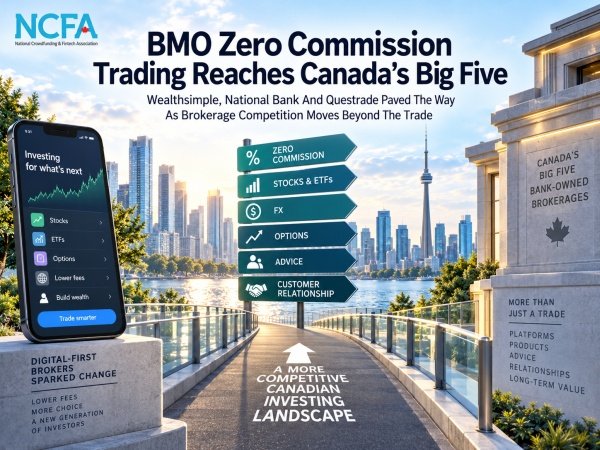
On September 9, 2026, BMO InvestorLine announced unlimited zero commission trading on stocks and exchange traded funds for all self directed clients. The pricing takes effect September 14. BMO is also removing brokerage account administration fees and cutting options pricing to zero base commission plus $0.90 per contract, down from $1.25.
BMO says InvestorLine is the first direct investing brokerage owned by one of Canada’s five largest banks to eliminate commissions across stock and ETF trades. That’s important, but it isn’t where Canada’s zero commission story begins. Wealthsimple had already made free stock trading a consumer proposition in 2019. National Bank and Desjardins followed in 2021. Questrade took its remaining stock and ETF commissions to zero in 2025.
What BMO changes is where the pressure has reached. A trading fee that survived for years inside Canada’s largest bank owned brokerages is now disappearing at one of them.
BMO is not the first Canadian financial institution to offer zero commission trading. It is the first of the Big Five to make unlimited zero commission stock and ETF trading its standard self directed price.
That leaves a more interesting question than who cuts next. If the trade itself costs nothing, what are Canada’s brokerages really competing to win?
In March 2019, Wealthsimple Trade opened zero commission investing to Canadians. Wealthsimple said most Canadian trading services were charging roughly $5 to $10 per trade at the time.
The proposition was easy to understand. Buy or sell a stock and the headline commission was zero.
Low cost online brokerage was already well established in Canada. Questrade had been competing with bank owned brokers since 1999 and spent years cutting the cost of self directed investing.
Wealthsimple changed the reference price. Instead of asking whether a digital broker was cheaper than a bank, customers could ask why a stock trade needed a commission at all.
Discount brokers already make trading cheaper. Wealthsimple makes zero easy to see, easy to compare and available through a mobile app. Every brokerage still charging by the trade now has a much simpler price to compete against.
Canada wasn’t developing in isolation. Robinhood began building its U.S. brokerage around commission free trading in the 2010s.
By October 2019, the pressure had reached the largest American brokers. Charles Schwab cut its US$4.95 online stock commission to zero. TD Ameritrade, E*Trade, Fidelity and others followed.
Those decisions weren’t cosmetic. When E*Trade announced zero commissions in 2019, it estimated the change would reduce revenue by roughly US$75 million per quarter.
Brokerage shares fell sharply as investors worked out what a disappearing transaction fee meant for firms that had relied heavily on commissions.
Robinhood shows that free trading can pull customers toward a new platform. The U.S. incumbents show what happens when enough customers begin expecting the same price. Canadian brokerage economics are different, but the competitive pressure travels.
The first Canadian bank owned brokerage to go all the way wasn’t BMO.
On August 23, 2021, National Bank Direct Brokerage eliminated commissions on online Canadian and U.S. stocks and ETFs.
National Bank called it a Canadian first for a bank owned direct broker. Its previous standard commission had been $6.95.
National Bank was unusually clear about the business logic.
Martin Gagnon, then Executive Vice President of Wealth Management, said “The objective is very simple. It’s to increase our client base.”
National Bank’s securities brokerage commission line was about C$60 million for the quarter, but management said only a very small fraction of that amount was at risk from the direct brokerage pricing change. Transaction revenue had already become a smaller part of the business.
National Bank proves that a Canadian bank owned brokerage can give up the visible trading fee when gaining customers, assets and other business is worth more.
Desjardins also removed online stock and ETF commissions in 2021.
By January 2026, Desjardins Online Brokerage reported C$30 billion in assets under administration. Assets had climbed 80% over four years and the number of platform and mobile app users had increased 30%.
Zero commissions alone didn’t produce those gains. They do show that the model can operate at meaningful Canadian scale.
Questrade took the pricing question further in February 2025 when it removed online stock and ETF commissions across its self directed accounts.
By 2026, the company reported more than C$80 billion in assets under administration and was extending well beyond basic trade execution. Questrade Connects Brokerage Accounts To AI Agents follows its expansion from lower cost trading into personalized portfolios, banking and agent accessible investing.
The commission is gone, but the platform has more products to sell.
A customer who arrives to buy a stock can also hold cash, borrow, use managed portfolios, buy private assets, open banking products or use new investing tools. That makes the account itself more valuable than the fee on an individual trade.
BMO now brings unlimited zero commission trading inside the Big Five.
Immediately before the announcement, its standard InvestorLine price was $9.95 per online stock trade. A customer making 100 commissionable trades a year could spend about $995 on those commissions.
At 250 trades, the amount was roughly $2,487.50. At 500, it reached $4,975.
The other Big Five brokerages aren’t standing still, but their standard offers remain different.
TD Direct Investing lists a standard stock commission of $9.99. RBC Direct Investing lists $9.95 for its full brokerage offer, while GoSmart includes a limited number of free trades. CIBC Investor’s Edge lists $6.95 for standard online equity trades and offers commission free ETFs. Scotia iTRADE lists a standard equity commission of $9.99, with some Scotia banking packages including a limited number of free trades.
National Bank gets there five years earlier. BMO matters because unlimited zero commission stock and ETF trading now reaches one of the institutions at the centre of Canadian banking.
Zero commission doesn’t mean zero cost.
BMO says it can earn 1.6% on currency conversions below US$25,000, with the percentage declining as the transaction gets larger.
A US$10,000 conversion at 1.6% works out to US$160. That is far larger than the $9.95 stock commission that disappears.
The same calculation matters across the industry. Wealthsimple lists a 1.5% foreign exchange fee on applicable Canadian dollar and U.S. dollar conversions.
Brokerages can also earn revenue from options, margin borrowing, subscriptions, interest, advisory services, managed portfolios and other financial products.
A $0 order therefore tells investors the cost of the trade. It doesn’t tell them the total cost of using the brokerage.
The brokerage can give up the transaction fee because customer assets create other opportunities. Currency gets converted. Cash stays on the platform. Some investors borrow, trade options, buy managed products or add other financial services.
Wealthsimple makes the strategy especially visible. What began with investing now stretches across cash, cards, tax, mortgages, private investments, crypto and other financial products.
Its growth also shows the scale challengers can reach. By early 2026, Wealthsimple said it served more than 3 million Canadians and had passed C$100 billion in assets under administration.
BMO starts from the opposite direction. It already has banking, lending, cards, advice and wealth management. Taking the trade commission to zero gives an existing bank another way to keep self directed investors inside a much larger financial relationship.
That makes BMO’s decision more than a brokerage price cut. A digital challenger can use cheap investing to enter the relationship. A large bank can use the same price to defend one it already has.
BMO removes one of the easiest price differences for investors to compare. Brokerages now have to win on total cost, foreign exchange, options, margin, tools, advice, product access and how much of a customer’s financial life they can serve.
BMO’s zero commission pricing follows years of pressure from discount brokers, fintechs and earlier bank competitors. Once the stock trade costs nothing, the bigger prize is the customer, their assets and the rest of their financial relationship.
The National Crowdfunding & Fintech Association (NCFA Canada) is a financial innovation ecosystem that provides education, market intelligence, industry stewardship, networking and funding opportunities and services to thousands of community members and works closely with industry, government, partners and affiliates to create a vibrant and innovative fintech and funding industry in Canada. Decentralized and distributed, NCFA is engaged with global stakeholders and helps incubate projects and investment in fintech, alternative finance, crowdfunding, peer to peer finance, payments, digital assets and tokens, artificial intelligence, blockchain, cryptocurrency, regtech, and insurtech sectors. Join Canada's Fintech & Funding Community today FREE! Or become a contributing member and get perks. For more information, please visit www.ncfacanada.org
| | |
|---|---|---|
| | |
September 8, 2026 | NCFA Insight | Payments Infrastructure And Money Movement, Digital Assets Blockchain And Tokenization, Treasury Liquidity And Cash Management

On September 8, 2026, Visa introduced an onchain credit model for stablecoin card programs that combines VisaNet settlement data with financing provided by Credit Coop. Visa isn't the lender. Credit Coop provides stablecoin denominated revolving credit secured by settlement receivables, while authorized Visa settlement records help lenders assess how participating programs are actually performing.
Visa says more than 160 stablecoin card programs are live globally, with payment volume up nearly 200% year over year. Its stablecoin settlement volume recently passed a US$20 billion annualized rate, more than 15 times the prior year. Credit Coop has financed more than US$2.5 billion since 2023 across more than 3,000 borrowing events and 9,000 repayments, with zero defaults reported across participating facilities.
Visa says more than US$694 billion in stablecoin denominated loans have been sent through onchain lending protocols since 2020. The new element is using payment network data to support credit decisions for businesses operating inside the card system.
Card programs can owe Visa money before they have collected the related funds from cardholders. Large issuers usually finance that timing gap through bank credit lines, warehouse facilities or securitizations. Those structures work well when portfolios are large and lenders have enough operating history to assess them.
Early stablecoin card programs can have a different funding profile. Visa says some need only a few million dollars, draw and repay capital every day and settle through weekends and holidays. At that scale, the fixed cost of arranging a traditional facility can be difficult to justify, while the borrower may not yet have enough history to satisfy an institutional lender.
Visa's financing model uses a revolving Credit Coop facility to fund daily settlement obligations against the receivables generated by the card program. As cardholder payments arrive, those proceeds repay and replenish the line.
That financing need grows with the card programs themselves. Wirex and Crossmint connected wallets, card issuance and stablecoin spending earlier this year, showing how quickly the customer facing infrastructure is becoming easier to assemble. Financing the settlement behind those products is a different problem.
The concept is similar to bringing rent payments into a traditional credit file. A recurring payment record that was previously difficult for lenders to use becomes additional evidence about the borrower. Here, the new evidence is payment network data being used to support onchain credit.
With the card program's authorization, Credit Coop receives daily Visa settlement files through a secure data connection. It compares those records with the onchain repayment history when sizing facilities, confirming settlement requirements and monitoring repayment. The borrower is no longer the only source of information about its payment obligations.
Credit Coop's Spigot smart contract controls how incoming receivables service the facility. Cardholder proceeds flow through the contract, which routes repayment before the remaining funds reach the borrower's operating account. The structure performs a role similar to a controlled bank lockbox, but repayment can occur programmatically.
Visa says stronger data and a longer repayment record have attracted more lenders to the facilities, reducing borrowing costs for participating programs by as much as 30%.
The same data connection can also support funding closer to the actual settlement obligation. Instead of drawing a larger amount in advance and holding unused capital, the daily settlement file can trigger a same day disbursement for the net amount owed to Visa. That reduces the time capital sits idle and ties lender exposure more closely to actual settlement activity.
Rain provides the longest operating record disclosed by Visa. The Visa Principal Member has used a Credit Coop revolving facility since August 2023 and settles directly with Visa in USDC. Rain says it tokenized its card receivables, allowing incoming payments to service financing through programmable contracts.
Visa reports that approximately US$2 billion of Rain settlement has been financed through the structure, with more than 2,000 borrowing events and 7,000 repayments. They also report zero defaults and says every settlement obligation under the facility has been funded on time. The underlying program figures were supplied by Credit Coop, so they should be treated as reported operating data rather than independently audited results.
Visa says Karta's U.S. card program used Credit Coop while its operating history was still developing. In June 2026, Karta raised US$140 million, including a US$125 million institutional credit facility from Community Investment Management and a US$15 million Series A led by Galaxy Ventures. Karta reported 10 times growth in 2025 and another four times increase in revenue and payment volume quarter over quarter in Q1 2026.
The growth gives the model its strongest strategic relevance. Onchain credit can help finance a younger payment program while it builds a verifiable repayment record. Larger institutional facilities can become available later when the portfolio reaches the scale and maturity conventional lenders want. Visa explicitly says this model adds to warehouse lending and securitization rather than replacing them.
Canada already has a direct connection to Visa's stablecoin settlement strategy. In May, Visa Canada and Wealthsimple began testing USDC settlement for certain Visa Canada obligations. There is no public evidence that the Credit Coop financing model is currently available to Canadian programs, but it gives Canadian issuers and payments firms a concrete example of how stablecoin settlement can connect to working capital and credit.
If payment network data can help a young card program prove credit performance before it qualifies for a traditional warehouse facility, onchain credit may become a bridge into institutional finance rather than a separate system.
The National Crowdfunding & Fintech Association (NCFA Canada) is a financial innovation ecosystem that provides education, market intelligence, industry stewardship, networking and funding opportunities and services to thousands of community members and works closely with industry, government, partners and affiliates to create a vibrant and innovative fintech and funding industry in Canada. Decentralized and distributed, NCFA is engaged with global stakeholders and helps incubate projects and investment in fintech, alternative finance, crowdfunding, peer to peer finance, payments, digital assets and tokens, artificial intelligence, blockchain, cryptocurrency, regtech, and insurtech sectors. Join Canada's Fintech & Funding Community today FREE! Or become a contributing member and get perks. For more information, please visit: www.ncfacanada.org
| | |
|---|---|---|
| | |
September 8, 2026 | NCFA Insight | Cross Border Payments And FX, Payments Infrastructure And Money Movement, Digital Assets Blockchain And Tokenization
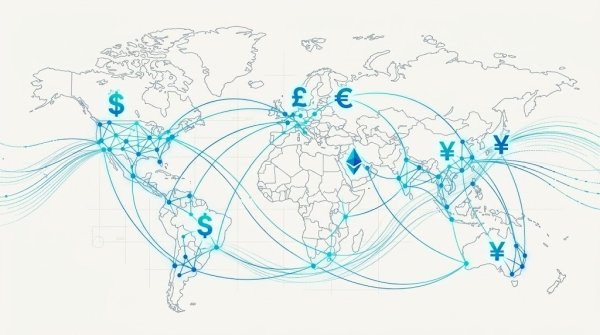
On September 8, 2026, Circle agreed to acquire Tazapay, a Singapore headquartered B2B payments company serving payment providers and financial institutions. Circle says Tazapay brings more than US$25 billion in annualized payment volume, 60+ banking and fintech partners and payout connections across 100+ markets. Approximately 60% of its transaction volume involves stablecoins.
The US$400 million transaction will be paid in Circle Class A shares, subject to specified adjustments. Circle signed the agreement on September 4 and expects it to close in 2027 after required approvals, including approval from the Monetary Authority of Singapore. The acquisition has not closed.
Tazapay was already a Circle Payments Network design partner, and Circle Ventures led an extension of its Series B in March 2026. Circle is now acquiring to own a company that connects stablecoin settlement with local banking, FX and payout access.
Tazapay connects businesses to international collections, local payouts, foreign exchange and stablecoin conversion. Its payments platform supports card payments from 170+ countries, local payment methods in 100+ countries, payouts across 100+ countries and balances in 40+ currencies.
Its operating scale has grown quickly. In August 2025, Tazapay reported more than US$10 billion in annualized volume, 300% annual growth and operational breakeven. Circle reported more than US$25 billion in annualized volume as of July 31, 2026.
Tazapay's Series B reached US$36 million after Circle Ventures led the March extension. So going from payment partner to investor to proposed owner gives Circle more direct control over a business already connecting digital dollars with conventional payment systems.
Stablecoins can settle value across borders, but businesses usually receive and spend local currency. Circle Payments Network reflects that model. Payout partners convert stablecoins to fiat for local delivery, while Circle provides USDC settlement and network routing. Circle's payout network already includes Tazapay and other regional providers.
Circle is also connecting external networks rather than owning every payout route. In May 2026, Nium joined Circle Payments Network with payout infrastructure spanning more than 190 countries and 100 currencies. That partnership gives Circle substantial reach without an acquisition. In Tazapay's case, Circle is paying US$400 million to bring part of that payment capability inside the company.
Circle says roughly 60% of Tazapay transaction volume involves stablecoins. Tazapay describes its stablecoin service as payment and conversion through onramps and offramps, so the figure does not mean 60% of transactions run entirely onchain. Stablecoins may handle settlement while customers still enter or leave through fiat.
Other large payment companies are making similar acquisitions. Stripe completed its purchase of Bridge in 2025, Ripple agreed to acquire Rail for US$200 million, and Mastercard completed its acquisition of BVNK in August 2026. Mastercard explicitly described the deal as connecting digital assets with traditional payment rails. Taken together, a competitive market is forming around the links between stablecoins, banks, FX and local payments.
NCFA's Programmable Stablecoin Payments highlights the same commercial opportunity opening around payment routing, treasury, reconciliation, compliance and bank integration around stablecoin settlement rather than simply issuing another token.
Tazapay has a direct Canadian operating connection. Tazapay Canada Corp. is registered with FINTRAC as a money services business and with the Bank of Canada as a payment service provider under the Retail Payment Activities Act. Tazapay says the Canadian entity handles foreign exchange, fund transfers and virtual currency activity, and provides its stablecoin payment and conversion services. However, Circle has not disclosed a specific role for Tazapay Canada Corp. post acquisition, and therefore should not be treated as automatically giving Circle new Canadian permissions.
The more immediate Canadian relevance is commercial. Tazapay already connects stablecoin settlement with fiat conversion and local payout access. Canadian fintechs serving international businesses face the same need to connect digital money with bank accounts, FX, compliance and usable local payment methods.
Stablecoins can settle globally, but businesses still need banks, currencies and payout systems at either end. As those connections become more valuable, will the leading stablecoin companies keep renting access or increasingly own the rails?
The National Crowdfunding & Fintech Association (NCFA Canada) is a financial innovation ecosystem that provides education, market intelligence, industry stewardship, networking and funding opportunities and services to thousands of community members and works closely with industry, government, partners and affiliates to create a vibrant and innovative fintech and funding industry in Canada. Decentralized and distributed, NCFA is engaged with global stakeholders and helps incubate projects and investment in fintech, alternative finance, crowdfunding, peer-to-peer finance, payments, digital assets and tokens, artificial intelligence, blockchain, cryptocurrency, regtech, and insurtech sectors. Join Canada's Fintech & Funding Community today FREE! Or become a contributing member and get perks. For more information, please visit: www.ncfacanada.org
| | |
|---|---|---|
| | |


August 26th, 2025

January 4th, 2024

June 1st, 2021

September 9th, 2020

July 9th, 2018

January 3rd, 2018

September 25th, 2017

June 20th, 2017

May 10th, 2017

December 14th, 2016