




Karsten Wenzlaff, Advisor
August 26th, 2025
Karsten Wenzlaff is a Crowdfunding and Fintech Expert from Germany. He is Secretary-General of Digit[...]


February 26, 2026

A national survey in Canada found that teens and their families are planning to spend a significant amount on prom this year.
On average, Canadian households with teenagers expect to spend about $508 on prom during the current prom season. That figure is a decrease from previous years, when the average was around $804, showing that many families are tightening their budgets while still wanting to make the night special.
Prom is widely seen as a major event for high school students. It is often described by experts as one of the biggest social occasions in a teenager’s life, a celebration of finishing school and a rite of passage.
Many parents are willing to help cover the costs, and the survey suggests that about three-quarters of total prom expenses are paid by parents, reflecting how important the event remains for families despite financial pressures.
Although hundreds of dollars are still being spent, the survey highlights a notable drop in expected spending compared with earlier years. The average planned spend of $508 represents roughly $300 less than the previous year’s figure of $804.
This decline suggests that families may be trying to balance making prom memorable with concerns about personal finances and the rising cost of living.
The reduction in spending might reflect careful budgeting by parents and teens. Some families are choosing to focus spending on a few key elements of the prom experience, while trimming costs on others.
For example, parents might prioritise the prom dress or formal outfit at around $200-$300 (Source: Dress2Party) but look for savings on extras such as limousines or professional photos.
Part of the overall prom culture — and one area that can add to the cost — is the trend known as the “promposal.” This has become more popular in recent years, especially among teenagers influenced by social media and American pop culture. A promposal is a creative or elaborate way of asking someone to be your prom date, sometimes involving decorations, gifts, or special outings.
The Canadian survey found that 65 per cent of graduating teens were willing to spend money on their promposal, with an average spend of about $151 on the gesture itself. This shows how even the lead-up to prom can carry significant costs as teens seek memorable and social-media worthy moments.
Despite the focus on costs, many families and students continue to view prom as an important milestone. For teenagers, prom is not just a dance — it is one of the few times in high school when everyone dresses up, takes photos, enjoys a night out with friends and sometimes with a date, and celebrates a key life transition.
Experts say that prom can also be an opportunity for parents to talk with their children about money and budgeting. In fact, the organisation behind the Canadian survey highlighted that prom is a chance for teens to learn about setting limits, planning expenses and understanding how to manage money in a real-world context, which can be useful before they head to college or university.
For many families, the challenge is finding a balance between creating a memorable prom experience and managing practical finances. The reduction in average expected spend suggests that many are becoming more mindful of budgets, particularly where the wider cost of living is a concern. Even as prom remains a cherished event, there is a growing awareness that spending does not necessarily need to be extravagant to be meaningful.
Some parents and teens choose to find creative ways to cut costs — for example, by renting dresses, asking friends to take photos instead of paying for professionals, or sharing transport rather than hiring private vehicles. These approaches can help keep the celebration within reach while still allowing students to enjoy what many describe as one of the most memorable nights of their school years.
Overall, the survey highlights that prom in Canada continues to be an important part of high school life, but one that is evolving with economic pressures. With an average planned spend of $508 and parents covering roughly 75 per cent of costs, families are still investing in the tradition, even as budgets tighten.
Prom remains a celebration of achievement, friendship and transition, and despite changes in how much money is spent, it continues to hold emotional and cultural significance for teenagers and their families across the country.
 The National Crowdfunding & Fintech Association (NCFA Canada) is a financial innovation ecosystem that provides education, market intelligence, industry stewardship, networking and funding opportunities and services to thousands of community members and works closely with industry, government, partners and affiliates to create a vibrant and innovative fintech and funding industry in Canada. Decentralized and distributed, NCFA is engaged with global stakeholders and helps incubate projects and investment in fintech, alternative finance, crowdfunding, peer-to-peer finance, payments, digital assets and tokens, artificial intelligence, blockchain, cryptocurrency, regtech, and insurtech sectors. Join Canada's Fintech & Funding Community today FREE! Or become a contributing member and get perks. For more information, please visit: www.ncfacanada.org
 |  |  |
|---|---|---|
 |  |  |
February 26, 2026

Image: Freepik/wavebreakmedia micro
In recent years, the business environment in Quebec has been evolving rapidly due to technological innovation, the growth of strong SMEs, and increasing global trade.
Firms in this region, including Montreal startups and Quebec City multinationals, are increasingly inclined to engage consulting firms to address growth, digital transformation, and strategic issues.
With so many advisory firms competing for attention, which ones truly stand out? This article discusses the top ten consulting firms in Quebec and guides on selecting the right consultant to meet your business needs.
The correct consulting firm can prove to be a transformational asset. It may also become a competitive advantage that your Quebec-based organization requires. The following ten business consulting companies, based on their highest ratings and industry reputation in Quebec, are listed below.
Montreal-based consulting firm specializing in HR Advisory and Business Profitability, with 17+ years of expertise serving firms across Quebec. ACM Canada delivers structured solutions, including Marketing and Strategic Planning, to guide businesses through expansion or restructuring, backed by a 2-for-1 ROI guarantee.
Alithya is a significant technology and digital strategy consultant that originated in Quebec. They are experts in business intelligence, ERP/CRM implementation, data analytics, and cloud transformation. Their advantage lies in integrating business advice with the latest technological solutions.
RCGT is one of the largest advisory and accounting firms in Quebec, offering a comprehensive range of services that includes business consulting, risk management, restructuring, and M&A advisory. Their excellent financial consulting qualifications and extensive geographical reach in Quebec would ensure that they are a suitable partner for both corporate and middle-income firms.
Although it is primarily an engineering and environmental consultancy, WSP Global (which also has a large office in Montreal) provides advice to companies on infrastructure development strategy, sustainability, and project development, all areas where Quebec is striving to develop green and built-environment industries.
This firm is listed on Clutch as a consulting provider, offering a two-fold advantage in accounting and advisory services. They are typically contracted to provide strategic financial planning, cost management, and performance enhancement services.
ProMerit is a combination of management consulting and a local presence in Quebec. They are designed to optimize business processes, facilitate change management, and enhance operational efficiency, offering flexible engagement models for evolving companies.
This company, based in Quebec, provides consulting services in accounting, with a focus on serving nonprofit organizations and the public sector. They are advised to be strong in financial planning, governance, and compliance.
Lemieux Nolet, based in Lévis, Quebec, draws on substantial financial experience to provide strategic advice, particularly to family businesses and SMEs. Their services usually encompass succession planning, economic restructuring, and growth strategy.
This is a multifaceted consultancy company located in Quebec City. Although they offer conventional business advisory services, they are also recognized for their effectiveness in ERP consulting, systems integration, and IT-related transformation, helping firms modernize their businesses and align their business objectives.
Interestingly, Deloitte has its roots in the consulting industry a long time ago. Furthermore, they are among the largest Canadian-owned consulting and services firms in Quebec and Canada at large. You should consider using their services based on Deloitte’s track record.
The selection of the consultant is as significant as the selection of the strategy. The six important criteria to consider potential partners are below:
Find consultants with actual, applicable experience in your business or size. When companies such as Proaction International and Alithya are involved, they have decades of field experience, meaning that they are aware of what your market is like.
A good consultant not only provides recommendations but also listens. Empathy refers to seeing beyond your financial objectives and knowing your business culture, emotional distress, and aspirations. Larger boutiques, such as Pyonnier Developpement, are usually competent in this aspect due to their personalized service.
Openness in charges, output, and reporting fosters confidence. Established companies, such as Raymond Chabot Grant Thornton, are typically very articulate about their engagement models. Request that potential consultants provide a clear breakdown of costs and milestones before signing any agreement.
Not only should you find solutions to your problems, but your consulting friend must also develop action plans. Find companies with a roadmap that has distinct stages, quantifiable KPIs, and a roadmap time. Alithya, as an example, tends to combine strategy and implementation in a single plan.
Versatility implies that a company will be able to deal with various forms of challenges, whether it is digital transformation, financial restructuring, or market expansion. Companies such as WSP Global or Genius Solutions can counsel on a variety of strategic questions due to their multidisciplinary staff.
Strategic acumen is key. An excellent consultant must be able to understand both macro trends (such as sustainability or digital disruption) and micro-level issues (including cash flow and operations). This two-fold approach provides a balanced perspective on advice, as it is both visionary and practical.
Quebec has a highly varied business consulting talent pool. You are a local company that needs to grow. You are a startup company that needs to digitalize. You are a larger company that needs to focus on governance and restructuring. Ideal consulting companies are right for the task. Finally, look for a consulting firm that has a business diagnostic service.
The National Crowdfunding & Fintech Association (NCFA Canada) is a financial innovation ecosystem that provides education, market intelligence, industry stewardship, networking and funding opportunities and services to thousands of community members and works closely with industry, government, partners and affiliates to create a vibrant and innovative fintech and funding industry in Canada. Decentralized and distributed, NCFA is engaged with global stakeholders and helps incubate projects and investment in fintech, alternative finance, crowdfunding, peer-to-peer finance, payments, digital assets and tokens, artificial intelligence, blockchain, cryptocurrency, regtech, and insurtech sectors. Join Canada's Fintech & Funding Community today FREE! Or become a contributing member and get perks. For more information, please visit: www.ncfacanada.org
| | |
|---|---|---|
| | |
February 18 2026 | NCFA Market Insight | Digital Assets And Payments
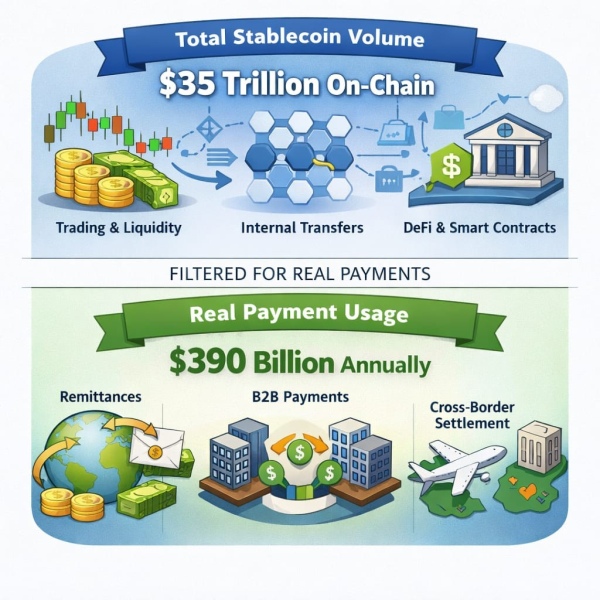
On February 18 2026, McKinsey stablecoin transaction analysis reported that stablecoins accounted for up to $35T in annual on chain transaction volume, yet most of that activity doesn't represent real world payments.
McKinsey and Artemis estimate that actual stablecoin payments run at about $390B annually (about 0.02% of global payments volume), after filtering out trading, internal exchange movements, liquidity management, and automated smart contract loops.
Public blockchains record value movement with precision, but they don't label intent. A single economic action can trigger multiple on chain steps, and large pools of stablecoins can move between wallets inside the same exchange or custodian without representing end user commerce. McKinsey uses raw volume as a starting point, not a proxy for adoption, and the methodology section explains how the team tags payment like patterns while excluding activity that reflects market structure rather than payments.
CoinDesk echoes the same measurement problem by reporting that stablecoins moved about $35T in transfers while only about 1% ties to genuine payments such as remittances and payroll. Payments industry coverage also confirms that stablecoin usage in payments is growing, yet most current activity still concentrates in internal or trading adjacent flows.
Market trackers help validate scale but they don't classify intent. CoinMarketCap aggregates stablecoin market cap and trading volume across listed tokens, which helps you track stablecoin liquidity concentration and market growth, not payments versus non payments.
Stablecoin payments represent one slice of stablecoin utility, so a payments only lens understates what stablecoins do across trading, treasury movement, DeFi collateral, and settlement workflows.
At the same time, a raw volume lens overstates payment adoption. The right reporting approach breaks stablecoin activity into functional buckets and tracks each bucket with the data source that fits it. For payments, intent classification and tagging matter. For liquidity and market structure, market cap and trading metrics matter. For payment segmentation, the underlying research partner publishes its own breakdowns that support the McKinsey approach.
If you build payment rails, you should not pitch adoption using raw on chain volume. You should show where real payment flows concentrate, how fast those flows grow, and what integration path turns that activity into revenue.
If you sell to financial institutions, you should map stablecoin opportunity to specific payment problems such as cross border B2B settlement, payroll, and corridor based remittances, then quantify addressable volume using intent filtered benchmarks like the McKinsey and Artemis estimates.
If you track policy or competitiveness, you should treat stablecoins as a measurement case study. Blockchain data looks transparent, yet it still requires more granular classification, assumptions, and cross checks to translate value movement into economic activity.
If the market keeps quoting $35T as proof of payment adoption, who sets the standard for intent based stablecoin reporting so Canada can measure real productivity and competition impact with confidence
The National Crowdfunding & Fintech Association (NCFA Canada) is a financial innovation ecosystem that provides education, market intelligence, industry stewardship, networking and funding opportunities and services to thousands of community members and works closely with industry, government, partners and affiliates to create a vibrant and innovative fintech and funding industry in Canada. Decentralized and distributed, NCFA is engaged with global stakeholders and helps incubate projects and investment in fintech, alternative finance, crowdfunding, peer-to-peer finance, payments, digital assets and tokens, artificial intelligence, blockchain, cryptocurrency, regtech, and insurtech sectors. Join Canada's Fintech & Funding Community today FREE! Or become a contributing member and get perks. For more information, please visit: www.ncfacanada.org
| | |
|---|---|---|
| | |
February 25 2026 | Feature | Payments And Market Structure

On February 24 2026, Stripe’s 2025 annual letter confirmed $1.9 trillion in payment volume, up 34% year over year and equivalent to roughly 1.6% of global GDP.
This year's annual update reinforces Stripe’s position as core digital infrastructure, not just a merchant tool. Stripe reported that more than half of the Fortune 100 now use its platform, alongside millions of startups and scaleups. Stripe is accelerating adoption across marketplaces, SaaS platforms, and AI native businesses.
It also disclosed that revenue from its billing, tax, and invoicing products is approaching a $1 billion annual run rate. It's a significant number because it reflects diversification away from transaction fees toward higher margin software and financial operations services.
The company’s valuation rose to $159 billion via a recent tender offer, underscoring investor confidence despite tighter capital markets across fintech. Stripe’s letter stressed disciplined growth with improved profitability and cost management while still maintaining strong product expansion.
The letter devoted significant attention to AI driven business formation. Stripe reported a surge in AI startups using the platform to launch global businesses faster, often generating revenue within days of incorporation, demonstrating Stripe’s role as an infrastructure provider embedded at the earliest stages of company creation.
Stripe also pointed to increased adoption of programmable billing, usage based pricing, and embedded financial workflows, trends closely aligned with software led commerce and the agent economy.
These data points confirm that payments growth increasingly tracks software distribution rather than traditional retail expansion.
Techcrunch reported via Bloomberg reporting that Stripe is interested in acquiring all or part of PayPal, pushing consolidation pressure across payments. While discussions are still unofficially confirmed, the strategic logic is clear. Stripe dominates developer first infrastructure while PayPal retains global consumer wallet reach and brand recognition.
The merger and acquisition combination would create one of the most comprehensive financial platforms spanning checkout, wallets, subscriptions, identity, and merchant services across online and offline commerce.
Payment providers are moving toward financial operating system models. The goal is to own customer onboarding, transaction processing, revenue management, compliance, and treasury workflows within a unified platform.
Such an evolution echoes themes explored in PayPal’s instant checkout integration with conversational AI, where payments become embedded directly inside digital experiences rather than appearing as a separate step.
As platforms expand vertically, competitive advantage moves from pricing to ecosystem depth, data visibility, and developer integration.
Stripe’s growth trajectory holds direct relevance for Canada. Many Canadian startups rely on Stripe for global payments, subscription infrastructure, and cross border expansion. The company’s expanding product stack increases dependency but also enables Canadian founders to reach global markets without building their own payments infrastructure.
Also, consolidation (risk) will create opportunities for Canadian fintechs specializing in compliance automation, treasury intelligence, identity infrastructure, and vertical specific payments to build differentiated layers on top of global rails.
If payment infrastructure providers evolve into full financial operating systems, will future fintech innovation depend more on building differentiated layers on top of global rails than competing directly with them?
The implication for founders and investors is that infrastructure ownership and ecosystem depth will define the next competitive cycle. Fintech innovation increasingly occurs through orchestration of financial services rather than standalone payment processing.
The National Crowdfunding & Fintech Association (NCFA Canada) is a financial innovation ecosystem that provides education, market intelligence, industry stewardship, networking and funding opportunities and services to thousands of community members and works closely with industry, government, partners and affiliates to create a vibrant and innovative fintech and funding industry in Canada. Decentralized and distributed, NCFA is engaged with global stakeholders and helps incubate projects and investment in fintech, alternative finance, crowdfunding, peer-to-peer finance, payments, digital assets and tokens, artificial intelligence, blockchain, cryptocurrency, regtech, and insurtech sectors. Join Canada's Fintech & Funding Community today FREE! Or become a contributing member and get perks. For more information, please visit: www.ncfacanada.org
| | |
|---|---|---|
| | |
Feb 24, 2026 | NCFA Fintech Market Activity | Alternative Finance And Home Equity Sharing

House rich, cash poor? Home equity sharing
On February 10 2026, The Home Equity Partners (HEQ) reported surpassing $10M in managed home asset value within its first year, highlighting early traction for home equity sharing agreements as Canadian households search for ways to access liquidity without taking on new debt.
The Toronto-based fintech became operational in May 2025 and offers homeowners capital in exchange for a share of future home value rather than interest payments. Homeowners receive funds today and settle later when the property is sold or refinanced.
That structure positions home equity sharing as a complement to traditional options such as HELOCs or refinancing. The difference is simple. Homeowners don't add interest bearing debt. They share both potential appreciation and downside risk with the provider.
This isn't only a mortgage stress product. It appeals to homeowners who feel house rich but cash constrained, including:
HEQ's model lands in a market where housing affordability remains under sustained pressure. CMHC’s latest housing supply gaps report says a return to affordability levels last seen in 2019 requires building about 430,000 to 480,000 new housing units per year over the next decade, roughly double the current pace. But supply shortages and higher borrowing costs continue to limit traditional refinancing options for many homeowners, increasing interest in ways to access home equity without selling the property.
Data tracking mortgage carrying costs shows many households face elevated payment ratios relative to income, with housing costs absorbing a growing share of disposable income across major Canadian cities. Read this Bank of Canada staff analysis about the typical Consumer's path to mortgage delinquency.
The company says its early portfolio reflects growing interest from homeowners seeking liquidity without increasing monthly obligations. While the $10 million figure remains modest relative to Canada’s housing market, it's an early sign that new financial products can tie directly to residential assets.
For fintech operators, the approach blends property finance, alternative lending logic, and long term investment exposure. Investors receive participation in home value changes, while homeowners gain flexibility that traditional credit products cannot always provide.
The structure also introduces new considerations. Pricing transparency, valuation methods, exit timing, consumer awareness and education will impact adoption and regulatory attention as the model expands.
If mortgage renewals and affordability pressure continue to strain Canadian households, will equity sharing evolve into a mainstream financing option or remain a niche tool for homeowners seeking flexibility without additional debt?
The National Crowdfunding & Fintech Association (NCFA Canada) is a financial innovation ecosystem that provides education, market intelligence, industry stewardship, networking and funding opportunities and services to thousands of community members and works closely with industry, government, partners and affiliates to create a vibrant and innovative fintech and funding industry in Canada. Decentralized and distributed, NCFA is engaged with global stakeholders and helps incubate projects and investment in fintech, alternative finance, crowdfunding, peer-to-peer finance, payments, digital assets and tokens, artificial intelligence, blockchain, cryptocurrency, regtech, and insurtech sectors. Join Canada's Fintech & Funding Community today FREE! Or become a contributing member and get perks. For more information, please visit: www.ncfacanada.org
| | |
|---|---|---|
| | |
Feb 23, 2026 | NCFA Market Activity | DAOs

On February 22 2026, Jupiter DAO closes the Net Zero Emissions option vote, moving JUP toward a supply tightening direction and a buyback first treasury posture. On chain reporting shows about 75% support for the Net Zero Emissions option and states the vote concluded at 7:00 PM ET. During the voting window, on chain analysis reports more than 24.5k votes recorded within the first 48 hours, with more than 13k individual voters backing the Proceed with Jupuary option by raw voter count, while the Net Zero Emissions option leads by voting weight at more than 73.9% during that same early period, on a voting distribution analysis that breaks down wallet counts and voting weight.
The proposal says net new emissions move from about 1.2B JUP to effectively zero, if the DAO approves the package. The proposal also states it postpones Jupuary and returns 700M tokens to the Community Cold Multisig, and it states Jupiter routes 50% of on chain revenues to open market buybacks. Jupiter already burns 3B tokens and it states founders lock tokens, including a founder lock to 2030.
Legacy allocations shape why the DAO focuses on offsets. On chain analysis reports Mercurial stakeholders receive 5% of total supply or 350m tokens, with about 182m vested by February 2026 and 168m remaining to unlock, also on the voting distribution analysis that quantifies the Mercurial allocation and vesting status.
Maker uses surplus auctions where the system auctions surplus Dai for MKR and then burns the MKR received from the winning bid, which contracts MKR supply, as described in Maker Protocol documentation on the Flapper surplus auction mechanism.
Aave documentation states the Aave DAO operates a buyback program funded by protocol revenue with a $50 million annual budget and weekly purchases that range from $250,000 to $1.75 million, with tokens sent to the DAO Ecosystem Reserve rather than burned, on Aave protocol documentation describing the buyback program budget and execution.
The proposal turns token governance into capital policy that stakeholders can measure. It targets a defined dilution outcome by moving net new emissions from about 1.2B JUP to effectively zero, and it pairs that supply stance with a stated rule that routes 50% of on chain revenues to buybacks. That combination gives the market a simple scoreboard, emissions near zero plus ongoing buy pressure funded by revenue, not inflation.
Early vote analysis shows more than 24.5k votes within 48 hours and it shows a divergence where the Jupuary option leads by raw voter count while Net Zero Emissions leads by voting weight. Token weighted voting aligns outcomes with economic exposure, but it can widen the gap between how many people show up and who decides. Fintech builders can reduce that gap with delegation tooling, transparent quorum logic, and reporting practices that make governance outcomes feel earned.
Offsets move sell pressure from the open market to treasury management. The proposal describes a treasury approach that aims to neutralize known future sell flows tied to vesting and distribution decisions, which creates a new execution test, the treasury must manage price, timing, and credibility in public. That's the same category of operational accountability that capital markets packaging requires.
Canada adds a practical lens because Canadian fintechs increasingly package products for institutional distribution where buyers demand explicit mechanics and predictable governance. Ledn’s Bitcoin backed ABS deal entering institutional markets shows how an institutional wrapper forces defined rules and clear investor expectations. Tokenized finance teams can apply that same discipline to emissions rules, treasury authority, and public reporting so partners can underwrite the model rather than debate it.
If a token stops emitting, who pays for growth and liquidity next, users through fees, builders through treasury, or the market through higher risk premiums?
The National Crowdfunding & Fintech Association (NCFA Canada) is a financial innovation ecosystem that provides education, market intelligence, industry stewardship, networking and funding opportunities and services to thousands of community members and works closely with industry, government, partners and affiliates to create a vibrant and innovative fintech and funding industry in Canada. Decentralized and distributed, NCFA is engaged with global stakeholders and helps incubate projects and investment in fintech, alternative finance, crowdfunding, peer-to-peer finance, payments, digital assets and tokens, artificial intelligence, blockchain, cryptocurrency, regtech, and insurtech sectors. Join Canada's Fintech & Funding Community today FREE! Or become a contributing member and get perks. For more information, please visit: www.ncfacanada.org
| | |
|---|---|---|
| | |
February 23, 2026 | NCFA Market Activity | Artificial Intelligence And Data

On February 21, 2026, B.C.’s premier says police are pursuing preservation orders for potential evidence held by digital services companies, including social media platforms and AI companies, after media reports tied OpenAI to the case. This isn't a new fintech policy just yet, but it puts evidence readiness into the open. If a partner asks what you can preserve and produce under lawful process, you can’t appear like a 'deer in headlights'. You need a working path.
BC Government, Office of the Premier, Media Relations:
“Reports that allege OpenAI had related intelligence before the shootings in Tumbler Ridge took place are profoundly disturbing for the victims’ families and all British Columbians. We will use all powers of government to ensure that police have the tools they need to investigate every aspect of this horrific tragedy.”
RCMP report said that the active shooter call came in at about 1:20 p.m. on February 10 and the public alert ended at 5:45 p.m. Six victims were found deceased inside the school, two victims were airlifted with serious or life threatening injuries, a third victim died during transport, and about 25 others were assessed for non life threatening injuries. RCMP also reports two additional victims were found deceased at a connected residence.
On February 13, RCMP reports more than 80 interviews took place with students, educators, and first responders, while forensic teams continued processing two scenes and a vehicle connected to the suspect. The investigative update also reported digital evidence work including witness images and videos, CCTV, and body worn camera video, and it says RCMP launched an online portal to collect more evidence, including phone footage captured inside the school.
In a BBC report, OpenAI spokesperson said that they didn't alert authorities about the account because its usage didn't meet its threshold of credible or imminent plan for serious physical harm to others...
"In June 2025, we proactively identified an account associated with this individual [Jesse Van Rootselaar] via our abuse detection and enforcement efforts, which include automated tools and human investigations to identify misuses of our models in furtherance of violent activities."
Evan Solomon, Minister of Artificial Intelligence and Digital Innovation per Globe and Mail reporting:
"Canadians expect online platforms, including OpenAI, to have robust safety protocols and escalation practices in place to protect online safety and ensure law enforcement are warned about potential violence,"
This story turns AI governance into an evidence workflow. If your product runs AI in onboarding, fraud triage, collections, or support, partners need clear answers on what the system records, what it retains, who can access it, and how the team preserves and produces records under lawful process without breaking integrity. A stakeholder may accept model error but they won’t accept uncertainty about records, access, and escalation ownership when scrutiny rises.
Financial technology companies should define escalation triggers in plain language. Name an accountable owner and a backup. Restrict log access. Set retention windows you can defend. Test a short runbook for preservation and production so the team can execute it without debate when the question lands, an be sure to provide suitable ongoing training.
If preservation orders become a more common tool when AI enters an incident, does Canada need a shared baseline for AI logging, retention, and escalation handoffs so every regulated buyer does not rebuild the same checklist from scratch?
Reuters reported that OpenAI reps have been summoned to Ottawa urgently to discuss AI safety.
Update per CTV article: Following the meeting in Ottawa with OpenAI safety leaders, federal officials said they were “deeply disturbed” and ultimately “disappointed” that warning signals tied to the Tumbler Ridge shooter were not escalated to police earlier, with AI Minister Evan Solomon stressing Canadians expect platforms to maintain “robust safety protocols and escalation practices.” OpenAI is cooperating with the RCMP but produced no immediate new safeguards, leaving ministers to seek concrete follow-up proposals.
The National Crowdfunding & Fintech Association (NCFA Canada) is a financial innovation ecosystem that provides education, market intelligence, industry stewardship, networking and funding opportunities and services to thousands of community members and works closely with industry, government, partners and affiliates to create a vibrant and innovative fintech and funding industry in Canada. Decentralized and distributed, NCFA is engaged with global stakeholders and helps incubate projects and investment in fintech, alternative finance, crowdfunding, peer-to-peer finance, payments, digital assets and tokens, artificial intelligence, blockchain, cryptocurrency, regtech, and insurtech sectors. Join Canada's Fintech & Funding Community today FREE! Or become a contributing member and get perks. For more information, please visit: www.ncfacanada.org
| | |
|---|---|---|
| | |


August 26th, 2025

January 4th, 2024

June 1st, 2021

September 9th, 2020

July 9th, 2018

January 3rd, 2018

September 25th, 2017

June 20th, 2017

May 10th, 2017

December 14th, 2016